This short but important unit formalizes the idea of the projection of one side of a triangle onto another, and uses it to extend the Pythagorean theorem to triangles that are NOT right-angled. Three theorems are proved: the obtuse-angle theorem (for the side opposite an obtuse angle), the acute-angle theorem (for the side opposite an acute angle), and Apollonius' theorem (relating the two sides of a triangle to the median that bisects the third side). Each is proved by drawing a perpendicular (altitude) and applying the ordinary Pythagorean theorem twice — once in each of the two right triangles the altitude creates.
These theorems matter because the plain Pythagorean theorem only applies to right triangles; the projection theorems generalize it so that unknown sides, angles, and medians can be found in ANY triangle once one angle is known to be acute or obtuse. This is the same idea, expressed geometrically, that the Law of Cosines expresses algebraically in later mathematics — a bridge between the projection concept here and the trigonometric ratios covered in the previous unit.
Learning Objectives
- Define the projection of a point, and of a line segment, on another line segment
- State and prove Theorem 1: the obtuse-angle projection theorem
- State and prove Theorem 2: the acute-angle projection theorem
- State and prove Theorem 3 (Apollonius' theorem): the relationship between two sides and the median to the third side
- Apply the projection theorems to compute an unknown side, angle, or median of a triangle
- Recognize how the sign of the projection term differs between the obtuse-angle and acute-angle theorems
- Solve problems that combine the projection theorems with basic properties of isosceles triangles
Key Concepts
8.1 The Projection of a Line Segment
The projection of a point C on a line segment AB is the foot of the perpendicular drawn from C to AB — if CD is perpendicular to AB, then D (the point where the perpendicular meets AB) is the projection of C on AB. Extending this, the projection of a line segment CD on a line segment AB is the portion EF of AB intercepted between the feet of the perpendiculars dropped from C and from D onto AB.
A special case worth noting: if the segment CD being projected is itself perpendicular to AB, its projection is not a line segment at all but a single point on AB — described as a projection of 'zero dimension'. This projection idea is the geometric foundation for both projection theorems that follow, where the projection of one side of a triangle onto another (or onto its extension) becomes the extra term that generalizes the Pythagorean theorem.
8.2 Theorem 1: The Obtuse-Angle Theorem
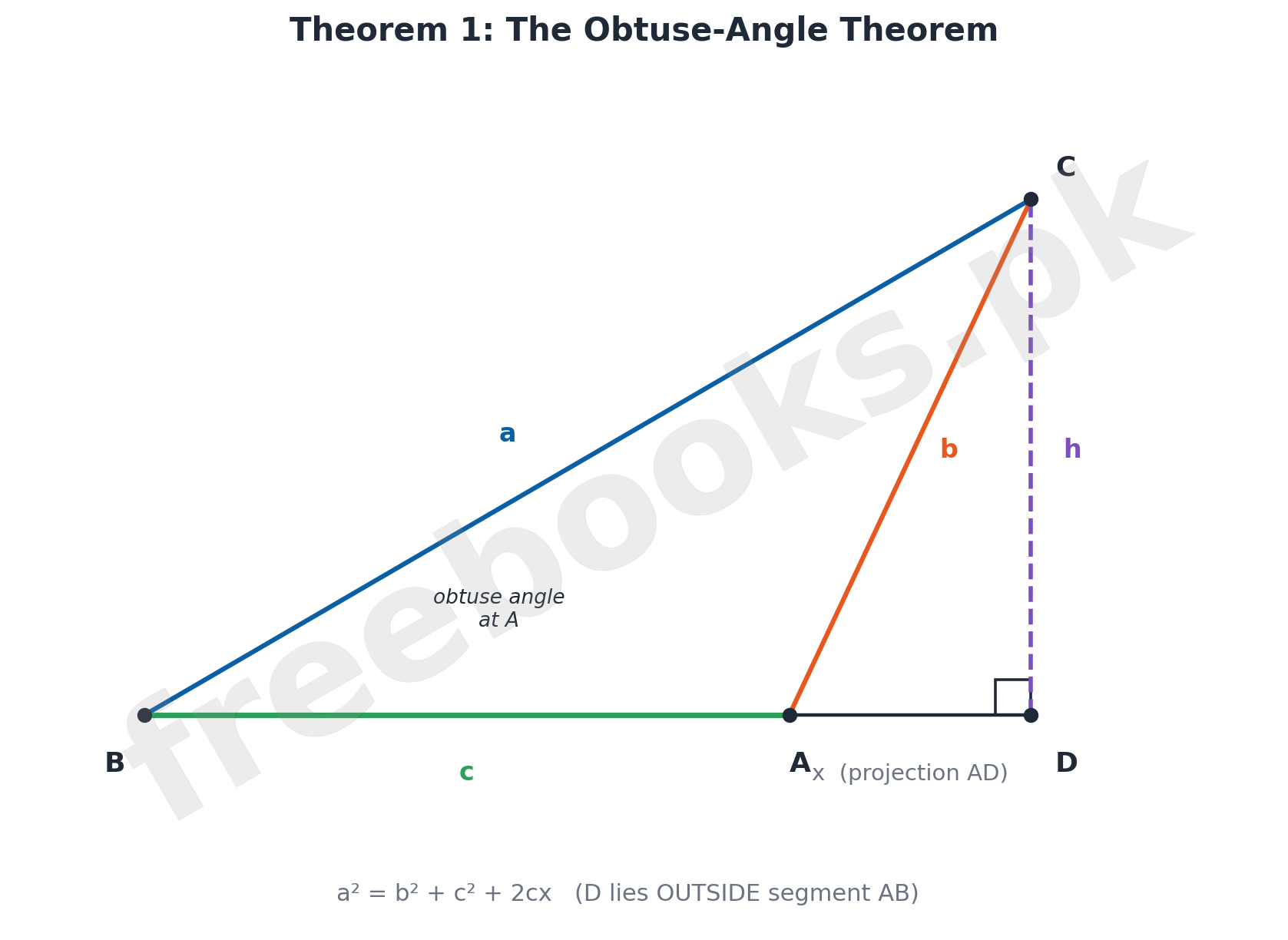
Theorem 1 states: in an obtuse-angled triangle, the square on the side opposite the obtuse angle equals the sum of the squares on the sides containing the obtuse angle, PLUS twice the rectangle contained by one of those sides and the projection of the other side upon it. Symbolically, if triangle ABC has an obtuse angle at A, with BC=a, CA=b, AB=c, and CD is drawn perpendicular to BA produced (meeting it at D, so that AD=x is the projection of AC on BA produced), then a² = b² + c² + 2cx.
The proof applies the Pythagorean theorem twice: in right triangle CDA, b² = x² + h² (where h = CD); in right triangle CDB, since BD = BA + AD = c + x, a² = (c+x)² + h² = c² + 2cx + x² + h². Substituting b² = x² + h² from the first equation into the second gives a² = c² + 2cx + b², i.e. a² = b² + c² + 2cx — the extra '+2cx' term is exactly what distinguishes this from the ordinary Pythagorean theorem, and it arises because D falls OUTSIDE segment AB when the angle at A is obtuse.
8.3 Theorem 2: The Acute-Angle Theorem
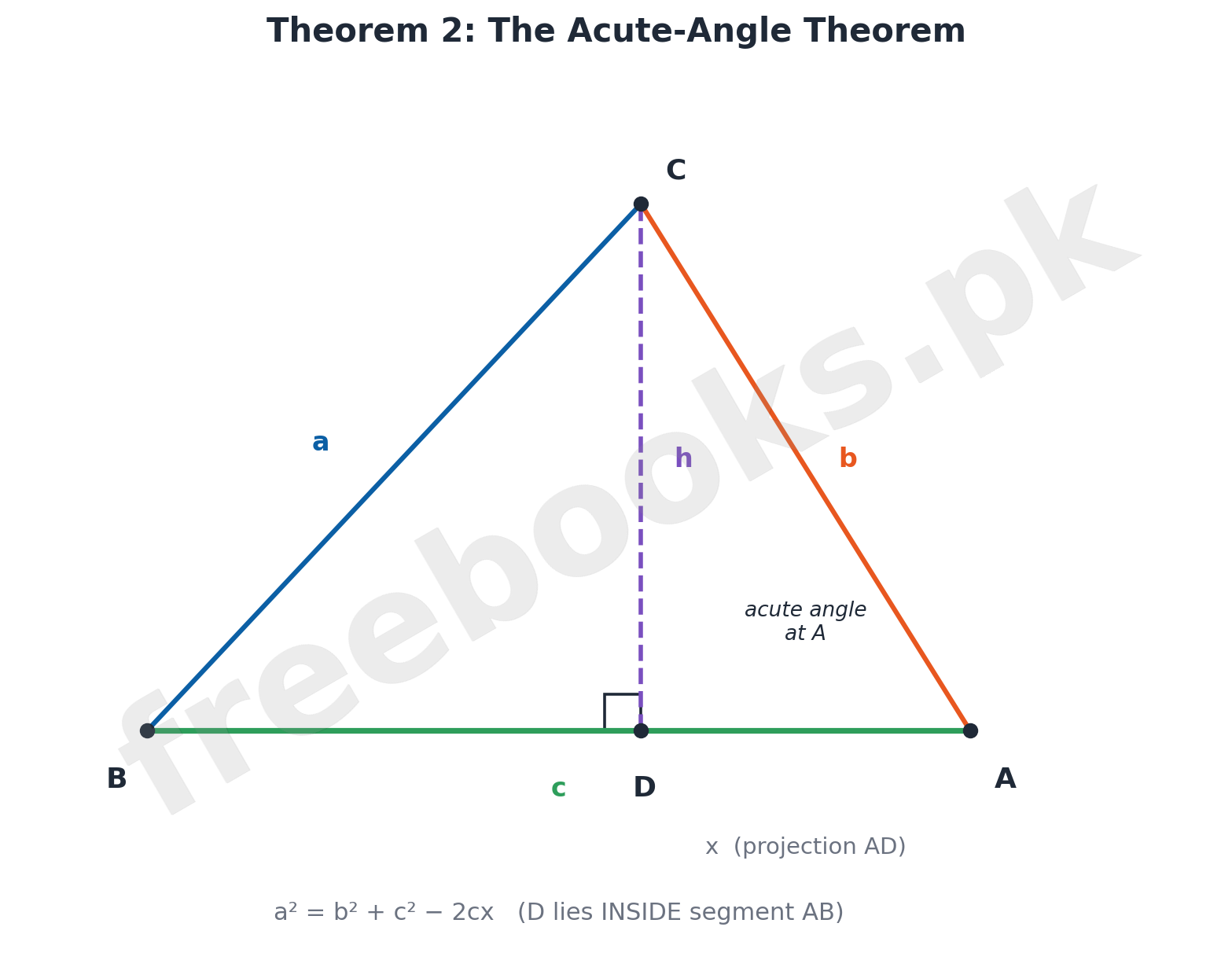
Theorem 2 states: in any triangle, the square on the side opposite an acute angle equals the sum of the squares on the sides containing that acute angle, MINUS twice the rectangle contained by one of those sides and the projection of the other side upon it. With the same labelling (BC=a, CA=b, AB=c) but now with CD perpendicular to AB itself (D falling INSIDE segment AB, so AD=x), the result is a² = b² + c² − 2cx — identical to Theorem 1 except for the sign of the projection term.
The proof mirrors Theorem 1's: in right triangle CDA, b² = x² + h²; in right triangle CDB, since BD = c − x (because D lies between B and A), a² = (c−x)² + h² = c² − 2cx + x² + h². Substituting gives a² = b² + c² − 2cx. A useful corollary appears when the triangle is isosceles: if AB = AC and BE is drawn perpendicular to AC (with CE the projection of BC on AC), Theorem 2 simplifies neatly to (BC)² = 2·(AC)·(CE), since the (AB)² and (AC)² terms cancel.
8.4 Theorem 3: Apollonius' Theorem (the Median Theorem)
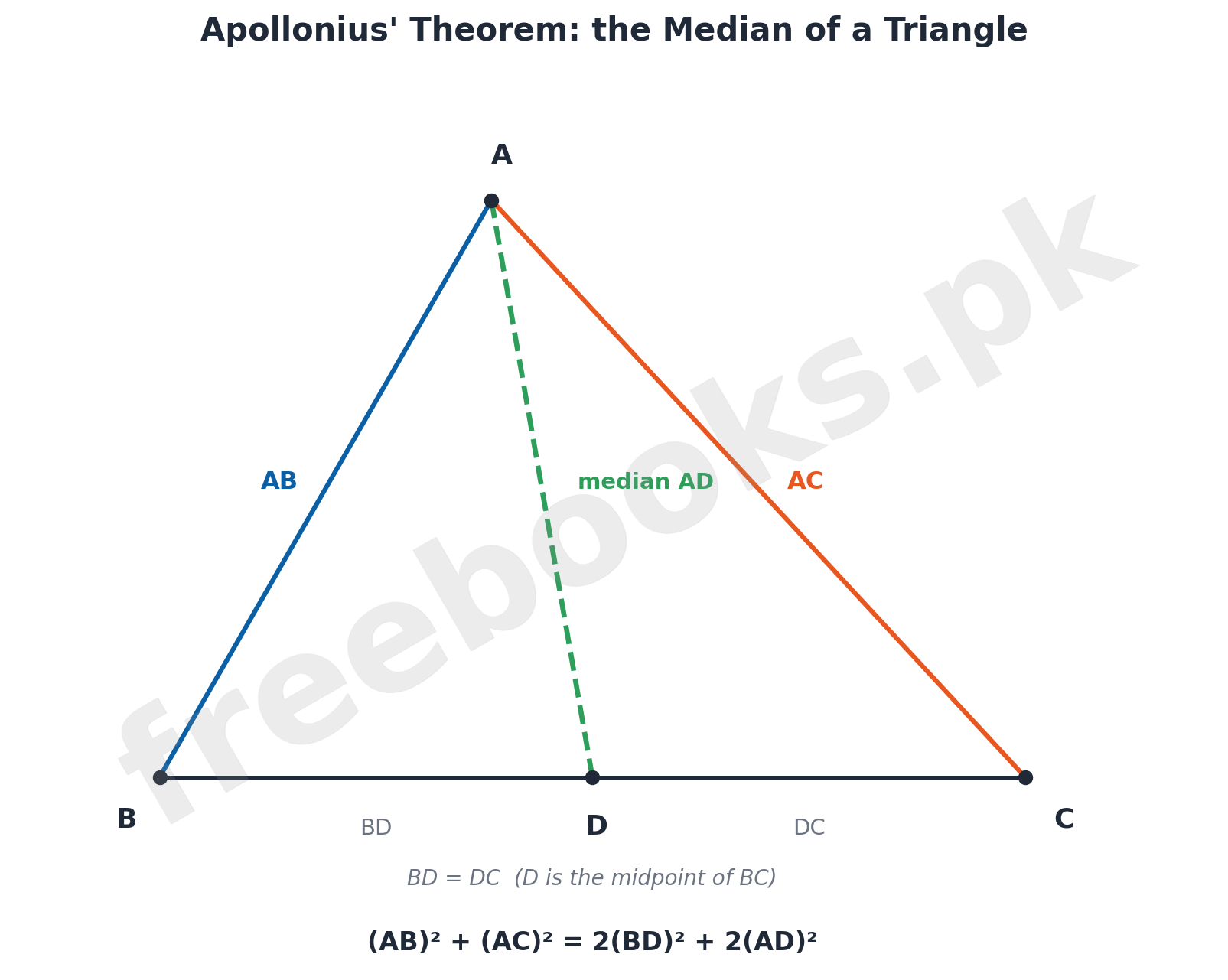
Apollonius' theorem states: in any triangle, the sum of the squares on any two sides equals twice the square on half the third side, together with twice the square on the median which bisects that third side. If AD is the median from A to side BC (so BD = DC = half of BC), the theorem gives (AB)² + (AC)² = 2(BD)² + 2(AD)².
The proof is a direct combination of Theorems 1 and 2: draw AF perpendicular to BC. In triangle ADB, angle ADB is acute at D, so by Theorem 2, (AB)² = (BD)² + (AD)² − 2·BD·FD. In triangle ADC, angle ADC is obtuse at D, so by Theorem 1, (AC)² = (CD)² + (AD)² + 2·CD·FD; since CD = BD, this becomes (AC)² = (BD)² + (AD)² + 2·BD·FD. Adding the two equations, the '−2·BD·FD' and '+2·BD·FD' terms cancel exactly, leaving (AB)² + (AC)² = 2(BD)² + 2(AD)² — letting the length of a median be calculated directly from the three side lengths of a triangle, without needing to know any of its angles.
Important Definitions
What is the projection of a point on a line segment?
The foot of the perpendicular drawn from that point to the line segment.
What is the projection of a line segment on another line segment?
The portion of the second segment intercepted between the feet of the perpendiculars dropped from the two endpoints of the first segment.
What does Theorem 1 (the obtuse-angle theorem) state?
In an obtuse-angled triangle, the square on the side opposite the obtuse angle equals the sum of the squares on the sides containing it, plus twice the rectangle of one side and the projection of the other upon it: a² = b² + c² + 2cx.
What does Theorem 2 (the acute-angle theorem) state?
In any triangle, the square on the side opposite an acute angle equals the sum of the squares on the sides containing it, minus twice the rectangle of one side and the projection of the other upon it: a² = b² + c² − 2cx.
What is Apollonius' theorem?
In any triangle, the sum of the squares on any two sides equals twice the square on half the third side, plus twice the square on the median that bisects it: (AB)² + (AC)² = 2(BD)² + 2(AD)².
What is a median of a triangle?
A line segment joining a vertex of a triangle to the midpoint of the opposite side.
Why does Theorem 1 have a plus sign before the projection term?
Because the obtuse angle at A pushes the foot of the perpendicular D outside segment AB, so BD = BA + AD, which produces a '+2cx' term when squared.
Why does Theorem 2 have a minus sign before the projection term?
Because the acute angle at A keeps the foot of the perpendicular D inside segment AB, so BD = BA − AD, which produces a '−2cx' term when squared.
What is the projection of a vertical (perpendicular) line segment on a base line?
A single point of zero dimension, since both of its endpoints project to the same foot of the perpendicular.
What theorem is normally used to find the length of a triangle's median from its three side lengths?
Apollonius' theorem (Theorem 3), which relates the median directly to the three sides without requiring any angle.
Key Facts and Relations
| Topic | Key Fact / Relation |
|---|---|
| Theorem 1 (obtuse-angle theorem) | a² = b² + c² + 2cx (x = projection of AC on BA produced) |
| Theorem 2 (acute-angle theorem) | a² = b² + c² − 2cx (x = projection of AC on AB) |
| Apollonius' theorem (Theorem 3) | (AB)² + (AC)² = 2(BD)² + 2(AD)² (AD = median, BD = DC = half of BC) |
| Isosceles corollary of Theorem 1 | If AB = AC (obtuse at A): (BC)² = 2·(AB)·(BD) |
| Isosceles corollary of Theorem 2 | If AB = AC (acute at C): (BC)² = 2·(AC)·(CE) |
| Pythagorean theorem (used inside every proof) | (hypotenuse)² = (leg 1)² + (leg 2)² |
| Projection and cosine (bridge to trigonometry) | projection AD = AC · cos(∠A) |
Diagrams
Theorem 1: The Obtuse-Angle Theorem: A triangle ABC with an obtuse angle at A, showing CD drawn perpendicular to BA produced, with the projection AD = x labelled alongside sides a, b, c and height h
Theorem 2: The Acute-Angle Theorem: A triangle ABC with an acute angle at A, showing CD drawn perpendicular to AB, with the projection AD = x labelled alongside sides a, b, c and height h
Apollonius' Theorem: the Median of a Triangle: A triangle ABC with median AD drawn to the midpoint D of side BC, showing BD = DC and illustrating the relationship proved by Apollonius' theorem
Short Questions & Answers
Define the projection of a point on a line segment.
The projection of a point on a line segment is the foot of the perpendicular drawn from that point to the segment.
State Theorem 1 (the obtuse-angle theorem).
In an obtuse-angled triangle, the square on the side opposite the obtuse angle equals the sum of the squares on the sides containing it, plus twice the rectangle of one side and the projection of the other upon it.
State Theorem 2 (the acute-angle theorem).
In any triangle, the square on the side opposite an acute angle equals the sum of the squares on the sides containing it, minus twice the rectangle of one side and the projection of the other upon it.
State Apollonius' theorem.
In any triangle, the sum of the squares on any two sides equals twice the square on half the third side, plus twice the square on the median which bisects it.
What is a median of a triangle?
A median is a line segment joining a vertex of a triangle to the midpoint of the side opposite that vertex.
In Theorem 2's setup, what does x represent?
x represents AD, the projection of side AC onto side AB, found by dropping a perpendicular from C to AB.
Long Questions & Answers
State and explain Theorem 1 (the obtuse-angle projection theorem) and Theorem 2 (the acute-angle projection theorem), including how their proofs use the Pythagorean theorem.
What does the obtuse-angle theorem (Theorem 1) state?
In an obtuse-angled triangle, the square on the side opposite the obtuse angle equals the sum of the squares on the sides containing that angle, plus twice the rectangle contained by one of those sides and the projection of the other side upon it: a² = b² + c² + 2cx.
How is Theorem 1 proved using the Pythagorean theorem?
Drawing CD perpendicular to BA produced gives two right triangles: CDA gives b² = x² + h², and CDB gives a² = (c+x)² + h² since BD = BA + AD. Substituting the first equation into the second gives a² = b² + c² + 2cx.
What does the acute-angle theorem (Theorem 2) state?
In any triangle, the square on the side opposite an acute angle equals the sum of the squares on the sides containing that angle, minus twice the rectangle contained by one of those sides and the projection of the other side upon it: a² = b² + c² − 2cx.
How is Theorem 2 proved, and why does the sign differ from Theorem 1?
The same two right triangles are used, but now D falls INSIDE segment AB (since the angle at A is acute), so BD = c − x instead of c + x. Squaring this produces a '−2cx' term instead of '+2cx', which is the only difference between the two theorems.
How are these two theorems applied to solve a triangle when one angle and two sides are known?
First determine whether the given angle is acute or obtuse, then apply the matching theorem (Theorem 2 or Theorem 1) using the known sides and the projection (often found via cosine or a given length), solving directly for the unknown third side.
Explain Apollonius' theorem (Theorem 3), including how it is proved from Theorems 1 and 2, and what it is used for.
What does Apollonius' theorem state?
In any triangle, the sum of the squares on any two sides is equal to twice the square on half the third side together with twice the square on the median which bisects that third side: (AB)² + (AC)² = 2(BD)² + 2(AD)².
What is a median, and why does the theorem require it to bisect the third side?
A median joins a vertex to the midpoint of the opposite side. The theorem specifically needs BD = DC (D is the midpoint of BC) because the proof relies on both sub-triangles sharing the same base length BD = DC.
How does the proof of Apollonius' theorem combine Theorem 1 and Theorem 2?
The median AD splits the triangle into ADB (where angle ADB is acute, so Theorem 2 applies) and ADC (where angle ADC is obtuse, so Theorem 1 applies). Writing both equations and adding them cancels the opposite-signed projection terms, leaving only the squares.
Why does the construction draw a perpendicular from the vertex to the third side?
The perpendicular AF (from A to BC) is what allows Theorems 1 and 2 to be applied to the two sub-triangles ADB and ADC in the first place, since both theorems require a perpendicular dropped to identify a projection.
What kind of problems does Apollonius' theorem let us solve?
It allows the length of a median to be calculated directly from the three side lengths of a triangle (or vice versa, one side to be found given the other two and the median), without needing to know any angle of the triangle.
Multiple Choice Questions (MCQs)
The projection of a point C on a line segment AB is: (A) The foot of the perpendicular from C to AB (B) The midpoint of AB (C) Point A itself (D) The length of AB
Correct answer: (A) The foot of the perpendicular from C to AB. The projection of a point on a line is defined as the foot of the perpendicular dropped from that point onto the line.
In an obtuse triangle with the obtuse angle at A, Theorem 1 states (BC)² equals: (A) (AC)²+(AB)²−2(AB)(AD) (B) (AC)²+(AB)²+2(AB)(AD) (C) (AC)²−(AB)² (D) 2(AB)²
Correct answer: (B) (AC)²+(AB)²+2(AB)(AD). Theorem 1 (the obtuse-angle theorem) adds twice the rectangle of one side and the projection: a² = b² + c² + 2cx.
In Theorem 2 (the acute-angle case), the sign before the projection term is: (A) Plus (B) Minus (C) Multiplication (D) Division
Correct answer: (B) Minus. Theorem 2 subtracts the projection term: a² = b² + c² − 2cx, since the foot of the perpendicular falls inside the side.
Apollonius' theorem relates the sum of squares of two sides of a triangle to: (A) The perimeter (B) The area (C) Twice the square on half the third side plus twice the square on the median (D) The product of all three sides
Correct answer: (C) Twice the square on half the third side plus twice the square on the median. Apollonius' theorem states (AB)²+(AC)² = 2(BD)²+2(AD)², connecting two sides to half the third side and the median.
A median of a triangle joins a vertex to: (A) The opposite vertex (B) The midpoint of the opposite side (C) The centroid only (D) The foot of the altitude
Correct answer: (B) The midpoint of the opposite side. By definition, a median joins a vertex of a triangle to the midpoint of the side opposite that vertex.
Theorem 1 and Theorem 2 are both proved using: (A) The Pythagorean theorem (B) Apollonius' theorem (C) The ASTC rule (D) The sine rule
Correct answer: (A) The Pythagorean theorem. Both projection theorems are proved by applying the Pythagorean theorem to the two right triangles formed by the altitude.
If AB = AC in an obtuse triangle with the obtuse angle at A, Theorem 1 simplifies to: (A) (BC)²=2(AB)(BD) (B) (BC)²=(AB)² (C) (BC)²=0 (D) (BC)²=4(AB)²
Correct answer: (A) (BC)²=2(AB)(BD). When AB = AC, the two equal-side terms combine and Theorem 1 reduces to (BC)² = 2(AB)(BD).
The projection of a vertical line segment onto a perpendicular base line is: (A) A line (B) A circle (C) A point of zero dimension (D) Undefined
Correct answer: (C) A point of zero dimension. When the segment being projected is itself perpendicular to the base, both its endpoints project to the same single point.
In proving Apollonius' theorem, the perpendicular AF is drawn from vertex A to: (A) The median (B) Side BC (C) Side AB (D) Side AC
Correct answer: (B) Side BC. The construction draws AF perpendicular to BC, allowing Theorems 1 and 2 to be applied to the two sub-triangles formed by the median.
Which theorem would you use to find the length of a triangle's median given all three sides? (A) Theorem 1 (B) Theorem 2 (C) Apollonius' theorem (Theorem 3) (D) The ASTC rule
Correct answer: (C) Apollonius' theorem (Theorem 3). Apollonius' theorem directly relates the three sides of a triangle to the length of a median, making it the right tool for this problem.
Quick Revision Summary
- Projection of a point on a line = the foot of the perpendicular from that point to the line
- Projection of a segment CD on segment AB = the portion between the feet of the perpendiculars from C and D
- Theorem 1 (obtuse angle): a² = b² + c² + 2cx, where x = AD is the projection of AC on BA produced
- Theorem 2 (acute angle): a² = b² + c² − 2cx, where x = AD is the projection of AC on AB
- Both theorems are proved using the Pythagorean theorem applied to two right triangles sharing the altitude CD
- Apollonius' theorem: (AB)² + (AC)² = 2(BD)² + 2(AD)², where AD is the median and BD = DC
- Apollonius' theorem is proved by adding the Theorem 2 result (acute at D) and Theorem 1 result (obtuse at D) for the two sub-triangles formed by the median
- A median joins a vertex to the midpoint of the opposite side
- These theorems generalize the Pythagorean theorem to triangles that are not right-angled
- Isosceles special cases: (BC)²=2·AB·BD (obtuse at A) and (BC)²=2·AC·CE (acute case) when AB=AC
Exam Tips
- Always identify first whether the given angle is acute or obtuse — that decides which theorem (and which sign) to use
- Draw the perpendicular (altitude) clearly and label the projection segment x before writing any equation
- Remember Theorem 1's '+2cx' and Theorem 2's '−2cx' are the ONLY difference between the two theorems — everything else is identical
- For Apollonius' theorem problems, always check the given segment truly is a median (bisects the opposite side), not just any line
- When AB = AC (isosceles), both theorems simplify neatly — look for this shortcut before grinding through the full formula
- Connect 'projection' language to cosine language (projection = adjacent side x cos of the angle) — it ties this unit back to trigonometry