This unit studies the relationship between a central angle (vertex at the centre) and a circum angle or inscribed angle (vertex on the circumference), both standing on the same arc. The central theorem shows that a central angle is always exactly double the inscribed angle standing on the same arc — a single fact from which every other result in this unit follows: any two angles in the same segment are equal, the angle in a semicircle is a right angle (with segments larger or smaller than a semicircle giving angles smaller or larger than a right angle), and the opposite angles of a cyclic quadrilateral are always supplementary.
These results are heavily used in circle geometry problems involving inscribed angles, cyclic quadrilaterals, and tangent-chord relationships, and the two worked examples in this unit (equal circles intersecting at a common chord, and a quadrilateral circumscribed about a circle) show how the angle-in-a-segment theorems combine with tangent-length and triangle-congruence ideas from earlier units.
Learning Objectives
- Prove that the central angle of a minor arc is double the inscribed (circum) angle subtended by the corresponding major arc
- Prove that any two angles in the same segment of a circle are equal
- Prove that the angle in a semicircle is a right angle, and relate segment size to whether the inscribed angle is greater or less than a right angle
- Prove that the opposite angles of any cyclic quadrilateral are supplementary
- State the corollaries relating equal arcs to equal inscribed angles
- Apply these theorems to problems involving intersecting circles and quadrilaterals circumscribed about a circle
Key Concepts
12.1 Theorem 1: The Central Angle is Double the Inscribed Angle
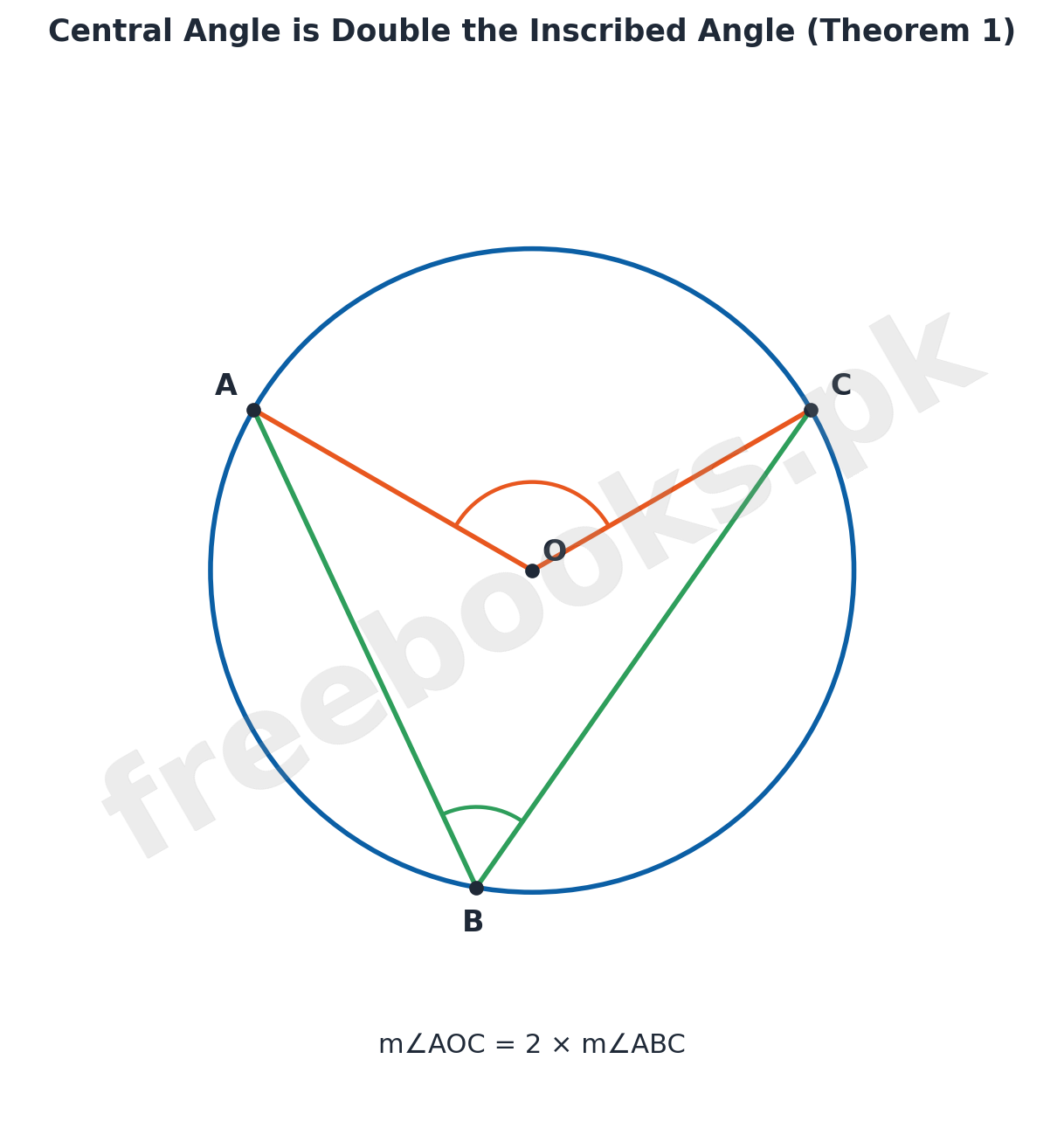
Theorem 1 states: the measure of a central angle of a minor arc of a circle is double that of the angle subtended by the corresponding major arc. Given central angle AOC and circum (inscribed) angle ABC standing on arc AC, joining B to the centre O and extending it to D creates two isosceles triangles OAB and OBC. Using the exterior-angle property (an exterior angle equals the sum of the two non-adjacent interior angles) on both triangles and combining the results gives angle AOC = 2 times angle ABC.
Example: a circle has radius root-2 cm, and a chord of length 2 cm divides it into two segments. In triangle OAB, OA squared plus OB squared equals 2 + 2 = 4, which equals AB squared — so triangle OAB is right-angled at O, meaning the central angle AOB is 90 degrees. By Theorem 1, the circum angle in the larger segment is half the central angle, so angle ACB = 45 degrees.
12.2 Theorem 2: Angles in the Same Segment are Equal
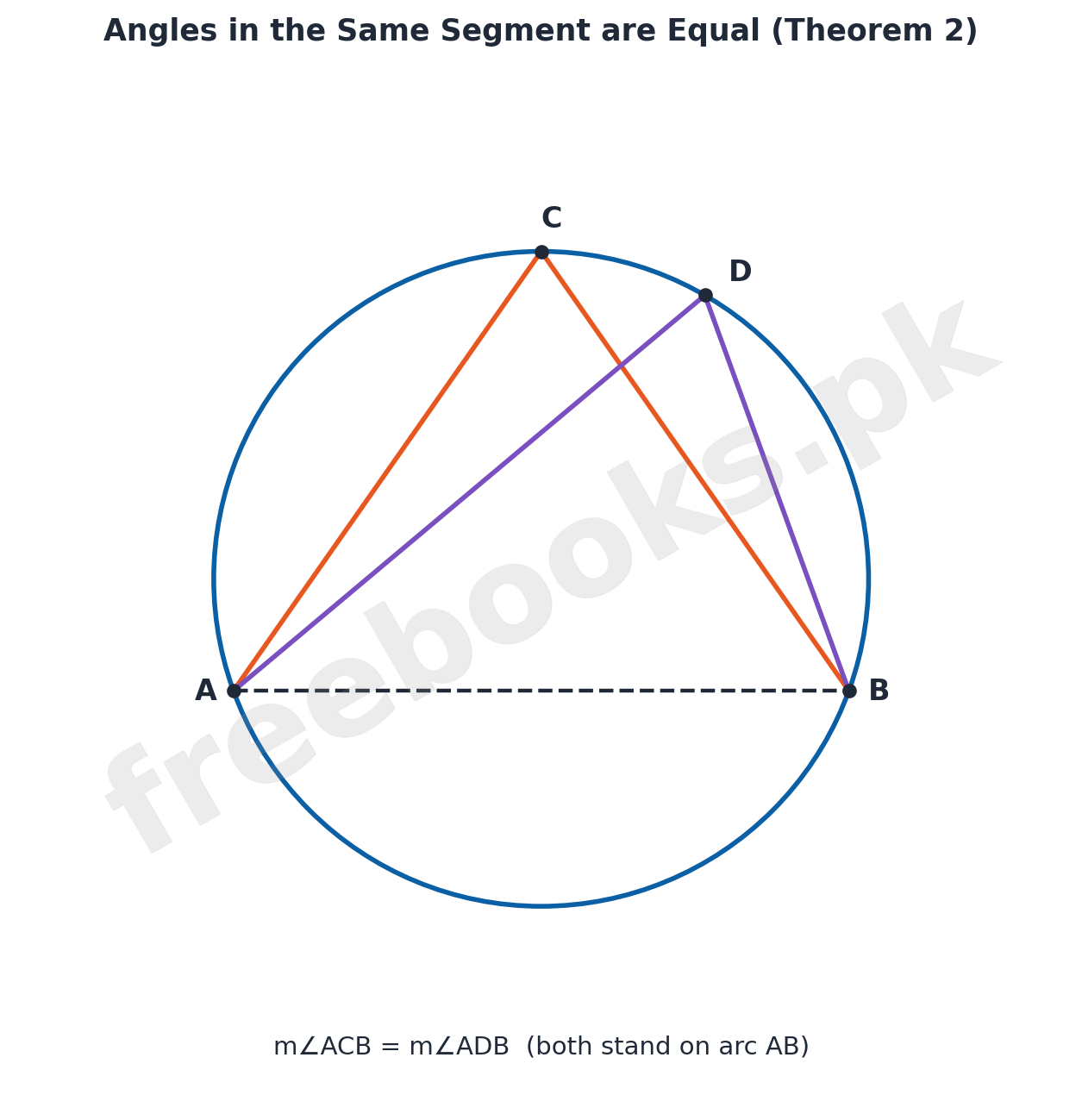
Theorem 2 states: any two angles in the same segment of a circle are equal. If angle ACB and angle ADB are two circum angles standing on the same arc AB, Theorem 1 gives central angle AOB = 2 times angle ACB and also central angle AOB = 2 times angle ADB. Since both expressions equal the same central angle, 2 times angle ACB = 2 times angle ADB, so angle ACB = angle ADB.
12.3 Theorem 3: The Angle in a Semicircle, and Larger/Smaller Segments
Theorem 3 states three related facts: the angle in a semicircle is a right angle; the angle in a segment greater than a semicircle is less than a right angle; and the angle in a segment less than a semicircle is greater than a right angle. All three follow from central angle AOB = 2 times circum angle ACB: when AOB is a straight angle of 180 degrees (a semicircle), ACB must be 90 degrees; when AOB is less than 180 degrees (segment greater than a semicircle), ACB is less than 90 degrees; and when AOB is more than 180 degrees (segment less than a semicircle), ACB is more than 90 degrees.
Corollary 1: the angles subtended by an arc at the circumference of a circle are all equal. Corollary 2: the angles in the same segment of a circle are congruent — essentially restating Theorem 2 as a direct consequence of Theorem 3's reasoning.
12.4 Opposite Angles of a Cyclic Quadrilateral are Supplementary
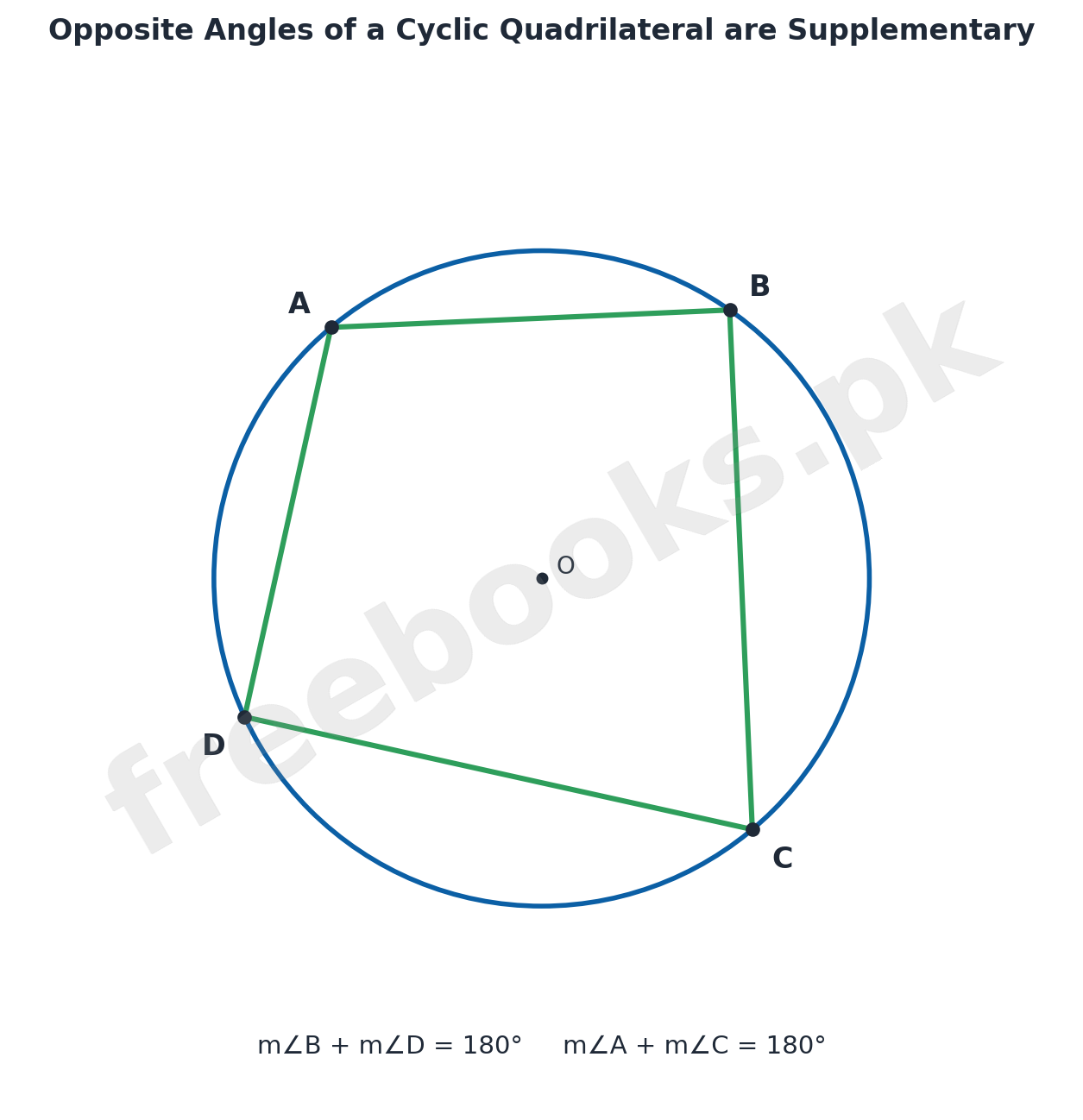
This theorem states: the opposite angles of any quadrilateral inscribed in a circle (a cyclic quadrilateral) are supplementary, each pair summing to two right angles (180 degrees). Given cyclic quadrilateral ABCD, angle B is half the central angle standing on arc ADC, and angle D is half the central angle standing on arc ABC; since these two arcs together make up the full circle (a total central angle of 4 right angles, or 360 degrees), angle B + angle D = half of 360 degrees = 180 degrees. The same reasoning shows angle A + angle C = 180 degrees.
Corollary 1: in equal circles or in the same circle, if two minor arcs are equal, the angles inscribed by their corresponding major arcs are also equal. Corollary 2: in equal circles or in the same circle, two equal arcs subtend equal angles at the circumference, and conversely.
Example 1: two equal circles intersect at points A and B; a line through B meets the two circumferences again at P and Q. Since arc ACB equals arc ADB (both stand on the common chord AB in equal circles), the angles they subtend are equal, making triangle APQ isosceles with AP = AQ.
Example 2: quadrilateral ABCD is circumscribed about a circle (each side tangent to it). Dropping perpendiculars from the centre to all four sides and using the equal-tangent-lengths property (two tangents from the same external point are equal) on each vertex shows that AB + CD = BC + DA — opposite sides of a tangential quadrilateral always have equal sums.
Important Definitions
What is a central angle?
The angle subtended by an arc at the centre of a circle, with its two arms being radii drawn to the endpoints of the arc.
What is a circum angle (inscribed angle)?
The angle subtended by an arc of a circle at a point on its circumference, formed between two chords sharing that common point.
What does Theorem 1 state about the central and inscribed angle?
The measure of the central angle of a minor arc of a circle is double the measure of the inscribed angle subtended by the corresponding major arc.
What does Theorem 2 state about angles in the same segment?
Any two angles in the same segment of a circle are equal.
What is the angle in a semicircle?
A right angle (90 degrees) — since the central angle on a semicircle is a straight angle of 180 degrees, the inscribed angle is always half of that.
What is a cyclic quadrilateral?
A quadrilateral whose four vertices all lie on the circumference of a single circle.
What does the cyclic quadrilateral theorem state?
The opposite angles of any quadrilateral inscribed in a circle are supplementary — each pair sums to 180 degrees.
What is a quadrilateral circumscribed about a circle?
A quadrilateral whose four sides are all tangent to a circle inscribed within it.
What is Corollary 1 of Theorem 3?
The angles subtended by the same arc at the circumference of a circle are all equal.
What key property of tangents is used to prove AB + CD = BC + DA for a tangential quadrilateral?
Two tangents drawn to a circle from the same external point are always equal in length.
Key Facts and Relations
| Topic | Key Fact / Relation |
|---|---|
| Theorem 1 | Central angle = 2 x inscribed (circum) angle on the same arc |
| Theorem 2 | Angles in the same segment of a circle are equal |
| Theorem 3(a) | Angle in a semicircle = 1 right angle (90 degrees) |
| Theorem 3(b) | Angle in a segment greater than a semicircle < 1 right angle |
| Theorem 3(c) | Angle in a segment less than a semicircle > 1 right angle |
| Cyclic quadrilateral theorem | Opposite angles of a cyclic quadrilateral are supplementary (sum = 180 degrees) |
| Corollary 1 of Theorem 3 | Angles subtended by the same arc at the circumference are equal |
| Tangential quadrilateral (circumscribed about a circle) | AB + CD = BC + DA (sums of opposite sides are equal) |
Diagrams
Central Angle is Double the Inscribed Angle (Theorem 1): A circle with centre O showing central angle AOC and inscribed angle ABC standing on the same arc AC, illustrating that the central angle is double the inscribed angle
Angles in the Same Segment are Equal (Theorem 2): A circle with chord AB and two inscribed angles ACB and ADB standing on the same arc from points C and D in the same segment, showing both angles are equal
Opposite Angles of a Cyclic Quadrilateral are Supplementary: A cyclic quadrilateral ABCD inscribed in a circle with centre O, showing that angle B plus angle D equals 180 degrees and angle A plus angle C equals 180 degrees
Short Questions & Answers
State Theorem 1 of this unit.
The measure of a central angle of a minor arc of a circle is double that of the inscribed (circum) angle subtended by the corresponding major arc.
State Theorem 2 of this unit.
Any two angles in the same segment of a circle are equal.
What is the measure of the angle in a semicircle?
A right angle, that is, 90 degrees.
How does the size of a segment relate to its inscribed angle?
The angle in a segment greater than a semicircle is less than a right angle, while the angle in a segment less than a semicircle is greater than a right angle.
State the theorem about opposite angles of a cyclic quadrilateral.
The opposite angles of any quadrilateral inscribed in a circle are supplementary, each pair summing to 180 degrees.
What does Corollary 1 of Theorem 3 state?
The angles subtended by the same arc at the circumference of a circle are all equal.
Long Questions & Answers
State and explain Theorem 1 (central angle double the inscribed angle) and Theorem 2 (angles in the same segment are equal).
What does Theorem 1 state, and how is it proved?
Theorem 1 states that the central angle of a minor arc is double the inscribed angle on the corresponding major arc. Joining the inscribed angle's vertex to the centre and extending it to the far side of the circle creates two isosceles triangles; using the exterior angle property on both and adding the results shows the central angle equals twice the inscribed angle.
How is Theorem 1 used to find an unknown angle, given a chord length and radius?
If triangle OAB (formed by the centre and the chord's endpoints) satisfies the Pythagorean relationship, its central angle can be shown to be 90 degrees; the inscribed angle in the larger segment is then found as half that central angle, using Theorem 1 directly.
What does Theorem 2 state, and how is it proved?
Theorem 2 states that any two angles in the same segment of a circle are equal. Since both inscribed angles stand on the same arc, Theorem 1 shows each equals half of the same central angle — so the two inscribed angles must be equal to each other.
Why must both circum angles in Theorem 2 stand on the same arc?
Because Theorem 1 only relates a central angle to an inscribed angle standing on the SAME arc — if the inscribed angles stood on different arcs, they would correspond to different central angles and there would be no reason for them to be equal.
State and explain Theorem 3 (angle in a semicircle) and the cyclic quadrilateral theorem, including the two worked examples.
What does Theorem 3 state about the angle in a semicircle?
The angle in a semicircle is always a right angle, because the central angle on a semicircle is a straight angle of 180 degrees, and by Theorem 1 the inscribed angle is exactly half of that, giving 90 degrees.
What happens to the inscribed angle in segments larger or smaller than a semicircle?
In a segment greater than a semicircle, the central angle is less than 180 degrees, so the inscribed angle is less than 90 degrees. In a segment less than a semicircle, the central angle exceeds 180 degrees, so the inscribed angle exceeds 90 degrees.
What does the cyclic quadrilateral theorem state, and how is it proved?
The opposite angles of a cyclic quadrilateral are supplementary. Since angle B and angle D are each half of the central angles standing on the two arcs that together make up the whole circle (360 degrees total), their sum is half of 360 degrees, which is 180 degrees.
How does the 'two equal circles intersecting' example use these theorems?
Since the common chord AB subtends equal arcs (and therefore equal inscribed angles) in the two equal circles, triangle APQ formed by the line through B is isosceles, giving AP = AQ.
How does the 'quadrilateral circumscribed about a circle' example use tangent properties?
By dropping perpendiculars from the centre to each of the four tangent sides and using the fact that two tangents from the same external point are equal, the eight tangent segments pair up so that AB + CD equals BC + DA.
Multiple Choice Questions (MCQs)
A central angle standing on the same arc as an inscribed angle is always: (A) Equal to it (B) Half of it (C) Double of it (D) Three times it
Correct answer: (C) Double of it. By Theorem 1, a central angle is always double the inscribed angle standing on the same arc.
Any two angles in the same segment of a circle are: (A) Supplementary (B) Complementary (C) Equal (D) Unrelated
Correct answer: (C) Equal. By Theorem 2, all inscribed angles in the same segment, standing on the same arc, are equal.
The angle inscribed in a semicircle is always: (A) An acute angle (B) A right angle (C) An obtuse angle (D) A reflex angle
Correct answer: (B) A right angle. By Theorem 3, the angle in a semicircle is always exactly 90 degrees, a right angle.
The angle in a segment greater than a semicircle is: (A) Greater than a right angle (B) Equal to a right angle (C) Less than a right angle (D) A straight angle
Correct answer: (C) Less than a right angle. By Theorem 3, a segment larger than a semicircle produces an inscribed angle smaller than 90 degrees.
The angle in a segment less than a semicircle is: (A) Less than a right angle (B) Equal to a right angle (C) Greater than a right angle (D) Zero
Correct answer: (C) Greater than a right angle. By Theorem 3, a segment smaller than a semicircle produces an inscribed angle greater than 90 degrees.
The opposite angles of a cyclic quadrilateral are: (A) Equal (B) Complementary (C) Supplementary (D) Unrelated
Correct answer: (C) Supplementary. The opposite angles of any quadrilateral inscribed in a circle always sum to 180 degrees (supplementary).
A quadrilateral is called cyclic when: (A) All its sides are tangent to a circle (B) All four vertices lie on a circle (C) It has two pairs of parallel sides (D) Its diagonals are equal
Correct answer: (B) All four vertices lie on a circle. A cyclic quadrilateral is one whose four vertices all lie on the circumference of a single circle.
For a quadrilateral circumscribed about a circle (tangential quadrilateral), which relation always holds? (A) AB = CD and BC = DA (B) AB + CD = BC + DA (C) AB x CD = BC x DA (D) AB – CD = BC – DA
Correct answer: (B) AB + CD = BC + DA. By the equal-tangent-lengths property applied at each vertex, the sums of opposite sides of a tangential quadrilateral are always equal.
If a central angle is 100 degrees, the inscribed angle on the same arc is: (A) 25 degrees (B) 50 degrees (C) 100 degrees (D) 200 degrees
Correct answer: (B) 50 degrees. Since the central angle is always double the inscribed angle on the same arc, the inscribed angle is 100/2 = 50 degrees.
Two tangents drawn to a circle from the same external point are always: (A) Perpendicular (B) Parallel (C) Equal in length (D) Unequal in length
Correct answer: (C) Equal in length. This equal-tangent-lengths property (from Unit 10) is the key tool used to prove AB + CD = BC + DA for a tangential quadrilateral.
Quick Revision Summary
- Central angle: vertex at the centre | Inscribed (circum) angle: vertex on the circumference
- Theorem 1: central angle = 2 x inscribed angle standing on the same arc
- Theorem 2: any two angles in the same segment of a circle are equal
- Theorem 3: angle in a semicircle = 90 degrees; larger segment gives smaller angle; smaller segment gives larger angle
- Corollary 1: angles subtended by the same arc at the circumference are all equal
- Cyclic quadrilateral: a quadrilateral with all four vertices on a circle
- Opposite angles of a cyclic quadrilateral are supplementary (sum to 180 degrees)
- Tangential quadrilateral (circumscribed about a circle): AB + CD = BC + DA
- In equal circles, equal arcs subtend equal angles at the circumference, and conversely
Exam Tips
- Always identify which angle is central (vertex at O) and which is inscribed (vertex on the circle) before applying Theorem 1
- For 'angles in the same segment' problems, check that both angles stand on the SAME arc — this is the condition for Theorem 2 to apply
- The angle-in-a-semicircle fact (90 degrees) is one of the most frequently tested results — watch for a diameter as one side of a triangle inscribed in a circle
- For cyclic quadrilateral problems, remember opposite angles sum to 180 degrees, not adjacent angles
- For tangential quadrilateral problems, look for the equal-tangent-lengths property from Unit 10 applied at all four vertices
- Sketch the central angle and inscribed angle together whenever a problem mixes both — the factor-of-2 relationship is easy to misapply without a clear diagram