This final unit moves from proving theorems to actually constructing circles and their related figures with a compass and straightedge. It covers locating the centre of a given circle, drawing a circle through three non-collinear points or through part of a given arc, and building the special circles attached to a triangle — the circumcircle (through all three vertices), the incircle (touching all three sides internally), and the escribed circle (touching one side and the other two sides extended).
The unit then extends to circumscribing and inscribing regular polygons — equilateral triangles, squares, and regular hexagons — about and within a given circle, and finally to a large family of tangent constructions: tangents to an arc without knowing its centre, tangents from a point on or outside a circle, tangents meeting at a given angle, and direct (external) and transverse (internal) common tangents to two circles of equal or unequal radii, including circles that already touch or intersect. Every construction in this unit rests on two repeated ideas from earlier units: the perpendicular bisector of a chord passes through the centre, and a tangent is always perpendicular to the radius at its point of contact.
Learning Objectives
- Locate the centre of a given circle and construct a circle through three non-collinear points
- Complete a circle when only part of its circumference is given, both by finding the centre and without finding it
- Circumscribe and inscribe a circle about and in a given triangle, and escribe a circle to a triangle
- Circumscribe and inscribe an equilateral triangle, a square, and a regular hexagon with respect to a given circle
- Construct a tangent to an arc or circle from a point on the circumference, outside it, or on the arc itself, without necessarily knowing the centre
- Construct direct (external) and transverse (internal) common tangents to two circles of equal or unequal radii, including circles that touch or intersect
- Construct a circle touching both arms of an angle, or touching two converging lines and passing through a given point between them
Key Concepts
13.1 Locating a Centre and Constructing Circles Through Points or Arcs
To locate the centre of a given circle, draw any two chords and construct the perpendicular bisector of each; since the perpendicular bisector of any chord always passes through the centre (Unit 9), the two bisectors intersect exactly at the centre O. The same idea, run in reverse, constructs a circle through three given non-collinear points A, B, and C: the perpendicular (right) bisectors of AB and BC meet at a single point O that is equidistant from all three points, and a circle centred at O with that radius passes through all three.
To complete a circle when only part of the circumference (an arc) is given, by finding the centre: mark four points C, D, E, F on the arc, draw chords CD and EF, and construct their perpendicular bisectors — these meet at the centre O, equidistant from every marked point, and the full circle can then be drawn with radius OA. A second method completes the circle WITHOUT finding the centre, by repeatedly constructing equal external angles between successive equal-length chords along the arc — each new equal angle and equal chord extends the circle's circumference a little further until it closes up.
13.2 Circles Attached to Triangles and Regular Polygons
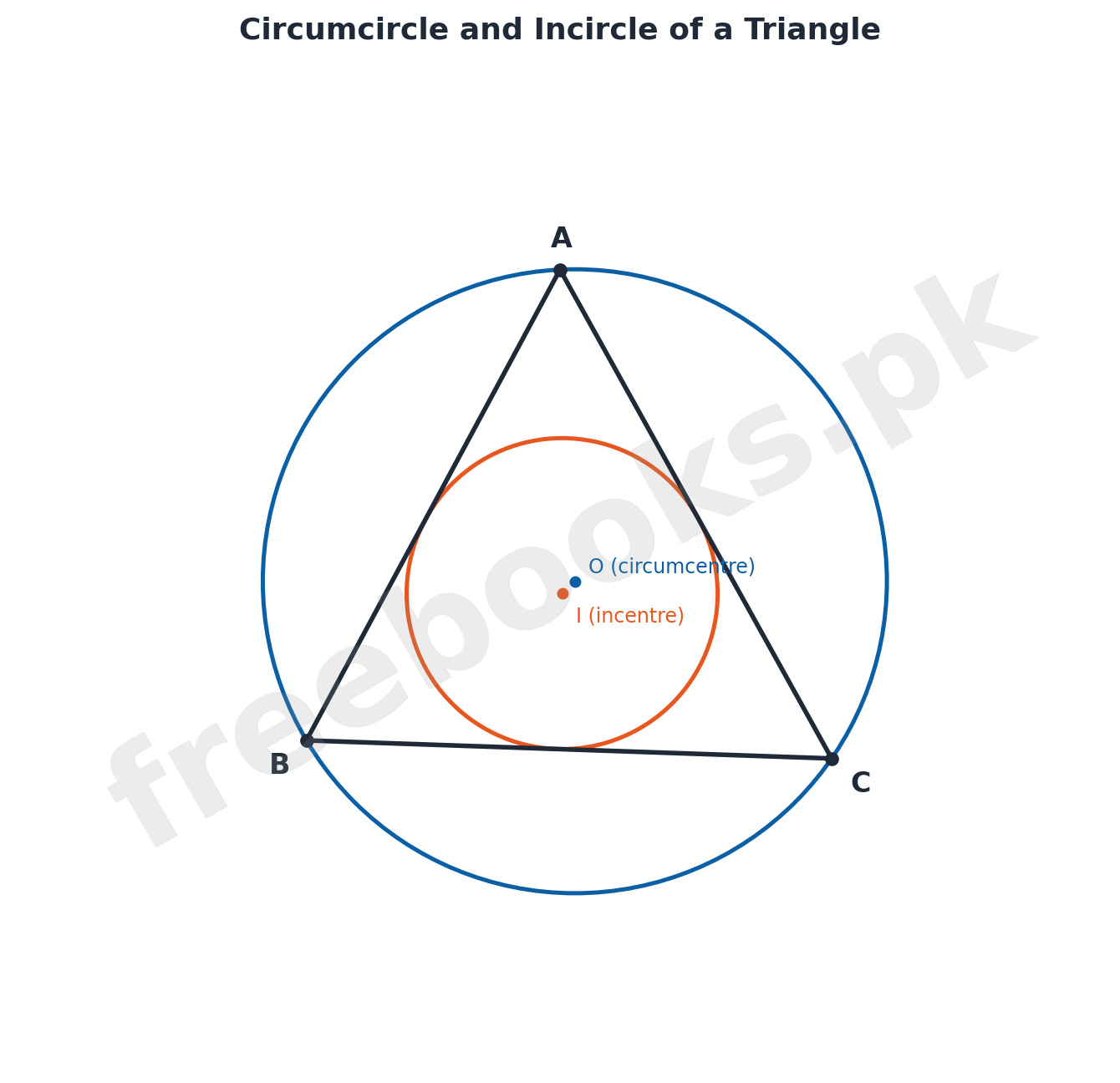
The circumcircle of a triangle ABC passes through all three vertices; it is constructed by drawing the perpendicular bisectors of any two sides (say AB and AC) and taking their intersection O as the circumcentre, with circumradius OA = OB = OC. The incircle touches all three sides internally; it is constructed by bisecting two of the triangle's interior angles (say at B and C) to find the incentre O, then dropping a perpendicular OP to any side to get the in-radius OP. The escribed circle (e-circle) touches one side of the triangle externally and the other two sides extended; it is constructed by bisecting two EXTERIOR angles of the triangle to find the e-centre, then dropping a perpendicular to the opposite side for the e-radius.
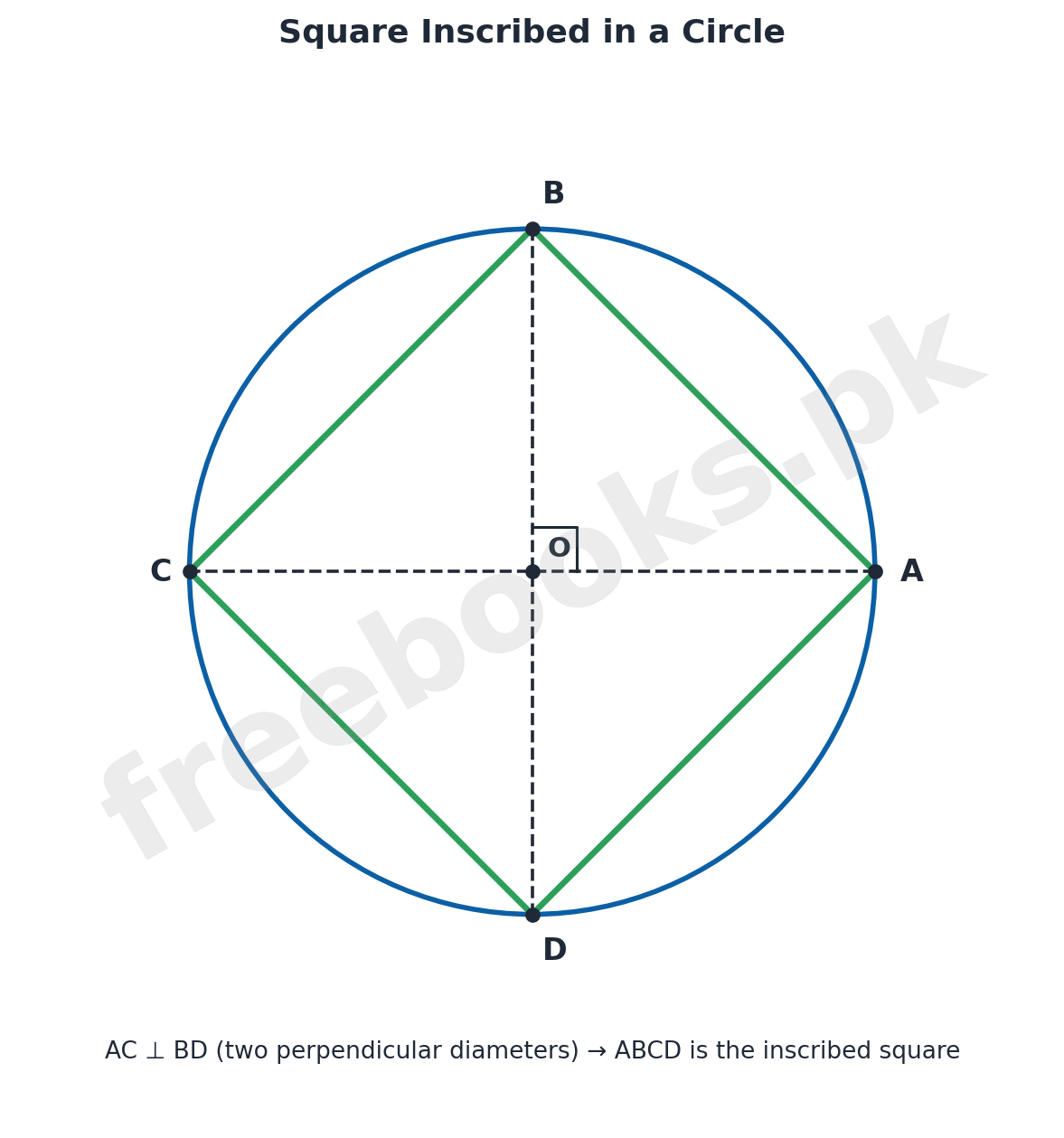
An equilateral triangle can be circumscribed about a given circle (tangents drawn at three points spaced 120 degrees apart around the circle) or inscribed within it (joining three points on the circle that are each 120 degrees apart, found using arcs of the circle's own radius). A square is circumscribed by drawing two perpendicular diameters and tangents at all four endpoints, or inscribed by simply joining the four endpoints of two perpendicular diameters directly. A regular hexagon is circumscribed or inscribed similarly, using six points spaced 60 degrees apart around the circle — found by repeatedly stepping off arcs equal to the circle's own radius, since a chord equal to the radius always subtends a 60-degree central angle.
13.3 Tangent Constructions
A tangent can be drawn to an arc without knowing its centre in three cases: when the given point P is the arc's midpoint (construct the perpendicular bisector of the chord through the arc, then erect a right angle at P to that bisector); when P is an endpoint of the arc (use an auxiliary point and an equal-angle construction based on the tangent-chord angle being equal to the inscribed angle in the alternate segment); and when P is outside the arc entirely (using a semicircle construction on segment AP, similar to the construction for a tangent from an external point to a full circle).
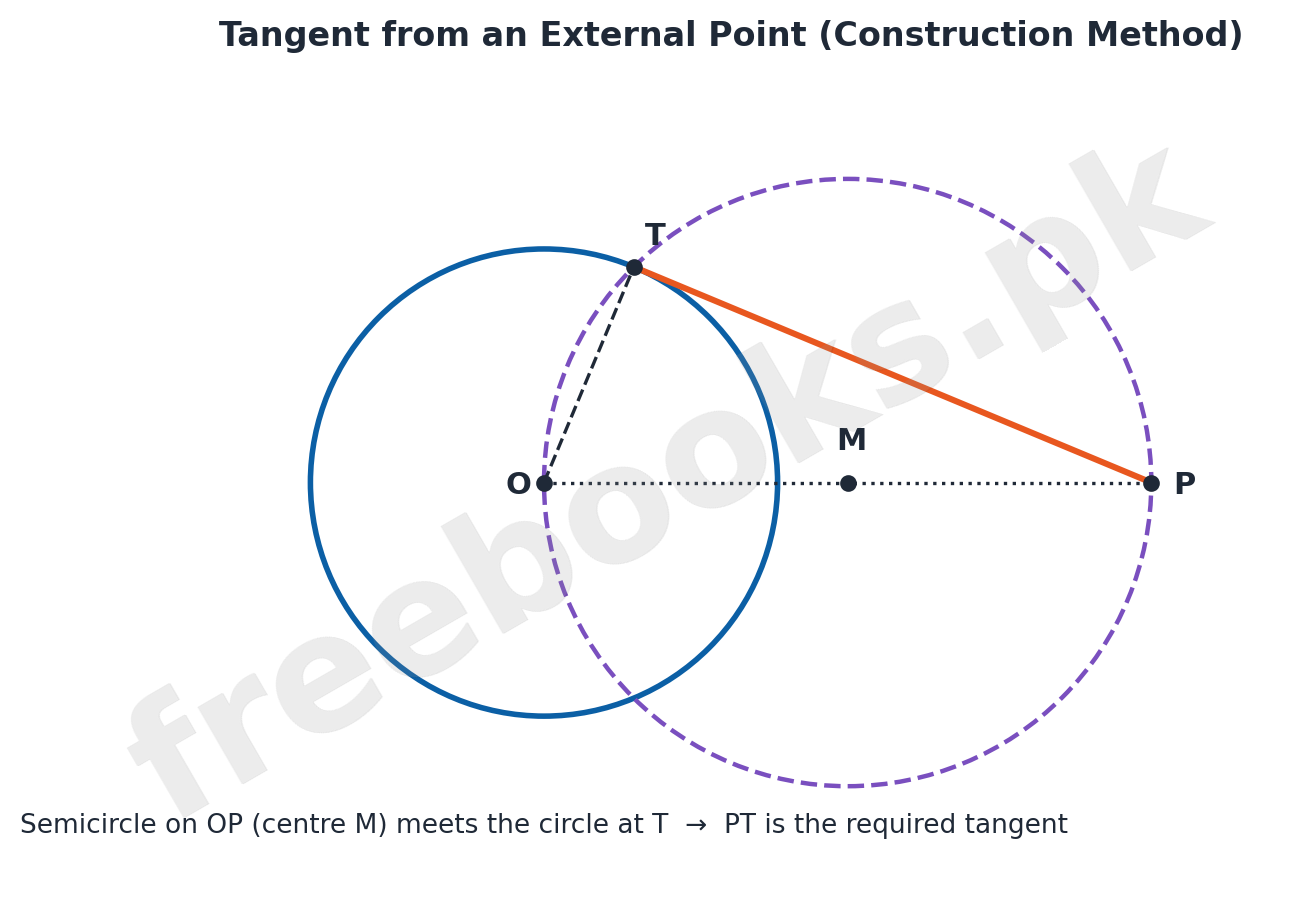
When the centre IS known, a tangent from a point P on the circumference is simply the line through P perpendicular to radius OP (Unit 10, Theorem 2). A tangent from a point P outside the circle is constructed by finding the midpoint M of OP, drawing a semicircle on diameter OP centred at M, and joining P to the point T where this semicircle crosses the given circle — since angle OTP is a right angle (angle in a semicircle), OT is perpendicular to PT, making PT tangent to the circle at T. Two tangents meeting at a specified angle can also be constructed by working backward from the desired angle at the centre.
13.4 Common Tangents to Two Circles, and Circles Touching Lines
Direct (external) common tangents to two EQUAL circles are constructed by drawing parallel diameters perpendicular to the line joining the centres, then joining corresponding endpoints. Transverse (internal) common tangents to two equal circles use a midpoint construction with an auxiliary circle to locate the tangent points on each circle. For two UNEQUAL circles (radii r and r'), direct common tangents use an auxiliary circle of radius r minus r' centred at the larger circle's centre, while transverse common tangents use an auxiliary circle of radius r plus r' — in both cases combined with a semicircle on the line joining the centres to locate the tangent line's direction, then translated by parallels to the second circle.
For two circles that already touch each other (internally or externally), the single common tangent at the point of contact is simply the line perpendicular to the line joining the two centres at that point (Unit 10, Theorem 2). For two intersecting circles, a tangent construction uses an auxiliary circle of radius r minus r-one together with a midpoint circle, similar in spirit to the unequal-circles case. Finally, a circle can be constructed to touch both arms of a given angle by bisecting the angle (any point on the bisector is equidistant from both arms) and dropping a perpendicular from a chosen point on the bisector to one arm for the radius; the same idea extends to a circle touching two converging lines and passing through a specified point between them. A circle touching three converging (non-parallel, non-concurrent) lines is not generally possible, since three lines in general position do not share a single point equidistant from all three in the required tangential sense.
Important Definitions
How is the centre of a circle located using compass and straightedge?
By drawing two chords and constructing the perpendicular bisector of each — their point of intersection is the centre, since the perpendicular bisector of any chord always passes through the centre.
What is a circumcircle of a triangle?
The circle passing through all three vertices of a triangle, with its centre (circumcentre) found at the intersection of the perpendicular bisectors of any two sides.
What is an incircle of a triangle?
The circle touching all three sides of a triangle internally, with its centre (incentre) found at the intersection of any two interior angle bisectors.
What is an escribed circle (e-circle) of a triangle?
A circle that touches one side of the triangle externally and the other two sides extended, with its centre (e-centre) found at the intersection of two exterior angle bisectors.
What is a direct (external) common tangent to two circles?
A common tangent line that does not cross the line segment joining the two centres — it touches both circles on the same side.
What is a transverse (internal) common tangent to two circles?
A common tangent line that crosses the line segment joining the two centres, passing between the two circles.
How is a tangent constructed from a point outside a circle, when the centre is known?
By finding the midpoint of the segment joining the point to the centre, drawing a semicircle on that segment as diameter, and joining the external point to where the semicircle crosses the given circle.
Why does a chord equal in length to the radius subtend a 60 degree central angle?
Because the triangle formed by the two radii and that chord has all three sides equal (each equal to the radius), making it equilateral, and every angle of an equilateral triangle measures 60 degrees.
Why can a circle not generally touch three converging lines?
Because three lines in general position do not share a single point that is simultaneously equidistant from all three in the way required for a common tangent circle to exist.
What must be true of the tangent line at the point where two circles touch each other?
It must be perpendicular to the line joining the two centres at that point of contact.
Key Facts and Relations
| Topic | Key Fact / Relation |
|---|---|
| Circumcircle | Passes through all 3 vertices; centre = intersection of perpendicular bisectors of 2 sides |
| Incircle | Touches all 3 sides internally; centre = intersection of 2 interior angle bisectors |
| Escribed circle (e-circle) | Touches 1 side externally, 2 sides extended; centre = intersection of 2 exterior angle bisectors |
| Inscribed square in a circle | Join the 4 endpoints of 2 perpendicular diameters directly |
| Inscribed regular hexagon in a circle | 6 points spaced 60 degrees apart, found by stepping off chords equal to the radius |
| Tangent from a point on the circumference | Line through that point, perpendicular to the radius drawn to it |
| Tangent from a point P outside a circle (centre O) | Semicircle on diameter OP locates the point of tangency T |
| Direct (external) common tangent, unequal circles (r > r') | Uses an auxiliary circle of radius r – r' |
| Transverse (internal) common tangent, unequal circles | Uses an auxiliary circle of radius r + r' |
| Tangent at the point of contact of two touching circles | Perpendicular to the line joining the two centres at that point |
Diagrams
Circumcircle and Incircle of a Triangle: A triangle ABC showing its circumcircle (through all three vertices, centre found from perpendicular bisectors of the sides) and its incircle (touching all three sides, centre found from the angle bisectors)
Square Inscribed in a Circle: A circle with centre O and two perpendicular diameters AC and BD, showing the inscribed square ABCD formed by joining the four endpoints in order
Tangent from an External Point (Construction Method): A circle with centre O and external point P, showing the auxiliary semicircle drawn on diameter OP with centre M, meeting the given circle at T, so that PT is the required tangent
Short Questions & Answers
How is the centre of a given circle located using a compass and straightedge?
By drawing two chords and constructing the perpendicular bisector of each; their point of intersection is the centre of the circle.
What is the circumcentre of a triangle, and how is it constructed?
The centre of the circle passing through all three vertices of a triangle, found at the intersection of the perpendicular bisectors of any two sides.
What is the incentre of a triangle, and how is it constructed?
The centre of the circle touching all three sides of a triangle internally, found at the intersection of any two interior angle bisectors.
What is the difference between a direct common tangent and a transverse common tangent?
A direct (external) common tangent does not cross the line joining the two centres, while a transverse (internal) common tangent crosses between the two circles.
How is a square inscribed in a given circle?
By drawing two diameters that bisect each other at right angles, then joining their four endpoints in order to form the square.
Why is it not generally possible to draw a circle touching three converging lines?
Because three lines in general position do not share a single point that can be simultaneously equidistant from all three in the way a common tangent circle requires.
Long Questions & Answers
Describe how to construct the circumcircle, incircle, and escribed circle of a given triangle.
How is the circumcircle of a triangle constructed?
Draw the perpendicular bisectors of any two sides of the triangle; they intersect at the circumcentre O, which is equidistant from all three vertices, giving the circumradius OA = OB = OC.
How is the incircle of a triangle constructed?
Bisect two of the triangle's interior angles; the bisectors meet at the incentre O. Dropping a perpendicular from O to any one side gives the in-radius, and the circle with this radius touches all three sides internally.
How is the escribed circle (e-circle) of a triangle constructed?
Produce two sides of the triangle and bisect the exterior angles formed; these bisectors meet at the e-centre. A perpendicular dropped from the e-centre to the third (un-produced) side gives the e-radius, and the resulting circle touches that side externally and the other two sides extended.
What is the key geometric idea shared by all three constructions?
Each relies on locating a point equidistant from the relevant lines or vertices: the circumcentre is equidistant from the three vertices (via perpendicular bisectors), while the incentre and e-centre are each equidistant from the three sides (via angle bisectors, since every point on an angle bisector is equidistant from the two arms of that angle).
Describe how to construct a tangent from a point outside a circle, and how to construct direct and transverse common tangents to two circles.
How is a tangent constructed from a point P outside a circle with known centre O?
Find the midpoint M of segment OP, then draw a semicircle on OP as diameter with centre M. This semicircle intersects the given circle at a point T; joining P to T gives the required tangent, since angle OTP is 90 degrees (angle in a semicircle), making OT perpendicular to PT.
How are direct (external) common tangents constructed for two equal circles?
Draw diameters of both circles perpendicular to the line joining their centres; joining the corresponding endpoints of these diameters on the same side gives the two direct common tangents.
How are direct common tangents constructed for two UNEQUAL circles?
An auxiliary circle of radius equal to the difference of the two radii is drawn centred at the larger circle's centre; combined with a semicircle on the line joining the centres, this locates points that, when joined through parallels, give the required tangent lines.
How do transverse (internal) common tangents differ in construction from direct tangents?
Transverse tangents cross between the two circles, so their auxiliary circle uses the SUM of the two radii (rather than the difference used for direct tangents), reflecting that the tangent line must pass to the opposite side of each circle.
What construction applies when the two circles already touch each other?
Only one common tangent exists at the point of contact, and it is simply the line perpendicular to the segment joining the two centres, drawn at that point of contact.
Multiple Choice Questions (MCQs)
The centre of a given circle can be located by drawing two chords and constructing: (A) Their midpoints (B) Their perpendicular bisectors (C) Tangents at their endpoints (D) Parallel lines through them
Correct answer: (B) Their perpendicular bisectors. The perpendicular bisectors of two chords always intersect at the centre of the circle.
The circumcentre of a triangle is the intersection of: (A) The three medians (B) The three angle bisectors (C) The perpendicular bisectors of two sides (D) The three altitudes
Correct answer: (C) The perpendicular bisectors of two sides. The circumcentre is found at the intersection of the perpendicular bisectors of any two sides of the triangle.
The incentre of a triangle is the intersection of: (A) Two interior angle bisectors (B) Two perpendicular bisectors (C) Two medians (D) Two altitudes
Correct answer: (A) Two interior angle bisectors. The incentre, equidistant from all three sides, is found at the intersection of two interior angle bisectors.
An escribed circle of a triangle touches: (A) All three sides internally (B) One side internally only (C) One side externally and two sides extended (D) None of the sides
Correct answer: (C) One side externally and two sides extended. An escribed (e-)circle touches one side of the triangle externally and the other two sides extended.
A square inscribed in a circle is constructed by joining the endpoints of: (A) One diameter (B) Two perpendicular diameters (C) Three equally spaced radii (D) A single chord
Correct answer: (B) Two perpendicular diameters. Two diameters that bisect each other at right angles give four points that, joined in order, form the inscribed square.
A chord equal in length to the radius of its circle subtends a central angle of: (A) 30 degrees (B) 45 degrees (C) 60 degrees (D) 90 degrees
Correct answer: (C) 60 degrees. The triangle formed by the two radii and such a chord is equilateral, so the central angle is 60 degrees.
A tangent to a circle from an external point P is constructed using a semicircle drawn on: (A) The radius as diameter (B) The segment OP as diameter (C) A chord as diameter (D) The diameter of the given circle
Correct answer: (B) The segment OP as diameter. A semicircle on OP as diameter locates the point of tangency T, since angle OTP must be 90 degrees.
A common tangent that does not cross the line joining the centres of two circles is called: (A) A transverse common tangent (B) An internal common tangent (C) A direct (external) common tangent (D) A secant
Correct answer: (C) A direct (external) common tangent. A direct or external common tangent stays on one side and does not cross between the two circles.
For two unequal circles, the auxiliary circle used to construct DIRECT common tangents has a radius equal to: (A) The sum of the two radii (B) The difference of the two radii (C) The average of the two radii (D) Twice the larger radius
Correct answer: (B) The difference of the two radii. Direct common tangent construction for unequal circles uses an auxiliary circle of radius equal to the difference of the two radii.
It is generally not possible to construct a circle that touches: (A) Both arms of an angle (B) Two converging lines through a given point (C) Three converging lines (D) A single line at one point
Correct answer: (C) Three converging lines. Three lines in general position do not share a single point that can be equidistant from all three, so no such tangent circle generally exists.
Quick Revision Summary
- Locate a circle's centre: draw two chords, construct their perpendicular bisectors, intersection = centre
- Circle through 3 non-collinear points: perpendicular bisectors of 2 connecting segments meet at the centre
- Circumcircle: through all 3 vertices; circumcentre = intersection of perpendicular bisectors of 2 sides
- Incircle: touches all 3 sides; incentre = intersection of 2 interior angle bisectors
- Escribed circle: touches 1 side externally, 2 sides extended; e-centre = intersection of 2 exterior angle bisectors
- Inscribed square: join the 4 endpoints of 2 perpendicular diameters
- Inscribed/circumscribed hexagon: 6 points spaced 60 degrees apart (chord = radius gives 60 degree central angle)
- Tangent from a point on the circle: perpendicular to the radius at that point
- Tangent from an external point P: semicircle on OP as diameter locates the tangent point T
- Direct common tangents: don't cross the centres' line | Transverse common tangents: cross between the circles
- Unequal circles: direct tangents use radius (r – r'); transverse tangents use radius (r + r') for the auxiliary circle
- A circle generally cannot be drawn touching three converging (non-concurrent) lines
Exam Tips
- Every construction in this unit reduces to one of two ideas: perpendicular bisectors locate points equidistant from two POINTS, and angle bisectors locate points equidistant from two LINES
- For circumcircle/incircle/escribed-circle questions, identify first whether you need vertices (perpendicular bisectors) or sides (angle bisectors) to be equidistant from
- The semicircle-on-OP trick for tangent construction works because of the angle-in-a-semicircle theorem from Unit 12 — keep that connection in mind
- For common-tangent constructions, remember: DIRECT tangents use the DIFFERENCE of radii, TRANSVERSE tangents use the SUM of radii, for the auxiliary circle
- When two circles already touch, there is only one tangent at the point of contact — perpendicular to the line joining the centres
- Always construct accurately with compass and straightedge and label every intersection point clearly — construction questions are graded on the steps as much as the final figure