This unit builds a toolkit for comparing quantities and describing how one quantity changes in response to another. It starts with ratio and proportion — the language used to compare two or more quantities of the same kind — and extends this into direct and inverse variation, which describe how one quantity grows or shrinks as another one changes, a relationship that appears constantly in physics, engineering, and everyday life (speed and time, pressure and depth, force and distance).
The unit then develops five classical theorems on proportions (invertendo, alternendo, componendo, dividendo, and componendo-dividendo) that let complicated-looking ratio equations be manipulated and simplified quickly, along with the k-method, a systematic technique for proving that two such ratio expressions are equal. It closes with joint variation — where a quantity depends on several others at once, some directly and some inversely — and real-life problems (Hooke's law, Newton's law of gravitation, kinetic energy) that are solved by translating a verbal description of a relationship into a variation equation.
Learning Objectives
- Define ratio, proportion, and variation (direct and inverse), and solve basic problems involving them
- Find the third, fourth, mean, and continued proportional of given quantities
- State and apply the theorems of invertendo, alternendo, componendo, dividendo, and componendo-dividendo
- Use the k-method to prove conditional equalities involving proportions
- Define joint variation and solve problems where a quantity varies jointly with several others
- Translate real-life word problems (physics, geometry, economics) into variation equations and solve them
Key Concepts
3.1 Ratio, Proportion, and Variation
A ratio is a relation between two quantities of the same kind (measured in the same unit), written a:b or as the fraction a/b, where b is not zero. The order of the terms matters — in a:b, a is called the antecedent and b the consequent — and a ratio itself has no units, since the units cancel. A proportion is a statement that two ratios are equal: if a:b = c:d, this is written a:b::c:d, where a and d are called the extremes and b, c are called the means. The key working rule is that the product of the extremes equals the product of the means, i.e. ad = bc — this single fact solves most proportion problems, including finding an unknown term or checking whether four given quantities are in proportion.
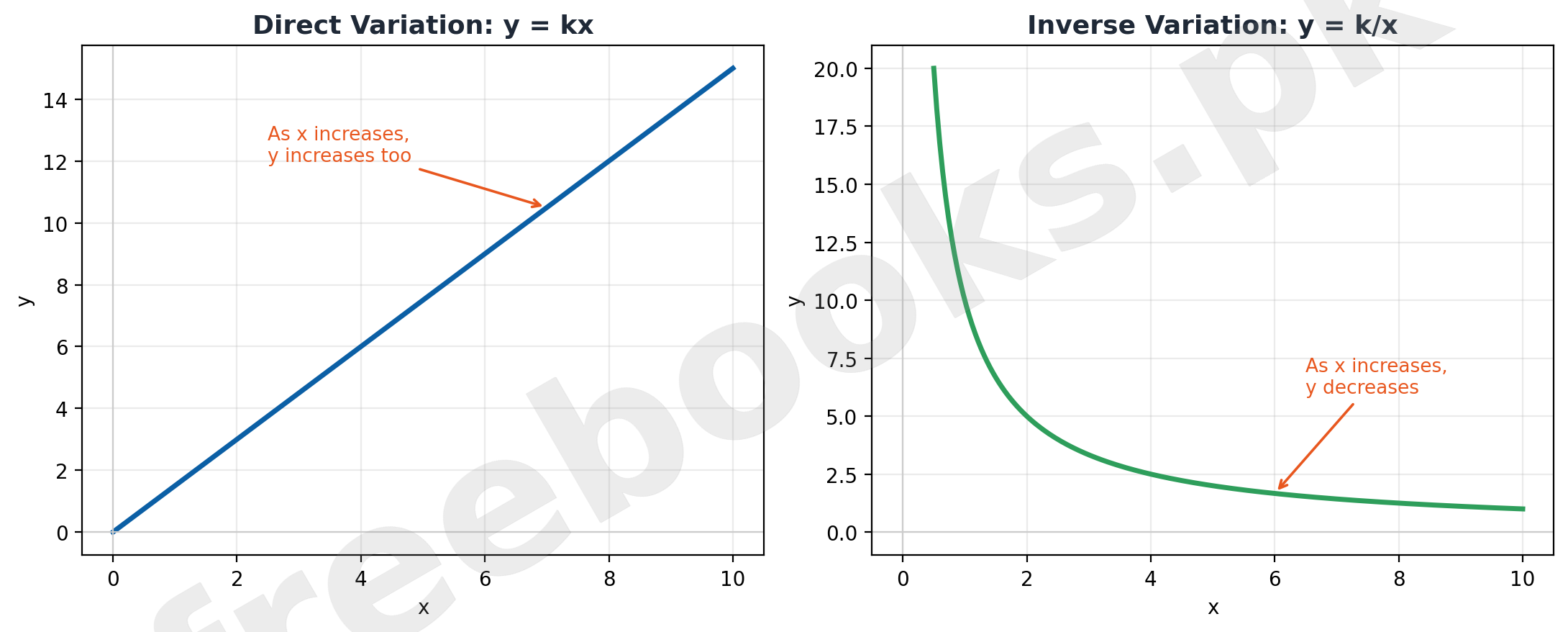
Variation describes how one quantity changes as another changes, and comes in two basic forms. In direct variation, an increase (or decrease) in one quantity causes a corresponding increase (or decrease) in the other: if y varies directly as x, this is written y ∝ x, meaning y = kx for some constant k (called the constant of variation) that is not zero. In inverse variation, an increase in one quantity causes a decrease in the other: if y varies inversely as x, this is written y ∝ 1/x, meaning y = k/x, or equivalently xy = k. In both cases, once k is found from one known pair of values, the same equation predicts y for any other value of x (or vice versa) — variation can also apply to powers of a variable, such as y ∝ x^2 or y ∝ x^3, following exactly the same method.
3.2 Third, Fourth, Mean, and Continued Proportional
Given two quantities a and b, if a third quantity c is chosen so that a:b::b:c, then c is called the third proportional to a and b — notice b is repeated as both a mean. Given three quantities a, b, c, if a fourth quantity d is chosen so that a:b::c:d, then d is called the fourth proportional. Both are found the same way: set up the proportion, apply 'product of extremes = product of means', and solve the resulting equation for the unknown term.
If three quantities a, b, c satisfy a:b::b:c (the same pattern as the third proportional), then b itself — the repeated middle term — is called the mean proportional between a and c, and satisfies b^2 = ac, so b = ±√(ac). When three quantities a, b, c are related this same way (a:b::b:c), with a first, b as the mean, and c third, they are together said to be in continued proportion; this idea can be extended to four or more quantities all connected by equal successive ratios.
3.3 Theorems on Proportions
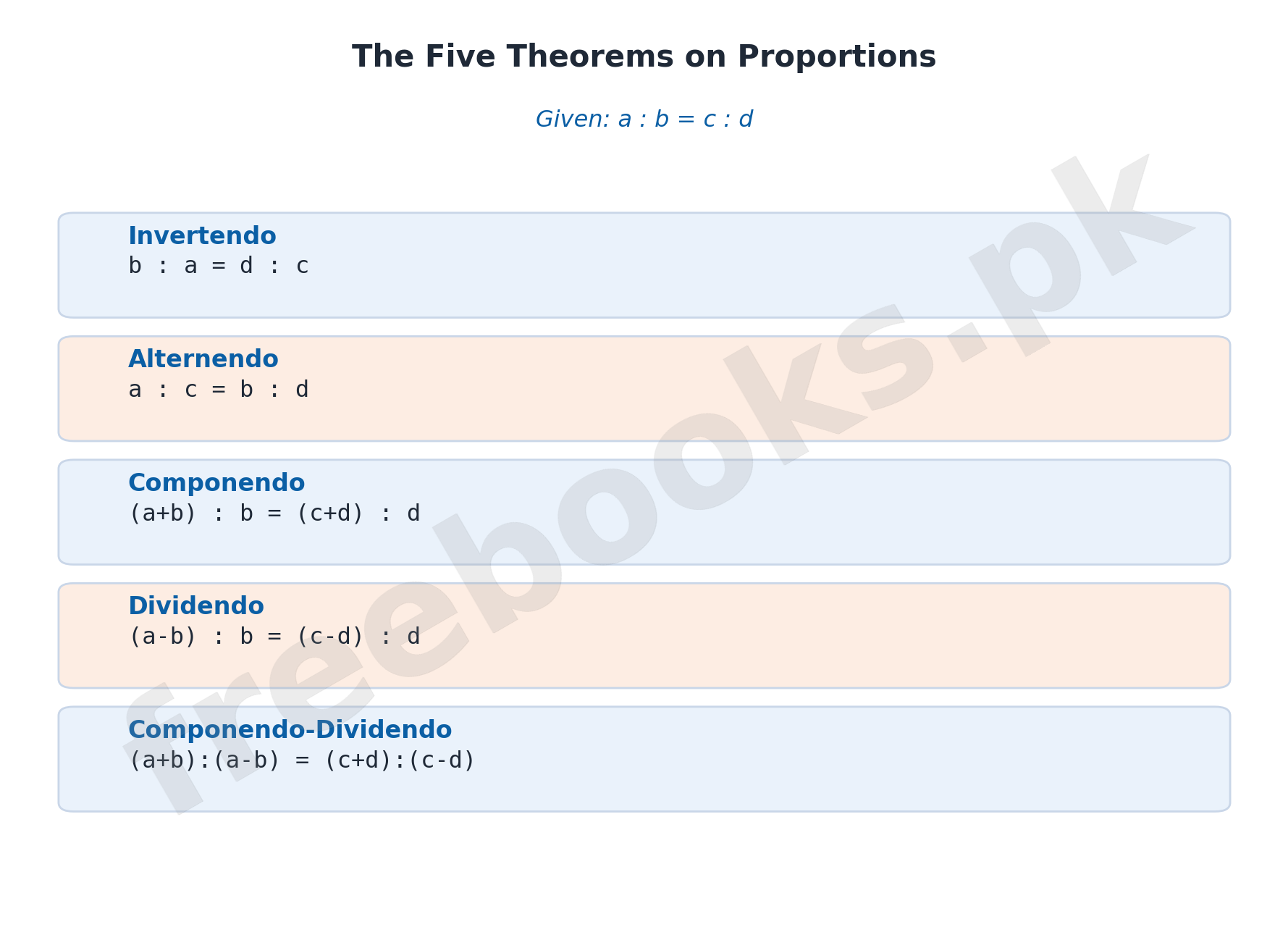
If a:b = c:d is a proportion, several useful new proportions can be deduced from it by standard theorems, each proved by writing a/b = c/d and manipulating the fraction algebraically. Invertendo: if a:b = c:d, then b:a = d:c (simply flip both ratios). Alternendo: if a:b = c:d, then a:c = b:d (swap the middle terms). Componendo: if a:b = c:d, then (a+b):b = (c+d):d, and equivalently a:(a+b) = c:(c+d) (add the denominator to the numerator on each side).
Dividendo: if a:b = c:d, then (a-b):b = (c-d):d, and equivalently a:(a-b) = c:(c-d) (subtract the denominator from the numerator on each side). Componendo-Dividendo, the most powerful of the five and the one most frequently tested: if a:b = c:d, then (a+b):(a-b) = (c+d):(c-d). This is especially useful for solving equations that already have a 'sum over difference' shape, or for combining two componendo results and two dividendo results to eliminate variables and reach a much simpler ratio, as when proving results like 3m+7n:3m-7n = 3p+7q:3p-7q from m:n=p:q.
3.4 Joint Variation
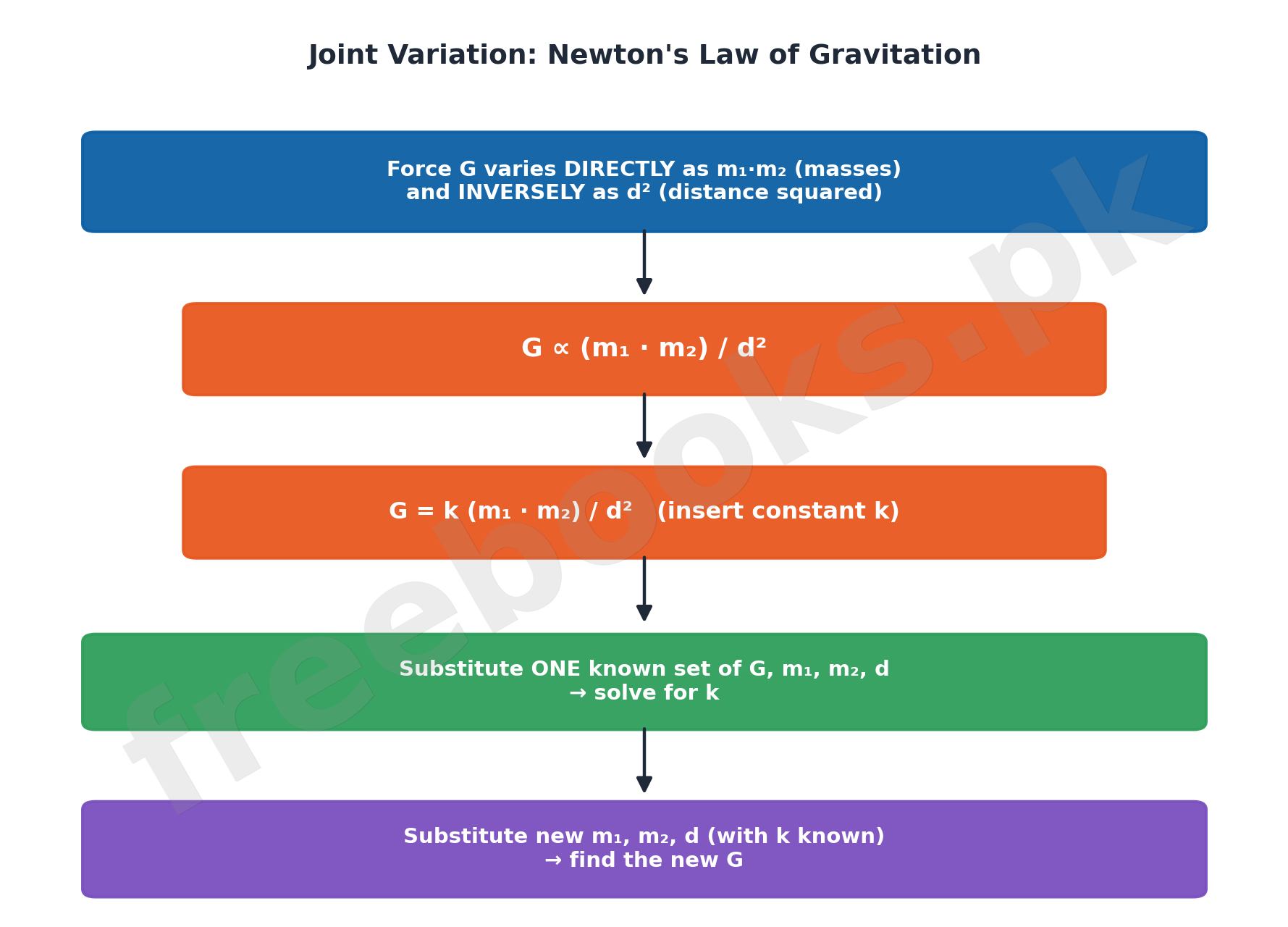
Joint variation combines direct and inverse variation of two or more variables into a single relationship. If y varies directly as x and inversely as z, this is written together as y ∝ x/z, meaning y = kx/z for some constant k. More generally, a quantity can vary directly as the product of several quantities and inversely as the product of several others, all combined into one proportionality and one constant k — for example, by Newton's law of gravitation, the gravitational force G between two bodies varies directly as the product of their masses m1, m2 and inversely as the square of the distance d between them, written G ∝ (m1·m2)/d^2, i.e. G = k(m1·m2)/d^2.
Joint variation problems are solved in three steps: first, translate the verbal description into a proportionality statement (e.g. 'y varies jointly as x^2 and z' becomes y ∝ x^2·z); second, insert the constant of variation to get an equation (y = k·x^2·z) and substitute one complete set of known values to solve for k; third, substitute the now-known k back into the equation, along with any new values given, to find the requested unknown.
3.5 K-Method
The k-method is a systematic technique for proving that two more complicated ratio expressions are equal, given that a:b = c:d (or a:b = c:d = e:f for three ratios). The method sets each of the given equal ratios to a single constant k — e.g. a/b = c/d = k — which gives a = bk and c = dk (and e = fk, if a third ratio is involved). These substitutions are then made into the Left Hand Side and Right Hand Side of whatever is to be proved; since both sides are rewritten purely in terms of b, d (and f) and the same k, common factors cancel and both sides simplify to the identical expression, completing the proof.
The k-method works because it replaces two 'unknown but equal ratios' with a single shared variable k, turning what looks like an abstract algebraic identity into straightforward substitution and simplification. It is the standard tool for proving conditional equalities of the form 'if a:b=c:d, then (some expression in a,b) = (the same expression in c,d)', and is far faster and more reliable than trying to manipulate the original ratio equation directly with cross-multiplication.
3.6 Real-Life Applications of Variation
Many real-life laws in physics, engineering, and economics are stated as variation relationships and solved using the same three-step method (translate to a proportionality, find k from known values, then predict a new value). Examples include Hooke's law (the force needed to stretch a spring varies directly as its elongation), the strength of a rectangular beam (varies directly as its breadth and the square of its depth), the intensity of light (varies inversely as the square of the distance from the source), and the kinetic energy of a moving body (varies jointly as its mass and the square of its velocity).
The general procedure: read the problem carefully to identify which quantities vary directly and which vary inversely (this determines whether each variable appears in the numerator or denominator of the k-expression); write the joint/direct/inverse variation equation with the constant k; substitute the first complete set of given values to solve for k; then substitute the new given values into the equation (with k now known) to find the requested quantity. Always check that the final answer makes physical sense for the situation described.
Important Definitions
What is a ratio?
A relation between two quantities of the same kind (measured in the same unit), written a:b or a/b, with no units of its own.
What is a proportion?
A statement that two ratios are equal, written a:b::c:d, where a, d are the extremes and b, c are the means, satisfying ad = bc.
What is direct variation?
A relationship where an increase (or decrease) in one quantity causes a corresponding increase (or decrease) in another, written y ∝ x or y = kx.
What is inverse variation?
A relationship where an increase in one quantity causes a decrease in another, written y ∝ 1/x or y = k/x, i.e. xy = k.
What is the third proportional to a and b?
The quantity c such that a:b::b:c.
What is the mean proportional between a and c?
The quantity b such that a:b::b:c, satisfying b² = ac, so b = ±√(ac).
What is joint variation?
A combination of direct and inverse variation of two or more variables into a single relationship, e.g. y ∝ x/z, i.e. y = kx/z.
What is the constant of variation?
The non-zero constant k in a variation equation (such as y = kx or y = k/x) that stays fixed for a given relationship.
State the componendo-dividendo theorem.
If a:b = c:d, then (a+b):(a-b) = (c+d):(c-d).
What is the k-method?
A technique for proving ratio identities by setting each side of a given proportion equal to a constant k, substituting, and simplifying both sides to the same expression.
Key Facts and Relations
| Topic | Key Fact / Relation |
|---|---|
| Proportion rule | a:b::c:d ⇒ ad = bc (product of extremes = product of means) |
| Direct variation | y ∝ x ⇒ y = kx |
| Inverse variation | y ∝ 1/x ⇒ y = k/x, i.e. xy = k |
| Third proportional | a:b::b:c ⇒ c = b²/a |
| Mean proportional | a:b::b:c ⇒ b = ±√(ac) |
| Invertendo | a:b=c:d ⇒ b:a=d:c |
| Alternendo | a:b=c:d ⇒ a:c=b:d |
| Componendo | a:b=c:d ⇒ (a+b):b=(c+d):d |
| Dividendo | a:b=c:d ⇒ (a-b):b=(c-d):d |
| Componendo-Dividendo | a:b=c:d ⇒ (a+b):(a-b)=(c+d):(c-d) |
| Joint variation | y ∝ x/z ⇒ y = kx/z |
| K-method setup | a/b = c/d = k ⇒ a=bk, c=dk |
Diagrams
Direct vs Inverse Variation: Side-by-side plots of y=kx (a straight line through the origin, direct variation) and y=k/x (a hyperbola, inverse variation), showing how y changes as x increases in each case
The Five Theorems on Proportions: A summary chart listing invertendo, alternendo, componendo, dividendo, and componendo-dividendo alongside the transformation each theorem applies to a:b=c:d
Joint Variation Flow: A flow diagram showing Newton's law of gravitation as a worked joint-variation example: force G varies directly as the product of two masses and inversely as the square of the distance between them
Short Questions & Answers
Define ratio.
A relation between two quantities of the same kind, measured in the same unit, written a:b or a/b, with no units.
In the proportion a:b::c:d, which terms are the extremes and which are the means?
a and d are the extremes; b and c are the means.
Write the mathematical form of 'y varies directly as x'.
y ∝ x, i.e. y = kx, where k is the constant of variation.
Write the mathematical form of 'y varies inversely as x'.
y ∝ 1/x, i.e. y = k/x, so xy = k.
State the componendo theorem.
If a:b = c:d, then (a+b):b = (c+d):d.
What does the k-method substitute for a given equal ratio a/b = c/d?
It sets a/b = c/d = k, giving a = bk and c = dk, which are then substituted into both sides of the expression to be proved.
Long Questions & Answers
Explain ratio, proportion, and the two basic types of variation, and describe how the third, fourth, and mean proportional of given quantities are found.
What is a ratio, and what rule governs a proportion?
A ratio a:b (or a/b) compares two quantities of the same kind and has no units. A proportion states that two ratios are equal, a:b::c:d, where a, d are the extremes and b, c are the means; the defining rule is that the product of the extremes equals the product of the means, ad = bc, which is used to find an unknown term in any proportion.
What is direct variation, and how is it written?
Direct variation describes a relationship where an increase in one quantity produces a corresponding increase in another (and a decrease produces a decrease). If y varies directly as x, this is written y ∝ x, meaning y = kx for a non-zero constant k called the constant of variation, found by substituting one known pair of x, y values.
What is inverse variation, and how is it written?
Inverse variation describes a relationship where an increase in one quantity produces a decrease in the other. If y varies inversely as x, this is written y ∝ 1/x, meaning y = k/x, or equivalently xy = k, with k again found from one known pair of values before predicting any other pair.
How is the third proportional to two quantities found?
For quantities a and b, the third proportional c satisfies a:b::b:c. Writing this as a fraction, a/b = b/c, cross-multiplying gives ac = b², so c = b²/a — e.g. the third proportional to 6 and 12 is 12²/6 = 24.
How are the fourth proportional and the mean proportional found?
For a, b, c, the fourth proportional d satisfies a:b::c:d, so ad = bc, giving d = bc/a. The mean proportional between a and c is the quantity b satisfying a:b::b:c, so b² = ac, giving b = ±√(ac) — both are solved by writing out the proportion and applying 'product of extremes = product of means'.
State the five theorems on proportions and the k-method, and explain how joint variation is used to solve real-life problems.
What do the theorems of invertendo and alternendo state?
If a:b = c:d, invertendo gives b:a = d:c (flipping both ratios), and alternendo gives a:c = b:d (swapping the middle terms b and c). Both are proved directly by manipulating the fraction a/b = c/d.
What do the theorems of componendo, dividendo, and componendo-dividendo state?
If a:b = c:d: componendo gives (a+b):b = (c+d):d; dividendo gives (a-b):b = (c-d):d; and combining both, componendo-dividendo gives (a+b):(a-b) = (c+d):(c-d) — the most powerful of the five, often used to simplify equations already in a sum-over-difference form.
What is the k-method, and how is it used to prove a ratio identity?
Given a:b = c:d, the k-method sets a/b = c/d = k, so a = bk and c = dk. Substituting these into both the Left Hand Side and Right Hand Side of the expression to be proved lets the common factors b and d cancel, reducing both sides to the same expression in k alone and completing the proof.
What is joint variation, and how is a joint variation problem solved?
Joint variation combines direct and inverse variation of several variables into one relationship, e.g. y varying directly as x and inversely as z is written y = kx/z. It is solved in three steps: write the proportionality, substitute one full set of known values to find k, then substitute the new values (with k now known) to find the requested unknown.
How does joint variation apply to a real-life law like Newton's law of gravitation?
The gravitational force G between two bodies varies directly as the product of their masses m1, m2 and inversely as the square of the distance d between them: G ∝ (m1·m2)/d², i.e. G = k(m1·m2)/d². Given one complete set of G, m1, m2, d values, k can be found, after which G can be predicted for any new masses or distance.
Multiple Choice Questions (MCQs)
In a ratio a:b, a is called the: (A) Consequent (B) Antecedent (C) Mean (D) Extreme
Correct answer: (B) Antecedent. In a ratio a:b, a is the antecedent (the first term) and b is the consequent (the second term).
In the proportion a:b::c:d, the product of the extremes equals the product of the: (A) Antecedents (B) Means (C) Consequents (D) Ratios
Correct answer: (B) Means. The rule of proportion states ad = bc, i.e. the product of the extremes (a, d) equals the product of the means (b, c).
If y varies directly as x, this is written as: (A) y = k/x (B) y = kx (C) xy = k (D) y = x/k
Correct answer: (B) y = kx. Direct variation means y ∝ x, i.e. y = kx for a constant k.
If y varies inversely as x, this is written as: (A) y = kx (B) xy = k (C) y – x = k (D) y + x = k
Correct answer: (B) xy = k. Inverse variation means y ∝ 1/x, i.e. y = k/x, equivalently xy = k.
The third proportional to a and b is given by: (A) b²/a (B) a²/b (C) ab (D) a/b
Correct answer: (A) b²/a. For a:b::b:c, cross-multiplying gives ac = b², so the third proportional c = b²/a.
The mean proportional between a and c is: (A) ac (B) a+c (C) ±√(ac) (D) (a+c)/2
Correct answer: (C) ±√(ac). For a:b::b:c, b² = ac, so the mean proportional b = ±√(ac).
If a:b = c:d, then by invertendo: (A) a:c = b:d (B) b:a = d:c (C) (a+b):b = (c+d):d (D) (a-b):b=(c-d):d
Correct answer: (B) b:a = d:c. Invertendo simply flips both ratios: a:b=c:d becomes b:a=d:c.
If a:b = c:d, then by componendo-dividendo: (A) (a+b):(a-b) = (c+d):(c-d) (B) a:c = b:d (C) b:a = d:c (D) ab = cd
Correct answer: (A) (a+b):(a-b) = (c+d):(c-d). Componendo-dividendo combines componendo and dividendo to give (a+b):(a-b) = (c+d):(c-d).
In the k-method, if a/b = c/d = k, then a and c equal: (A) a=bk, c=dk (B) a=b/k, c=d/k (C) a=k/b, c=k/d (D) a=b+k, c=d+k
Correct answer: (A) a=bk, c=dk. Setting the common ratio equal to k gives a = bk and c = dk directly from a/b=k and c/d=k.
If y varies jointly as x and inversely as z, the relationship is written as: (A) y = kxz (B) y = kx/z (C) y = kz/x (D) y = k/(xz)
Correct answer: (B) y = kx/z. Joint variation combining direct variation with x and inverse variation with z gives y = kx/z.
Quick Revision Summary
- Ratio a:b compares two like quantities; no units; proportion a:b::c:d means ad=bc
- Direct variation: y ∝ x ⇒ y=kx | Inverse variation: y ∝ 1/x ⇒ y=k/x (xy=k)
- Third proportional to a,b: c=b²/a | Fourth proportional to a,b,c: d=bc/a
- Mean proportional between a,c: b=±√(ac)
- Invertendo: b:a=d:c | Alternendo: a:c=b:d
- Componendo: (a+b):b=(c+d):d | Dividendo: (a-b):b=(c-d):d
- Componendo-Dividendo: (a+b):(a-b)=(c+d):(c-d) — most useful for sum-over-difference equations
- K-method: set a/b=c/d=k ⇒ a=bk, c=dk, then substitute and simplify both sides
- Joint variation: y ∝ x/z ⇒ y=kx/z; solve by finding k from one known set of values first
- Newton's gravitation, Hooke's law, kinetic energy are all joint-variation relationships
- Always check whether a solution makes physical sense in real-life variation problems
Exam Tips
- Whenever you see 'product of extremes = product of means', cross-multiply immediately — it solves most proportion problems in one step
- For variation word problems, first decide which quantities are direct (numerator) and which are inverse (denominator) before writing the k-equation
- Memorize componendo-dividendo specifically — it appears most often in exams and solves equations that already look like a sum over a difference
- When using the k-method, always substitute into BOTH sides separately, then simplify each side down before comparing them
- In joint variation, find k using the FIRST complete set of given values before touching the question being asked
- Double-check units and signs in real-life variation problems — reject any answer that doesn't make physical sense (e.g. a negative length)