This unit turns from chords to the special line that touches a circle at exactly one point — the tangent. It begins by distinguishing a tangent from a secant (which cuts the circle at two points), then builds four theorems that describe the tight relationship between a tangent, the radius drawn to its point of contact, and the centre of the circle: a line perpendicular to a radius at its outer end must be tangent there, a tangent is always perpendicular to the radius at the point of contact, the two tangents from any external point are equal in length, and the distance between the centres of two touching circles equals the sum (external contact) or difference (internal contact) of their radii.
These theorems have direct practical uses — finding unknown tangent lengths, proving lines parallel or perpendicular using tangent properties, and working out the distance between the centres of touching circles — and they set up the geometry needed for the arcs and inscribed-angle theorems that follow in later units.
Learning Objectives
- Distinguish between a secant and a tangent to a circle, and identify the point of contact
- Prove that a line perpendicular to a radial segment at its outer end point is tangent to the circle at that point
- Prove that the tangent to a circle and the radial segment to the point of contact are perpendicular to each other
- Prove that two tangents drawn to a circle from an external point are equal in length
- Prove that if two circles touch externally or internally, the distance between their centres equals the sum or difference of their radii
- Apply these theorems to solve problems involving tangent lengths, touching circles, and related angles
Key Concepts
10.1 Secant and Tangent Lines
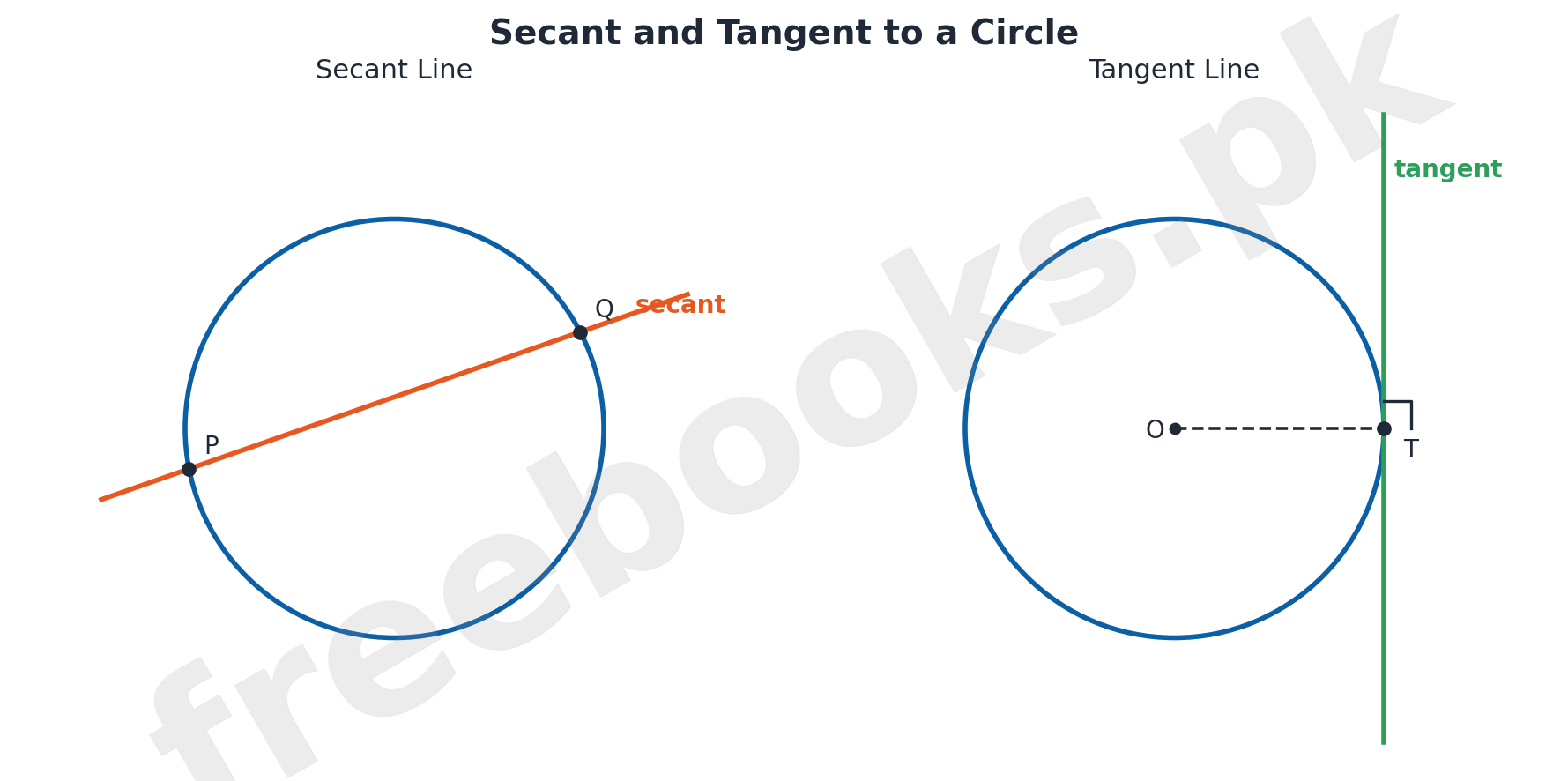
A secant is a straight line that cuts the circumference of a circle in two distinct points. A tangent to a circle, by contrast, is a straight line that touches the circumference at a single point only — that point is called the point of tangency or the point of contact. Every tangent line lies entirely outside the circle except for this one shared point, while a secant always has a chord of the circle as the segment between its two intersection points.
The length of a tangent to a circle is always measured from the given external point to the point of contact — this becomes important in Theorem 3, where two tangent lengths from the same external point are compared.
10.2 Theorem 1: Perpendicular at the Outer End of a Radius is Tangent
Theorem 1 states: if a line is drawn perpendicular to a radial segment of a circle at its outer end point, it is tangent to the circle at that point. Given a circle with centre O and radial segment OC, if line AB is perpendicular to OC at C, then for any other point P on AB, triangle OCP has a right angle at C, so the angle at P is acute, making OP greater than OC (the side opposite the larger angle in a triangle is longer). Since OP > OC (the radius), every point on AB except C lies outside the circle — so AB touches the circle at exactly one point, C, proving it is tangent there.
10.3 Theorem 2: The Tangent is Perpendicular to the Radius
Theorem 2 is essentially the converse: the tangent to a circle and the radial segment joining the point of contact and the centre are perpendicular to each other. If AB is tangent at C and P is any other point on AB, the segment OP (drawn from the centre to P) must cross the circle at some point D, giving OC = OD (radii) and OD < OP (since P is outside), so OC < OP. This makes OC the shortest possible segment from O to the line AB, and the shortest distance from a point to a line is always the perpendicular distance — so OC is perpendicular to AB.
Corollary: only one perpendicular can be drawn to the radial segment OC at the point C, so one and only one tangent can be drawn to a circle at a given point on its circumference.
10.4 Theorem 3: Two Tangents from an External Point are Equal
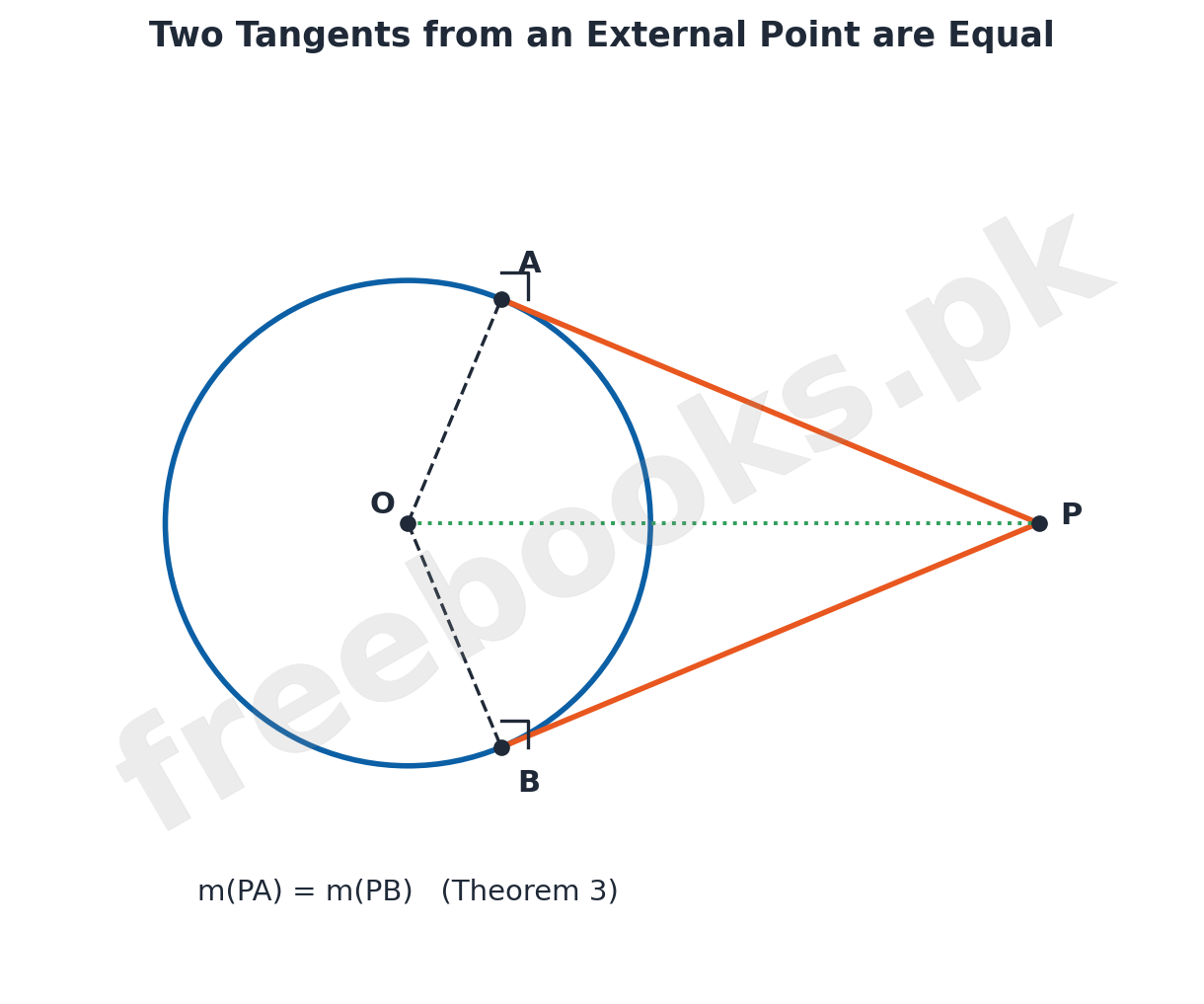
Theorem 3 states: two tangents drawn to a circle from a point outside it are equal in length. Given tangents PA and PB from external point P to a circle with centre O, joining O to A, B, and P creates two right triangles OAP and OBP: both have a right angle at the point of contact (Theorem 2), equal hypotenuses OP (shared), and equal legs OA = OB (radii of the same circle) — so by the right-angle-hypotenuse-side (H.S.) congruence postulate, triangle OAP is congruent to triangle OBP, giving PA = PB.
Corollary: OP is the right bisector of the chord of contact AB. Two classic applications follow: tangents drawn at the two ends of a diameter are always parallel to each other (Example 1), and the tangents drawn at the ends of a chord always make equal angles with that chord (Example 2) — both proved using the same perpendicularity and congruent-triangle ideas from Theorems 2 and 3.
10.5 Theorems 4(A) and 4(B): Distance Between Centres of Touching Circles
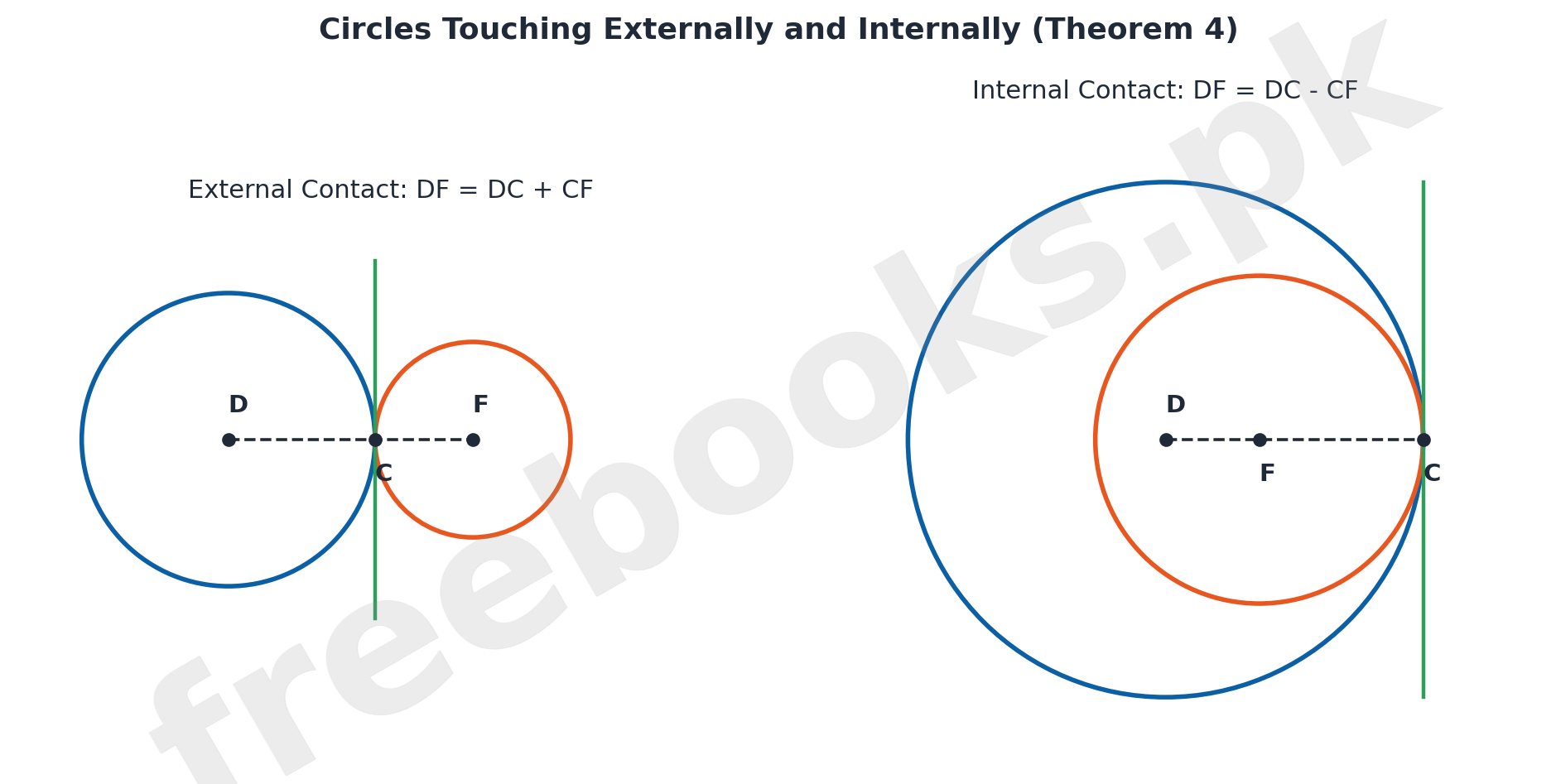
Theorem 4(A): if two circles touch each other externally, the distance between their centres equals the sum of their radii. With circles centred at D and F touching externally at C, and ACB drawn as their common tangent at C, both radial segments CD and CF are perpendicular to the tangent line at C (Theorem 2). Since angle ACD + angle ACF = 90 degrees + 90 degrees = 180 degrees, points D, C, F must be collinear with C between D and F, giving DF = DC + CF.
Theorem 4(B): if two circles touch each other internally, the distance between their centres equals the difference of their radii. The argument is the same, except the common tangent line at C shows that D, C, F are collinear with F between D and C this time, giving DF = DC – FC. A direct application: if three circles touch each other in pairs externally, the perimeter of the triangle formed by joining their centres equals the sum of all three diameters, since each side of the triangle equals the sum of two radii.
Important Definitions
What is a secant of a circle?
A straight line that cuts the circumference of a circle in two distinct points.
What is a tangent to a circle?
A straight line that touches the circumference of a circle at a single point only, called the point of contact or point of tangency.
How is the length of a tangent measured?
From the given external point to the point of contact on the circle.
What does Theorem 1 state about a perpendicular at the outer end of a radius?
If a line is drawn perpendicular to a radial segment of a circle at its outer end point, it is tangent to the circle at that point.
What does Theorem 2 state about a tangent and the radius to its point of contact?
The tangent to a circle and the radial segment joining the point of contact and the centre are perpendicular to each other.
How many tangents can be drawn to a circle at one given point on its circumference?
Exactly one — only one perpendicular can be drawn to the radial segment at that point.
What does Theorem 3 state about two tangents from an external point?
The two tangents drawn to a circle from a point outside it are equal in length.
What is the corollary of Theorem 3 about the chord of contact?
The segment joining the external point to the centre is the right bisector of the chord of contact joining the two points of tangency.
What does Theorem 4(A) state about externally touching circles?
If two circles touch each other externally, the distance between their centres is equal to the sum of their radii.
What does Theorem 4(B) state about internally touching circles?
If two circles touch each other internally, the distance between their centres is equal to the difference of their radii.
Key Facts and Relations
| Topic | Key Fact / Relation |
|---|---|
| Secant | A line cutting the circle at two distinct points |
| Tangent | A line touching the circle at exactly one point (point of contact) |
| Theorem 1 | A line perpendicular to a radius at its outer end point is tangent there |
| Theorem 2 | A tangent and the radius to its point of contact are perpendicular |
| Corollary of Theorem 2 | Only one tangent can be drawn at a given point on a circle |
| Theorem 3 | Two tangents from an external point are equal in length |
| Corollary of Theorem 3 | The line from the external point to the centre right-bisects the chord of contact |
| Theorem 4(A) — external contact | Distance between centres = sum of radii (m(DF) = m(DC) + m(CF)) |
| Theorem 4(B) — internal contact | Distance between centres = difference of radii (m(DF) = m(DC) – m(CF)) |
| Three circles touching in pairs externally | Perimeter of triangle of centres = sum of the three diameters |
Diagrams
Secant and Tangent to a Circle: A circle showing a secant line cutting the circumference at two distinct points, alongside a tangent line touching the circumference at a single point of contact
Two Tangents from an External Point are Equal (Theorem 3): A circle with centre O and an external point P, showing two tangents PA and PB drawn from P to the circle, with OA and OB as radii perpendicular to the tangents at the points of contact
Circles Touching Externally and Internally (Theorem 4): Two diagrams side by side: circles with centres D and F touching externally at point C with DF = DC + CF, and circles touching internally at point C with DF = DC – CF
Short Questions & Answers
Define a tangent to a circle.
A tangent is a straight line that touches the circumference of a circle at a single point only, called the point of contact.
How does a secant differ from a tangent?
A secant cuts the circle at two distinct points, while a tangent touches the circle at only one point.
State Theorem 2 of this unit.
The tangent to a circle and the radial segment joining the point of contact and the centre are perpendicular to each other.
State Theorem 3 of this unit.
Two tangents drawn to a circle from a point outside it are equal in length.
What does the corollary of Theorem 3 say about the chord of contact?
The line joining the external point to the centre is the right bisector of the chord of contact joining the two points of tangency.
State Theorem 4(A) about two circles touching externally.
If two circles touch each other externally, the distance between their centres is equal to the sum of their radii.
Long Questions & Answers
Explain the difference between a secant and a tangent, and state and explain Theorems 1 and 2 relating a tangent to the radius at its point of contact.
What is a secant, and what is a tangent?
A secant is a straight line cutting the circumference of a circle at two distinct points. A tangent is a straight line touching the circumference at exactly one point, called the point of contact.
How is the length of a tangent measured?
The length of a tangent to a circle is always measured from the external point from which it is drawn to the point of contact on the circle.
What does Theorem 1 state, and how is it proved?
Theorem 1 states that a line perpendicular to a radial segment at its outer end point is tangent to the circle at that point. Any other point P on the line forms a right triangle with the centre O and the point of tangency C, where the right angle is at C; since the angle at P is acute, OP is longer than OC, placing P outside the circle — so the line meets the circle only at C.
What does Theorem 2 state, and how is it proved?
Theorem 2 states that a tangent and the radius to its point of contact are perpendicular. For any other point P on the tangent, the segment OP crosses the circle at D, and since OD < OP while OC = OD (radii), OC is the shortest segment from O to the tangent line — and the shortest distance from a point to a line is always along the perpendicular.
What is the corollary of Theorem 2?
Only one perpendicular can be drawn to a radial segment at its outer end point, so only one tangent line can be drawn to a circle at any given point on its circumference.
State and explain Theorem 3 on tangents from an external point, and Theorems 4(A) and 4(B) on the distance between the centres of touching circles.
What does Theorem 3 state, and how is it proved?
Theorem 3 states that two tangents drawn to a circle from an external point are equal in length. Joining the centre O to the external point P and to both points of contact A and B creates two right triangles OAP and OBP with equal hypotenuses OP, equal legs OA = OB (radii), and right angles at A and B — congruent by the H.S. postulate, so PA = PB.
What is the corollary of Theorem 3, and what does it help prove about tangents at the ends of a diameter?
The corollary states that the segment from the external point to the centre right-bisects the chord of contact. Using perpendicularity from Theorem 2, tangents drawn at the two ends of a diameter can be shown to both be perpendicular to that diameter, which makes them parallel to each other.
What does Theorem 4(A) state about circles touching externally?
If two circles touch each other externally at point C, the distance between their centres D and F equals the sum of their radii, DF = DC + CF, because the common tangent at C makes angle DCF a straight angle of 180 degrees, placing C between D and F.
What does Theorem 4(B) state about circles touching internally?
If two circles touch each other internally at point C, the distance between their centres equals the difference of their radii, DF = DC – CF, since the smaller circle's centre F lies between D and C along the same line.
How is the sum-of-diameters result used for three mutually externally touching circles?
If three circles touch each other in pairs externally, each side of the triangle formed by joining their centres equals the sum of two radii, so the total perimeter of the triangle equals twice the sum of all three radii — which is exactly the sum of the three diameters.
Multiple Choice Questions (MCQs)
A line that touches the circumference of a circle at exactly one point is called: (A) A secant (B) A chord (C) A tangent (D) A diameter
Correct answer: (C) A tangent. A tangent is defined as a line that touches the circle's circumference at a single point only.
A line that has two points in common with a circle is called: (A) A tangent (B) A radius (C) A secant (D) A diameter
Correct answer: (C) A secant. A secant is a line that cuts the circle at two distinct points.
If OT is the radial segment and PTQ is the tangent line at T, then: (A) OT is parallel to PQ (B) OT is perpendicular to PQ (C) OT equals PQ (D) OT bisects the circle
Correct answer: (B) OT is perpendicular to PQ. By Theorem 2, the radius to the point of contact is always perpendicular to the tangent line.
Two tangents drawn to a circle from a point outside it are: (A) Half in length (B) Equal in length (C) Double in length (D) Unrelated in length
Correct answer: (B) Equal in length. By Theorem 3, the two tangents from the same external point are always equal in length.
A circle can have how many tangents at a single given point on its circumference? (A) Two (B) Three (C) Only one (D) Infinitely many
Correct answer: (C) Only one. By the corollary of Theorem 2, only one tangent can be drawn to a circle at a given point.
Tangents drawn at the two ends of a diameter of a circle are: (A) Perpendicular (B) Parallel (C) Collinear (D) Equal to the radius
Correct answer: (B) Parallel. Since both tangents are perpendicular to the same diameter, they must be parallel to each other.
A tangent line intersects a circle at: (A) No point (B) A single point (C) Two points (D) Three points
Correct answer: (B) A single point. By definition, a tangent touches the circle's circumference at exactly one point.
If two circles touch each other externally, the distance between their centres equals: (A) The difference of their radii (B) The sum of their radii (C) Twice the larger radius (D) Half the sum of their radii
Correct answer: (B) The sum of their radii. By Theorem 4(A), external contact means the distance between centres equals the sum of the two radii.
If two circles touch each other internally, the distance between their centres equals: (A) The sum of their radii (B) The difference of their radii (C) Zero (D) The average of their radii
Correct answer: (B) The difference of their radii. By Theorem 4(B), internal contact means the distance between centres equals the difference of the two radii.
The length of a tangent to a circle is measured from: (A) The centre to the point of contact (B) The given external point to the point of contact (C) One point of contact to another (D) The circumference to the centre
Correct answer: (B) The given external point to the point of contact. The length of a tangent is always measured from the external point it is drawn from to the point where it touches the circle.
Quick Revision Summary
- Secant: line cutting the circle at two points | Tangent: line touching the circle at exactly one point (point of contact)
- Tangent length is measured from the external point to the point of contact
- Theorem 1: a line perpendicular to a radius at its outer end point is tangent to the circle there
- Theorem 2: the tangent and the radius to its point of contact are perpendicular to each other
- Corollary of Theorem 2: only one tangent can be drawn to a circle at a given point
- Theorem 3: two tangents from the same external point are equal in length
- Corollary of Theorem 3: the line from the external point to the centre right-bisects the chord of contact
- Tangents at the two ends of a diameter are parallel; tangents at the ends of a chord make equal angles with it
- Theorem 4(A): circles touching externally — distance between centres = sum of radii
- Theorem 4(B): circles touching internally — distance between centres = difference of radii
- Three circles touching in pairs externally: perimeter of the triangle of centres = sum of the three diameters
Exam Tips
- Never confuse 'secant' (two intersection points) with 'tangent' (exactly one) — draw both if unsure
- Whenever a tangent appears in a proof, immediately mark the right angle between the tangent and the radius at the point of contact — Theorem 2 is used constantly
- For 'two tangents from a point' problems, look for the H.S. (right-angle-hypotenuse-side) congruence pattern between the two triangles formed
- Remember: external contact adds the radii, internal contact subtracts them — sketch the touching circles to see which case applies
- The common tangent at the point of contact of two touching circles is always perpendicular to the line joining their centres
- For 'triangle of centres' problems with mutually touching circles, each side is simply the sum of the two relevant radii