
This unit presents 'The Dear Departed', a one-act play by William Stanley Houghton (1881-1913), set in the living room of the Slater family's Edwardian home. The family believes that grandfather Abel Merryweather has died, and the play follows his daughters and their husbands as they begin dividing up his belongings — only for Abel to reappear very much alive.
Through sharp dialogue and dark comedy, Houghton satirises materialism, greed, and hypocrisy within family relationships, showing how quickly genuine grief gives way to self-interest when inheritance is at stake.
These notes summarise the play as given in the textbook and provide comprehension questions, vocabulary, and exam-oriented material for this unit, including the skill-based Reading, Vocabulary (connotative vs denotative meanings), Grammar (direct/indirect narration), Oral Communication, and Writing (playscript and dialogue writing) sections that accompany it.
Learning Objectives
- Explore simple to complex ideas and issues in a one-act play, assembly, or class presentation
- Analyse organisational patterns in a text, such as sequence of events, comparison-contrast, cause-effect, and problem-solution
- Change direct speech into indirect speech and vice versa (present, past and perfect tenses, future, modals, time, questions, orders, requests, suggestions, and advice)
- Write multiple-paragraph essays, stories, poems, or playscripts using correct writing mechanics
- Write a dialogue between multiple people, including narration/background in brackets and director's notes, using vocabulary, tone, and style appropriate to context and relationship
Key Concepts
About the Play and the Playwright
'The Dear Departed', written by Stanley Houghton in 1908, reflects early 20th-century Edwardian society, focusing on middle-class family dynamics and attitudes towards inheritance. The play critiques materialism and superficiality within families when possessions come into question, and is part of the realistic 'Manchester School' of drama.
William Stanley Houghton (1881-1913) was an English playwright known for his social commentary and sharp wit, critiquing middle-class values and hypocrisies of Edwardian society. His most famous play, Hindle Wakes (1912), challenged traditional gender roles, while The Dear Departed satirises greed and materialism within family dynamics. Despite dying at just 32, Houghton made a significant impact on British theatre.
Characters and Setting
The play centres on Mr. Abel Merryweather and his two daughters, Mrs. Amelia Slater (married to Henry Slater, mother of Victoria) and Mrs. Elizabeth Jordan (married to Ben Jordan). The action takes place entirely in the modest, functional living room of the Slater family's Edwardian home — the play's sole location.
A one-act play is a short dramatic work structured within a single continuous act, typically running 15 to 60 minutes. It features a focused plot without subplots, a limited cast of characters, a single setting, quick pacing, and usually revolves around one central theme — all qualities on display in 'The Dear Departed'.
Plot: Exposition — Mourning Begins
Mrs. Slater scolds her daughter Victoria for playing outside while 'grandfather lies dead and cold upstairs', and instructs her to dress in mourning before her Aunt Elizabeth and Uncle Ben arrive. Henry Slater enters, and the couple discuss how they will outshine the Jordans since their own mourning clothes are not yet ready.
Mrs. Slater reveals she has long wanted grandfather's bureau, and persuades a reluctant Henry to secretly move it downstairs, along with grandfather's clock, before Elizabeth and Ben arrive — swapping them for an old chest of drawers.
Plot: Rising Action — The Bureau and the Family Gathering
Ben and Mrs. Jordan arrive in full, expensive new mourning, in contrast to the Slaters' half-mourning. The two sisters exchange barbed remarks about doctors, mourning clothes, and their father's habits, while all agree Abel had likely been drinking that morning.
The families discuss funeral announcements, grandfather's gold watch (which Mrs. Jordan claims was promised to her son Jimmy), and his life insurance premium. Victoria reveals grandfather actually went to the pub, not to pay his insurance, raising fears the premium was never paid — and Mrs. Jordan and Ben notice the 'new' bureau, unaware it is actually Abel's.
Plot: Climax — Grandfather Returns
Victoria is sent to fetch grandfather's keys and returns terrified, announcing 'Grandpa's getting up!' Abel Merryweather appears alive and well in his dressing gown, having merely been in a deep, drunken sleep — to the shock of the entire family.
Abel notices his bureau and clock have been moved downstairs and demands an explanation. Mrs. Jordan, seizing the moment, accuses Amelia and Henry of stealing the items, exposing the Slaters' scheme in front of everyone.
Plot: Falling Action and Resolution — The Final Twist
Abel reveals he made a will, now locked in the very bureau his family stole, and threatens to make a new one. He proposes a new arrangement: he will leave his belongings to whichever daughter he is living with when he dies — prompting both daughters to suddenly compete for his favour.
In a final ironic twist, Abel announces he plans to remarry — to Mrs. John Shorrocks, who keeps the 'Ring-o'-Bells' pub — making both daughters' scheming over his estate pointless, before calmly walking out as the curtain falls.
Theme
The theme of The Dear Departed revolves around materialism and hypocrisy in family relationships. The play highlights how greed and self-interest often overshadow genuine care and affection, especially when inheritance is involved. It exposes the superficiality of familial bonds and critiques how people can become opportunistic and selfish when material gains are at stake. Through dark humour and satire, Stanley Houghton underscores the moral decay and lack of sincerity that can exist within families, prompting reflection on the true nature of familial love and values.
Important Definitions (Glossary)
bureau
a desk with drawers and usually a top that opens down to make a table to write on
gallivanting
to go from place to place enjoying yourself
hearth
the floor at the bottom of a fireplace
impassive
not showing any feeling or emotion
malicious
having or showing a desire to harm somebody or hurt their feelings, caused by a feeling of hate
piqued
annoyed or upset
precocious
having developed particular abilities and ways of behaving at a much younger age than usual
shabby
(of buildings, clothes, objects, etc.) in poor condition because they have been used a lot
speck
a very small spot; a small piece of dirt, etc.
stupefied
to surprise or shock somebody; to make somebody unable to think clearly
Key Facts
| Item | Detail |
|---|---|
| Playwright | William Stanley Houghton (1881-1913) |
| Year written | 1908 |
| Genre / school | One-act play; realistic 'Manchester School' of drama |
| Setting | The living room of the Slater family's Edwardian home (sole location) |
| Main theme | Materialism and hypocrisy in family relationships |
| Key items disputed | Grandfather's bureau, clock, gold watch, and insurance money |
| Twist ending | Abel Merryweather is alive, and plans to remarry Mrs. John Shorrocks |
| Houghton's other famous play | Hindle Wakes (1912) |
Diagram
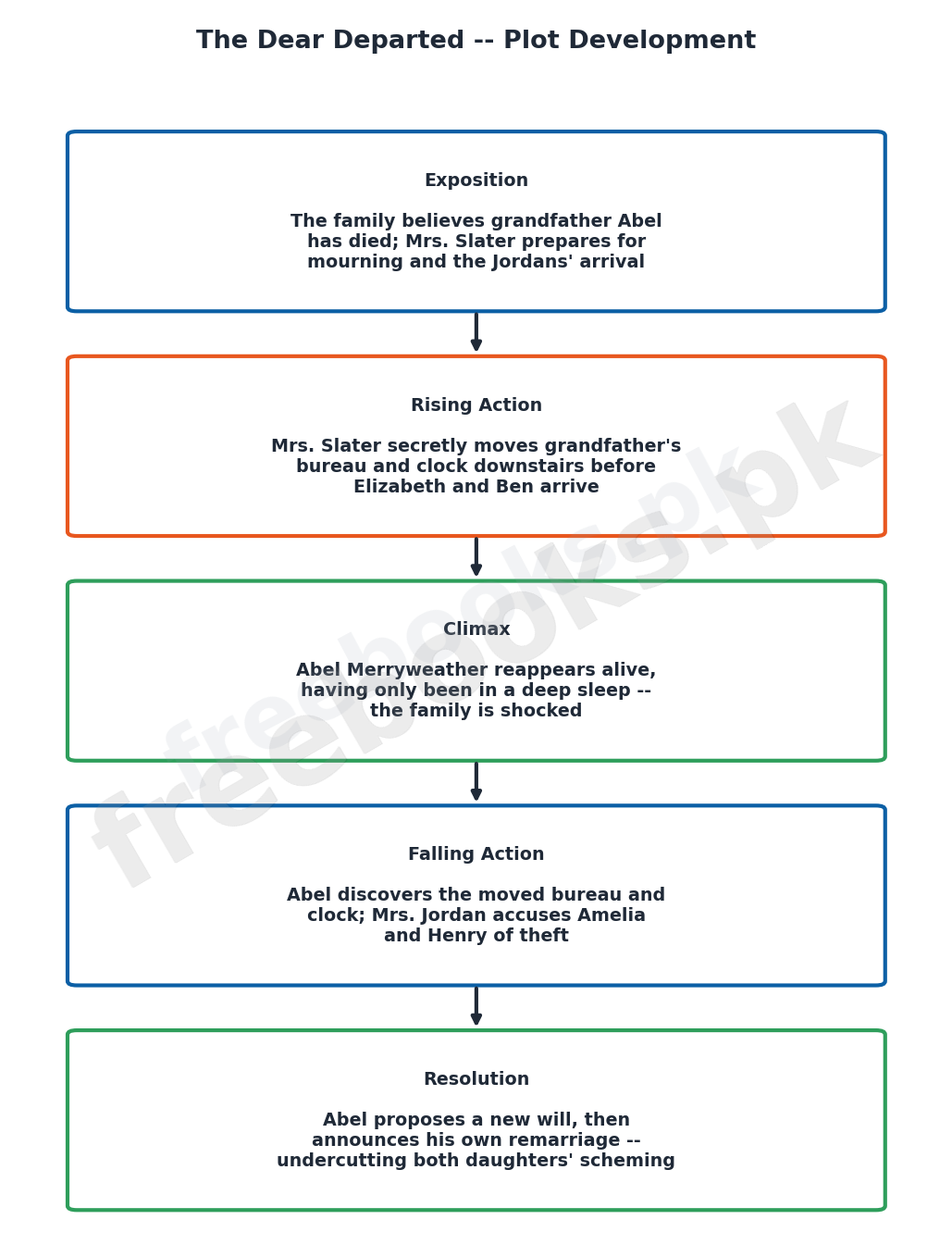
The Dear Departed — Plot Development: A purely textual/schematic diagram showing the play's five plot stages — Exposition, Rising Action, Climax, Falling Action, and Resolution — as labelled boxes connected by arrows (no illustrated human figures).
Short Questions & Answers
Who are the main characters in 'The Dear Departed', and how are they related?
The main characters are Mr. Abel Merryweather and his daughters, Mrs. Amelia Slater and Mrs. Elizabeth Jordan, along with their husbands Henry Slater and Ben Jordan, and Amelia's daughter Victoria.
Where and when is the play set?
The play is set entirely in the living room of the Slater family's Edwardian home, in early 20th-century England.
Why does Mrs. Slater want to move grandfather's bureau downstairs?
She has long wanted the bureau for herself and wants to claim it before her sister Elizabeth arrives and can dispute it, replacing it with an old chest of drawers.
What does Victoria reveal about where grandfather actually went that morning?
Victoria reveals that grandfather did not go to pay his insurance premium as claimed, but instead went to the 'Ring-o'-Bells' pub with Mr. Tattersall.
How does the family discover that Abel is not actually dead?
Victoria is sent upstairs to fetch keys and returns terrified, announcing that grandfather is getting up — and Abel then appears alive in his dressing gown.
How does Mrs. Jordan react when she discovers the bureau and clock in the living room?
She accuses Amelia and Henry of stealing the items after believing their father was dead, calling it 'nothing short of robbery'.
What new arrangement does Abel propose regarding his will?
He proposes to leave all his belongings to whichever daughter he is living with at the time of his death, prompting both daughters to compete for his favour.
What is the final twist at the end of the play?
Abel announces he plans to marry Mrs. John Shorrocks, the owner of the 'Ring-o'-Bells' pub, making his daughters' scheming over his estate pointless.
How does Victoria's character contrast with the adults in the play?
Victoria shows innocence and confusion at her parents' behaviour, at one point plainly stating she thought they were 'pinching' grandfather's things, contrasting with the adults' calculated greed.
What is the central theme of this play?
The central theme is materialism and hypocrisy in family relationships, showing how greed and self-interest can overshadow genuine care when inheritance is at stake.
Long Questions & Answers
Discuss how Stanley Houghton uses the character of Mrs. Slater to expose materialism and hypocrisy within the family.
How does Mrs. Slater behave immediately after her father's supposed death?
Rather than mourning, she scolds Victoria for playing outside and focuses on outdoing her sister's mourning clothes, showing her priorities lie in appearances rather than grief.
What specific actions reveal her materialism?
She persuades Henry to secretly move grandfather's bureau and clock downstairs before her sister arrives, replacing them with an old chest of drawers so she can claim them as her own.
How does she react when confronted about the theft?
She is initially speechless when Abel questions the missing bureau, and later becomes defensive and tearful, trying to justify her actions rather than admitting genuine wrongdoing.
What does her behaviour ultimately reveal about her character?
It reveals that her outward displays of grief and family loyalty are superficial, masking a deeply self-interested and opportunistic nature.
Explain the significance of the play's final twist and how it reflects the play's central theme.
What is the final twist in the play?
Abel Merryweather, who everyone believed was dead, turns out to be alive, and he announces at the end that he plans to remarry Mrs. John Shorrocks, the owner of the local pub.
How do the daughters react once Abel proposes his new will arrangement?
Both Mrs. Slater and Mrs. Jordan immediately begin competing for Abel's favour, each trying to convince him to live with her, revealing their true motivation is his estate, not affection.
How does the marriage announcement undercut the daughters' scheming?
It reveals that all their competing and plotting over his estate has been pointless, since Abel's remarriage will change his plans entirely, exposing the futility of their materialism.
How does this twist support the play's theme of materialism and hypocrisy?
It delivers Houghton's satirical message with dark humour: the family's greed is ultimately outwitted by the very man they thought was dead, underscoring the emptiness of their self-interested behaviour.
Multiple Choice Questions (MCQs)
What does the behaviour of Mrs. Slater and Mrs. Jordan primarily reveal about their characters? (A) They are affectionate and caring daughters (B) They value material wealth over family bonds (C) They respect their father's memory and legacy (D) They are indifferent to their father's possessions
Correct answer: (B) They value material wealth over family bonds. Both sisters focus on claiming their father's possessions rather than genuinely mourning him, revealing they value material wealth over family bonds.
Why is the setting of a single room (the living room) significant in the play? (A) It highlights the family's financial struggles (B) It creates an intimate space where the characters' true natures are revealed (C) It allows for more dramatic costume changes (D) It serves as a symbol of the family's closeness and unity
Correct answer: (B) It creates an intimate space where the characters' true natures are revealed. The single, confined setting creates an intimate space where the characters' true, often unflattering natures are exposed through their interactions.
How does Victoria's reaction differ from the adults when discussing Mr. Merryweather's possessions? (A) She is indifferent and doesn't care about the inheritance (B) She criticizes the adults for their materialism (C) She shows confusion, hinting at her innocence compared to the adults' greed (D) She eagerly participates in claiming possessions
Correct answer: (C) She shows confusion, hinting at her innocence compared to the adults' greed. Victoria's confused remarks, like thinking they 'pinched' the items, show her innocence in contrast to the adults' calculated greed.
How does Stanley Houghton use satire in The Dear Departed? (A) To exaggerate the family's love for each other (B) To humorously criticize the characters' hypocrisy and greed (C) To create tension and suspense among the characters (D) To present a tragic view of death and mourning
Correct answer: (B) To humorously criticize the characters' hypocrisy and greed. Houghton uses satire and dark humour to criticize the hypocrisy and greed on display within the family.
The clock on the mantelpiece can be interpreted as a symbol of: (A) The passing of time and routine in the family's life (B) The wealth and prosperity of Mr. Merryweather (C) The bond between the Slater sisters (D) The memories that the family cherishes
Correct answer: (A) The passing of time and routine in the family's life. The clock striking at a key moment symbolizes the passing of time, and its theft also reflects the family's routine self-interest.
What does Abel Merryweather do that surprises the family near the end of the play? (A) He forgives everyone and gives away all his money (B) He announces he plans to remarry (C) He decides to move in with Mrs. Jordan permanently (D) He destroys his will without explanation
Correct answer: (B) He announces he plans to remarry. Abel surprises everyone by announcing he plans to marry Mrs. John Shorrocks, owner of the local pub.
Why did Abel not pay his insurance premium as the family assumed? (A) He forgot where the insurance office was (B) He went to the 'Ring-o'-Bells' pub instead (C) He had already paid it the week before (D) He gave the money to Victoria
Correct answer: (B) He went to the 'Ring-o'-Bells' pub instead. Victoria reveals that grandfather went to the pub with Mr. Tattersall instead of paying his insurance premium.
What items does Mrs. Slater secretly move downstairs before the Jordans arrive? (A) A wardrobe and a mirror (B) The bureau and the clock (C) A piano and some paintings (D) Grandfather's clothes and shoes
Correct answer: (B) The bureau and the clock. Mrs. Slater and Henry secretly move grandfather's bureau and clock downstairs, replacing them with an old chest of drawers.
What genre and dramatic school does The Dear Departed belong to? (A) Tragedy; Elizabethan drama (B) One-act play; the realistic 'Manchester School' (C) Musical; Victorian melodrama (D) Epic; Greek tragedy
Correct answer: (B) One-act play; the realistic 'Manchester School'. The Dear Departed is a one-act play belonging to the realistic 'Manchester School' of drama.
What is the central theme of this play? (A) The joys of family reunions (B) Materialism and hypocrisy in family relationships (C) The importance of respecting elders (D) The dangers of drinking alcohol
Correct answer: (B) Materialism and hypocrisy in family relationships. The central theme is materialism and hypocrisy in family relationships, especially concerning inheritance.
Quick Revision Summary
- 'The Dear Departed' is a one-act play by William Stanley Houghton (1908), part of the 'Manchester School' of realistic drama
- Setting: the living room of the Slater family's Edwardian home — the play's single setting
- Exposition: the family believes grandfather Abel Merryweather has died and begins preparing for mourning
- Rising Action: Mrs. Slater secretly moves grandfather's bureau and clock downstairs before the Jordans arrive
- Climax: Abel Merryweather reappears alive, having only been in a deep sleep, exposing the theft
- Falling Action/Resolution: Abel proposes a new will based on who he lives with, then announces his own remarriage, undercutting both daughters' scheming
- Theme: materialism and hypocrisy in family relationships, especially around inheritance
- Houghton uses dark humour and satire to expose greed and superficiality within the family
Exam Tips
- Learn the glossary words with their exact textbook meanings — synonym-in-context and spelling MCQs are drawn directly from unit glossaries
- Memorise the key plot events in order (bureau/clock swap, Victoria's revelation, Abel's return, the will proposal, the remarriage announcement) since MCQs often test sequence and detail
- Be ready to discuss how specific characters (Mrs. Slater, Mrs. Jordan, Victoria) reveal the play's themes through their words and actions
- Review the conventions of playscript writing: character names before dialogue, stage directions in brackets/italics, and how punctuation shows pacing and tone
- Practice converting direct speech to indirect speech and vice versa, paying attention to tense shifts, modals, and time expressions
- When answering 'how does X reveal Y' questions about characters, cite specific dialogue or actions from the play as evidence