This unit presents 'Quality Education: A Key to Success', an expository (informative) prose passage that explains why quality education is essential for sustainable development, and explores its role in economic growth, empowerment, social cohesion, innovation, and overall human wellbeing.
The passage is closely tied to Sustainable Development Goal 4 (Quality Education), and explains how education builds human capital, reduces poverty and inequality, promotes peace and tolerance, and drives innovation — while also acknowledging real challenges such as outdated curricula, teacher shortages, and unequal access.
These notes summarise the passage as given in the textbook and provide comprehension questions, vocabulary, and exam-oriented material for this unit, including the skill-based Reading, Vocabulary/Grammar (adjectival, prepositional, and adverbial phrases), Oral Communication, and Writing (book review) sections that accompany it.
Learning Objectives
- Summarize complex concepts, processes, or information by paraphrasing them using correct language structure, transitional devices, own words, and relevant punctuation marks
- Make inferences to draw conclusions from contextual information, the writer's viewpoint, and implied information
- Interpret and integrate information from a variety of sources for comprehension, such as maps, graphs, charts, and diagrams
- Cite strong and thorough textual evidence to support analysis of what the text says explicitly as well as give inferences drawn from the text
- Clarify the meaning of unknown and multiple-meaning words and phrases
- Identify and use adjectival, prepositional, and adverbial phrases in reading and writing tasks
- Examine the mechanics of developing a book review and write a book review report
Key Concepts
What Is Quality Education?
Quality education is essential for the sustainable development of our world. It helps individuals gain the knowledge, skills, and values necessary for productive and fulfilling lives, and encompasses a holistic approach to education that equips learners with the knowledge, skills, values, and attitudes necessary to thrive in a rapidly changing world.
Sustainable development, as defined by the United Nations, aims to meet the needs of the present without compromising the ability of future generations to meet their own needs. Education fosters economic growth, reduces poverty, promotes gender equality, and helps protect the environment — in Pakistan, where a significant portion of the population is young, investing in education can unlock the potential of millions.
Education and Economic Growth
Quality education equips individuals with skills and knowledge necessary for the workforce. Subjects like mathematics, science, and technology help students develop critical thinking and problem-solving abilities, which are in high demand in industries such as technology, healthcare, and engineering, reducing unemployment and underemployment.
Human capital refers to the knowledge, skills, and health that individuals accumulate over their lives, enabling them to contribute effectively to economic growth. Quality education enhances human capital by equipping individuals with the competencies needed to thrive in a rapidly evolving global economy, emphasising literacy, numeracy, digital literacy, and vocational skills that improve employability and reduce income inequality.
Education as Empowerment
Education is a powerful tool for empowerment, enabling individuals to realize their full potential and participate actively in social, economic, and political spheres. It equips them with essential skills such as literacy, numeracy, and digital literacy, laying the foundation for lifelong learning and socio-economic advancement, and is crucial for advancing gender equality by empowering women with knowledge, confidence, and leadership opportunities.
Quality education is a powerful tool for addressing socio-economic disparities. It serves as a leveller, providing equal opportunities for all regardless of socio-economic background, gender, or ethnicity, helping to break the cycle of poverty and foster inclusive growth.
Education, Social Cohesion, and Peace
Quality education teaches students about different cultures, religions, and perspectives, fostering mutual respect and understanding. Providing equitable access to education for all helps bridge social divides, and schools often serve as community hubs where diverse groups come together, enhancing social cohesion.
Education encourages critical thinking, allowing individuals to question and understand the root causes of conflicts and violence. It promotes understanding, tolerance, and respect for diversity, cultivating empathy and enabling individuals to engage constructively in democratic processes and resolve conflicts peacefully.
Education, Innovation, and Wellbeing
Quality education fuels innovation and creativity, driving technological advancements and fostering entrepreneurship, which creates economic opportunities and lifts individuals and communities out of poverty. Education also improves health outcomes by promoting awareness of hygiene, nutrition, and disease prevention.
Emphasizing science, technology, engineering, and mathematics (STEM) equips students with technical skills necessary for innovation, fostering curiosity and a problem-solving mindset. Higher education institutions play a pivotal role in research and development, providing the resources and environment for new inventions, technologies, and methodologies.
Challenges and the Way Forward
Outdated curricula and pedagogical approaches fail to equip learners with the skills demanded by the rapidly changing global landscape. There is a pressing need to align education systems with 21st-century needs, emphasising critical thinking, problem-solving, and digital literacy — while shortages of teachers, low salaries, and inadequate training undermine educational quality.
Quality education is a fundamental human right and a prerequisite for individual fulfillment and societal progress, serving as the bedrock of sustainable development. By prioritising quality education and investing in teacher training, curriculum reform, and equitable access, societies can unlock the transformative potential of education for a brighter future.
Theme
Quality education plays a crucial role in advancing sustainable development goals (SDGs). It explores how quality education, as outlined in SDG 4, promotes inclusivity, equity, practical skills, and safe learning environments. It discusses challenges in achieving quality education, such as disparities in access, teacher shortages, and education in emergencies. It emphasizes the transformative impact of education in empowering individuals, fostering social cohesion, and contributing to global progress towards sustainable development.
Important Definitions (Glossary)
bedrock
a strong base for something, especially the facts or the principles on which it is based
cohesion
the act or state of keeping together
conflict
a situation in which people, groups or countries disagree strongly or are involved in a serious argument
crucial
extremely important, because it will affect other things
curiosity
a strong desire to know about something
emphasis
to give special importance to something
enhance
to increase or further improve the good quality, value or status of somebody/something
equip
to provide yourself/somebody/something with the things that are needed for a particular purpose or activity
essential
completely necessary; extremely important in a particular situation or for a particular activity
formidable
if people, things or situations are formidable, you feel fear and/or respect for them, because they are impressive or powerful, or because they seem very difficult
holistic
considering a whole thing or being to be more than a collection of parts
inclusive
designed to include, and providing equal opportunities for, people who might otherwise be excluded or marginalized
literacy
the ability to read and write
pedagogical
relating to teaching methods
prosperity
the state of being successful, especially in making money
Key Facts
| Item | Detail |
|---|---|
| Text type | Expository (informative) prose |
| Related SDG | SDG 4 — Quality Education (Sustainable Development Goals) |
| Definition of human capital | The knowledge, skills, and health individuals accumulate over their lives, enabling them to contribute to economic growth |
| Key subjects for critical thinking | Mathematics, science, and technology |
| Core skills education provides | Literacy, numeracy, and digital literacy |
| Meaning of STEM | Science, Technology, Engineering, and Mathematics |
| Key challenges to quality education | Outdated curricula, teacher shortages, low salaries, inadequate training |
| What education is described as | A fundamental human right and the bedrock of sustainable development |
Diagram
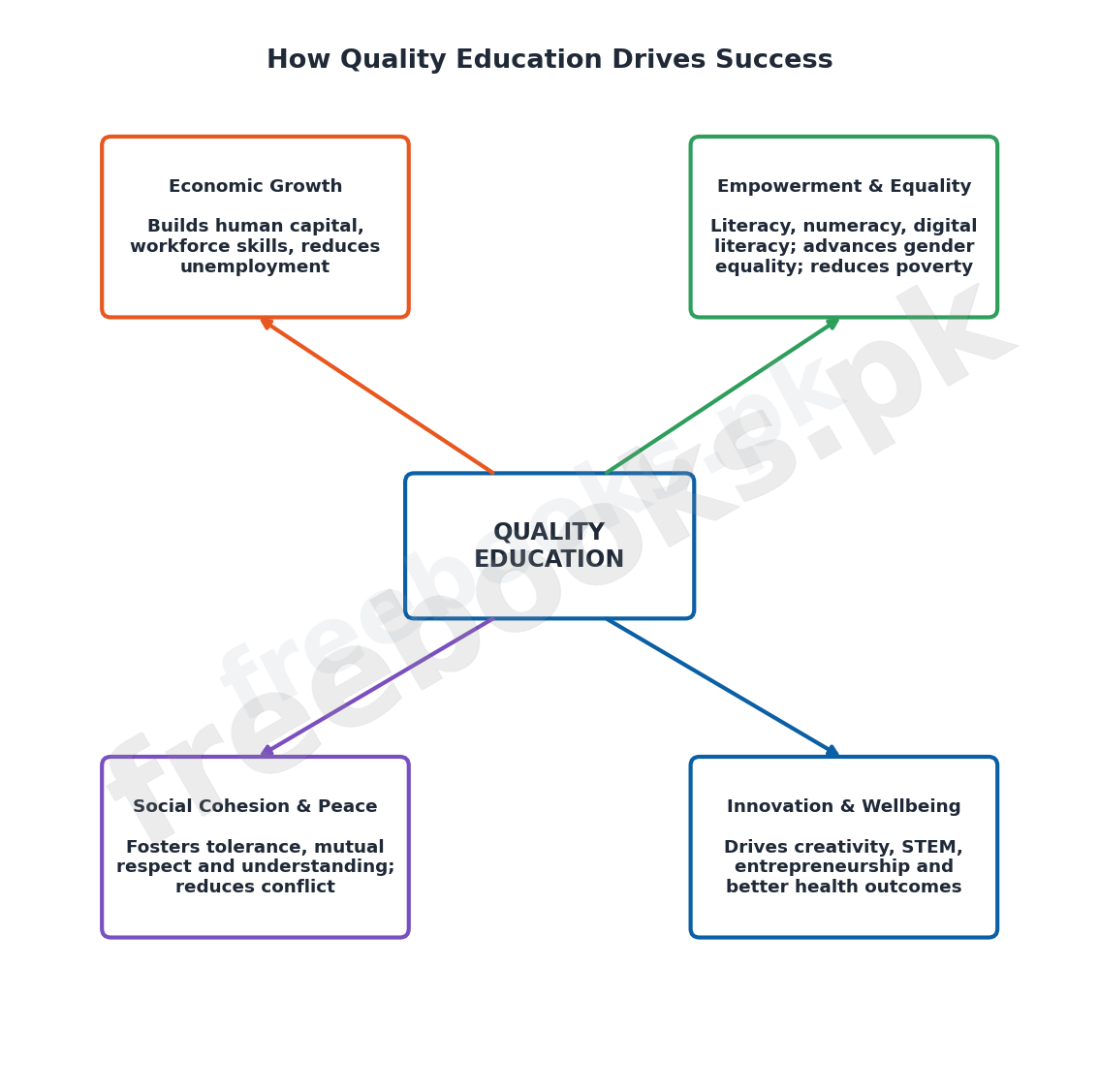
How Quality Education Drives Success: A purely textual/schematic diagram showing 'QUALITY EDUCATION' at the centre, branching out into four labelled boxes — Economic Growth, Empowerment & Equality, Social Cohesion & Peace, and Innovation & Wellbeing — connected by lines (no illustrated human figures).
Short Questions & Answers
How does the text define quality education?
Quality education is described as essential for sustainable development, helping individuals gain the knowledge, skills, and values necessary for productive and fulfilling lives, through a holistic approach.
Name three benefits of quality education mentioned in the passage.
Three benefits mentioned are economic growth, reduction of poverty, and promotion of gender equality (education also fosters social cohesion, innovation, and better health outcomes).
Why is human capital development important for a country's economic growth?
Human capital — the knowledge, skills, and health individuals accumulate — enables people to contribute effectively to economic growth; quality education enhances this by equipping individuals with the competencies needed to thrive in a global economy.
Describe the role of education in reducing inequality and poverty.
Quality education acts as a leveller, providing equal opportunities for all regardless of socio-economic background, gender, or ethnicity, helping to break the cycle of poverty and foster inclusive growth.
How does quality education promote understanding and tolerance?
It teaches students about different cultures, religions, and perspectives, fostering mutual respect and understanding, and helps bridge social divides through equitable access to education.
How does teaching entrepreneurship in schools promote economic growth?
Education fuels innovation and creativity, fostering entrepreneurship that creates economic opportunities and lifts individuals and communities out of poverty.
Why is STEM education important for driving innovation?
STEM education equips students with technical skills necessary for innovation and fosters curiosity and a problem-solving mindset, which are crucial for technological advancements and scientific discoveries.
What role do higher education institutions play in research and development?
Universities and colleges provide the resources and environment for students and faculty to conduct research, leading to new inventions, technologies, and methodologies that drive innovation.
What challenges does the text identify as obstacles to quality education?
Outdated curricula and pedagogical approaches, along with shortages of teachers, low salaries, and inadequate training, undermine the effectiveness of education systems.
What is the central theme of this unit?
Quality education plays a crucial role in advancing sustainable development goals by promoting inclusivity, equity, practical skills, and safe learning environments, while facing challenges like disparities in access and teacher shortages.
Long Questions & Answers
Explain how quality education contributes to economic growth and reducing poverty.
How does education prepare individuals for the workforce?
It equips individuals with skills in subjects like mathematics, science, and technology, developing critical thinking and problem-solving abilities that are in high demand across industries like technology, healthcare, and engineering.
What is human capital and how does education enhance it?
Human capital is the knowledge, skills, and health individuals accumulate over their lives; quality education enhances it by equipping people with the competencies needed to thrive in a rapidly evolving global economy.
How does education help break the cycle of poverty?
By providing equal opportunities for all regardless of socio-economic background, gender, or ethnicity, quality education serves as a leveller that helps marginalized populations escape poverty and fosters inclusive growth.
How does entrepreneurship link education to economic opportunity?
Education fuels innovation and creativity, fostering entrepreneurship that creates new economic opportunities and lifts individuals and communities out of poverty.
Discuss the role of quality education in promoting social cohesion, peace, and innovation.
How does education promote understanding between different groups?
It teaches students about different cultures, religions, and perspectives, fostering mutual respect and understanding, and schools often serve as community hubs where diverse groups come together.
How does education help reduce conflict?
It encourages critical thinking, allowing individuals to question and understand the root causes of conflicts and violence, and cultivates empathy that enables peaceful, constructive engagement.
How does STEM education drive innovation?
STEM education equips students with technical skills and fosters curiosity and a problem-solving mindset, which are crucial for technological advancements and scientific discoveries.
What role do universities play in this process?
Higher education institutions provide the resources and environment for research and development, leading to new inventions, technologies, and methodologies that drive innovation and progress.
Multiple Choice Questions (MCQs)
How does quality education contribute to sustainable development? (A) By focusing on economic growth, reducing poverty, and gender equality (B) By focusing solely on theoretical knowledge (C) By neglecting environmental protection (D) By limiting education to primary schools only
Correct answer: (A) By focusing on economic growth, reducing poverty, and gender equality. The passage explains that education fosters economic growth, reduces poverty, promotes gender equality, and helps protect the environment.
Which of the following is NOT mentioned as a benefit of quality education in the text? (A) Economic growth (B) Reduction of poverty (C) Promotion of gender equality (D) Focus on sports and entertainment
Correct answer: (D) Focus on sports and entertainment. The text discusses economic growth, poverty reduction, and gender equality as benefits — sports and entertainment are not mentioned.
Which subjects are highlighted as important for developing critical thinking and problem-solving abilities? (A) History, literature, and arts (B) Mathematics, science, and technology (C) Physical education, music, and drama (D) Geography, sociology, and philosophy
Correct answer: (B) Mathematics, science, and technology. The passage highlights mathematics, science, and technology as key subjects for developing these skills.
What essential skills does education provide that lay the foundation for lifelong learning and socio-economic advancement? (A) Physical strength and endurance (B) Literacy, numeracy, and digital literacy (C) Artistic and musical talent (D) Traditional crafts and trades
Correct answer: (B) Literacy, numeracy, and digital literacy. The text states that literacy, numeracy, and digital literacy lay the foundation for lifelong learning and socio-economic advancement.
How does education help in understanding conflicts? (A) By encouraging obedience (B) By promoting violent solutions (C) By encouraging critical thinking (D) By ignoring some causes
Correct answer: (C) By encouraging critical thinking. Education encourages critical thinking, allowing individuals to question and understand the root causes of conflicts.
What broader impact does education have on society, according to the text? (A) Benefits individuals only (B) Strengthens communities (C) Weakens social bonds (D) Limits development
Correct answer: (B) Strengthens communities. The passage states that education not only empowers individuals but also strengthens communities and societies.
What skills does emphasising STEM education aim to develop in students? (A) Artistic abilities (B) Technical skills for innovation (C) Sports proficiency (D) Linguistic aptitude
Correct answer: (B) Technical skills for innovation. Emphasizing STEM equips students with the technical skills necessary for innovation.
What role do higher education institutions play in research and development (R&D)? (A) They discourage research initiatives (B) They provide resources and environment for research (C) They restrict access to technology (D) They focus solely on theoretical learning
Correct answer: (B) They provide resources and environment for research. Universities and colleges provide the resources and environment for research, leading to new inventions and technologies.
What is identified as undermining the effectiveness of education systems? (A) Too many holidays (B) Shortage of teachers, low salaries, and inadequate training (C) Excessive funding (D) Too much use of technology
Correct answer: (B) Shortage of teachers, low salaries, and inadequate training. The text states that shortage of teachers, low salaries, and inadequate training undermine the effectiveness of education systems.
What is the central theme of this unit? (A) The history of Pakistan's education system (B) Quality education's role in advancing sustainable development goals (C) The rules of classroom management (D) The geography of Pakistan
Correct answer: (B) Quality education's role in advancing sustainable development goals. The theme is that quality education plays a crucial role in advancing sustainable development goals (SDGs), particularly SDG 4.
Quick Revision Summary
- Quality education is essential for sustainable development and takes a holistic approach to equipping learners
- It is closely linked to SDG 4 and drives economic growth by building human capital and workforce skills
- Education empowers individuals through literacy, numeracy, and digital literacy, and advances gender equality
- Quality education acts as a leveller, helping break the cycle of poverty and fostering inclusive growth
- Education promotes social cohesion, tolerance, and peace by encouraging critical thinking and understanding
- STEM education and higher education institutions drive innovation, research, and technological advancement
- Key challenges: outdated curricula, teacher shortages, low salaries, and inadequate training
- Theme: quality education empowers individuals, fosters social cohesion, and drives progress toward sustainable development
Exam Tips
- Learn the glossary words with their exact textbook meanings — synonym-in-context and spelling MCQs are drawn directly from unit glossaries
- Memorise the specific examples given (SDG 4, STEM, human capital, literacy/numeracy/digital literacy), since MCQs often test these details
- Be ready to explain the multiple roles of education covered in this unit: economic growth, empowerment, social cohesion, innovation, and wellbeing
- Practice identifying adjectival, prepositional, and adverbial phrases in sentences, and be able to explain what question each type of phrase answers
- Review the components of a book review (introduction, plot summary, character analysis, themes, writing style, personal opinion, conclusion & recommendation) for the Writing Skills task
- When answering 'how does X contribute to Y' questions, structure your answer with a clear cause (the aspect of education) and effect (its specific benefit)