This unit presents 'If', one of Rudyard Kipling's most celebrated poems, written as a father's advice to his son on how to face life's triumphs and disasters with calm self-control, patience, humility, and unwavering determination.
Structured as a long series of conditional 'If you can…' clauses, the poem builds toward its final promise: a person who can meet all these tests of character 'will be a Man' who possesses the whole earth and everything in it.
These notes summarise the poem stanza by stanza and provide comprehension questions, vocabulary, figures of speech, and exam-oriented material for this unit, including the skill-based Vocabulary/Grammar, Oral Communication, and Writing (paraphrasing and summary) sections that accompany it.
Learning Objectives
- Discuss how authors use language, including figurative language, considering the impact on the reader, and critically discuss their own understanding of it
- Make recommendations and develop an interest in fiction and poetry
- Provide an objective summary of fiction and poetry texts
- Examine and interpret the use of conjunctions and transitional devices in speech and writing for effective communication
- Recognize and use subordinating conjunctions to connect independent clauses to dependent clauses
- Recognize and use correlative conjunctions including pairs such as both/and, either/or, neither/nor, not/but, and not only/but also
Key Concepts
Stanza 1: Keeping Your Head and Trusting Yourself
The poem opens by describing self-control amid chaos: keeping calm and level-headed when everyone else is panicking and blaming you, and trusting yourself even when others doubt you, while still allowing for their doubt.
It also urges patience without growing tired of waiting, honesty even when lied about, avoiding hatred even when hated, and staying humble — 'don't look too good, nor talk too wise'.
Stanza 2: Dreams, Thoughts, and Facing Triumph and Disaster
The second stanza advises having dreams and ambitious thoughts without letting them control or dominate you — dreaming is good, but dreams should not become your master, nor thoughts your only aim.
It introduces the poem's most famous idea: meeting 'Triumph and Disaster' and treating 'those two impostors just the same' — neither success nor failure should be allowed to define or destabilise a person. It also speaks of bearing to hear one's own truthful words twisted by dishonest people ('knaves'), and having the strength to rebuild broken life's work with 'worn-out tools'.
Stanza 3: Risking Everything and Holding On
This stanza describes risking everything one has gained ('make one heap of all your winnings') on a single chance, losing it all, and having the courage to start again from the beginning without ever complaining about the loss.
It celebrates sheer willpower: forcing your 'heart and nerve and sinew' to keep serving you long after they are exhausted, holding on through sheer determination when there is 'nothing' left in you except the Will that says 'Hold on!'.
Stanza 4: Balance, Humility, and the Final Promise
The final stanza speaks of balance across social situations: talking with common crowds without losing your virtue, and walking with kings without losing the 'common touch'. It also speaks of being resilient to both enemies and friends, and being valued by all people without letting anyone matter 'too much'.
The poem closes with its central image: filling 'the unforgiving minute with sixty seconds' worth of distance run', meaning making the most of every moment. The reward for meeting all these conditions is total: 'Yours is the Earth and everything that's in it, / And — which is more — you'll be a Man, my son!'
About the Poem and the Poet
Rudyard Kipling (1865-1936) was an English author, poet, and journalist, best known for works of fiction including The Jungle Book, Kim, and The Man Who Would Be King. Born in British colonial India, his upbringing greatly influenced his writing, which often explores themes of British imperialism, adventure, and the interaction of British and subcontinental cultures during colonial rule.
'If' is written in the form of paternal advice, addressed directly to 'my son' at its close, framing the whole poem as a father's guide to developing maturity, character, and self-mastery.
Theme
The theme of 'If' is the ideal of stoic self-mastery: the poem sets out the qualities — patience, humility, honesty, resilience, balance, and quiet determination — that define genuine maturity and integrity. It teaches that true strength lies in remaining steady and humble through both success and failure, and that a person who can meet every test described will possess not just material reward but complete self-command.
Form and Poetic Devices
The poem is built almost entirely from a repeated conditional structure ('If you can…'), creating an anaphora that gives the poem its rhythmic, sermon-like momentum leading to the final resolution in the last two lines.
Kipling uses personification and metaphor throughout — describing Triumph and Disaster as 'impostors', dreams as something that could become a 'master', and time as 'the unforgiving minute' — as well as vivid imagery ('worn-out tools', 'heart and nerve and sinew') to make abstract virtues feel physical and urgent.
Important Definitions (Glossary)
imposter
a person who pretends to be somebody else in order to trick people
knave
a dishonest man or a boy
sinew
a strong band of tissue in the body that joins a muscle to a bone
stoop
to bend your body forwards and downwards
triumph
a great success, achievement or victory
virtue
behaviour or attitudes that show high moral standards
Key Facts
| Item | Detail |
|---|---|
| Poet | Rudyard Kipling (1865-1936) |
| Nationality/background | English author, poet, journalist; born in British colonial India |
| Other famous works | The Jungle Book, Kim, The Man Who Would Be King |
| Number of stanzas | 4 (eight lines each) |
| Poem's structure | A repeated series of conditional 'If you can…' clauses |
| Famous phrase | "Triumph and Disaster" treated as "just the same" — two "impostors" |
| Closing image | "Fill the unforgiving minute / With sixty seconds' worth of distance run" |
| Final line | "…you'll be a Man, my son!" |
Diagram
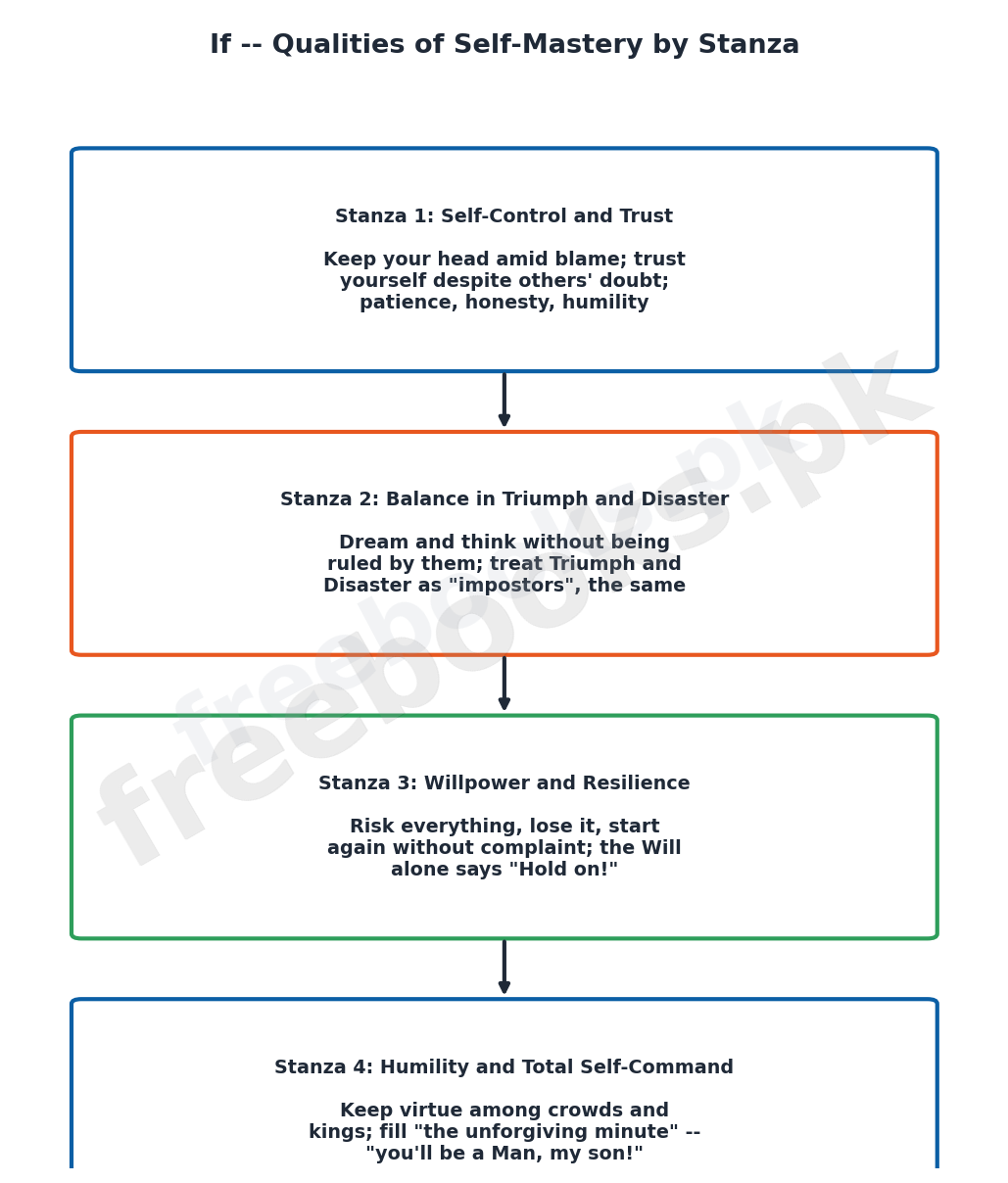
If — Qualities of Self-Mastery by Stanza: A purely textual/schematic diagram showing the four stanzas of the poem mapped to the core quality each emphasises — self-control and trust, balance between dreams/triumph and disaster, willpower and resilience, and humility with total self-command — shown as labelled boxes connected by a single line (no illustrated human figures).
Short Questions & Answers
According to the poem, how should one respond to being blamed by others?
The poet advises keeping your head and staying calm even when everyone around you is losing theirs and blaming it on you.
What does the poem say about trusting yourself when others doubt you?
It advises trusting yourself even when all men doubt you, while still making allowance for their doubting too, rather than dismissing it entirely.
What does the poem mean by treating Triumph and Disaster 'just the same'?
It means not letting either success or failure control your emotions or self-worth — both should be met with the same steady, balanced attitude, since both are ultimately temporary 'impostors'.
How does the poem describe handling a total loss of one's winnings?
It describes risking everything on one chance, losing it all, and having the strength to start again from the beginning without ever complaining about the loss.
What keeps a person going when they have 'nothing' left, according to the poem?
The poet says it is the sheer Will — willpower alone — that says 'Hold on!' and keeps a person going after their heart, nerve, and sinew are exhausted.
How does the poem describe maintaining balance in social life?
It describes being able to talk with common crowds without losing your virtue, and walk with kings without losing the common touch — being valued by everyone without letting anyone matter excessively.
What does 'fill the unforgiving minute' mean?
It means making full use of every moment of time, since time given ('the minute') does not forgive being wasted, so each of its sixty seconds should be used productively.
What is the poem's final promise to the reader?
If all the conditions described are met, 'Yours is the Earth and everything that's in it', and more importantly, the person will have become a true 'Man' in full possession of themselves.
Why is the poem structured almost entirely of 'If you can…' clauses?
This repeated conditional structure builds a rhythmic, cumulative list of tests of character, creating anaphora that gives the poem its momentum toward the final resolution in the last two lines.
What is the central theme of 'If'?
The theme is stoic self-mastery: patience, humility, honesty, resilience, and quiet determination define true maturity, and steadiness through both success and failure is the mark of genuine strength.
Long Questions & Answers
Explain the qualities of self-control and balance that the poem 'If' encourages in its opening stanzas.
What does the poem say about handling blame and doubt?
It advises keeping your head when others are losing theirs and blaming you, and trusting yourself even when others doubt you, while still allowing room for their doubt.
What does the poem say about patience and honesty?
It advises waiting without growing tired of waiting, and staying honest even when lied about, rather than deceiving others in return.
How does the poem describe handling dreams and thoughts?
It advises having dreams and ambitious thoughts without letting them become your master or sole aim, keeping ambition balanced with groundedness.
What is the poem's key message about Triumph and Disaster?
It urges treating both success and failure the same way, calling them 'impostors' because neither should be allowed to permanently define or control a person's sense of self.
Describe how the poem 'If' presents resilience, humility, and the final reward of self-mastery.
How does the poem describe resilience after a total loss?
It describes risking everything on one chance, losing it completely, and having the strength to start over from the beginning without complaint.
What keeps a person persevering when exhausted, according to the poem?
The poem says it is pure Will — willpower itself commanding 'Hold on!' — that keeps a person going after their physical and emotional strength is spent.
How does the poem describe humility in different social situations?
It describes talking with crowds without losing your virtue and walking with kings without losing the common touch, being valued by all without letting anyone matter excessively.
What is the poem's ultimate promise for someone who meets all these conditions?
The poem promises that such a person will possess 'the Earth and everything that's in it' and, more significantly, will have truly become a 'Man' — fully self-possessed and mature.
Multiple Choice Questions (MCQs)
Who wrote the poem 'If'? (A) William Wordsworth (B) Rudyard Kipling (C) Robert Frost (D) John Milton
Correct answer: (B) Rudyard Kipling. The poem 'If' was written by Rudyard Kipling (1865-1936).
What other famous work is Rudyard Kipling known for? (A) Romeo and Juliet (B) The Jungle Book (C) Pride and Prejudice (D) Hamlet
Correct answer: (B) The Jungle Book. Kipling is well known for The Jungle Book, along with Kim and The Man Who Would Be King.
What does the poet call Triumph and Disaster? (A) Two teachers (B) Two impostors (C) Two friends (D) Two enemies
Correct answer: (B) Two impostors. The poem describes Triumph and Disaster as 'those two impostors' that should be treated the same way.
What must a person NOT let their dreams become, according to the poem? (A) Their hobby (B) Their master (C) Their friend (D) Their job
Correct answer: (B) Their master. The poem advises, 'If you can dream — and not make dreams your master'.
What keeps a person going when they have 'nothing' left in them? (A) Money (B) The Will (C) Friends (D) Luck
Correct answer: (B) The Will. The poem states it is the Will that says 'Hold on!' that keeps a person going.
According to the poem, what should one not lose while walking with Kings? (A) Their wealth (B) The common touch (C) Their patience (D) Their temper
Correct answer: (B) The common touch. The poem advises walking with Kings 'nor lose the common touch'.
What does 'fill the unforgiving minute' mean in the poem? (A) Waste no time and use every moment well (B) Complain about lost time (C) Sleep for a full minute (D) Count exactly sixty seconds
Correct answer: (A) Waste no time and use every moment well. It means making full, productive use of every moment, since time does not forgive being wasted.
What is promised to the person who fulfils all the conditions in the poem? (A) Wealth only (B) Fame only (C) The Earth and everything in it, and becoming a Man (D) A long life only
Correct answer: (C) The Earth and everything in it, and becoming a Man. The poem promises, 'Yours is the Earth and everything that's in it, / And — which is more — you'll be a Man, my son!'
What repeated structure gives the poem its rhythm and momentum? (A) Rhyming couplets only (B) A series of 'If you can…' conditional clauses (C) A single long sentence (D) A question-and-answer format
Correct answer: (B) A series of 'If you can…' conditional clauses. The poem is built almost entirely from repeated 'If you can…' conditional clauses, creating anaphora.
What is the central theme of the poem 'If'? (A) The beauty of nature (B) Stoic self-mastery and balanced maturity (C) The history of British colonialism (D) The rules of cricket
Correct answer: (B) Stoic self-mastery and balanced maturity. The theme is stoic self-mastery — patience, humility, resilience, and balance define true maturity.
Quick Revision Summary
- 'If' by Rudyard Kipling is structured as a father's advice to his son, built almost entirely from 'If you can…' clauses
- Stanza 1: keeping your head, trusting yourself, patience, honesty, and humility
- Stanza 2: not letting dreams/thoughts control you; treating Triumph and Disaster as 'impostors', treated 'just the same'
- Stanza 3: risking everything, losing it, starting again without complaint; the Will alone keeps you going
- Stanza 4: balance between crowds and kings, being valued without excess, filling 'the unforgiving minute'
- Final promise: 'Yours is the Earth and everything that's in it… you'll be a Man, my son!'
- Kipling (1865-1936) also wrote The Jungle Book, Kim, and The Man Who Would Be King
- Theme: stoic self-mastery — patience, humility, resilience, and quiet determination define true maturity
Exam Tips
- Learn the glossary words with their exact textbook meanings — synonym-in-context and spelling MCQs are drawn directly from unit glossaries
- Memorise the poem's most quoted lines exactly: 'Triumph and Disaster… just the same', 'the Will which says to them: Hold on!', and the final two lines
- Be ready to explain the anaphora ('If you can…') and how it builds the poem's rhythm and cumulative effect
- Practice identifying the personification/metaphor in phrases like 'those two impostors' and 'the unforgiving minute'
- Review subordinating and correlative conjunctions from this unit's Grammar section, since MCQ Part D draws from grammar across most units
- When paraphrasing or summarising the poem, keep Kipling's core message — balance, patience, and self-mastery — intact while using simpler language