
This unit presents 'Daffodils', one of William Wordsworth's most famous poems, in which the speaker recalls wandering alone like a cloud until he comes upon a vast, joyful field of golden daffodils beside a lake, an image that continues to lift his spirits whenever he recalls it in solitude.
The poem was inspired by a real walk Wordsworth took with his sister Dorothy near Ullswater in the Lake District on 15 April 1802, where they encountered a long belt of daffodils, and it is a key example of the English Romantic movement's celebration of nature's power to inspire and heal the human spirit.
These notes summarise the poem stanza by stanza and provide comprehension questions, vocabulary, figurative language, and exam-oriented material for this unit, including the skill-based Vocabulary/Grammar, Oral Communication, and Writing (paraphrasing and summary) sections that accompany it.
Learning Objectives
- Demonstrate attentive listening skills to respond orally with standard pronunciation and intonation
- Use pre-reading and while-reading strategies to analyse and explore different layers of meaning within texts, including biases and opinions
- Demonstrate understanding of figurative language, word relationships, and nuances in word meanings
- Identify and use compound prepositions and prepositional phrases in writing
- Use paraphrasing skills to paraphrase a poem
- Use summary skills to write an objective summary of the given text and poems
Key Concepts
Stanza 1: A Chance Encounter with the Daffodils
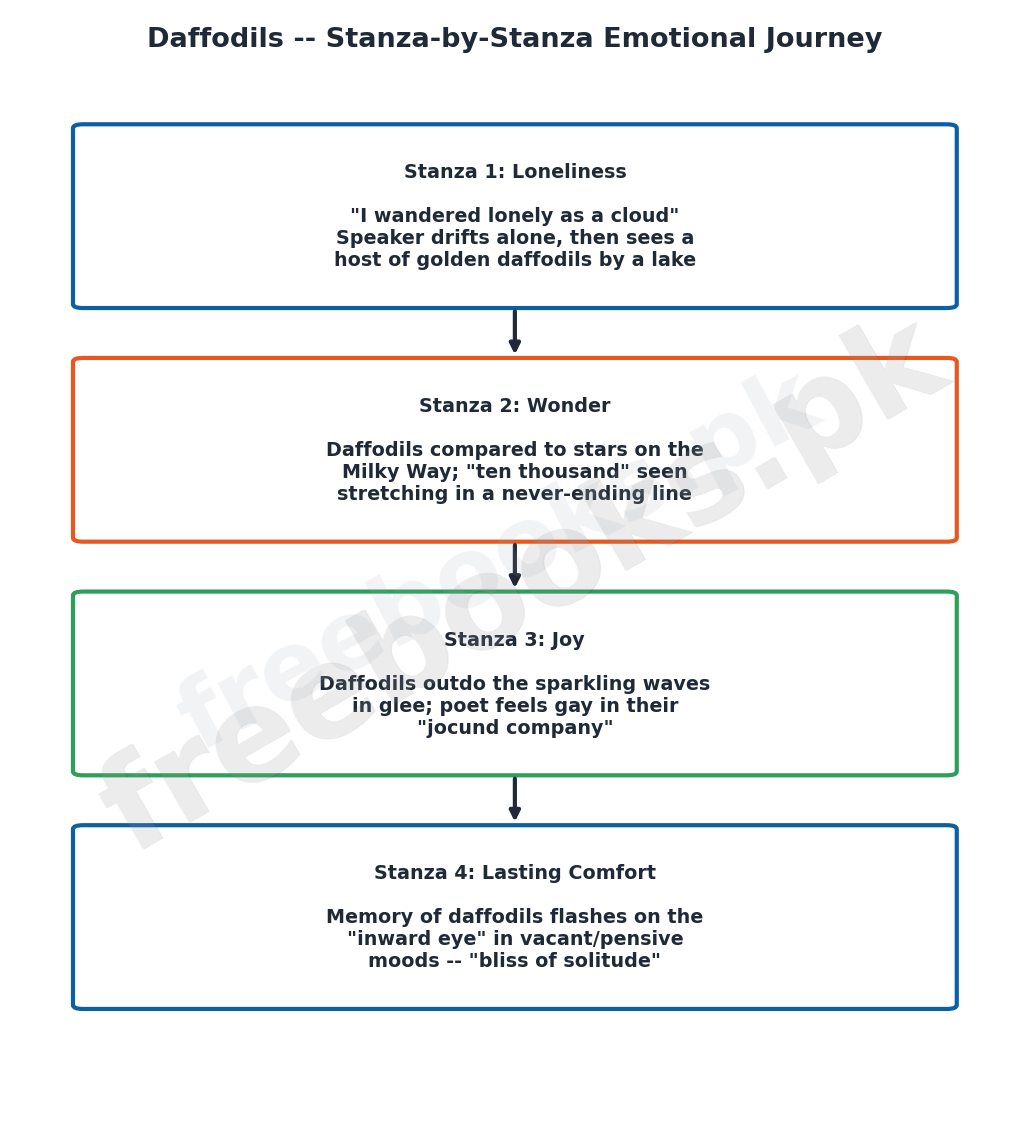
The speaker describes wandering alone, comparing himself to a cloud that floats high over valleys ('vales') and hills. Suddenly, he sees a great crowd — 'a host of golden daffodils' — beside a lake and beneath the trees, fluttering and dancing in the breeze.
The simile 'I wandered lonely as a cloud' establishes the speaker's initial mood of isolation and aimlessness, which is about to be transformed by what he sees.
Stanza 2: The Vastness of the Golden Host
The daffodils are described as continuous, like the stars that shine and twinkle on the Milky Way, stretching in a never-ending line along the margin of a bay. The speaker estimates he saw ten thousand daffodils at a glance, tossing their heads in a lively ('sprightly') dance.
This stanza uses hyperbole ('ten thousand') and imagery comparing the daffodils to stars to emphasise the overwhelming scale and beauty of the scene.
Stanza 3: Daffodils Outshine the Waves
The waves beside the daffodils danced too, but the daffodils outdid the sparkling waves in glee. The speaker says a poet could not help but feel joyful ('gay') in such a cheerful ('jocund') company, and he simply gazed and gazed, not yet realising what wealth the sight would later bring him.
This stanza shows the daffodils' effect deepening from a striking visual sight into a source of joy that even surpasses the beauty of the sparkling lake waves.
Stanza 4: The Lasting Gift of Memory
The final stanza shifts to the present: often, when the speaker lies on his couch in an empty ('vacant') or thoughtful ('pensive') mood, the daffodils flash upon his 'inward eye' — his memory or imagination — which is the source of the bliss of solitude.
When this happens, his heart fills with pleasure and 'dances with the daffodils', showing that the memory of nature's beauty continues to comfort and uplift him long after the actual moment has passed.
About the Poem and the Poet
'Daffodils' was inspired by a walk William Wordsworth took with his sister Dorothy near Ullswater in the Lake District on 15 April 1802, where they encountered a long belt of daffodils.
William Wordsworth (1770-1850) was a key figure in the English Romantic movement. Born in Cockermouth, England, he developed a deep love for nature, which became a central theme of his poetry, and he believed nature had the power to inspire and heal the human spirit.
Theme
'Daffodils' explores several interconnected themes: the beauty of nature, celebrating the daffodils' vibrant and joyful presence; the power of memory, showing how beautiful experiences in nature can provide comfort long after the event; solitude and connection, as the poet's initial loneliness is transformed into a joyful connection with nature; and emotional and spiritual uplift, showing nature's ability to elevate the poet's mood and offer solace.
Form and Poetic Devices
The poem uses several figures of speech: simile ('I wandered lonely as a cloud'), personification (the daffodils 'fluttering and dancing in the breeze'), hyperbole ('Ten thousand saw I at a glance'), metaphor ('inward eye' for memory/imagination), alliteration ('Beside the lake, beneath the trees'), assonance ('A host of golden daffodils'), and imagery comparing the daffodils to stars on the Milky Way.
The poem does not use euphemism or oxymoron, since Wordsworth's language is direct and aims to create a harmonious, uplifting picture of nature rather than softening harsh topics or creating contradictions.
Important Definitions (Glossary)
bliss
happiness
continuous
spreading in a line or over an area without any spaces
fluttering
to move lightly and quickly
host
a large number of people or things
jocund
cheerful
milky way
a band of light across the night sky made up of a huge number of stars that form a large part of the galaxy that includes our sun and its planets
pensive
thinking deeply
solitude
the state of being alone
sprightly
full of life and energy
vacant
empty or unoccupied
vales
valleys
wandered
to walk slowly around
Key Facts
| Item | Detail |
|---|---|
| Poet | William Wordsworth (1770-1850) |
| Movement | English Romanticism |
| Inspired by | A walk with his sister Dorothy near Ullswater, Lake District, 15 April 1802 |
| Number of stanzas | 4 (six lines each) |
| Opening simile | "I wandered lonely as a cloud" |
| Estimated number of daffodils | Ten thousand (hyperbole) |
| Key metaphor | "inward eye" = memory / imagination |
| Central themes | Beauty of nature, power of memory, solitude and connection, emotional uplift |
Diagram
Daffodils — Stanza-by-Stanza Emotional Journey: A purely textual/schematic diagram showing the poet's emotional journey across the four stanzas — from loneliness, to wonder at the vast field of daffodils, to joy that outshines the waves, to lasting comfort through memory — shown as labelled boxes connected by a single line (no illustrated human figures).
Short Questions & Answers
What does the poet compare himself to at the start of the poem, and why?
The poet compares himself to a cloud that floats over valleys and hills, suggesting a sense of loneliness and aimless wandering before he encounters the daffodils.
Where does the poet see the daffodils, and how are they first described?
He sees them beside a lake and beneath the trees, described as 'a host of golden daffodils' fluttering and dancing in the breeze.
How does the poet convey the vastness of the field of daffodils?
He compares them to the continuous, twinkling stars of the Milky Way and estimates that he saw ten thousand of them at a glance, stretching in a never-ending line.
How do the daffodils compare to the waves beside them?
Although the waves beside them also danced, the daffodils outdid the sparkling waves in glee, showing that the daffodils' joyful movement surpassed even the beauty of the lake.
What does the poet mean by 'jocund company'?
He means the daffodils were such cheerful, lively company that a poet could not help but feel joyful in their presence.
What is the 'inward eye' mentioned in the last stanza?
The 'inward eye' is a metaphor for the poet's memory or imagination, through which he can vividly recall the daffodils long after seeing them.
How does the memory of the daffodils affect the poet afterward?
Whenever he lies in a vacant or pensive mood, the memory of the daffodils flashes before his inward eye, filling his heart with pleasure and making it 'dance' with joy.
Identify one example of personification in the poem and explain its effect.
The daffodils are described as 'fluttering and dancing in the breeze', giving them human-like liveliness that makes the scene feel more joyful and animated.
Why is 'Ten thousand saw I at a glance' considered a hyperbole?
It is an exaggerated figure used for effect, emphasising the overwhelming scale and beauty of the daffodils rather than stating a literally counted number.
What overall theme does the poem convey about nature and memory?
It conveys that the beauty of nature can leave a lasting impression on the mind, providing comfort, joy, and emotional upliftment long after the original experience.
Long Questions & Answers
Describe the poet's experience of encountering the daffodils and how it changes his mood.
What was the poet's mood before he saw the daffodils?
He describes himself as wandering lonely, like a cloud drifting aimlessly over valleys and hills, suggesting a quiet sense of isolation.
What did the poet suddenly see, and where?
He suddenly saw a great host of golden daffodils beside a lake and beneath the trees, fluttering and dancing in the breeze.
How does the poet emphasise the scale of the daffodils?
He compares them to the continuous stars of the Milky Way and estimates ten thousand daffodils stretching in a never-ending line along the bay.
How does the sight of the daffodils affect the poet's mood in the moment?
The daffodils' joyful dancing outdoes even the sparkling waves beside them, filling the poet with such gaiety that he simply gazed at them in wonder.
Explain how memory and solitude work together in the final stanza of the poem.
In what state of mind does the poet recall the daffodils?
He recalls them when lying on his couch in a vacant or pensive mood, that is, when his mind is empty or deep in thought.
What does 'they flash upon that inward eye' mean?
It means the image of the daffodils vividly reappears in his memory or imagination, as if seen again with an inner form of sight.
Why does the poet call this the 'bliss of solitude'?
Because being alone allows him to fully experience this inner vision without distraction, turning solitude into a source of happiness rather than loneliness.
What is the final effect of remembering the daffodils?
His heart fills with pleasure and 'dances with the daffodils', showing that the memory recreates the same joy he felt during the original encounter.
Multiple Choice Questions (MCQs)
What is the primary theme of the poem 'Daffodils'? (A) the power of love (B) the beauty of nature (C) the importance of friendship (D) the struggle of life
Correct answer: (B) the beauty of nature. The poem primarily celebrates the beauty of nature through the image of the daffodils.
To which natural element does the poet compare himself in the beginning of the poem? (A) a tree (B) a river (C) a cloud (D) a mountain
Correct answer: (C) a cloud. The poet compares himself to a cloud in the opening simile, 'I wandered lonely as a cloud'.
Where does the poet see the daffodils? (A) beside a river (B) in a garden (C) beside a lake (D) on a mountain
Correct answer: (C) beside a lake. The poet sees the daffodils beside a lake and beneath the trees.
How does the poet describe the movement of the daffodils? (A) swaying in the wind (B) standing still (C) fluttering and dancing (D) falling to the ground
Correct answer: (C) fluttering and dancing. The daffodils are described as 'fluttering and dancing in the breeze'.
To what does the poet compare the daffodils in terms of their continuous stretch? (A) a flowing river (B) a starry night (C) a long road (D) an endless forest
Correct answer: (B) a starry night. The daffodils are compared to the continuous stars of the Milky Way, stretching without end.
How many daffodils does the poet estimate he saw at a glance? (A) hundreds (B) thousands (C) tens of thousands (D) hundreds of thousands
Correct answer: (C) tens of thousands. The poet says 'Ten thousand saw I at a glance', which falls in the tens-of-thousands range.
Which word best describes the poet's initial feeling before he sees the daffodils? (A) happy (B) lonely (C) excited (D) angry
Correct answer: (B) lonely. The poet describes himself as 'lonely' in the opening line of the poem.
What effect do the daffodils have on the poet's mood when he later recalls them? (A) They make him sad. (B) They make him anxious. (C) They bring him joy. (D) They make him tired.
Correct answer: (C) They bring him joy.. Recalling the daffodils fills the poet's heart with pleasure and makes it dance with joy.
What phrase does the poet use to describe his reflective moments about the daffodils? (A) in a cheerful mood (B) in a vacant or in pensive mood (C) in a thoughtful moment (D) in a joyous state
Correct answer: (B) in a vacant or in pensive mood. The poet says the memory returns to him 'in vacant or in pensive mood'.
Which line from the poem best conveys the lasting impact of the daffodils on the poet? (A) I wandered lonely as a cloud (B) They stretched in never-ending line (C) And then my heart with pleasure fills (D) The waves beside them danced
Correct answer: (C) And then my heart with pleasure fills. 'And then my heart with pleasure fills' shows the lasting emotional impact of remembering the daffodils.
Quick Revision Summary
- 'Daffodils' by William Wordsworth is a Romantic poem in 4 stanzas about a joyful encounter with a field of daffodils
- The poem was inspired by a real walk near Ullswater, Lake District, with his sister Dorothy in April 1802
- Opening simile: 'I wandered lonely as a cloud' establishes the poet's initial loneliness
- The daffodils are compared to the stars of the Milky Way; the poet estimates 'ten thousand' of them (hyperbole)
- The daffodils' joy outdoes even the sparkling waves beside them
- The 'inward eye' is a metaphor for memory/imagination, source of the 'bliss of solitude'
- Key devices: simile, personification, hyperbole, metaphor, alliteration, assonance, imagery
- Themes: beauty of nature, the power of memory, solitude transformed into connection, emotional and spiritual uplift
Exam Tips
- Learn the glossary words with their exact textbook meanings — synonym-in-context and spelling MCQs are drawn directly from unit glossaries
- Memorise the opening line and the final two lines of the poem exactly, as direct-quotation questions are common
- Be ready to identify and explain at least one example each of simile, personification, hyperbole, and metaphor from this poem
- Practice explaining WHY the poem is classified as Romantic/nature poetry and how it reflects Wordsworth's belief in nature's healing power
- Review compound prepositions and prepositional phrases from this unit's Grammar section, since MCQ Part D draws from grammar across most units
- When paraphrasing or summarising, keep the poet's original meaning intact while using simpler, everyday language, and avoid inserting personal opinions