This unit presents 'Patriotism', an expository (informative) prose passage that explains the meaning of patriotism, the qualities of a true patriot, and the sacrifices made by the people of Pakistan — most notably Quaid-e-Azam Muhammad Ali Jinnah and the soldiers awarded Nishan-e-Haider — for the sovereignty, integrity, and honour of their homeland.
The passage traces the origin of the word 'patriot' from the Latin 'patriota', explains the supreme values a patriot upholds, cites Quaid-e-Azam's vision of a united and strong nation, lists the great martyrs of Pakistan's wars who embraced martyrdom for the country, and closes with a quotation from Sir Walter Scott describing a man devoid of patriotic spirit.
These notes summarise the passage as given in the textbook and provide comprehension questions, vocabulary, and exam-oriented material for this unit, including the skill-based Reading, Vocabulary/Grammar, Oral Communication, and Writing sections that accompany it.
Learning Objectives
- Respond to text through oral discussion, telling short stories and acting plays
- Read with correct pronunciation, appropriate pitch and voice variation suitable for fictional and nonfictional texts
- Distinguish cause from effect, fact from opinion, and generalized statements from evidence-based information with specific reference to informational texts
- Read, view, and analyse a variety of grade-appropriate expository texts (e.g., reviews, arguments)
- Apply knowledge of parts of speech, tenses, sentence structure, and other features of grammar and vocabulary to understand how language functions in context
- Write arguments to support claims in an analysis of substantive topics or texts, using valid reasoning and relevant, sufficient evidence
Key Concepts
Meaning and Value of Patriotism
Patriotism means love for the motherland or devotion to one's country. A patriot loves his country and is willing to sacrifice when the need arises. The word 'patriot' comes from the Latin word 'patriota', meaning countryman, and patriotism is considered a commendable quality.
Patriotism gives people the strength and courage to safeguard the interests of the country and nation. For a patriot, the sovereignty, integrity, and honour of the country are of supreme values on which no compromise can be made, and patriots render great sacrifice for the preservation and protection of these values.
Quaid-e-Azam Muhammad Ali Jinnah: A Great Patriot
Quaid-e-Azam Muhammad Ali Jinnah was a nation-builder and great patriot who wanted to protect the values, culture, and traditions of the Muslims of the subcontinent. He gave the Muslims a sense of identity by securing a separate homeland for them.
He said: 'We must develop a sense of patriotism which galvanizes us all into a united and strong nation' — showing that, for him, patriotism was the force that could unite a diverse nation into one strong identity.
Sacrifices of Pakistan's Martyrs
The spirit of patriotism makes a nation stay alert in case of foreign invasion. In the wars of 1965, 1971, and the Kargil War of 1999, many brave soldiers laid down their lives to protect the homeland.
The text names several martyrs: Naik Saif Ali Janjua Shaheed (awarded Hilal-e-Kashmir, an equivalent to Nishan-e-Haider), Captain Muhammad Sarwar Shaheed, Major Tufail Muhammad Shaheed, Major Raja Aziz Bhatti Shaheed, Pilot Officer Rashid Minhas Shaheed, Major Shabbir Sharif Shaheed, Sowar Muhammad Hussain Shaheed, Major Muhammad Akram Shaheed, Lance Naik Muhammad Mahfuz Shaheed, Havildar Lalak Jan Shaheed, and Captain Karnal Sher Khan Shaheed.
All of these soldiers embraced martyrdom while fighting bravely for their motherland, and all were awarded Nishan-e-Haider, the highest military award given to great patriots who laid down their lives for the country.
The Living Spirit of Patriotism
Patriotism is not just a feeling but a living spirit that continuously inspires and guides a nation. The passage quotes S. W. Scott (Sir Walter Scott) describing a man devoid of patriotic spirit as one who never says: 'This is my own, my native land!'
The quoted lines are: 'Breathes there the man, with soul so dead, / Who never to himself hath said, / This is my own, my native land!' — used to show, by contrast, how essential a sense of belonging and love of country is to genuine patriotism.
Theme
The theme of the unit is the spirit of patriotism: it explains the qualities of true patriots and shows how they look after the interests and progress of their country, often at great personal sacrifice.
Important Definitions (Glossary)
commendable
deserving praise and approval
devoid
completely without something / deprived
devotion
great love, care, and support for somebody/something
embrace
the act of accepting an idea, a proposal, a set of beliefs, etc., especially when done with enthusiasm
instances
examples
martyrdom
the suffering of death on account of adherence to a cause, especially one's religious or political faith
native
connected with the place where you were born and lived for the first years of your life
preservation
the act of keeping something in its original state or in good condition
spirit
a person's feelings or state of mind
supreme
highest in rank or position
Key Facts
| Item | Detail |
|---|---|
| Text type | Expository (informative) prose |
| Origin of the word 'patriot' | Latin word 'patriota', meaning countryman |
| Supreme values of a patriot | Sovereignty, integrity, and honour of the country |
| Key historical figure | Quaid-e-Azam Muhammad Ali Jinnah |
| Wars mentioned | 1965 War, 1971 War, Kargil War (1999) |
| Highest military award | Nishan-e-Haider |
| Poet quoted | S. W. Scott (Sir Walter Scott) |
Diagram
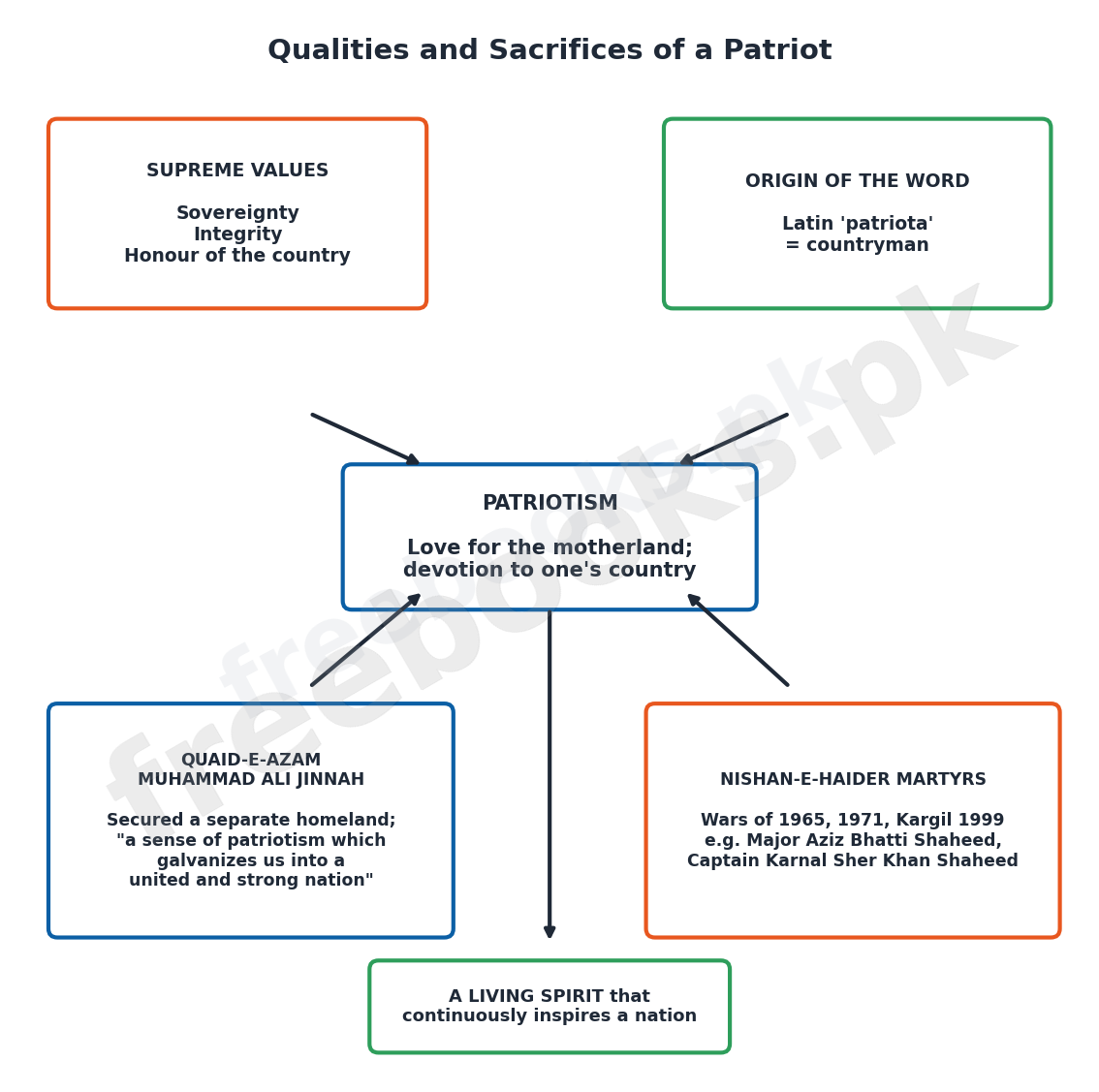
Qualities and Sacrifices of a Patriot: A purely textual/schematic diagram showing the meaning of patriotism at the centre, connected to its supreme values (sovereignty, integrity, honour), its key examples (Quaid-e-Azam Muhammad Ali Jinnah and the Nishan-e-Haider martyrs), and its living spirit, shown as labelled boxes connected by lines (no illustrated human figures).
Short Questions & Answers
What does the word 'patriot' originally mean, and where does it come from?
The word 'patriot' comes from the Latin word 'patriota', meaning countryman, and patriotism itself is considered a commendable quality.
What are the supreme values that a patriot upholds according to the text?
According to the text, the sovereignty, integrity, and honour of the country are of supreme value to a patriot, and no compromise can be made on them.
Why did Quaid-e-Azam Muhammad Ali Jinnah want a separate homeland for the Muslims of the subcontinent?
He wanted to protect the values, culture, and traditions of the Muslims of the subcontinent and give them a sense of identity through a separate homeland.
What does Quaid-e-Azam's quote about patriotism suggest about his vision for the nation?
It suggests he believed a shared sense of patriotism was necessary to unite the diverse Muslims of the subcontinent into a single, strong, and united nation.
Why are the soldiers named in the text considered great patriots?
They embraced martyrdom while bravely defending Pakistan in the wars of 1965, 1971, and the Kargil War, sacrificing their lives for the sovereignty and honour of their country.
What is Nishan-e-Haider, and why is it significant?
Nishan-e-Haider is the highest military award of Pakistan, given to soldiers who laid down their lives while displaying extraordinary courage in defence of the country.
How does the S. W. Scott quotation help explain the theme of the passage?
It illustrates, by contrast, that a person without patriotic spirit is someone who feels no sense of belonging to his native land, emphasising how essential love of country is to being a true patriot.
Why does the author describe patriotism as 'a live spirit' rather than just a feeling?
Because patriotism does not remain passive; it continuously inspires and guides a nation's actions, motivating real sacrifice and service rather than remaining a private emotion.
What role does the spirit of patriotism play during a foreign invasion, according to the text?
It makes the nation stay alert and prepared, giving people the courage to defend their homeland against foreign threats.
Why is this passage classified as an expository text?
Because it aims to inform and explain the meaning, values, and historical examples of patriotism using facts, quotations, and logical organisation, rather than telling a fictional story or arguing a single debatable opinion.
Long Questions & Answers
Explain the meaning of patriotism and the values a true patriot upholds, according to the text.
What is the literal meaning and origin of the word 'patriot'?
The word 'patriot' comes from the Latin word 'patriota', meaning countryman, and patriotism means love for the motherland or devotion to one's country.
What does patriotism give people the strength to do?
It gives people the strength and courage to safeguard the interests of the country and nation, especially in the face of threats to it.
What are the supreme values a patriot upholds?
The sovereignty, integrity, and honour of the country are of supreme value to a patriot, and no compromise can be made on them.
What are patriots willing to do for these values?
Patriots render great sacrifice, including the sacrifice of their own lives, for the preservation and protection of these values.
Describe how Quaid-e-Azam Muhammad Ali Jinnah and Pakistan's martyrs demonstrated patriotism.
How did Quaid-e-Azam Muhammad Ali Jinnah demonstrate patriotism?
As a nation-builder, he worked to protect the values, culture, and traditions of the Muslims of the subcontinent and secured a separate homeland to give them a distinct identity.
What did Quaid-e-Azam say about patriotism and national unity?
He said, 'We must develop a sense of patriotism which galvanizes us all into a united and strong nation,' showing that he saw patriotism as the force that could unite the nation.
How did soldiers demonstrate patriotism in Pakistan's wars?
Many soldiers, including Major Aziz Bhatti Shaheed and Captain Karnal Sher Khan Shaheed, embraced martyrdom in the wars of 1965, 1971, and the Kargil War while defending the homeland.
How were these soldiers' sacrifices recognised?
They were awarded Nishan-e-Haider, the highest military award given to great patriots who laid down their lives for the country.
Multiple Choice Questions (MCQs)
The word 'patriot' originates from _______. (A) the Greek word 'patriotikos' (B) the Latin word 'patriota' (C) the French word 'patriote' (D) the Spanish word 'patriota'
Correct answer: (B) the Latin word 'patriota'. The passage states that the word 'patriot' comes from the Latin word 'patriota', meaning countryman.
What is considered a commendable quality according to the text? (A) bravery (B) intelligence (C) patriotism (D) honesty
Correct answer: (C) patriotism. The text describes patriotism itself as a commendable quality.
Who led the Muslims of the subcontinent in their struggle for a separate homeland? (A) Allama Iqbal (B) Liaqat Ali Khan (C) Quaid-e-Azam Muhammad Ali Jinnah (D) Sir Syed Ahmad Khan
Correct answer: (C) Quaid-e-Azam Muhammad Ali Jinnah. The passage identifies Quaid-e-Azam Muhammad Ali Jinnah as the nation-builder who secured a separate homeland for the Muslims.
What are the supreme values for a patriot according to the text? (A) wealth and power (B) sovereignty, integrity and honour (C) education and knowledge (D) freedom and independence
Correct answer: (B) sovereignty, integrity and honour. The text states that sovereignty, integrity, and honour are of supreme value to a patriot.
In which wars did many brave soldiers lay down their lives for Pakistan, according to the text? (A) the wars of 1965, 1971, and the Kargil War 1999 (B) the World War I and the World War II (C) the War of 1857 and the Afghan Wars (D) the Gulf War and the Iraq War
Correct answer: (A) the wars of 1965, 1971, and the Kargil War 1999. The passage mentions the wars of 1965, 1971, and the Kargil War of 1999.
What is the highest military award mentioned in the text? (A) Sitara-e-Jurat (B) Tamgha-e-Basalat (C) Nishan-e-Haider (D) Hilal-e-Imtiaz
Correct answer: (C) Nishan-e-Haider. Nishan-e-Haider is named as the highest military award given to great patriots who laid down their lives for the country.
Who is quoted in the text describing a man devoid of patriotic spirit? (A) William Wordsworth (B) S. W. Scott (C) John Keats (D) Robert Frost
Correct answer: (B) S. W. Scott. The passage quotes S. W. Scott (Sir Walter Scott) on the idea of a man devoid of patriotic spirit.
According to the text, patriotism is best described as _______. (A) a temporary feeling (B) a live spirit that inspires and guides a nation (C) a legal obligation (D) a purely academic concept
Correct answer: (B) a live spirit that inspires and guides a nation. The passage states patriotism is not just a feeling but a live spirit that continuously inspires and guides a nation.
What type of text is 'Patriotism'? (A) A narrative story (B) A persuasive argument only (C) An expository (informative) text (D) A dramatic script
Correct answer: (C) An expository (informative) text. The passage is identified as an expository (informative) text explaining facts using logical organisation.
What is the central theme of this unit? (A) The history of Pakistan's wars (B) The spirit of patriotism and the qualities of patriots (C) The biography of Quaid-e-Azam (D) The rules of military awards
Correct answer: (B) The spirit of patriotism and the qualities of patriots. The theme states that the unit is about the spirit of patriotism and the qualities of patriots who look after their country's interests.
Quick Revision Summary
- 'Patriotism' is an expository (informative) prose passage explaining love for one's country and its supreme values
- The word 'patriot' comes from the Latin 'patriota', meaning countryman
- A patriot upholds the sovereignty, integrity, and honour of the country above all else
- Quaid-e-Azam Muhammad Ali Jinnah secured a separate homeland to protect the identity of the Muslims of the subcontinent
- Many soldiers embraced martyrdom in the wars of 1965, 1971, and the Kargil War (1999)
- Nishan-e-Haider is Pakistan's highest military award for great patriots who sacrificed their lives
- S. W. Scott's quote describes a man with no love for his native land as one lacking a true 'soul'
- Patriotism is described as a 'live spirit' that continuously inspires and guides a nation, not just a passing feeling
Exam Tips
- Learn the glossary words with their exact textbook meanings — synonym-in-context and spelling MCQs are drawn directly from unit glossaries
- Memorise the origin of the word 'patriot' (Latin 'patriota') and the three supreme values (sovereignty, integrity, honour), as these are frequently tested
- Learn the names and achievements of at least two or three of the Nishan-e-Haider martyrs mentioned in the text for long-answer questions
- Practice quoting Quaid-e-Azam's line about patriotism and unity, and the S. W. Scott lines, exactly as given in the textbook
- Review verb tenses, gerunds, infinitives, and participles covered in this unit's Grammar section, since MCQ Part D draws from grammar across most units
- When answering 'why' questions, connect the specific example (a person or event) back to the general definition of patriotism given at the start of the passage