This unit presents 'The Saviour of Mankind', an expository (informative) prose passage describing the birth, prophethood, and mission of Hazrat Muhammad (صلى الله عليه وسلم), who is presented as the most influential figure in human history and the last Rasool of Allah.
The passage traces the pre-Islamic condition of Arabia, the eloquence and poetic culture of the Arabs, the moral decline of mankind before Islam, the first revelation in the Cave of Hira, the beginning of the Prophet's (صلى الله عليه وسلم) mission to proclaim Tawheed, the persecution he faced from the pagan Arabs, his uncle Hazrat Abu Talib's support, and an assessment by the historian Michael H. Hart of his unmatched influence on world history.
These notes summarise the passage as given in the textbook, preserving the honorifics used, and provide comprehension questions, vocabulary, and exam-oriented material for this unit, including the skill-based Reading, Vocabulary/Grammar, Oral Communication, and Writing sections that accompany it.
Learning Objectives
- Speak confidently and fluently in a wide range of contexts (conflict resolution, panel discussion, role-play, dialogue) to fulfil different purposes such as exposition and argumentation
- Analyse how a text comprises a group of paragraphs that develop the main idea addressed by the author throughout the text
- Apply skimming and scanning strategies to identify the writer's purpose and intended audience, and infer the theme/main idea of a text
- Examine the central idea of an informational text and analyse its development, including its relationship to supporting ideas, and provide an objective summary
- Demonstrate knowledge and application of parts of speech in oral and written communication at varying levels of complexity
- Follow the process approach (brainstorming, structuring, mind-mapping, free writing, note-taking) to plan a paragraph
- Write informative/explanatory texts that convey complex ideas and information clearly and accurately
Key Concepts
Arabia Before Islam
Arabia is described as a land of unparalleled charm and beauty, with trackless deserts of sand dunes under a dazzling tropical sun — it was in this land, in Makkah Mukarramah (about fifty miles from the Red Sea), that Rasoolullah (صلى الله عليه وسلم) was born.
The Arabs possessed remarkable memory and eloquence, which found expression in their poetry; an annual poetry fair was held at Ukaz. Hammad claimed he could recite a hundred long poems for each letter of the alphabet, all composed before Islam — showing why Allah chose the Arabic language for His final revelation and the preservation of His Word.
By the fifth and sixth centuries, mankind stood at the verge of chaos, and the civilization that had taken four thousand years to grow seemed to be crumbling. At this point, Allah raised a Rasool among the people to lift humanity from ignorance into the light of faith.
The First Revelation in the Cave of Hira
At the age of thirty-eight, Hazrat Muhammad (صلى الله عليه وسلم) began spending much of his time in solitude and meditation in the Cave of Hira, retiring there with food and water for days and weeks in remembrance of Allah.
When the period of waiting came to a close, his heart overflowed with compassion for humanity and a pressing urge to eradicate wrong beliefs, social evils, cruelty, and injustice. Hazrat Jibril (Gabriel) came to him in the cave and conveyed Allah's first message: 'Read in the name of thy Lord Who created, created man from a clot (of congealed blood): Read and thy Lord is the Most Bountiful, Who taught (the use of) the pen, taught man that which he knew not.' (Quran, 96:1-5)
The Mission and the Persecution
The revelation continued for the next twenty-three years, and the Rasoolullah (صلى الله عليه وسلم) arose to proclaim the Oneness of Allah (Tawheed) and the unity of mankind, aiming to destroy superstition, ignorance, and disbelief and lead mankind to faith and divine bliss.
Since this threatened their social dominance, the pagan Arabs pressured the Rasoolullah (صلى الله عليه وسلم) and his followers to renounce their cause. They sent a delegation to his caring uncle, Hazrat Abu Talib, demanding he restrain his nephew or face their enmity.
The Rasoolullah (صلى الله عليه وسلم) responded with his memorable words: 'My dear uncle, if they put the sun in my right hand and the moon in my left, even then I shall not abandon the proclamation of the Oneness of Allah. I shall set up the true faith upon the earth or perish in the attempt.' Impressed by this determination, Abu Talib replied: 'Son of my brother, go thy way; none will dare to touch thee. I shall never forsake thee.'
The Most Influential Figure in History
Imbued with divine guidance and firm resolve, the Rasoolullah (صلى الله عليه وسلم) faced every challenge with grace and dignity, elevating mankind to the highest spiritual and worldly level and driving the Arab conquests that left an everlasting impression on human history.
The historian Michael H. Hart, in 'The 100: A Ranking of the Most Influential Persons in History', wrote that Muhammad (صلى الله عليه وسلم) was responsible for both the theology of Islam and its ethical and moral principles, played the key role in spreading the new faith and establishing its religious practices, and as the driving force behind the Arab conquests, may rank as the most influential political leader of all time.
This thorough transformation of man and society is attributed to the Rasoolullah's (صلى الله عليه وسلم) deep faith in Allah, his love for humanity, and the nobility of his character. Asked about his life, Hazrat Ayesha (رضي الله عنها) said: 'His morals and character are an embodiment of the Holy Quran.' The unit closes with the Quranic verse describing him as a witness, a bearer of good news, a warner, one inviting to Allah, and a light-giving torch (Quran, 33:45-46).
Theme and Text Type
The theme of the unit is that Hazrat Muhammad (صلى الله عليه وسلم), the last Rasool of Allah, has the greatest influence on mankind, and his teachings and life remain a source of motivation and guidance for humanity.
The passage is an expository (informative) text, which aims to inform or explain a topic using facts, examples, and logical organisation, rather than to narrate a story or argue a single position.
Important Definitions (Glossary)
bestow
to give something as an honour or a gift
chaos
lack of order, disorder
compassion
sympathy
crumble
to break something into very small pieces
dazzling
(of light) so bright that you cannot see for a short time
dilemma
a situation that makes problems
dispensation
special permission to do something
dune
a small hill of sand
eloquence
the ability to use language and express your opinions well
embodiment
a typical example of an idea or a quality
eradicate
to destroy or get rid of something
everlasting
continuing forever
meditation
the practice of focusing your mind in silence, especially for religious reasons or to make your mind calm
nexus
a complicated series of connections between different things
proclaim
to publicly and officially tell people about something important
promulgation
the act of spreading an idea, a belief, etc. among many people
proselytizing
to try to persuade other people to accept your beliefs, especially about religion or politics
renounce
to state publicly that you no longer have a particular belief or that you will no longer behave in a particular way
solitude
the state of being alone, especially when you find it pleasant
theology
the study of religions and beliefs
transformation
a complete change in somebody/something
tropical
the area between the two tropics, which is the hottest part of the world
unparalleled
used to emphasize that something is bigger or better than anything else like it
verge
the edge of a path, a road, etc.
Key Facts
| Item | Detail |
|---|---|
| Text type | Expository (informative) prose |
| Setting/origin | Makkah Mukarramah, about fifty miles from the Red Sea |
| Age at first revelation | 40 years (waiting period began at 38, in the Cave of Hira) |
| Angel of revelation | Hazrat Jibril (Gabriel) (عليه السلام) |
| Duration of revelation | 23 years |
| Uncle who supported him | Hazrat Abu Talib |
| Historian quoted | Michael H. Hart, 'The 100: A Ranking of the Most Influential Persons in History' |
| Closing Quranic reference | Quran, 33:45-46 |
Diagram
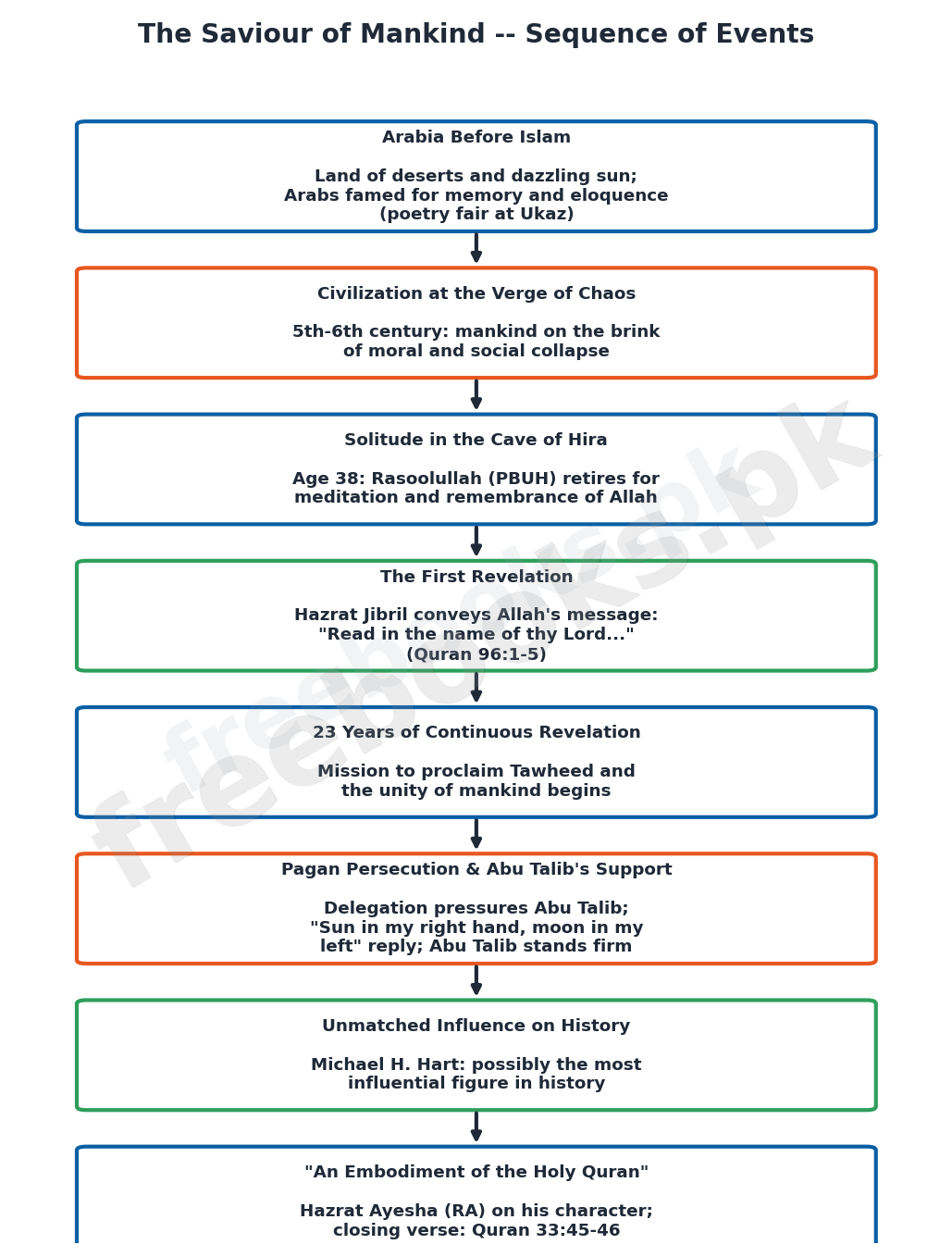
The Saviour of Mankind — Sequence of Events: A purely textual/schematic timeline of the key events described in the passage, from the condition of pre-Islamic Arabia through the first revelation, the mission, the persecution, Abu Talib's support, and the historian's assessment, shown as labelled boxes connected by a single line (no illustrated human figures).
Short Questions & Answers
How does the geographical description of Makkah Mukarramah help the reader understand its historical importance?
It shows Makkah as part of a vast, striking desert landscape near the Red Sea, helping the reader appreciate the setting from which a message of world-changing significance would emerge.
What does the emphasis on the Arabs' memory and eloquence suggest about their culture before Islam?
It suggests that pre-Islamic Arab culture placed very high value on language, oral memory, and poetic skill, as shown by their organised poetry competitions at Ukaz and figures like Hammad who could recite hundreds of poems from memory.
Why is the anecdote about Hammad and Caliph Walid bin Yazid significant?
It illustrates just how extraordinary Arab poetic memory and output were before Islam, reinforcing why Allah chose Arabic, a language already rich in eloquence, for His final revelation.
What challenges did the Rasoolullah (صلى الله عليه وسلم) face in proclaiming Tawheed?
He faced pressure and enmity from the pagan Arabs, whose social dominance was threatened by his message, including a delegation sent to his uncle Hazrat Abu Talib demanding he be restrained or face open hostility.
In what ways did the Rasoolullah (صلى الله عليه وسلم) elevate mankind in both spiritual and worldly domains?
He raised humanity from ignorance and idol-worship to faith in the Oneness of Allah, established noble moral and ethical principles, and was the driving force behind Arab conquests that reshaped the course of human history.
How does the closing Quranic verse (33:45-46) summarise the Rasoolullah's (صلى الله عليه وسلم) role?
It describes him as a witness, a bearer of good news, a warner, one who invites people to Allah by His permission, and a light-giving torch — summarising his complete mission in a single verse.
What does Hazrat Abu Talib's reply reveal about his character?
It reveals deep love, loyalty, and protectiveness toward his nephew — despite the danger, he promised never to forsake him, showing courage and unwavering family support.
Why does the author quote the historian Michael H. Hart?
To provide an outside, non-Muslim scholarly perspective that independently confirms the Rasoolullah's (صلى الله عليه وسلم) unmatched influence, lending the passage's central claim additional credibility.
What is the significance of Hazrat Ayesha's (رضي الله عنها) statement that his character was 'an embodiment of the Holy Quran'?
It shows that his everyday conduct perfectly reflected the teachings of the Quran, making his life a living, practical model of Quranic values for others to follow.
Why is this passage classified as an expository text?
Because it aims to inform and explain historical and biographical facts about the Rasoolullah's (صلى الله عليه وسلم) life using evidence, quotations, and logical organisation, rather than telling a fictional story or arguing a debatable opinion.
Long Questions & Answers
Describe the circumstances leading up to the first revelation and explain its significance.
What was Hazrat Muhammad's (صلى الله عليه وسلم) practice before the first revelation?
At the age of thirty-eight, he began spending much of his time in solitude and meditation in the Cave of Hira, retiring there with food and water for days and weeks in remembrance of Allah.
What state of mind did he have as the period of waiting came to a close?
His heart was overflowing with profound compassion for humanity, and he had a pressing urge to eradicate wrong beliefs, social evils, cruelty, and injustice from society.
What happened during the first revelation?
Hazrat Jibril (عليه السلام) came to him in the Cave of Hira and conveyed Allah's message, commanding him to 'Read in the name of thy Lord Who created,' marking the start of his prophethood.
Why is this revelation significant?
It marked the beginning of twenty-three years of continuous revelation and the start of his mission to proclaim the Oneness of Allah (Tawheed) and the unity of mankind, ultimately transforming both individuals and society.
Explain the persecution faced by the Rasoolullah (صلى الله عليه وسلم) and how Hazrat Abu Talib responded to it.
Why did the pagan Arabs oppose the Rasoolullah's (صلى الله عليه وسلم) message?
His message of Tawheed threatened their existing social dominance and traditional idol-worship, so they pressured him and his followers to abandon their cause.
What did the pagan Arabs demand from Hazrat Abu Talib?
They sent a delegation asking him either to restrain his nephew from preaching Allah's message or to face their open enmity, placing him in a difficult dilemma.
How did the Rasoolullah (صلى الله عليه وسلم) respond when his uncle explained the situation?
He firmly replied that even if the sun were placed in his right hand and the moon in his left, he would not abandon the proclamation of Tawheed, declaring he would establish the true faith or perish in the attempt.
How did Hazrat Abu Talib respond to this determination?
He was deeply moved and promised his nephew that none would dare to touch him, and that he would never forsake him — showing steadfast loyalty despite the risk to himself.
Multiple Choice Questions (MCQs)
Where was Rasoolullah (صلى الله عليه وسلم) born? (A) Madinah (B) Makkah Mukarramah (C) Taif (D) Damascus
Correct answer: (B) Makkah Mukarramah. The passage states he was born in Makkah Mukarramah, about fifty miles from the Red Sea.
Where was the first revelation received? (A) Cave of Thawr (B) Cave of Hira (C) Mount Uhud (D) Masjid al-Haram
Correct answer: (B) Cave of Hira. The first revelation was received in the Cave of Hira, where he used to retire for meditation.
Who conveyed the first message of Allah to the Rasoolullah (صلى الله عليه وسلم)? (A) Hazrat Mikael (B) Hazrat Israfil (C) Hazrat Jibril (D) Hazrat Izraeel
Correct answer: (C) Hazrat Jibril. Hazrat Jibril (Gabriel) conveyed the first revelation to him in the Cave of Hira.
For how many years did the revelation continue? (A) 13 years (B) 20 years (C) 23 years (D) 40 years
Correct answer: (C) 23 years. The passage states the revelation continued for the next twenty-three years.
To whom did the pagan Arabs send a delegation to stop the preaching? (A) Hazrat Khadija (B) Hazrat Abu Talib (C) Hazrat Abu Bakr (D) Hazrat Hamza
Correct answer: (B) Hazrat Abu Talib. They sent a delegation to his kind and caring uncle, Hazrat Abu Talib.
Which historian is quoted regarding the Rasoolullah's (صلى الله عليه وسلم) influence? (A) Arnold Toynbee (B) Michael H. Hart (C) Edward Gibbon (D) Karen Armstrong
Correct answer: (B) Michael H. Hart. The passage quotes Michael H. Hart, author of 'The 100: A Ranking of the Most Influential Persons in History'.
What did Hazrat Ayesha (رضي الله عنها) say about his character? (A) It was like the stars (B) It was an embodiment of the Holy Quran (C) It was unmatched in Arabia (D) It was known to all tribes
Correct answer: (B) It was an embodiment of the Holy Quran. She said, 'His morals and character are an embodiment of the Holy Quran.'
What type of text is 'The Saviour of Mankind'? (A) A narrative story (B) A persuasive argument (C) An expository (informative) text (D) A dramatic script
Correct answer: (C) An expository (informative) text. The passage is identified as an expository (informative) text that explains facts using logical organisation.
What was held annually at Ukaz? (A) A trade fair (B) A poetical competition (C) A religious pilgrimage (D) A wrestling contest
Correct answer: (B) A poetical competition. Every year a fair was held for poetical competitions at Ukaz, reflecting the Arabs' love of poetry and eloquence.
What is the central theme of this unit? (A) The beauty of the Arabian desert (B) The greatest influence of Hazrat Muhammad (صلى الله عليه وسلم) on mankind (C) The history of Arabic poetry (D) The customs of pre-Islamic tribes
Correct answer: (B) The greatest influence of Hazrat Muhammad (صلى الله عليه وسلم) on mankind. The theme states that Hazrat Muhammad (صلى الله عليه وسلم) has the greatest influence on mankind, and his life and teachings guide humanity.
Quick Revision Summary
- 'The Saviour of Mankind' is an expository (informative) prose passage about Hazrat Muhammad (صلى الله عليه وسلم)
- He was born in Makkah Mukarramah, near the Red Sea
- Pre-Islamic Arabs were known for their remarkable memory and eloquence, celebrated at the Ukaz poetry fair
- By the 5th-6th centuries, mankind stood on the verge of chaos before Islam's guidance arrived
- First revelation occurred in the Cave of Hira, delivered by Hazrat Jibril (عليه السلام)
- Revelation continued for 23 years; his mission was to proclaim Tawheed and the unity of mankind
- Pagan Arabs pressured Hazrat Abu Talib to restrain him; he refused and remained loyal
- The Rasoolullah's (صلى الله عليه وسلم) famous words: 'I shall set up the true faith upon the earth or perish in the attempt'
- Historian Michael H. Hart called him possibly the most influential person in history
- Hazrat Ayesha (رضي الله عنها) described his character as 'an embodiment of the Holy Quran'
Exam Tips
- Learn the glossary words with their exact textbook meanings — synonym-in-context and spelling MCQs are drawn directly from unit glossaries
- Memorise the sequence of events (pre-Islamic Arabia, Cave of Hira, first revelation, mission, persecution, Abu Talib's support, historian's assessment) so long answers stay in order
- Practice explaining WHY the text is classified as expository/informative, since text-type identification is commonly tested
- Learn the two famous quoted lines (the Rasoolullah's words to Abu Talib, and Hazrat Ayesha's statement) word-for-word, as these are frequently quoted in exams
- Review parts of speech (noun, pronoun, verb, adjective, adverb, preposition, conjunction, interjection) covered in this unit's Grammar section, since MCQ Part D draws from grammar across most units
- Maintain a formal, respectful tone and stick strictly to facts from the text when answering questions about Hazrat Muhammad (صلى الله عليه وسلم); avoid inserting personal opinions or unsupported details