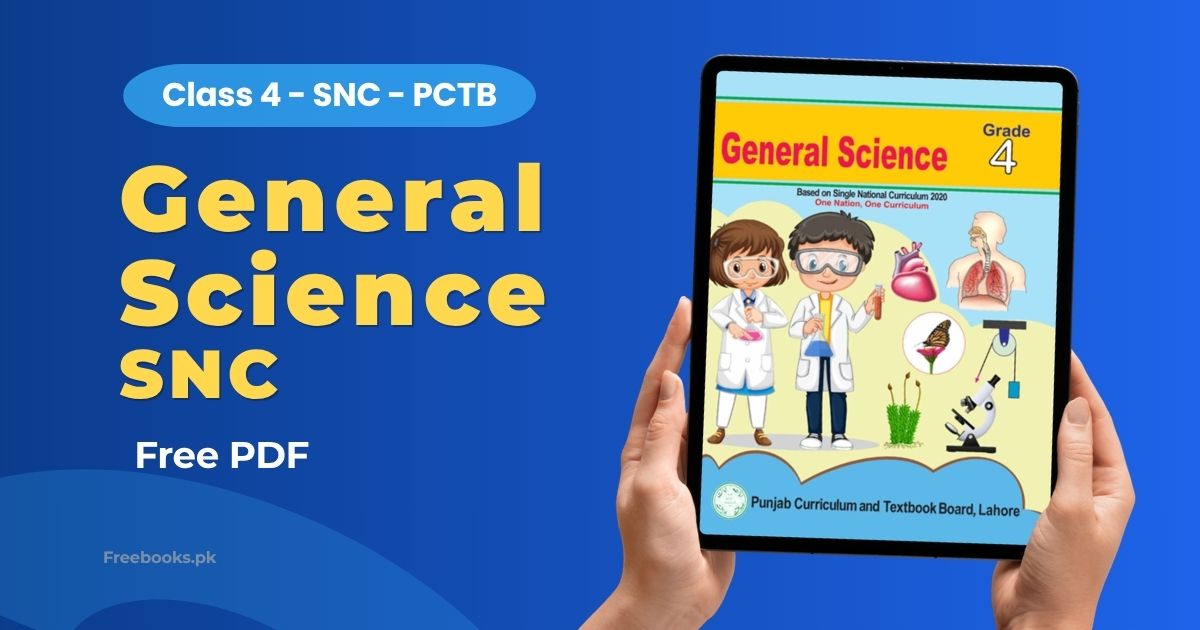
General Science for Class 4 is part of the official Punjab Curriculum and Textbook Board (PCTB) syllabus, based on the Single National Curriculum (SNC) 2020. This page covers all 10 chapters of the book, from living organisms and ecosystems to matter, energy, force, the Earth, and everyday technology.
For Class 4 students, this book explains science concepts through simple examples, activities, and real-life situations rather than dry definitions. Each chapter summary and its important questions on this page make revision quicker before class tests, so key ideas stay clear without re-reading the whole chapter.
Book Overview
| Class | 4 |
| Subject | General Science |
| Board | Punjab Curriculum and Textbook Board (PCTB) |
| Curriculum | Single National Curriculum (SNC) 2020 |
| Total Chapters | 10 |
| Total Pages | 132 |
| Format | PDF (Free Download) |
Chapter List
Chapter 1: Characteristics and Life Process of Organisms
This chapter explains the two major groups of living things, plants and animals, and how animals are classified as vertebrates or invertebrates, and plants as flowering or non-flowering. It covers biodiversity and the threats living things face, then moves into the major human body parts, teeth, bones, lungs, heart, stomach, muscles, and brain, and the major plant parts, root, stem, leaf, flower, and seed, along with their functions.
Important Questions:
- What are the two major groups of living things? They are plants and animals.
- What is the difference between vertebrates and invertebrates? Vertebrates have a backbone while invertebrates do not.
- What are the four types of human teeth and their functions? Incisors bite and cut, canines pierce and tear, and premolars and molars chew and grind food.
- What is the function of roots in a plant? Roots anchor the plant in the soil and absorb water and minerals from it.
Chapter 2: Ecosystem
This chapter explains the biotic and abiotic components of an ecosystem, and how producers, consumers, and decomposers keep it balanced. It introduces food chains, herbivores, carnivores, and omnivores, along with predator-prey relationships and competition among organisms for food and space. The chapter closes with how human actions like deforestation affect ecosystems, and steps being taken to protect them, such as wildlife parks and tree plantation.
Important Questions:
- What are the biotic and abiotic components of an ecosystem? Biotic components are living things like plants and animals; abiotic components are non-living things like light, water and soil.
- What is a food chain? The series of eating and being eaten among living things in an ecosystem.
- What is the difference between a predator and prey? A predator hunts and eats another animal, while the prey is the animal that is hunted and eaten.
- Name one way humans are trying to save ecosystems. Creating wildlife parks such as Margalla National Park and planting trees.
Chapter 3: Human Health
This chapter covers common symptoms of illness like fever and cough, and the difference between contagious diseases such as flu and TB and non-contagious diseases such as diabetes and cancer. It explains prevention methods like handwashing, wearing masks, and vaccination, then describes the four food groups in a balanced diet and why clean drinking water matters, including boiling and filtration as ways to purify it.
Important Questions:
- What is a contagious disease? A disease that can be transmitted from one person to another, such as flu or TB.
- Name three ways to prevent contagious diseases. Washing hands, wearing a mask, and getting vaccinated.
- What is a balanced diet? A diet with proper proportions of food from the dairy, grain, protein, and fruit and vegetable groups.
- What are two ways to make water clean for drinking? Boiling water and filtering it.
Chapter 4: Matter and Its Characteristics
This chapter explains the three states of matter, solid, liquid, and gas, and how the arrangement of particles gives each state its shape and volume. It covers classifying objects by mass, volume, and their ability to float, sink, or conduct heat and electricity, along with the physical properties of metals, their appearance, texture, colour, and density, and why certain metals are used for wires or cooking utensils.
Important Questions:
- What are the three states of matter? Solid, liquid and gas.
- Why do liquids not have a definite shape? Because their particles can move and flow, taking the shape of the container they are poured into.
- What is the difference between conductors and non-conductors of heat? Conductors allow heat to pass through them, like metals, while non-conductors do not, like wood and rubber.
- What determines whether an object floats or sinks in water? Its density compared to the density of water.
Chapter 5: Forms of Energy and Energy Transfer
This chapter identifies sources of energy like the Sun, flowing water, and fuels, and shows how energy transforms from one form to another, such as water turning turbines to generate hydroelectricity. It explains light (shadows, reflection, rainbows), sound (vibration and echo), heat and temperature, and how electrical energy powers a simple circuit and converts into heat, light, or sound in everyday devices.
Important Questions:
- What is the biggest source of energy on Earth? The Sun.
- How is a rainbow formed? Sunlight passing through water droplets in the air splits into seven colours, like light passing through a prism.
- What causes an echo? Sound bouncing back after hitting a surface at a certain distance.
- What is needed to complete a simple electric circuit? An unbroken path of current from the battery, through the wires and bulb, and back to the battery.
Chapter 6: Force and Motion
This chapter defines force as a push or pull, and motion as a change in an object’s position, using everyday examples like swings and seesaws. It introduces gravity as the force pulling objects towards Earth, explains how friction can help or hinder movement, and describes simple machines, levers, pulleys, gears, and inclined planes, that make lifting and moving objects easier.
Important Questions:
- What is force? The act of pushing or pulling a body.
- What is gravity? The force with which the Earth pulls objects towards itself.
- Name one advantage and one disadvantage of friction. It helps us walk and lets brakes stop vehicles, but it also wears out tyres and shoes.
- What is a lever? A simple machine, like a rod turning around a fulcrum, used to lift or move heavy objects with less effort.
Chapter 7: Earth and Its Resources
This chapter describes Earth’s surface as mostly water with the rest land, and lists natural resources like water, air, soil, forests, oil, gas, and minerals that are used in everyday life. It explains how fossils form and what they tell us about ancient life, the difference between renewable and non-renewable resources, and practical ways people can conserve resources, such as planting trees and recycling.
Important Questions:
- What percentage of Earth’s surface is covered by water? About 71 percent.
- What is the difference between renewable and non-renewable resources? Renewable resources like air, water and forests can be replaced after use, while non-renewable resources like coal and oil take millions of years to form.
- What are fossils? The preserved remains or imprints of plants and animals that lived long ago.
- Name two ways to conserve natural resources. Planting trees and recycling materials like paper and plastic.
Chapter 8: Earth’s Weather and Climate
This chapter explains the difference between weather, the daily condition of the atmosphere, and climate, the general weather pattern of a region over time. It introduces instruments used to study weather, the barometer, anemometer, rain gauge, and thermometer, describes the tropical, temperate, and polar climate zones, and touches on how human activity contributes to global warming.
Important Questions:
- What is the difference between weather and climate? Weather is the daily condition of the atmosphere, while climate is the general, long-lasting weather pattern of a region.
- What instrument measures wind speed and direction? An anemometer.
- What are the three climate zones of the Earth? Tropical, temperate, and polar zones.
- What causes global warming? Heat, smoke, and gases released from factories and vehicles that raise the Earth’s average temperature.
Chapter 9: Solar System and Our Earth
This chapter describes the Solar System with the Sun at its centre and the eight planets revolving around it, along with the Moon’s phases as it orbits the Earth. It explains how Earth’s rotation on its axis causes day and night, how its tilt and revolution around the Sun cause the seasons, and how solar and lunar eclipses occur when the Sun, Earth, and Moon line up in different ways.
Important Questions:
- What is at the centre of the Solar System? The Sun.
- How long does the Moon take to complete one revolution around the Earth? About 29.5 days.
- What causes day and night? The Earth’s rotation around its own axis.
- What is the difference between a solar eclipse and a lunar eclipse? In a solar eclipse the Moon comes between the Sun and Earth, blocking sunlight; in a lunar eclipse the Earth comes between the Sun and Moon, casting its shadow on the Moon.
Chapter 10: Technology in Everyday Life
This chapter teaches practical skills like folding, cutting, tearing, and pasting paper to make bags, envelopes, cards, and masks, and shaping clay into cubes, cones, and other simple forms. It also covers everyday uses of a mobile phone, calculator, alarm clock, calendar, and camera, and introduces the items in a first aid box, along with how to measure body temperature and blood pressure.
Important Questions:
- Name three uses of a mobile phone besides making calls. Calculator, alarm clock, and calendar.
- What is the purpose of a first aid box? To provide temporary, immediate care to an injured or sick person in an emergency.
- What is used to measure body temperature? A clinical or digital thermometer.
- What is a normal blood pressure reading? 120/80 mm Hg.
Download General Science Class 4 PDF
Click the button below to download the General Science Class 4 PDF for free:
Who Should Read This
This book is meant for Class 4 students studying General Science under the Punjab Curriculum and Textbook Board’s SNC syllabus. It also builds the science foundation useful for entry test General Science sections in later years.
Applicable Boards
This book is published by the Punjab Curriculum and Textbook Board (PCTB) and is the primary General Science textbook for Class 4 in Punjab. Since it follows the Single National Curriculum (SNC), students in other provinces and boards using the same SNC syllabus can also refer to this book for their Class 4 General Science topics.
FAQs
Is this book for Class 4 students?
Yes, this is the official General Science textbook for Class 4 under the Punjab Curriculum and Textbook Board’s Single National Curriculum (SNC).
Can other board students use this book?
Yes. Since this book follows the SNC syllabus used across Pakistan, students from other boards following the same curriculum can also use it for Class 4 General Science.
Is this the latest edition?
Yes, this is the current SNC 2020 edition used in Punjab schools.
Does it include exercises and important questions?
Yes, each chapter has exercises, activities, and short questions. This page also lists important questions with short answers for quick revision.
How many chapters are in this book?
The book has 10 chapters, covering living organisms, ecosystems, human health, matter, energy, force and motion, Earth’s resources, weather and climate, the solar system, and everyday technology.
Is the PDF free to download?
Yes, the PDF on this page is completely free to download.
Related Books
- English Class 4 SNC PDF Download – Punjab Board (PCTB)
- Urdu Class 4 SNC PDF Download – Punjab Board (PCTB)
- Mathematics Class 4 SNC PDF Download – Punjab Board (PCTB)
- General Science Class 5 SNC PDF Download – Punjab Board (PCTB)
Related Books
© Copyright Policy
Freebooks.pk is an educational resource for students in Pakistan. Textbooks and other books belong to their respective boards, authors and publishers, and all rights remain with them. If you are the copyright holder of any material on this page and want it changed or removed, please contact us or file a request under our DMCA policy. We review every request and remove reported content promptly.