This unit connects three quantities associated with a circle — the chord, the arc it cuts off, and the central angle it subtends — and proves that any two of these being equal forces the third to be equal too. Four theorems build this equivalence: congruent arcs give equal chords, equal chords give congruent arcs (the converse), equal chords subtend equal central angles, and equal central angles produce equal chords (the converse). All four proofs rely on the same underlying congruent-triangle argument applied to the triangles formed by joining the centre to the endpoints of each chord.
Two useful corollaries follow directly: equal central angles always produce equal sectors, and unequal arcs always subtend unequal central angles. Together these results let a chord length, an arc, or a central angle be substituted for one another freely in later problems — proving one is often the fastest way to prove all three, and this unit's applied examples (equidistant points, angle bisectors, and perpendicular diameters) show exactly how that substitution is used in practice.
Learning Objectives
- Prove that if two arcs of a circle (or of congruent circles) are congruent, the corresponding chords are equal
- Prove that if two chords of a circle (or of congruent circles) are equal, their corresponding arcs are congruent
- Prove that equal chords of a circle (or of congruent circles) subtend equal angles at the centre
- Prove that if the angles subtended by two chords at the centre are equal, the chords are equal
- State the corollaries relating equal central angles to equal sectors and unequal arcs to unequal central angles
- Apply these theorems to problems involving equidistant points, angle bisectors, and perpendicular diameters
Key Concepts
11.1 Theorem 1: Congruent Arcs Give Equal Chords
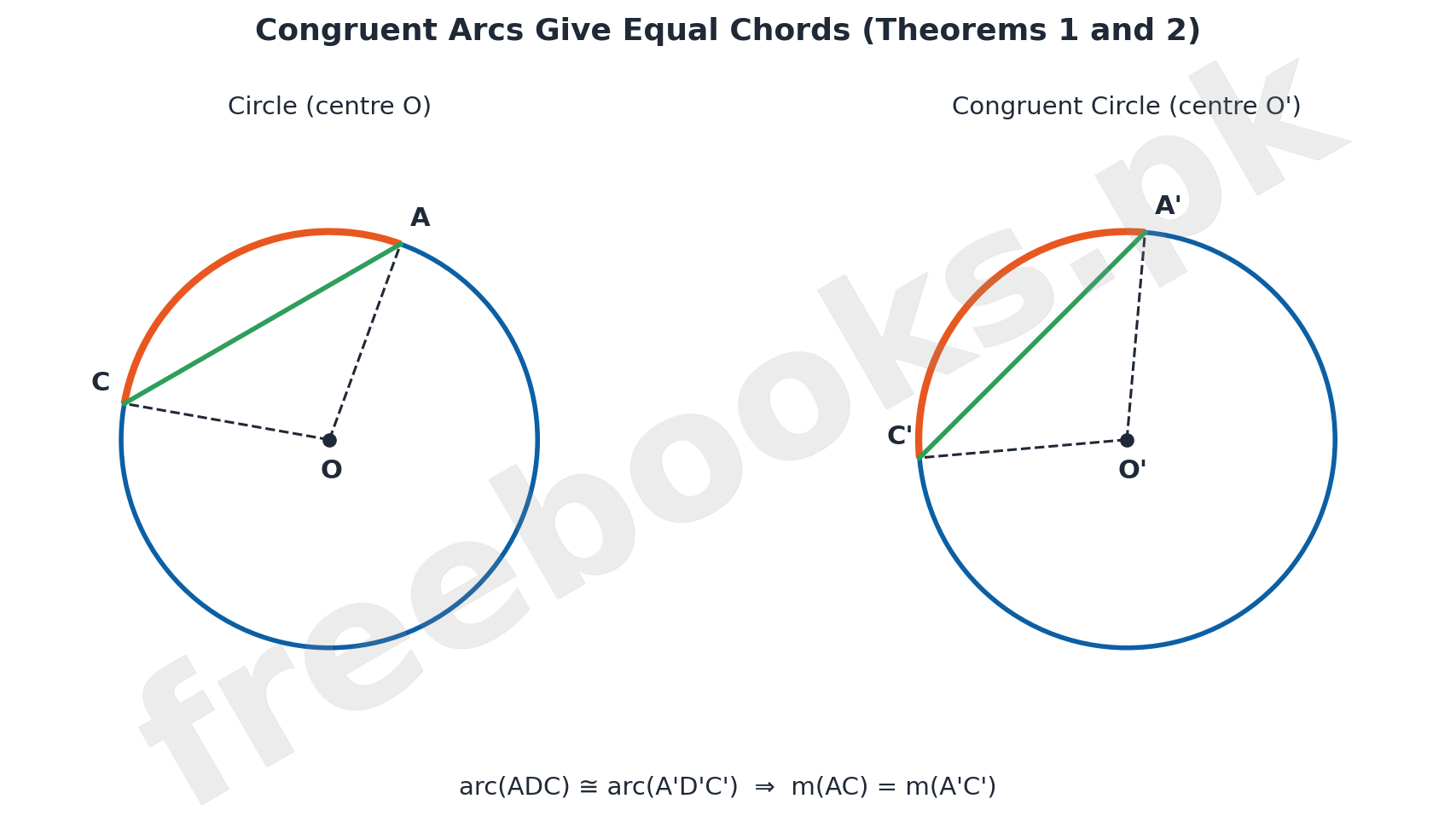
Theorem 1 states: if two arcs of a circle (or of congruent circles) are congruent, then the corresponding chords are equal. Given two congruent circles ABCD and A'B'C'D' with centres O and O', and arc ADC congruent to arc A'D'C', joining O to A and C (and O' to A' and C') gives central angles AOC and A'O'C' that are equal, since equal arcs of equal circles subtend equal central angles. Triangles AOC and A'O'C' are then congruent by SAS (OA = O'A' and OC = O'C', being radii of equal circles, with the included angle equal), giving AC = A'C' as a direct consequence. The same argument proves the result within a single circle as well.
11.2 Theorem 2: Equal Chords Give Congruent Arcs (Converse of Theorem 1)
Theorem 2 is the converse: if two chords of a circle (or of congruent circles) are equal, their corresponding arcs are congruent. Starting from AC = A'C' (given) with OA = O'A' and OC = O'C' (radii of equal circles), triangles AOC and A'O'C' are congruent by SSS, giving equal central angles AOC and A'O'C' — and since arcs correspond directly to their central angles, arc ADC is congruent to arc A'D'C'.
Example: if a point P on the circumference is equidistant from radii OA and OB, then arc AP equals arc BP. Dropping perpendiculars PR and PS from P to the two radii gives two right triangles OPR and OPS sharing hypotenuse OP with equal legs PR = PS, congruent by the H.S. postulate — so the two central angles at O are equal, making chord AP equal to chord BP, and therefore arc AP congruent to arc BP.
11.3 Theorem 3: Equal Chords Subtend Equal Central Angles
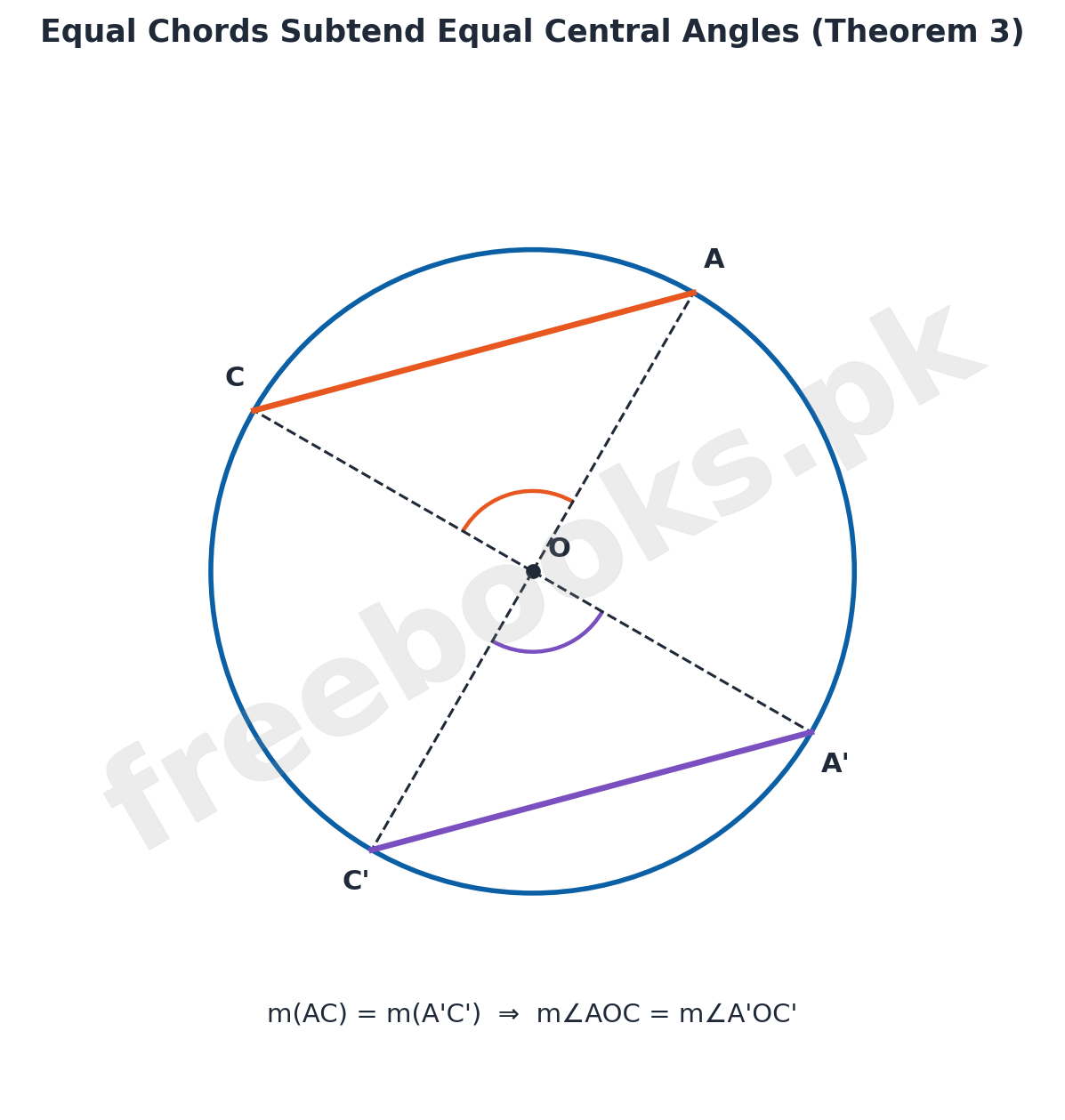
Theorem 3 states: equal chords of a circle (or of congruent circles) subtend equal angles at the centre. Given congruent circles with AC = A'C', the proof uses an indirect argument: assuming angle AOC is not equal to angle A'O'C', construct angle AOC congruent to angle A'O'D' for some other point D' on the second circle. This forces arc AC to equal arc A'D' (Theorem 1's proof direction), and since arc AC also equals arc A'C' (from the equal chords, via Theorem 2), point D' must coincide with C' — contradicting the assumption and proving angle AOC equals angle A'O'C' after all.
Corollary 1: in congruent circles or in the same circle, if central angles are equal, then the corresponding sectors are equal. Corollary 2: in congruent circles or in the same circle, unequal arcs subtend unequal central angles.
Example: the internal bisector of a central angle in a circle bisects the arc it stands on. If OP bisects angle AOB, triangles OAP and OBP are congruent by SAS (equal radii OA = OB, equal bisected angles, shared side OP), giving AP = BP as chords — and equal chords correspond to congruent arcs, so arc AP is congruent to arc BP.
11.4 Theorem 4: Equal Central Angles Give Equal Chords (Converse of Theorem 3)
Theorem 4 states: if the angles subtended by two chords of a circle (or congruent circles) at the centre are equal, the chords are equal. Given angle AOC equal to angle A'O'C' in two congruent circles, triangles OAC and O'A'C' are congruent by SAS (OA = O'A' and OC = O'C' as radii of congruent circles, with the included angle equal by hypothesis), giving AC = A'C' directly.
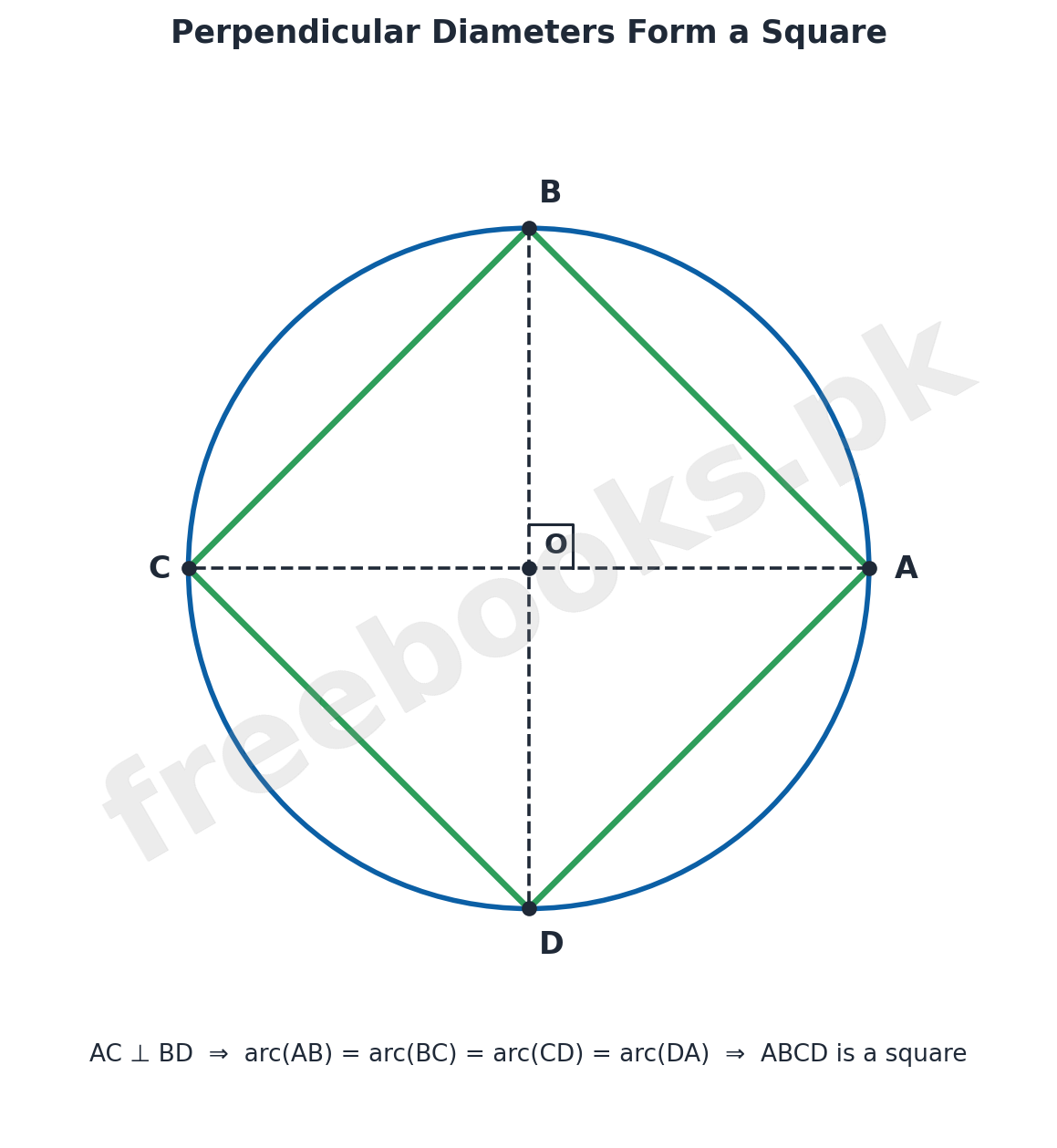
Example: if a pair of diameters of a circle are perpendicular to each other, the lines joining their endpoints in order form a square. With AC and BD as perpendicular diameters, all four central angles at O equal 90 degrees, so by Theorem 4 all four arcs AB, BC, CD, DA are equal, making all four chords (the sides of quadrilateral ABCD) equal in length — and since each interior angle of the quadrilateral works out to 90 degrees as well, ABCD is a square.
Important Definitions
What does Theorem 1 state about congruent arcs?
If two arcs of a circle (or of congruent circles) are congruent, then the corresponding chords are equal.
What does Theorem 2 state about equal chords?
If two chords of a circle (or of congruent circles) are equal, then their corresponding arcs (minor, major, or semi-circular) are congruent.
What does Theorem 3 state about equal chords and central angles?
Equal chords of a circle (or of congruent circles) subtend equal angles at the centre.
What does Theorem 4 state about equal central angles?
If the angles subtended by two chords of a circle (or congruent circles) at the centre are equal, then the chords are equal.
What is Corollary 1 of Theorem 3?
In congruent circles or in the same circle, if central angles are equal, then the corresponding sectors are equal.
What is Corollary 2 of Theorem 3?
In congruent circles or in the same circle, unequal arcs subtend unequal central angles.
What triangle congruence postulate proves Theorem 1?
SAS — the two radii and the included central angle are equal, giving equal chords as corresponding sides.
What triangle congruence postulate proves Theorem 2?
SSS — the two radii and the given equal chords make the triangles congruent, giving equal central angles.
What does it mean for two circles to be congruent?
Two circles are congruent (or equal) when they have equal radii, so one can be superimposed exactly onto the other.
What is a central angle?
The angle whose vertex is the centre of a circle, with its two arms being radii drawn to the endpoints of an arc.
Key Facts and Relations
| Topic | Key Fact / Relation |
|---|---|
| Theorem 1 | Congruent arcs give equal corresponding chords |
| Theorem 2 (converse of Theorem 1) | Equal chords give congruent corresponding arcs |
| Theorem 3 | Equal chords subtend equal central angles |
| Theorem 4 (converse of Theorem 3) | Equal central angles give equal chords |
| Corollary 1 of Theorem 3 | Equal central angles give equal corresponding sectors |
| Corollary 2 of Theorem 3 | Unequal arcs subtend unequal central angles |
| Congruence used for Theorem 1 and Theorem 4 | S.A.S postulate (two radii + included central angle) |
| Congruence used for Theorem 2 and Theorem 3 | S.S.S postulate (two radii + the equal/given chord) |
| Perpendicular diameters | Two perpendicular diameters divide a circle into four equal arcs, forming a square when endpoints are joined |
Diagrams
Congruent Arcs Give Equal Chords (Theorems 1 and 2): Two congruent circles with centres O and O', each showing an arc and its corresponding chord, illustrating that congruent arcs ADC and A'D'C' correspond to equal chords AC and A'C'
Equal Chords Subtend Equal Central Angles (Theorem 3): A circle with centre O showing two equal chords AC and A'C' (drawn within the same circle for comparison) with radii to their endpoints, illustrating that equal chords produce equal central angles AOC and A'OC'
Perpendicular Diameters Form a Square: A circle with centre O and two perpendicular diameters AC and BD, showing the four equal arcs AB, BC, CD, DA and the square ABCD formed by joining their endpoints in order
Short Questions & Answers
State Theorem 1 of this unit.
If two arcs of a circle (or of congruent circles) are congruent, then the corresponding chords are equal.
State Theorem 2 (the converse of Theorem 1).
If two chords of a circle (or of congruent circles) are equal, then their corresponding arcs are congruent.
State Theorem 3 of this unit.
Equal chords of a circle (or of congruent circles) subtend equal angles at the centre.
State Corollary 1 of Theorem 3.
In congruent circles or in the same circle, if central angles are equal, then the corresponding sectors are equal.
State Corollary 2 of Theorem 3.
In congruent circles or in the same circle, unequal arcs subtend unequal central angles.
Which congruence postulates are used to prove Theorems 1-4 of this unit?
S.A.S is used for Theorems 1 and 4 (radii plus the included central angle); S.S.S is used for Theorems 2 and 3 (radii plus the given equal chord).
Long Questions & Answers
State and explain Theorem 1 and Theorem 2 relating congruent arcs and equal chords, including the point-equidistant-from-radii example.
What does Theorem 1 state, and how is it proved?
Theorem 1 states that congruent arcs of a circle (or of congruent circles) give equal corresponding chords. Joining the centre to the endpoints of each arc gives equal central angles (since equal arcs subtend equal central angles), and with equal radii on both sides, SAS congruence of the two triangles gives equal chords as corresponding sides.
What does Theorem 2 state, and how does it differ in direction from Theorem 1?
Theorem 2 is the converse: equal chords give congruent corresponding arcs. It starts from the chords being equal (given) and uses SSS congruence (equal radii plus the equal chord) to prove the central angles — and therefore the arcs — are equal, the reverse direction of logic from Theorem 1.
How is the 'point equidistant from two radii' example proved using Theorem 2?
If point P on the circumference is equidistant from radii OA and OB, the perpendiculars from P to each radius create two right triangles sharing hypotenuse OP with equal legs, congruent by the H.S. postulate. This makes the two central angles at O equal, so chord AP equals chord BP, and by Theorem 2, arc AP is congruent to arc BP.
Why does the same argument prove Theorem 1 within a single circle, not just between two congruent circles?
Since a circle is trivially congruent to itself (equal radii), the same SAS congruence argument applies directly to two arcs and chords within one circle — the 'congruent circles' version and the 'same circle' version are really the same proof.
State and explain Theorem 3 and Theorem 4 relating equal chords and equal central angles, including the perpendicular-diameters-form-a-square example.
What does Theorem 3 state, and how is it proved?
Theorem 3 states that equal chords subtend equal central angles. The proof is indirect: assuming the central angles are unequal leads to a contradiction (a second point D' would have to coincide with C'), so the central angles must in fact be equal.
What does Theorem 4 state, and how is it proved?
Theorem 4 is the converse: equal central angles give equal chords. Given equal central angles AOC and A'O'C' with equal radii on both sides, SAS congruence of triangles OAC and O'A'C' gives AC = A'C' directly.
What are the two corollaries of Theorem 3?
Corollary 1: equal central angles produce equal corresponding sectors. Corollary 2: unequal arcs subtend unequal central angles — the natural extension of the equal-angle results to the unequal case.
How does Theorem 4 prove that perpendicular diameters form a square?
Two perpendicular diameters AC and BD create four central angles of 90 degrees each at O. By Theorem 4, equal central angles give equal chords, so all four sides AB, BC, CD, DA of quadrilateral ABCD are equal in length; combined with each interior angle also working out to 90 degrees, ABCD is a square.
What does the angle-bisector example show about bisecting an arc?
If OP bisects central angle AOB, triangles OAP and OBP are congruent by SAS (equal radii, equal bisected angles, shared side OP), giving equal chords AP and BP — and by Theorem 2, congruent arcs AP and BP, proving the internal bisector of a central angle also bisects the arc it stands on.
Multiple Choice Questions (MCQs)
If two arcs of a circle are congruent, their corresponding chords are: (A) Unequal (B) Equal (C) Perpendicular (D) Parallel
Correct answer: (B) Equal. By Theorem 1, congruent arcs always give equal corresponding chords.
If two chords of a circle are equal, their corresponding arcs are: (A) Unequal (B) Perpendicular (C) Congruent (D) Parallel
Correct answer: (C) Congruent. By Theorem 2 (the converse of Theorem 1), equal chords produce congruent corresponding arcs.
Equal chords of a circle subtend, at the centre, angles that are: (A) Unequal (B) Supplementary (C) Equal (D) Complementary
Correct answer: (C) Equal. By Theorem 3, equal chords always subtend equal angles at the centre of the circle.
If the central angles subtended by two chords are equal, the chords are: (A) Parallel (B) Perpendicular (C) Unequal (D) Equal
Correct answer: (D) Equal. By Theorem 4 (the converse of Theorem 3), equal central angles give equal chords.
If central angles in the same circle are equal, the corresponding sectors are: (A) Unequal (B) Equal (C) Perpendicular (D) Overlapping
Correct answer: (B) Equal. By Corollary 1 of Theorem 3, equal central angles always give equal corresponding sectors.
Unequal arcs of a circle subtend central angles that are: (A) Equal (B) Complementary (C) Unequal (D) Right angles
Correct answer: (C) Unequal. By Corollary 2 of Theorem 3, unequal arcs always subtend unequal central angles.
Theorems 1 and 4 of this unit are proved using which congruence postulate? (A) S.S.S (B) S.A.S (C) A.S.A (D) H.S
Correct answer: (B) S.A.S. Theorems 1 and 4 use SAS congruence — two equal radii with the included central angle equal.
Theorems 2 and 3 of this unit are proved using which congruence postulate? (A) A.S.A (B) H.S (C) S.S.S (D) S.A.S
Correct answer: (C) S.S.S. Theorems 2 and 3 use SSS congruence — two equal radii plus the given equal chord.
Two perpendicular diameters of a circle, when their endpoints are joined in order, always form a: (A) Rectangle (B) Rhombus (C) Square (D) Trapezium
Correct answer: (C) Square. Since perpendicular diameters create four equal central angles of 90 degrees, all four chords (sides) are equal and all interior angles are 90 degrees, forming a square.
If a point on a circle's circumference is equidistant from two radii, the arcs cut off from those radii to the point are: (A) Unequal (B) Congruent (C) Perpendicular (D) Parallel
Correct answer: (B) Congruent. Equidistance from the two radii makes the two central angles equal, giving equal chords and therefore congruent arcs.
Quick Revision Summary
- Theorem 1: congruent arcs give equal corresponding chords
- Theorem 2 (converse): equal chords give congruent corresponding arcs
- Theorem 3: equal chords subtend equal angles at the centre
- Theorem 4 (converse): equal central angles give equal chords
- Corollary 1: equal central angles give equal sectors
- Corollary 2: unequal arcs subtend unequal central angles
- Theorems 1 and 4 use S.A.S congruence (radii + included central angle)
- Theorems 2 and 3 use S.S.S congruence (radii + the equal chord)
- A point equidistant from two radii cuts off equal chords and congruent arcs from them
- The internal bisector of a central angle also bisects the arc it stands on
- Two perpendicular diameters of a circle, joined at their endpoints, always form a square
Exam Tips
- Chord, arc, and central angle are three interchangeable measures in a circle — proving any one equal lets you conclude the other two are equal as well
- Watch which direction the proof runs: Theorems 1 and 3 start from arcs/chords and prove angles; Theorems 2 and 4 start from chords/angles and prove arcs — know which is 'given' and which is 'to prove'
- For SAS-based proofs (Theorems 1 and 4), always check the two radii and the INCLUDED angle between them
- For SSS-based proofs (Theorems 2 and 3), always check the two radii and the given equal chord as the third side
- In 'equidistant from two radii' problems, look for right triangles and the H.S. congruence postulate
- For quadrilateral-in-a-circle problems, converting equal central angles to equal chords (sides) is usually the fastest route to proving a shape regular