This unit opens the geometry of circles by first fixing the basic vocabulary — centre, radius, circumference, arc, chord, diameter, segment, sector, and central angle — and then proving five theorems that describe exactly how a chord relates to the centre of its circle. Together these theorems explain why a triangle's circumcircle is unique, how a perpendicular from the centre always bisects a chord (and vice versa), and how the DISTANCE of a chord from the centre determines whether two chords are equal in length.
These results are the geometric toolkit used throughout the rest of the geometry units (tangents, arcs, and inscribed angles all build on chord properties). Each theorem is proved using triangle congruence (SSS, SAS, or the right-triangle hypotenuse-side postulate) applied to the triangles formed by joining the centre of the circle to the endpoints of a chord — the same proof pattern repeats with small variations across all five theorems.
Learning Objectives
- Define a circle and identify its basic parts: centre, radius, circumference, arc, chord, diameter, segment, sector, and central angle
- Distinguish between an arc and a chord, and between a sector and a segment of a circle
- Prove that one and only one circle can pass through three non-collinear points
- Prove that a line drawn from the centre of a circle to bisect a chord (not a diameter) is perpendicular to that chord
- Prove that a perpendicular from the centre of a circle to a chord bisects the chord
- Prove that congruent chords of a circle are equidistant from the centre
- Prove that chords of a circle which are equidistant from the centre are congruent
- Apply these theorems to find unknown chord lengths, distances from the centre, or the diameter of a circle
Key Concepts
9.1 Basic Concepts of a Circle
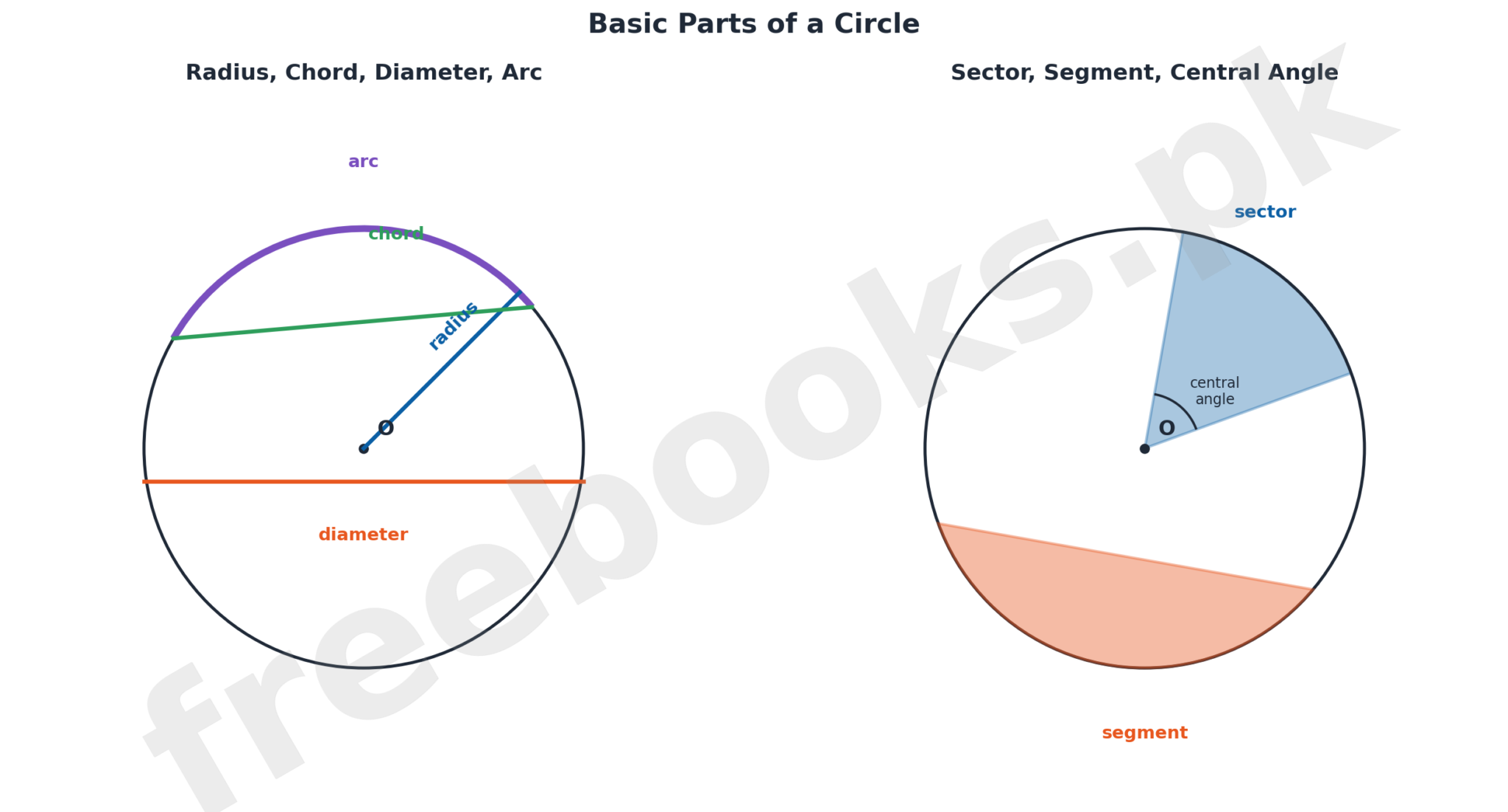
A circle is the locus of a moving point P in a plane that stays always equidistant from a fixed point O; O is called the centre, the constant distance OP is the radius, and the path traced by P is the circumference, equal to 2*pi*r. Every radius of a given circle is equal in length, though a circle has only one centre. An arc is any portion of the circumference; a chord is a line segment joining any two points on the circumference, and a diameter is a chord that passes through the centre (so it evidently bisects the circle into two equal halves).
A segment is the region of a circle bounded by an arc and its corresponding chord — any chord divides the circle into a larger major segment and a smaller minor segment. A sector, by contrast, is the region bounded by two radii and the arc between them — any pair of radii divides the circle into a major sector and a minor sector. The central angle of a circle is the angle whose vertex is the centre and whose arms are the two radii drawn to the endpoints of an arc.
9.2 Theorem 1: One Circle Through Three Non-Collinear Points
Theorem 1 states: one and only one circle can pass through three non-collinear points. Given three non-collinear points A, B, and C, drawing the perpendicular bisectors of AB and of BC gives two lines that are not parallel (since A, B, C are non-collinear) and so must intersect at a unique point O. Every point on the perpendicular bisector of AB is equidistant from A and B, so OA = OB; similarly every point on the perpendicular bisector of BC is equidistant from B and C, so OB = OC. Combining these, OA = OB = OC, so a circle centred at O with radius OA passes through all three points — and since O is the ONLY point common to both perpendicular bisectors, this circle is unique.
A direct application: since the diagonals of a rectangle are equal in length and bisect each other, the point O where they meet is equidistant from all four vertices, so exactly one circle (the rectangle's circumcircle) passes through all four vertices of any rectangle — a special case of the same underlying idea, since any three of the four vertices already determine that unique circle.
9.3 Theorems 2 and 3: Bisecting Chords and Perpendiculars from the Centre
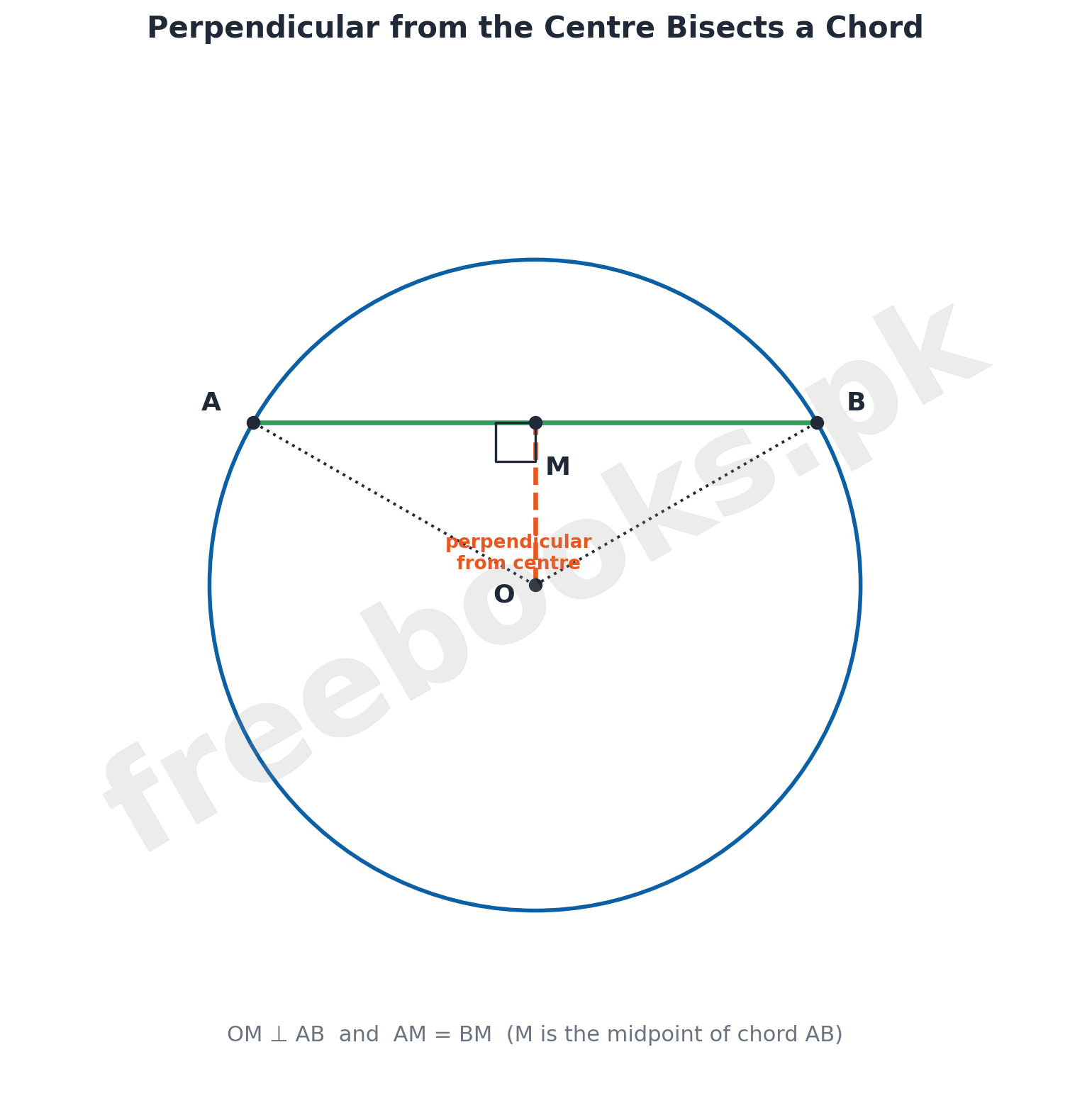
Theorem 2 states: a straight line drawn from the centre of a circle to bisect a chord (which is not a diameter) is perpendicular to that chord. If M is the midpoint of chord AB and O is the centre, then triangles OAM and OBM share OM, have OA = OB (radii of the same circle) and AM = BM (M is the midpoint, given), so by SSS the triangles are congruent. This makes the two angles at M equal; since they are also supplementary (they form a straight line AMB), each must equal 90 degrees, proving OM is perpendicular to AB.
Theorem 3 is the converse: a perpendicular from the centre of a circle to a chord bisects that chord. If OM is perpendicular to chord AB, triangles OAM and OBM are right triangles sharing hypotenuse… rather, sharing OM, with equal hypotenuses OA = OB (radii), so by the right-triangle hypotenuse-side (H.S.) postulate the triangles are congruent, giving AM = BM. Two useful corollaries follow directly: the perpendicular bisector of any chord of a circle always passes through the centre, and the diameter of a circle passes through the midpoints of any two parallel chords (since both are bisected along the same perpendicular direction from the centre).
9.4 Theorems 4 and 5: Congruent Chords and Distance from the Centre
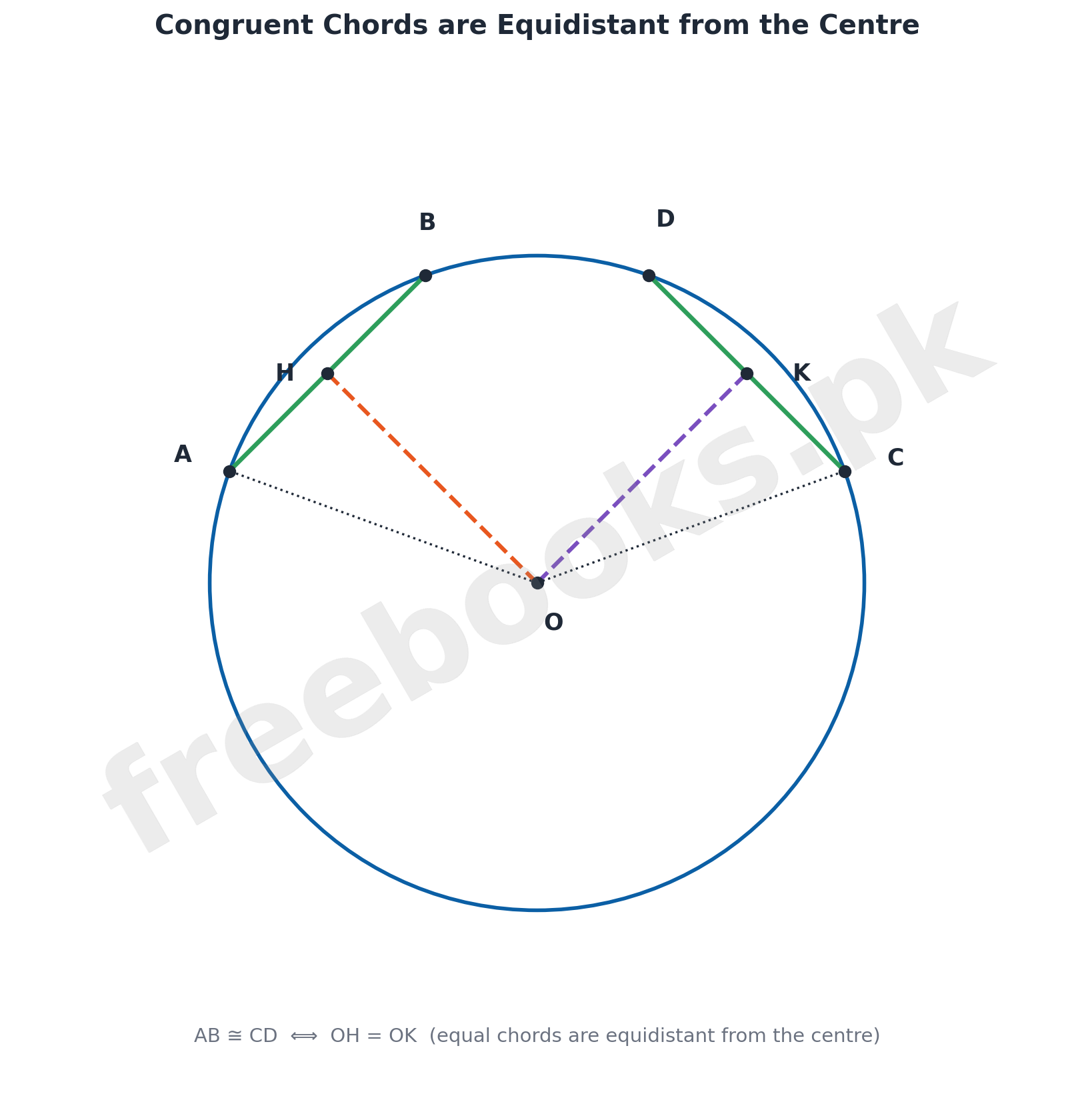
Theorem 4 states: if two chords of a circle are congruent, then they are equidistant from the centre. Given equal chords AB and CD with perpendiculars OH and OK dropped from the centre O to each, Theorem 3 shows H and K are the midpoints of AB and CD respectively, so AH = CK (half of equal chords are equal). In right triangles OAH and OCK, the hypotenuses OA = OC (radii) and the legs AH = CK, so by the H.S. postulate the triangles are congruent, giving OH = OK — the two chords are the same perpendicular distance from the centre.
Theorem 5, the converse, states: two chords of a circle which are equidistant from the centre are congruent. The same right triangles OAH and OCK are now congruent because OA = OC (radii) and OH = OK (given equal distances), by the H.S. postulate; this gives AH = CK, and since these are half of chords AB and CD respectively, AB = CD. A classic application of these ideas is proving that the diameter is the longest chord in any circle: since the sum of two sides of a triangle OAB always exceeds the third side, OA + OB > AB, and since OA + OB equals the diameter, the diameter is greater than every other chord.
Important Definitions
What is a circle?
The locus of a moving point in a plane that stays always equidistant from a fixed point called the centre; that constant distance is the radius.
What is the radius of a circle?
The constant distance between the centre of a circle and any point on its circumference.
What is an arc of a circle?
Any portion of the circumference of a circle.
What is a chord of a circle?
A line segment joining any two points on the circumference of a circle.
What is the diameter of a circle?
A chord that passes through the centre of the circle; it bisects the circle into two equal halves.
What is a segment of a circle?
The region of a circle bounded by an arc and its corresponding chord — the larger region is the major segment and the smaller is the minor segment.
What is a sector of a circle?
The region of a circle bounded by two radii and the arc between them — the larger region is the major sector and the smaller is the minor sector.
What is the central angle of a circle?
The angle whose vertex is the centre of the circle and whose arms are two radii drawn to the endpoints of an arc.
What does Theorem 2 state about a line bisecting a chord?
A straight line drawn from the centre of a circle to bisect a chord (not a diameter) is perpendicular to that chord.
What does Theorem 4 state about congruent chords?
If two chords of a circle are congruent, they are equidistant from the centre of the circle.
Key Facts and Relations
| Topic | Key Fact / Relation |
|---|---|
| Circumference of a circle | C = 2*pi*r |
| Area of a circle | A = pi*r^2 |
| Theorem 1 | One and only one circle can pass through three non-collinear points |
| Theorem 2 | A line from the centre bisecting a chord (not a diameter) is perpendicular to it |
| Theorem 3 (converse of Theorem 2) | A perpendicular from the centre to a chord bisects the chord |
| Corollary of Theorem 3 | The perpendicular bisector of any chord passes through the centre |
| Corollary of Theorem 3 | The diameter passes through the midpoints of two parallel chords |
| Theorem 4 | Congruent chords of a circle are equidistant from the centre |
| Theorem 5 (converse of Theorem 4) | Chords of a circle equidistant from the centre are congruent |
| Longest chord | The diameter is the longest chord of any circle (since OA + OB > AB in triangle OAB) |
Diagrams
Basic Parts of a Circle: A labelled circle diagram showing the centre, radius, chord, diameter, arc, a major and minor segment, a sector, and the central angle
Perpendicular from the Centre Bisects a Chord (Theorems 2 and 3): A circle with centre O and chord AB, showing the perpendicular OM dropped from the centre meeting the chord at its midpoint M
Congruent Chords are Equidistant from the Centre (Theorems 4 and 5): A circle with two congruent chords AB and CD, showing the perpendiculars OH and OK dropped from the centre O to each chord, with OH equal to OK
Short Questions & Answers
Define a chord of a circle.
A chord is a line segment joining any two points on the circumference of a circle.
What is the difference between a sector and a segment of a circle?
A sector is bounded by two radii and an arc, while a segment is bounded by a chord and an arc — a sector always touches the centre, a segment does not.
State Theorem 2.
A straight line drawn from the centre of a circle to bisect a chord (which is not a diameter) is perpendicular to that chord.
State Theorem 3.
A perpendicular drawn from the centre of a circle to a chord bisects that chord.
State Theorem 4.
If two chords of a circle are congruent, then they are equidistant from the centre of the circle.
Why is the diameter the longest chord of a circle?
Because in triangle OAB formed by the centre and the endpoints of any chord AB, OA + OB > AB (sum of two sides of a triangle exceeds the third), and OA + OB equals the diameter.
Long Questions & Answers
Explain the basic parts of a circle, and state and explain Theorem 1 (one circle through three non-collinear points).
What are the centre, radius, and circumference of a circle?
The centre is the fixed point every point of the circle stays equidistant from; the radius is that constant distance; the circumference is the path traced by the moving point, equal to 2*pi*r.
What is the difference between an arc, a chord, and a diameter?
An arc is a curved portion of the circumference; a chord is a straight line segment joining two points on the circumference; a diameter is a special chord that passes through the centre, bisecting the circle into two equal halves.
What is the difference between a segment and a sector of a circle?
A segment is the region bounded by a chord and its arc (not touching the centre); a sector is the region bounded by two radii and an arc (always touching the centre).
What does Theorem 1 state, and how is it proved?
Theorem 1 states that one and only one circle can pass through three non-collinear points. The perpendicular bisectors of any two of the three connecting segments meet at a single point O that is equidistant from all three points, giving a unique circle centred at O.
How does Theorem 1 explain why every rectangle has a circumscribing circle?
A rectangle's diagonals are equal and bisect each other at a point O, making O equidistant from all four vertices; since any three of those vertices are non-collinear, Theorem 1 guarantees a unique circle through them, and the fourth vertex lies on it too.
Explain Theorems 2-5 relating chords, perpendiculars from the centre, and distance from the centre.
What does Theorem 2 state, and how is it proved?
Theorem 2 states that a line from the centre bisecting a chord (not a diameter) is perpendicular to it. Triangles OAM and OBM are congruent by SSS (OA=OB radii, AM=BM given, OM shared), making the two angles at M equal and supplementary, so each equals 90 degrees.
What does Theorem 3 state, and how does it differ from Theorem 2?
Theorem 3 is the converse of Theorem 2: a perpendicular from the centre to a chord bisects it. It starts from the perpendicularity (given) and proves the bisection (to prove), the opposite direction of logic from Theorem 2.
What are the two corollaries of Theorem 3?
First, the perpendicular bisector of any chord of a circle always passes through the centre. Second, the diameter of a circle passes through the midpoints of any two parallel chords, since both chords are bisected along the same perpendicular direction from the centre.
What does Theorem 4 state about congruent chords?
Theorem 4 states that if two chords of a circle are congruent, they are equidistant from the centre — proved by showing the right triangles formed by the radii and the half-chords are congruent (H.S. postulate), giving equal perpendicular distances OH = OK.
What does Theorem 5 (the converse of Theorem 4) state, and how is the diameter shown to be the longest chord?
Theorem 5 states that chords equidistant from the centre are congruent. Using the triangle inequality on triangle OAB (OA + OB > AB), and noting OA + OB equals the diameter for any chord AB, it follows that the diameter is longer than every other chord in the circle.
Multiple Choice Questions (MCQs)
The locus of a point in a plane equidistant from a fixed point is called: (A) A radius (B) A circle (C) A circumference (D) A diameter
Correct answer: (B) A circle. A circle is defined as the locus of a point that stays equidistant from a fixed centre point.
A chord that passes through the centre of a circle is called: (A) A radius (B) A diameter (C) A sector (D) An arc
Correct answer: (B) A diameter. A chord passing through the centre of the circle is specifically called a diameter.
The region bounded by an arc and its chord is called: (A) A sector (B) A segment (C) A radius (D) A circumference
Correct answer: (B) A segment. A segment of a circle is the region enclosed between an arc and the chord joining its endpoints.
The region bounded by two radii and the arc between them is called: (A) A sector (B) A segment (C) A diameter (D) A chord
Correct answer: (A) A sector. A sector is the region bounded by two radii and the arc intercepted between them.
How many circles can pass through three given non-collinear points? (A) None (B) Exactly one (C) Exactly two (D) Infinitely many
Correct answer: (B) Exactly one. By Theorem 1, one and only one circle can pass through three non-collinear points.
A line from the centre of a circle that bisects a chord (not a diameter) is: (A) Parallel to the chord (B) Perpendicular to the chord (C) Equal in length to the chord (D) Twice the chord
Correct answer: (B) Perpendicular to the chord. By Theorem 2, a line from the centre bisecting a chord is always perpendicular to that chord.
A perpendicular drawn from the centre of a circle to a chord: (A) Bisects the chord (B) Doubles the chord (C) Is parallel to the chord (D) Passes outside the circle
Correct answer: (A) Bisects the chord. By Theorem 3, a perpendicular from the centre to a chord always bisects that chord.
If two chords of a circle are congruent, they are: (A) Parallel (B) Perpendicular to each other (C) Equidistant from the centre (D) Both diameters
Correct answer: (C) Equidistant from the centre. By Theorem 4, congruent chords of a circle are always equidistant from the centre.
The longest chord in any circle is: (A) Any random chord (B) The diameter (C) The radius (D) A minor arc
Correct answer: (B) The diameter. The diameter is the longest possible chord in a circle, since OA + OB > AB for any other chord AB.
The angle formed at the centre by the two radii to the endpoints of an arc is called: (A) An inscribed angle (B) A central angle (C) A right angle (D) A reflex angle
Correct answer: (B) A central angle. The central angle is the angle at the centre of the circle, formed by the two radii drawn to the endpoints of an arc.
Quick Revision Summary
- Circle: locus of a point equidistant from a fixed centre O; radius = constant distance
- Circumference = 2*pi*r | Area = pi*r^2
- Arc: portion of the circumference | Chord: segment joining two points on the circle | Diameter: chord through the centre
- Segment: region bounded by an arc and a chord (major/minor) | Sector: region bounded by two radii and an arc (major/minor)
- Central angle: angle at the centre formed by two radii to the endpoints of an arc
- Theorem 1: one and only one circle passes through three non-collinear points
- Theorem 2: a line from the centre bisecting a chord (not a diameter) is perpendicular to it
- Theorem 3: a perpendicular from the centre to a chord bisects the chord
- Corollaries: perpendicular bisector of a chord passes through the centre; diameter bisects two parallel chords
- Theorem 4: congruent chords are equidistant from the centre | Theorem 5: chords equidistant from the centre are congruent
- The diameter is the longest chord of any circle
Exam Tips
- Always distinguish 'chord' (a straight line segment) from 'arc' (a curved portion of the circumference) — mixing them up is a very common mistake
- Remember Theorems 2 and 3 are converses of each other — one starts from 'bisects', the other starts from 'perpendicular'
- Similarly, Theorems 4 and 5 are converses — one starts from 'congruent chords', the other from 'equidistant from the centre'
- When proving, look for SSS, SAS, or the H.S. (hypotenuse-side) congruence postulate between the two triangles formed by joining the centre to the chord's endpoints
- For 'distance from the centre' problems, that distance is always measured along the PERPENDICULAR from the centre to the chord
- Sketch every problem — most chord theorems are much easier to see in a diagram than to follow purely from text