
This unit opens trigonometry by first fixing how an angle is measured. The everyday sexagesimal system (degrees, minutes, and seconds, with 60'' = 1' and 60' = 1 degree) is joined by the circular (radian) system used throughout higher mathematics, where one radian is the angle subtended by an arc equal in length to the radius; the two systems are linked by the identity 180 degrees = pi radians. Once angles are measured in radians, a circle's arc length and sector area follow directly: l = r*theta for arc length and Area = (1/2)*r^2*theta for the area of a sector, both derived from simple proportions between angles and their arcs.
The heart of the unit is the definition of the six trigonometric ratios — sine, cosine, tangent, cotangent, secant, and cosecant — using a unit circle, which extends these ratios to angles of ANY size, not just the acute angles of a right triangle. General (coterminal) angles and the idea of standard position let any angle be classified into one of four quadrants, whose signs of ratios follow the ASTC pattern. The unit shows how to recall exact values at 45, 30, 60 degrees and at the quadrantal angles 0, 90, 180, 270, 360 degrees, how to find every other ratio once a single ratio is known, and closes with the three fundamental (Pythagorean) trigonometric identities and their first real-world application: finding heights and distances using the angle of elevation and angle of depression.
Learning Objectives
- Measure an angle in degrees, minutes, and seconds, and convert between D M S form and decimal degrees
- Define a radian and prove the relationship between radians and degrees (180 degrees = pi radians)
- Establish and apply the rule l = r*theta for the length of a circular arc
- Prove and apply the formula Area of a sector = (1/2)*r^2*theta
- Define a general angle (coterminal angles) and locate an angle in standard position
- Recognize quadrants and quadrantal angles
- Define the six trigonometric ratios and their reciprocals using a unit circle
- Recall the exact values of trigonometric ratios for 45, 30, and 60 degrees
- Recognize the signs of trigonometric ratios in each quadrant, and find the remaining ratios when one is given
- Calculate trigonometric ratios at 0, 90, 180, 270, 360 degrees, prove and apply trigonometric identities, and solve angle of elevation/depression problems
Key Concepts
7.1 Measurement of an Angle: Degrees and Radians
An angle is the union of two non-collinear rays (its arms) sharing a common endpoint (its vertex); the original ray position is the initial side and the final position after rotation is the terminal side — anticlockwise rotation gives a positive angle, clockwise gives a negative angle. In the sexagesimal system, the circumference of a circle is divided into 360 equal arcs, each subtending one degree (1 deg) at the centre; 60 seconds (60'') make one minute (1'), 60 minutes make one degree, and 90 degrees makes one right angle. An angle is in standard position when its vertex is at the origin and its initial side lies along the positive x-axis. Converting between D M S form and decimal degrees is done by dividing minutes by 60 and seconds by 3600 (to go to decimal), or by multiplying the decimal part by 60 repeatedly (to go back to D M S).
The circular (radian) system, used throughout higher mathematics, defines one radian as the angle subtended at the centre of a circle by an arc whose length equals the circle's radius. Since a circle's circumference is 2*pi*r, a complete revolution measures 2*pi*r/r = 2*pi radians, giving the key relationship 360 degrees = 2*pi radians, or equivalently 180 degrees = pi radians. This yields the conversion formulas: x degrees = x(pi/180) radians, and y radians = y(180/pi) degrees — so 1 degree is about 0.0175 radians and 1 radian is about 57.296 degrees (57 deg 17' 45'').
7.2 Sector of a Circle: Arc Length and Area
A part of a circle's circumference is called an arc; a region bounded by an arc and a chord is a segment; a region bounded by two radii and an arc is a sector. Because the central angles subtended by arcs of a circle are proportional to the lengths of those arcs, comparing an arc of length l (subtending theta radians) to the arc of one full radian (length r) gives theta/1 = l/r, so l = r*theta — the rule connecting arc length, radius, and central angle, valid only when theta is measured in radians.
The area of a sector follows a similar proportion: the ratio of a sector's area to the full circle's area (pi*r^2) equals the ratio of the sector's angle theta to the full angle of the circle (2*pi radians). Solving (Area of sector)/(pi*r^2) = theta/(2*pi) gives Area of sector = (theta/2*pi) * pi*r^2 = (1/2)*r^2*theta, again with theta in radians.
7.3 General Angles, Standard Position, and Quadrants
Two or more angles that share the same initial side and the same terminal side are called coterminal angles — a terminal side returns to its original position after every complete revolution of 2*pi radians (360 degrees), so if theta is coterminal with some angle, then theta + 360*k degrees or theta + 2*k*pi radians, for any integer k, is also coterminal with it. This gives the idea of a general angle: theta = 2*k*pi + theta, k is an integer.
The x-axis and y-axis divide the coordinate plane into four quadrants, meeting at the origin O. An angle in standard position is said to lie in whichever quadrant its terminal side falls in: Quadrant I is 0 to 90 degrees, Quadrant II is 90 to 180 degrees, Quadrant III is 180 to 270 degrees, and Quadrant IV is 270 to 360 degrees. If the terminal side of an angle in standard position falls exactly on the x-axis or y-axis (i.e. the angle is 90, 180, 270, or 360 degrees), it is called a quadrantal angle.
7.4 Trigonometric Ratios and the Unit Circle
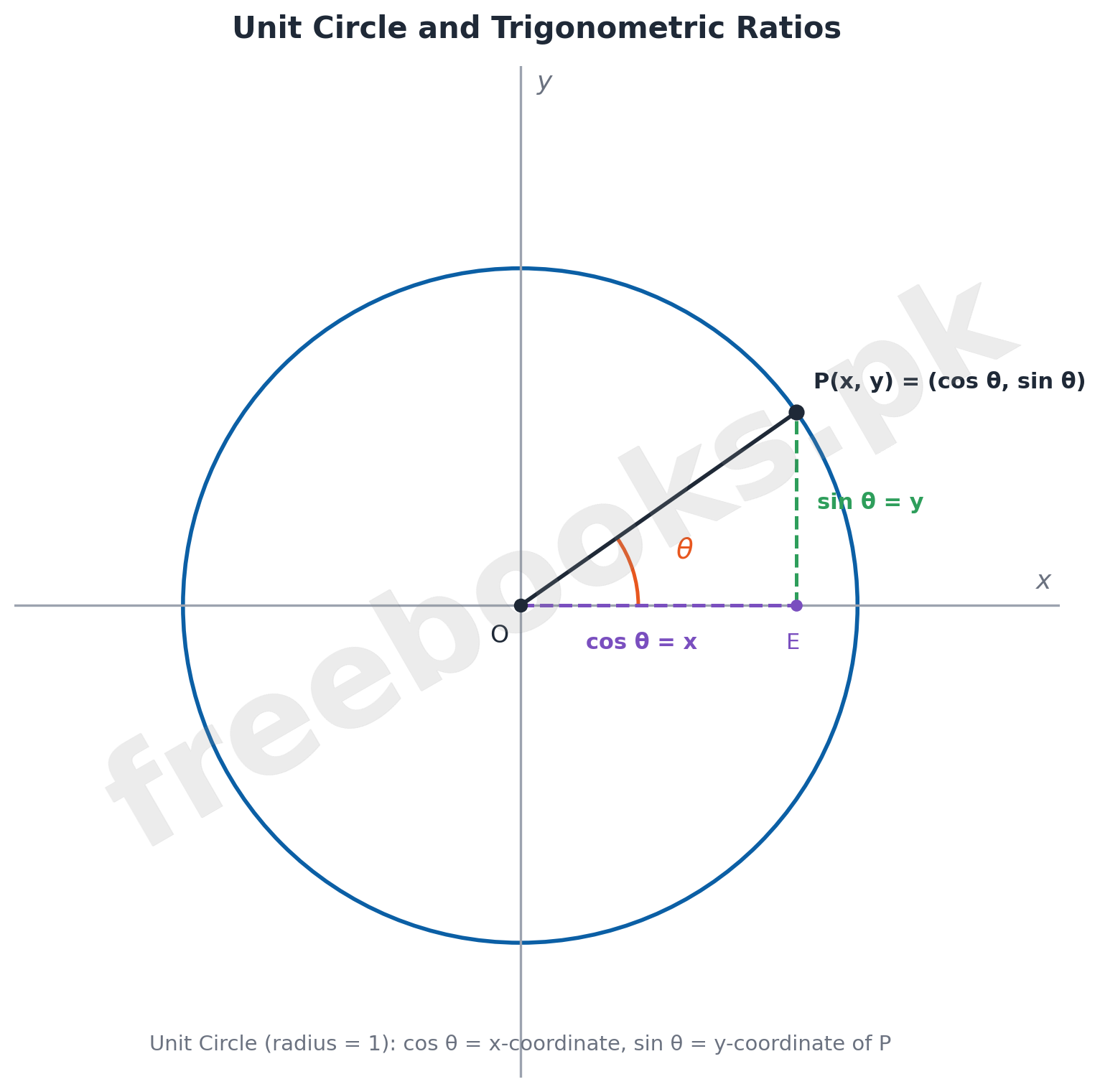
Let theta be the radian measure of an angle in standard position, and let P(x, y) be the point where its terminal side meets the unit circle (radius 1, centred at the origin). Sine and cosine are defined directly as the coordinates of P: cos theta = x and sin theta = y. The remaining four ratios follow: tan theta = y/x = sin theta/cos theta (x not 0), cot theta = x/y = cos theta/sin theta (y not 0), sec theta = 1/x = 1/cos theta (x not 0), and cosec theta = 1/y = 1/sin theta (y not 0) — giving the reciprocal identities sin theta = 1/cosec theta, cos theta = 1/sec theta, and tan theta = 1/cot theta. For a point (x, y) not necessarily on the unit circle, r = sqrt(x^2+y^2) is used instead, so sin theta = y/r, cos theta = x/r, tan theta = y/x, and so on.
The exact values at 45, 30, and 60 degrees are found using two special right triangles. Using an isosceles right triangle with legs a = b = 1 (so hypotenuse c = sqrt(2)) gives sin 45 = cos 45 = 1/sqrt(2) and tan 45 = 1. Using an equilateral triangle with side 2, bisected into two 30-60-90 triangles with height sqrt(3), gives sin 30 = 1/2, cos 30 = sqrt(3)/2, tan 30 = 1/sqrt(3), and sin 60 = sqrt(3)/2, cos 60 = 1/2, tan 60 = sqrt(3) — with the reciprocal ratios (cosec, sec, cot) following directly from these.
7.5 Signs of Trigonometric Ratios and Finding Remaining Ratios
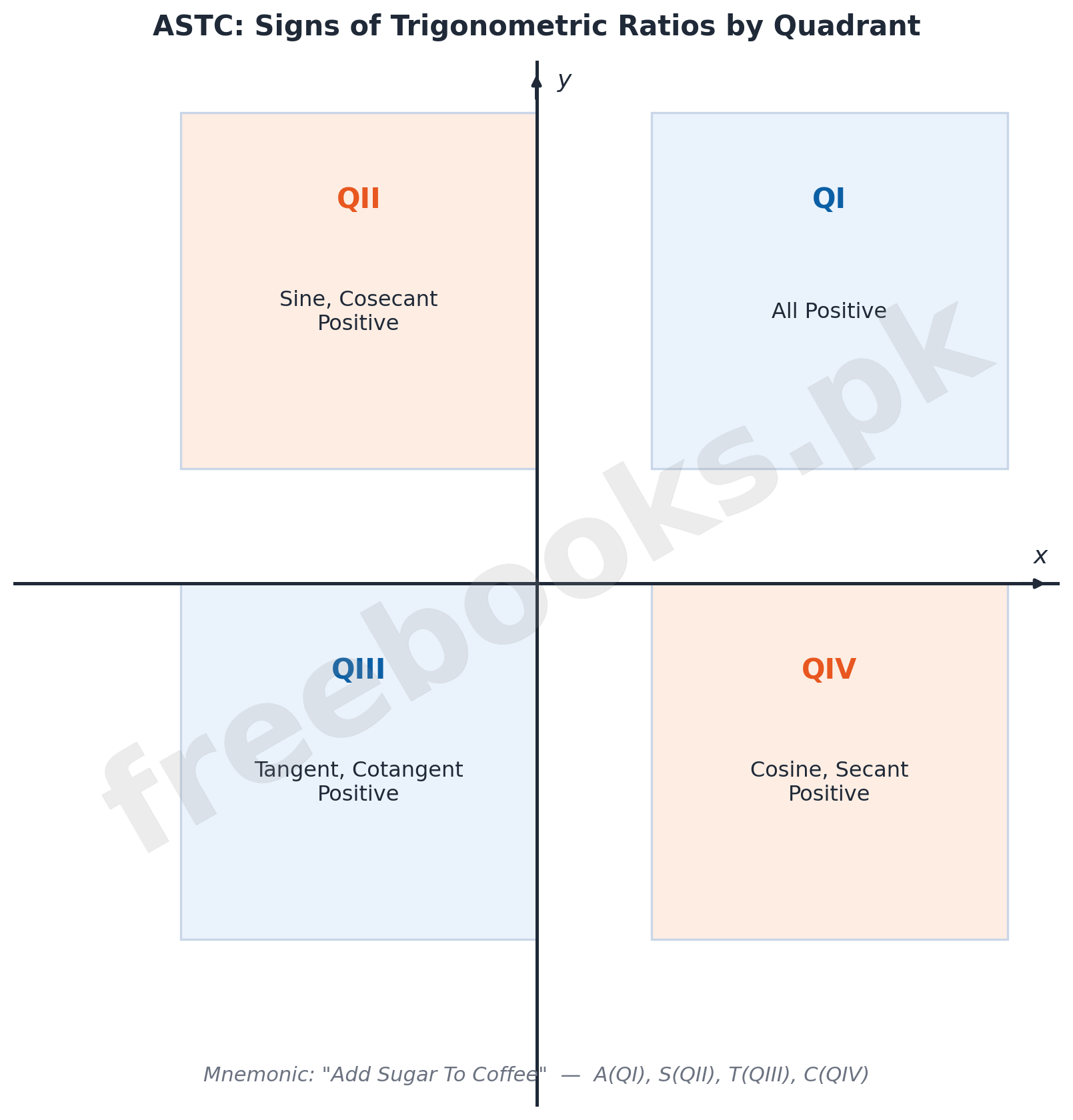
Since r = sqrt(x^2+y^2) is always positive, the sign of each ratio depends only on the signs of x and y in the quadrant containing theta's terminal side. In Quadrant I, x and y are both positive, so all six ratios are positive. In Quadrant II, x is negative and y is positive, so only sin theta (and cosec theta) are positive. In Quadrant III, both x and y are negative, so only tan theta (and cot theta) are positive. In Quadrant IV, x is positive and y is negative, so only cos theta (and sec theta) are positive. This pattern is remembered with the mnemonic ASTC ('Add Sugar To Coffee'): All positive in QI, Sine positive in QII, Tangent positive in QIII, Cosine positive in QIV.
If one trigonometric ratio is known (along with which quadrant theta lies in, to fix the signs), every other ratio can be found. One method treats the known ratio as a fraction of two sides of a right triangle, finds the third side with the Pythagorean theorem, and reads off the remaining ratios directly. A second method uses the reciprocal identities together with the Pythagorean identities (covered next) to solve algebraically for each remaining ratio in terms of the one given. The same unit-circle approach gives exact values at the quadrantal angles: at theta = 0 the point is (1,0), at 90 it is (0,1), at 180 it is (-1,0), and at 270 it is (0,-1) — so ratios with a zero denominator (such as tan 90 or sec 90) are undefined at these angles, while theta = 360 repeats the values of theta = 0.
7.6 Trigonometric Identities and Angle of Elevation/Depression
For any point P(x,y) on the terminal side of theta with r = sqrt(x^2+y^2), the Pythagorean theorem gives x^2 + y^2 = r^2. Dividing this equation by r^2 gives cos^2(theta) + sin^2(theta) = 1 (the first Pythagorean identity). Dividing instead by x^2 gives 1 + tan^2(theta) = sec^2(theta), and dividing by y^2 gives 1 + cot^2(theta) = cosec^2(theta) — together these three are called the Pythagorean identities, and they are the main tool for simplifying trigonometric expressions and proving that a left-hand-side expression equals a right-hand-side expression (usually by first rewriting everything in terms of sin theta and cos theta).
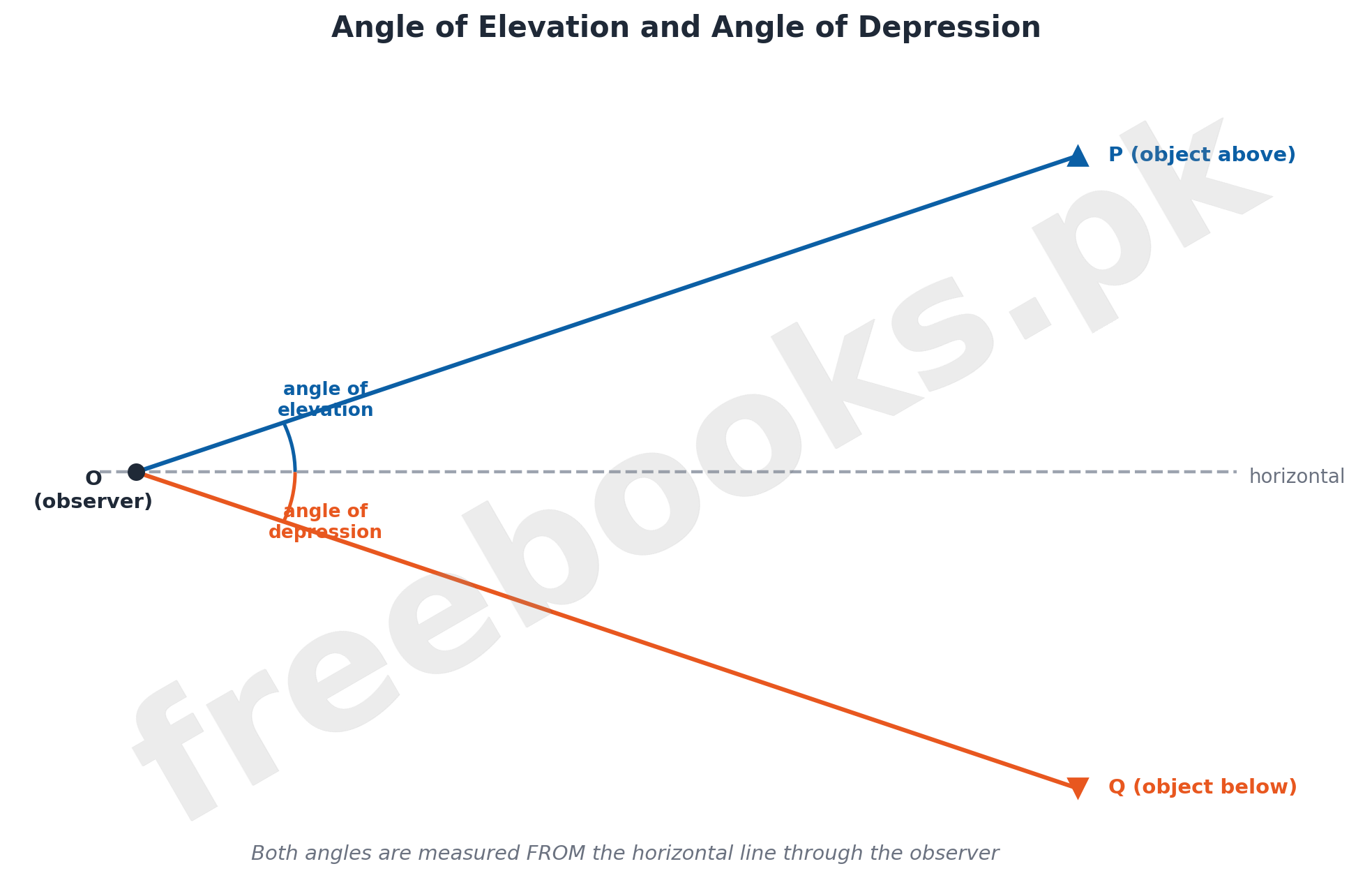
One of trigonometry's classic applications is finding heights and distances without directly measuring them. If a horizontal line is drawn through an observer's eye, the angle of elevation is the angle between that horizontal line and the line of sight up to an object above it; the angle of depression is the angle between the horizontal line and the line of sight down to an object below it. Both are measured FROM the horizontal line. Once such an angle is known along with one distance (e.g. a shadow length), the tangent ratio (tan angle = opposite/adjacent) is used to solve for the unknown height or distance.
Important Definitions
What is an angle?
The union of two non-collinear rays (arms) sharing a common endpoint (vertex); rotating one ray to another anticlockwise gives a positive angle, clockwise gives a negative angle.
What is one degree?
The angle subtended at the centre of a circle by 1/360 of its circumference; 60 minutes make one degree and 60 seconds make one minute.
What is one radian?
The angle subtended at the centre of a circle by an arc whose length is equal to the circle's radius.
What is the relationship between degrees and radians?
180 degrees = pi radians, giving x degrees = x(pi/180) radians and y radians = y(180/pi) degrees.
What is a sector of a circle?
The region of a circle bounded by two radii and the arc between them.
What are coterminal angles?
Two or more angles that share the same initial side and the same terminal side, differing by a whole number of complete revolutions (360k degrees or 2k*pi radians, k an integer).
What is an angle in standard position?
An angle whose vertex is at the origin and whose initial side lies along the positive x-axis of a coordinate system.
What is a quadrantal angle?
An angle in standard position whose terminal side falls exactly on the x-axis or y-axis — i.e. 90, 180, 270, or 360 degrees.
How are sine and cosine defined using the unit circle?
For angle theta in standard position with terminal side meeting the unit circle at P(x,y): cos theta = x (the x-coordinate of P) and sin theta = y (the y-coordinate of P).
What is the angle of elevation?
The angle between a horizontal line through an observer and the line of sight up to an object located above that horizontal line.
Key Facts and Relations
| Topic | Key Fact / Relation |
|---|---|
| Degree to radian | x degrees = x(pi/180) radians |
| Radian to degree | y radians = y(180/pi) degrees |
| Arc length | l = r*theta (theta in radians) |
| Area of a sector | Area = (1/2) r^2 theta (theta in radians) |
| Unit circle definitions | cos theta = x, sin theta = y |
| Quotient identities | tan theta = sin theta / cos theta, cot theta = cos theta / sin theta |
| Reciprocal identities | sec theta = 1/cos theta, cosec theta = 1/sin theta, cot theta = 1/tan theta |
| Pythagorean identity I | cos^2(theta) + sin^2(theta) = 1 |
| Pythagorean identity II | 1 + tan^2(theta) = sec^2(theta) |
| Pythagorean identity III | 1 + cot^2(theta) = cosec^2(theta) |
| Coterminal (general) angle | theta + 360k degrees or theta + 2k*pi radians, k an integer |
| Special values (30, 45, 60 degrees) | sin30=1/2, sin45=1/sqrt(2), sin60=sqrt(3)/2 (cos mirrors: cos30=sqrt(3)/2, cos60=1/2) |
Diagrams
Unit Circle and Trigonometric Ratios: A unit circle with an angle theta in standard position, showing point P(x,y) on the circle, the right triangle formed by dropping a perpendicular to the x-axis, and how cos theta and sin theta correspond to the x- and y-coordinates of P
ASTC: Signs of Trigonometric Ratios by Quadrant: A quadrant diagram showing which trigonometric ratios are positive in each of the four quadrants, following the ASTC (All, Sine, Tangent, Cosine) rule
Angle of Elevation and Angle of Depression: A diagram showing an observer's horizontal line of sight, with the angle of elevation measured up to an object above and the angle of depression measured down to an object below
Short Questions & Answers
Define one radian.
One radian is the angle subtended at the centre of a circle by an arc whose length is equal to the circle's radius.
What is the relationship between 180 degrees and pi radians?
180 degrees = pi radians; this is the key relationship used to convert between degrees and radians.
Define coterminal angles.
Coterminal angles are two or more angles that share the same initial side and the same terminal side, differing by a whole number of complete revolutions.
What is a quadrantal angle?
A quadrantal angle is an angle in standard position whose terminal side falls exactly on the x-axis or y-axis, i.e. 90, 180, 270, or 360 degrees.
State the ASTC rule.
ASTC ('Add Sugar To Coffee') states that All ratios are positive in Quadrant I, Sine (and cosecant) in Quadrant II, Tangent (and cotangent) in Quadrant III, and Cosine (and secant) in Quadrant IV.
Define angle of elevation.
The angle of elevation is the angle between a horizontal line through an observer and the line of sight up to an object located above that line.
Long Questions & Answers
Explain how an angle is measured in the sexagesimal and circular systems, and how the length of an arc and the area of a sector are found.
What is the sexagesimal system of angle measurement?
The sexagesimal system divides a circle's circumference into 360 equal arcs, each subtending one degree; 60 seconds make one minute and 60 minutes make one degree, with 90 degrees equal to one right angle and 360 degrees equal to one complete revolution.
How is an angle converted between D M S form and decimal degrees?
To convert to decimal, divide the minutes by 60 and the seconds by 3600 and add these to the whole degrees (e.g. 25 deg 30' = 25 + 30/60 = 25.5 degrees). To convert back, multiply the decimal fraction of a degree by 60 to get minutes, and any remaining decimal fraction of a minute by 60 to get seconds.
What is a radian, and how are degrees and radians related?
A radian is the angle subtended by an arc equal in length to the circle's radius. Since a full revolution equals 2*pi radians and also 360 degrees, the key relationship is 180 degrees = pi radians, giving x degrees = x(pi/180) radians and y radians = y(180/pi) degrees.
How is the length of a circular arc calculated?
Because central angles are proportional to their arc lengths, comparing an arc l (subtending theta radians) to the one-radian arc (length r) gives l = r*theta, where theta must be in radians.
How is the area of a sector of a circle calculated?
By proportion, (area of sector)/(area of circle) = theta/(2*pi), so Area of sector = (theta/2*pi) * pi*r^2 = (1/2)*r^2*theta, again with theta measured in radians.
Explain how the six trigonometric ratios are defined using the unit circle, and how their signs and values are determined in different quadrants.
How are the six trigonometric ratios defined using a point on the unit circle?
For angle theta in standard position with terminal side meeting the unit circle at P(x,y): cos theta = x and sin theta = y directly; then tan theta = y/x, cot theta = x/y, sec theta = 1/x, and cosec theta = 1/y, giving the reciprocal identities connecting each ratio to its reciprocal.
What are the exact values of the trigonometric ratios for 30, 45, and 60 degrees?
From an isosceles right triangle (legs 1, hypotenuse sqrt(2)): sin45 = cos45 = 1/sqrt(2), tan45 = 1. From an equilateral triangle of side 2 bisected into 30-60-90 triangles (height sqrt(3)): sin30 = 1/2, cos30 = sqrt(3)/2, tan30 = 1/sqrt(3), and sin60 = sqrt(3)/2, cos60 = 1/2, tan60 = sqrt(3).
How is the sign of a trigonometric ratio determined in each quadrant (the ASTC rule)?
Since r is always positive, signs depend only on x and y in that quadrant: All ratios positive in QI (x,y both positive), Sine/cosecant positive in QII (x negative, y positive), Tangent/cotangent positive in QIII (x,y both negative), Cosine/secant positive in QIV (x positive, y negative) — remembered as ASTC, 'Add Sugar To Coffee'.
How can the remaining trigonometric ratios be found if one ratio is known?
Treat the known ratio as two sides of a right triangle, use the Pythagorean theorem to find the third side, then read off the remaining ratios directly — using the given quadrant (or sign information) to assign the correct positive or negative sign to each result.
What are the Pythagorean identities, and how are they used to simplify trigonometric expressions?
From x^2+y^2=r^2, dividing by r^2 gives cos^2(theta)+sin^2(theta)=1; dividing by x^2 gives 1+tan^2(theta)=sec^2(theta); dividing by y^2 gives 1+cot^2(theta)=cosec^2(theta). These three identities are used to rewrite trigonometric expressions in simpler or equivalent forms, usually by first converting everything to sin theta and cos theta.
Multiple Choice Questions (MCQs)
One radian is the angle subtended by an arc whose length equals: (A) The diameter (B) The radius (C) The circumference (D) Half the radius
Correct answer: (B) The radius. One radian is defined as the angle subtended at the centre of a circle by an arc equal in length to the radius.
180 degrees is equal to: (A) pi/2 radians (B) pi radians (C) 2*pi radians (D) pi/4 radians
Correct answer: (B) pi radians. The key relationship linking the two angle systems is 180 degrees = pi radians.
The length of a circular arc is given by the formula: (A) l = r*theta (B) l = r/theta (C) l = r^2*theta (D) l = 2*pi*r
Correct answer: (A) l = r*theta. Arc length is given by l = r*theta, where theta is the central angle measured in radians.
The area of a sector of a circle is given by: (A) pi*r^2 (B) (1/2)*r^2*theta (C) r*theta (D) 2*pi*r*theta
Correct answer: (B) (1/2)*r^2*theta. The area of a sector is Area = (1/2)*r^2*theta, with theta measured in radians.
Two angles with the same initial and terminal sides are called: (A) Quadrantal angles (B) Coterminal angles (C) Standard angles (D) Reference angles
Correct answer: (B) Coterminal angles. Angles sharing the same initial and terminal sides are called coterminal angles.
On the unit circle, cos theta is defined as: (A) The y-coordinate of P (B) The x-coordinate of P (C) The radius (D) The arc length
Correct answer: (B) The x-coordinate of P. By definition on the unit circle, cos theta is the x-coordinate of the point P where the terminal side meets the circle.
In which quadrant are all six trigonometric ratios positive? (A) I (B) II (C) III (D) IV
Correct answer: (A) I. In Quadrant I, both x and y are positive, so all six trigonometric ratios are positive there.
The value of tan 45 degrees is: (A) 0 (B) 1 (C) sqrt(3) (D) Undefined
Correct answer: (B) 1. From the isosceles right triangle with legs 1 and 1, tan45 = 1/1 = 1.
Which of the following is a Pythagorean identity? (A) sin theta = 1/cosec theta (B) cos^2(theta) + sin^2(theta) = 1 (C) tan theta = sin theta/cos theta (D) l = r*theta
Correct answer: (B) cos^2(theta) + sin^2(theta) = 1. cos^2(theta) + sin^2(theta) = 1 is one of the three Pythagorean identities, derived from x^2+y^2=r^2.
The angle measured downward from a horizontal line to an object is called the angle of: (A) Elevation (B) Standard position (C) Depression (D) Rotation
Correct answer: (C) Depression. The angle measured from the horizontal down to an object below is called the angle of depression.
Quick Revision Summary
- Angle: union of two rays sharing a vertex; positive if anticlockwise, negative if clockwise
- Degree: 60''=1', 60'=1 degree, 90 degrees=1 right angle, 360 degrees=1 revolution
- Radian: angle subtended by an arc of length = radius | 180 degrees = pi radians
- Conversion: x degrees = x(pi/180) radians | y radians = y(180/pi) degrees
- Arc length l = r*theta | Area of sector = (1/2)*r^2*theta (theta in radians)
- Coterminal (general) angle: theta + 360k degrees or theta + 2k*pi radians, k an integer
- Standard position: vertex at origin, initial side on positive x-axis
- Quadrants: I(0-90deg), II(90-180deg), III(180-270deg), IV(270-360deg) | Quadrantal angles: 90,180,270,360 deg
- Unit circle: cos theta = x, sin theta = y | tan theta = y/x, cot theta = x/y, sec theta = 1/x, cosec theta = 1/y
- ASTC rule: All +ve in QI, Sine(&cosec) +ve in QII, Tangent(&cot) +ve in QIII, Cosine(&sec) +ve in QIV
- Pythagorean identities: cos^2(theta)+sin^2(theta)=1, 1+tan^2(theta)=sec^2(theta), 1+cot^2(theta)=cosec^2(theta)
- Angle of elevation (looking up) and angle of depression (looking down), both measured from a horizontal line
Exam Tips
- Always confirm whether an angle is given in degrees or radians before applying a formula — mixing the two is the most common trigonometry mistake
- Memorize just the two special triangles (45-45-90 and 30-60-90) instead of a full values table — every special-angle value can be derived from them
- Use the mnemonic 'Add Sugar To Coffee' (ASTC) to instantly recall which two ratios are positive in each quadrant
- When one ratio is given, sketch a quick right triangle using its numerator and denominator as two sides, then find the third side with the Pythagorean theorem
- For identity proofs, convert everything to sin theta and cos theta first — most identities simplify almost immediately once written this way
- In elevation/depression problems, draw the horizontal reference line first — the angle is always measured FROM that line, never from the vertical