
This unit revisits sets — well-defined collections of objects — and builds up the formal machinery used throughout higher mathematics to combine and compare them: union, intersection, difference, and complement, followed by seven fundamental properties (commutative, associative, and distributive laws, plus De Morgan's laws) that these operations obey, each provable directly from the definitions using basic logic. Venn diagrams, introduced by John Venn, give a visual way to represent these operations and to verify the same properties geometrically by shading regions.
The unit then moves from sets to relations and functions: ordered pairs and the Cartesian product of two sets form the foundation for defining a binary relation as any subset of a Cartesian product, and a function as a special, more restrictive kind of relation where every element of the domain maps to exactly one element of the range. The unit closes by classifying functions into four key types — into, one-one (injective), onto (surjective), and bijective (one-one and onto) — which describe exactly how the elements of one set correspond to the elements of another.
Learning Objectives
- Recall the standard number sets N, W, Z, E, O, P, and Q, and recognize the set operations union, intersection, difference, and complement
- Perform union, intersection, difference, and complement operations on given sets
- State and prove the commutative, associative, and distributive properties of union and intersection, and De Morgan's laws
- Verify these fundamental properties for specific given sets by direct computation
- Use Venn diagrams to represent union, intersection, and complement, and to verify the fundamental properties
- Recognize ordered pairs and compute the Cartesian product of two sets
- Define a binary relation and identify its domain and range
- Define a function and identify its domain, co-domain, and range
- Distinguish into, one-one, onto, and bijective functions, and examine whether a given relation is a function
- Differentiate between a one-one function and a one-to-one correspondence
Key Concepts
5.1 Sets and Basic Operations
A set is a well-defined collection of objects, denoted by capital letters. Standard number sets used throughout mathematics include N (natural numbers, 1,2,3,…), W (whole numbers, 0,1,2,3,…), Z (integers), E and O (even and odd integers), P (prime numbers), Q (rational numbers, expressible as m/n with m,n integers and n not 0), Q' (irrational numbers), and R = Q union Q' (real numbers).
Four operations combine or compare sets. Union A union B is the set of elements in A, in B, or in both. Intersection A intersect B is the set of elements common to both A and B. Difference A – B (or AB) is the set of elements in A but NOT in B. Complement A' (relative to a universal set U) is the set of elements in U but not in A, i.e. A' = U – A. Each is computed directly by listing which elements of the given sets satisfy the operation's defining condition.
5.2 Properties of Union and Intersection
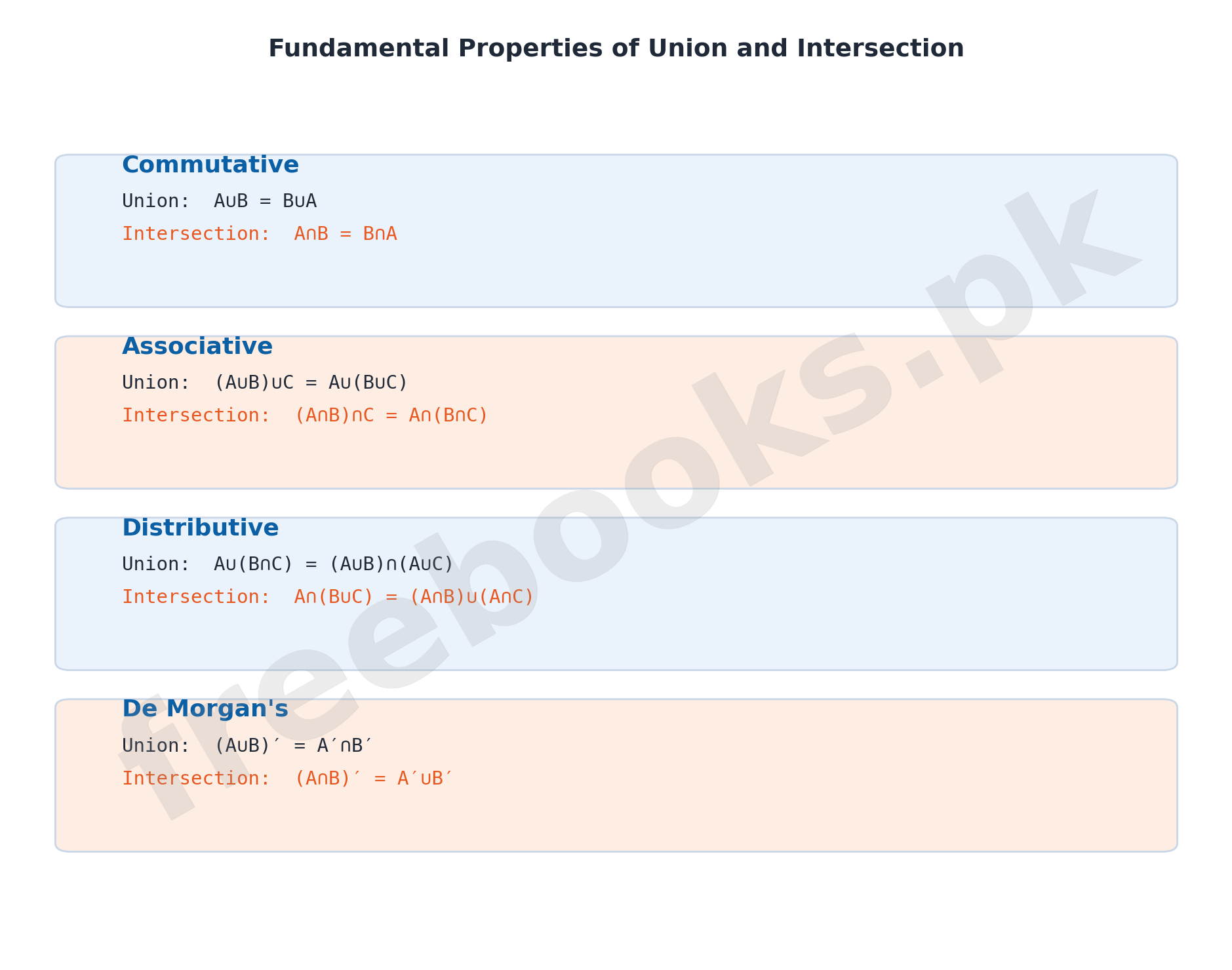
Union and intersection obey several fundamental properties, each provable using the 'double subset' method: show every element of the left side is in the right side, and vice versa, so the two sets are equal. Commutative property: A union B = B union A, and A intersect B = B intersect A (order doesn't matter). Associative property: (A union B) union C = A union (B union C), and similarly for intersection (grouping doesn't matter).
Distributive property of union over intersection: A union (B intersect C) = (A union B) intersect (A union C). Distributive property of intersection over union: A intersect (B union C) = (A intersect B) union (A intersect C). De Morgan's laws connect complement with union/intersection: (A union B)' = A' intersect B', and (A intersect B)' = A' union B' — the complement of a union is the intersection of the complements, and vice versa. All seven properties can also be VERIFIED (not just proved abstractly) for specific given sets by computing both sides directly and checking they match.
5.3 Venn Diagrams
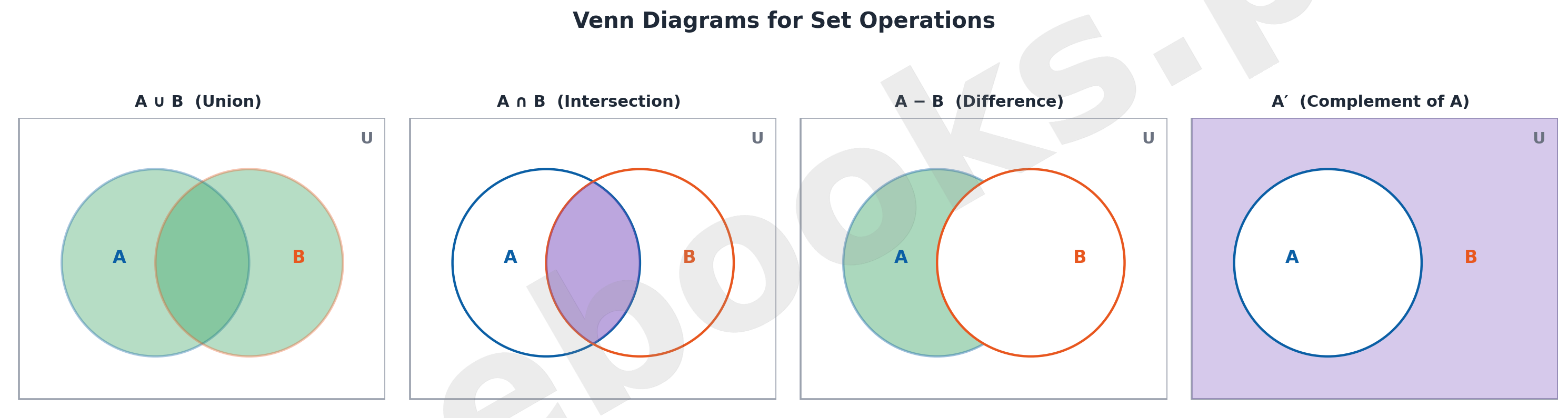
A Venn diagram, introduced by British mathematician John Venn, represents a universal set U as a rectangle, with its subsets A, B, etc. drawn as closed figures (usually circles) inside it. Union, intersection, difference, and complement are all represented by shading the appropriate region: union shades everything in either circle, intersection shades only the overlapping region, and complement shades everything in the rectangle outside the given circle.
Venn diagrams also give a visual way to VERIFY the fundamental properties: draw the region for each side of a property (e.g. A union B using horizontal shading, B union A using vertical shading), and confirm the shaded regions are identical. This method is especially useful for checking De Morgan's laws and the distributive laws, where the algebraic proof involves several steps but the diagram makes the equality immediately visible.
5.4 Ordered Pairs and Cartesian Product
An ordered pair (x, y) is a pair of numbers where ORDER matters — (x,y) is generally different from (y,x) unless x = y, and two ordered pairs (x,y) and (s,t) are equal only when x=s AND y=t simultaneously. This differs from a set, where {x,y} = {y,x} always.
The Cartesian product of two non-empty sets A and B, written A times B, is the set of ALL ordered pairs (x,y) where x is from A and y is from B. If A has m elements and B has n elements, then A times B has exactly m times n ordered pairs. In general A times B is NOT equal to B times A (unless A = B), since swapping the sets changes which set each coordinate comes from.
5.5 Binary Relations
A binary relation R from set A into set B is any subset of the Cartesian product A times B — i.e., any collection of ordered pairs (x,y) with x from A and y from B, selected according to some rule or condition connecting x and y (such as y = 2x, or x+y = 6).
The domain of a relation R, written Dom R, is the set of all FIRST elements appearing in R's ordered pairs (a subset of A). The range of R, written Rang R, is the set of all SECOND elements appearing in R's ordered pairs (a subset of B). Both are found simply by listing the first and second coordinates of every ordered pair in the relation.
5.6 Functions: Domain, Co-domain, Range, and Types
A function f: A to B is a special kind of relation satisfying two conditions: Dom f = A (every element of A appears as a first coordinate), and every x in A appears in exactly ONE ordered pair of f (no element of A maps to two different outputs). Equivalently, every x in A is assigned a unique image y = f(x) in B. Here A is called the domain, B the co-domain, and the actual set of outputs achieved is the range (a subset of, or equal to, the co-domain).
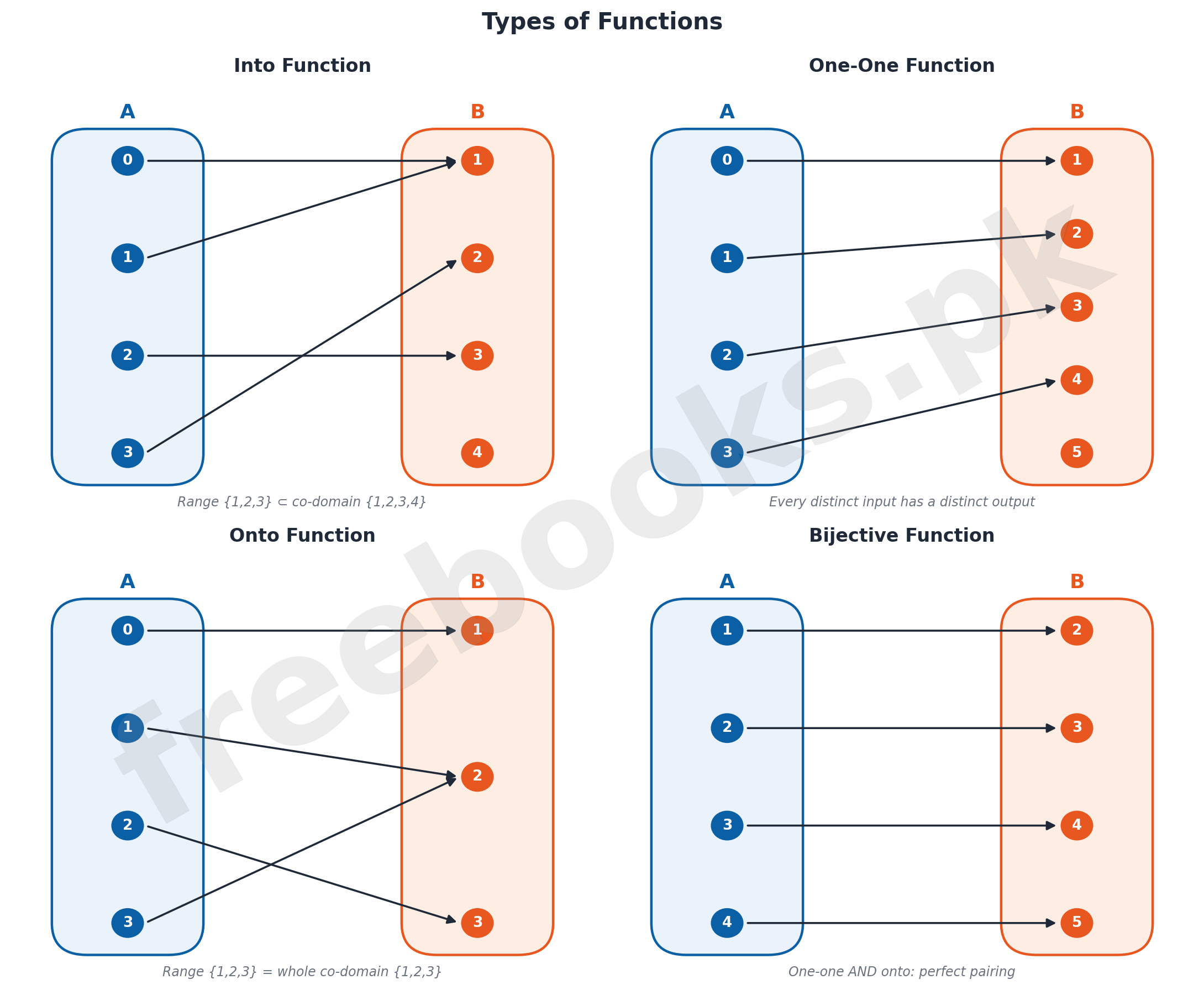
Functions are classified into four key types based on how domain elements map to co-domain elements. An into function has range strictly smaller than the co-domain (some element of B is never used). A one-one (injective) function has every distinct input mapping to a distinct output (f(x1)=f(x2) forces x1=x2). An onto (surjective) function has range EQUAL to the co-domain (every element of B is used at least once). A bijective function (one-to-one correspondence) is both one-one AND onto simultaneously — every element of A pairs with exactly one element of B and vice versa. Every function is a relation, but not every relation is a function; and a function need not be one-one or onto unless specifically shown to be.
Important Definitions
What is a set?
A well-defined collection of objects, denoted by a capital letter such as A, B, or C.
What is the union of two sets A and B?
The set of all elements that are in A, in B, or in both: A ∪ B = {x | x ∈ A or x ∈ B}.
What is the intersection of two sets A and B?
The set of all elements common to both A and B: A ∩ B = {x | x ∈ A and x ∈ B}.
What is the complement of a set A?
The set of elements in the universal set U that are not in A: A' = U – A.
What is an ordered pair?
A pair of numbers (x, y) in which the order matters, so (x,y) is generally different from (y,x) unless x = y.
What is the Cartesian product of sets A and B?
The set A × B of all ordered pairs (x,y) with x ∈ A and y ∈ B; if A has m elements and B has n elements, A × B has m×n ordered pairs.
What is a binary relation from set A to set B?
Any subset R of the Cartesian product A × B, consisting of ordered pairs connecting elements of A to elements of B.
What is a function f: A → B?
A relation where Dom f = A and every element of A is paired with exactly one (unique) element of B.
What is a one-one (injective) function?
A function where distinct elements of the domain always map to distinct elements of the co-domain: f(x1)=f(x2) implies x1=x2.
What is a bijective function?
A function that is both one-one and onto — every element of A corresponds to exactly one element of B, and vice versa.
Key Facts and Relations
| Topic | Key Fact / Relation |
|---|---|
| Union | A ∪ B = {x | x ∈ A or x ∈ B} |
| Intersection | A ∩ B = {x | x ∈ A and x ∈ B} |
| Difference | A – B = {x | x ∈ A and x ∉ B} |
| Complement | A' = U – A |
| Commutative laws | A∪B = B∪A, A∩B = B∩A |
| Associative laws | (A∪B)∪C = A∪(B∪C), (A∩B)∩C = A∩(B∩C) |
| Distributive laws | A∪(B∩C) = (A∪B)∩(A∪C), A∩(B∪C) = (A∩B)∪(A∩C) |
| De Morgan's laws | (A∪B)' = A'∩B', (A∩B)' = A'∪B' |
| Cartesian product size | |A × B| = |A| × |B| |
| Function condition | Dom f = A, and every x ∈ A has exactly one image f(x) ∈ B |
Diagrams
Venn Diagrams for Set Operations: A four-panel Venn diagram showing union, intersection, difference, and complement of two sets A and B inside a universal set U, with the relevant region shaded in each panel
Fundamental Properties Summary: A summary chart listing the commutative, associative, distributive, and De Morgan's properties of union and intersection side by side
Types of Functions: A comparison diagram of mapping arrows between two sets showing an into function, a one-one function, an onto function, and a bijective function
Short Questions & Answers
Define the union of two sets.
A ∪ B is the set of all elements that are in A, in B, or in both.
Define the intersection of two sets.
A ∩ B is the set of all elements common to both A and B.
What is the complement of a set A relative to universal set U?
A' = U – A, the set of elements in U that are not in A.
State De Morgan's first law.
(A ∪ B)' = A' ∩ B' — the complement of a union equals the intersection of the complements.
What condition makes a relation a function?
Its domain equals the whole starting set A, and every element of A has exactly one image in B.
Define a bijective function.
A function that is both one-one and onto — every element of A corresponds to exactly one element of B, and vice versa.
Long Questions & Answers
State the fundamental properties of union and intersection of sets (commutative, associative, distributive, De Morgan's), and explain how they are proved and verified.
What are the commutative and associative properties of union and intersection?
Commutative: A∪B=B∪A and A∩B=B∩A (order doesn't matter). Associative: (A∪B)∪C=A∪(B∪C) and (A∩B)∩C=A∩(B∩C) (grouping doesn't matter). Both are proved by showing an arbitrary element of the left side is always in the right side, and vice versa (the 'double subset' method).
What are the distributive properties connecting union and intersection?
Union distributes over intersection: A∪(B∩C)=(A∪B)∩(A∪C). Intersection distributes over union: A∩(B∪C)=(A∩B)∪(A∩C). Each is proved the same double-subset way, breaking 'x is in A or (in B and in C)' into the equivalent 'x is in (A or B) and (A or C)' using basic logic.
What are De Morgan's laws?
(A∪B)'=A'∩B' (the complement of a union is the intersection of the complements) and (A∩B)'=A'∪B' (the complement of an intersection is the union of the complements). They are proved by translating 'x is not in A∪B' into 'x is not in A AND not in B', which is exactly the definition of x being in A'∩B'.
How is a property PROVED versus VERIFIED?
A proof shows the property holds for ANY sets A, B, C in general, using the double-subset method and the definitions of the operations. Verification instead picks SPECIFIC given sets, computes both sides of the property directly by listing elements, and confirms the two resulting sets are identical — a proof establishes the general law, verification just checks one example obeys it.
How does a Venn diagram help verify these properties?
Each side of a property is drawn as a shaded region inside the universal-set rectangle (e.g. using horizontal lines for one side, vertical lines for the other); if the two shaded regions cover exactly the same area, the property is visually confirmed for any sets in that general configuration, without needing to list elements algebraically.
Explain ordered pairs, the Cartesian product, binary relations, and how a function is defined and classified into different types.
What is an ordered pair, and how does it differ from a set?
An ordered pair (x,y) is written with order mattering, so (x,y) generally differs from (y,x) unless x=y, and (x,y)=(s,t) only when x=s and y=t together. This differs from a set {x,y}, where the order of listing elements never matters.
What is the Cartesian product of two sets?
For non-empty sets A and B, A×B is the set of all ordered pairs (x,y) with x from A and y from B. If A has m elements and B has n elements, A×B has m×n ordered pairs, and in general A×B is not equal to B×A.
What is a binary relation, and what are its domain and range?
A binary relation R from A to B is any subset of A×B. Its domain, Dom R, is the set of all first elements of its ordered pairs; its range, Rang R, is the set of all second elements — both found by listing the first and second coordinates of every pair in R.
What conditions must a relation satisfy to be a function?
A relation f:A→B is a function only if its domain equals the entire set A (every element of A is used), AND every element of A appears in exactly one ordered pair of f (no element of A has two different images) — equivalently, every x in A has a unique image y=f(x) in B.
What are the four key types of functions?
An into function has range strictly smaller than the co-domain. A one-one (injective) function sends distinct inputs to distinct outputs. An onto (surjective) function has range equal to the whole co-domain. A bijective function (one-to-one correspondence) is both one-one and onto at once, pairing every element of A with exactly one element of B and vice versa.
Multiple Choice Questions (MCQs)
A ∪ B is the set of elements that are: (A) Only in A (B) Only in B (C) In A, in B, or in both (D) In neither A nor B
Correct answer: (C) In A, in B, or in both. Union collects every element that belongs to A, to B, or to both sets.
A ∩ B is the set of elements that are: (A) In A or B (B) Common to both A and B (C) In A but not B (D) In neither set
Correct answer: (B) Common to both A and B. Intersection consists only of the elements shared by both A and B.
The complement A' of a set A (relative to U) is defined as: (A) A ∪ U (B) A ∩ U (C) U – A (D) A – U
Correct answer: (C) U – A. A' is everything in the universal set U that is not in A, i.e. U – A.
Which property states A ∪ B = B ∪ A? (A) Associative (B) Distributive (C) Commutative (D) De Morgan's
Correct answer: (C) Commutative. The commutative property says the order of union (or intersection) doesn't affect the result.
De Morgan's law states that (A ∪ B)' equals: (A) A' ∪ B' (B) A' ∩ B' (C) A ∩ B (D) A ∪ B
Correct answer: (B) A' ∩ B'. By De Morgan's law, the complement of a union is the intersection of the individual complements.
An ordered pair (x, y) is equal to (s, t) only when: (A) x = t and y = s (B) x = s and y = t (C) x + y = s + t (D) Never equal
Correct answer: (B) x = s and y = t. Two ordered pairs are equal only when their corresponding first and second coordinates both match.
If set A has 4 elements and set B has 3 elements, then A × B has: (A) 7 elements (B) 12 elements (C) 4 elements (D) 3 elements
Correct answer: (B) 12 elements. The Cartesian product A×B has |A|×|B| ordered pairs, so 4×3 = 12.
A binary relation from A to B is defined as: (A) Any element of A (B) Any subset of A × B (C) Any subset of A (D) A function only
Correct answer: (B) Any subset of A × B. A binary relation is any subset of the Cartesian product A×B, connecting elements of A to elements of B.
A function f: A → B must satisfy: (A) Dom f = B only (B) Every element of A has exactly one image in B (C) Range f = B always (D) A and B must be equal
Correct answer: (B) Every element of A has exactly one image in B. A function requires the domain to equal A and every element of A to map to exactly one unique image in B.
A function that is both one-one and onto is called: (A) Into (B) Injective only (C) Bijective (D) Not a function
Correct answer: (C) Bijective. A bijective function (one-to-one correspondence) is one that is simultaneously one-one and onto.
Quick Revision Summary
- Union A∪B: elements in A or B or both | Intersection A∩B: elements common to both
- Difference A-B: in A but not B | Complement A': U – A
- Commutative: A∪B=B∪A, A∩B=B∩A | Associative: grouping doesn't matter
- Distributive: A∪(B∩C)=(A∪B)∩(A∪C), A∩(B∪C)=(A∩B)∪(A∩C)
- De Morgan's: (A∪B)'=A'∩B', (A∩B)'=A'∪B'
- Venn diagrams: shade regions to represent AND verify set operations/properties
- Ordered pair (x,y): order matters, unlike a set {x,y}
- Cartesian product A×B: all ordered pairs (x,y), x∈A, y∈B; size = |A|×|B|
- Binary relation: any subset of A×B; Dom R = first elements, Rang R = second elements
- Function: Dom f = A, and every x∈A has exactly ONE image in B
- Function types: into (range ⊂ co-domain), one-one (distinct→distinct), onto (range=co-domain), bijective (both)
Exam Tips
- When computing set operations, always list the elements clearly first — mistakes usually come from rushing the listing step
- Remember A – B and B – A are generally different — subtraction order matters just like with ordered pairs
- For proofs, always use the double-subset method: show left ⊆ right, then right ⊆ left, then conclude equality
- When verifying with Venn diagrams, use different shading styles (horizontal, vertical, crossed) for each side of the property being checked
- To check if a relation is a function, verify BOTH conditions: every domain element is used, AND no domain element repeats with a different output
- Memorize the four function types together as a group — into/onto describe the RANGE, one-one/bijective describe how inputs MAP to outputs