
A quadratic equation is a second-degree equation in one variable — the highest power of the unknown is 2, never higher. Quadratic equations are the gateway from linear algebra to the wider study of polynomial equations, and this unit builds the three core solution techniques (factorization, completing the square, and the quadratic formula) before extending them to more complicated equation types that LOOK unlike a quadratic on the surface but can be reduced to one by a clever substitution.
This unit also introduces radical equations — equations where the variable sits under a square-root sign — and the important idea of an extraneous root: a value that satisfies the squared/simplified version of an equation but fails to satisfy the original equation, and must therefore be rejected after checking.
Learning Objectives
- Define a quadratic equation and write it in standard form
- Solve a quadratic equation by factorization
- Solve a quadratic equation by completing the square
- Derive the quadratic formula using the method of completing the square
- Solve a quadratic equation using the quadratic formula
- Solve equations of the type ax^4 + bx^2 + c = 0 by reducing them to quadratic form
- Solve equations of the type ap(x) + b/p(x) = c by substitution
- Solve reciprocal equations of the type a(x^2 + 1/x^2) + b(x + 1/x) + c = 0
- Solve exponential equations where the variable occurs in the exponent
- Solve equations of the type (x+a)(x+b)(x+c)(x+d) = k where a+b = c+d
- Solve radical equations and check for extraneous roots
Key Concepts
1.1 Quadratic Equation
An equation that contains the square of the unknown quantity, but no higher power, is called a quadratic equation, or an equation of the second degree. Its standard (general) form is ax^2 + bx + c = 0, where a is not equal to 0 and a, b, c are real numbers — here a is the coefficient of x^2, b is the coefficient of x, and c is the constant term. For example, x^2 – 7x + 6 = 0 is already in standard form, while 3x^2 + 4x = 5 is not (it must first be rearranged to 3x^2 + 4x – 5 = 0).
If b = 0 in ax^2 + bx + c = 0, the equation is called a pure quadratic equation — for example x^2 – 16 = 0 and 4x^2 = 7. If instead a = 0, the equation collapses to a linear equation bx + c = 0, since the x^2 term disappears entirely — this is why the condition a not equal to 0 is essential to the definition.
1.2 Solving by Factorization and Completing the Square
Factorization method: write the equation in standard form ax^2 + bx + c = 0. Find two numbers r and s such that r + s = b and r*s = a*c; then ax^2 + bx + c splits into two linear factors, and setting each factor to zero gives the two roots. For example, to solve 3x^2 – 7x – 20 = 0, since -12 + 5 = -7 and -12 * 5 = -60 = 3*(-20), the equation becomes 3x^2 – 12x + 5x – 20 = 0, which factors as (x-4)(3x+5) = 0, giving x = 4 or x = -5/3.
Completing the square method: shift the constant term to the right-hand side, then add the square of (half the coefficient of x) to both sides so the left side becomes a perfect square trinomial. For x^2 – 3x – 4 = 0, shifting gives x^2 – 3x = 4; adding (-3/2)^2 = 9/4 to both sides gives (x – 3/2)^2 = 25/4; taking the square root of both sides gives x – 3/2 = +/-5/2, so x = 4 or x = -1. If the coefficient of x^2 is not 1, every term is first divided by that coefficient before completing the square.
1.3 The Quadratic Formula
Applying the completing-the-square method to the general equation ax^2 + bx + c = 0 (dividing throughout by a, shifting c/a to the right, then adding (b/2a)^2 to both sides) leads to the general result x = (-b +/- sqrt(b^2 – 4ac)) / 2a, a not equal to 0 — known as the quadratic formula. It solves ANY quadratic equation directly from its coefficients a, b, c, without needing to find a factorization by inspection, which makes it especially useful when the roots are irrational or when factorization is not obvious. For example, solving 5x^2 – 9x – 2 = 0 by substituting a=5, b=-9, c=-2 gives x = (9 +/- sqrt(81+40))/10 = (9 +/- 11)/10, so x = 2 or x = -1/5.
1.4 Equations Reducible to Quadratic Form
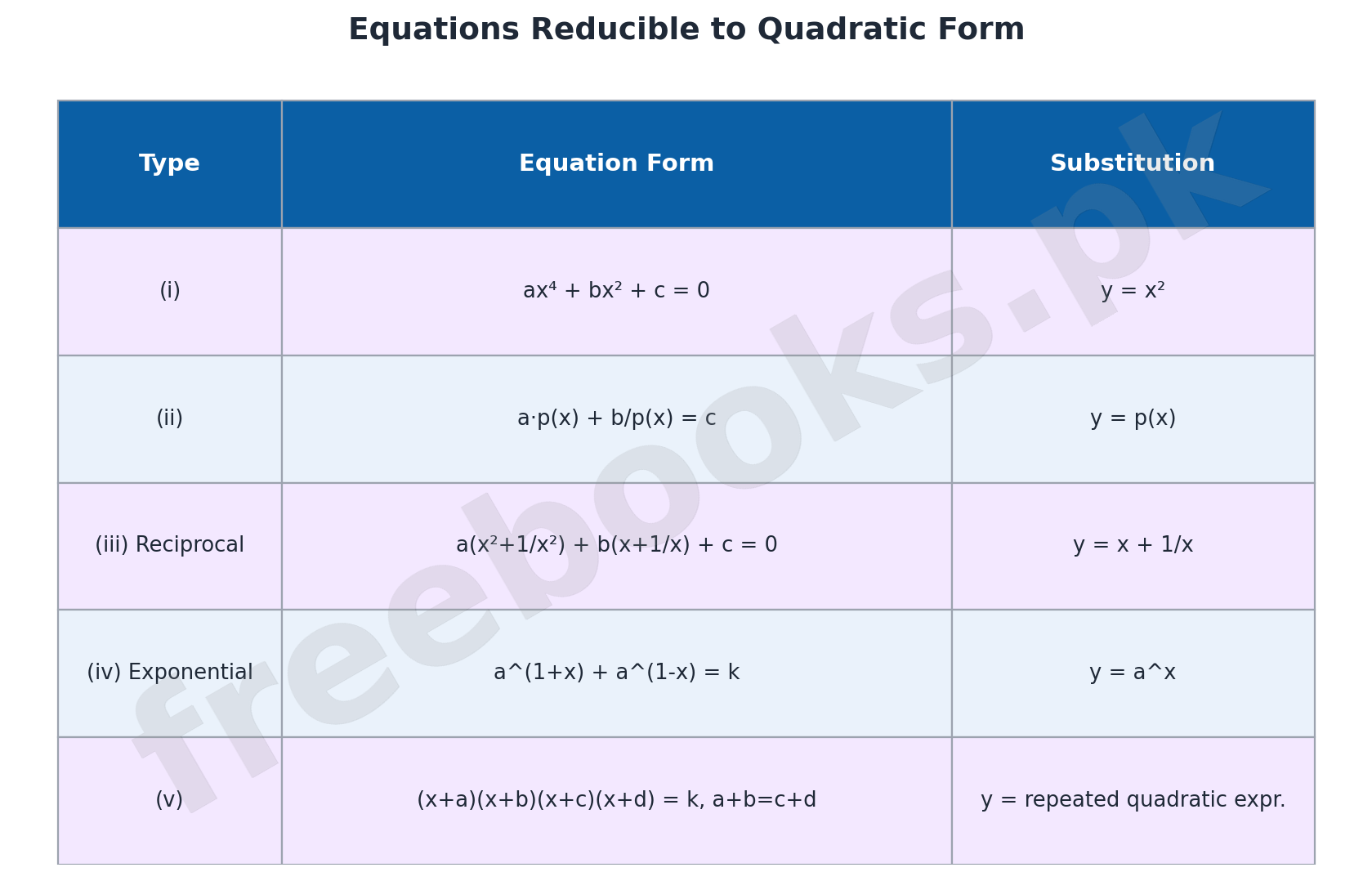
Several equation types that do not initially look quadratic can be converted into one by a suitable substitution, solved as a quadratic in the new variable, and then converted back. Type (i): ax^4 + bx^2 + c = 0 — substitute y = x^2 to get a quadratic in y, solve for y, then solve x^2 = y for x. Type (ii): a*p(x) + b/p(x) = c — substitute y = p(x) to clear the fraction into a quadratic in y. Type (iii) reciprocal equations: a(x^2 + 1/x^2) + b(x + 1/x) + c = 0 — substitute y = x + 1/x, noting that x^2 + 1/x^2 = y^2 – 2, to reduce it to a quadratic in y.
Type (iv) exponential equations: the variable appears in the exponent, e.g. 5^(1+x) + 5^(1-x) = 26; rewriting using exponent laws and substituting y = 5^x converts it into a quadratic in y. Type (v): (x+a)(x+b)(x+c)(x+d) = k, where a+b = c+d — pairing the factors as [(x+a)(x+b)][(x+c)(x+d)] and substituting y for the repeated quadratic expression that results converts the equation into a quadratic in y. In every type, the key skill is recognizing which substitution turns the given equation into a standard quadratic.
1.5 Radical Equations
An equation in which an expression involving the variable appears under a radical (square-root) sign is called a radical equation, e.g. sqrt(x+3) = x+1. The general strategy is to isolate a radical on one side and square both sides to remove it, repeating if a second radical remains, until a polynomial (usually quadratic) equation results — which is then solved by the usual methods.
Because squaring both sides of an equation can introduce extraneous roots (values that satisfy the squared equation but not the original one), every candidate solution to a radical equation MUST be substituted back into the original (unsquared) equation to check whether it genuinely satisfies it; any value that fails this check must be rejected. For example, solving sqrt(3x+7) = 2x+3 by squaring leads to 4x^2 + 9x + 2 = 0, giving x = -1/4 or x = -2; checking both in the original equation determines which (if any) must be discarded as extraneous.
Important Definitions
What is a quadratic equation?
An equation containing the square of the unknown variable but no higher power, written in standard form as ax^2 + bx + c = 0 where a is not equal to 0.
What is a pure quadratic equation?
A quadratic equation in which the coefficient of x (that is, b) is zero, so it has the form ax^2 + c = 0, e.g. x^2 – 16 = 0.
What is the standard form of a quadratic equation?
The form ax^2 + bx + c = 0, with a, b, c real numbers and a not equal to 0, where a is the coefficient of x^2, b is the coefficient of x, and c is the constant term.
What is the quadratic formula?
x = (-b +/- sqrt(b^2 – 4ac)) / 2a, a not equal to 0 — a formula that gives both roots of any quadratic equation directly from its coefficients.
What is a reciprocal equation?
An equation that remains unchanged when x is replaced by 1/x, typically of the form ax^4 + bx^3 + cx^2 + bx + a = 0.
What is a radical equation?
An equation in which an expression containing the variable appears under a square-root (radical) sign, e.g. sqrt(x+3) = x+1.
What is an extraneous root?
A value obtained while solving an equation (typically after squaring both sides) that satisfies the transformed equation but does NOT satisfy the original equation, and must therefore be rejected.
What is the solution set of an equation?
The set containing all values of the variable that satisfy the equation — for example {4, -5/3} for the equation 3x^2 – 7x – 20 = 0.
What condition on a, b, c makes ax^2+bx+c=0 a genuine quadratic equation?
The condition a is not equal to 0 — if a = 0, the x^2 term vanishes and the equation reduces to the linear equation bx + c = 0.
What substitution is used to solve a(x^2 + 1/x^2) + b(x + 1/x) + c = 0?
Let y = x + 1/x, so that x^2 + 1/x^2 = y^2 – 2; this converts the equation into a standard quadratic in y.
Key Facts and Relations
| Topic | Key Fact / Relation |
|---|---|
| Standard form | ax^2 + bx + c = 0, a not equal to 0 |
| Quadratic formula | x = (-b +/- sqrt(b^2 – 4ac)) / 2a |
| Pure quadratic equation | ax^2 + c = 0 (i.e. b = 0) |
| Factorization condition | Find r, s such that r + s = b and r*s = a*c |
| Completing the square step | Add (b/2a)^2 to both sides after shifting the constant term |
| Type ax^4+bx^2+c=0 | Substitute y = x^2 |
| Type a*p(x)+b/p(x)=c | Substitute y = p(x) |
| Reciprocal equation identity | x^2 + 1/x^2 = (x + 1/x)^2 – 2 |
| Exponential equation substitution | Substitute y = a^x for equations like a^(1+x) + a^(1-x) = k |
| Type (x+a)(x+b)(x+c)(x+d)=k | Valid when a + b = c + d; pair factors and substitute y for the repeated quadratic expression |
| Radical equation strategy | Isolate one radical, square both sides, repeat if needed, then solve the resulting polynomial equation |
| Extraneous root check | Every solution of a squared/radical equation must be verified in the ORIGINAL equation before being accepted |
Diagrams
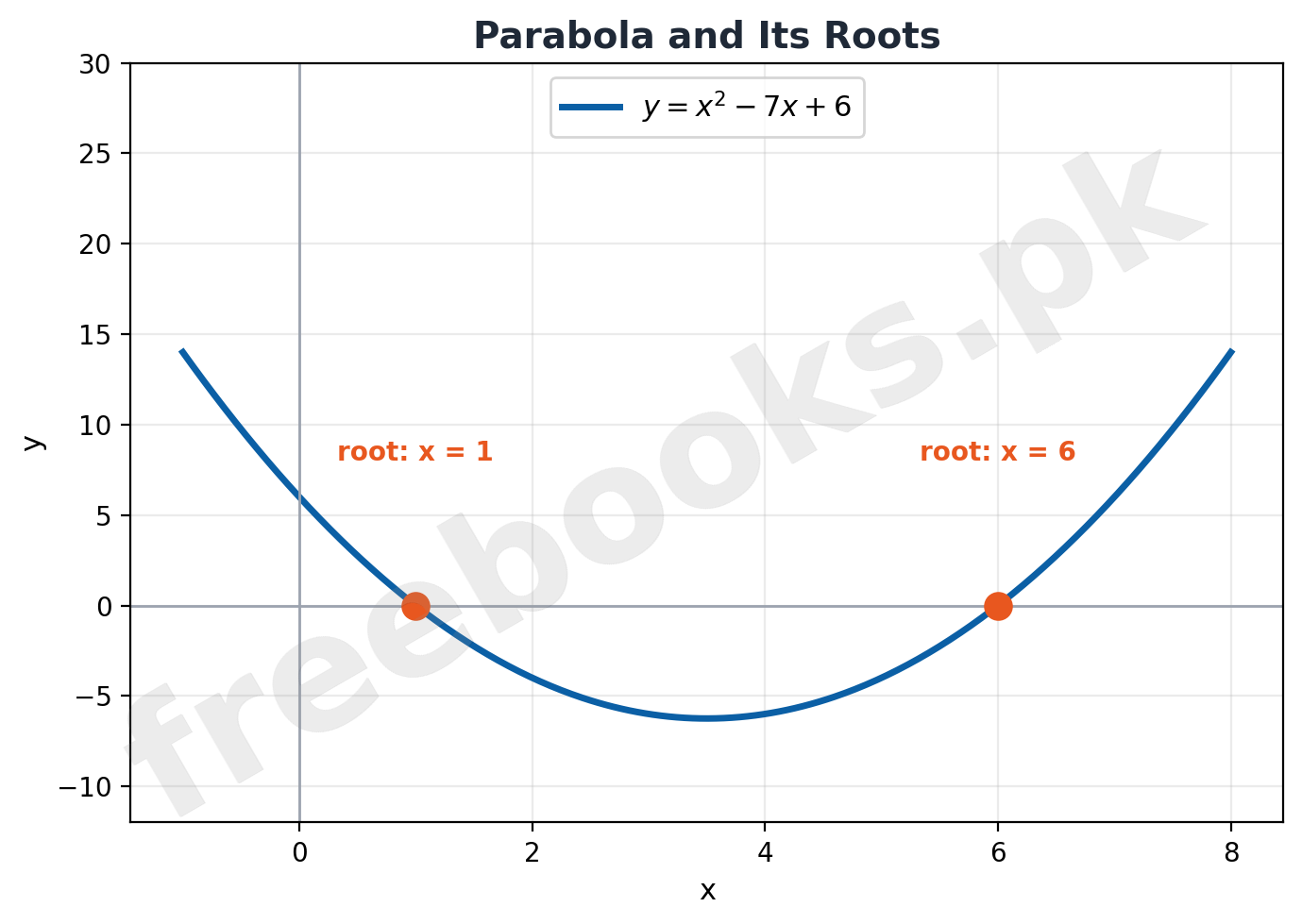
Parabola and Its Roots: A graph of y = x^2 – 7x + 6 showing the parabola crossing the x-axis at its two real roots, x = 1 and x = 6, illustrating that the roots of a quadratic equation are exactly the x-intercepts of its graph
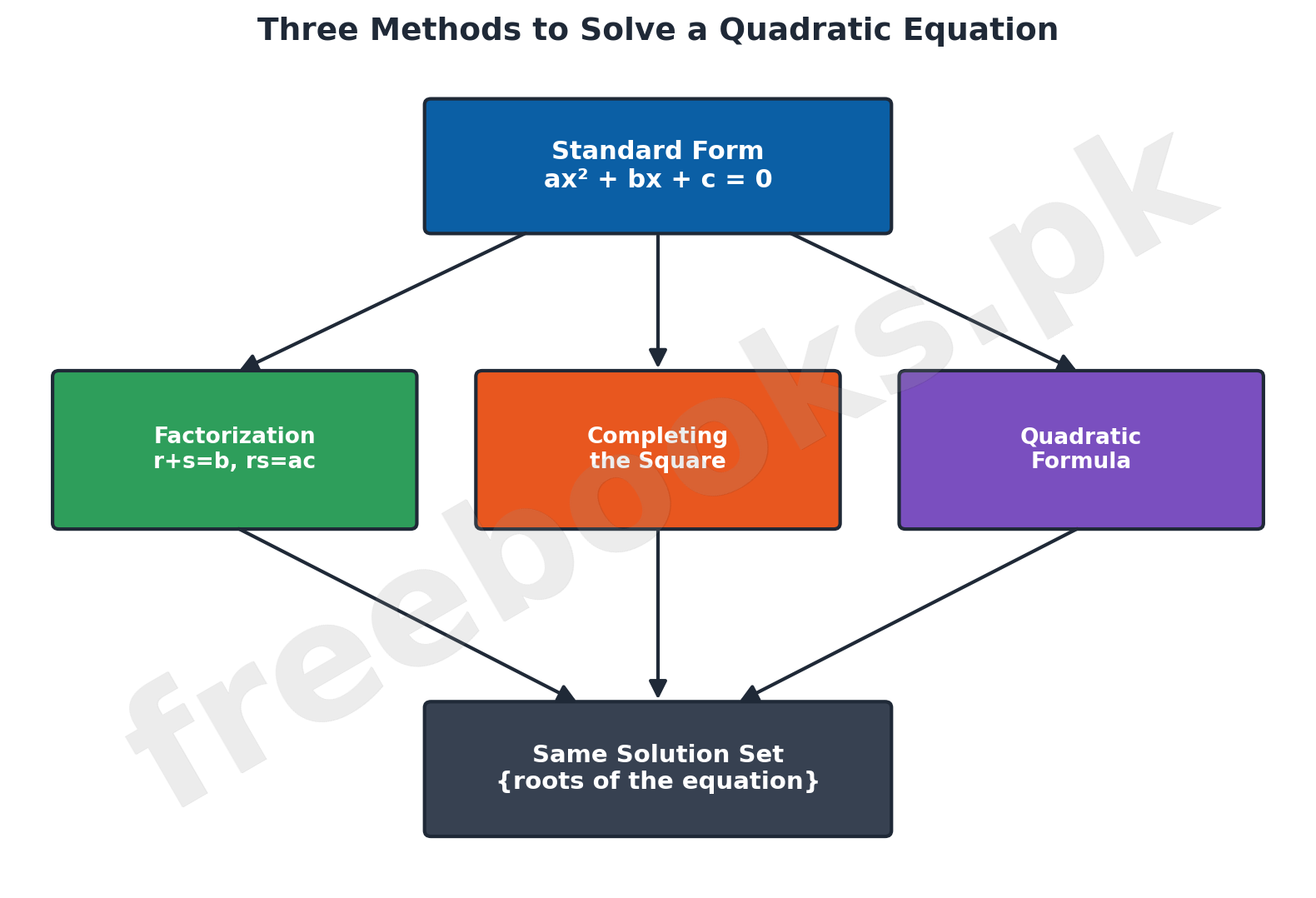
Three Methods to Solve a Quadratic Equation: A flow/comparison diagram showing the three standard solution methods — Factorization, Completing the Square, and the Quadratic Formula — branching from the standard form ax^2+bx+c=0, each leading to the same solution set
Equations Reducible to Quadratic Form: A summary chart listing the five types of equations reducible to quadratic form (ax^4+bx^2+c=0, a*p(x)+b/p(x)=c, reciprocal equations, exponential equations, and (x+a)(x+b)(x+c)(x+d)=k) alongside the substitution used to reduce each to a standard quadratic
Short Questions & Answers
Write the standard form of a quadratic equation.
ax^2 + bx + c = 0, where a, b, c are real numbers and a is not equal to 0.
What makes an equation a pure quadratic equation?
The coefficient of x (b) is zero, so the equation has the form ax^2 + c = 0.
State the quadratic formula.
x = (-b +/- sqrt(b^2 – 4ac)) / 2a.
What substitution reduces ax^4 + bx^2 + c = 0 to a quadratic?
Let y = x^2, giving ay^2 + by + c = 0.
Why must roots of a radical equation be checked in the original equation?
Because squaring both sides can introduce extraneous roots that satisfy the squared equation but not the original one.
What identity connects x + 1/x and x^2 + 1/x^2?
x^2 + 1/x^2 = (x + 1/x)^2 – 2.
Long Questions & Answers
Explain, with the general method and a worked illustration, how a quadratic equation is solved by (a) factorization and (b) completing the square.
How does the factorization method work for solving a quadratic equation?
Write the equation in standard form ax^2 + bx + c = 0. Find two numbers r and s such that r + s = b and r times s = a times c. Once found, rewrite the middle term bx as rx + sx, then factor the resulting four-term expression by grouping into two linear factors. Setting each linear factor equal to zero gives the two roots of the equation.
Work through an example of solving by factorization.
To solve 3x^2 – 7x – 20 = 0: here a=3, b=-7, c=-20, so a*c = -60. The numbers -12 and 5 satisfy -12+5=-7 and -12*5=-60. Rewriting gives 3x^2 – 12x + 5x – 20 = 0, which groups as 3x(x-4) + 5(x-4) = 0, or (x-4)(3x+5) = 0. So x = 4 or x = -5/3, and the solution set is {-5/3, 4}.
How does the completing-the-square method work?
First make the coefficient of x^2 equal to 1 by dividing every term by a, if needed. Shift the constant term to the right-hand side. Add the square of half the coefficient of x to BOTH sides, which makes the left side a perfect square trinomial. Take the square root of both sides (remembering the plus-or-minus), then solve the resulting linear equation for x.
Work through an example of completing the square.
To solve x^2 – 3x – 4 = 0: shifting gives x^2 – 3x = 4. Adding (-3/2)^2 = 9/4 to both sides gives (x – 3/2)^2 = 4 + 9/4 = 25/4. Taking the square root gives x – 3/2 = +/-5/2, so x = 3/2 + 5/2 = 4 or x = 3/2 – 5/2 = -1. The solution set is {-1, 4}.
Derive the quadratic formula from the standard form of a quadratic equation using the method of completing the square, and explain how it is used to solve equations that do not factor easily.
How is the quadratic formula derived?
Starting from ax^2 + bx + c = 0 (a not equal to 0), divide every term by a to get x^2 + (b/a)x + c/a = 0. Shift c/a to the right: x^2 + (b/a)x = -c/a. Add (b/2a)^2 to both sides to complete the square on the left, giving (x + b/2a)^2 = (b^2 – 4ac)/4a^2.
What is the final step of the derivation, and what formula results?
Taking the square root of both sides gives x + b/2a = +/- sqrt(b^2-4ac)/2a. Isolating x gives the quadratic formula: x = (-b +/- sqrt(b^2 – 4ac)) / 2a, valid for any a, b, c with a not equal to 0.
Why is the quadratic formula useful even when factorization is possible?
It solves any quadratic equation directly from its coefficients without needing to search for a factorization by inspection, which makes it essential when the roots are irrational, complex, or otherwise not obvious from the coefficients — unlike factorization, it always works.
Work through an example using the quadratic formula.
To solve 5x^2 – 9x – 2 = 0: here a=5, b=-9, c=-2. Substituting gives x = (9 +/- sqrt(81 – 4(5)(-2)))/10 = (9 +/- sqrt(121))/10 = (9 +/- 11)/10. So x = 20/10 = 2 or x = -2/10 = -1/5, giving the solution set {-1/5, 2}.
Multiple Choice Questions (MCQs)
The standard form of a quadratic equation is: (A) ax + b = 0 (B) ax^2 + bx + c = 0, a≠0 (C) ax^3 + bx + c = 0 (D) ax^2 + b = 0 only
Correct answer: (B) ax^2 + bx + c = 0, a≠0. The standard form of a quadratic (second-degree) equation is ax^2 + bx + c = 0 with a not equal to 0.
If b = 0 in ax^2 + bx + c = 0, the equation is called: (A) A linear equation (B) A pure quadratic equation (C) A reciprocal equation (D) A radical equation
Correct answer: (B) A pure quadratic equation. When b = 0, the equation reduces to ax^2 + c = 0, called a pure quadratic equation.
The quadratic formula is: (A) x = -b ± √(b²-4ac) / 2a (B) x = -b ± √(b²+4ac) / 2a (C) x = b ± √(b²-4ac) / a (D) x = -b ± √(b²-4ac) / a
Correct answer: (A) x = -b ± √(b²-4ac) / 2a. The quadratic formula, derived by completing the square on ax^2+bx+c=0, is x = (-b ± √(b²-4ac))/2a.
To reduce ax^4 + bx^2 + c = 0 to a quadratic equation, the correct substitution is: (A) y = x (B) y = x^2 (C) y = 1/x (D) y = x^4
Correct answer: (B) y = x^2. Substituting y = x^2 turns ax^4+bx^2+c=0 into the quadratic ay^2+by+c=0.
A value that satisfies a squared equation but not the original equation is called: (A) A pure root (B) A reciprocal root (C) An extraneous root (D) A rational root
Correct answer: (C) An extraneous root. An extraneous root satisfies the transformed (e.g. squared) equation but fails to satisfy the original equation, so it must be rejected.
For x + 1/x = y, the expression x^2 + 1/x^2 equals: (A) y^2 (B) y^2 – 1 (C) y^2 – 2 (D) y^2 + 2
Correct answer: (C) y^2 – 2. Squaring x + 1/x = y gives x^2 + 2 + 1/x^2 = y^2, so x^2 + 1/x^2 = y^2 – 2.
Which method always works for solving any quadratic equation, factorable or not? (A) Factorization only (B) Completing the square only (C) The quadratic formula (D) Guessing
Correct answer: (C) The quadratic formula. Unlike factorization (which requires the equation to factor neatly), the quadratic formula solves any quadratic equation directly from its coefficients.
An equation containing the variable under a square-root sign is called: (A) A reciprocal equation (B) A radical equation (C) An exponential equation (D) A pure quadratic equation
Correct answer: (B) A radical equation. An equation with an expression under a radical (square-root) sign is called a radical equation.
In factorization by the ac-method for ax^2+bx+c=0, the two numbers r and s must satisfy: (A) r+s=a, rs=b (B) r+s=c, rs=a (C) r+s=b, rs=ac (D) r+s=ac, rs=b
Correct answer: (C) r+s=b, rs=ac. The two numbers r and s must satisfy r+s=b and r×s=a×c so that bx can be split into rx+sx for grouping.
The roots of a quadratic equation y = ax^2+bx+c correspond graphically to: (A) The y-intercept (B) The vertex only (C) The x-intercepts of the parabola (D) The slope of the curve
Correct answer: (C) The x-intercepts of the parabola. The real roots of ax^2+bx+c=0 are exactly the x-values where the parabola y=ax^2+bx+c crosses the x-axis.
Quick Revision Summary
- A quadratic equation has the standard form ax^2 + bx + c = 0, a ≠ 0
- b = 0 gives a pure quadratic equation ax^2 + c = 0
- Factorization: find r, s with r+s=b, rs=ac, then split and group
- Completing the square: shift constant, add (half coefficient of x)^2 to both sides
- Quadratic formula: x = (-b ± √(b²-4ac)) / 2a — works for every quadratic equation
- ax^4+bx^2+c=0 reduces to a quadratic via y=x^2
- Reciprocal equations reduce via y = x + 1/x, using x²+1/x² = y²-2
- Exponential equations (variable in exponent) reduce via y = a^x
- (x+a)(x+b)(x+c)(x+d)=k reduces via pairing when a+b=c+d
- Radical equations: isolate the radical, square, solve, then CHECK for extraneous roots
- Every squared/simplified solution must be verified in the original equation
Exam Tips
- Always rearrange an equation into standard form ax^2+bx+c=0 before choosing a solution method
- Try factorization first (fast); switch to the quadratic formula if a*c doesn't factor easily
- In completing the square, always add the same term to BOTH sides of the equation
- Memorize the quadratic formula exactly — a sign error in -b or ±√ is the most common mistake
- For any radical equation, substitute every candidate root back into the ORIGINAL equation before writing the final answer
- For reciprocal-type equations, remember x²+1/x² = (x+1/x)² – 2, not (x+1/x)²