
This chapter studies magnets and magnetism: the properties of magnetic poles, the concept of a magnetic field and its field lines, and the difference between temporary and permanent magnets, including electromagnets and their many practical uses.
It also explains magnetism at the atomic level through the domain theory of magnetism (paramagnetic, diamagnetic, and ferromagnetic materials), how magnets are made and demagnetised, and applications of magnetism in recording technology and magnetic shielding.
Learning Objectives
- Describe the forces between magnetic poles and between magnets and magnetic materials, using the terms north pole, south pole, attraction, and repulsion
- Describe induced magnetism and differentiate between temporary and permanent magnets
- Describe a magnetic field as a region in which a magnetic pole experiences a force, and state how field direction and field strength are represented
- Describe uses of permanent magnets and electromagnets
- Explain qualitatively, using domain theory, how materials can be magnetised and demagnetised
- Differentiate between ferromagnetic, paramagnetic, and diamagnetic materials with reference to domain theory
- Analyse applications of magnets in recording technology and describe how electronic devices are protected from strong magnetic fields
- State that soft magnetic materials such as soft iron can be used to provide magnetic shielding
Key Concepts
8.1 Magnetic Materials and Properties of Magnets
Materials that are attracted to magnets are called magnetic materials — iron, nickel, and cobalt are magnetic, while materials such as brass, copper, wood, glass, and plastic are non-magnetic and unaffected by a magnet. A magnet can attract magnetic materials even without direct contact, acting at a distance through its magnetic field.
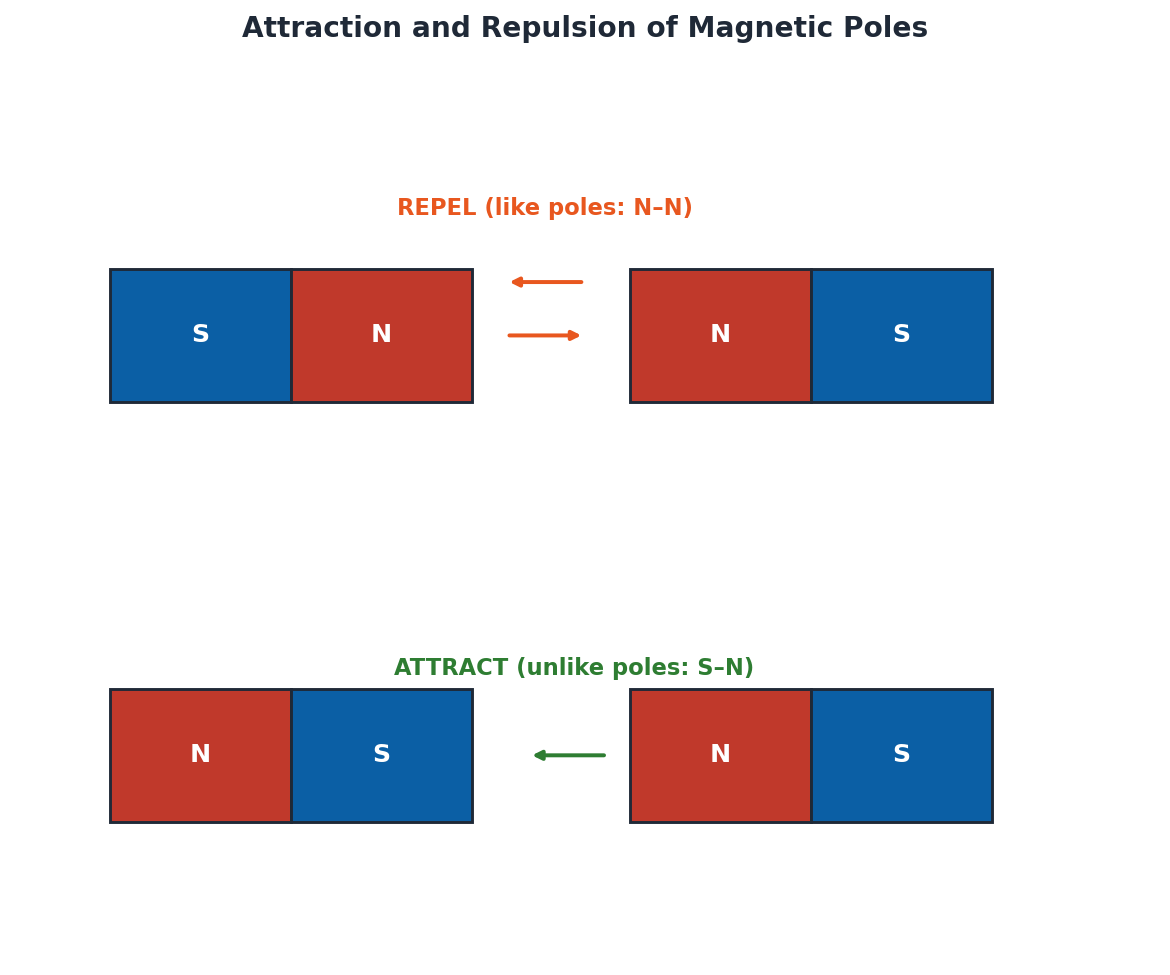
A freely suspended bar magnet always comes to rest pointing in a north-south direction; the end pointing north is called the north pole (N) and the end pointing south is the south pole (S). When two magnets are brought close together, like poles (N-N or S-S) repel each other, while unlike poles (N-S) attract — like poles repel and unlike poles attract. This repulsion between like poles is the definitive test for identifying whether an object is a true magnet (since a magnetic material, unlike a magnet, is always attracted to either pole and never repelled). It is not possible to isolate a single magnetic pole: breaking a bar magnet into pieces, however many, always produces smaller complete magnets each with their own N-pole and S-pole.
8.2 Induced Magnetism, Temporary and Permanent Magnets
Magnetization (or induced magnetism) is the process by which a magnetic material such as iron or steel becomes a magnet — for example, when the S-pole of a true magnet is brought near a piece of iron, it induces an N-pole in the near end of the iron and an S-pole in the far end. This induced magnetism disappears once the true magnet is removed, at least for materials like soft iron.
Temporary magnets (commonly made of soft iron, such as paper clips, iron nails, and electromagnets) only display magnetism while in the presence of an external magnetic field, and lose it once that field is removed. Permanent magnets (made of materials such as steel, cobalt, alnico, and ferrite) retain their magnetic properties indefinitely, either occurring naturally or being manufactured by placing suitable materials in a strong magnetic field for a sufficient time.
8.3 Magnetic Fields and Lines of Force
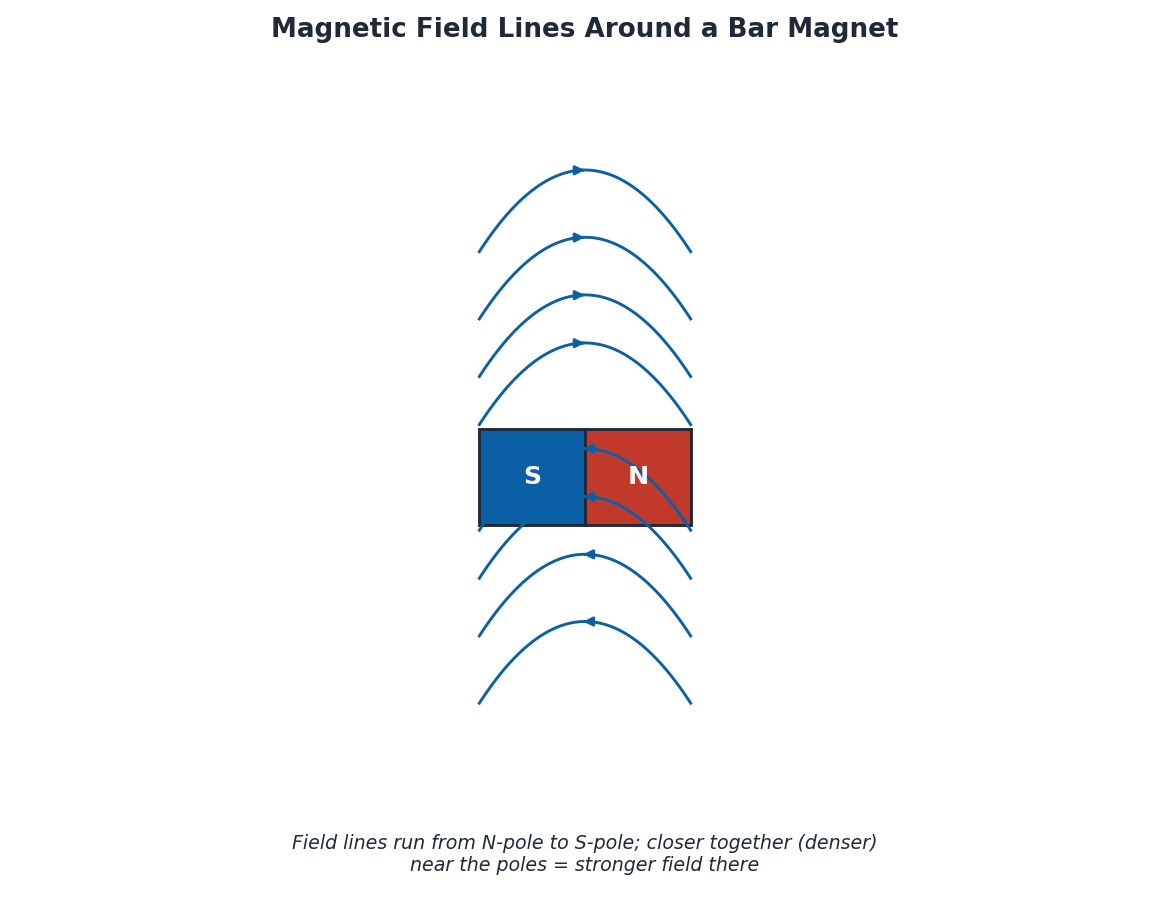
A magnetic field is the region around a magnet in which another magnetic object experiences a force. The pattern of a magnetic field can be visualised using iron filings sprinkled around a magnet, or traced using a small compass, whose needle aligns along the magnetic lines of force at each point. The direction of the magnetic field at any point is defined as the direction in which the N-pole of a compass needle points when placed at that point; field lines appear to originate from the north pole and end at the south pole.
The magnetic field has both magnitude and direction at every point. Its strength is proportional to the number of field lines passing through a unit area perpendicular to them — so the field is stronger where lines are closely spaced (near the poles) and weaker where lines are spread further apart. When two magnets are placed near each other, their combined field can produce a neutral point, where the fields due to each magnet cancel exactly.
8.4 Uses of Permanent Magnets
Permanent magnets are essential components of DC motors and AC/DC electric generators, moving-coil loudspeakers, door catchers and refrigerator door seals, magnetic separators (used in flour mills to remove iron fragments from grain), medical instruments for removing iron splinters from the eye, and resetting mechanisms in maximum-minimum thermometers.
In an AC generator, rotating a coil between the poles of a permanent magnet changes the magnetic field through the coil, inducing an EMF that drives an alternating current in an external circuit; an electric motor works by the reverse process. In a moving-coil loudspeaker, a varying electric current (representing a sound signal) flows through a voice coil placed in the field of a permanent magnet; the resulting varying force makes the coil and its attached cone vibrate, producing sound.
8.5 Electromagnets and Their Uses
An electromagnet is formed when an iron core (such as a nail) is wound with a coil of wire and an electric current is passed through the coil; the current produces a magnetic field that magnetises the iron core, but this magnetism is temporary and disappears once the current stops. Increasing the number of battery cells (current) or the number of coil turns increases the strength of the electromagnet's magnetic field.
Electromagnets are used in electric bells, magnetic relays (a low-current input circuit that uses an electromagnet to switch on a separate high-current circuit), circuit breakers (which detach an armature from a copper strip to break the circuit when current becomes excessive, protecting appliances), telephone receivers (where a varying current changes the electromagnet's pull on an iron diaphragm to reproduce sound), maglev trains (which use induced magnetism to levitate above the guideway, eliminating wheel friction and enabling speeds up to 400 km/h), and electromagnetic cranes (used in scrapyards and steel works, capable of lifting heavy iron and steel objects and releasing them simply by switching off the current).
8.6 Domain Theory of Magnetism
The magnetic field of a bar magnet resembles that of a current-carrying solenoid, suggesting that magnetism arises from moving electric charges. Within atoms, electrons both orbit the nucleus and spin on their own axis, and both motions produce a magnetic field; depending on how these fields combine, an atom may or may not have a net magnetic field. In paramagnetic materials (such as aluminium and lithium), the orbital and spin magnetic fields of electrons partly support one another, so the atom behaves as a weak magnet. In diamagnetic materials (such as copper, bismuth, and water), these fields cancel out entirely, leaving the atom with no net magnetic field.
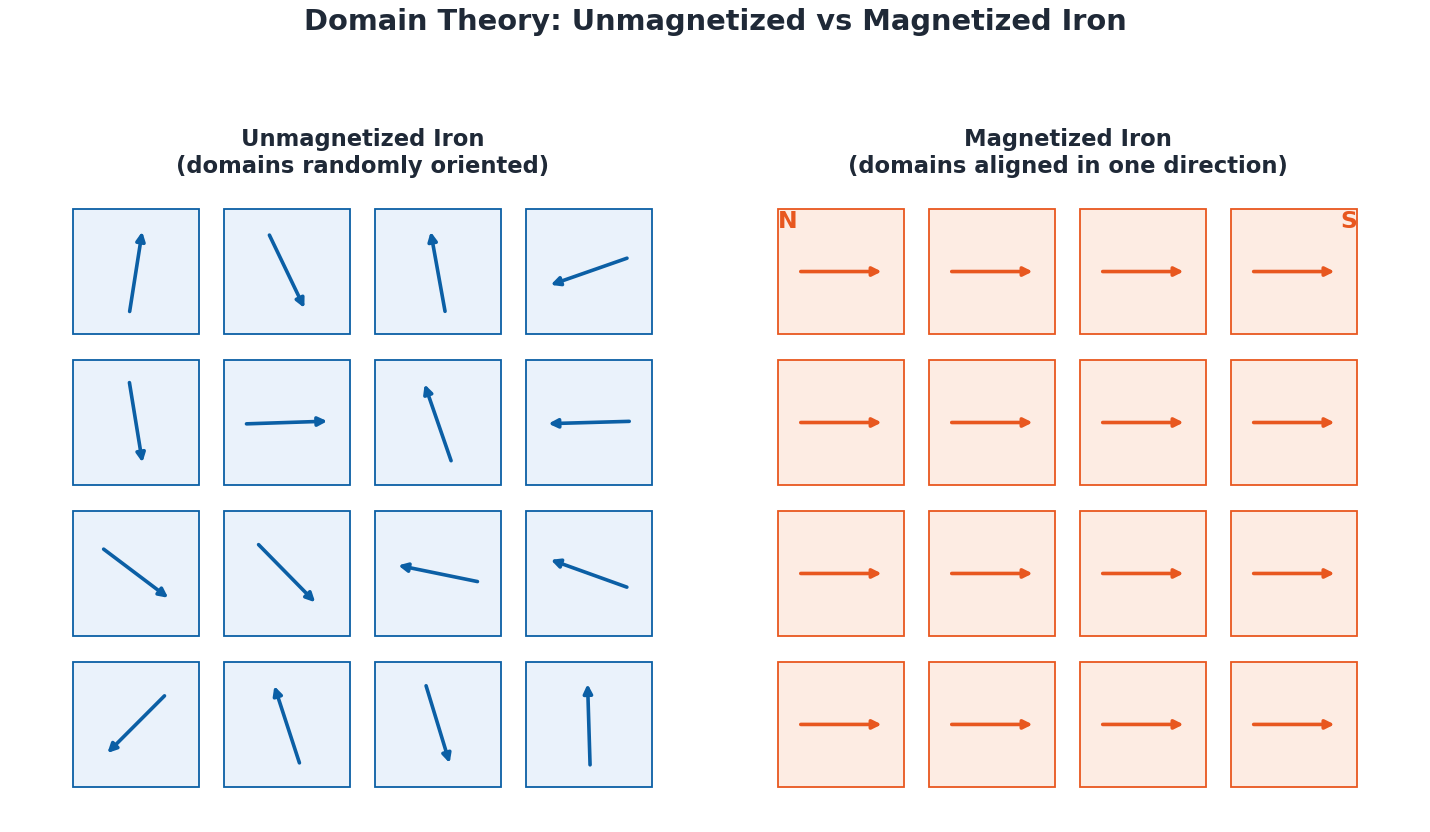
In ferromagnetic materials (such as iron, steel, nickel, and cobalt), large groups of about 10¹⁶ neighbouring atoms have their electron spins naturally aligned parallel to each other, forming a highly magnetized region about 0.1 mm in size called a magnetic domain, each behaving like a tiny magnet with its own N and S poles. In an unmagnetized piece of ferromagnetic material, these domains are randomly oriented and their fields cancel out overall. Applying an external magnetic field causes favourably-oriented domains to grow at the expense of others, and rotates the alignment of remaining domains toward the field direction — magnetizing the material. In soft iron, domains realign easily but return to random orientation once the external field is removed (ideal for electromagnets and transformer cores); in steel, domains are harder to realign but retain their alignment once magnetized, which is why steel is used for permanent magnets. Non-ferromagnetic materials like aluminium and copper do not form domains, so magnetism cannot be induced in them this way.
8.7 Magnetisation and Demagnetisation
A steel bar can be magnetised by stroking: in the single-touch method, one pole of a permanent magnet is stroked repeatedly across the bar in the same direction (lifting the magnet clear before each return stroke); in the double-touch method (more efficient), stroking begins from the centre of the bar outward using unlike poles of two magnets simultaneously. In both methods, the pole produced at the end of the bar is opposite to the stroking pole. Alternatively, a steel bar can be magnetised by placing it inside a solenoid (a long coil of several hundred turns of insulated wire) and passing a strong direct current through it; the polarity produced is found using the right-hand grip rule — gripping the solenoid so the curled fingers point in the direction of conventional current flow, the thumb points toward the N-pole.
Magnets can be demagnetised in three ways: heating strongly (thermal vibrations disturb the alignment of magnetic domains), hammering (mechanical shock disturbs domain alignment), or by slowly withdrawing the magnet from inside a solenoid carrying alternating current (the constantly reversing field scrambles the domain alignment).
8.8 Applications in Recording Technology and Magnetic Shielding
Electromagnets are widely used in recording technology to store audio, video, and computer data through induced magnetism in magnetic tapes and hard disks (both coated with a ferromagnetic material such as iron oxide). In magnetic tape recording, a recording head (an electromagnet with a horse-shoe-shaped iron core) produces a fringe field at a narrow gap; as the coated tape moves past this gap, the fringe field induces and permanently retains a pattern of magnetism in the tape's coating, corresponding to the original sound or picture signal. In hard disk recording, a small electromagnetic head writes binary digits by magnetising tiny spots on a spinning disk in different directions and reads them back by detecting each spot's magnetisation direction; disks offer near-instant access compared to the slower sequential access of tape.
Soft iron has high magnetic permeability, meaning it readily allows magnetic field lines (flux) to pass through it. Enclosing a sensitive electronic device in a soft iron casing shields it from external magnetic fields, since the magnetic flux preferentially passes through the high-permeability iron shell rather than through the device inside — protecting devices such as compasses, speakers, and other magnetically sensitive electronics. Soft iron's high permeability is also why it is used for the cores of transformers and electromagnets, since it magnetises easily when current flows and demagnetises quickly when current stops.
Important Definitions
What is a magnetic material?
A material that is attracted to a magnet, such as iron, nickel, or cobalt; non-magnetic materials like wood, glass, and plastic are not attracted.
State the law of magnetic poles.
Like poles repel each other, and unlike poles attract each other.
Define a magnetic field.
The region around a magnet in which another magnetic object experiences a force.
What is the direction of a magnetic field at a point?
The direction in which the N-pole of a compass needle points when placed at that point.
Differentiate between temporary and permanent magnets.
Temporary magnets (e.g. soft iron, electromagnets) display magnetism only while an external magnetic field is present and lose it when the field is removed; permanent magnets (e.g. steel, alnico) retain their magnetism indefinitely.
What is a magnetic domain?
A region of about 0.1 mm in a ferromagnetic material where roughly 10¹⁶ neighbouring atoms have their electron spins aligned parallel, making the region behave like a tiny magnet.
Define an electromagnet.
A temporary magnet formed when an electric current flows through a coil of wire wound around an iron core, magnetising the core only while the current flows.
What is magnetic shielding, and which material is commonly used for it?
Enclosing a sensitive device in a casing that redirects external magnetic flux away from it; soft iron, due to its high magnetic permeability, is commonly used for this purpose.
Key Formulas & Rules
| Topic | Rule / Relation |
|---|---|
| Law of poles | Like poles repel; unlike poles attract |
| Field strength | ∝ number of field lines per unit area (perpendicular to lines) |
| Right-hand grip rule (solenoid) | Curl fingers in current direction → thumb points to N-pole |
| Domain size (ferromagnetic) | ≈ 0.1 mm, containing ≈ 10¹⁶ aligned atoms |
Diagrams
Attraction and Repulsion of Magnetic Poles: Like poles (N-N or S-S) repel; unlike poles (N-S) attract
Magnetic Field Lines Around a Bar Magnet: Field lines running from the N-pole to the S-pole, closely spaced (stronger field) near the poles
Domain Theory: Unmagnetized vs Magnetized Iron: Randomly oriented magnetic domains in unmagnetized iron versus aligned domains after magnetisation
Short Questions & Answers
What are temporary and permanent magnets?
Temporary magnets show magnetism only in the presence of an external magnetic field and lose it once that field is removed (e.g. soft iron, electromagnets); permanent magnets retain their magnetism indefinitely (e.g. steel, alnico).
Define the magnetic field of a magnet.
The region around a magnet in which another magnetic object or pole experiences a force.
What are magnetic lines of force?
Imaginary lines representing the direction and pattern of a magnetic field, drawn so that the field's direction at any point is tangent to the line and the density of lines indicates field strength.
Name some uses of permanent magnets and electromagnets.
Permanent magnets: electric motors, loudspeakers, door catchers, magnetic separators. Electromagnets: electric bells, magnetic relays, circuit breakers, telephone receivers, cranes.
What are magnetic domains?
Small regions (about 0.1 mm) within a ferromagnetic material where large groups of atoms have their electron spins aligned parallel, so the region behaves as a tiny magnet.
Which type of magnetic field is formed by a current-carrying long coil (solenoid)?
A field pattern very similar to that of a bar magnet, with distinct N and S poles at its two ends.
Differentiate between paramagnetic and diamagnetic materials.
In paramagnetic materials, the orbital and spin magnetic fields of electrons in an atom partly support one another, giving a net weak magnetic field; in diamagnetic materials, these fields cancel out completely, giving no net magnetic field.
Why is it not possible to isolate a single magnetic pole?
Because breaking a magnet into any number of pieces always produces smaller complete magnets, each with its own N-pole and S-pole — a single isolated pole cannot be obtained.
Long Questions & Answers
Describe how you would identify whether an unknown object is a magnet or simply a magnetic material.
Bring one end of the unknown object close to one pole (say the N-pole) of a freely suspended bar magnet. If the object is attracted, it could either be a magnet with its opposite (S) pole facing the suspended magnet, or it could simply be an unmagnetised magnetic material — attraction alone does not distinguish between the two. To confirm, bring the same end of the object close to the other pole (S-pole) of the suspended magnet: if the object is again attracted, it is not a magnet but merely a magnetic material (since a magnetic material is always attracted to any pole); however, if the object is repelled by this second pole, then the object must itself be a magnet, since only two like poles can repel each other. Repulsion between like poles is therefore the definitive test for identifying a true magnet.
Explain the domain theory of magnetism and use it to differentiate between paramagnetic, diamagnetic, and ferromagnetic materials.
According to domain theory, magnetism at the atomic level arises from the motion of electrons — both their orbit around the nucleus and their spin on their own axis generate small magnetic fields. In paramagnetic materials (e.g. aluminium, lithium), the orbital and spin fields of electrons in an atom partially reinforce one another, so each atom behaves as a weak magnetic dipole, though the material as a whole shows only weak magnetism. In diamagnetic materials (e.g. copper, bismuth, water), these electron fields cancel out completely, leaving atoms with no net magnetic field. In ferromagnetic materials (e.g. iron, steel, nickel, cobalt), large groups of about 10¹⁶ neighbouring atoms have their electron spins naturally aligned parallel to one another, forming highly magnetized regions called magnetic domains, each about 0.1 mm in size and behaving like a tiny magnet. In an unmagnetized ferromagnetic material, these domains point in random directions and their fields cancel overall; applying an external magnetic field causes favourably aligned domains to grow and other domains to rotate into alignment, magnetizing the material as a whole.
Describe, with the help of a diagram, how the strength of a magnetic field is represented and interpreted using magnetic lines of force.
The strength of a magnetic field at any point is represented by the closeness (density) of the magnetic field lines there: field lines drawn closer together indicate a stronger field, while lines spread further apart indicate a weaker field. Near the poles of a bar magnet, the field lines converge closely together, showing that the field is strongest in these regions; moving away from the poles, the lines spread out, showing the field becomes progressively weaker. The direction of the field at any point is given by the direction a compass needle's N-pole would point if placed there, and field lines are conventionally drawn running from the N-pole, around the magnet, to the S-pole. When two magnets are placed near one another, their combined field pattern can produce a neutral point, where the fields due to the two magnets exactly cancel and the net field is zero — at this point, a compass needle would show no preferred direction due to the magnets.
Describe two methods of magnetising a steel bar and two methods of demagnetising a magnet.
Steel bars can be magnetised by stroking: in the single-touch method, one pole of a permanent magnet is drawn repeatedly across the bar in the same direction, being lifted clear before each return pass, while in the more efficient double-touch method, two magnets with unlike poles are stroked simultaneously outward from the centre of the bar. In both methods, the polarity produced at the stroked end is opposite to the stroking pole used. Alternatively, a steel bar can be magnetised by placing it inside a solenoid with several hundred turns of wire and passing a strong direct current through it; the resulting polarity is found using the right-hand grip rule. Demagnetisation can be achieved by heating the magnet strongly, since thermal vibrations disrupt the alignment of magnetic domains; by hammering or striking the magnet, which mechanically disturbs domain alignment; or by slowly withdrawing the magnet from inside a solenoid carrying alternating current, whose constantly reversing field scrambles the domain orientations.
Multiple Choice Questions (MCQs)
Which of the following is NOT a magnetic material? (A) Cobalt (B) Iron (C) Aluminium (D) Nickel
Correct answer: (C) Aluminium. Aluminium is not attracted to ordinary magnets and is classified as a (weakly) paramagnetic, not ferromagnetic, material; cobalt, iron, and nickel are all strongly magnetic materials.
Like magnetic poles placed near each other will: (A) Attract (B) Repel (C) Have no effect on each other (D) Cancel out completely
Correct answer: (B) Repel. Like poles (N-N or S-S) always repel each other; only unlike poles attract.
Breaking a bar magnet into several pieces produces: (A) Isolated N-poles only (B) Isolated S-poles only (C) Each piece with its own N and S pole (D) Pieces with no magnetism at all
Correct answer: (C) Each piece with its own N and S pole. It is impossible to isolate a single magnetic pole — every piece of a broken magnet becomes a complete magnet with its own N-pole and S-pole.
A material that retains its magnetism only while an external magnetic field is present is called a: (A) Permanent magnet (B) Temporary magnet (C) Diamagnetic material (D) Non-magnetic material
Correct answer: (B) Temporary magnet. A temporary magnet (e.g. soft iron or an electromagnet) is magnetic only in the presence of an external field, losing its magnetism once that field is removed.
The direction of a magnetic field at a point is defined by: (A) The S-pole of a compass needle placed there (B) The N-pole of a compass needle placed there (C) The direction of gravity at that point (D) The nearest magnetic pole
Correct answer: (B) The N-pole of a compass needle placed there. By convention, the magnetic field direction at a point is the direction the N-pole of a compass needle points when placed at that point.
The strength of a magnetic field is indicated by: (A) The colour of the field lines (B) How closely spaced the field lines are (C) The total number of poles present (D) The temperature of the magnet
Correct answer: (B) How closely spaced the field lines are. Field strength is proportional to the density (closeness) of magnetic field lines per unit area — closely spaced lines mean a stronger field.
In ferromagnetic materials, a magnetic domain is best described as: (A) A single isolated atom (B) A region where electron spins of many atoms are aligned parallel (C) The N-pole of the material only (D) A region with no magnetic properties
Correct answer: (B) A region where electron spins of many atoms are aligned parallel. A magnetic domain is a region (about 0.1 mm) where a large group of atoms (~10¹⁶) have their electron spins naturally aligned parallel, so the region behaves like a tiny magnet.
Which material is most suitable for making a permanent magnet? (A) Soft iron (B) Steel (C) Aluminium (D) Copper
Correct answer: (B) Steel. Steel's domains are difficult to realign but retain their alignment once magnetised, making it well suited for permanent magnets (unlike soft iron, which easily loses its magnetism).
A magnet can be demagnetised by: (A) Cooling it to a very low temperature (B) Heating it strongly, hammering it, or using an A.C. solenoid (C) Wrapping it in plastic (D) Placing it near a compass
Correct answer: (B) Heating it strongly, hammering it, or using an A.C. solenoid. Demagnetisation methods include heating strongly (disrupting domain alignment via thermal vibration), hammering (mechanical disruption), and slowly withdrawing the magnet from a solenoid carrying alternating current.
Soft iron is used for magnetic shielding mainly because it has: (A) Low density (B) High magnetic permeability (C) High electrical resistance (D) Low melting point
Correct answer: (B) High magnetic permeability. Soft iron's high magnetic permeability allows magnetic flux to pass preferentially through it rather than through a shielded device, protecting the device from external magnetic fields.
Quick Revision Summary
- Magnetic materials: iron, nickel, cobalt; attracted to magnets even without contact
- Like poles repel, unlike poles attract; isolated single poles are impossible
- Induced magnetism: a magnetic material becomes magnetised near a true magnet, may be temporary or permanent
- Temporary magnets (soft iron, electromagnets) lose magnetism when field removed; permanent magnets (steel, alnico) retain it
- Magnetic field = region where a magnetic object feels a force; direction = N-pole of compass; strength ∝ field line density
- Permanent magnet uses: motors, generators, loudspeakers, door catchers, separators
- Electromagnet uses: bells, relays, circuit breakers, telephone receivers, maglev trains, cranes
- Domain theory: paramagnetic (weak net field), diamagnetic (no net field), ferromagnetic (aligned domains, ~10¹⁶ atoms, ~0.1mm)
- Magnetise by: stroking (single/double touch) or solenoid + DC current (right-hand grip rule for polarity)
- Demagnetise by: heating, hammering, or A.C. solenoid withdrawal
- Recording tech uses induced magnetism (tapes, hard disks); soft iron shields devices via high permeability
Exam Tips
- Remember the repulsion test is the only reliable way to confirm an object is a true magnet, not just a magnetic material
- Practice applying the right-hand grip rule for solenoid polarity — a frequent diagram-based exam question
- Keep the three domain-theory categories (paramagnetic, diamagnetic, ferromagnetic) and their example materials clearly separated in your answers
- Link each use of permanent magnets and electromagnets to the specific device by name — exam questions often ask 'name a device that uses…'
- For magnetic field diagrams, always show field lines running from N to S and getting denser near the poles
- Remember: soft iron = easy to magnetise/demagnetise (electromagnets, shielding); steel = hard to magnetise but retains it (permanent magnets)