This chapter explains matter's behaviour using the kinetic molecular theory: how the arrangement and motion of particles differ in solids, liquids, gases, and plasma (the fourth state of matter). It then defines temperature and heat, and explains how temperature relates to the internal (kinetic + potential) energy of a substance's molecules.
The chapter also covers how thermometers work, the three common temperature scales (Celsius, Fahrenheit, Kelvin) and how to convert between them, and the key properties — sensitivity, range, and linearity — that determine how well a thermometer performs.
Learning Objectives
- Describe qualitatively the particle structure of solids, liquids, and gases, relating properties to intermolecular forces, spacing, and particle motion
- Describe plasma as the fourth state of matter and give examples of where it occurs
- Relate particle motion to temperature, including the concept of absolute zero (~ -273°C)
- State that increasing an object's temperature increases its internal energy
- Explain how a temperature-dependent physical property can be used to measure temperature
- Explain the need for fixed points (ice point, steam point) in calibrating thermometers
- Describe sensitivity, range, and linearity as properties of a thermometer
- Differentiate the structure and function of liquid-in-glass and thermocouple thermometers, and convert temperatures between Celsius, Fahrenheit, and Kelvin scales
Key Concepts
7.1 Kinetic Molecular Theory of Matter
According to kinetic molecular theory, matter is made of tiny particles called molecules that are always in motion (vibrational, rotational, or linear), with a mutual force of attraction (intermolecular force) between them that weakens as the distance between molecules increases. Molecules possess kinetic energy due to their motion and potential energy due to this force of attraction; when a substance is heated, its molecules move more vigorously, increasing their kinetic energy — so the temperature of a substance depends on the average kinetic energy of its molecules.
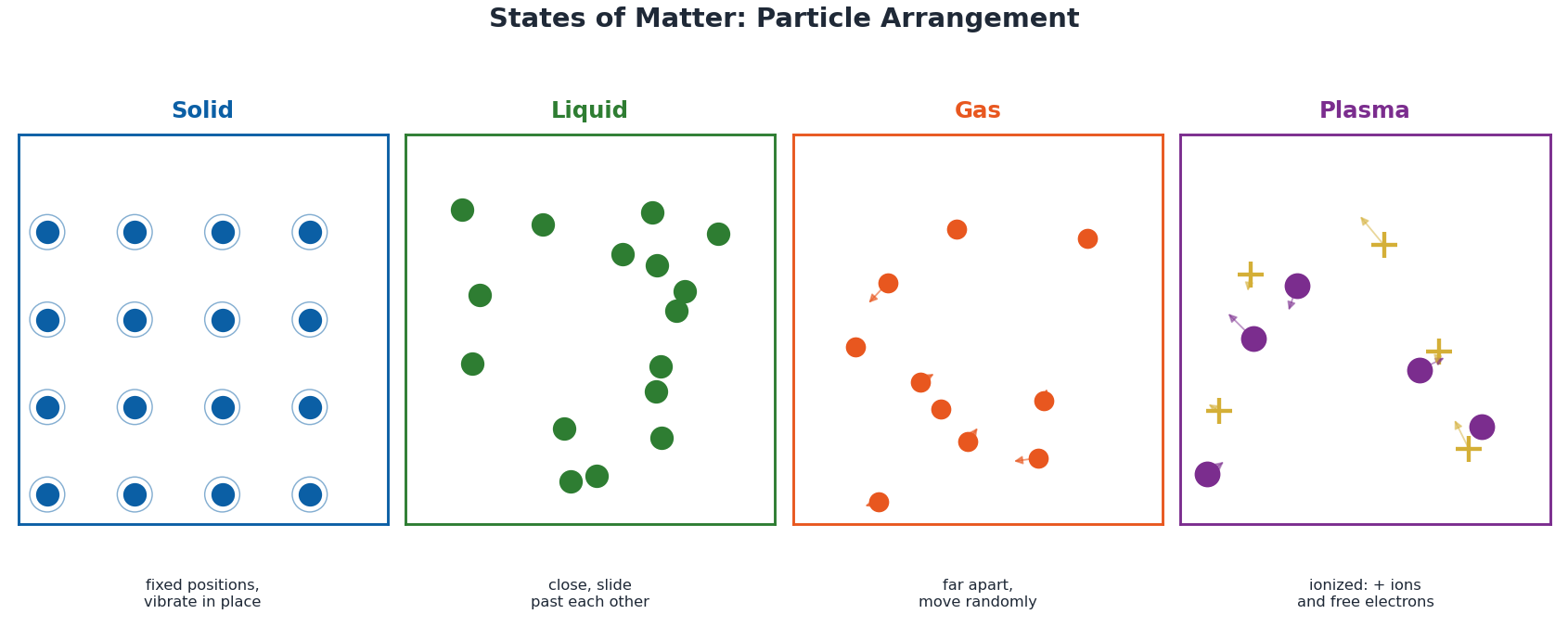
In solids, strong intermolecular forces hold molecules at fixed positions, though they still vibrate about these points — giving solids a definite shape and definite volume. In liquids, the intermolecular force is too weak to fix molecules in place, so they slide over each other in random directions — liquids have a definite volume but take the shape of their container. In gases, molecules are far apart with very weak intermolecular forces, so gases have neither a definite shape nor a definite volume.
Plasma is a gas in which most atoms are ionized into positive ions and free electrons that move freely through the gas; because of these charged particles, plasma conducts electric current and behaves very differently from an ordinary gas, which is why it is called the fourth state of matter. The Sun and most stars exist in the plasma state, and plasma also occurs in neon/plasma lights, gas discharge tubes, and lightning streamers (the ionized conducting paths formed during early lightning formation).
7.2 Temperature and Heat
Temperature is defined as the degree of hotness or coldness of a body. More precisely, temperature is the physical quantity that determines the direction of flow of thermal energy — heat always flows from a body at higher temperature to one at lower temperature when they are in contact, as demonstrated by a metal spoon placed in hot water becoming warm at its other end. Heat is therefore defined as the energy transferred from one object to another due to a difference in temperature between them.
The sum of the kinetic and potential energies of all the molecules of an object is called its internal energy. Heating a substance makes its molecular motion more vigorous, increasing its internal energy and raising its temperature. It is incorrect to say a substance 'contains heat' — a substance contains internal energy, while the word heat refers only to energy that is actually in transit from a hotter body to a colder one.
7.3 Thermometers and Thermometric Properties
A thermometer is a device used for the exact measurement of temperature, since touch alone cannot give a precise value. Thermometers work by using a physical property of a substance that changes measurably and predictably with temperature — this is called a thermometric property. Good thermometric substances should be good conductors of heat, respond quickly to temperature changes, expand uniformly, have a high boiling point and low freezing point (for a wide range), have large expansivity, not wet glass, not vaporize easily, and be visible.
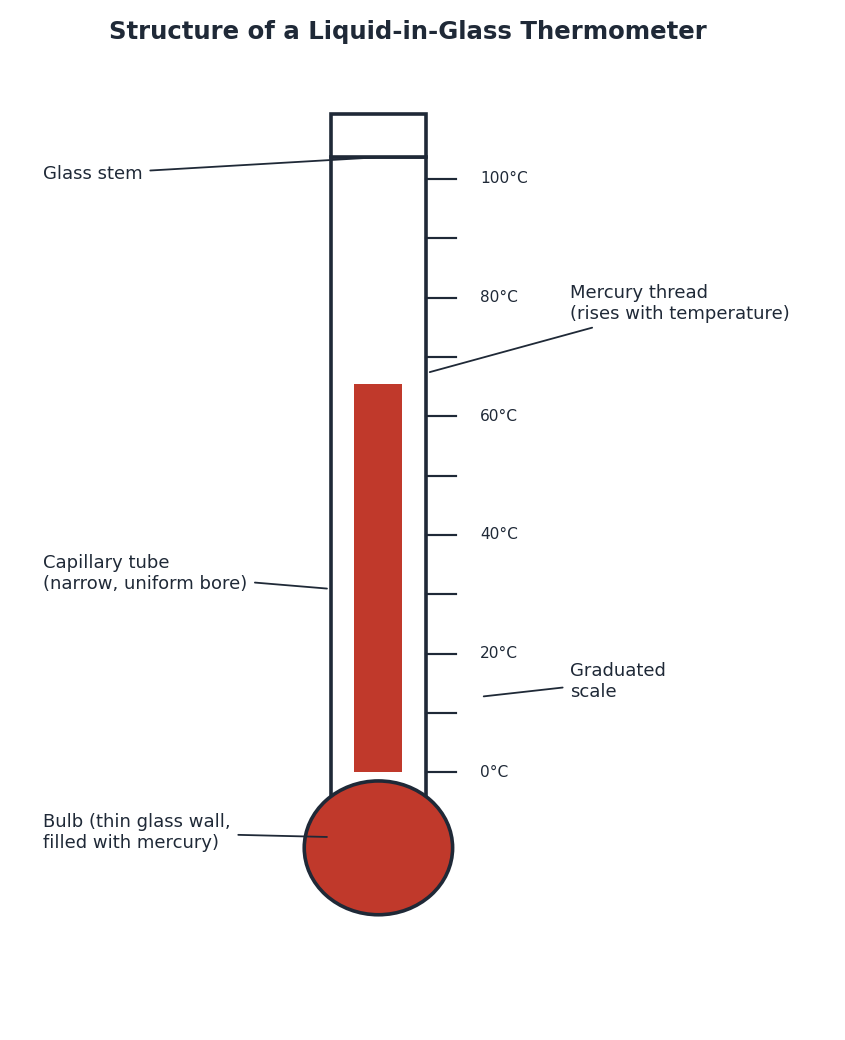
A liquid-in-glass thermometer uses the thermal expansion of a liquid (commonly mercury or coloured alcohol) inside a glass bulb connected to a narrow capillary tube; as temperature rises, the liquid expands and moves up the tube, and the position of the liquid thread indicates the temperature on a marked scale. Mercury is silvery and easily visible, is a good conductor so it responds quickly, and has a wide usable range (freezes at -39°C, boils at 357°C). Alcohol has six times the expansivity of mercury (giving finer precision) but has a much lower boiling point (78°C), limiting it to lower-temperature measurements, though its very low freezing point (-112°C) suits it to extremely cold conditions.
A thermocouple thermometer consists of two wires of different materials (e.g. copper and iron) joined at two junctions; when the junctions are at different temperatures, a small current flows due to a potential difference (voltage) that increases with the temperature difference between the junctions. With one junction held at a fixed reference temperature (e.g. an ice bath at 0°C), the other junction's temperature can be read from a calibrated millivolt meter. Because only a small mass of metal needs to heat up, thermocouples respond quickly and are well suited to measuring very high or rapidly changing temperatures.
7.4 Temperature Scales and Fixed Points
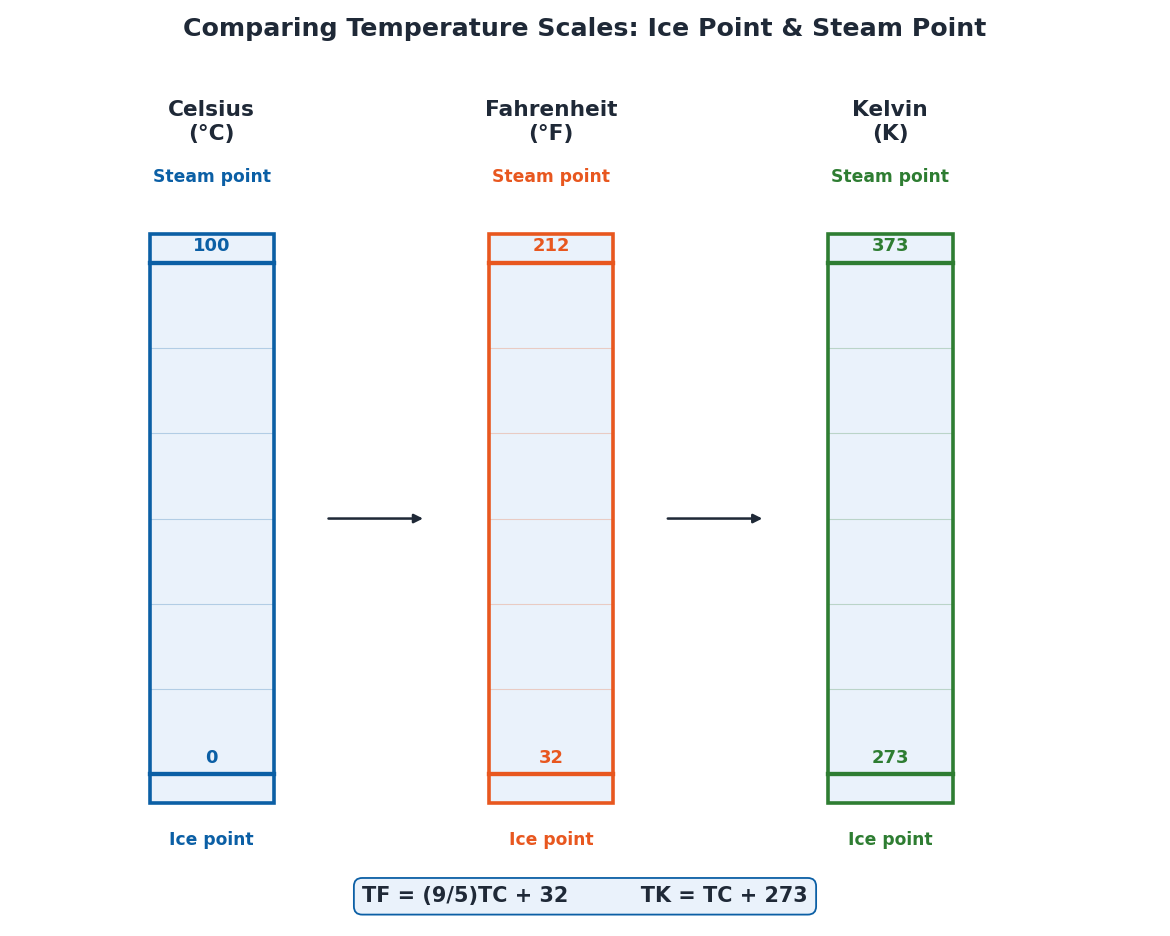
To construct a temperature scale, two reference temperatures called fixed points are needed: the steam point (the temperature of steam above boiling water at standard atmospheric pressure, the upper fixed point) and the ice point (the melting point of pure ice, the lower fixed point). Three common scales assign different numbers to these points: on the Celsius (centigrade) scale, the ice point is 0°C and the steam point is 100°C, giving 100 equal divisions of 1°C each; on the Fahrenheit scale, the ice point is 32°F and the steam point is 212°F, giving 180 divisions of 1°F each; on the Kelvin (absolute) scale, used in scientific work, the ice point is 273 K and the steam point is 373 K, so 1 K equals 1°C in size.
The zero of the Kelvin scale, called absolute zero, is the temperature (about -273.15°C, taken as -273°C for calculations) at which molecules would have essentially zero average kinetic energy — it is the lowest possible temperature in the universe, and matter cannot exist below it.
7.5 Converting Between Temperature Scales
The three scales are related by simple formulas. To convert Celsius to Fahrenheit: TF = (9/5) × TC + 32. To convert Fahrenheit to Celsius: TC = (5/9) × (TF − 32). To convert between Celsius and Kelvin: TK = TC + 273. These conversions allow a temperature measured on one scale to be expressed on any of the others.
7.6 Sensitivity, Range, and Linearity of Thermometers
Sensitivity refers to a thermometer's ability to detect small temperature changes — a thermometer with scale markings every 0.1°C is more sensitive (gives more precise readings) than one marked only every 1°C. Range refers to the span of temperatures a thermometer can accurately measure — a clinical thermometer has a narrow range (e.g. 35°C to 45°C) suited to body temperature, while a laboratory thermometer has a wider range (e.g. -10°C to 110°C); the thermometric liquid used sets natural limits on range, since mercury freezes at -39°C and boils at 357°C, while alcohol (freezing at -112°C, boiling at 78°C) extends the lower limit but restricts the upper limit.
Linearity refers to how directly proportional the scale reading is to the actual temperature across the whole range — a good thermometer produces evenly spaced scale markings for equal temperature increments throughout its range, ensuring consistent accuracy from one end of the scale to the other.
7.7 Structure of a Liquid-in-Glass Thermometer
A liquid-in-glass thermometer has a narrow, uniform capillary tube connected to a small bulb filled with mercury or alcohol. The bulb's thin glass walls allow heat to conduct quickly from the object being measured into the liquid, and the small volume of liquid responds rapidly to temperature changes, making the thermometer sensitive. The narrowness and uniformity of the capillary bore ensures that the liquid expands evenly along its length, which is essential for producing a linear (evenly spaced) measuring scale. Mercury's combination of low freezing point and high boiling point gives it a long usable temperature range, which is why it remains a common choice despite alcohol's greater sensitivity (expansivity).
Important Definitions
Define temperature.
The degree of hotness or coldness of a body; more precisely, the physical quantity that determines the direction of flow of thermal energy between two bodies in contact.
Define heat.
The energy that is transferred from one object to another due to a difference in temperature between them.
Define internal energy.
The sum of the kinetic and potential energies of all the molecules that make up an object.
What is absolute zero?
The lowest possible temperature, about -273°C (0 K), at which the molecules of a substance have essentially zero average kinetic energy.
What is a thermometric property?
A physical property of a substance that changes measurably and predictably with temperature, allowing it to be used to construct a thermometer (e.g. liquid expansion, electrical resistance, thermo-electric voltage).
Define sensitivity of a thermometer.
The ability of a thermometer to detect and register small changes in temperature; finer scale markings mean greater sensitivity.
Define the range of a thermometer.
The span of temperatures, from lowest to highest, over which a thermometer can measure accurately.
Define linearity of a thermometer.
The property by which equal changes in temperature produce equal, evenly spaced changes on the thermometer's scale throughout its entire range.
Key Formulas
| Topic | Formula |
|---|---|
| Celsius to Fahrenheit | TF = (9/5) × TC + 32 |
| Fahrenheit to Celsius | TC = (5/9) × (TF − 32) |
| Celsius to Kelvin | TK = TC + 273 |
| Absolute zero | ≈ -273°C = 0 K |
| Ice point (Celsius / Fahrenheit / Kelvin) | 0°C = 32°F = 273 K |
| Steam point (Celsius / Fahrenheit / Kelvin) | 100°C = 212°F = 373 K |
Diagrams
States of Matter: Particle Arrangement: Particle spacing and motion in solids, liquids, gases, and plasma, based on kinetic molecular theory
Comparing Temperature Scales: Ice point and steam point shown side by side on the Celsius, Fahrenheit, and Kelvin scales
Structure of a Liquid-in-Glass Thermometer: Labelled diagram showing the bulb, capillary tube, thermometric liquid, and scale
Short Questions & Answers
Why do solids have a fixed shape and fixed volume?
Because the strong intermolecular forces in a solid hold its molecules at fixed positions (though they still vibrate about these points), giving the solid a definite shape and volume.
Why do gases have neither a fixed shape nor a fixed volume?
Because gas molecules are far apart with very weak intermolecular forces, allowing them to move freely and spread to fill whatever container they are in, with no fixed arrangement.
What is the effect of raising the temperature of a substance on its molecules?
Raising the temperature makes the molecules move more vigorously, increasing their average kinetic energy and hence the substance's internal energy.
Distinguish between heat and internal energy.
Internal energy is the total kinetic and potential energy possessed by all the molecules of a substance at any time; heat is the energy specifically in transit from a hotter body to a colder one due to their temperature difference — a body possesses internal energy but does not 'contain' heat.
What determines the direction of heat flow between two bodies?
Temperature difference — heat always flows from the body at higher temperature to the body at lower temperature when they are in contact.
Why is mercury commonly preferred over alcohol as a thermometric liquid?
Mercury has a much wider usable temperature range (freezing at -39°C and boiling at 357°C, compared to alcohol's boiling point of only 78°C), is a good heat conductor for fast response, and is easily visible due to its silvery colour.
What is meant by the linearity of a thermometer?
Linearity means that equal changes in temperature produce equal, evenly spaced changes on the thermometer's scale across its full range, ensuring consistent accuracy.
Why are the walls of a thermometer's bulb made thin?
Thin bulb walls allow heat to conduct quickly from the object being measured into the thermometric liquid, making the thermometer respond faster and more sensitively to temperature changes.
Long Questions & Answers
Describe, using kinetic molecular theory, how the particle arrangement and motion differ in solids, liquids, and gases, and explain plasma as a fourth state of matter.
According to kinetic molecular theory, all matter consists of molecules in constant motion, held together to varying degrees by intermolecular forces of attraction. In solids, these forces are strong enough to hold molecules at fixed positions, though the molecules still vibrate about these points; this gives solids a definite shape and definite volume. In liquids, intermolecular forces are weaker, allowing molecules to slide over one another in random directions — liquids therefore have a definite volume but take the shape of their container. In gases, molecules are far apart and intermolecular forces are very weak, so gas molecules move freely and independently, meaning gases have neither a definite shape nor a definite volume. Plasma, sometimes called the fourth state of matter, is a gas in which most atoms have been ionized into positive ions and free electrons; because these charged particles move freely and conduct electric current, plasma behaves very differently from an ordinary gas. Plasma occurs in the Sun and other stars, in neon and plasma lights, in gas discharge tubes, and in the ionized conducting paths (lightning streamers) formed during lightning.
Define temperature and heat, and explain their relationship to internal energy.
Temperature is the degree of hotness or coldness of a body, and more precisely is the physical quantity that determines the direction in which thermal energy flows between two bodies in contact — heat always flows from the hotter (higher temperature) body to the colder (lower temperature) one. Heat is defined as the energy transferred from one object to another as a result of a temperature difference between them. All matter is made of molecules possessing kinetic energy (due to motion) and potential energy (due to intermolecular attractive forces); the sum of these energies for all the molecules in an object is its internal energy. When a substance is heated, its molecules move more vigorously, increasing its internal energy, which is observed as a rise in temperature. It is important to note that a substance does not 'contain' heat — it contains internal energy, and the term 'heat' refers only to energy that is actively being transferred between bodies due to a temperature difference.
Compare the Celsius, Fahrenheit, and Kelvin temperature scales, including their fixed points and how to convert between them.
All three scales are built using two fixed reference points: the ice point (melting point of pure ice) and the steam point (boiling point of water at standard atmospheric pressure). On the Celsius scale, these points are assigned values of 0°C and 100°C, with the interval divided into 100 equal parts of 1°C each. On the Fahrenheit scale, the ice point is 32°F and the steam point is 212°F, with the interval divided into 180 parts of 1°F each — meaning a Fahrenheit degree is a smaller unit than a Celsius degree. On the Kelvin (absolute) scale, used for scientific work, the ice point is 273 K and the steam point is 373 K, so the size of 1 K equals the size of 1°C, and its zero (absolute zero, about -273°C) is the theoretical point of minimum molecular kinetic energy. Conversions between the scales use TF = (9/5)TC + 32 (Celsius to Fahrenheit), TC = (5/9)(TF − 32) (Fahrenheit to Celsius), and TK = TC + 273 (Celsius to Kelvin).
Explain what is meant by the sensitivity, range, and linearity of a thermometer, and describe how the structure of a liquid-in-glass thermometer is designed to optimise these properties.
Sensitivity is a thermometer's ability to detect small temperature changes — finer scale spacing means greater sensitivity and more precise readings. Range is the span of temperatures over which the thermometer can measure accurately, which is limited by the freezing and boiling points of the thermometric liquid used. Linearity is the extent to which equal temperature changes produce equal, evenly spaced changes on the scale throughout the whole range, ensuring consistent accuracy. In a liquid-in-glass thermometer, sensitivity is improved by using a thin-walled bulb (for fast heat conduction) containing a small volume of liquid (which heats up and expands quickly) together with a narrow capillary tube (so a small volume change produces a large, easily readable movement of the liquid thread). Range depends on the properties of the chosen liquid: mercury offers a wide range (-39°C to 357°C) suitable for most everyday and laboratory uses, while alcohol, though more sensitive due to greater expansivity, has a much lower boiling point (78°C) that restricts its upper range, though its very low freezing point (-112°C) suits it for extremely cold conditions. Linearity is achieved by using a uniform (evenly-bored) capillary tube, which ensures the liquid expands by an equal amount along its length for each equal rise in temperature, producing evenly spaced scale markings.
Multiple Choice Questions (MCQs)
According to kinetic molecular theory, molecules in a solid mainly: (A) Move randomly (B) Vibrate about fixed positions (C) Slide over each other (D) Move in straight lines only
Correct answer: (B) Vibrate about fixed positions. In a solid, strong intermolecular forces hold molecules at fixed positions, but the molecules still vibrate about these points.
The gas in which atoms are ionized into positive ions and electrons is called: (A) Vapour (B) Aerosol (C) Plasma (D) Colloid
Correct answer: (C) Plasma. This ionized, conducting state of matter is called plasma, often referred to as the fourth state of matter.
Temperature determines the direction of flow of: (A) Mass (B) Thermal energy (C) Electric charge (D) Momentum
Correct answer: (B) Thermal energy. Temperature is the physical quantity that determines the direction in which thermal energy (heat) flows between two bodies.
The internal energy of an object is the sum of the: (A) Mass and volume of its molecules (B) Kinetic and potential energies of its molecules (C) Heat and work done on it (D) Pressure and temperature of its molecules
Correct answer: (B) Kinetic and potential energies of its molecules. Internal energy is defined as the sum of the kinetic energy (due to motion) and potential energy (due to intermolecular forces) of all the molecules in an object.
On the Kelvin scale, the ice point (melting point of ice) corresponds to: (A) 0 K (B) 100 K (C) 273 K (D) 373 K
Correct answer: (C) 273 K. The ice point is 273 K on the Kelvin scale (equivalent to 0°C).
30°C is equivalent to how many degrees Fahrenheit? (A) 54°F (B) 86°F (C) 62°F (D) 30°F
Correct answer: (B) 86°F. TF = (9/5)×30 + 32 = 54 + 32 = 86°F.
Absolute zero is approximately: (A) 0°C (B) -100°C (C) -173°C (D) -273°C
Correct answer: (D) -273°C. Absolute zero, the lowest possible temperature, is approximately -273°C (0 K).
A thermocouple thermometer generates a reading based on: (A) Liquid expansion (B) Gas pressure change (C) Voltage from two junctions at different temperatures (D) Change in colour
Correct answer: (C) Voltage from two junctions at different temperatures. A thermocouple uses two wires of different materials joined at two junctions; a temperature difference between the junctions produces a measurable voltage.
A thermometer with scale markings every 0.1°C compared to one with markings every 1°C is: (A) Less sensitive (B) More sensitive (C) Equally sensitive (D) Has a wider range
Correct answer: (B) More sensitive. Finer scale divisions mean the thermometer can detect smaller temperature changes, making it more sensitive.
Mercury is preferred over alcohol in many thermometers mainly because: (A) It has a lower freezing point than alcohol (B) It has a much wider temperature range and is a good conductor (C) It has greater expansivity than alcohol (D) It is cheaper to produce
Correct answer: (B) It has a much wider temperature range and is a good conductor. Mercury's wide range (-39°C to 357°C), good thermal conductivity, and clear visibility make it a preferred thermometric liquid despite alcohol having greater expansivity.
Quick Revision Summary
- Kinetic molecular theory: matter = moving molecules + intermolecular attractive forces
- Solids: fixed shape & volume (molecules vibrate in place); Liquids: fixed volume, no fixed shape; Gases: neither fixed
- Plasma = ionized gas (positive ions + electrons), the fourth state of matter; conducts electricity
- Temperature = degree of hotness/coldness; determines direction of heat flow
- Heat = energy in transit due to temperature difference; internal energy = KE + PE of molecules
- Fixed points: ice point (melting ice) and steam point (boiling water at standard pressure)
- Celsius: 0–100°C; Fahrenheit: 32–212°F; Kelvin: 273–373 K; absolute zero ≈ -273°C
- TF = (9/5)TC + 32; TC = (5/9)(TF − 32); TK = TC + 273
- Thermometer qualities: sensitivity (small changes detected), range (span measurable), linearity (even scale spacing)
- Liquid-in-glass thermometer: thin bulb + narrow uniform capillary for sensitivity & linearity; thermocouple: fast response via junction voltage
Exam Tips
- Memorise all three conversion formulas (C↔F, C↔K) and practice both directions
- Remember: a Fahrenheit degree is smaller than a Celsius degree (180 divisions vs 100 over the same temperature span)
- For 'why' questions on thermometer design, connect the feature directly to sensitivity, range, or linearity — examiners look for the correct term
- Distinguish clearly between heat (energy in transit) and internal energy (energy possessed) in written answers — a very common exam trap
- For plasma questions, remember the key distinguishing feature: it conducts electricity due to free ions and electrons
- Practice fixed-point/scale-conversion numericals (e.g. mercury thread position problems) — these appear frequently in exams