Kinematics describes motion without considering its cause. Dynamics is concerned with the forces that produce and change the motion of bodies — whenever there is acceleration, a force is present to cause it.
This chapter covers the concept and types of force (contact and non-contact), the four fundamental forces of nature, free-body diagrams, Newton's three laws of motion, mass and weight, instruments used to measure mass and force, friction and terminal velocity, and momentum, impulse, and the principle of conservation of momentum.
Learning Objectives
- Differentiate between contact and non-contact forces, and identify different types of forces
- State the four fundamental forces of nature and compare their relative strengths
- Represent forces acting on a body using free-body diagrams
- State and apply Newton's first, second and third laws of motion
- Differentiate between mass and weight, and calculate weight using w = mg
- Justify the use of mechanical/electronic balances and a force meter to measure mass and weight
- Analyse the dissipative effect of friction and the concept of terminal velocity
- Define and calculate momentum and impulse, and apply the principle of conservation of momentum
Key Concepts
3.1 Concept and Types of Force
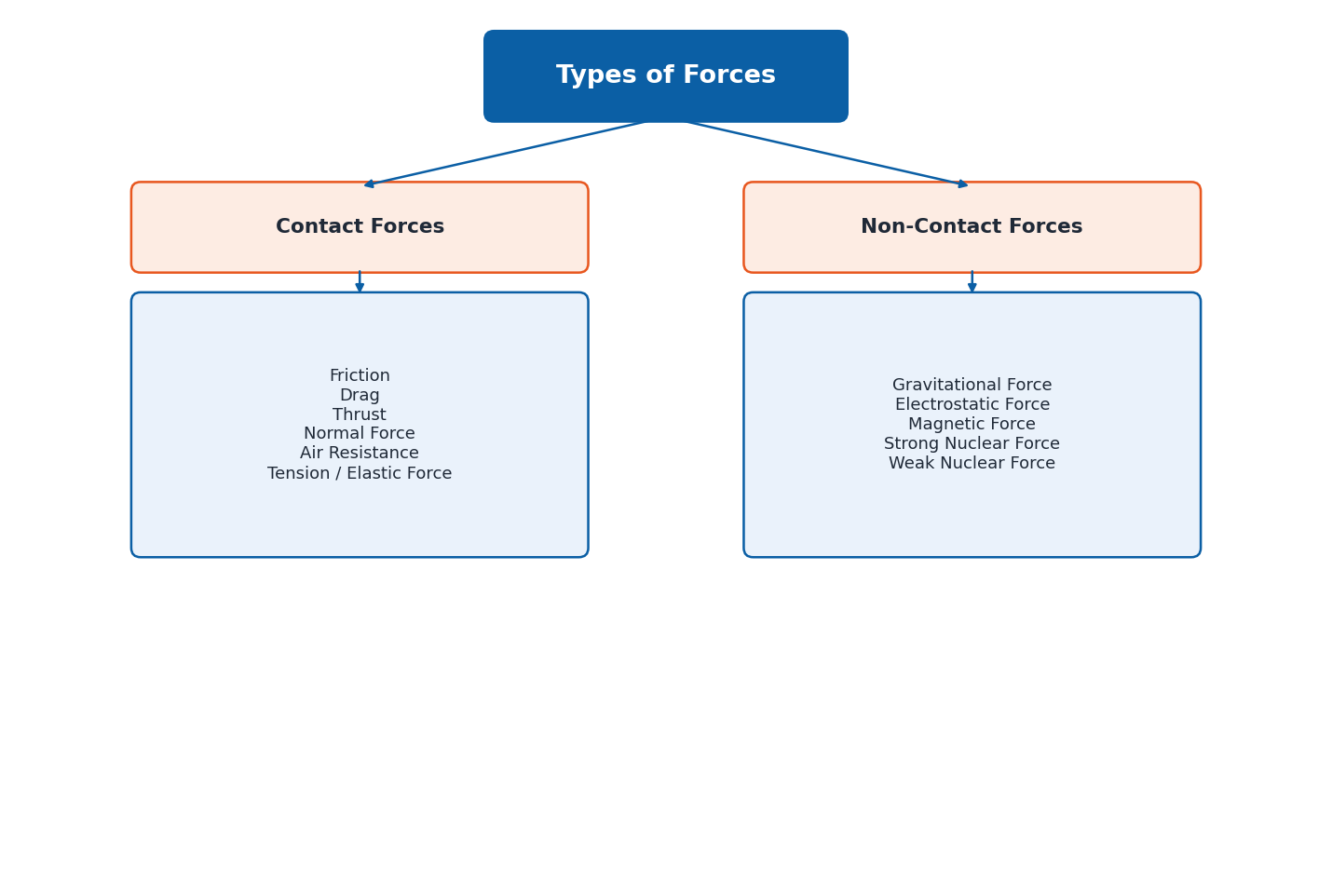
A force is a push or pull that starts, stops, or changes the magnitude or direction of the velocity of a body. Forces are of two major types. Contact forces act at the point of contact between two objects — examples include friction (resists relative motion between surfaces), drag (resistance from a fluid), thrust (upward force from a liquid on an immersed object), normal force (reaction from a surface, perpendicular to it), air resistance, tension force, and elastic force (restores deformed materials to their original shape). Non-contact (field) forces act between objects that are not touching, also called action-at-a-distance forces — examples include gravitational force, electrostatic force, and magnetic force.
3.2 The Four Fundamental Forces
All forces in nature fall under four fundamental forces. Gravitational force is the weakest of the four, but is long-range, extending to infinite distance while weakening with distance; it is described by Newton's law of gravitation, F = Gm₁m₂/r², where G = 6.67 × 10⁻¹¹ N m² kg⁻². Electromagnetic force, which includes electrostatic and magnetic forces, is stronger than gravity, is also long-range, and is responsible for chemical reactions and (at the macroscopic level) friction. Strong nuclear force binds protons and neutrons together in the nucleus, overcoming electromagnetic repulsion between protons; it is short-range, acting only over about 10⁻¹⁴ m. Weak nuclear force is responsible for radioactive decay (such as beta decay), is stronger than gravity but weaker than electromagnetic force, and is short-range, acting over about 10⁻¹⁷ m. Pakistani scientist Dr. Abdus Salam, along with Sheldon Glashow and Steven Weinberg, won the 1979 Nobel Prize in Physics for showing that the weak nuclear force and electromagnetic force are two aspects of a single unified electroweak force.
3.3 Free-Body Diagrams
A free-body diagram shows the relative magnitudes and directions of all forces acting on an object in a given situation. The object is represented as a box, and force arrows are drawn outward from its centre in the direction of each force, with arrow length representing magnitude and each force labelled by type (e.g. weight, friction, normal force).
3.4 Newton's Laws of Motion
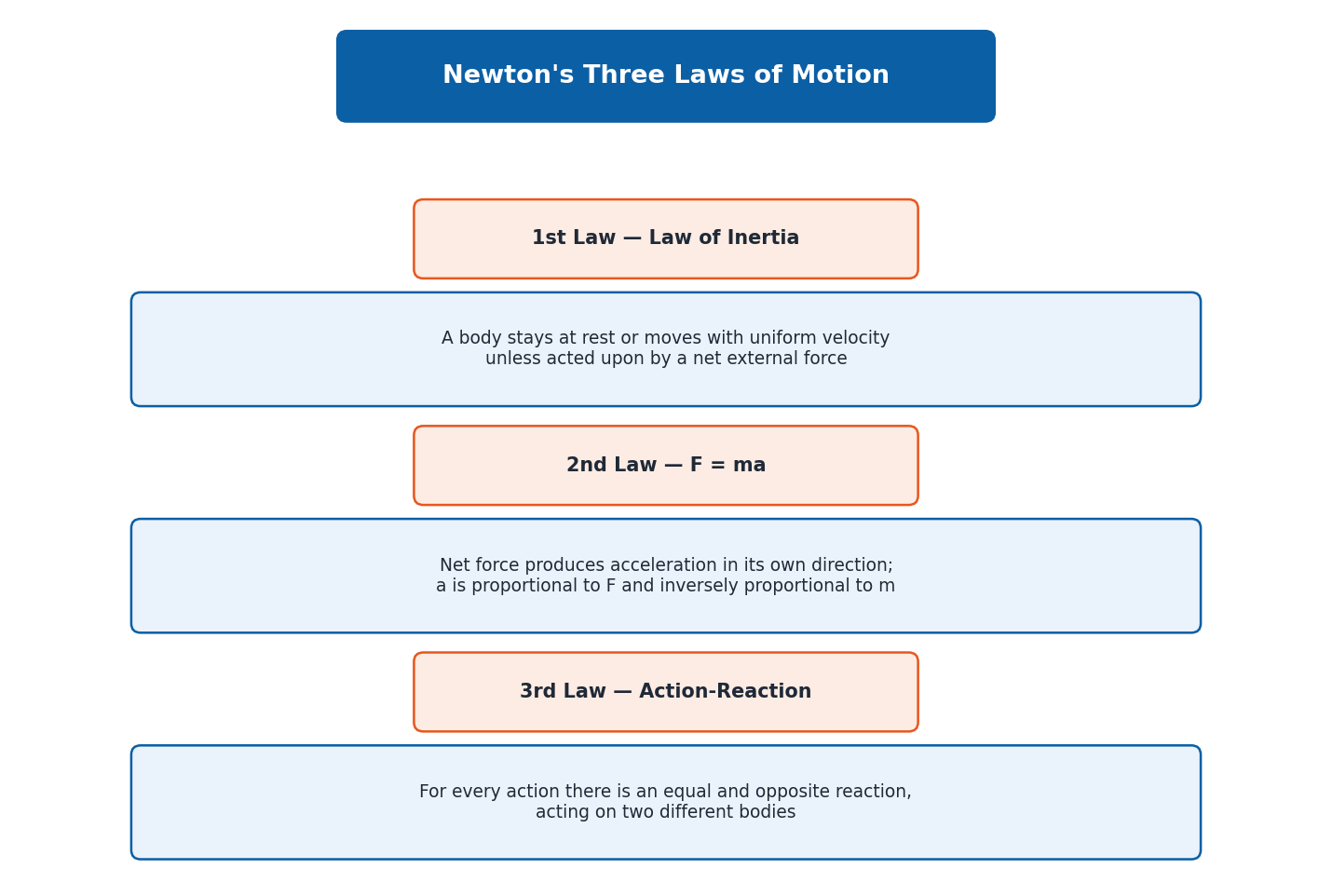
Newton's First Law: a body continues its state of rest or of uniform motion in a straight line unless acted upon by some external force. This is also called the law of inertia — inertia is the property of a body to resist a change in its state of rest or motion, and mass is a measure of an object's inertia (greater mass means greater inertia).
Newton's Second Law: if a net external force acts on a body, it produces acceleration in the direction of the force; the acceleration is directly proportional to the force and inversely proportional to the mass, giving F = ma. One newton is defined as the force that produces an acceleration of 1 m s⁻² in a body of mass 1 kg (1 N = 1 kg m s⁻²). Since velocity is a vector, a force can change a body's speed, direction, or both.
Newton's Third Law: for every action, there is an equal and opposite reaction — if one body exerts a force on a second body, the second body exerts an equal and opposite force on the first. Action and reaction act on two different bodies, so they never cancel each other. Examples: a block resting on a table exerts its weight downward on the table, and the table exerts an equal normal reaction force upward on the block; when a bullet is fired, it moves forward with force F (action) while the gun recoils backward with reaction force R.
Newton's laws apply with very high accuracy to everyday motion but are not exact for particles moving at speeds close to the speed of light, where Einstein's relativistic mechanics is needed instead.
3.5 Mass and Weight
Mass is the quantity of matter in a body and is a measure of the body's inertia — it is a scalar quantity, remains constant everywhere, has SI unit kilogram (kg), and is measured with an ordinary balance. Weight is the gravitational force with which the Earth (or another planet) attracts a body toward its centre — it is a vector quantity directed downward, with SI unit newton (N), and is measured using a spring balance (force meter), not an ordinary balance.
A gravitational field is the region around a mass in which another mass experiences a gravitational force. Gravitational field strength g is the gravitational force per unit mass: g = w/m, so weight is given by w = mg (equivalent to the acceleration of free fall). Since g varies with location and altitude, an object's weight varies from place to place even though its mass stays the same; at any given location, weight remains proportional to mass, so masses can be compared by comparing weights there.
3.6 Measuring Mass and Weight
A mechanical balance uses a rigid beam pivoting on a central knife-edge, with pans on each end; the object is balanced against standard weights. A mechanical platform balance (for heavy items like flour or cement bags) places the fulcrum near one end so small calibrated weights at the other end balance a much heavier load. An electronic balance requires no standard weights, is more precise, and displays mass directly (some models also compute price from a per-kg rate). A force meter (spring balance or newton meter) measures force/weight directly in newtons using the compression or stretching of an internal spring against a calibrated scale; digital force meters are also available.
3.7 Friction and Terminal Velocity
Friction is a dissipative force — energy used to overcome it is converted to heat (e.g. warming of rubbed hands, hot machine parts, worn tyres, and burning meteors from air friction). Sliding friction between two solid surfaces has two forms: static friction (opposes the start of motion, up to a maximum called limiting friction) and kinetic friction (acts once the object is sliding). Rolling friction occurs when an object rolls over a surface (e.g. wheels, ball bearings) and is roughly one hundred times smaller than sliding friction, because the rolling surface touches only at a point with no relative sliding motion.
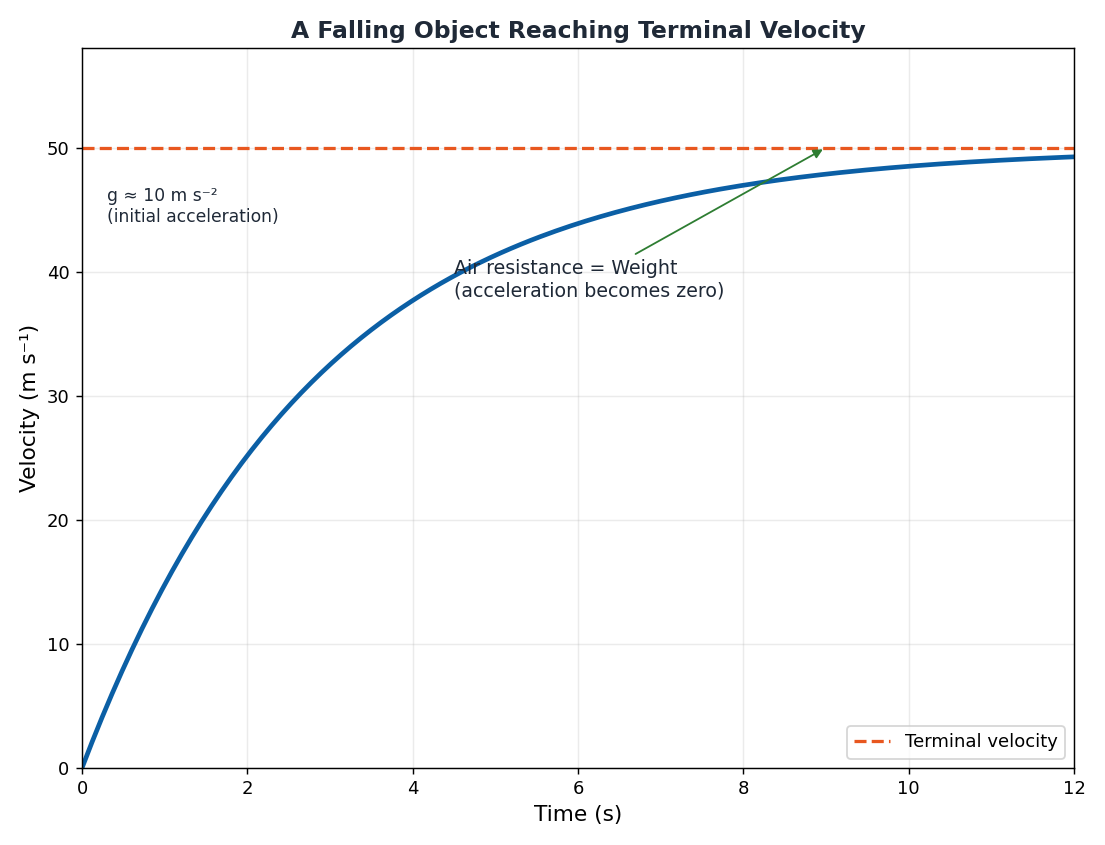
Terminal velocity is the constant velocity reached by a falling object when the upward force of air resistance exactly balances the downward force of gravity, so the object stops accelerating (e.g. a parachutist descending safely). Methods used to reduce friction include polishing sliding surfaces, applying oil or grease (liquid friction is less than solid friction), converting sliding friction to rolling friction using ball bearings, and streamlining vehicles/vessels to allow smooth (streamline) airflow or water flow around them.
3.8 Momentum, Impulse and Conservation of Momentum
Momentum is the quantity of motion of a moving body, defined as the product of its mass and velocity: p = mv. It is a vector quantity with SI unit kg m s⁻¹ (equivalent to N s). Impulse is the product of a large force acting for a short time interval and equals the total change in momentum it produces: Impulse = F × Δt = m × Δv = m(v_f − v_i). Rearranged, this gives Newton's second law in terms of momentum: F = Δp/Δt — the rate of change of momentum of a body equals the net force acting on it.
The principle of conservation of momentum states that if no external force acts on an isolated system, the total momentum of the system after an interaction (such as a collision) equals its total momentum before the interaction: m₁v₁ + m₂v₂ (before) = m₁v₁′ + m₂v₂′ (after). This principle applies to both macroscopic objects (e.g. colliding balls, a recoiling gun) and microscopic particles such as atoms and molecules. Everyday applications of impulse and momentum concepts include drawing hands back while catching a fast ball (increasing contact time to reduce force), soft packing materials for fragile goods, seatbelts, airbags, and vehicle crumple zones — all reduce the force of impact by increasing the time over which momentum changes.
Important Definitions
What is a force?
A push or pull that starts, stops, or changes the magnitude or direction of velocity of a body.
What is inertia?
The property of a body to maintain its state of rest or of uniform motion in a straight line; mass is a measure of inertia.
State Newton's first law of motion.
A body continues its state of rest or of uniform motion in a straight line unless acted upon by some external force.
State Newton's second law of motion.
If a net external force acts on a body, it produces acceleration in the direction of the force; acceleration is directly proportional to the force and inversely proportional to the mass (F = ma).
State Newton's third law of motion.
For every action, there is always an equal and opposite reaction, acting on two different bodies.
What is weight?
The gravitational force with which the Earth attracts a body toward its centre; weight = mass × gravitational field strength (w = mg).
What is terminal velocity?
The constant velocity reached by a falling object when the upward air resistance balances the downward force of gravity, so the object no longer accelerates.
What is momentum?
The product of a moving body's mass and velocity (p = mv); a vector quantity.
Key Formulas
| Topic | Formula |
|---|---|
| Newton's law of gravitation | F = G m₁m₂ / r² (G = 6.67 × 10⁻¹¹ N m² kg⁻²) |
| Weight | w = mg (g ≈ 10 N kg⁻¹ or 10 m s⁻²) |
| Gravitational field strength | g = w/m |
| Newton's second law | F = ma (1 N = 1 kg m s⁻²) |
| Momentum | p = mv |
| Impulse | Impulse = F × Δt = m × Δv = m(v_f − v_i) |
| Force as rate of change of momentum | F = Δp/Δt |
| Conservation of momentum | m₁v₁ + m₂v₂ (before) = m₁v₁′ + m₂v₂′ (after) |
Diagrams
Types of Forces: Classification of contact and non-contact forces with examples of each
Newton's Three Laws of Motion: Summary of the first, second and third laws with their key statements
Terminal Velocity: Velocity-time graph showing a falling object's speed levelling off at terminal velocity
Short Questions & Answers
What kinds of changes in motion can a force produce?
A force can start motion, stop motion, or change the speed or direction (or both) of a moving body.
Give five examples of contact forces.
Friction, drag, thrust, normal force, and tension force (air resistance and elastic force are also acceptable).
Define impulse of a force.
Impulse is the product of a large force and the short time interval for which it acts, equal to the total change in momentum it produces: Impulse = FΔt = mΔv.
Why has Newton's first law never been directly observed on Earth?
Because friction and air resistance act on all moving bodies on Earth, so a body never truly moves with zero net external force acting on it.
Define terminal velocity.
The constant velocity attained by a freely falling object when the upward force of air resistance equals the downward force of gravity.
How can you show that rolling friction is less than sliding friction?
A wheeled object requires much less force to keep moving at constant speed than an identical object without wheels sliding over the same surface, showing rolling friction is significantly smaller.
Why is the force in Newton's second law called the net force?
Because several forces may act on a body simultaneously; it is their vector sum (net/resultant force) that determines the resulting acceleration.
In what direction should an astronaut fire a hand rocket to return to the spaceship?
Away from the spaceship — by Newton's third law, firing the rocket away from the spaceship produces a reaction force that pushes the astronaut toward the spaceship.
Long Questions & Answers
State and explain Newton's three laws of motion with examples.
Newton's first law states that a body continues its state of rest or uniform motion unless acted on by an external force — e.g. passengers lurch forward when a bus stops suddenly because their bodies tend to continue moving. Newton's second law states that a net force produces acceleration in its own direction, proportional to the force and inversely proportional to mass, giving F = ma — e.g. a truck accelerates less than a bicycle under the same applied force because of its greater mass. Newton's third law states that for every action there is an equal and opposite reaction acting on a different body — e.g. a bullet fired forward from a gun (action) causes the gun to recoil backward (reaction).
Differentiate between mass and weight.
Mass is the quantity of matter in a body, a scalar quantity measured in kilograms, that stays constant everywhere and is measured with an ordinary balance. Weight is the gravitational force pulling a body toward the centre of a planet, a vector quantity measured in newtons (w = mg), that varies with location because gravitational field strength g varies with location and altitude, and is measured with a spring balance (force meter) rather than an ordinary balance.
Describe static and kinetic friction using the example of a block on a table, and explain terminal velocity.
When a horizontal pulling force is gradually applied to a block resting on a table (e.g. via weights added to a pan connected by a string), an opposing force called static friction initially prevents the block from moving; this increases up to a maximum called limiting friction. Once the applied force exceeds limiting friction, the block begins to slide, and the opposing friction during sliding is called kinetic friction. Terminal velocity occurs when a body falling through air (or another fluid) accelerates until the upward air resistance force grows large enough to balance the downward weight; beyond this point, the net force is zero, so the body falls at a constant (terminal) velocity — as seen in a parachutist's steady descent.
State the principle of conservation of momentum and explain it using a collision example.
The principle states that if no external force acts on an isolated system, the total momentum of the system after an interaction equals its total momentum before the interaction. For two balls of masses m₁ and m₂ moving with velocities v₁ and v₂ that collide and move off with velocities v₁′ and v₂′, m₁v₁ + m₂v₂ = m₁v₁′ + m₂v₂′. For example, when a moving ball strikes an identical stationary ball, momentum transfers from the first ball to the second: the striking ball can come to rest while the second ball moves off with the same momentum the first ball had before the collision, showing total momentum is conserved.
Multiple Choice Questions (MCQs)
When we kick a stone, we get hurt. This is due to: (A) inertia (B) velocity (C) momentum (D) reaction
Correct answer: (D) reaction. By Newton's third law, the stone exerts an equal and opposite reaction force back on the foot, causing pain.
Which of the following is a non-contact force? (A) Friction (B) Air resistance (C) Electrostatic force (D) Tension in a string
Correct answer: (C) Electrostatic force. Electrostatic force acts between charged objects without physical contact; the others require contact.
A ball with momentum p hits a solid wall and bounces back with the same speed. Its momentum p' after collision is: (A) p' = p (B) p' = -p (C) p' = 2p (D) p' = -2p
Correct answer: (B) p' = -p. The ball reverses direction with the same magnitude of velocity, so its momentum reverses sign: p' = -p.
Conservation of linear momentum is a direct consequence of: (A) Newton's first law of motion (B) Newton's second law of motion (C) Newton's third law of motion (D) None of these
Correct answer: (C) Newton's third law of motion. Conservation of momentum follows from Newton's third law — the equal and opposite forces during interaction cause equal and opposite changes in momentum.
Newton's law of gravitation states force is: (A) directly proportional to r² (B) inversely proportional to r² (C) directly proportional to (m₁+m₂) (D) independent of mass
Correct answer: (B) inversely proportional to r². F = Gm₁m₂/r² — gravitational force is inversely proportional to the square of the distance between the masses.
The SI unit of momentum is: (A) N (B) kg m s⁻¹ (C) kg m s⁻² (D) J
Correct answer: (B) kg m s⁻¹. Momentum p = mv has units of kg × m s⁻¹ = kg m s⁻¹ (equivalent to N s).
One newton is the force that produces an acceleration of 1 m s⁻² in a mass of: (A) 1 g (B) 1 kg (C) 10 kg (D) 100 kg
Correct answer: (B) 1 kg. By definition, 1 N = 1 kg × 1 m s⁻², i.e. the force needed to accelerate a 1 kg mass at 1 m s⁻².
A lubricant reduces friction between two surfaces mainly by: (A) decreasing temperature (B) acting as ball bearings (C) preventing direct contact of the surfaces (D) providing rolling friction
Correct answer: (C) preventing direct contact of the surfaces. A lubricant forms a thin liquid layer that keeps the two solid surfaces from direct contact, reducing friction.
Rolling friction compared to sliding friction is approximately: (A) 100 times greater (B) 100 times smaller (C) equal (D) 10 times greater
Correct answer: (B) 100 times smaller. Rolling friction is about one hundred times smaller than sliding friction because there is no relative sliding at the contact point.
A large force acting on an object for a very short time makes it easiest to determine the: (A) magnitude of the force alone (B) time interval alone (C) product of force and time (impulse) (D) none of these
Correct answer: (C) product of force and time (impulse). Since the exact force and exact contact time are both hard to measure individually, their product — the impulse (equal to the change in momentum) — is what can be determined.
Quick Revision Summary
- Force = push/pull that changes speed, direction, or state of motion
- Contact forces: friction, drag, thrust, normal, tension, elastic, air resistance
- Non-contact forces: gravitational, electrostatic, magnetic (also strong/weak nuclear)
- 4 fundamental forces (weakest to strongest): gravitational, weak nuclear, electromagnetic, strong nuclear
- Newton's 1st law: inertia; 2nd law: F=ma; 3rd law: action-reaction pairs on different bodies
- Mass = quantity of matter (scalar, kg, constant); Weight = mg (vector, N, varies with location)
- Static friction ≤ limiting friction; kinetic friction acts during sliding; rolling friction ≪ sliding friction
- Terminal velocity: air resistance balances weight, so acceleration becomes zero
- Momentum p = mv; Impulse = FΔt = Δp
- Conservation of momentum: total momentum before collision = total momentum after (isolated system)
Exam Tips
- Memorise the three statements of Newton's laws precisely — exam questions often ask to 'state' them exactly
- Practice distinguishing contact vs non-contact forces and classifying examples correctly
- Be clear on the mass vs weight distinction: mass is constant and scalar; weight = mg, is a vector, and varies with location
- Work through F=ma, p=mv, and impulse numericals step by step, listing given values before selecting the formula
- Remember real-life applications of momentum conservation and impulse (airbags, seatbelts, crumple zones, catching a ball) — these are common short-answer topics
- Know the order-of-magnitude ranges for strong (10⁻¹⁴ m) and weak (10⁻¹⁷ m) nuclear forces, and that Dr. Abdus Salam shared the 1979 Nobel Prize for the electroweak unification