This chapter covers Circular Motion from the 1st Year (FSc Part-I) Physics syllabus of the Punjab Curriculum and Textbook Board (PTB/PCTB). It studies angular quantities, the link between linear and angular motion, centripetal force, moment of inertia, angular momentum and its conservation, and the motion of satellites. These notes are prepared by freebooks.pk.
When a body moves in a circle, a force is always needed to keep it turning. You will learn the angular quantities that describe rotation, how they relate to linear ones, and the important idea of centripetal force.
Learning Objectives
- Define angular displacement, angular velocity and angular acceleration.
- Relate linear and angular quantities (v = r omega).
- Define centripetal acceleration and centripetal force.
- Define moment of inertia and rotational kinetic energy.
- Define angular momentum and state its conservation.
- Describe artificial satellites and orbital velocity.
Key Concepts
Angular Displacement, Velocity and Acceleration
When a body rotates, the angle it turns through is the angular displacement (theta), measured in radians. The rate of change of angular displacement is the angular velocity (omega), and the rate of change of angular velocity is the angular acceleration (alpha). These angular quantities describe rotation in the same way that displacement, velocity and acceleration describe straight-line motion.
Relation between Linear and Angular Quantities
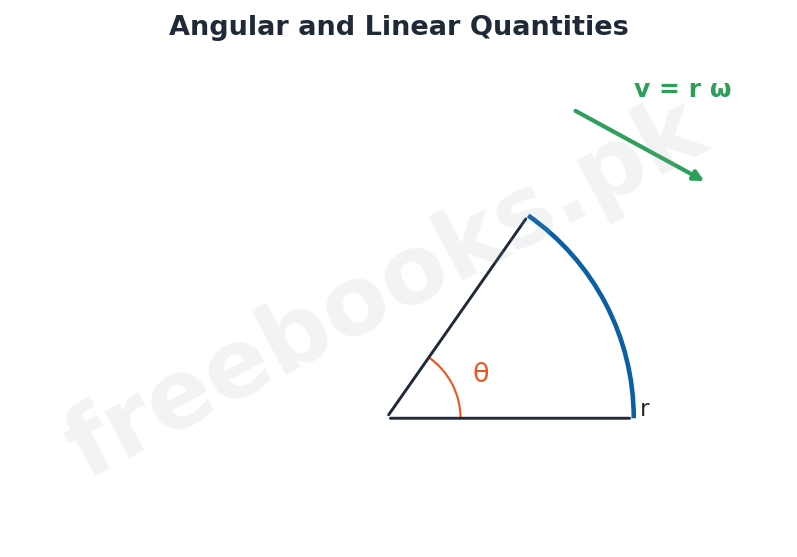
For a body moving in a circle of radius r, the linear (tangential) quantities are related to the angular ones by simple equations: the linear speed is v = r omega, the tangential acceleration is a = r alpha, and the arc length is s = r theta. The linear velocity is always directed along the tangent to the circle.
Centripetal Acceleration and Force
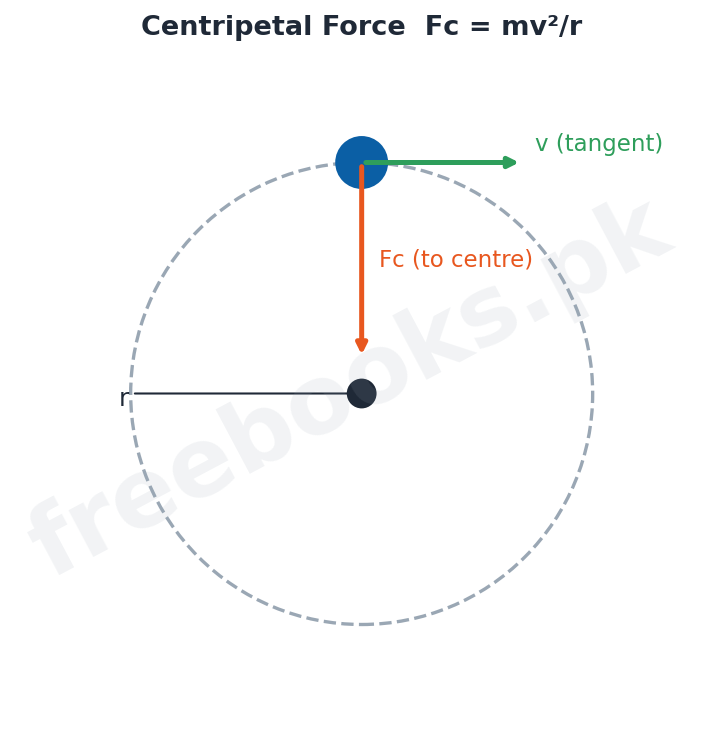
A body moving in a circle is continuously changing direction, so it has an acceleration directed towards the centre of the circle called the centripetal acceleration, a = v^2/r = r omega^2. The force that provides this acceleration and keeps the body moving in the circle is the centripetal force, F = mv^2/r = m r omega^2, always directed towards the centre. Examples of centripetal force are the tension in a whirling string, gravity for a satellite, and friction for a car turning a corner.
Moment of Inertia and Rotational Kinetic Energy
The moment of inertia of a body is its resistance to a change in its rotation, and depends on the mass and how that mass is distributed about the axis; for a point mass, I = m r^2. A rotating body has rotational kinetic energy KE = (1/2) I omega^2, which is the rotational analogue of (1/2)mv^2.
Angular Momentum and Its Conservation
The angular momentum of a rotating body is L = I omega, the rotational analogue of linear momentum. The law of conservation of angular momentum states that if no external torque acts on a system, its total angular momentum remains constant. This is why an ice skater spins faster when she pulls her arms in: reducing her moment of inertia increases her angular velocity so that L stays the same.
Artificial Satellites and Orbital Velocity
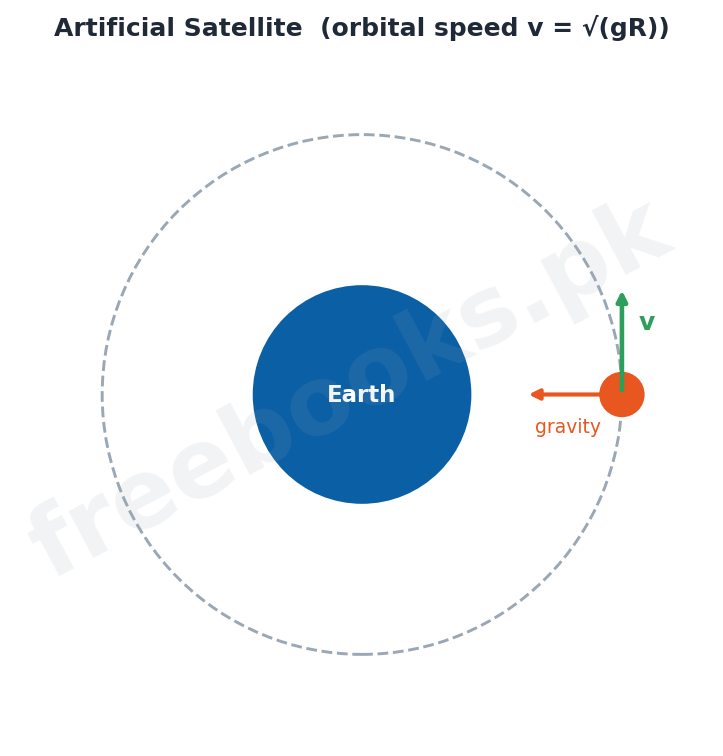
An artificial satellite is a body that orbits the Earth; the gravitational pull of the Earth provides the centripetal force needed to keep it in orbit. For a satellite close to the Earth the orbital speed is v = sqrt(gR), about 7.9 km/s. A geostationary satellite orbits once every 24 hours above the equator, so it appears fixed over one point and is used for communications. An astronaut in an orbiting satellite feels weightless because both the astronaut and the satellite fall together with the same acceleration.
Important Definitions
Angular displacement
The angle turned through by a rotating body, measured in radians.
Angular velocity
The rate of change of angular displacement, omega.
Angular acceleration
The rate of change of angular velocity, alpha.
Centripetal acceleration
The acceleration directed towards the centre, a = v^2/r.
Centripetal force
The force directed towards the centre that keeps a body in a circle, F = mv^2/r.
Moment of inertia
The resistance of a body to a change in its rotation; I = m r^2 for a point mass.
Angular momentum
The rotational analogue of linear momentum, L = I omega.
Orbital velocity
The speed a satellite needs to stay in orbit, v = sqrt(gR) near the Earth.
Formulas & Rules
| Item | Fact |
|---|---|
| Linear-angular relations | v = r omega; a = r alpha; s = r theta |
| Centripetal acceleration | a = v^2/r = r omega^2 |
| Centripetal force | F = mv^2/r = m r omega^2 |
| Moment of inertia (point mass) | I = m r^2 |
| Rotational kinetic energy | KE = (1/2) I omega^2 |
| Angular momentum | L = I omega |
| Orbital velocity (near Earth) | v = sqrt(gR) (about 7.9 km/s) |
Diagrams & Illustrations
Centripetal force: a body moving in a circle with its velocity along the tangent and the centripetal force directed towards the centre, F = mv^2/r.
Angular and linear quantities: a rotating radius sweeping an angle theta, showing the relation between the linear speed and the angular velocity, v = r omega.
Artificial satellite: a satellite orbiting the Earth, with its velocity along the orbit and gravity providing the centripetal force.
Solved Examples & Numericals
Linear speed
A wheel of radius 0.5 m turns at an angular velocity of 4 rad/s. The linear speed of a point on its rim is v = r omega = 0.5 x 4 = 2 m/s.
Centripetal force
A 2 kg ball is whirled in a circle of radius 1 m at 3 m/s. The centripetal force is F = mv^2/r = 2 x 9 / 1 = 18 N.
Centripetal acceleration
A car moves at 10 m/s around a circle of radius 25 m. Its centripetal acceleration is a = v^2/r = 100/25 = 4 m/s^2.
Angular momentum
A body of moment of inertia 2 kg m^2 rotates at 5 rad/s. Its angular momentum is L = I omega = 2 x 5 = 10 kg m^2/s.
Short Questions & Answers
Define angular velocity.
The rate of change of angular displacement of a rotating body, omega, measured in radians per second.
Write the relation between linear and angular speed.
v = r omega, where r is the radius and omega the angular velocity.
What is centripetal force?
The force directed towards the centre of a circle that keeps a body moving in that circle, F = mv^2/r.
Define moment of inertia.
The resistance of a body to a change in its rotational motion; for a point mass I = m r^2.
State the law of conservation of angular momentum.
If no external torque acts on a system, its total angular momentum stays constant.
Why does an astronaut in orbit feel weightless?
Because the astronaut and the satellite fall together with the same acceleration, so there is no reaction force.
Long Questions & Answers
Q1: Define centripetal acceleration and centripetal force and give examples.
A body moving in a circle constantly changes the direction of its velocity, and any change in velocity is an acceleration. Because the direction change is always towards the centre of the circle, this acceleration is directed towards the centre and is called the centripetal acceleration, given by a = v^2/r = r omega^2, where v is the linear speed, r the radius and omega the angular velocity. By Newton’s second law an acceleration requires a force, so a force directed towards the centre must act on the body; this is the centripetal force, F = mv^2/r = m r omega^2. The centripetal force is not a new kind of force but is provided by some real force in each situation: the tension in the string when a stone is whirled around, the gravitational pull of the Earth for a satellite, and the friction between the tyres and the road for a car going round a bend.
Q2: Define angular momentum and explain the law of its conservation with an example.
The angular momentum of a rotating body is the rotational analogue of linear momentum and is defined as L = I omega, where I is the moment of inertia and omega the angular velocity. The law of conservation of angular momentum states that if the net external torque acting on a system is zero, the total angular momentum of the system remains constant. This means that if the moment of inertia of a body changes, its angular velocity must change in the opposite way so that the product I omega stays the same. A familiar example is a spinning ice skater: when she pulls her arms and one leg inwards, she reduces her moment of inertia, and because angular momentum is conserved her angular velocity increases and she spins faster; stretching her arms out again slows her down. The same principle explains how a diver controls the speed of a somersault.
Q3: Describe an artificial satellite and derive its orbital velocity near the Earth.
An artificial satellite is a man-made body that revolves around the Earth in a fixed orbit. The gravitational pull of the Earth on the satellite provides exactly the centripetal force needed to keep it moving in its circular orbit. For a satellite orbiting close to the Earth’s surface, the gravitational force mg provides the centripetal force mv^2/R, where R is the radius of the Earth; equating these gives mg = mv^2/R, so the orbital velocity is v = sqrt(gR), which works out to about 7.9 km/s. A special case is the geostationary satellite, which orbits above the equator once every 24 hours so that it appears to stay fixed over one point of the Earth; such satellites are used for communications and weather monitoring.
MCQs with Answers
The SI unit of angular displacement is the: (a) metre (b) radian (c) degree (d) second
Correct Answer: (b) radian.
The relation between linear and angular speed is: (a) v = r/omega (b) v = r omega (c) v = omega/r (d) v = r + omega
Correct Answer: (b) v = r omega.
Centripetal acceleration is directed: (a) along the tangent (b) towards the centre (c) away from the centre (d) upward
Correct Answer: (b) towards the centre.
Centripetal force is given by: (a) mv/r (b) mv^2/r (c) m/r (d) mvr
Correct Answer: (b) mv^2/r.
The moment of inertia of a point mass is: (a) mr (b) mr^2 (c) m/r (d) m^2 r
Correct Answer: (b) mr^2.
Angular momentum is equal to: (a) I/omega (b) I omega (c) omega/I (d) I + omega
Correct Answer: (b) I omega.
An ice skater spins faster when she pulls her arms in because of conservation of: (a) energy (b) linear momentum (c) angular momentum (d) mass
Correct Answer: (c) angular momentum.
The centripetal force on a satellite is provided by: (a) friction (b) tension (c) gravity (d) magnetism
Correct Answer: (c) gravity.
The approximate orbital speed of a satellite near the Earth is: (a) 3 km/s (b) 7.9 km/s (c) 11 km/s (d) 30 km/s
Correct Answer: (b) 7.9 km/s.
The rotational kinetic energy of a body is: (a) (1/2)mv^2 (b) (1/2) I omega^2 (c) I omega (d) mgh
Correct Answer: (b) (1/2) I omega^2.
Quick Revision Summary
- Angular quantities: displacement theta, velocity omega, acceleration alpha (in radians).
- Linear-angular: v = r omega; a = r alpha; s = r theta.
- Centripetal acceleration a = v^2/r; centripetal force F = mv^2/r (towards centre).
- Moment of inertia I = m r^2; rotational KE = (1/2) I omega^2.
- Angular momentum L = I omega; conserved if no external torque.
- Satellite: gravity provides centripetal force; v = sqrt(gR) near Earth. Notes by freebooks.pk.
Exam Tips
- Work in radians for all angular quantities.
- Remember centripetal force always points towards the centre.
- Use conservation of angular momentum for spinning-body problems.
- Learn v = sqrt(gR) for a near-Earth satellite.
- Distinguish moment of inertia (I) from momentum.
- Weightlessness in orbit: both astronaut and satellite fall together.