This chapter introduces the theory of systems — a foundational idea used to understand both the natural world and human-made technology. It defines what a system is, discussing its objectives, components, environment, and communication, then differentiates between natural systems (physical, chemical, biological, psychological) and artificial systems (knowledge, engineering, social).
The chapter also explores how systems relate to natural science and design science, before returning to computers as systems — covering their objectives, components, and interactions, a detailed look at the Von Neumann computer architecture (memory, CPU, input/output, and the fetch-decode-execute-store cycle), and the broader computing systems of computer networks and the Internet.
Learning Objectives
- Define and describe a system, including its objectives, components, communication, and environment
- Differentiate between static/dynamic and deterministic/non-deterministic system environments
- Differentiate between natural systems (physical, chemical, biological, psychological) and artificial systems (knowledge, engineering, social)
- Explain the relationship between systems and natural science, design science, and computer science
- Describe a computer as a system, including its objectives, interface/processing/communication components, and interactions
- Explain the Von Neumann architecture: memory, CPU (ALU + CU), input devices, output devices, and the system bus
- Describe the fetch-decode-execute-store instruction cycle of the Von Neumann architecture
- State the key characteristics, advantages, and disadvantages of the Von Neumann architecture
- Identify the types of computing systems: computer, software, computer network, and the Internet
- Differentiate between a Local Area Network (LAN) and a Wide Area Network (WAN)
Key Concepts
1.1 Theory of Systems and Basic Concepts
A system is an organized set of components coordinated to perform a designated function; all components are related to each other, and the functioning of each component enhances the operation of the whole. Systems Theory is the branch of science that studies complex structures — in living organisms, society, and machines — and how systems and sub-systems operate, integrate, grow, and change over time. Systems can be physical objects (a car), processes (a university admission process), or abstract objects (a mathematical formula).
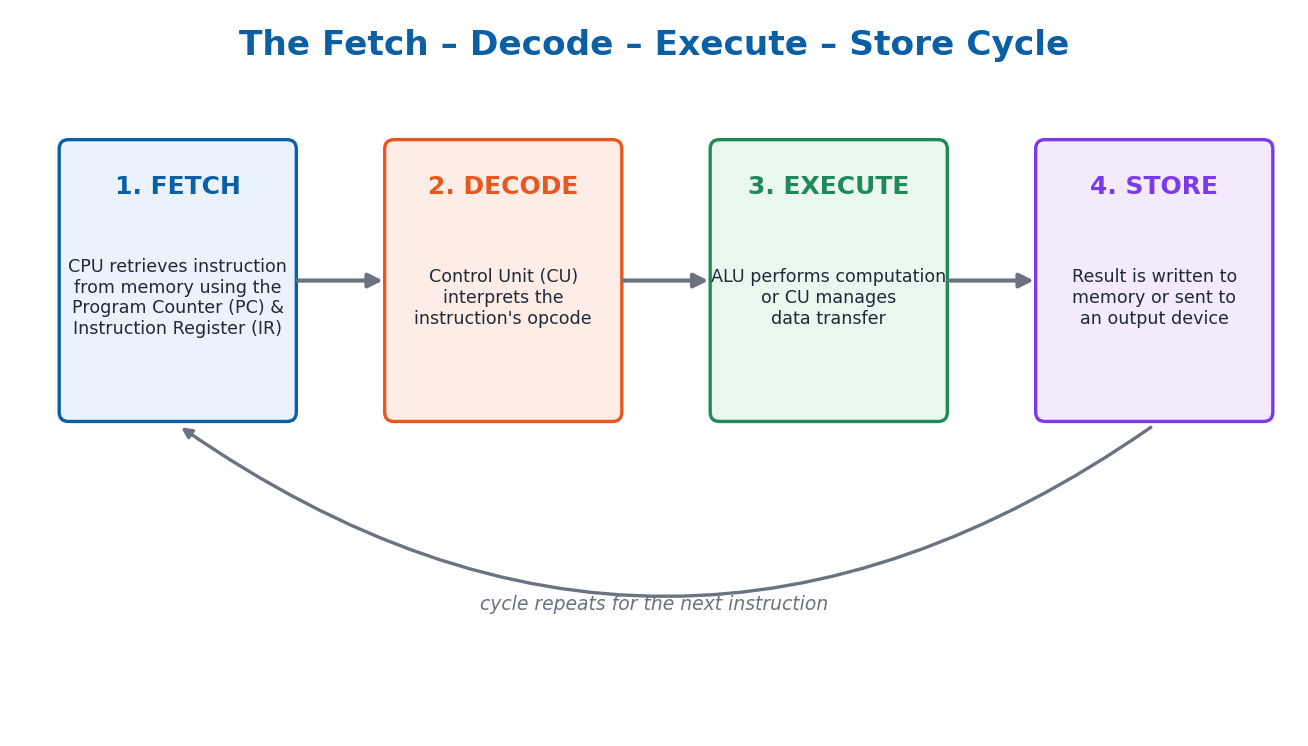
A system is described by four basic concepts: its objective (the purpose or goal it fulfils, such as a transport system moving people safely, or a computer processing data), its components (the building blocks that each play a specific role, such as a computer's CPU, memory, and input/output devices), its environment (everything external to the system that interacts with it, which can be static or dynamic, and deterministic or non-deterministic), and communication (the interaction among components that lets them work together, such as a CPU communicating with memory to fetch and store data).
1.2 Types of Systems: Natural Systems
Systems are broadly categorized as natural or artificial. Natural systems exist in nature and operate independently of human involvement, governed by natural laws, ranging from atoms and cells to forests, oceans, and the cosmos. Physical systems are composed of physical components governed by the laws of physics (e.g., hydrogen gas forming from an electron, proton, and neutron). Chemical systems involve substances and their reactions, governed by chemistry (e.g., water forming when hydrogen bonds with oxygen).
Biological systems consist of living organisms governed by processes like growth, reproduction, and metabolism, emerging from chemical systems when molecules form living cells, tissues, and organisms. Psychological systems involve the mind and behaviour — thoughts, emotions, and mental processes — emerging from biological systems when the brain's physical and chemical processes give rise to behaviour, influenced by experience and environment.
1.3 Types of Systems: Artificial Systems
Artificial systems are created and developed by people to fulfil specific functions or solve problems, ranging in scale from a simple wheel to an organization like the United Nations. Knowledge systems capture, process, store, retrieve, and manage information for decision-making and problem-solving, including mathematics, logic, databases (e.g., MySQL, MongoDB), and information management systems.
Engineering systems apply engineering principles to perform tasks or solve technical challenges, including civil engineering (bridges, roads), mechanical engineering (robotic arms), chemical engineering (water treatment plants), electrical engineering (home automation systems), and software engineering (library management tools). Social systems are structured frameworks created by people to manage social interactions, governance, and community activities, including academic institutions, governments, and organizations (e.g., corporations, non-profits).
1.4 System and Science
Science is a systematic way of validating our understanding of systems, divided into natural science and design science. Natural science is descriptive — scientists study existing natural systems (like a forest ecosystem) to understand how they work, following an empirical cycle. Design science is prescriptive — researchers create new artificial systems (artifacts) to achieve specific goals (like new software to manage forest conservation data), following a regulative cycle.
Computer science studies how computers work, what they can do, and their limitations, drawing on both natural science and design science. The natural science of computer science studies the basic rules governing computer systems, such as analyzing the efficiency of algorithms like QuickSort or MergeSort. The design science of computer science focuses on creating and improving computer tools and systems, such as designing new programming languages or more efficient database management systems.
1.5 Computer as a System
A computer is a complex system designed to process data and perform tasks according to a set of instructions; its main objective is to perform computations, process data, and execute tasks efficiently. Its components fall into three groups: interface components (input devices like keyboard/mouse; output devices like monitors/printers), processing components (the CPU, RAM for transient storage, storage devices like hard drives/SSDs for permanent storage, the operating system, and application software), and communication components (the motherboard, which interconnects components, and the system bus — data bus, address bus, and control bus — which transmits data, addresses, and control signals between the CPU and other components).
These components interact to perform tasks: for example, opening a file involves an input device (mouse/keyboard) sending a signal, which the operating system and CPU process to retrieve and display the file. The computer's environment includes external devices like the power supply, network connections, and peripherals (printers, scanners, external drives); the computer interacts with this environment through user input, network communication, and its reliance on a stable power supply.
1.6 The Von Neumann Architecture: Components and Working
The Von Neumann architecture, developed by mathematician and physicist John von Neumann in the 1940s, describes a computer with four primary hardware components: memory (holds both data and program instructions — for instance, RAM, which runs programs faster than a hard disk), the CPU (performs computations and executes instructions, made up of the Arithmetic Logic Unit (ALU), which performs mathematical/logical operations, and the Control Unit (CU), which governs and coordinates the CPU's activities), input devices (keyboard, mouse, microphone), and output devices (monitor, printer) — all connected by a system bus (data bus, address bus, control bus).
The CPU executes instructions through four essential stages: Fetching, where the CPU retrieves an instruction from memory using the Program Counter (PC) to find its address and the Instruction Register (IR) to hold it; Decoding, where the Control Unit interprets the instruction's opcode to determine the required operation; Executing, where the ALU performs any computation or the CU manages any data transfer; and Storing, where the result is written back to memory or sent to an output device.
1.7 Von Neumann Characteristics, Advantages and Disadvantages
Key characteristics of the Von Neumann architecture include: a single memory store, where both program instructions and data share the same memory space (e.g., a game's code and its score data are both stored in RAM); sequential execution, where instructions are processed one after another in order; and the stored program concept, where programs are stored in memory and can be changed (e.g., updating software replaces old instructions with new ones).
Its advantages include simplified design (combining instructions and data into one memory area) and flexibility (programs can be easily changed by altering memory contents). Its disadvantages include the Von Neumann bottleneck, where a single shared memory area limits how quickly the CPU can retrieve both instructions and data, and security risks, since storing data and instructions in the same area means one program could potentially alter another's instructions.
1.8 Computing Systems: Networks and the Internet
Beyond the computer itself, computing systems include software systems, computer networks, and the Internet. A computer network connects multiple computers and devices to share resources (files, printers, internet access), enable communication, and manage data. Its hardware includes routers (transmit data between networks), switches (connect devices within a network), and cables; its software includes protocols (rules like TCP/IP) and network operating systems. A Local Area Network (LAN) connects computers in one area (e.g., an office or school), while a Wide Area Network (WAN) connects computers across larger regions (e.g., the Internet connecting computers worldwide).
The Internet is a vast system connecting private, public, academic, business, and government networks worldwide to enable global communication and data exchange. Its core protocols include TCP/IP (governs data transmission), UDP (faster but less reliable), FTP (transfers files), and POP (retrieves emails). When a user requests a web page, multiple Internet components interact to deliver its content, all within an environment spanning homes, offices, data centres, and mobile networks.
Important Definitions
Define a system.
An organized set of components coordinated to perform a designated function, described by its objective, components, communication, and environment.
What is Systems Theory?
The branch of science that studies complex structures in living organisms, society, and machines, explaining how systems and sub-systems operate, integrate, grow, and change over time.
Define the environment of a system.
Everything external to a system that interacts with it, influencing its performance and behaviour by providing inputs and receiving outputs; it can be static or dynamic, and deterministic or non-deterministic.
Differentiate a natural system from an artificial system.
A natural system exists in nature and operates independently of human involvement, governed by natural laws; an artificial system is created and developed by people to fulfil a specific function or solve a problem.
What is the Von Neumann architecture?
A computer design in which memory, the CPU, input devices, and output devices are connected by a system bus, with program instructions and data stored together in a single memory space.
What are the ALU and the CU?
The Arithmetic Logic Unit (ALU) performs mathematical computations and logical operations; the Control Unit (CU) governs the CPU's activities, instructing the ALU and memory to execute tasks in the correct order.
What is the Von Neumann bottleneck?
A disadvantage of the Von Neumann architecture where having a single shared memory area for both instructions and data limits how quickly the CPU can retrieve them, restricting overall performance.
Differentiate a LAN from a WAN.
A Local Area Network (LAN) connects computers within a limited area, such as a single building or school; a Wide Area Network (WAN) connects computers across much larger geographic regions, such as cities or countries (e.g., the Internet).
Key Facts and Relations
| Topic | Key Fact / Relation |
|---|---|
| A system is described by | Objective + Components + Communication + Environment |
| Natural systems (order of emergence) | Physical → Chemical → Biological → Psychological |
| Von Neumann architecture core components | Memory + CPU + Input Devices + Output Devices (linked by the System Bus) |
| CPU is composed of | Arithmetic Logic Unit (ALU) + Control Unit (CU) |
| Von Neumann instruction cycle | Fetch → Decode → Execute → Store |
| System bus types | Data Bus (transports data) + Address Bus (data destination) + Control Bus (control signals) |
| Requirements to run a computing system | Hardware + Software + Electricity |
| Network scale | LAN = small area (building/school); WAN = large area (city/country/globe, e.g. the Internet) |
Diagrams
The Four Elements of a System: A diagram showing how a system is described by its objective, components, environment, and communication, with a natural system and an artificial system example
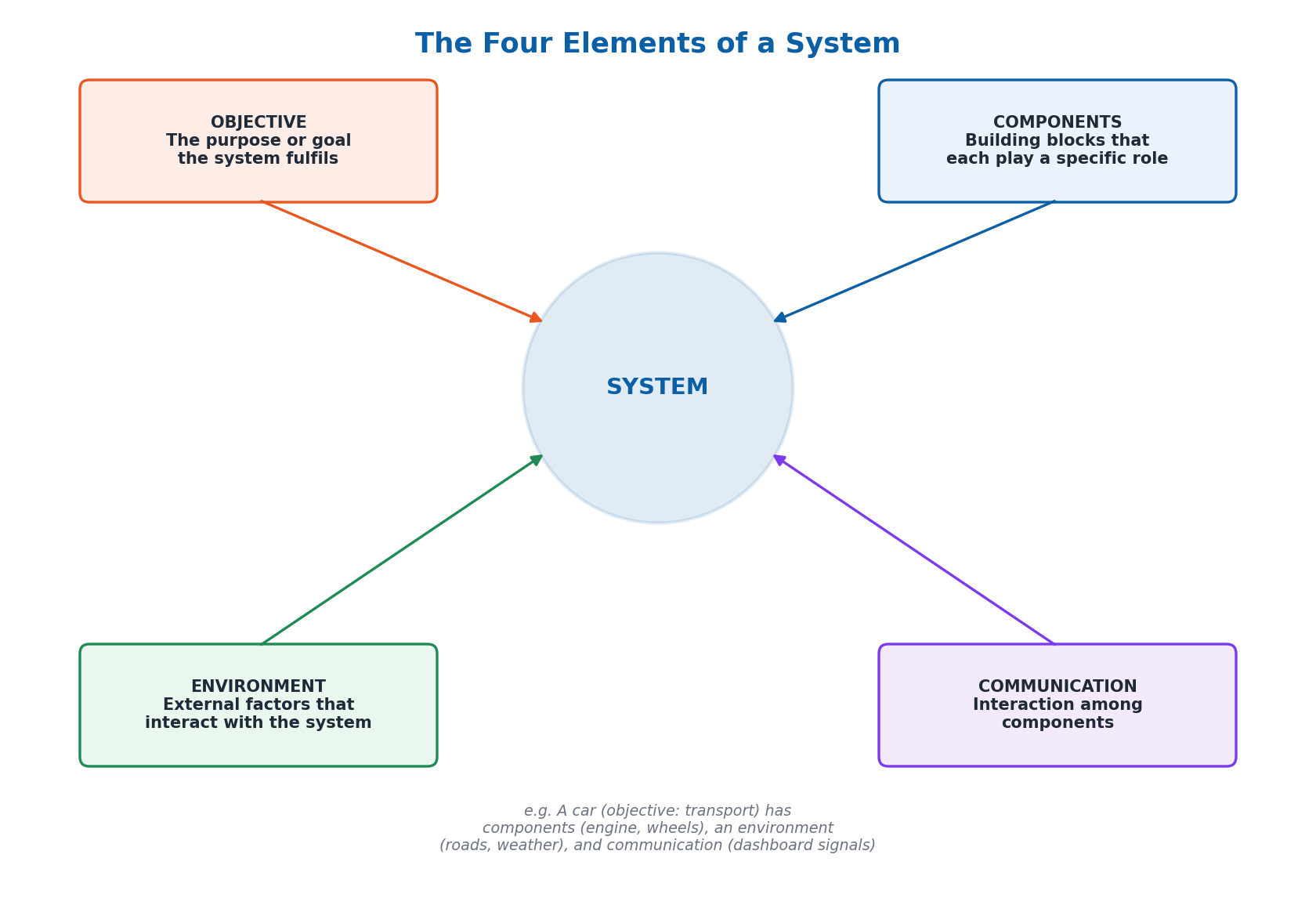
Von Neumann Computer Architecture: The four core components of the Von Neumann architecture — memory, CPU (ALU + CU), input devices, and output devices — connected by the data, address, and control buses
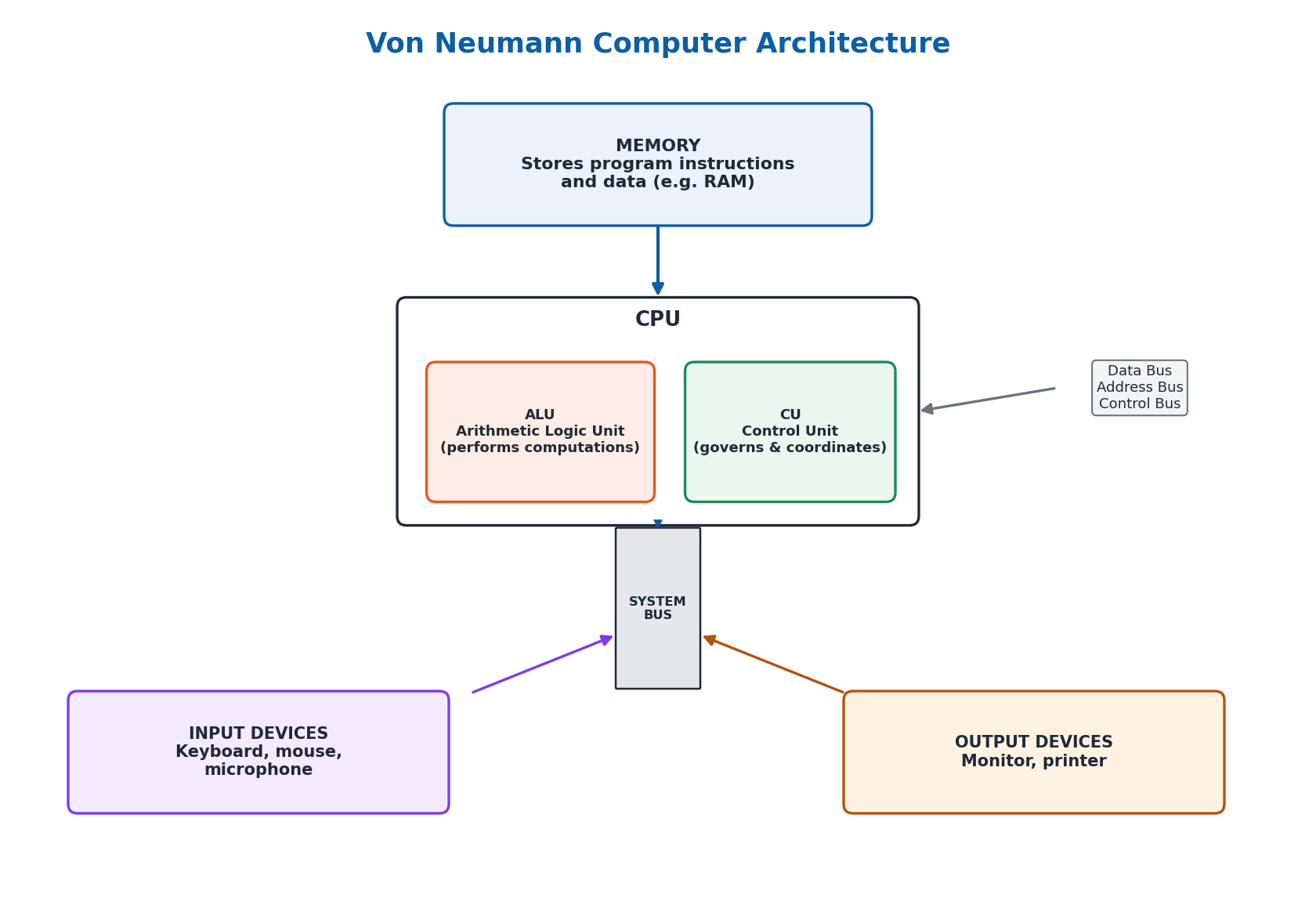
The Fetch-Decode-Execute-Store Cycle: The four stages of the Von Neumann instruction cycle: fetching an instruction from memory, decoding it in the Control Unit, executing it via the ALU/CU, and storing the result
Short Questions & Answers
Define a system. What are its basic components?
A system is an organized set of components coordinated to perform a designated function. It is described by its objective, components, communication among components, and the environment in which it works.
Differentiate between natural and artificial systems.
Natural systems exist in nature and operate independently of human involvement, governed by natural laws (e.g., the solar system); artificial systems are created and developed by people to fulfil specific needs or solve problems (e.g., a computer network).
Describe the main components of a computer system.
A computer system consists of interface components (input/output devices), processing components (CPU, RAM, storage, operating system, application software), and communication components (motherboard and system bus).
What are the main components of the Von Neumann architecture?
The Von Neumann architecture consists of memory (stores data and instructions), the CPU (ALU + CU, performs computations and controls execution), input devices, and output devices, all connected by a system bus.
What are the four main steps in the Von Neumann architecture's instruction cycle?
The four steps are: Fetching (retrieving an instruction from memory), Decoding (the Control Unit interprets the instruction), Executing (the ALU/CU carries out the operation), and Storing (the result is saved to memory or sent to an output device).
What is the Von Neumann bottleneck?
It is a limitation of the Von Neumann architecture where a single shared memory area for both instructions and data restricts how quickly the CPU can retrieve them, limiting overall processing speed.
What is a key advantage of the Von Neumann architecture?
Its simplified design — combining instructions and data into a single memory area — makes the architecture easier to build, and its flexibility allows programs to be easily changed by modifying memory contents.
What are the three main requirements for a computing system to function?
A computing system requires hardware (the physical components), software (instructions that direct hardware, divided into system software and application software), and electricity (the power source enabling the hardware to operate).
Long Questions & Answers
Define and describe the concept of a system. Explain the fundamental components, objectives, environment, and methods of communication within a system.
What is a system, and what forms can it take?
A system is an organized set of components coordinated to perform a designated function, with every component related to the others so that each one's functioning enhances the operation of the whole. Systems appear at every level of existence, from the natural world such as atoms, cells, and ecosystems, to human-made systems such as cars, computers, and organizations. A system can take the form of a physical object, a process, or even an abstract object such as a mathematical formula. Every system, regardless of its form, is described by four fundamental concepts: its objective, its components, its environment, and communication among its components.
What is a system's objective, and what are its components?
A system's objective is the purpose or goal it aims to fulfil, and understanding it is essential to analyzing how well the system operates — for example, a transport system's objective is to move people and goods safely and efficiently, while a computer system's objective is to process data into useful information. A system's components are its building blocks, each playing a specific role and contributing to overall functionality. Understanding each component's role is essential for identifying problems, improving performance, and refining design, since the smooth working of all components together is what lets the system meet its objective.
What is a system's environment, and how is it classified?
A system's environment is everything external to the system that interacts with it, providing inputs and receiving outputs. It can be static, remaining unchanged unless the system itself produces an output, or dynamic, changing independently of the system's output and requiring the system to adapt. It can also be deterministic, where the system's output has a fully known, certain effect on the environment, or non-deterministic, where that effect involves uncertainty or randomness. These two classifications together describe how a system relates to everything outside it.
What is communication within a system, and why is it important?
Communication is the interaction and coordination among a system's components, and it is key to the system functioning correctly. It ensures that all components work together in an organized, smooth manner to achieve the system's objective — for example, a computer's CPU communicating with memory to fetch and store data, or a biological system's brain sending signals to muscles to initiate movement. Together with objective, components, and environment, communication completes the framework used to understand, analyze, and design any system, whether natural or artificial.
Differentiate between natural and artificial systems. Discuss their characteristics, functions, and purposes with relevant examples.
What are natural systems, and what is their hierarchy?
Natural systems exist in nature and operate entirely independently of human involvement, governed instead by natural laws and processes. They occur at every scale, from extremely small structures like atoms and living cells to enormous structures like forests, oceans, and the wider cosmos. Natural systems form a hierarchy of increasingly complex types — physical, chemical, biological, and psychological — with each more complex type emerging from the one before it as interactions become more intricate.
What are physical and chemical systems?
Physical systems are composed of physical components and governed strictly by the laws of physics, emerging from the interactions of sub-atomic particles such as electrons, protons, and neutrons — for example, hydrogen gas forming when these particles combine according to physical forces. Chemical systems emerge from physical systems when atoms and molecules interact and bond according to chemical principles, forming new substances — for example, water forming when hydrogen atoms bond with oxygen atoms.
What are biological and psychological systems?
Biological systems emerge from chemical systems when molecules interact in complex ways to form living cells that organize into tissues, organs, and complete organisms, governed by biological processes like growth, reproduction, and metabolism. Psychological systems emerge from biological systems when the brain's underlying physical and chemical processes give rise to thoughts, emotions, and behaviours, which are further shaped and influenced by an individual's experiences and surrounding environment.
What are artificial systems, and how do they differ from natural systems?
Artificial systems are systems deliberately created and developed by people to fulfil certain functions or address particular problems and needs — in sharp contrast to natural systems, which exist and operate independently of human involvement. Artificial systems can range enormously in scale and complexity, from something as simple as a single wheel to something as vast as an international organization like the United Nations. Each is designed deliberately to perform its intended task, improve the efficiency of some process, or provide practical solutions to real-world issues.
What are the three categories of artificial systems?
Artificial systems are organized into three categories. Knowledge systems capture, process, store, retrieve, and manage information to support decision-making, learning, and problem-solving, such as mathematics, formal logic, and computer databases like MySQL. Engineering systems apply engineering principles to perform tasks or solve technical challenges, such as bridges and roads (civil), robotic arms (mechanical), water treatment plants (chemical), home automation setups (electrical), and library management applications (software). Social systems are structured frameworks that manage social interactions, governance, and community endeavours, such as schools, universities, governments, and corporations.
Explain the Von Neumann architecture of a computer. Include a discussion of the main components, their functions, and the step-by-step process of how the architecture operates.
What is the Von Neumann architecture, and what are its main components?
The Von Neumann architecture is a foundational computer design paradigm named after mathematician and physicist John von Neumann, who contributed significantly to its development during the 1940s. It describes a computer system whose hardware is organized around four primary components — memory, the CPU, input devices, and output devices — all interconnected and coordinated to allow the computer to store and execute programs. These four components are physically connected via a system bus, a shared communication pathway that lets them exchange data, addresses, and control signals.
What role does memory play in the Von Neumann architecture?
Memory holds both the input data to be processed and the program instructions the CPU needs to carry out its work. A practical example is a computer's RAM, into which a program is loaded when it starts running, since executing instructions directly from RAM is significantly faster than executing them from a hard disk. Because both instructions and data share this single memory space, the CPU can fetch whichever it needs from the same place during processing.
What are the ALU and CU, and how do they make up the CPU?
The Central Processing Unit (CPU) performs computations such as addition and subtraction and executes the commands provided to it via memory. It consists of two essential sub-components: the Arithmetic Logic Unit (ALU), responsible for carrying out all mathematical computations and logical operations, and the Control Unit (CU), which acts as an internal supervisor, governing and coordinating the CPU's activities by instructing both the ALU and memory on which tasks to execute and in what order.
What are input/output devices and the system bus in this architecture?
Input devices, such as a keyboard, mouse, or microphone, allow a user to enter data and instructions into the computer for processing. Output devices, such as a monitor or printer, present back to the user the results of whatever tasks the computer has executed. All four major components — memory, CPU, input devices, and output devices — are interconnected via a system bus, subdivided into a data bus (transports the actual data), an address bus (carries the memory location of that data), and a control bus (transports timing and control signals).
What are the four stages of the instruction cycle?
The CPU executes each program instruction through four sequential stages known as the instruction cycle. In fetching, the CPU retrieves the next instruction from memory: the Program Counter (PC) tracks the address of the next instruction, and once located, that instruction is copied into the Instruction Register (IR). In decoding, the Control Unit examines the instruction in the IR and decodes its opcode, which specifies the operation to perform. In executing, the CPU carries out the decoded instruction — the ALU performs any mathematical or logical computation, while the Control Unit manages any data transfer. In storing, the result is either written back to memory for future use or sent directly to an output device such as a monitor, so the outcome can be seen or used immediately.
Describe the process of retrieving and displaying a file using a computer, based on the interactions among different components. Provide a step-by-step explanation of how input is processed, data is transferred, and results are displayed on the screen.
What happens when a user first tries to open a file?
Although opening a file might feel like a single, instantaneous action, it actually involves a coordinated sequence of interactions between several hardware and software components. The process begins with a user action, such as double-clicking a file icon labelled 'report.docx' on the desktop using a mouse, or pressing a specific key combination, with the intention of opening that file. This physical action is immediately detected by the input device — in this example, the mouse — which converts the click into an electronic signal transmitted to the computer, typically via a USB connection, telling the operating system what action the user wants performed and on which file.
How does the operating system decide which application should open the file?
Once the input signal reaches the operating system, the operating system, working in close coordination with the CPU, determines — based on the file's extension and type — which application software is required to correctly open and display it. For a '.docx' file, this would typically be a word-processing application. This step ensures the right software is launched to interpret that specific type of file's data correctly, before any further retrieval or processing takes place.
How is a file's data retrieved from storage into memory?
The operating system instructs the storage device, such as the computer's hard disk or solid-state drive where the file is permanently stored, to locate the requested file. The relevant portion of the file's data is then copied from this longer-term storage into the computer's faster, temporary working memory (RAM), since data can be accessed and processed by the CPU far more quickly from RAM than directly from a storage device.
How does the CPU process the file's data and display it on the screen?
With the file data loaded into RAM, the CPU — following the standard fetch-decode-execute-store instruction cycle — fetches and executes the program instructions of the relevant application software, processing and interpreting the raw file data so it can be correctly formatted for display. Once processed, this output data is transmitted via the system bus to the monitor, which uses it to illuminate the correct pattern of pixels on screen, displaying the fully rendered contents of the file for the user to view, interact with, and edit.
Multiple Choice Questions (MCQs)
What is the primary function of a system? (A) To work independently (B) To achieve a common goal (C) To create new systems (D) To provide entertainment
Correct answer: (B) To achieve a common goal. A system is an organized set of components coordinated together to achieve a common goal, or objective.
What is one of the fundamental concepts of any system? (A) Its size (B) Its objective (C) Its age (D) Its price
Correct answer: (B) Its objective. Every system is described by its objective, components, communication among components, and its environment.
What is an example of a simple system? (A) A human body (B) A computer network (C) A thermostat regulating temperature (D) The Internet
Correct answer: (C) A thermostat regulating temperature. A thermostat regulating temperature is an example of a simple system, compared with far more complex systems like the human body, a computer network, or the Internet.
What type of environment remains unchanged unless the system provides an output? (A) Dynamic (B) Static (C) Deterministic (D) Non-deterministic
Correct answer: (B) Static. A static environment remains unchanged unless the system itself produces an output; a dynamic environment can change independently of the system.
What are the basic components of a system? (A) Users, hardware, software (B) Objectives, components, environment, communication (C) Inputs, outputs, processes (D) Sensors, actuators, controllers
Correct answer: (B) Objectives, components, environment, communication. A system is described by four basic concepts: its objective, its components, its environment, and communication among its components.
What role does the Operating System (OS) play in a computer? (A) It performs calculations and executes instructions (B) It temporarily stores data and instructions for the CPU (C) It receives input from interface components and decides what to do with it (D) It provides long-term storage of data and software
Correct answer: (C) It receives input from interface components and decides what to do with it. The operating system receives information from interface components (like a keyboard) and determines the appropriate actions the computer should take.
Which of the following describes the Von Neumann architecture's main characteristic? (A) Separate memory for data and instructions (B) Parallel execution of instructions (C) Single memory store for both program instructions and data (D) Multiple CPUs for different tasks
Correct answer: (C) Single memory store for both program instructions and data. A key characteristic of the Von Neumann architecture is that both program instructions and data are stored together in a single, shared memory space.
What is a disadvantage of the Von Neumann architecture? (A) Complex design due to separate memory spaces (B) Difficult to modify programs stored in memory (C) Bottleneck due to single memory space for instructions and data (D) Lack of flexibility in executing instructions
Correct answer: (C) Bottleneck due to single memory space for instructions and data. The Von Neumann bottleneck occurs because a single shared memory area limits how quickly the CPU can retrieve both instructions and data.
Which of the following transports data inside a computer among different components? (A) Control Unit (B) System Bus (C) Memory (D) Processor
Correct answer: (B) System Bus. The system bus (comprising the data, address, and control buses) transports data and signals between the CPU and other components inside a computer.
A Wide Area Network (WAN) is best described as a network that: (A) connects computers within a single room only (B) connects computers across large geographic regions, such as the Internet (C) only connects two computers directly (D) cannot connect to the Internet
Correct answer: (B) connects computers across large geographic regions, such as the Internet. A WAN connects computers across larger geographic regions such as cities, countries, or continents — the Internet is the largest example of a WAN.
Quick Revision Summary
- A system = objective + components + communication + environment
- Environment: static (unchanged unless system outputs) vs dynamic (changes independently); deterministic (certain effect) vs non-deterministic (uncertain effect)
- Natural systems (no human involvement): physical → chemical → biological → psychological (each emerges from the one before)
- Artificial systems (human-created): knowledge (databases, logic), engineering (civil, mechanical, chemical, electrical, software), social (institutions, governments, organizations)
- Natural science = descriptive (studies existing systems); Design science = prescriptive (creates new systems/artifacts)
- Computer as a system: interface components (input/output), processing components (CPU, RAM, storage, OS, apps), communication components (motherboard, system bus)
- Von Neumann architecture: Memory + CPU (ALU+CU) + Input + Output, linked by data/address/control buses
- Instruction cycle: Fetch (PC finds address, IR holds instruction) → Decode (CU interprets opcode) → Execute (ALU computes / CU transfers) → Store (result to memory/output)
- Von Neumann: single memory store, sequential execution, stored program concept; advantage = simple & flexible; disadvantage = bottleneck & security risk
- Computing systems: Computer, Software, Computer Network, Internet; LAN = small area, WAN = large area (Internet = largest WAN)
Exam Tips
- Always name all FOUR elements of a system (objective, components, environment, communication) — partial answers lose marks
- Don't confuse static/dynamic (whether the environment changes on its own) with deterministic/non-deterministic (whether the system's effect on the environment is certain)
- Remember the emergence order of natural systems: physical → chemical → biological → psychological — each level builds on the one before it
- For Von Neumann questions, always state the 4 components (Memory, CPU, Input, Output) AND the 4-step instruction cycle (Fetch, Decode, Execute, Store) separately — they are often confused with each other
- Remember CPU = ALU (does the math/logic) + CU (controls/coordinates) — a very frequently tested distinction
- For LAN vs WAN questions, always give a concrete example (LAN = school/office network; WAN = the Internet)