Carboxylic acids, or organic acids, are a class of organic compounds containing a carboxyl group (-COOH) attached to an alkyl group or hydrogen. Compared with mineral acids like HCl or H2SO4, they are generally weak acids because they do not release protons easily, yet they occur widely in living organisms and can also be synthesised industrially. This chapter focuses on ethanoic acid (acetic acid), the most familiar member of the family, covering how it is manufactured, how it reacts as an acid, and how it combines with alcohols to form esters.
The chapter also surveys the huge range of everyday and industrial roles carboxylic acids and esters play — as solvents, flavouring and fragrance agents, raw materials for synthetic fibres and plastics, food preservatives, and ingredients in medicines and cosmetics — showing how a single functional group underpins products found in almost every kitchen, pharmacy and factory.
Learning Objectives
- Describe the reactions of carboxylic acids with metals, bases and carbonates, including the names and formulae of the salts produced.
- Describe the formation of ethanoic acid by the oxidation of ethanol with acidified aqueous potassium manganate (VII), and by bacterial oxidation during vinegar production.
- Describe the reaction of a carboxylic acid with an alcohol using an acid catalyst to form an ester (esterification).
- Describe the industrial applications of carboxylic acids and esters, including their use as solvents, flavours, fragrances and plastics.
- Explain the role of carboxylic acids and esters in daily life, including their use in food preservation, cosmetics and pharmaceuticals.
Key Concepts
24.1 Preparation of Acetic Acid or Ethanoic Acid
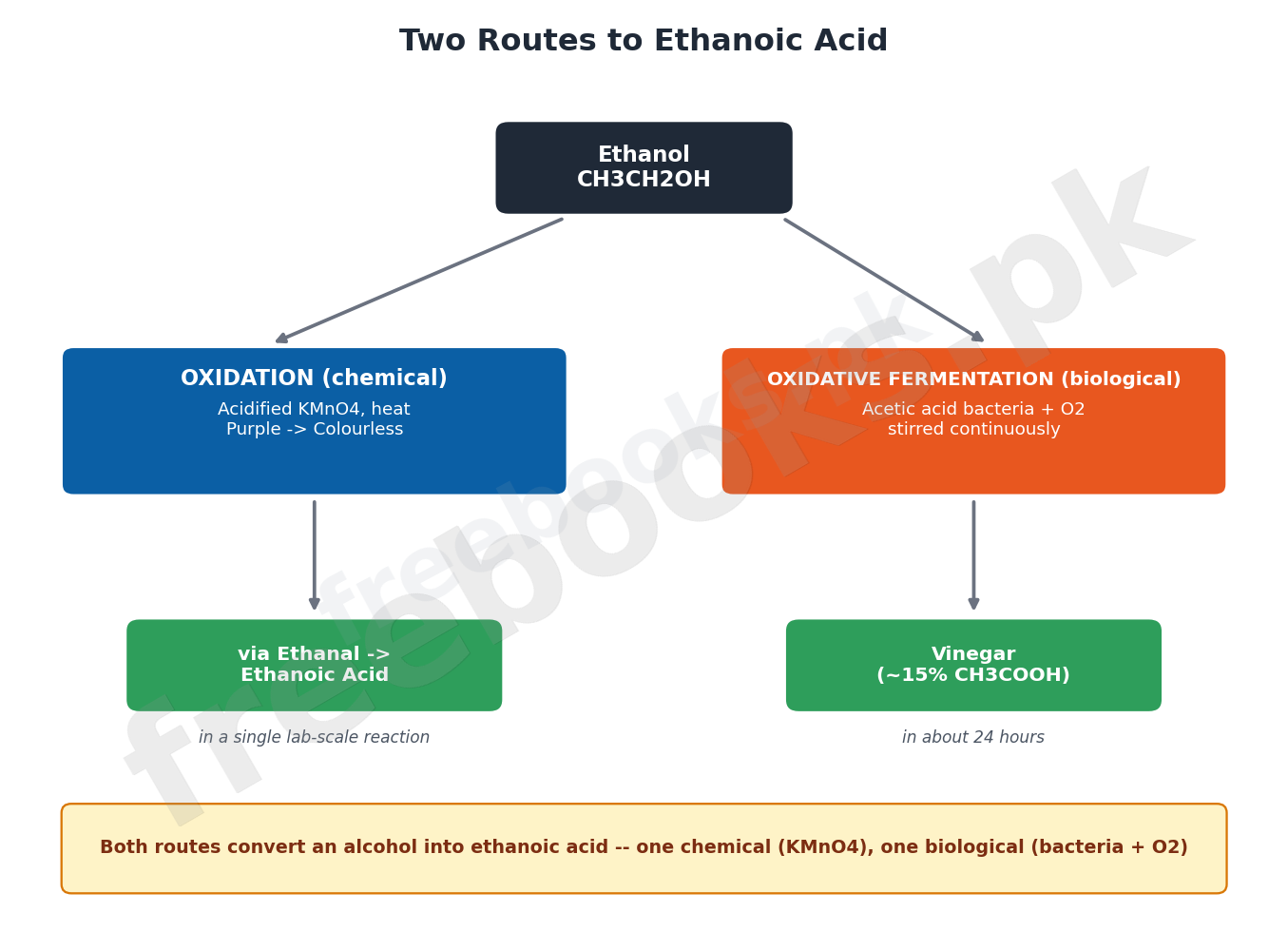
Ethanol is oxidised by acidified potassium manganate (VII) (KMnO4), first to ethanal, which then undergoes further oxidation under the same reaction conditions to give ethanoic acid. Hot acidified KMnO4 acts as a very efficient oxidising agent, and as it oxidises ethanol to ethanoic acid, its own purple colour changes to colourless — a visible sign that oxidation has occurred.
Ethanoic acid is also produced industrially by oxidative (bacterial) fermentation. Alcoholic foodstuffs such as grain, malt, rice or potato mash are converted to vinegar when acetic acid bacteria oxidise the alcohol they contain, provided a sufficient and continuous supply of oxygen is available. In this process the liquid is held in a tank fitted with a continuous oxygen supply and is stirred continuously as oxygen bubbles through it; using this method, vinegar containing about 15% ethanoic acid can be produced in as little as 24 hours.
24.2 Reactions of Carboxylic Acids as Acids
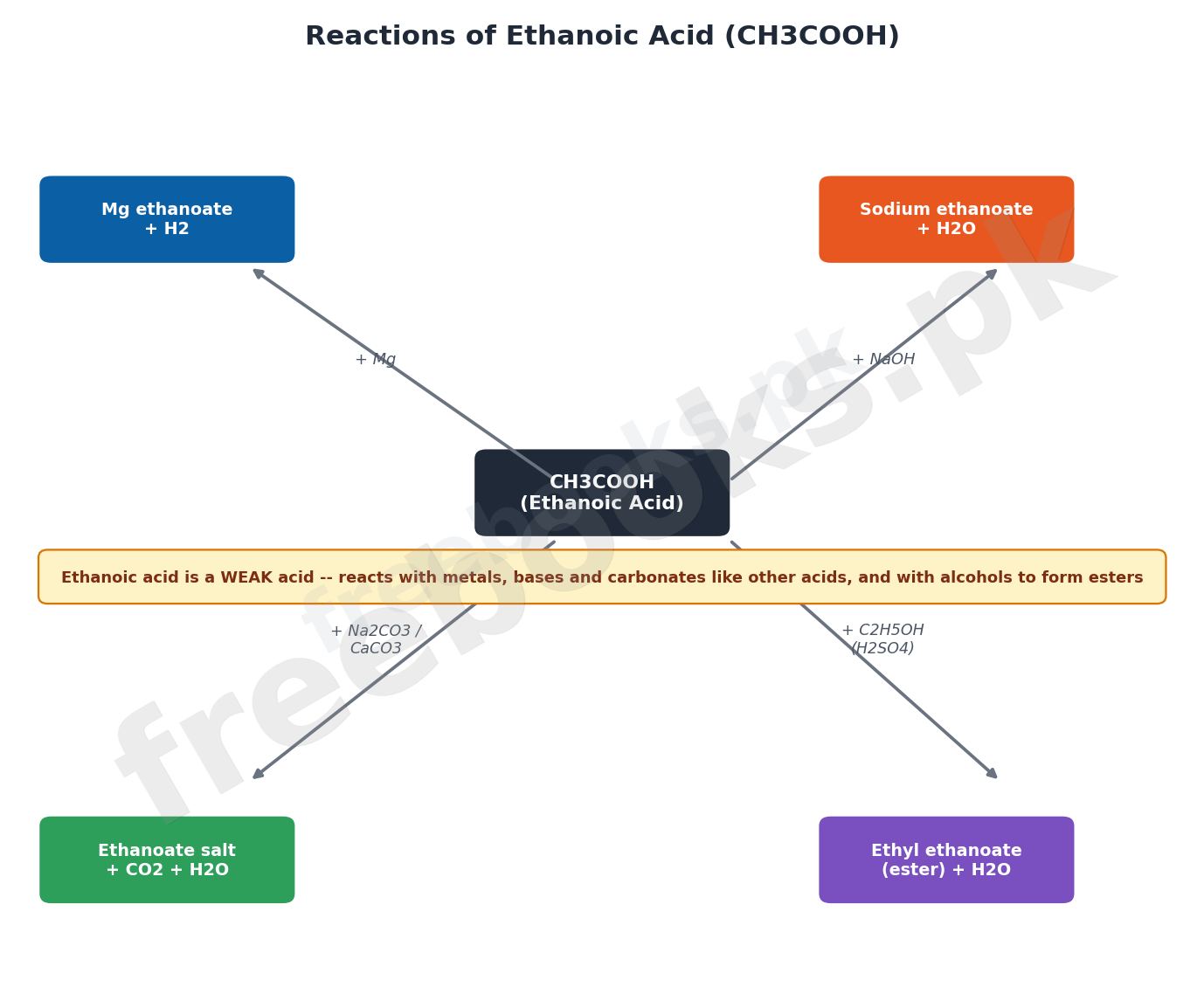
Carboxylic acids are much weaker acids than mineral acids, but some react, rather slowly, with more reactive metals to give a salt and hydrogen gas. Dilute ethanoic acid reacts with magnesium metal to give magnesium ethanoate and hydrogen gas: 2CH3COOH + Mg -> (CH3COO)2Mg + H2. Reactions of carboxylic acids with bases such as metal hydroxides are simple neutralisation reactions: ethanoic acid reacts with sodium hydroxide to give sodium ethanoate and water: CH3COOH + NaOH -> CH3COONa + H2O.
When solid sodium carbonate is mixed with an aqueous solution of ethanoic acid, effervescence takes place as CO2 gas is evolved and sodium ethanoate forms in solution: 2CH3COOH + Na2CO3 -> 2CH3COONa + CO2 + H2O. The same reaction proceeds more slowly with marble chips (calcium carbonate): 2CH3COOH + CaCO3 -> (CH3COO)2Ca + CO2 + H2O.
24.3 Reaction of Carboxylic Acids with Alcohols (Esterification)
Carboxylic acids form esters when heated with an excess of alcohol in the presence of concentrated H2SO4 as a catalyst; this reaction is called esterification. In general, a carboxylic acid plus an alcohol, under acid catalysis and heat, yields an ester plus water — for example, ethanoic acid reacting with ethanol gives ethyl ethanoate and water. Esters are named from the alcohol (the ‘-yl’ part) and the acid (the ‘-oate’ part) that formed them, and this single reaction type is the source of nearly every ester used in industry and food.
24.4 Industrial Applications of Carboxylic Acids and Esters
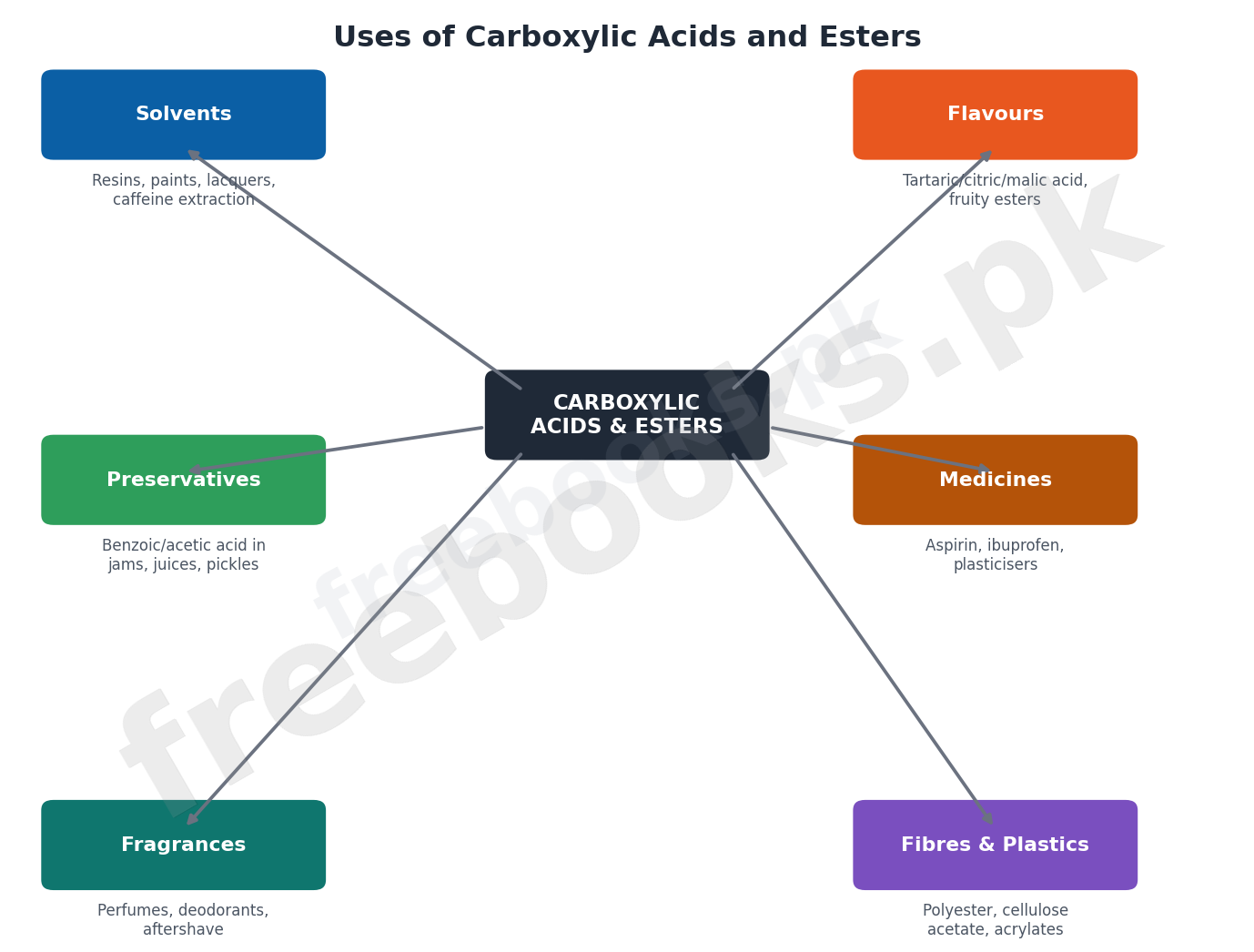
As solvents, acetic acid dissolves many compounds such as oils, sulphur, iodine and water, and industry uses it as a solvent for resins, paints and lacquers; pure acetic acid, known as glacial acetic acid, is a corrosive, colourless solid that is completely miscible with water. Esters are also widely used as solvents: ethyl acetate is used to extract caffeine from coffee and is found in nail-polish and paint remover, while other volatile esters serve as solvents for coatings, paints, varnishes, plastics, resins and lacquers.
As flavouring agents, substances that add taste or mask the unpleasant taste of drugs (especially for children), organic acids such as tartaric, citric and malic acid are commonly used as flavour enhancers, and are largely responsible for the sour taste of foods and beverages, especially soft drinks; esters, which have pleasant odours and flavours, are added to food products to improve their smell or taste. As raw materials for synthetic fibres and plastics, esters play a key role in making polymers — polyester, an important polymer, is made by reacting diols with dicarboxylic acids, and esters are also important in manufacturing soaps and detergents. Acetic acid is used to make cellulose acetate plastic; palmitic and stearic acids go into soaps, cosmetics, pharmaceuticals, candles and protective coatings; oleic acid is used in soaps and detergents; and acrylic acid is the starting reagent for long-chain polymers called acrylates.
24.5 Carboxylic Acids and Esters in Daily Life
Food preservatives are chemical compounds added to foodstuffs to prevent or retard the growth of microorganisms — examples include benzoic acid, acetic acid, propionic acid, and the methyl and ethyl esters of 4-hydroxybenzoic acid. These preservatives help maintain food quality and extend shelf life in products such as jams, juices, milk and other drinks, and acetic acid is very widely used as a preservative in pickles.
Carboxylic acids and compounds derived from them are commonly used as medicines, such as aspirin and ibuprofen, where added carboxylic acid groups can improve drug delivery, absorption and overall performance. Citric acid esters are primarily used as plasticisers across many industries, and polymethyl methacrylate — known as Plexiglass — is used as a substitute for glass. Carboxylic acids also occur naturally in many household fragrant items: ascorbic acid in vitamin C, citric acid in lemons, acetic acid in vinegar, and malic acid in apples, grapes and carrots. Esters, meanwhile, are important components of many fruits, giving them their pleasant, characteristic flavours — for example, methyl butyrate smells of apple, ethyl butyrate of pineapple, n-amyl acetate of pears and bananas, n-octyl acetate of orange, and methyl salicylate of apricot.
Important Definitions
Carboxylic acid
An organic compound containing a carboxyl group (-COOH) attached to an alkyl group or hydrogen; generally a weak acid compared with mineral acids.
Carboxyl group
The functional group -COOH that defines carboxylic acids, combining a carbonyl (C=O) and a hydroxyl (-OH) on the same carbon.
Ethanoic acid (acetic acid)
CH3COOH, the most familiar carboxylic acid, prepared by oxidation of ethanol or by bacterial fermentation, and the acid present in vinegar.
Oxidation (of ethanol)
The chemical change in which ethanol is converted, via ethanal, into ethanoic acid using an oxidising agent such as acidified potassium manganate (VII).
Oxidative (bacterial) fermentation
A process in which acetic acid bacteria oxidise alcohol in foodstuffs, using a continuous oxygen supply, to produce vinegar.
Esterification
The reaction of a carboxylic acid with an alcohol, in the presence of an acid catalyst such as concentrated H2SO4 and heat, to form an ester and water.
Ester
An organic compound formed from a carboxylic acid and an alcohol, generally having a pleasant odour, and named from its parent alcohol and acid.
Glacial acetic acid
Pure (water-free) acetic acid, a corrosive, colourless solid that is completely miscible with water.
Neutralisation reaction
The reaction of an acid with a base to form a salt and water, such as ethanoic acid reacting with sodium hydroxide.
Flavouring agent
A substance, such as an organic acid or ester, added to food or medicine to give or enhance taste or to mask an unpleasant taste.
Food preservative
A chemical compound, such as benzoic or acetic acid, added to food to prevent or slow the growth of microorganisms and extend shelf life.
Plasticiser
A substance, such as a citric acid ester, added to polymers to make them more flexible and workable.
Polyester
A polymer formed by reacting a diol with a dicarboxylic acid, widely used as a synthetic fibre and in plastics.
Solvent
A substance, such as acetic acid or ethyl acetate, that dissolves other compounds to form a solution, used industrially in paints, resins and lacquers.
Key Facts & Relations
| Topic | Relation |
|---|---|
| Oxidation of ethanol to ethanoic acid | CH3CH2OH –acidified KMnO4, heat–> (CH3CHO) –further oxidation–> CH3COOH; purple colour turns colourless |
| Reaction with a metal | 2CH3COOH + Mg -> (CH3COO)2Mg + H2 (magnesium ethanoate + hydrogen gas) |
| Reaction with a base | CH3COOH + NaOH -> CH3COONa + H2O (sodium ethanoate + water) |
| Reaction with sodium carbonate | 2CH3COOH + Na2CO3 -> 2CH3COONa + CO2 + H2O |
| Reaction with calcium carbonate (marble) | 2CH3COOH + CaCO3 -> (CH3COO)2Ca + CO2 + H2O (slower reaction) |
| Esterification (general) | Carboxylic acid + Alcohol –conc. H2SO4, heat–> Ester + H2O |
| Vinegar by fermentation | Alcoholic foodstuff + O2 –acetic acid bacteria, ~24 hours–> ~15% ethanoic acid (vinegar) |
| Acids in household items | Vitamin C: ascorbic acid; lemons: citric acid; vinegar: acetic acid; apples/grapes/carrots: malic acid |
Diagrams
Two Routes to Ethanoic Acid: A comparison diagram showing the two methods of preparing ethanoic acid — oxidation of ethanol with acidified KMnO4, and oxidative bacterial fermentation to make vinegar.
Reactions of Ethanoic Acid as an Acid: A hub-and-spoke diagram showing ethanoic acid reacting with a metal, a base, a carbonate, and an alcohol (esterification), with the product of each reaction.
Uses of Carboxylic Acids and Esters: A hub-and-spoke chart showing the major industrial and daily-life uses of carboxylic acids and esters — as solvents, flavours/fragrances, synthetic fibres/plastics, preservatives, and medicines.
Short Questions & Answers
Can methanol be oxidised with KMnO4 just like ethanol?
Yes — methanol, like ethanol, can be oxidised by acidified KMnO4, first to methanal and then further to methanoic acid, following the same overall oxidation pattern as ethanol to ethanoic acid.
What is the difference between a fermentation reaction and an ordinary chemical reaction?
A fermentation reaction is a biological process carried out by living organisms such as yeast or bacteria using their own enzymes under mild conditions (e.g. ~35 degC for yeast, or bacterial oxidation for vinegar), whereas an ordinary chemical reaction, like oxidation with KMnO4, is carried out directly with chemical reagents and does not require a living organism.
Is ethanoic acid a weak acid?
Yes — ethanoic acid is a weak acid because it does not ionise completely in water and does not release protons as readily as mineral acids such as HCl or H2SO4.
How will calcium carbonate react with ethanoic acid?
Calcium carbonate reacts with ethanoic acid, though slowly, to give calcium ethanoate, carbon dioxide gas and water: 2CH3COOH + CaCO3 -> (CH3COO)2Ca + CO2 + H2O.
What is an esterification reaction?
Esterification is the reaction of a carboxylic acid with an alcohol, heated together in the presence of an acid catalyst such as concentrated H2SO4, to produce an ester and water.
Name an oxidising agent used to oxidise alcohols.
Acidified potassium manganate (VII) (KMnO4) is a common oxidising agent used to oxidise alcohols such as ethanol into ethanoic acid, changing colour from purple to colourless in the process.
Why is sufficient oxygen provided during fermentation to prepare acetic acid from ethanol?
A continuous supply of oxygen is needed because acetic acid bacteria require oxygen to oxidise the alcohol in the foodstuff into acetic acid; without enough oxygen the bacterial oxidation reaction cannot proceed efficiently, and vinegar will not form.
Give a practical example in which an acid or an ester is used as a flavouring agent.
Citric acid is used as a flavour enhancer in soft drinks, and methyl butyrate, an ester, is added to food products to give them an apple-like flavour.
Which carboxylic acids are very often used as flavour enhancers?
Tartaric acid, citric acid and malic acid are commonly used as flavour enhancers, largely responsible for the sour taste of many foods and beverages, especially soft drinks.
Which property of acetic acid makes it suitable to act as a preservative in pickles?
Acetic acid’s ability to prevent or retard the growth of microorganisms makes it suitable as a preservative — by lowering the pH and creating an environment unfavourable to microbial growth, it helps pickles resist spoilage and extends their shelf life.
Long Questions & Answers
How is ethanoic acid prepared, and how does it react as an acid with metals, bases and carbonates?
How is ethanoic acid prepared by oxidation of ethanol?
Ethanol is oxidised by hot acidified potassium manganate (VII), first to ethanal and then further to ethanoic acid; the purple colour of the KMnO4 reagent turns colourless as the oxidation proceeds, giving a clear visual sign that the reaction has occurred.
How is ethanoic acid prepared by oxidative fermentation (vinegar production)?
Alcoholic foodstuffs such as grain, malt, rice or potato mash are placed in a tank with a continuous, stirred supply of oxygen, where acetic acid bacteria oxidise the alcohol present into ethanoic acid; using this method, vinegar containing about 15% ethanoic acid can be produced in as little as 24 hours.
How does ethanoic acid react with metals and bases?
With a reactive metal such as magnesium, dilute ethanoic acid reacts slowly to give a salt and hydrogen gas: 2CH3COOH + Mg -> (CH3COO)2Mg + H2; with a base such as sodium hydroxide, it undergoes a simple neutralisation reaction to give a salt and water: CH3COOH + NaOH -> CH3COONa + H2O.
How does ethanoic acid react with carbonates?
Ethanoic acid reacts with sodium carbonate with effervescence, evolving CO2 gas and forming sodium ethanoate in solution: 2CH3COOH + Na2CO3 -> 2CH3COONa + CO2 + H2O; the same type of reaction occurs more slowly with calcium carbonate (marble chips) to give calcium ethanoate, CO2 and water.
Describe the industrial applications of carboxylic acids and esters, and their role in daily life.
How are carboxylic acids and esters used as solvents?
Acetic acid dissolves oils, sulphur, iodine and water and is used industrially as a solvent for resins, paints and lacquers, while esters such as ethyl acetate are used to extract caffeine from coffee and serve as solvents in nail-polish remover, coatings, varnishes, plastics and resins.
How are carboxylic acids and esters used as flavouring and fragrance agents?
Organic acids such as tartaric, citric and malic acid act as flavour enhancers and give foods and soft drinks their sour taste, while esters have naturally pleasant odours and are added to food products to improve their smell or flavour, and also occur naturally in fruit to give them their characteristic aromas.
How are esters used in synthetic fibres and plastics?
Polyester, an important synthetic polymer used as a fibre and in plastics, is made by reacting a diol with a dicarboxylic acid; acetic acid is also used to make cellulose acetate plastic, and acids such as palmitic, stearic, oleic and acrylic acid are widely used to manufacture soaps, detergents and long-chain acrylate polymers.
How are carboxylic acids and esters used in daily life, including preservation and medicine?
Food preservatives such as benzoic acid and acetic acid are added to jams, juices, milk and pickles to prevent microbial growth and extend shelf life; carboxylic acid derivatives such as aspirin and ibuprofen are used as medicines, citric acid esters serve as plasticisers, and naturally occurring acids like ascorbic, citric and malic acid are found in everyday items such as vitamin C, lemons and fruit.
Multiple Choice Questions (MCQs)
Identify the ester functional group: (A) -COOR (B) -COOH (C) >C=O (D) -CH2-OH
Correct answer: (A) -COOR. The ester functional group is -COOR, where R is the alkyl group derived from the alcohol that reacted with the carboxylic acid; -COOH is the carboxylic acid group itself, not an ester.
During the oxidation of ethanol by acidified KMnO4, which element is reduced? (A) K (B) O (C) Mn (D) H
Correct answer: (C) Mn. Manganese in KMnO4 is reduced from the +7 oxidation state (in MnO4-) to a lower oxidation state as it accepts electrons while oxidising ethanol, which is why the purple colour of the reagent disappears.
Fermentation of foodstuff in the presence of acetic acid bacteria needs a sufficient supply of oxygen. What is the role of oxygen in this process? (A) It enhances the reactivity of bacteria (B) It oxidizes ethanol which is formed during the reaction (C) It inhibits the destruction of bacteria (D) It inhibits the oxidation of acetic acid
Correct answer: (B) It oxidizes ethanol which is formed during the reaction. Oxygen is needed because acetic acid bacteria use it to oxidise the ethanol present in the alcoholic foodstuff into ethanoic acid (vinegar) — without enough oxygen, this oxidation cannot proceed.
Which organic acid is used as a component of food? (A) Formic acid (B) Oxalic acid (C) Propanoic acid (D) Acetic acid
Correct answer: (D) Acetic acid. Acetic acid, present in vinegar, is a common food component and preservative, widely used in pickles and other food products, unlike formic, oxalic or propanoic acid which are not typical food ingredients.
Which of the following acids is present in apples? (A) Citric acid (B) Tartaric acid (C) Acetic acid (D) Malic acid
Correct answer: (D) Malic acid. Malic acid is the carboxylic acid naturally present in apples, grapes and carrots, giving them part of their characteristic tart flavour.
Which polymer is made by reacting a diol and a dicarboxylic acid? (A) Polyethene (B) Polyester (C) Polystyrene (D) Polyamide
Correct answer: (B) Polyester. Polyester is the important synthetic polymer formed by reacting a diol with a dicarboxylic acid, and is widely used as a synthetic fibre and in plastics.
Which compound is used as a synthetic fiber? (A) Methyl acetate (B) Polyester (C) Resin (D) n-Amyl acetate
Correct answer: (B) Polyester. Polyester, formed from a diol and a dicarboxylic acid, is the ester-derived polymer used as a synthetic fibre in textiles, unlike the other listed esters, which are small-molecule flavouring/solvent esters.
Pure, water-free acetic acid is also known by which name? (A) Vinegar (B) Glacial acetic acid (C) Formic acid (D) Acetic anhydride
Correct answer: (B) Glacial acetic acid. Pure acetic acid, free of water, is called glacial acetic acid — a corrosive, colourless solid that is completely miscible with water.
Quick Revision Summary
- Ethanoic acid is prepared by oxidation of ethanol with acidified KMnO4 (via ethanal) or by oxidative bacterial fermentation of alcoholic foodstuffs (vinegar, ~15% in ~24 hours).
- As a weak acid, ethanoic acid reacts slowly with reactive metals (salt + H2), neutralises bases (salt + H2O), and effervesces with carbonates (salt + CO2 + H2O).
- Esterification: carboxylic acid + alcohol, with conc. H2SO4 catalyst and heat, gives an ester + water.
- Glacial acetic acid = pure, water-free acetic acid; a corrosive colourless solid, miscible with water.
- Carboxylic acids and esters as solvents: acetic acid (resins, paints, lacquers); esters like ethyl acetate (caffeine extraction, nail-polish remover).
- As flavouring agents: tartaric/citric/malic acid enhance sourness; esters (e.g. methyl butyrate = apple, ethyl butyrate = pineapple) give fruity flavours.
- Esters make polyester (diol + dicarboxylic acid) for synthetic fibres and plastics; acids like palmitic, stearic, oleic and acrylic acid go into soaps, detergents and polymers.
- Daily life: acids/esters preserve food (jams, juices, pickles), feature in medicines (aspirin, ibuprofen), plasticisers, and occur naturally in vitamin C, lemons, vinegar and fruit.
Exam Tips
- Remember the two ethanoic acid routes as ‘chemical vs biological’: KMnO4 oxidation (chemical) vs bacterial fermentation (biological, needs O2).
- For reactions with metals/bases/carbonates, always predict the products first (salt + H2 / salt + H2O / salt + CO2 + H2O) before balancing.
- Esterification recipe: acid + alcohol + conc. H2SO4 + heat -> ester + water — name the ester from its alcohol (‘-yl’) and acid (‘-oate’) parts.
- Sort carboxylic acid/ester uses into three buckets: solvents, flavours/fragrances, and fibres/plastics — then a fourth for daily life: preservatives and medicines.
- Link each named acid to its source for quick recall: citric = lemons, malic = apples, ascorbic = vitamin C, acetic = vinegar.
- ‘Glacial’ acetic acid just means pure, water-free acetic acid — don’t confuse it with a different compound.