Hydrocarbons are organic compounds made only of carbon and hydrogen, and this chapter focuses on the unsaturated ones — alkenes with a carbon-carbon double bond and alkynes with a carbon-carbon triple bond — alongside alkanes’ role as the starting material from which alkenes are made industrially. Because alkenes and alkynes contain reactive multiple bonds, they undergo addition reactions that saturated alkanes cannot, which is also how chemists test whether a hydrocarbon is saturated or unsaturated.
The chapter then turns to where hydrocarbons come from and how they are made useful: coal, petroleum and natural gas are the three major fossil-fuel sources of organic compounds, and crude petroleum — a complex mixture of hundreds of hydrocarbons — is separated by fractional distillation into fractions such as refinery gas, gasoline, naphtha, kerosene, diesel, lubricating oil and bitumen, each with its own boiling range, chain length and everyday use.
Learning Objectives
- State that alkenes contain a carbon-carbon double bond and are unsaturated hydrocarbons.
- Describe the cracking of large alkane molecules into smaller alkanes and alkenes, and explain why cracking is carried out.
- Describe the bromine water and KMnO4 tests used to distinguish saturated from unsaturated hydrocarbons.
- Describe the addition reactions of alkenes with bromine, hydrogen (with a nickel catalyst) and steam (with an acid catalyst).
- Describe, using symbol equations, the preparation of alkenes by elimination reactions from halogenoalkanes and alcohols.
- Identify alkynes as hydrocarbons containing a carbon-carbon triple bond, and describe the uses of ethyne as a welding fuel and fruit-ripening agent.
- Describe the fractional distillation of petroleum and name the main fractions and their uses.
- Describe how chain length, volatility, boiling point and viscosity change from the bottom to the top of the fractionating column.
Key Concepts
22.1 Alkenes
Alkenes are unsaturated hydrocarbons containing one or more carbon-carbon double bonds; they are also called olefins and follow the general formula CnH2n. Because of their reactive double bond, alkenes are widely used to make plastics, fuels and many other commercially important chemicals.
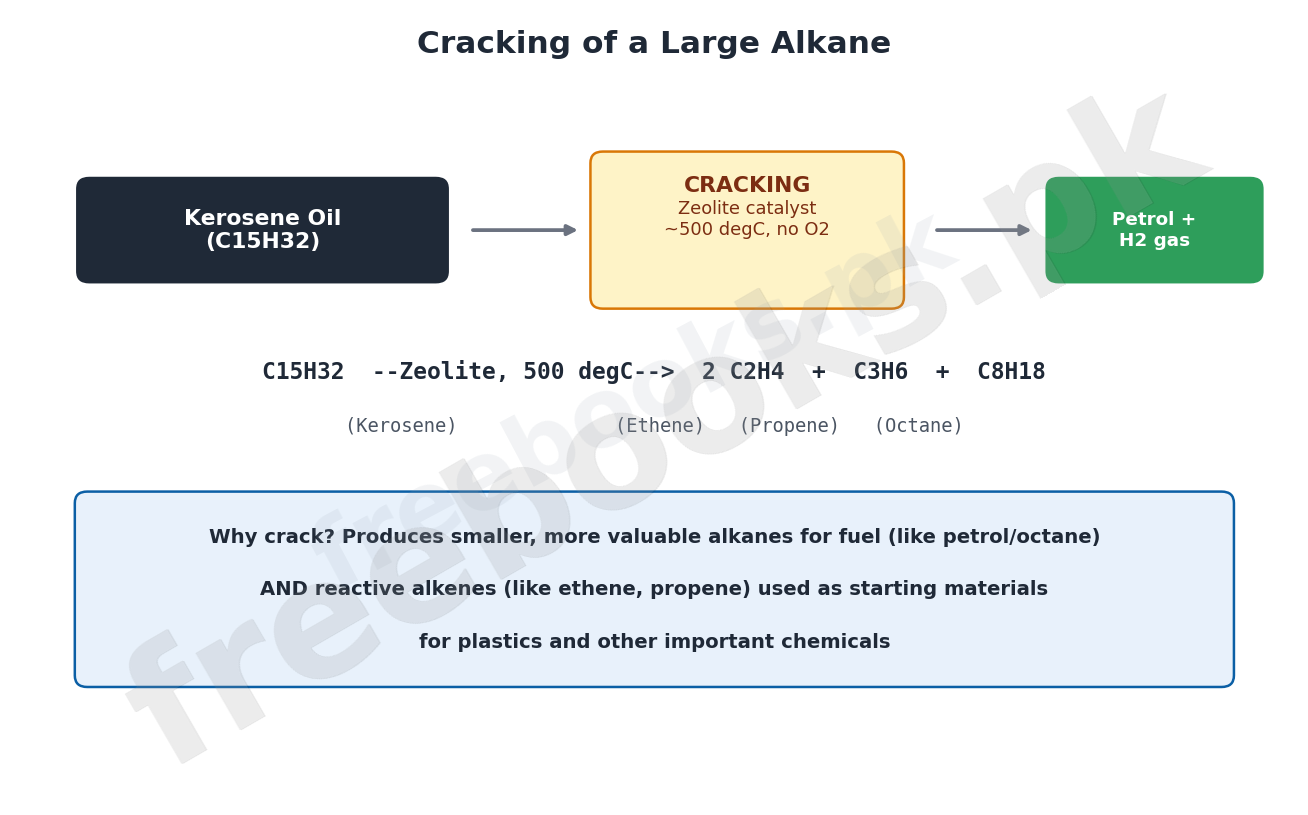
Alkenes are prepared in three main ways. Dehydration of alcohols removes a water molecule using a dehydrating agent such as concentrated sulphuric acid at about 180 degC, converting ethanol (CH3-CH2-OH) to ethene (CH2=CH2). Dehydrohalogenation of alkyl halides removes a molecule of hydrogen halide (HX) using potassium hydroxide dissolved in ethanol, converting chloroethane to ethene; both of these are elimination reactions, in which a small molecule is removed from a saturated compound to give an unsaturated one. Alkenes are also produced by cracking of alkanes — heating high molecular mass alkanes at high temperature, without oxygen, in the presence of a zeolite catalyst, breaking them into smaller alkanes and alkenes. Cracking matters commercially because it produces smaller alkanes useful as fuel and alkenes such as ethene and propene that are valuable starting materials for many products; for example, kerosene oil or diesel oil can be cracked to give petrol, alkenes and hydrogen gas.
22.2 Important Reactions of Alkenes
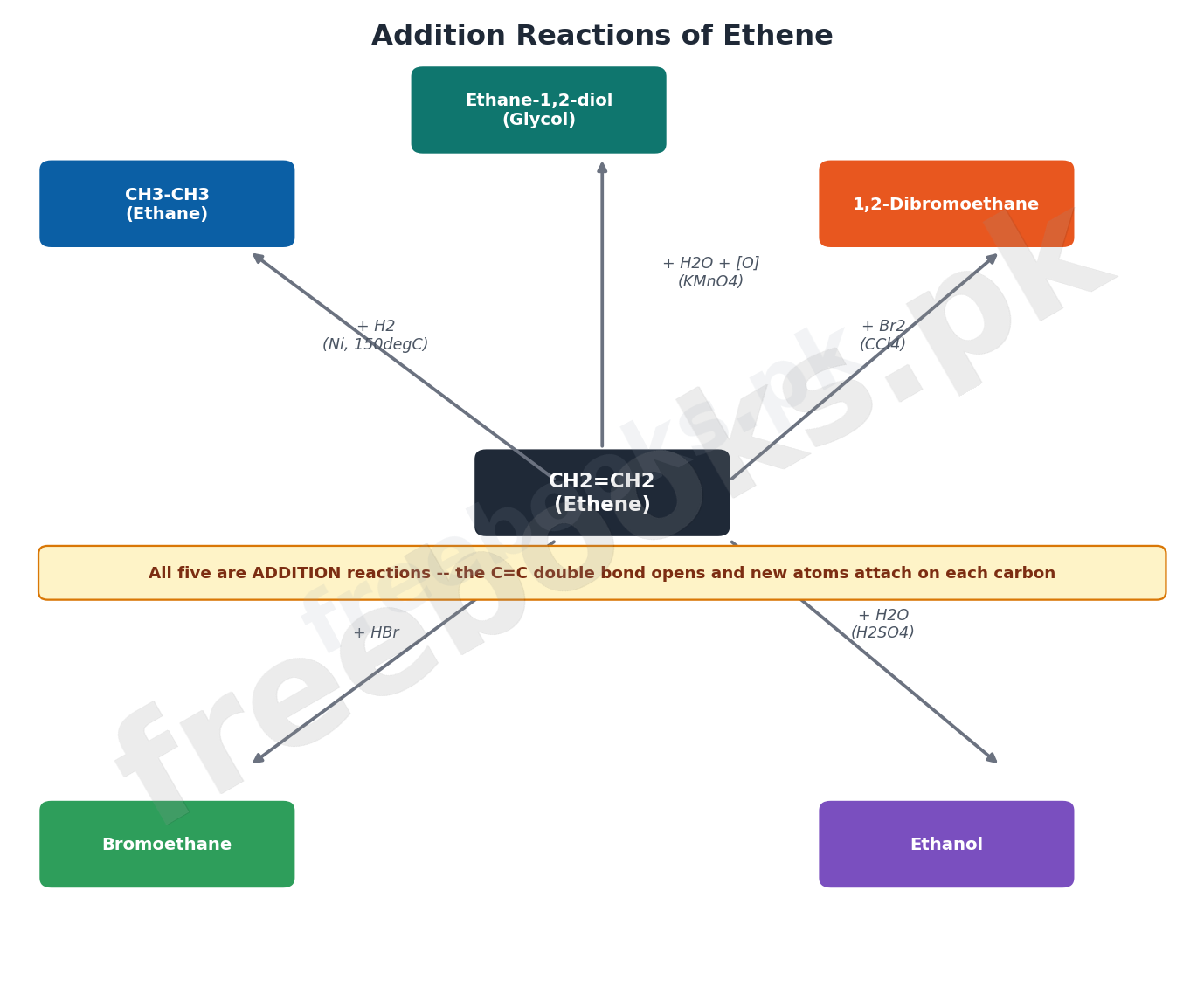
Alkenes are very reactive because of their carbon-carbon double bond, and they mainly undergo addition reactions, in which two or more reactants combine to form a single new product. Addition of hydrogen (catalytic hydrogenation) uses a nickel catalyst at about 150 degC and 2 atm pressure to convert an alkene into the corresponding alkane, for example ethene plus hydrogen gives ethane. Addition of halogens adds bromine across the double bond in a non-polar solvent such as CCl4 to give an alkyl dihalide, for example ethene plus bromine gives 1,2-dibromoethane.
Oxidation with cold, dilute, alkaline potassium permanganate (KMnO4) converts an alkene into a diol, for example ethene gives ethane-1,2-diol (glycol). Both the bromine test and the KMnO4 test are used to distinguish saturated from unsaturated compounds: the reddish-brown colour of bromine, the purple colour of KMnO4, and the violet colour of iodine are all rapidly discharged (decolourised) by an alkene, but not by an alkane, because alkanes lack a reactive double bond. Addition of hydrogen halides (hydrohalogenation) adds HBr or similar acids across the double bond, for example ethene plus hydrogen bromide gives bromoethane. Addition of water (hydration) in the presence of sulphuric acid at about 300 degC adds water across the double bond, for example but-1-ene plus water gives butan-2-ol.
22.3 Alkynes
Alkynes are unsaturated hydrocarbons containing at least one carbon-carbon triple bond (-C-triple bond-C-), represented by the general formula CnH2n-2. Like alkenes, alkynes are named from the longest continuous chain containing the triple bond, with examples including ethyne (CH-triple bond-CH), propyne, but-1-yne and but-2-yne.
The simplest alkyne, ethyne (commonly called acetylene), is widely used in welding and cutting because it releases a large amount of heat when burned in oxygen, producing carbon dioxide, water and an extremely hot oxyacetylene flame that speeds up cutting and welding. Acetylene gas is also used to artificially ripen green fruit: when solid calcium carbide reacts with moisture in the air it produces acetylene gas, which accelerates ripening and induces a colour change — though the use of calcium carbide for this purpose is prohibited in many countries because of health risks such as dizziness, vomiting and skin ulcers.
22.4 Sources of Organic Compounds
Coal, petroleum and natural gas — the three major fossil fuels — are the principal sources of organic compounds. Natural gas and petroleum are the chief sources of aliphatic (chain) hydrocarbons, while coal is the major source of aromatic hydrocarbons. Natural gas is a mixture of hydrocarbon gases with methane (CH4) as its largest component.
Petroleum and natural gas are usually found together, trapped between layers of non-porous rock underground; drilling releases the gas along with some volatile liquids, after which the liquid petroleum is pumped out. Liquid petroleum is a complex mixture of mainly aliphatic hydrocarbons — boiling it up to 400 degC can yield at least 500 different compounds. Beyond fuels, petroleum products supply alkenes used to make plastics, and aromatic compounds such as benzene (produced from n-hexane) which is used to make perfumes, drugs, dyes and photographic developers.
22.5 Refining of Petroleum
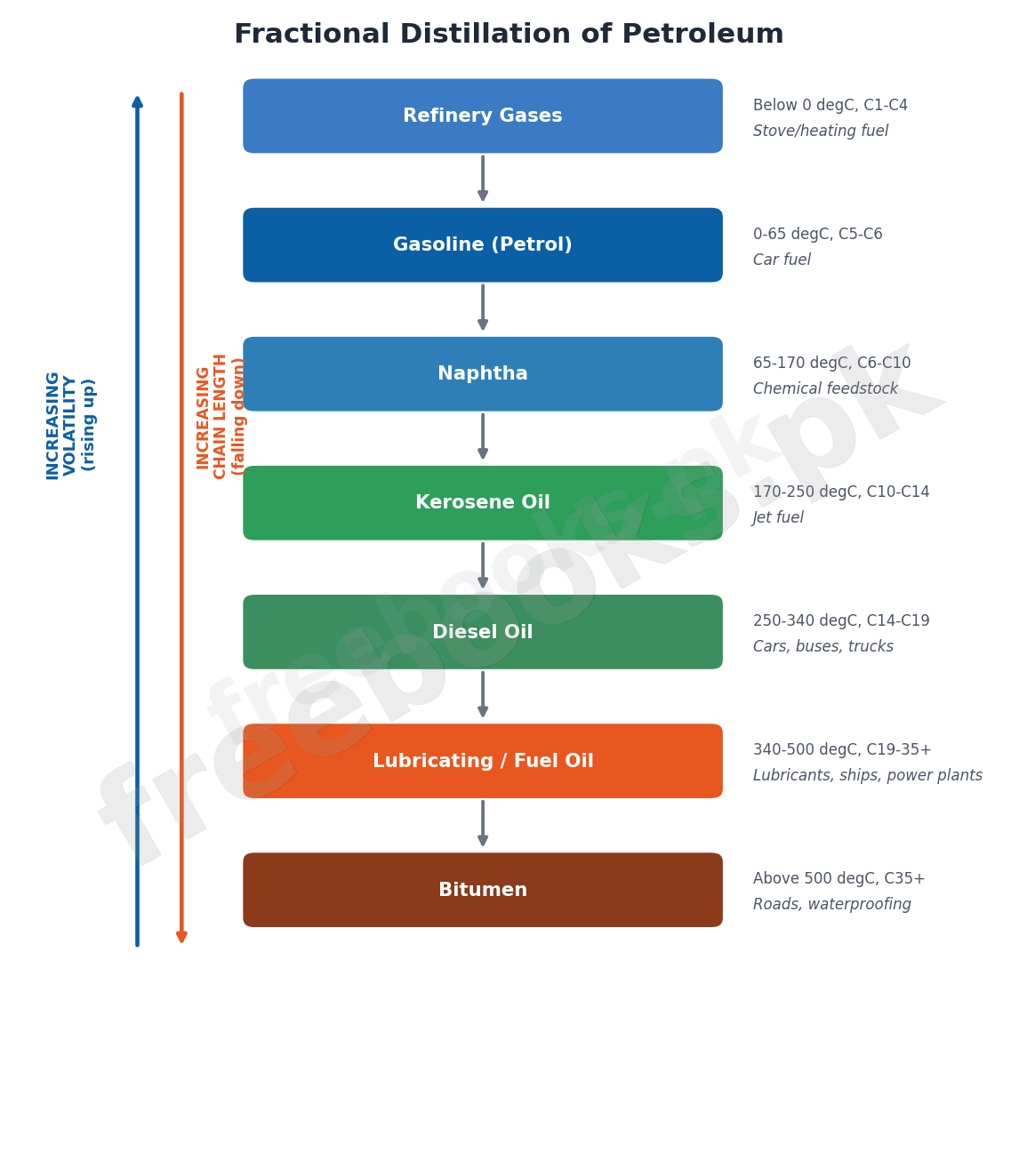
Crude petroleum is a mixture of many hydrocarbons that does not burn easily, so it must be separated into useful fractions by refining, which is carried out by fractional distillation at about 400 degC. Crude oil is first neutralised by washing with an acidic or basic solution, then heated in a furnace above 400 degC; the resulting gases and vapours rise through a tall fractionating column fitted with shelves and bubble caps. Refinery gases escape at the very top; as the vapour rises, fractions with higher boiling points condense to liquids lower down in the column, while fractions with lower boiling points rise further before condensing, and each condensed fraction is drained off from its own shelf into storage tanks and later redistilled for better separation.
The main fractions, from lowest to highest boiling range, are refinery gases (below 0 degC, 1-4 carbons, used as stove fuel), gasoline/petrol (0-65 degC, 5-6 carbons, car fuel), naphtha (65-170 degC, 6-10 carbons, chemical feedstock), kerosene (170-250 degC, 10-14 carbons, jet fuel), diesel oil (250-340 degC, 14-19 carbons, fuel for cars/buses/trucks), lubricating oil and fuel oil (340-500 degC, 19 carbons and above, lubricants/ship and power-plant fuel) and bitumen (above 500 degC, above 35 carbons, road construction and waterproofing). As chain length decreases up the column, molecular mass and intermolecular forces fall, so the fractions near the top have higher volatility, lower boiling points and lower viscosity, while fractions near the bottom have longer chains, lower volatility, higher boiling points and higher viscosity.
Important Definitions
Alkene
An unsaturated hydrocarbon containing one or more carbon-carbon double bonds; general formula CnH2n; also called an olefin.
Alkyne
An unsaturated hydrocarbon containing at least one carbon-carbon triple bond; general formula CnH2n-2.
Dehydration
Removal of a water molecule from a compound, as when concentrated sulphuric acid converts an alcohol into an alkene.
Dehydrohalogenation
Removal of a molecule of hydrogen halide (HX) from an alkyl halide, typically using KOH dissolved in ethanol, to form an alkene.
Elimination reaction
A reaction in which a small molecule is removed from a saturated compound to produce an unsaturated compound.
Cracking
The process of converting high molecular mass alkanes into smaller alkanes and alkenes by heating at high temperature, without oxygen, using a catalyst such as zeolite.
Addition reaction
A reaction in which two or more reactants combine to form a single new product, typical of compounds containing a double or triple bond.
Catalytic hydrogenation
The addition of hydrogen to an alkene in the presence of a nickel catalyst to form the corresponding alkane.
Hydrohalogenation
The addition of a hydrogen halide (such as HBr) across the double bond of an alkene.
Hydration reaction
The addition of water across the double bond of an alkene in the presence of an acid catalyst such as sulphuric acid.
Fossil fuel
A fuel such as coal, petroleum or natural gas formed from the remains of ancient organisms, and a major source of organic compounds.
Petroleum
A complex, naturally occurring mixture of mainly aliphatic hydrocarbons found trapped underground.
Natural gas
A naturally occurring mixture of hydrocarbon gases, mainly methane, often found together with petroleum.
Fractional distillation (of petroleum)
The process of separating crude petroleum into fractions of differing boiling range by heating and condensing vapours in a fractionating column.
Volatility
A measure of how readily a liquid evaporates into vapour; higher for shorter-chain hydrocarbons.
Viscosity
A measure of a liquid’s resistance to flow; higher for longer-chain, higher molecular mass hydrocarbons.
Key Facts & Relations
| Topic | Relation |
|---|---|
| Alkenes | General formula CnH2n |
| Alkynes | General formula CnH2n-2 |
| Catalytic hydrogenation | CH2=CH2 + H2 –Ni, 150 degC, 2 atm–> CH3-CH3 |
| Halogen addition | CH2=CH2 + Br2 –CCl4–> 1,2-dibromoethane |
| KMnO4 oxidation (unsaturation test) | CH2=CH2 + H2O + [O] –KMnO4–> ethane-1,2-diol (glycol) |
| Hydrogen halide addition | CH2=CH2 + HBr –> bromoethane |
| Hydration (steam addition) | But-1-ene + H2O –H2SO4, ~300 degC–> Butan-2-ol |
| Combustion of ethyne (oxyacetylene) | 2 CH-triple bond-CH + 5 O2 –> 4 CO2 + 2 H2O + heat |
Diagrams
Addition Reactions of Ethene: A hub-and-spoke diagram showing ethene reacting with hydrogen (Ni catalyst), bromine, hydrogen bromide, and water/KMnO4 to give five different addition products.
The Fractionating Column of Petroleum: A labelled diagram of the petroleum fractionating column, showing the fractions from refinery gases at the top down to bitumen at the bottom, with their boiling ranges and the trend in chain length, volatility and viscosity.
Cracking of a Large Alkane: A flow diagram showing a high molecular mass alkane (such as kerosene, C15H32) being cracked at high temperature with a zeolite catalyst into smaller alkanes and alkenes, including the symbol equation.
Short Questions & Answers
Give two examples of addition reactions.
The addition of hydrogen to ethene (with a nickel catalyst) to give ethane, and the addition of bromine to ethene (in CCl4) to give 1,2-dibromoethane, are both addition reactions.
Give the names of the compounds obtained from coal tar and petroleum.
Coal tar is a major source of aromatic hydrocarbons such as benzene and its derivatives, while petroleum is the chief source of aliphatic hydrocarbons such as alkanes, alkenes and their derivatives used to make fuels and plastics.
How is ethene oxidised by a cold aqueous solution of potassium permanganate?
Cold, dilute, alkaline KMnO4 adds an oxygen atom and a water molecule across ethene’s double bond to give ethane-1,2-diol (glycol); the purple colour of the KMnO4 is discharged as the reaction proceeds, which is why this reaction is also used to test for unsaturation.
Differentiate between elimination and addition reactions.
An elimination reaction removes a small molecule (such as water or a hydrogen halide) from a saturated compound to produce an unsaturated one, while an addition reaction combines two or more reactants across a double or triple bond of an unsaturated compound to give a single saturated product — the two are essentially opposite processes.
Name the starting materials used to generate an oxyacetylene flame.
Ethyne (acetylene) gas and oxygen gas are burned together to generate the very hot oxyacetylene flame used for welding and cutting metal.
How can an alkene be identified?
An alkene can be identified because it rapidly decolourises reddish-brown bromine water and purple potassium permanganate solution (and violet iodine solution) through addition/oxidation reactions across its double bond, whereas a saturated alkane does not react with these reagents under the same mild conditions.
What is the difference between the terms dehydration and dehydrohalogenation?
Dehydration removes a molecule of water from an alcohol (using concentrated H2SO4) to form an alkene, while dehydrohalogenation removes a molecule of hydrogen halide (HX) from an alkyl halide (using KOH in ethanol) to form an alkene — both are elimination reactions but remove different small molecules.
Why is the oxyacetylene flame so hot?
Burning ethyne in oxygen releases a very large amount of heat energy because of the high energy stored in its carbon-carbon triple bond and the efficient, complete combustion with pure oxygen rather than air, producing a flame hot enough to cut and weld metal.
Do you expect ethyne to decolourise a cold solution of KMnO4?
Yes — ethyne contains a carbon-carbon triple bond, an even more reactive unsaturated linkage than the double bond in alkenes, so it also reacts with and decolourises cold dilute KMnO4 solution through oxidation.
How do chlorine and hydrogen chloride add to ethene?
Chlorine (Cl2) adds across the double bond to give 1,2-dichloroethane, while hydrogen chloride (HCl) adds across the double bond to give chloroethane — both are simple addition reactions typical of alkenes.
Long Questions & Answers
Describe the fractional distillation of petroleum, and explain how the properties of the fractions change from the bottom to the top of the column.
How is crude petroleum prepared and heated before distillation?
The crude oil is first neutralised by washing with an acidic or basic solution as needed, then heated in an electric furnace to above 400 degC so that it turns into a mixture of hot gases and vapours ready to enter the fractionating column.
How does the fractionating column separate the vapours into fractions?
The hot vapours rise through a tall column fitted with shelves covered by bubble caps. Refinery gases, which have the lowest boiling points, pass straight to the top and escape as gas; heavier fractions with higher boiling points condense back to liquid lower down, while lighter fractions rise further before condensing, and each condensed liquid is drained from its shelf into a separate storage tank, later redistilled for better purity.
What are the main fractions obtained and their uses?
From lowest to highest boiling range: refinery gases (fuel for stoves), gasoline/petrol (car fuel), naphtha (chemical feedstock), kerosene (jet fuel), diesel oil (fuel for cars, buses, trucks), lubricating oil and fuel oil (lubricants, waxes, ship and power-plant fuel), and bitumen (roads and waterproofing).
How do the physical properties of the fractions change from bottom to top?
As chain length decreases going up the column, molecular mass and the strength of intermolecular forces fall, so fractions near the top (like refinery gases) have higher volatility, lower boiling points and lower viscosity, while fractions near the bottom (like bitumen) have longer chains, higher boiling points and higher viscosity.
Describe two methods of preparation of ethene and its important addition reactions.
How is ethene prepared by dehydration of an alcohol?
Ethanol is heated with concentrated sulphuric acid as a dehydrating agent at about 180 degC, removing a water molecule to form ethene: CH3-CH2-OH gives CH2=CH2 + H2O.
How is ethene prepared by dehydrohalogenation of an alkyl halide?
Chloroethane is heated with potassium hydroxide dissolved in ethanol at about 180 degC; a molecule of HCl is eliminated to form ethene: CH3-CH2Cl + KOH gives CH2=CH2 + KCl + H2O — this is an elimination reaction.
How does ethene react with hydrogen and with bromine?
With hydrogen and a nickel catalyst at about 150 degC and 2 atm, ethene undergoes catalytic hydrogenation to give ethane. With bromine in a non-polar solvent such as CCl4, ethene undergoes halogen addition to give 1,2-dibromoethane, discharging bromine’s reddish-brown colour.
How does ethene react with KMnO4, hydrogen bromide and steam?
Cold dilute alkaline KMnO4 oxidises ethene to ethane-1,2-diol (glycol), discharging the purple colour — a key test for unsaturation. Hydrogen bromide adds to give bromoethane. Steam, with a sulphuric acid catalyst at about 300 degC, adds across the double bond in a hydration reaction to give an alcohol.
Multiple Choice Questions (MCQs)
Which of the following compounds is expected to give an addition reaction? (A) CH3-CH3 (B) CH2=CH2 (C) CH4 (D) CH3-CH2-CH3
Correct answer: (B) CH2=CH2. Only CH2=CH2 (ethene) has a carbon-carbon double bond, which is needed for addition reactions; the other three are saturated alkanes.
Which of the following is not used as a fuel? (A) LPG (B) CNG (C) Diesel (D) Asphalt
Correct answer: (D) Asphalt. Asphalt (bitumen) is a thick, high-boiling petroleum fraction used for roads and waterproofing, not as a fuel; LPG, CNG and diesel are all common fuels.
Indicate the type of the following reaction: CH4 + 2O2 -> CO2 + 2H2O. (A) Substitution (B) Oxidation (C) Reduction (D) Addition
Correct answer: (B) Oxidation. Methane reacting with oxygen to form carbon dioxide and water is combustion, a form of oxidation.
Which species acts as a reducing agent in the reaction between ethene and KMnO4? (A) H2O (B) CH2=CH2 (ethene) (C) KMnO4 (D) NaOH
Correct answer: (B) CH2=CH2 (ethene). Ethene is oxidised (loses electrons/gains oxygen) by KMnO4, so ethene acts as the reducing agent while KMnO4 itself is the oxidising agent.
What product forms when propene reacts with a bromine molecule? (A) 1,2-Dibromopropane (B) 1,1-Dibromopropane (C) 2,3-Dibromopropane (D) 1,3-Dibromopropane
Correct answer: (A) 1,2-Dibromopropane. Bromine adds across propene’s double bond (between carbons 1 and 2), giving 1,2-dibromopropane.
Which petroleum fraction is used to generate electricity in power plants? (A) Bitumen (B) Lubricating oil (C) Kerosene oil (D) Fuel oil
Correct answer: (D) Fuel oil. Fuel oil is burned in ships and power plants to generate energy/electricity, distinct from lubricating oil (used as a lubricant) and bitumen (used for roads).
In the reaction CH3-CH2-Br + KOH –ethanol–> CH2=CH2 + KBr + H2O, which molecule is eliminated? (A) Br2 (B) H2 (C) HBr (D) H2O
Correct answer: (C) HBr. A molecule of hydrogen bromide (HBr, released here as KBr + implied H) is eliminated from the alkyl halide during this dehydrohalogenation, forming the double bond of ethene.
Fractional distillation of petroleum is based on: (A) Viscosity (B) Boiling point range (C) Flammability (D) Melting point range
Correct answer: (B) Boiling point range. Fractional distillation separates the hydrocarbons in petroleum according to their different boiling point ranges, condensing each fraction at a different height in the column.
Quick Revision Summary
- Alkenes (CnH2n) have a C=C double bond; alkynes (CnH2n-2) have a C-triple bond-C; both are unsaturated and undergo addition reactions.
- Alkenes are made by dehydration of alcohols (conc. H2SO4), dehydrohalogenation of alkyl halides (KOH/ethanol), or cracking of large alkanes (heat, no O2, zeolite catalyst).
- Key alkene addition reactions: + H2 (Ni) -> alkane; + Br2 -> dibromide; + HX -> haloalkane; + H2O (H2SO4) -> alcohol; + [O]/KMnO4 -> diol (glycol).
- Bromine water, KMnO4 and iodine are all decolourised by alkenes (and alkynes) but not by alkanes — the standard test for unsaturation.
- Ethyne (acetylene) burns with oxygen in a very hot oxyacetylene flame, used for welding/cutting and (via calcium carbide) fruit ripening.
- Coal, petroleum and natural gas are the three major fossil-fuel sources of organic compounds; natural gas is mostly methane.
- Petroleum is refined by fractional distillation (~400 degC) into refinery gas, gasoline, naphtha, kerosene, diesel, lubricating/fuel oil and bitumen.
- Going up the fractionating column, chain length falls while volatility rises and boiling point/viscosity fall; going down, the reverse trend holds.
Exam Tips
- To spot an addition reaction, look for a double or triple bond disappearing as new atoms attach on either side of it.
- Remember the unsaturation test as a colour-fade: bromine water (orange/brown to colourless), KMnO4 (purple to colourless) both fade only with alkenes/alkynes.
- Keep dehydration (removes H2O, needs H2SO4) and dehydrohalogenation (removes HX, needs KOH/ethanol) straight by what small molecule leaves.
- For petroleum fractions, remember the pattern: shorter chain = lower boiling point = higher up the column = more volatile and less viscous.
- Cracking always produces at least one smaller alkane AND at least one alkene from a larger alkane — check both are present in an equation.
- Link ethyne’s uses to its triple bond: huge combustion heat drives welding; its reactivity (via calcium carbide) drives fruit ripening.