Reaction kinetics is the study of the rate at which chemical reactions proceed and of the factors that govern that rate. This chapter explains reactions at the molecular level using collision theory: particles must collide with enough energy and the right orientation for a reaction to occur, and only a small fraction of collisions — effective collisions — actually lead to products.
The chapter then examines the physical signs that let us follow a reaction's progress (change in mass, change in temperature, formation of a gas) and works through the factors that speed up or slow down a reaction — concentration, pressure of gases, surface area of solids, temperature, and catalysts including biological enzymes — explaining each one using collision theory. It closes by connecting these ideas to the food industry, where reaction rates determine ideal harvesting, storage and transportation times for produce.
Learning Objectives
- Describe collision theory in terms of number of particles per unit volume, frequency of collisions, kinetic energy of particles and activation energy
- State that a catalyst increases the rate of reaction by providing an alternate pathway with lower activation energy, and remains unchanged at the end of the reaction
- Describe the physical parameters that may be affected by the rate of reaction, including change in mass, change in temperature, and formation of a gas
- Interpret data, including graphs, for investigating the rate of a reaction
- Explain the effect on rate of reaction of changing concentration of a reactant, pressure of gases, surface area of solids, temperature, and presence of a catalyst (including enzymes), using collision theory
- Justify the importance of chemical kinetics in the food industry for determining ideal harvesting and transportation times for produce
Key Concepts
17.1 Collision Theory of Reaction Rate
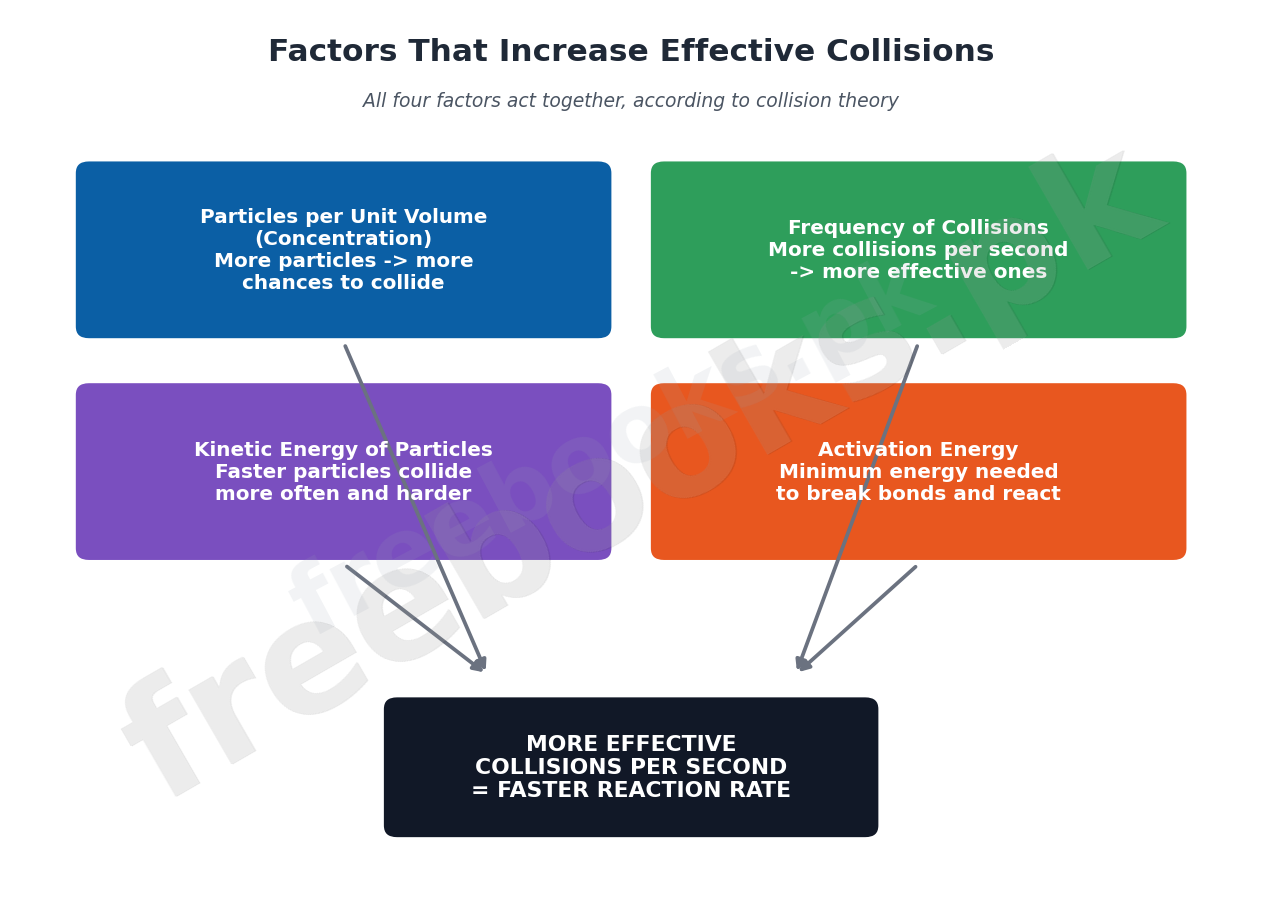
A reaction takes place only when the participating particles (atoms, molecules or ions) collide with one another, but only a very small fraction of collisions actually lead to the formation of products — these are called effective collisions. In the majority of collisions the reactant particles simply bounce back without any change. The rate of a reaction depends on the number of effective collisions occurring per second, which in turn depends on four factors.
The number of particles per unit volume: the higher the concentration of the reactants, the more particles are present and the more collisions occur between them. The frequency of collisions: a greater number of collisions per second increases the number of effective collisions — at higher temperature the velocities of molecules increase, raising the frequency of collisions. The kinetic energy of the particles: as temperature increases, particles move faster and have more chances to collide with each other with greater force.
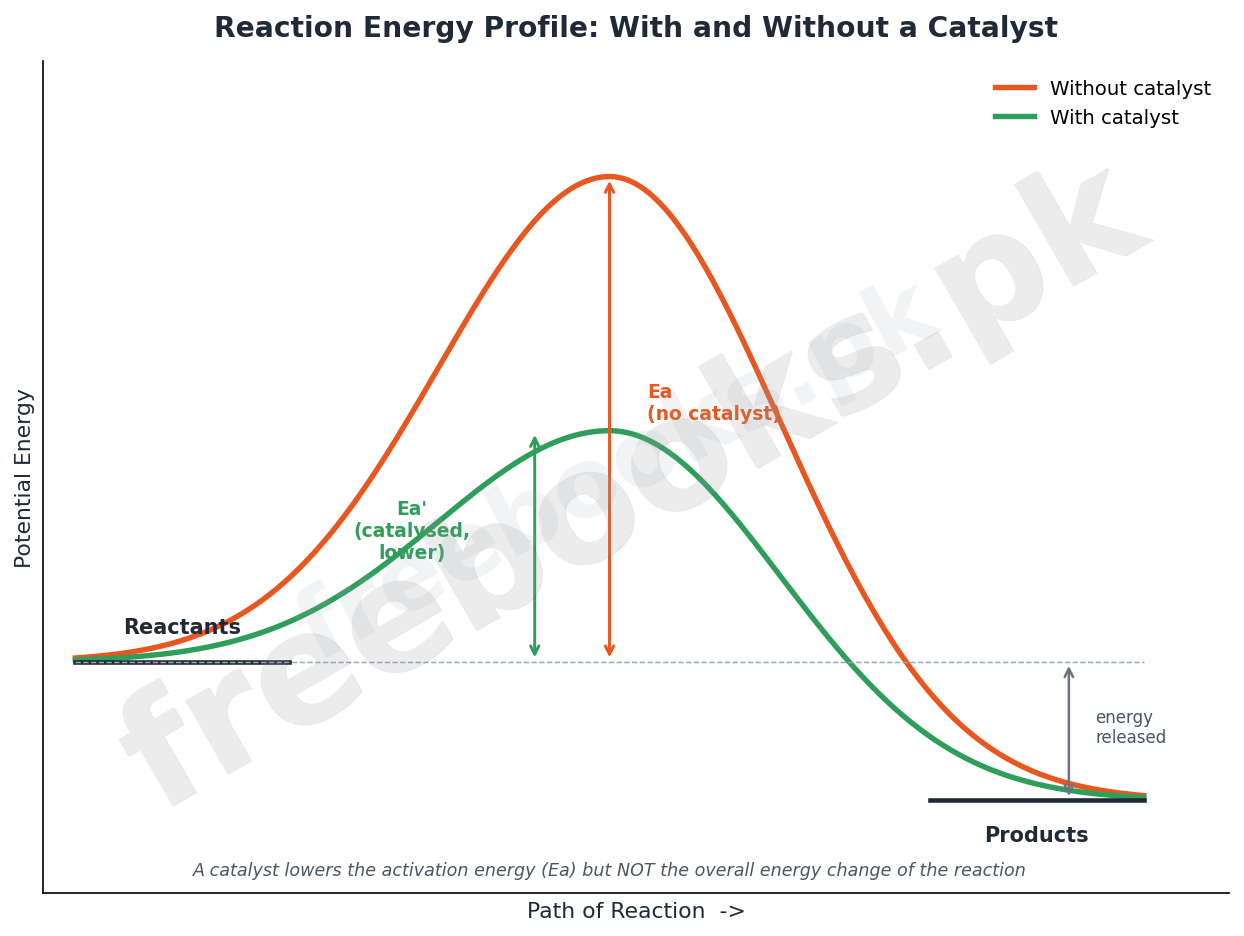
The fourth and most decisive factor is activation energy — the minimum energy the colliding particles must possess to break the bonds present in the reactant molecules and start the reaction. At a given temperature, most molecules possess only the average energy; only the small fraction whose energy exceeds the activation energy can react on collision. When particles with enough energy collide, they briefly form a high-energy state (with a corresponding rise in the potential energy of the system) before falling to the more stable products, a process usually shown as a graph of potential energy against the path of the reaction.
17.2 Change in Mass during a Chemical Reaction
The total mass during a chemical reaction always remains the same, obeying the law of conservation of mass. However, in an open container where gases can escape or enter, a reaction may appear to change mass because a reactant or product is a gas: if a gas is evolved, an apparent decrease in mass is observed; if a gas is absorbed, an apparent increase in mass is observed.
For example, burning a ribbon of magnesium in an open crucible produces MgO whose mass is greater than the magnesium alone, because oxygen from the air has combined with it — but if the same reaction were carried out in a closed container, the total mass would stay the same. Conversely, reacting marble chips with dilute hydrochloric acid in an open container gives an apparent decrease in mass because CO2 gas escapes into the atmosphere: CaCO3(s) + 2HCl(aq) -> CaCl2(aq) + H2O(l) + CO2(g). As a reaction proceeds, the concentration of reactants steadily decreases while the concentration of products increases, reaching its maximum once the reaction is complete — a relationship usually shown on a concentration-time graph.
17.3 Change in Temperature during a Chemical Reaction
Chemical reactions are often accompanied by a change in temperature that reveals whether they are exothermic or endothermic. In an exothermic reaction, heat energy is released and absorbed by the surroundings, raising their temperature — for example, quicklime reacting with water to form slaked lime releases a large amount of heat: CaO(s) + H2O(l) -> Ca(OH)2(s).
In an endothermic reaction, heat energy is absorbed from the surroundings, cooling them down — for example, dissolving ammonium chloride or ammonium nitrate in water absorbs heat and cools the container. Increasing the temperature of a reaction also increases its rate: for many reactions, the rate roughly doubles with every 10 degC rise in temperature, which is why cooking food at high temperature speeds up the reactions that break down its components.
17.4 Factors Affecting the Rates of Reactions
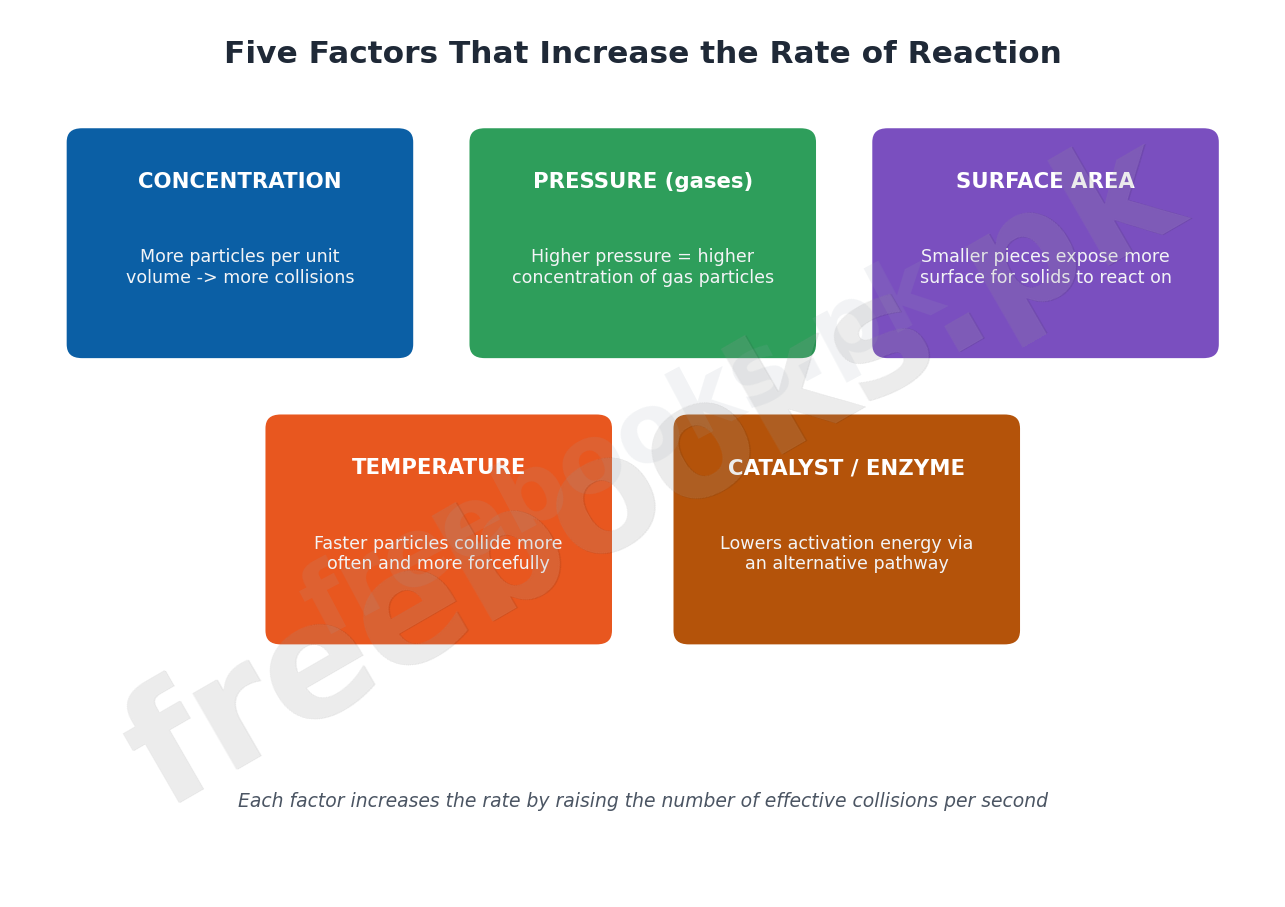
According to collision theory, any factor that changes the number of successful collisions per second will affect the rate of a reaction. Effect of concentration: the higher the concentration of reactants, the more particles per unit volume and the higher the chance of effective collisions, so the rate increases — coal burns faster in pure oxygen than in air (21% oxygen), and limestone reacts with hydrochloric acid at a rate that depends on the acid's concentration. Reactants in the gas phase behave the same way with respect to pressure: doubling the pressure of chlorine gas (with hydrogen in excess) doubles the rate of the hydrogen-chlorine reaction, because pressure increases the concentration of gas particles.
Effect of surface area: reactions involving solids occur at their surfaces, so the larger the surface area exposed, the more particles can come into contact and the higher the rate — finely divided aluminium reacts rapidly with cold aqueous sodium hydroxide, evolving hydrogen gas, while aluminium foil reacts only slowly with warm sodium hydroxide: 2Al(s) + 2NaOH(aq) + 6H2O(l) -> 2NaAl(OH)4(aq) + 3H2(g). Effect of temperature: raising the temperature increases the kinetic energy and hence the velocity of reacting particles, increasing the frequency of successful collisions — the rate of many reactions roughly doubles for every 10 degC rise, which is why food cooks faster at higher temperature and iron oxidizes far faster when hot than at room temperature.
Effect of a catalyst: a catalyst alters the rate of a reaction without being consumed, by providing an alternative reaction pathway with a substantially lower activation energy — when the activation energy is lowered, a much larger fraction of reactant particles has enough energy to reach the high-energy state, so the rate increases. Platinum metal, for example, catalyses the addition of hydrogen to ethene by adsorbing both molecules on its surface and weakening their bonds. Enzymes are biological catalysts — proteins that bind specific reactant molecules at active sites, weaken particular bonds enough for the reaction to occur, then release the product and become free to bind another reactant molecule; their active sites are highly specific, so a given enzyme usually catalyses only one particular reaction.
17.5 Importance of Chemical Kinetics in Food Industry
Studying reaction rates and the factors that affect them plays an important role in the food industry. The rates of reactions involved in food ripening and food spoilage are studied for different fruits and vegetables, and this information helps minimize losses due to spoilage — food scientists use the rates of enzymatic reactions, oxidation and microbial growth to determine the optimum conditions for harvesting, storage and transportation of food products.
Fruits and vegetables ripen because of enzymatic reactions that convert starches into sugars, soften tissues, and develop characteristic flavour and colour; by monitoring the rate of these reactions — for example, the rate of ethene production during ripening — farmers can predict when produce will reach peak quality and is ready for harvesting. Some naturally present enzymes also spoil food by changing its texture, flavour and nutritional value over time, so understanding the rates of these reactions lets producers plan how to slow spoilage — for instance, using refrigeration to slow the rapid degradation of a fruit that is sensitive to high temperature during transport or storage, or understanding the kinetics of fat oxidation to help prevent the spoilage of butter.
Important Definitions
Define rate of reaction.
The speed at which a chemical reaction takes place, usually measured as the change in concentration of a reactant or product per unit time.
Define an effective collision.
A collision between reacting particles that possesses enough energy and proper orientation to result in the formation of products.
Define collision theory.
The theory that a reaction occurs only when reactant particles collide with sufficient energy (activation energy) and correct orientation, and that the rate of reaction depends on the frequency of such effective collisions.
Define activation energy.
The minimum energy that colliding particles must possess to break the bonds present in the reactant molecules and allow a reaction to occur.
Define an exothermic reaction.
A reaction in which heat energy is released, causing the temperature of the surroundings to increase.
Define an endothermic reaction.
A reaction in which heat energy is absorbed from the surroundings, causing their temperature to decrease.
Define a catalyst.
A substance that alters the rate of a reaction by providing an alternative pathway with a different activation energy, without itself being consumed during the reaction.
Define an enzyme.
A biological catalyst, usually a protein, that speeds up a specific chemical reaction in a living organism by binding the reactant at an active site.
Define collision frequency.
The number of collisions occurring between reactant particles per unit time; a higher collision frequency increases the number of effective collisions.
Define the law of conservation of mass (in a chemical reaction).
The principle that the total mass of the reactants equals the total mass of the products in a chemical reaction, so mass is neither created nor destroyed.
Define concentration (as it affects rate of reaction).
The number of particles of a reactant present per unit volume; a higher concentration increases the rate of a reaction by increasing the chance of effective collisions.
Define surface area (as a rate factor).
The exposed area of a solid reactant available for contact with other reactants; a larger surface area, as in a finely divided solid, increases the rate of reaction.
Define a biosensor.
A device that uses a biological component, such as an enzyme, to detect a specific substance — for example, enzyme-based biosensors used to detect glucose in blood.
Define potential energy (in the context of a reaction pathway).
The stored energy of a chemical system that rises as colliding particles absorb activation energy to reach the high-energy state, then falls as stable products are formed.
Define kinetic energy (of reacting particles).
The energy a particle possesses due to its motion; it increases with temperature and determines how forcefully and how often particles collide.
Define food ripening (in terms of kinetics).
The set of enzymatic reactions in fruits and vegetables that convert starches into sugars, soften tissues and develop flavour and colour as the produce matures.
Key Facts & Relations
| Topic | Relation |
|---|---|
| Effect of concentration on rate | Rate increases as concentration of reactants increases |
| Effect of temperature on rate | Rate roughly doubles for every 10 degC rise in temperature (many reactions) |
| Effect of pressure on rate (gases) | Rate increases as pressure of gaseous reactants increases |
| Effect of surface area on rate | Rate increases as surface area of a solid reactant increases |
| Effect of a catalyst on rate | Catalyst lowers activation energy; rate increases; catalyst is unchanged at the end |
| Mass-loss example reaction | CaCO3(s) + 2HCl(aq) -> CaCl2(aq) + H2O(l) + CO2(g) |
| Mass-gain example reaction | 2Mg(s) + O2(g) -> 2MgO(s) |
| Exothermic example reaction | CaO(s) + H2O(l) -> Ca(OH)2(s) (releases heat) |
Diagrams
Factors Affecting Collision Theory: A summary diagram of the four factors that increase the number of effective collisions per second: particles per unit volume (concentration), frequency of collisions, kinetic energy of particles, and activation energy.
Reaction Energy Profile With and Without a Catalyst: A potential-energy-versus-reaction-path diagram comparing the uncatalysed and catalysed pathways for the same reaction, showing how a catalyst provides an alternative route with a lower activation energy while the overall energy change of the reaction stays the same.
Factors That Change the Rate of Reaction: A grid summarising how concentration, pressure, surface area, temperature and catalysts each increase the rate of reaction, with a short collision-theory reason given for each factor.
Short Questions & Answers
What is a successful (effective) collision?
A collision between reactant particles that has enough energy (equal to or greater than the activation energy) and the correct orientation to result in the formation of products.
How does an increase in temperature increase the rate of a reaction?
Higher temperature increases the kinetic energy and hence the velocity of particles, increasing both the frequency of collisions and the fraction of particles with energy above the activation energy, so more collisions become effective.
Why does the burning of sulphur proceed slower in air than in pure oxygen?
Air contains only about 21% oxygen, so the concentration of oxygen particles per unit volume is lower than in pure oxygen, giving fewer effective collisions per second and a slower rate.
Why is a catalyst preferably used in a finely divided (powdered) form?
A finely divided catalyst has a much larger surface area exposed to the reactants, allowing more reactant particles to be adsorbed and react at once, which increases the rate at which the catalyst can speed up the reaction.
Why is the rate of a reaction often very fast at the beginning of the reaction?
At the start, the concentration of reactants is at its highest, giving the greatest possible number of effective collisions per second; as reactants are used up, their concentration falls and the rate progressively slows down.
Magnesium does not react with air at room temperature but reacts very fast at high temperature, giving intense white light. Explain.
At room temperature, very few magnesium and oxygen particles collide with energy equal to or greater than the activation energy, so the reaction is negligible; at high temperature, particle kinetic energy rises sharply, greatly increasing the frequency and effectiveness of collisions, so the reaction proceeds rapidly and releases a large amount of light and heat.
What happens to the reactants after they climb the energy hill during a reaction?
Once reactant particles reach the top of the energy hill (the high-energy transition state), they descend to form the more stable products, releasing the excess potential energy that was gained during activation.
How does a catalyst lower the activation energy of a reaction?
A catalyst provides an alternative reaction pathway or mechanism, often by adsorbing reactant particles on its surface and weakening the bonds within them, so that a lower amount of energy is needed for the particles to reach the high-energy state and react.
Give two features of the catalytic action of an enzyme.
An enzyme binds its reactant molecule at a specific active site and lowers the activation energy needed for that particular reaction; it is highly specific, usually catalysing only one type of reaction, and is released unchanged once the product has formed.
How does chemical kinetics help determine the best time for fruit harvesting?
By studying the rate at which ripening reactions (such as ethene production) proceed in a fruit, scientists can predict when the fruit will reach its peak quality, allowing harvesting to be timed for the best flavour, texture and shelf life.
Long Questions & Answers
Describe the main points of the collision theory of reaction rate.
What must happen for reactant particles to react, according to collision theory?
Reactant particles (atoms, molecules or ions) must collide with each other; however, only a small fraction of these collisions are effective collisions that actually lead to the formation of products, since the particles must also possess enough energy and the correct orientation.
How does the number of particles per unit volume affect the rate?
The larger the number of reactant particles per unit volume — that is, the higher the concentration — the greater the possibility of particles meeting and colliding, so more effective collisions occur per second and the rate of reaction increases.
How does the frequency of collisions affect the rate?
A greater number of collisions occurring per second increases the number of effective collisions among them; at higher temperature, particle velocities increase, which raises the frequency of collisions and therefore the rate.
Why is activation energy central to whether a collision leads to a reaction?
Colliding particles react only if their combined energy is equal to or greater than the activation energy, the minimum energy needed to break bonds in the reactants; only a small fraction of molecules possess this much energy at a given temperature, which is why most collisions are unsuccessful even though particles are constantly colliding.
Discuss the factors affecting the rate of a chemical reaction, explaining each one using collision theory.
How does the concentration of reactants affect the rate of reaction?
Increasing the concentration of reactants raises the number of particles per unit volume, which increases the chance of particles meeting and colliding effectively; this is why coal burns faster in pure oxygen than in ordinary air, which contains only about 21% oxygen.
How does the surface area of a solid reactant affect the rate of reaction?
Reactions involving solids occur only at their exposed surfaces, so increasing the surface area — for example, by using a powdered solid instead of a large lump — exposes more particles to collision with the other reactant, increasing the frequency of effective collisions and the overall rate.
How does temperature affect the rate of reaction?
Raising the temperature increases the kinetic energy of the reacting particles, making them move faster; this increases both the frequency of collisions and the fraction of particles with energy equal to or above the activation energy, so the rate of reaction increases, often roughly doubling for every 10 degC rise.
How does a catalyst, including an enzyme, affect the rate of reaction?
A catalyst provides an alternative pathway for the reaction with a lower activation energy, so a much larger proportion of particles can react on collision, increasing the rate without the catalyst itself being used up; an enzyme is a biological catalyst that achieves the same effect by binding its specific reactant at an active site and weakening the bonds that must break.
Multiple Choice Questions (MCQs)
The number of collisions per unit volume of the reaction mixture is called: (A) Collision energy (B) Activation energy (C) Collision frequency (D) Collision force
Correct answer: (C) Collision frequency. Collision frequency is defined as the number of collisions occurring between reactant particles per unit time/volume.
If the reactant particles possess an energy higher than the activation energy, the reaction will be: (A) Slow (B) Fast (C) Not affected (D) Instantaneous
Correct answer: (B) Fast. Particles with energy above the activation energy can react readily on collision, so a greater fraction of high-energy particles gives a faster reaction.
Which of the following explains the increase in rate of reaction in the presence of a catalyst? (A) Catalyst provides extra energy to the reactant molecules (B) Catalyst provides an alternative pathway which lowers the activation energy (C) Catalyst increases the collision frequency directly (D) Catalyst decreases the collision frequency
Correct answer: (B) Catalyst provides an alternative pathway which lowers the activation energy. A catalyst works by opening an alternative reaction pathway with a lower activation energy, not by adding energy to the particles themselves.
Which of the following statements is correct? (A) Collisions with energy equal to or greater than the activation energy lead to reaction (B) Collision frequency is not related to the reaction rate (C) All collisions lead to a reaction (D) Collisions with energy less than the activation energy lead to the reaction
Correct answer: (A) Collisions with energy equal to or greater than the activation energy lead to reaction. Only collisions in which the particles have energy equal to or greater than the activation energy (and correct orientation) are effective and lead to a reaction.
When a reaction proceeds forward, how do the concentrations of reactants and products change? (A) Concentration of reactants increases and that of products decreases (B) Concentration of reactants decreases and that of products increases (C) Concentration of both reactants and products decreases (D) Concentration of both reactants and products increases
Correct answer: (B) Concentration of reactants decreases and that of products increases. As a reaction proceeds, reactants are consumed (their concentration falls) while products accumulate (their concentration rises), until the reaction is complete.
A ribbon of magnesium burnt in an open crucible shows an apparent: (A) Decrease in mass, because a gas escapes (B) Increase in mass, because it combines with oxygen from air (C) No change in mass (D) Decrease in mass, because magnesium evaporates
Correct answer: (B) Increase in mass, because it combines with oxygen from air. Magnesium combines with oxygen from the surrounding air to form MgO, so the solid product's mass is greater than the mass of magnesium alone.
Marble chips reacting with dilute hydrochloric acid in an open container show an apparent decrease in mass because: (A) Hydrochloric acid evaporates (B) Carbon dioxide gas escapes into the atmosphere (C) Marble dissolves completely (D) Water is absorbed from the air
Correct answer: (B) Carbon dioxide gas escapes into the atmosphere. CO2 gas produced in the reaction escapes from the open container, so the measured mass of the remaining contents appears to decrease even though total mass is conserved.
Doubling the pressure of chlorine gas (with hydrogen present in excess) has what effect on the rate of the hydrogen-chlorine reaction? (A) No effect (B) Roughly doubles the rate (C) Halves the rate (D) Stops the reaction
Correct answer: (B) Roughly doubles the rate. For gaseous reactants, increasing pressure increases the concentration of particles per unit volume, so doubling the pressure of chlorine roughly doubles the reaction rate.
Why does finely divided aluminium react much faster with cold sodium hydroxide solution than aluminium foil does with warm sodium hydroxide? (A) Finely divided aluminium is a different element (B) Finely divided aluminium has a much larger exposed surface area (C) Powdered aluminium is at a higher temperature (D) Aluminium foil is more concentrated
Correct answer: (B) Finely divided aluminium has a much larger exposed surface area. Breaking aluminium into fine particles greatly increases its exposed surface area, allowing many more particles to be in contact with the sodium hydroxide solution at once.
Enzyme-based biosensors are commonly used to detect which substance in blood? (A) Oxygen (B) Glucose (C) Iron (D) Carbon dioxide
Correct answer: (B) Glucose. Enzyme-based biosensors are widely used to detect glucose levels in blood, an application of enzyme specificity and reaction-rate measurement.
Quick Revision Summary
- Rate of reaction depends on the number of effective collisions per second, which needs both enough energy (activation energy) and correct orientation.
- Higher concentration (particles per unit volume) and higher collision frequency both increase the number of effective collisions and therefore the rate.
- Activation energy is the minimum energy colliding particles need to react; only a small fraction of molecules possess this much energy at a given temperature.
- Total mass is always conserved in a reaction; apparent mass changes in open containers are usually caused by a gas escaping (apparent decrease) or being absorbed (apparent increase).
- Exothermic reactions release heat and raise the surrounding temperature; endothermic reactions absorb heat and lower it.
- Rate increases with: higher concentration, higher pressure of gases, larger surface area of solids, higher temperature (often roughly doubling per 10 degC), and the presence of a catalyst.
- A catalyst speeds up a reaction by lowering its activation energy through an alternative pathway, without being consumed; enzymes are specific biological catalysts.
- Chemical kinetics helps the food industry determine ideal harvesting, storage and transportation times by studying the rates of ripening, spoilage and oxidation reactions.
Exam Tips
- When asked to explain any rate-increasing factor, always connect it back to collision theory: does it increase the number of particles colliding, the frequency of collisions, or the fraction of particles with enough energy to react?
- Remember the four collision-theory factors together: particles per unit volume, frequency of collisions, kinetic energy of particles, and activation energy.
- For mass-change questions, first identify whether a gas is a reactant or product and whether the container is open or closed — that alone tells you whether mass will appear to increase, decrease or stay the same.
- Learn one worked example for each rate factor (concentration: coal in air vs oxygen; surface area: aluminium foil vs powder; temperature: the 10 degC doubling rule; catalyst: platinum with hydrogen and ethene) as model answers.
- A catalyst changes the RATE of a reaction by lowering activation energy — it never changes the overall energy released or absorbed by the reaction itself, and it is chemically unchanged at the end.
- For food-industry questions, connect the kinetics concept directly to a practical outcome: monitoring ripening rate to decide harvest time, or using refrigeration to slow spoilage reaction rates.