Electrochemistry studies the connection between chemical reactions and electricity. This chapter begins with oxidation numbers — a bookkeeping tool for tracking how electrons are apparently distributed in a compound or ion — and uses them to write formulas of ionic compounds and to identify oxidation, reduction and redox (oxidation-reduction) reactions in terms of oxygen, hydrogen, electrons and changes in oxidation number.
The second half of the chapter covers electrolysis, the process by which an electric current decomposes molten or dissolved ionic compounds at an anode and a cathode, with worked cases including brine, dilute and concentrated metal halide solutions, molten lead(II) chloride, dilute sulphuric acid and copper(II) sulphate. It then covers hydrogen-oxygen fuel cells, corrosion and its prevention, electroplating, and galvanic cells such as the Daniel cell, ending with how voltage data from galvanic cells is used to build the electrochemical (reactivity) series of metals.
Learning Objectives
- Define oxidation number and use the rules for assigning it to atoms in compounds and ions
- Derive the formula of an ionic compound from oxidation numbers or ionic charges
- Define oxidation and reduction in terms of oxygen, hydrogen, electrons and oxidation number changes
- Identify the oxidizing agent and reducing agent in a given redox reaction
- Define electrolysis and identify the anode, cathode, electrolyte and direction of electron flow in an electrolytic cell
- Predict the products formed at each electrode during electrolysis of common electrolytes (brine, dilute/concentrated metal halides, molten lead(II) chloride, dilute sulphuric acid, copper(II) sulphate)
- Describe how a hydrogen-oxygen fuel cell works and compare its advantages and disadvantages with petrol/diesel engines
- Define corrosion, explain the reactions involved in the rusting of iron, and describe methods used to prevent it
- Describe electroplating and its main objectives (decoration, protection, repair)
- Sketch a galvanic cell such as the Daniel cell and use voltage data to compare the reactivity of metals
Key Concepts
16.1 Oxidation Number
The oxidation number of an atom is an apparent charge assigned to it in a compound or ion, used to track electron distribution and identify oxidation-reduction reactions and oxidizing/reducing agents. It is found using a set of rules: an atom in its free (uncombined) element always has oxidation number zero; a monatomic ion's oxidation number equals the charge on that ion; group 1 elements are +1, group 2 are +2; the more electronegative atom in a binary compound is given the negative oxidation number (fluorine is always -1); hydrogen is +1 with more electronegative atoms and -1 with less electronegative atoms (as in metal hydrides); oxygen is usually -2.
Two further rules tie everything together: the oxidation numbers of all atoms in a neutral compound must add up to zero, and the oxidation numbers of all atoms in a polyatomic ion must add up to the charge on that ion. These two rules are what let us calculate an unknown oxidation number — for example, in SO4(2-), since oxygen is -2, S + 4(-2) = -2 gives S = +6.
16.2 Writing Formulas of Ionic Compounds Using Oxidation Numbers and Ionic Charges
Once the oxidation numbers (or ionic charges) of the elements or polyatomic ions in a compound are known, its formula can be written so that the total positive and negative charges add up to zero. For calcium chloride, calcium (group 2) has oxidation number +2 and chlorine (group 17, combined with a less electronegative element) has -1, so two chloride ions are needed for every calcium ion, giving CaCl2.
The same method works for polyatomic ions: combine the cation and anion in whatever ratio makes the compound electrically neutral, writing a polyatomic ion's formula in brackets with a subscript when more than one is needed — ammonium carbonate, from NH4(1+) and CO3(2-), becomes (NH4)2CO3. Common polyatomic ions include acetate, ammonium, carbonate, chromate, dichromate, hydroxide, nitrate, permanganate, phosphate and sulfate, among others.
16.3 Oxidation, Reduction and Redox Reactions
Oxidation and reduction are simultaneous, opposite processes described in three equivalent ways. In terms of oxygen and hydrogen: oxidation is the addition of oxygen or removal of hydrogen (as when iron rusts, or oxygen removes hydrogen from CH4); reduction is the addition of hydrogen or removal of oxygen (as when hydrogen reduces CuO to copper metal). In terms of electrons: oxidation is the loss of electrons (Cu -> Cu2+ + 2e-) and reduction is the gain of electrons (Fe3+ + e- -> Fe2+). In terms of oxidation number: oxidation is an increase in oxidation number, and reduction is a decrease.
A chemical reaction involving both oxidation and reduction together is called a redox reaction. The substance that is reduced is the oxidizing agent (it causes oxidation in the other species by accepting electrons), while the substance that is oxidized is the reducing agent. Acidified potassium permanganate is a strong oxidizing agent, visibly losing its dark purple colour as it oxidizes oxalic acid to carbon dioxide (Mn going from +7 to +2), and turning colourless potassium iodide solution yellow-brown as it oxidizes iodide ions to iodine.
16.4 Electrolysis: Basic Concepts
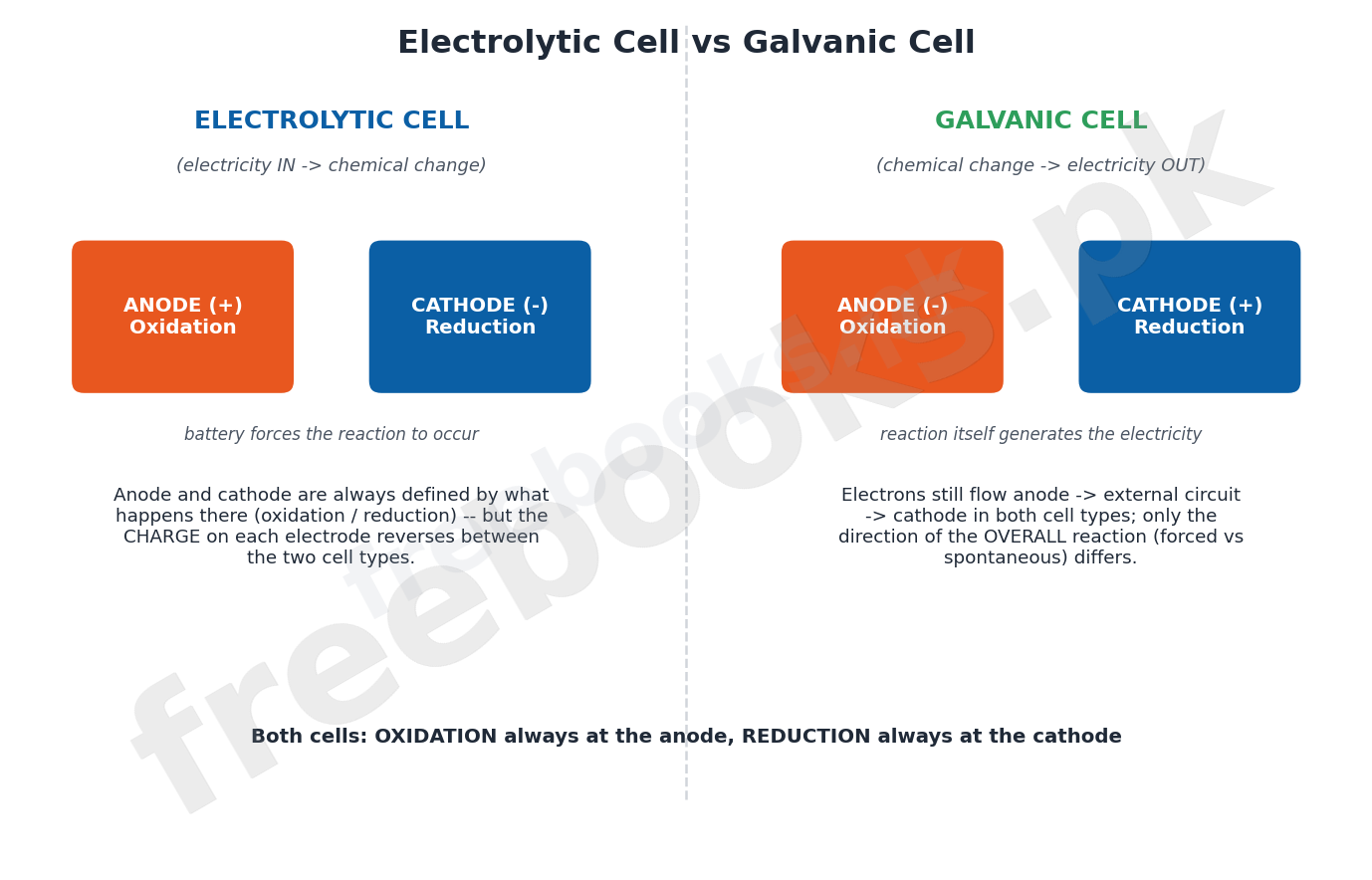
Electrolysis is the decomposition of a molten or dissolved ionic compound (an electrolyte) by passing an electric current through it, using two electrodes in an electrolytic cell. The anode is the positive electrode, where oxidation occurs and electrons enter the external circuit; the cathode is the negative electrode, where reduction occurs and electrons leave the external circuit. Positive ions in the electrolyte migrate to the cathode and are reduced there; negative ions migrate to the anode and are oxidized there.
Because electrolysis forces a non-spontaneous reaction to occur using electrical energy from a battery, the charges on the electrodes are the reverse of those in a galvanic cell (covered in section 16.8): in an electrolytic cell, the anode is positive and the cathode is negative, even though oxidation still always happens at the anode and reduction still always happens at the cathode in both types of cell.
16.5 Electrolysis of Aqueous Solutions and Molten Compounds
When brine (concentrated aqueous NaCl) is electrolyzed with inert electrodes, hydrogen gas forms at the cathode (H+ and water are reduced in preference to Na+) and chlorine gas forms at the anode, leaving sodium hydroxide solution behind. For dilute aqueous metal halides, which ion is discharged at the cathode depends on the metal's position in the electrochemical series: metals below hydrogen (like copper and silver) are deposited as metal, metals above hydrogen (like sodium and magnesium) are not, and hydrogen gas is evolved instead; at the anode of a dilute halide, oxygen is usually discharged in preference to the halide ion, because hydroxide ions are more concentrated. In concentrated metal halide solutions, however, the halide ion IS discharged at the anode because its higher concentration now favours it.
Molten lead(II) chloride (heated above 501 degC to free its ions) deposits liquid lead metal at the cathode and releases chlorine gas at the anode, with no water present to complicate the outcome. Electrolysis of dilute sulphuric acid with inert electrodes decomposes water itself: hydrogen gas forms at the cathode and oxygen gas forms at the anode (hydroxide ions are discharged in preference to sulphate ions, which resist oxidation), so the acid's concentration slowly increases as water is used up. Electrolysis of dilute copper(II) sulphate deposits copper metal at an inert cathode and releases oxygen at an inert anode — but if copper electrodes are used instead, the copper anode itself dissolves into solution as Cu2+ while copper is still deposited at the cathode, so the blue colour of the solution and the electrode masses barely change; this principle underlies copper electroplating.
16.6 Hydrogen-Oxygen Fuel Cells
A fuel cell converts the chemical energy of a continuously supplied fuel directly into electrical energy. In a hydrogen-oxygen fuel cell, porous carbon electrodes coated with platinum catalyst sit in an aqueous potassium hydroxide electrolyte; at the anode, hydrogen is oxidized (combining with hydroxide ions to form water and release electrons), and at the cathode, oxygen is reduced (combining with water and electrons to form more hydroxide ions). The overall reaction is 2H2(g) + O2(g) -> 2H2O(l), with water as the only chemical product, and the cell keeps producing electricity as long as hydrogen and oxygen are supplied.
Compared with petrol or diesel engines, fuel cells produce zero carbon dioxide emissions, convert a much larger share of the fuel's chemical energy into useful electrical energy, and run more quietly; hydrogen can also be produced from renewable sources, making fuel cells more sustainable. Their disadvantages are that producing hydrogen by electrolysis is currently expensive, hydrogen is highly flammable and needs special storage and transport, and fuel cells and electric motors are currently less durable than conventional engines.
16.7 Corrosion and Its Prevention
Corrosion is the gradual chemical decay of a metal as it reacts with substances in its environment, coating its surface with oxides, sulphides or carbonates. Rusting of iron is the most familiar example: iron loses electrons to form Fe2+, oxygen gains those electrons in the presence of water to form hydroxide ions, and Fe2+ then reacts further with oxygen and water to form hydrated iron(III) oxide (rust). Because rust is porous, it lets air and moisture keep reaching fresh metal underneath, so an unprotected piece of iron will eventually corrode completely.
Corrosion is prevented mainly by keeping the metal surface out of contact with air and moisture: barrier methods include greasing, painting, galvanizing (dipping iron or steel in molten zinc, which also protects sacrificially if the coating is scratched) and electroplating with a more resistant metal. Sacrificial protection instead deliberately attaches a more reactive metal, such as magnesium or zinc, which corrodes in place of the metal it protects — magnesium blocks are commonly used to protect ship hulls and buried steel pipelines.
16.8 Electroplating and Galvanic Cells
Electroplating deposits a thin layer of one metal onto another electrolytically, for decoration (coating cheap metals with gold or silver), protection (against corrosion or acid attack) or repair (rebuilding worn machine parts). The object to be plated is made the cathode, the metal being deposited is made the anode, and the electrolyte is usually a soluble salt of that metal (for example CuSO4 with a little sulphuric acid for copper plating, or potassium argentocyanide for silver plating); good current density, low temperature and a concentrated electrolyte all favour a good-quality deposit.
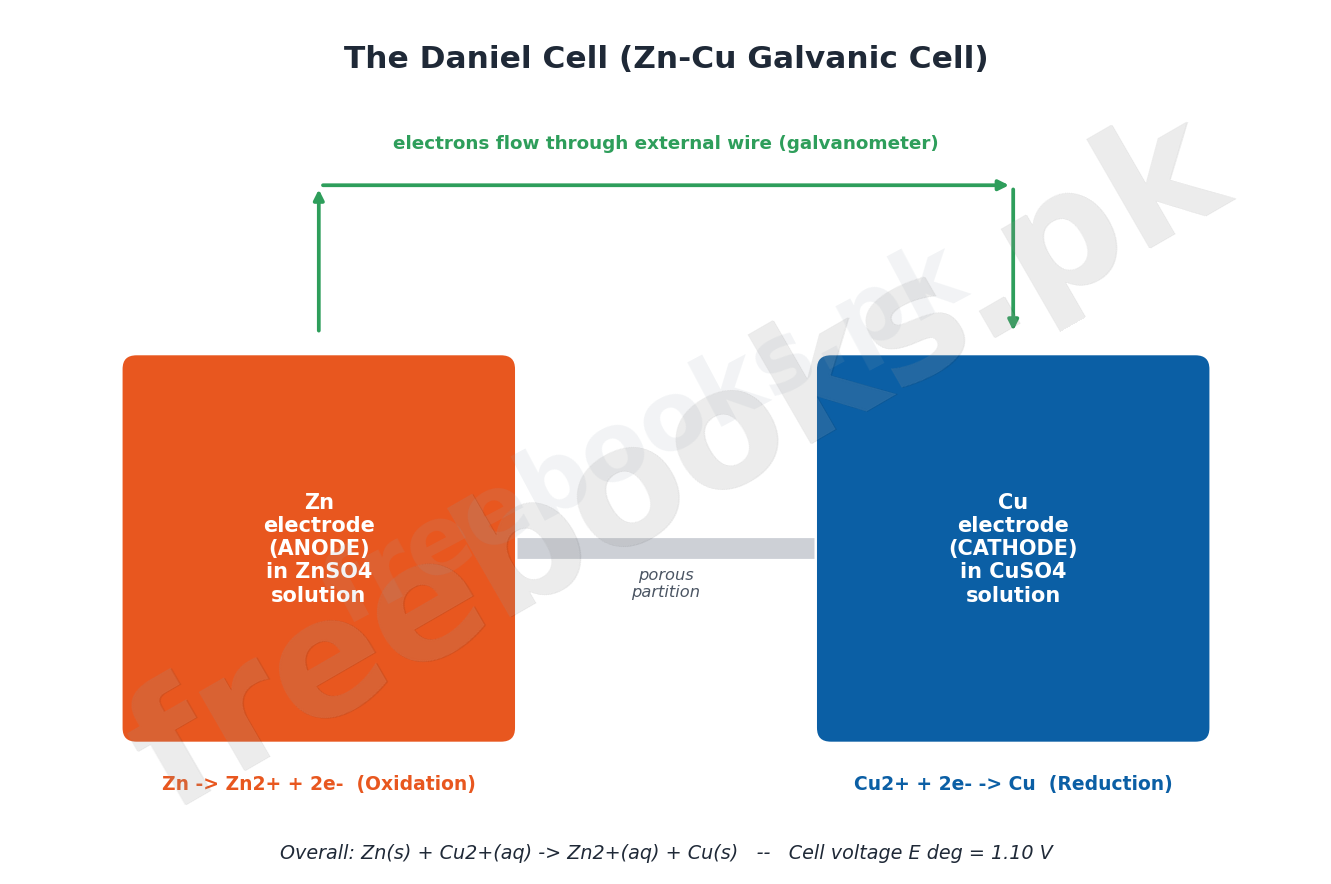
A galvanic (voltaic) cell does the reverse of electrolysis: a spontaneous redox reaction is used to generate electricity. In the Daniel cell, a zinc electrode sits in zinc sulphate solution and a copper electrode sits in copper sulphate solution, connected by a wire and kept apart by a porous partition that lets ions, but not the two solutions, pass through. Zinc is oxidized at the anode (Zn -> Zn2+ + 2e-) and copper ions are reduced at the cathode (Cu2+ + 2e- -> Cu); electrons travel through the external wire while ions cross the partition, and the cell produces a standard voltage of about 1.10 volts.
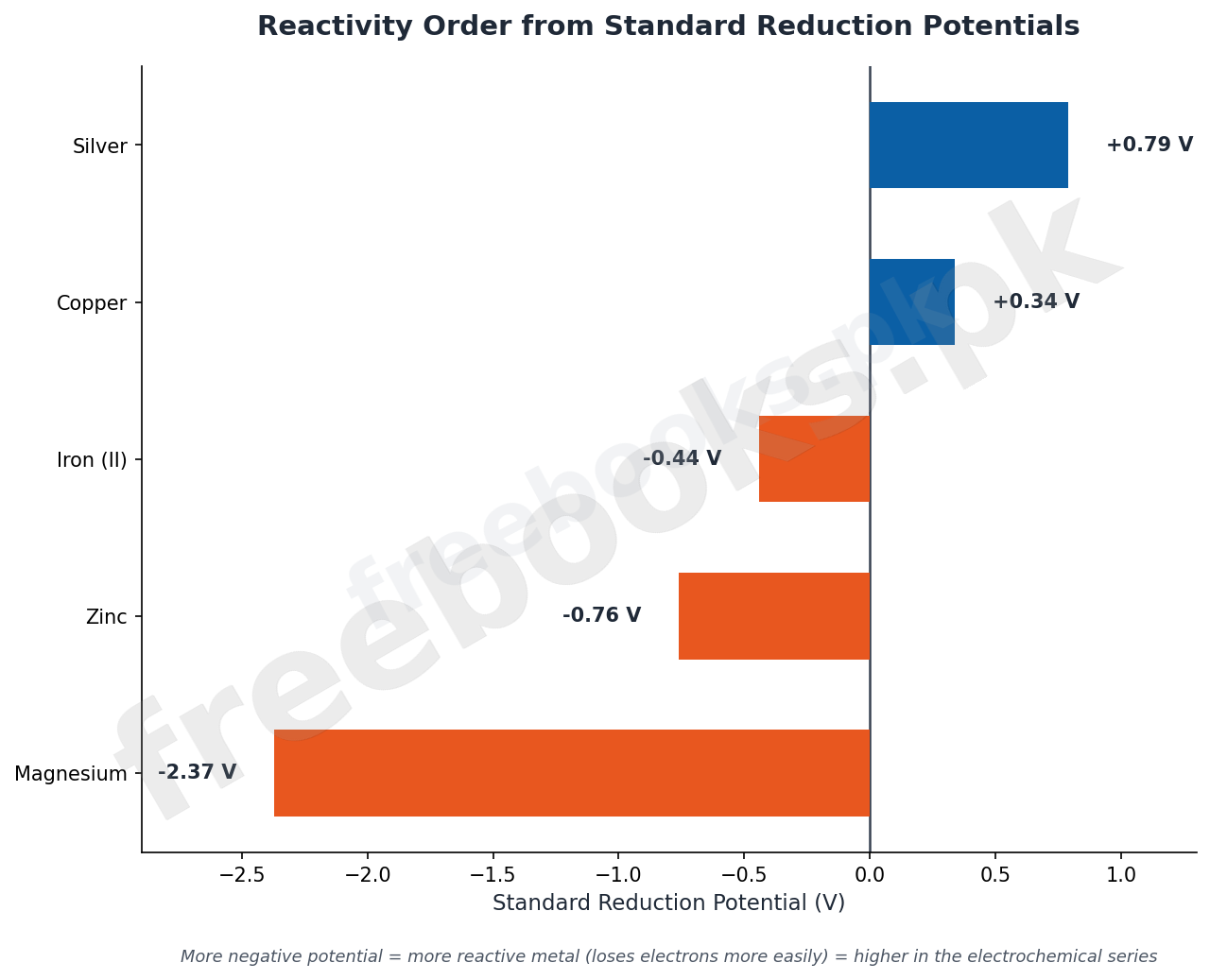
Comparing the voltage produced by galvanic cells built from different metal pairs reveals how strongly each metal tends to lose electrons — its reactivity. A cell between magnesium and copper produces a higher voltage than one between iron and copper, showing magnesium is more reactive than iron. Ranking metals this way by their measured voltages (standard reduction potentials) builds the electrochemical series, with the most reactive, most easily oxidized metals placed highest.
Important Definitions
Define oxidation number.
An apparent charge assigned to an atom in a compound or ion, used to track electron distribution and identify oxidation-reduction reactions; it can be positive, negative or zero.
Define oxidation (in terms of electrons).
A process in which an atom, ion or molecule loses one or more electrons; also defined as gain of oxygen, loss of hydrogen, or an increase in oxidation number.
Define reduction (in terms of electrons).
A process in which an atom, ion or molecule gains one or more electrons; also defined as loss of oxygen, gain of hydrogen, or a decrease in oxidation number.
Define a redox reaction.
A chemical reaction in which oxidation and reduction occur simultaneously.
Define oxidizing agent.
A substance that is itself reduced while causing another substance to be oxidized (it accepts electrons from the other substance).
Define reducing agent.
A substance that is itself oxidized while causing another substance to be reduced (it donates electrons to the other substance).
Define electrolysis.
The decomposition of an ionic compound, in the molten state or in aqueous solution, by passing an electric current through it.
Define electrolyte.
A molten or dissolved ionic compound that conducts electricity and is decomposed during electrolysis.
Define anode.
The electrode at which oxidation occurs; positive in an electrolytic cell but negative in a galvanic cell.
Define cathode.
The electrode at which reduction occurs; negative in an electrolytic cell but positive in a galvanic cell.
Define a fuel cell.
A device that converts the chemical energy of a continuously supplied fuel (such as hydrogen and oxygen) directly into electrical energy, with water as the only product of a hydrogen-oxygen fuel cell.
Define corrosion.
The gradual chemical decay of a metal as it reacts with substances in its environment, such as oxygen and water, coating its surface with compounds like oxides.
Define galvanization.
A method of protecting iron or steel from rusting by coating it with a layer of zinc, usually by dipping it in molten zinc.
Define sacrificial protection.
A method of corrosion prevention in which a more reactive metal, such as magnesium or zinc, is deliberately attached to a less reactive metal so that it corrodes first, protecting the other metal.
Define electroplating.
A process in which a metal is deposited electrolytically onto another metal, for decoration, protection or repair.
Define the electrochemical series.
A list of metals (and some other substances) arranged in order of their standard reduction potentials, showing their relative tendency to lose or gain electrons; more reactive metals are placed higher.
Key Formulas
| Topic | Relation |
|---|---|
| Oxidation number of a free element | Always zero |
| Oxidation number of a monatomic ion | Equal to the charge on the ion |
| Sum of oxidation numbers in a neutral compound | Zero |
| Sum of oxidation numbers in a polyatomic ion | Equal to the charge on the ion |
| In an electrolytic cell | Anode = positive (oxidation); Cathode = negative (reduction) |
| In a galvanic cell | Anode = negative (oxidation); Cathode = positive (reduction) |
| Daniel cell overall reaction | Zn(s) + Cu2+(aq) -> Zn2+(aq) + Cu(s), E deg = +1.10 V |
| Hydrogen-oxygen fuel cell overall reaction | 2H2(g) + O2(g) -> 2H2O(l) |
Diagrams
Electrolytic Cell vs Galvanic Cell: A side-by-side comparison showing that oxidation always occurs at the anode and reduction always at the cathode in both cell types, but the charge on each electrode reverses between an electrolytic cell (electricity forces the reaction) and a galvanic cell (the reaction produces electricity).
The Daniel Cell (Zn-Cu Galvanic Cell): A schematic of a Daniel cell showing the zinc anode in zinc sulphate solution and the copper cathode in copper sulphate solution, connected by an external wire and separated by a porous partition, with the oxidation and reduction half-reactions and the overall cell voltage.
Reactivity Order from Standard Reduction Potentials: A bar chart comparing the standard reduction potentials of magnesium, zinc, iron(II), copper and silver, showing how a more negative potential corresponds to a more reactive metal and a higher position in the electrochemical series.
Short Questions & Answers
What happens when electricity is passed through an aqueous solution of NaCl?
The solution (brine) is electrolyzed: hydrogen gas forms at the cathode, chlorine gas forms at the anode, and sodium hydroxide solution is left behind.
What are the main objectives of electroplating?
Decoration (coating an inexpensive metal with a noble metal like gold or silver), protection (against corrosion or acid attack), and repair (rebuilding worn machine parts).
Mention one difference between an electrolytic cell and a galvanic cell.
In an electrolytic cell, electrical energy is supplied to force a non-spontaneous reaction (the anode is positive); in a galvanic cell, a spontaneous reaction generates electrical energy (the anode is negative).
Through which electrode do electrons leave an electrolytic cell?
Through the anode, which is connected to the positive terminal of the battery and is where electrons enter the external circuit.
How does an electrolyte conduct electricity?
By the movement of its freely moving positive and negative ions towards the cathode and anode respectively, where they are reduced or oxidized.
What will happen if a strip of copper metal is dipped in FeSO4 solution?
Nothing significant happens, because copper is below iron in the electrochemical series and is less reactive, so it cannot displace iron from its salt solution.
Why are fuel cells regarded as environment-friendly?
Because a hydrogen-oxygen fuel cell produces only water as a chemical product, with zero carbon dioxide emissions, unlike petrol or diesel engines.
Why does the blue colour of copper sulphate solution fade during electrolysis with inert electrodes?
Because copper ions are continuously removed from solution as they are reduced and deposited as copper metal at the cathode, lowering the concentration of Cu2+ in the solution.
Why are carbon (graphite) electrodes used for electrolyzing concentrated NaCl solution?
Because graphite is inert and does not react with the chlorine gas produced at the anode, unlike some metals would.
Why does corrosion become faster during the rainy season?
Because rusting needs both oxygen and water, and the increased moisture in the air during the rainy season speeds up the electrochemical reactions involved in rusting.
Long Questions & Answers
Explain, with reference to the electrolysis of aqueous sodium chloride and dilute sulphuric acid, how the products formed at each electrode are determined.
What ions are present in these two electrolytes, and why does that matter?
Brine contains Na+ and Cl- from sodium chloride plus H+ and OH- from water; dilute sulphuric acid contains H+ and SO4(2-) from the acid plus H+ and OH- from water. Because more than one type of ion approaches each electrode, there is a choice over which ion is actually discharged, and that choice determines the products.
Why is hydrogen gas, not sodium, produced at the cathode of brine?
Water molecules and hydrogen ions have a greater tendency to be reduced than sodium ions do, so H+ (or water) picks up electrons at the cathode to form hydrogen gas, leaving Na+ and the resulting OH- in solution, which is why the solution around the cathode becomes alkaline.
What happens at the anode in each case, and why does dilute sulphuric acid give oxygen rather than sulphate discharge?
At the anode of brine, chloride ions are oxidized to chlorine gas. At the anode of dilute sulphuric acid, hydroxide ions are oxidized to oxygen gas instead of sulphate ions, because sulphate ions are much harder to oxidize than hydroxide ions, even though both are present.
How does the overall outcome change between dilute and concentrated solutions, or with different electrode materials?
In a dilute halide solution, the anode gives oxygen because hydroxide ions dominate, but in a concentrated halide solution, the halide ion's much higher concentration means it is discharged instead, giving the halogen gas; using an active electrode (such as copper in copper sulphate electrolysis) instead of an inert one also changes the anode outcome, since the electrode metal itself dissolves into solution rather than oxygen being produced.
Explain how a Daniel cell generates an electric current, and how measuring cell voltages between different metal pairs is used to build the electrochemical (reactivity) series.
What happens at the zinc and copper electrodes of a Daniel cell?
At the zinc electrode (the anode), each zinc atom loses two electrons and enters the solution as a Zn2+ ion — an oxidation reaction. At the copper electrode (the cathode), Cu2+ ions from the solution gain those electrons and are deposited as copper metal — a reduction reaction.
Why must the two half-cells be kept in separate compartments?
If the zinc metal were placed directly into the copper sulphate solution, the oxidation and reduction reactions would happen right at the zinc surface and the electron transfer would not pass through an external circuit, so no usable electric current could be generated; keeping the reactions physically apart forces the electrons to travel through a wire instead.
What is the role of the porous partition and the external wire?
The porous partition allows ions to move between the two half-cells to keep both solutions electrically neutral as the reaction proceeds, but stops the two solutions from mixing directly; the external wire (through a galvanometer) is the only path by which the electrons released at the zinc anode can reach the copper cathode, and this flow of electrons is the electric current the cell produces.
How does comparing cell voltages between different metal pairs establish the order of reactivity?
A galvanic cell's voltage measures the difference in how strongly its two metals tend to lose electrons; a higher voltage between a given pair means a bigger difference in reactivity. Since a magnesium-copper cell produces a higher voltage than an iron-copper cell, magnesium must be more reactive than iron, and by measuring many such pairs, metals can be ranked from most to least reactive, giving the electrochemical series.
Multiple Choice Questions (MCQs)
The oxidation number of Mn in K2MnO4 is: (A) +7 (B) +5 (C) +6 (D) -6
Correct answer: (C) +6. K is +1 (x2 = +2), O is -2 (x4 = -8); for the neutral compound, +2 + Mn – 8 = 0, so Mn = +6.
In the reaction 4HBr + MnO2 -> MnBr2 + Br2 + 2H2O, which element is being reduced? (A) Br (B) Mn (C) H (D) Both Mn and H
Correct answer: (B) Mn. Manganese goes from +4 in MnO2 to +2 in MnBr2, a decrease in oxidation number, so manganese is reduced.
During electrolysis of dilute H2SO4 using platinum electrodes, which process takes place at the cathode? (A) Reduction (B) Neither oxidation nor reduction (C) Oxidation (D) First oxidation and then reduction
Correct answer: (A) Reduction. Hydrogen ions gain electrons at the cathode to form hydrogen gas, which is a reduction.
What product forms at the anode when an aqueous solution of CuSO4 is electrolysed using copper electrodes? (A) Cu (B) O2 (C) H2 (D) No gas product — the copper anode dissolves into solution as Cu2+
Correct answer: (D) No gas product — the copper anode dissolves into solution as Cu2+. With an active copper anode, copper metal atoms leave the electrode as Cu2+ ions instead of oxygen being produced, keeping the electrolyte concentration roughly constant.
Which of the following statements is NOT correct about a Zn-Cu galvanic (electrochemical) cell? (A) Anode is negatively charged (B) Reduction occurs at the anode (C) Cathode is positively charged (D) Reduction occurs at the cathode
Correct answer: (B) Reduction occurs at the anode. In a galvanic cell, oxidation — not reduction — occurs at the anode; reduction occurs at the cathode.
Which product is obtained at the anode when a concentrated solution of NaCl is electrolysed? (A) Cl2 (B) O2 (C) More O2 and less Cl2 (D) More Cl2 and less O2
Correct answer: (A) Cl2. In a concentrated chloride solution, the high concentration of Cl- means chloride ions are preferentially discharged at the anode, giving chlorine gas.
When a dilute aqueous solution of ZnCl2 is electrolysed, which product forms at the cathode? (A) H2 (B) Zn (C) O2 (D) Zn and O2
Correct answer: (A) H2. Zinc is above hydrogen in the electrochemical series, so hydrogen ions (or water) are preferentially reduced at the cathode instead of zinc ions.
What is produced at the cathode in a hydrogen-oxygen fuel cell? (A) H+ (B) O2- (C) H2O (D) OH-
Correct answer: (D) OH-. At the cathode, oxygen combines with water and electrons to form hydroxide ions: O2 + 2H2O + 4e- -> 4OH-.
Which of the following metals is highest (most reactive) in the electrochemical series? (A) Tin (B) Iron (C) Magnesium (D) Zinc
Correct answer: (C) Magnesium. Magnesium has the most negative standard reduction potential of the four, making it the most reactive and the one that loses electrons most easily.
Which corrosion-prevention method deliberately uses a more reactive metal to corrode in place of the metal being protected? (A) Galvanization (B) Sacrificial protection (C) Electroplating (D) Painting
Correct answer: (B) Sacrificial protection. Sacrificial protection attaches a more reactive metal, such as magnesium or zinc, which corrodes first and protects the less reactive metal underneath.
Quick Revision Summary
- Oxidation number rules: free element = 0; monatomic ion = its charge; neutral compound's oxidation numbers sum to 0; polyatomic ion's sum to its charge.
- Oxidation = loss of electrons / gain of oxygen / loss of hydrogen / increase in oxidation number. Reduction is the exact opposite of each.
- A redox reaction involves both oxidation and reduction together; the oxidizing agent is reduced, the reducing agent is oxidized.
- Electrolysis: anode = oxidation, cathode = reduction, in every cell — but the CHARGE on each electrode is opposite in an electrolytic cell versus a galvanic cell.
- Dilute halide solution: H2 or O2 tends to form at the electrodes (unless the metal is below hydrogen); concentrated halide solution: the halogen forms at the anode.
- Hydrogen-oxygen fuel cell: 2H2 + O2 -> 2H2O, water is the only product, very efficient and clean but currently costly.
- Corrosion (rusting) needs both oxygen and water; prevented by barrier methods (paint, galvanizing, electroplating) or sacrificial protection (Mg/Zn).
- Daniel cell: Zn anode oxidized, Cu cathode reduced, E deg = 1.10 V; higher cell voltage between a metal pair = bigger difference in reactivity — basis of the electrochemical series.
Exam Tips
- Practice assigning oxidation numbers using the neutral-compound-sums-to-zero and ion-sums-to-its-charge rules — this is the most common calculation-style question.
- Remember: OXIDATION is always at the ANODE and REDUCTION is always at the CATHODE, in every cell type — only the electrode's charge sign changes between electrolytic and galvanic cells.
- For electrolysis questions, always check whether the solution is dilute or concentrated, and whether the metal is above or below hydrogen in the electrochemical series, before predicting the cathode/anode product.
- Learn the Daniel cell's electrode reactions and overall cell voltage (1.10 V) as a model answer for any galvanic cell question.
- Connect corrosion prevention methods to their mechanism: barrier methods physically block air/water; sacrificial protection works because a more reactive metal is oxidized instead.
- When comparing reactivity of metals, remember: a MORE NEGATIVE standard reduction potential means a MORE reactive metal, higher in the electrochemical series.