Stoichiometry is the branch of chemistry that uses the quantitative relationships between reactants and products in a balanced chemical equation to calculate reacting masses, gas volumes and solution concentrations. This chapter builds on the mole concept to introduce molar volume — the fact that one mole of any gas occupies 24 dm3 at room temperature and pressure (RTP) — and shows how to express and convert between the two common ways of stating the concentration of a solution, g/dm3 and mol/dm3, including how titration data can be used to calculate an unknown concentration.
The second half of the chapter uses percentage composition by mass to calculate a compound's empirical formula and, from its molar mass, its molecular formula. It then applies the mole ratios given by a balanced chemical equation to calculate reacting masses and gas volumes, to identify the limiting reactant in a reaction where reactants are not mixed in exact stoichiometric proportions, and to calculate percentage yield and percentage purity from experimental data.
Learning Objectives
- Use the molar gas volume (24 dm3 at RTP) in calculations involving gases
- Define concentration and use both g/dm3 and mol/dm3, converting between them
- Calculate the concentration of a solution in a titration from empirical data
- Calculate reacting masses, limiting reactants and gas volumes at RTP from a balanced chemical equation
- Calculate percentage composition by mass of a compound
- Calculate the empirical formula and molecular formula of a compound from appropriate data
- Calculate percentage yield of a reaction from actual and theoretical yield
- Calculate percentage purity of a sample from appropriate data
Key Concepts
15.1 Molar Volume and Room Temperature and Pressure (RTP)
The volume of a gas changes with pressure and temperature, so to compare volumes of different gases fairly, chemists use a fixed set of standard conditions called room temperature and pressure (RTP): 25 degC (298.15 K) and one atmosphere (760 torr). Under these conditions, one mole of ANY gas — regardless of its identity, molecule size or mass — occupies exactly 24 dm3. This is called the molar volume, and it follows directly from the fact that equal numbers of gas particles occupy equal volumes at the same temperature and pressure.
Because molar volume is fixed, it lets us convert directly between the volume of a gas at RTP and the number of moles it contains: number of moles of a gas = volume of the gas at RTP divided by the molar volume (24 dm3). This single relationship is the starting point for almost every gas calculation in this chapter, including finding the volume produced by a given mass of gas, or the mass corresponding to a measured volume.
15.2 Concentration of a Solution
Concentration is a measure of how much solute is dissolved in a given amount of solution. The amount of solute can be expressed either in grams or in moles, while the amount of solution is expressed as a volume, in dm3 or cm3 (with 1 dm3 = 1000 cm3, so a volume in cm3 is converted to dm3 by dividing by 1000).
Mass concentration is expressed in g/dm3: concentration = mass of solute in grams divided by volume of solution in dm3. Molar concentration, also called molarity, is expressed in mol/dm3: concentration = number of moles of solute divided by volume of solution in dm3. The two are related through the solute's molar mass, since moles = mass divided by molar mass.
15.3 Calculating Concentration from Titration Data
A titration determines the concentration of a solution of unknown concentration by reacting it, drop by drop, with a solution of known concentration until the reaction between them is exactly complete — the end point. To calculate the unknown concentration from a titration, three pieces of information are needed: the balanced chemical equation for the reaction, the volumes of both solutions used, and the concentration of the known solution.
The calculation proceeds in a fixed sequence: convert both volumes to dm3; calculate the number of moles of the known solution used (concentration times volume); use the mole ratio from the balanced equation to find the number of moles of the unknown solution that must have reacted; then divide that number of moles by the unknown solution's volume (in dm3) to get its concentration.
15.4 Percentage Composition by Mass
The percentage composition of a compound is the percentage, by mass, of each element present in it — the number of grams of that element present in every 100 grams of the compound. It is calculated as: percentage of an element = (mass of the element in the compound divided by the formula mass of the compound) times 100.
Percentage composition can be worked out theoretically from a compound's formula, or experimentally by quantitative analysis — decomposing a known mass of the compound and weighing the elements recovered. It is a useful tool for checking the purity of a compound and for calculating its empirical and molecular formulae.
15.5 Empirical Formula and Molecular Formula
An empirical formula shows the simplest whole-number ratio of atoms of each element present in a compound. All ionic compounds are represented by empirical formulae, since they do not exist as discrete molecules — the formula NaCl, for example, simply shows the 1:1 ratio between sodium and chloride ions. Because an empirical formula only records a simplified ratio, different compounds can share the same one: acetylene (C2H2) and benzene (C6H6) both reduce to the empirical formula CH, and acetic acid (CH3COOH) and glucose (C6H12O6) both reduce to CH2O.
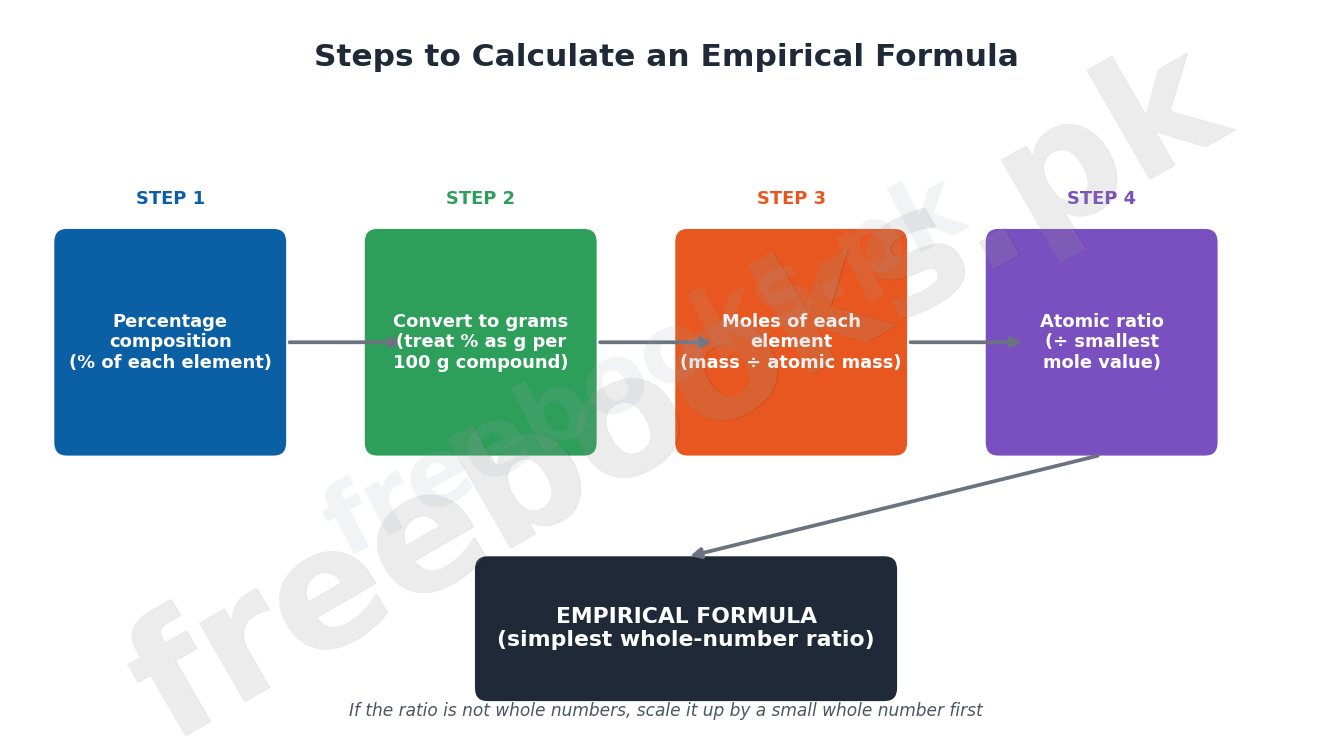
To calculate an empirical formula: find the percentage composition of the compound; convert each element's percentage into grams (treating it as grams per 100 g of compound); divide each mass by that element's atomic mass to get the number of moles; divide every mole value by the smallest one to get the atomic ratio; and if that ratio is not already whole numbers, scale the whole ratio up by a small whole number until it is.
The molecular formula, by contrast, shows the actual number of atoms of each element present in one molecule — for example H2O2 for hydrogen peroxide, rather than its empirical formula HO. It is calculated as molecular formula = n times the empirical formula, where n = molecular mass divided by empirical formula mass.
15.6 Calculations Based on a Balanced Chemical Equation
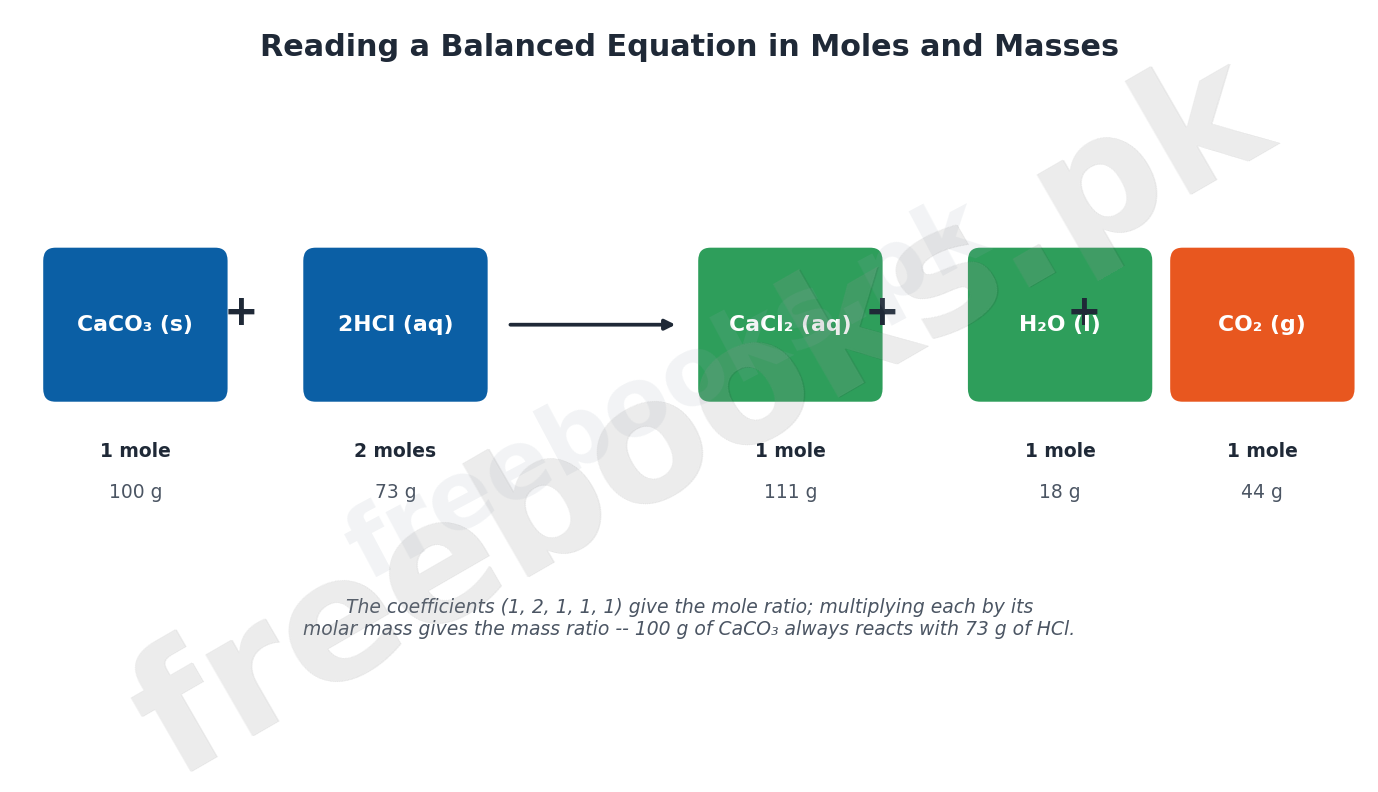
A complete, balanced chemical equation tells us the mole ratio — and therefore the mass ratio — between every reactant and product in a reaction. For example, CaCO3(s) + 2HCl(aq) -> CaCl2(aq) + H2O(l) + CO2(g) tells us that 1 mole (100 g) of calcium carbonate always reacts with 2 moles (73 g) of hydrochloric acid to produce 1 mole (111 g) of calcium chloride, 1 mole (18 g) of water and 1 mole (44 g) of carbon dioxide.
Using this fixed ratio, the mass of any product can be calculated from a given mass of any reactant (or vice versa) by proportion: work out how much product 1 gram of the reactant would give, then scale that up to the actual mass of reactant used. The same logic extends to gas volumes at RTP using the molar volume relationship from section 15.1.
15.7 Limiting Reactant
In real experiments, reactants are rarely mixed in the exact stoichiometric ratio given by the balanced equation. Often one reactant is deliberately supplied in excess, to make sure that another — usually more expensive or more important — reactant is used up completely. The reactant that is consumed first is called the limiting reactant, because it is the one that actually controls, or limits, how much product the reaction can form; the other reactant is left over (in excess) once the reaction stops.
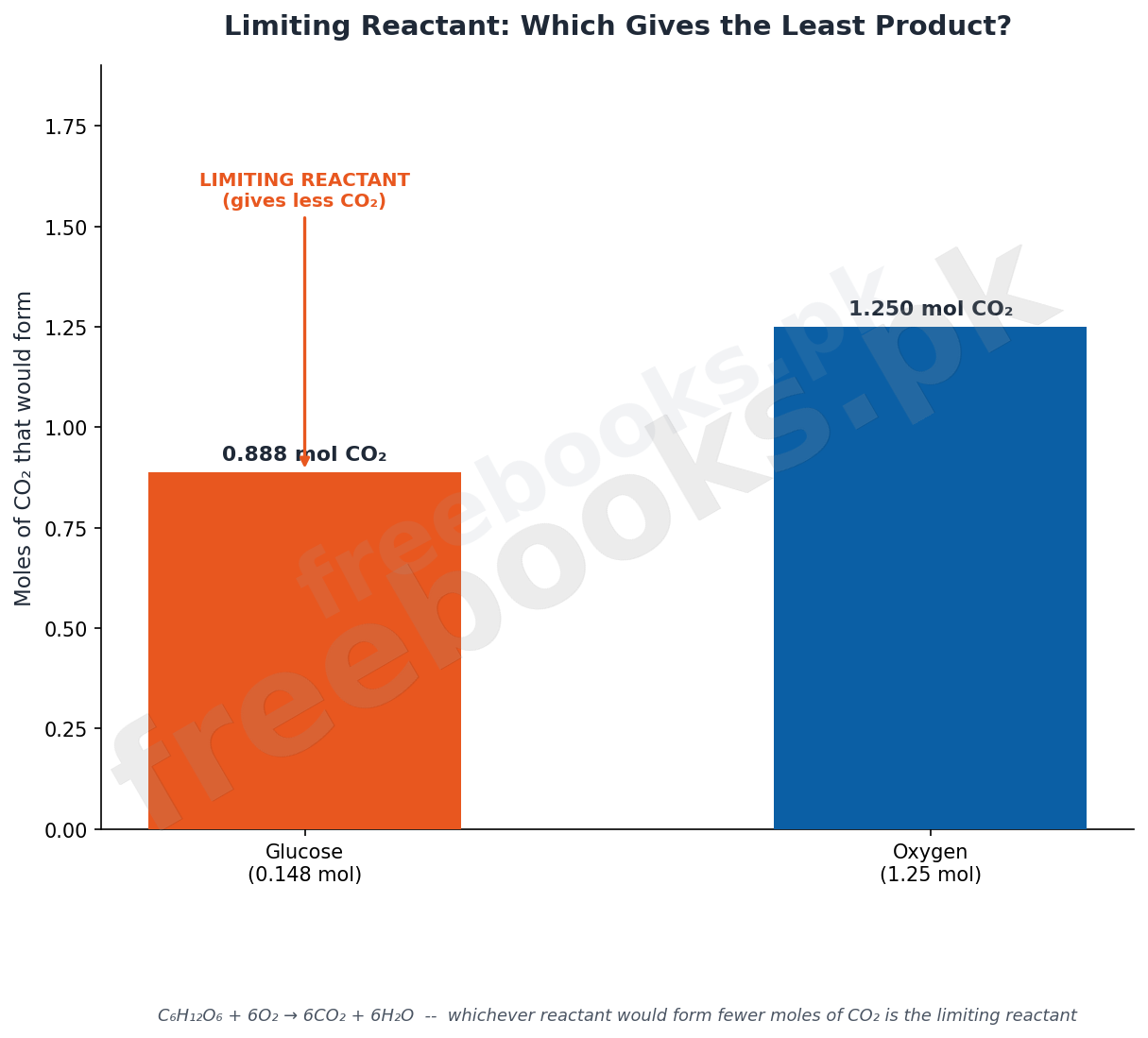
A limiting reactant is identified in three steps: calculate the number of moles of each reactant supplied; calculate, using the balanced equation's mole ratio, how many moles of product each reactant would give if it reacted completely on its own; and identify whichever reactant gives the SMALLER amount of product — that one is the limiting reactant, since it runs out first.
15.8 Percentage Yield and Percentage Purity
The actual yield of a reaction is the quantity of product actually obtained when the reaction is carried out in the laboratory or industry. It is almost always less than the theoretical yield — the amount calculated on paper by assuming every reactant reacts completely and exactly as the balanced equation describes — because of side reactions, incomplete reactions, and losses during handling and purification. Percentage yield expresses how efficient a reaction actually was: percentage yield = (actual yield divided by theoretical yield) times 100.
Percentage purity measures how much of a sample is the substance you actually want, expressed as a percentage of the sample's total mass: percentage purity = (mass of the pure substance divided by total mass of the impure sample) times 100. This matters wherever a sample is not 100% pure — for example, checking how much active drug is present in a pharmaceutical tablet, or how much gold is present in a sample of alloy.
Important Definitions
Define molar volume.
The volume occupied by one mole of any gas at room temperature and pressure (RTP); it equals 24 dm3 for every gas.
What are the standard conditions for RTP?
25 degC (298.15 K) and one atmosphere (760 torr) pressure.
Define concentration of a solution.
The amount of solute dissolved in a given volume of solution, expressed in g/dm3 (mass concentration) or mol/dm3 (molar concentration).
What is molarity?
The concentration of a solution expressed in moles of solute per dm3 of solution (mol/dm3); also called molar concentration.
Define titration.
A technique in which a solution of known concentration is added to a solution of unknown concentration until the reaction between them is just complete (the end point), allowing the unknown concentration to be calculated.
Define percentage composition by mass.
The percentage mass of each element present in a compound, found by dividing the mass of that element by the formula mass of the compound and multiplying by 100.
Define empirical formula.
The formula that shows the simplest whole-number ratio of atoms of each element present in a compound.
Define molecular formula.
The formula that shows the actual number of atoms of each element present in one molecule of a compound.
How is molecular formula related to empirical formula?
Molecular formula = n times the empirical formula, where n = molecular mass divided by empirical formula mass.
Define limiting reactant.
The reactant that is completely consumed first in a chemical reaction, and which therefore controls the amount of product formed.
Define theoretical yield.
The amount of product calculated assuming that all the reactants react completely according to the balanced chemical equation.
Define actual yield.
The quantity of product actually obtained when a chemical reaction is carried out in practice; always less than or equal to the theoretical yield.
Define percentage yield.
The actual yield of a reaction expressed as a percentage of its theoretical yield: (actual yield divided by theoretical yield) times 100.
Define percentage purity.
The mass of the pure substance in a sample expressed as a percentage of the total mass of the impure sample.
Why are ionic compounds written with empirical rather than molecular formulae?
Because ionic compounds do not exist as discrete molecules; their formula only shows the simplest ratio between the ions present, e.g. NaCl or CaCl2.
What does a balanced chemical equation tell you, in stoichiometric terms?
The mole ratio, and therefore the mass ratio, between the reactants and the products of the reaction.
Key Formulas
| Topic | Relation |
|---|---|
| No. of moles of a gas | Volume of gas at RTP / Molar volume (24 dm3) |
| Concentration (mass/volume) | Mass of solute (g) / Volume of solution (dm3) |
| Concentration (molar) | No. of moles of solute / Volume of solution (dm3) |
| Percentage composition of an element | (Mass of element / Formula mass of compound) x 100 |
| Molecular formula | n x Empirical formula, where n = Molecular mass / Empirical formula mass |
| Percentage yield | (Actual yield / Theoretical yield) x 100 |
| Percentage purity | (Mass of pure sample / Total mass of impure sample) x 100 |
Diagrams
Steps to Calculate an Empirical Formula: A flowchart showing the four steps from percentage composition to empirical formula: convert percentages to grams, find moles of each element, divide by the smallest mole value for the atomic ratio, and scale to the simplest whole-number formula.
Reading a Balanced Equation in Moles and Masses: A labelled diagram of CaCO3 + 2HCl -> CaCl2 + H2O + CO2 showing the mole ratio and corresponding mass in grams for each species, illustrating how reacting masses are read directly from a balanced equation.
Limiting Reactant Comparison: A bar-chart comparison showing how much carbon dioxide two reactants (glucose and oxygen) would each give if fully consumed in a photosynthesis-reverse reaction, with the smaller bar identifying the limiting reactant.
Short Questions & Answers
What is the molar volume of a gas at RTP?
The volume occupied by one mole of any gas at room temperature and pressure; it is 24 dm3 for every gas, regardless of its identity.
How is the concept of molar volume useful?
It lets us convert directly between the volume of a gas at RTP and the number of moles (or mass) of that gas, without needing to know its density.
How does molar volume relate to Avogadro's law?
Avogadro's law states that equal volumes of different gases at the same temperature and pressure contain equal numbers of molecules; molar volume follows directly from this, since one mole of any gas — containing the same number of molecules — must occupy the same volume at RTP.
Why may two different compounds show the same empirical formula?
Because an empirical formula shows only the simplest whole-number ratio of atoms, not the actual number of atoms in a molecule; compounds whose molecular formulae are simple multiples of each other, such as C2H2 and C6H6, reduce to the same ratio.
Why is percentage yield important?
It tells a chemist how efficient a reaction actually is in practice compared with the maximum possible (theoretical) yield, which matters for cost, resource use and industrial process design.
What is the concentration, in mol/dm3, of a solution containing 49 g of H2SO4 in one dm3 of solution?
Moles of H2SO4 = 49 / 98 = 0.5 mol; since the volume is exactly 1 dm3, the concentration is 0.5 mol/dm3.
How would you identify the limiting reactant in a reaction?
Calculate the number of moles of each reactant supplied, then calculate how many moles of product each would give according to the balanced equation; the reactant that gives the smaller amount of product is the limiting reactant.
Why is it important to know the purity of a compound used as a medicine?
Because the dose a patient receives depends on how much of the pure active drug the sample actually contains; an impure sample would deliver a weaker or unpredictable dose than intended.
How do you know whether a formula is empirical or molecular?
An empirical formula cannot be reduced to a simpler whole-number ratio, while a molecular formula shows the actual atom count and may be a whole-number multiple of the empirical formula, found using n = molecular mass / empirical formula mass.
Why must a chemical equation be balanced before it is used in stoichiometric calculations?
Because the calculation depends entirely on the mole ratio between reactants and products shown by the equation's coefficients; an unbalanced equation gives the wrong ratio and therefore the wrong answer.
Long Questions & Answers
Explain, with reference to worked calculations, how the empirical formula and then the molecular formula of a compound are determined from its percentage composition by mass.
Why must percentage composition be converted into a mole ratio rather than used directly?
Percentage composition gives the ratio of masses of the elements present, but a chemical formula is a ratio of atoms (or moles), not masses; dividing each element's percentage (taken as grams per 100 g of compound) by its atomic mass converts the mass ratio into a mole ratio, which is what a formula actually represents.
How is the mole ratio converted into the empirical formula?
Each element's number of moles is divided by the smallest number of moles among the elements present, giving the simplest ratio relative to that element; if this ratio comes out as whole numbers, it is used directly as the subscripts in the empirical formula, and if not, the whole ratio is scaled up by a small whole number until it does.
Why can the empirical formula alone not identify a compound uniquely?
Because it only records a simplified ratio of atoms, so unrelated compounds whose molecular formulae are whole-number multiples of each other — such as acetylene C2H2 and benzene C6H6 — reduce to exactly the same empirical formula, CH.
How is the molecular formula calculated once the empirical formula is known?
The compound's molar mass is divided by its empirical formula mass to give n, the number of empirical formula units in one molecule; the molecular formula is then obtained by multiplying every subscript in the empirical formula by n.
Explain how a balanced chemical equation is used to identify the limiting reactant in a reaction, and how percentage yield is then calculated for the product obtained.
What information does a balanced chemical equation provide for these calculations?
It gives the exact mole ratio in which reactants combine and products form, shown by the coefficients in front of each formula; this ratio is the basis for converting between moles, masses and, for gases, volumes of any species in the reaction.
Why does a reaction usually have a limiting reactant?
Reactants are rarely mixed in the exact stoichiometric ratio given by the equation; often one reactant is deliberately supplied in excess so that a more expensive or important reactant is used up completely, leaving the excess reactant left over at the end.
What are the steps used to identify which reactant is limiting?
Convert the given mass of each reactant into moles; use the mole ratio from the balanced equation to calculate how many moles of product each reactant would produce if it reacted completely; the reactant that would give the smaller amount of product is the limiting reactant, since it runs out first and stops the reaction.
How is percentage yield calculated once the theoretical yield is known?
The theoretical yield — the maximum product possible from the limiting reactant according to the equation — is compared with the actual yield obtained experimentally, using percentage yield = (actual yield / theoretical yield) x 100; the percentage yield is always at or below 100% because side reactions, incomplete reactions and losses during handling reduce the actual amount recovered.
Multiple Choice Questions (MCQs)
One mole of any gas at room temperature and pressure (RTP) occupies a volume of: (A) 11.2 dm3 (B) 22.4 dm3 (C) 24 dm3 (D) 32 dm3
Correct answer: (C) 24 dm3. At RTP (25 degC, 1 atm), molar volume is 24 dm3 for every gas, regardless of its identity or mass.
What is the concentration, in g/dm3, of a solution containing 1.8 g of HCl dissolved in 500 cm3 of solution? (A) 0.9 g/dm3 (B) 1.8 g/dm3 (C) 3.6 g/dm3 (D) 9.0 g/dm3
Correct answer: (C) 3.6 g/dm3. Volume = 500/1000 = 0.5 dm3; concentration = 1.8 divided by 0.5 = 3.6 g/dm3.
Which formula shows the actual number of atoms of each element present in one molecule of a compound? (A) Empirical formula (B) Molecular formula (C) Structural formula (D) Ionic formula
Correct answer: (B) Molecular formula. The molecular formula gives the true atom count in a molecule; the empirical formula only gives the simplest whole-number ratio.
Acetylene (C2H2) and benzene (C6H6) share the same: (A) molecular formula (B) molar mass (C) empirical formula (D) boiling point
Correct answer: (C) empirical formula. Both reduce to the simplest ratio CH, even though their molecular formulae and molar masses differ.
In a reaction where reactants are not mixed in exact stoichiometric proportions, the reactant consumed completely first is called the: (A) excess reactant (B) limiting reactant (C) catalytic reactant (D) theoretical reactant
Correct answer: (B) limiting reactant. The limiting reactant runs out first and therefore controls (limits) how much product can form.
If the actual yield of a reaction is 0.198 g and the theoretical yield is 0.220 g, the percentage yield is closest to: (A) 90% (B) 80% (C) 95% (D) 100%
Correct answer: (A) 90%. Percentage yield = (0.198 / 0.220) x 100, which is approximately 90%.
Percentage purity of a sample is calculated using: (A) actual yield / theoretical yield x 100 (B) mass of pure sample / total mass of sample x 100 (C) mass of element / formula mass x 100 (D) moles of solute / volume in dm3
Correct answer: (B) mass of pure sample / total mass of sample x 100. Percentage purity compares the mass of the pure substance present with the total mass of the impure sample.
A compound has an empirical formula CH2O and a molar mass of 180 g/mol. Its molecular formula is: (A) CH2O (B) C2H4O2 (C) C6H12O6 (D) C3H6O3
Correct answer: (C) C6H12O6. Empirical formula mass of CH2O = 30; n = 180/30 = 6, so the molecular formula is 6x(CH2O) = C6H12O6, which is glucose.
The unit mol/dm3 describes a solution's: (A) mass concentration (B) molar concentration (C) percentage purity (D) percentage yield
Correct answer: (B) molar concentration. mol/dm3 (moles of solute per dm3 of solution) is the unit of molar concentration, or molarity.
In a titration used to find an unknown concentration, which piece of information is NOT required? (A) the balanced equation for the reaction (B) the volumes of both solutions used (C) the concentration of the known solution (D) the colour of the solutions
Correct answer: (D) the colour of the solutions. The calculation needs the balanced equation, both volumes, and the known concentration — the colour of the solutions plays no role in the stoichiometric calculation itself.
Quick Revision Summary
- Molar volume: 1 mole of any gas occupies 24 dm3 at RTP (25 degC, 1 atm) — no. of moles = volume at RTP / 24.
- Concentration: g/dm3 = mass of solute / volume of solution in dm3; mol/dm3 (molarity) = moles of solute / volume of solution in dm3.
- Titration calculations need the balanced equation, both volumes, and one known concentration to find the other.
- Percentage composition = (mass of element / formula mass of compound) x 100.
- Empirical formula = simplest whole-number atom ratio; Molecular formula = n x empirical formula, n = molar mass / empirical formula mass.
- A balanced equation gives the mole ratio (and mass ratio) between reactants and products — always balance first.
- Limiting reactant: found by comparing the amount of product each reactant would give — the smaller amount identifies the limiting reactant.
- Percentage yield = (actual / theoretical) x 100; Percentage purity = (mass of pure sample / total mass of sample) x 100.
Exam Tips
- Always convert volumes from cm3 to dm3 (divide by 1000) before using them in a concentration or titration formula.
- When finding an empirical formula, always divide by the SMALLEST number of moles, not by any other value, to get the atomic ratio.
- Check that a chemical equation is balanced before using its coefficients for any mole or mass calculation.
- To find the limiting reactant, compare the amount of PRODUCT each reactant would give — not just the number of moles of each reactant.
- Remember percentage yield and percentage purity are always 100% or less — if your answer exceeds 100%, recheck your calculation.
- Practice converting cleanly between percentage composition, empirical formula and molecular formula — this progression appears frequently as a multi-part numerical question.