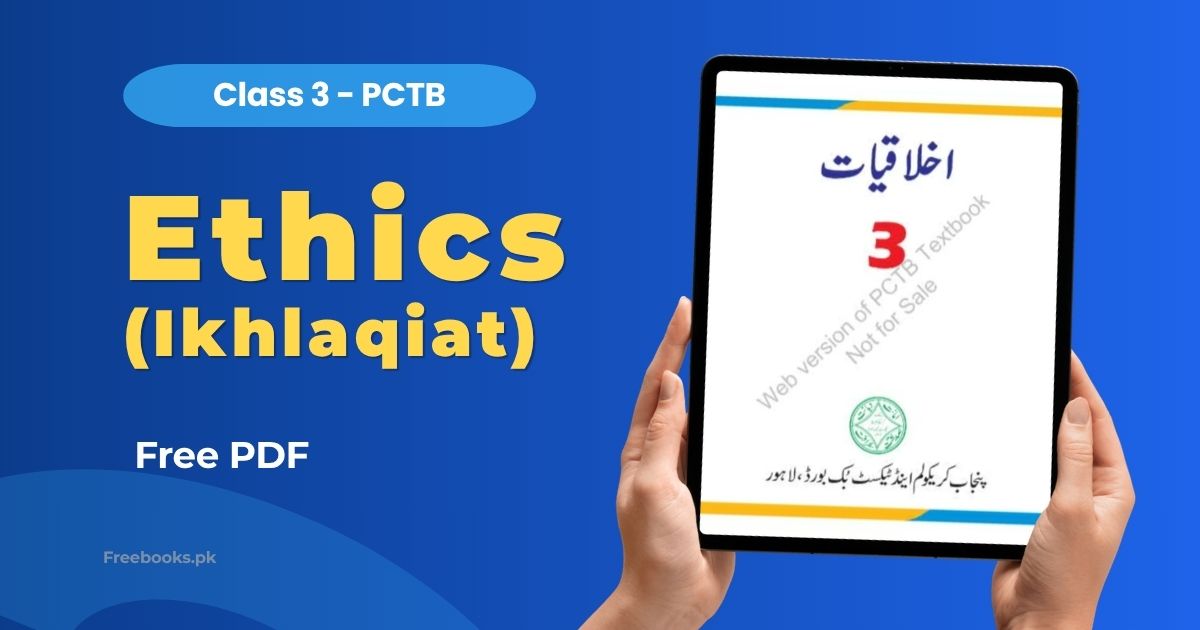
Ethics (Ikhlaqiat) for Class 3 is part of the Punjab Curriculum and Textbook Board (PCTB) syllabus for students who study Ethics instead of Islamiat. This page covers all 3 chapters of the book, from the history of early religions to religious values and the story of Hazrat Ibrahim (AS).
For Class 3 students, this book uses simple stories and classroom dialogues between children, teachers, and parents to explain right and wrong rather than long definitions. Each chapter summary and its important questions on this page make revision quicker before class tests, so key facts stay clear without re-reading the whole chapter.
Book Overview
| Class | 3 |
| Subject | Ethics (Ikhlaqiat) |
| Board | Punjab Curriculum and Textbook Board (PCTB) |
| Edition | 2022 |
| Total Chapters | 3 (+ Glossary) |
| Total Pages | 40 |
| Medium | Urdu |
| Format | PDF (Free Download) |
Chapter List
Chapter 1: Introduction to Early Religions
This chapter, told through a dialogue between a student named Yousaf, his mother, and his teacher, explains two views on how religion began: the evolutionary view, where early humans worshipped natural forces like the sun, rain, and thunder out of fear, and the revealed view, where God guided humanity from Hazrat Adam onward. It covers nature worship, the sky god known as Zeus to the Greeks and Jupiter to the Romans, the earth goddess Demeter, and the Egyptian earth god Geb, along with why ancient people worshipped trees, animals, mountains, and fire.
Important Questions:
- What are the two concepts about the origin of religion described in this chapter? Answer: The evolutionary concept and the revealed (Aasmani) concept.
- What was the sky god called by the Greeks and the Romans? Answer: Zeus by the Greeks, and Jupiter by the Romans.
- What was the name of the earth goddess in Greek stories, and what was she connected to? Answer: Demeter, connected to corn, grain, and the harvest.
- Why did ancient people worship fire, according to this chapter? Answer: They believed it protected them from cold and kept dangerous animals away.
Chapter 2: Religious Ethics and Manners
This chapter explains that every religion is built on ethics, teaching good deeds like honesty, keeping promises, and respecting elders while forbidding evils like lying and injustice. Through short classroom stories, it covers respect for human life, caring for plants and animals, human equality regardless of religion or wealth, self-respect, the value of education, and personal habits like cleanliness, exercise, and keeping the environment clean by planting trees and avoiding litter.
Important Questions:
- What is the foundation of every religion, according to this chapter? Answer: Ethics (akhlaq).
- In the story of Naila, what lesson does the teacher give the class? Answer: That every person deserves respect, whether rich or poor.
- What does self-respect (izzat-e-nafs) mean, according to this chapter? Answer: Protecting one’s own dignity and standing in society through patience and self-restraint.
- Name two ways this chapter suggests to keep the environment clean. Answer: Planting trees, and not throwing household waste outside.
Chapter 3: Introduction to Hazrat Ibrahim (AS)
This chapter tells the story of Hazrat Ibrahim (AS), a prophet born in the town of Ur in Iraq, whose people worshipped idols and stars. It covers his call to Tawheed, breaking the idols and leaving the largest one untouched to expose their powerlessness, his exile from his homeland and journeys through Haran and Palestine to Egypt, being thrown into a fire by King Nimrod that Allah made cool and safe, and his willingness to sacrifice his son on Allah’s command, which is remembered every year on Eid-ul-Adha.
Important Questions:
- In which town was Hazrat Ibrahim (AS) born, according to this chapter? Answer: Ur, in Iraq.
- What did Hazrat Ibrahim (AS) do to the idols, and why did he leave the largest one untouched? Answer: He broke them, leaving the largest idol untouched so his people would realise the idols had no power to act.
- What happened when King Nimrod had Hazrat Ibrahim (AS) thrown into a fire? Answer: Allah commanded the fire to become cool and safe, and he came out unharmed.
- What event from Hazrat Ibrahim’s (AS) life is remembered every year on Eid-ul-Adha? Answer: His willingness to sacrifice his son on Allah’s command.
Download Ethics (Ikhlaqiat) Class 3 PDF
Click the button below to download the free PDF of Ethics (Ikhlaqiat) Class 3 for Punjab Board (PCTB).
Who Should Read This
This book is meant for Class 3 students who study Ethics instead of Islamiat under the Punjab Board (PCTB) syllabus. Parents and tutors helping with homework or early exam preparation will also find the chapter summaries and important questions useful for quick revision.
Applicable Boards
This book is designed for the Punjab Curriculum and Textbook Board (PCTB). Students from other boards with a similar Class 3 Ethics syllabus can use this book too.
FAQs
Is this Ethics book for Class 3 students only?
Yes, this book is designed for Class 3 students who study Ethics under the Punjab Board (PCTB) syllabus.
Can other students use this book?
Yes, students from other boards with a similar Class 3 Ethics syllabus can also use it.
Is this the latest edition?
Yes, this is the 2022 edition approved by the Punjab Curriculum and Textbook Board.
Does the PDF include all 3 chapters?
Yes, the PDF covers all 3 chapters of the book, plus the glossary.
Is the download free?
Yes, the PDF download is completely free.
Does this book include exercises and questions?
Yes, each chapter includes exercises, and this page also lists important questions with short answers for quick revision.
Related Books
- Urdu Class 3 SNC PDF Download – Punjab Board (PCTB)
- General Knowledge Class 3 SNC PDF Download – Punjab Board (PCTB)
- Ethics (Ikhlaqiat) Class 4 SNC PDF Download – Punjab Board (PCTB)
- Ethics (Ikhlaqiat) Class 5 SNC PDF Download – Punjab Board (PCTB)
Related Books
© Copyright Policy
Freebooks.pk is an educational resource for students in Pakistan. Textbooks and other books belong to their respective boards, authors and publishers, and all rights remain with them. If you are the copyright holder of any material on this page and want it changed or removed, please contact us or file a request under our DMCA policy. We review every request and remove reported content promptly.