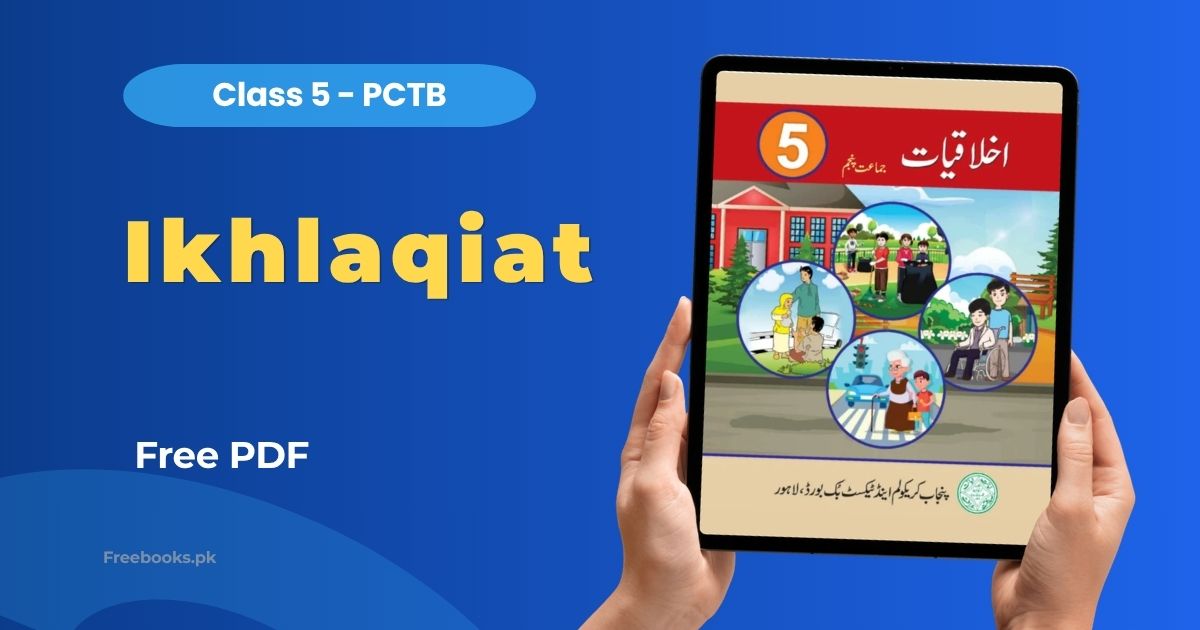
Class 5 students in Punjab who take Ethics instead of Islamiat continue this subject from Class 4 as part of the SNC 2020 syllabus set by the Punjab Curriculum and Textbook Board (PCTB). This book goes deeper into world religions, looks closely at Judaism, Christianity, and Islam, and teaches values like respect for neighbours, elders, and time.
For Class 5 students, this book prepares them for their annual exams with clear explanations instead of dense theory. Each unit builds on real teachings and stories from different faiths, which makes revision easier and helps students recall important facts, commandments, and figures covered in the syllabus.
Book Overview
| Class | 5 |
| Subject | Ethics (Ikhlaqiat) |
| Category | Class 1-5 |
| Board | Punjab Curriculum and Textbook Board (PCTB) |
| Curriculum | SNC 2020 |
| Total Chapters | 4 Units (+ Glossary + Bibliography) |
| Total Pages | 58 |
| Format |
Chapter List
Unit 1: Mazhab Ka Taaruf (Introduction to Religion)
This unit explains the meaning of religion and its three basic elements: belief, rituals, and ethics, along with how ancient people worshipped nature before the concept of one God spread. It then profiles the great prophets: Hazrat Adam (AS), Hazrat Nuh (AS) and the flood, Hazrat Ibrahim (AS) and his covenant with God, Hazrat Yaqoob (AS) and his twelve sons, Hazrat Musa (AS) and the exodus from Egypt, Hazrat Isa (AS), and Hazrat Muhammad (PBUH), the final Prophet.
Important Questions:
- What are the three basic elements of every religion? Answer: Belief (Aqeedah), rituals (Rusoom), and ethics (Akhlaqiyat).
- Which prophet built an ark to survive the great flood? Answer: Hazrat Nuh (AS).
- Whom was Hazrat Ibrahim (AS) commanded to sacrifice as a test of obedience? Answer: His son, whom he was ready to sacrifice for God.
- Who is the final Prophet in Islam? Answer: Hazrat Muhammad (PBUH), known as Khatam-un-Nabiyyeen.
Unit 2: Aalmi Mazahib (World Religions: Judaism, Christianity and Islam)
This unit compares three major world religions. Judaism is explained through Hazrat Musa (AS) and the Ten Commandments given in the Torah. Christianity covers the life of Jesus Christ, his miracles, and the Sermon on the Mount with its list of blessings. Islam covers the basic beliefs, the five pillars, key ethical teachings, and the importance of the Farewell Sermon (Khutbah Hajjatul Wida) delivered by Prophet Muhammad (PBUH).
Important Questions:
- How many commandments did God give to Hazrat Musa (AS)? Answer: Ten commandments, recorded in the Torah.
- What is the Sermon on the Mount? Answer: A teaching given by Jesus Christ on a mountain, including the Beatitudes such as “Blessed are the peacemakers.”
- What are the five pillars of Islam? Answer: Faith in God and His Prophet, Salah, Zakat, Sawm, and Hajj.
- What is the Khutbah Hajjatul Wida? Answer: The Farewell Sermon of Prophet Muhammad (PBUH), often called the charter of humanity.
Unit 3: Akhlaqi Iqdaar (Ethical Values)
This unit covers six practical values: respecting neighbours (citing the Hadith that a neighbour’s rights extend forty houses in every direction), respecting elders, respecting other religions and their places of worship, keeping the environment clean, helping others including classmates, people with disabilities, and the needy, and the importance of punctuality in nature, studies, work, and worship across different religions.
Important Questions:
- How far does a neighbour’s right extend, according to a Hadith? Answer: Forty houses in every direction.
- Name two ways to show respect to elders. Answer: Speaking to them politely and not raising your voice in front of them.
- Give one way students can help their classmates. Answer: Helping weak or poor classmates with books, fees, or lessons.
- Why is punctuality important? Answer: Because success depends on valuing time, and even nature, such as sunrise and the seasons, follows a fixed schedule.
Unit 4: Shakhsiyat (Personalities)
This unit profiles two figures. Hazrat Dawood (AS) was a prophet and king who ruled with justice for about 40 years, defeated Jalut (Goliath), and was given the book Zabur along with a beautiful voice. Saint Paul, originally a persecutor of Christians named Saul, later became one of Christianity’s leading missionaries, spreading its teachings through long journeys and letters written to communities across the Roman world before his death in Rome.
Important Questions:
- What holy book was given to Hazrat Dawood (AS)? Answer: The Zabur (Psalms).
- Whom did Hazrat Dawood (AS) defeat in battle? Answer: Jalut (Goliath).
- What was Saint Paul’s original name? Answer: Saul (Shaul).
- How did Saint Paul spread Christianity? Answer: Through long journeys and letters written to churches across the Roman world.
Download Section
Click the button below to download the Ethics (Ikhlaqiat) Class 5 PDF for free and start your revision today.
Who Should Read This
This PDF is meant for Class 5 students who study Ethics instead of Islamiat under the Punjab Board (PCTB), following the SNC 2020 curriculum. It is also useful for parents and teachers who want a quick, unit-wise overview of what students need to know before their annual exams.
Applicable Boards
This book is officially prescribed by the Punjab Curriculum and Textbook Board (PCTB) for Class 5 students. Since the SNC 2020 syllabus is shared across provinces, students following a similar Ethics syllabus in other boards may also find this PDF useful for revision.
Is this PDF for Class 5 students only?
Yes, this PDF is designed for Class 5 Ethics students following the Punjab Board (PCTB) SNC 2020 syllabus.
Can other students use this book?
Yes, students from other boards following a similar Ethics syllabus can also use this PDF for revision.
Is this the latest edition?
Yes, this PDF is based on the latest SNC 2020 edition prescribed by the Punjab Curriculum and Textbook Board.
Does it include solved exercises or important questions?
Yes, each unit includes a short summary along with important questions and answers for quick revision.
How many chapters does this book have?
The book has 4 units, plus a glossary and bibliography, covering introduction to religion, world religions, ethical values, and important personalities.
Is the download free?
Yes, the Ethics Class 5 PDF is completely free to download.
Related Books
© Copyright Policy
Freebooks.pk is an educational resource for students in Pakistan. Textbooks and other books belong to their respective boards, authors and publishers, and all rights remain with them. If you are the copyright holder of any material on this page and want it changed or removed, please contact us or file a request under our DMCA policy. We review every request and remove reported content promptly.