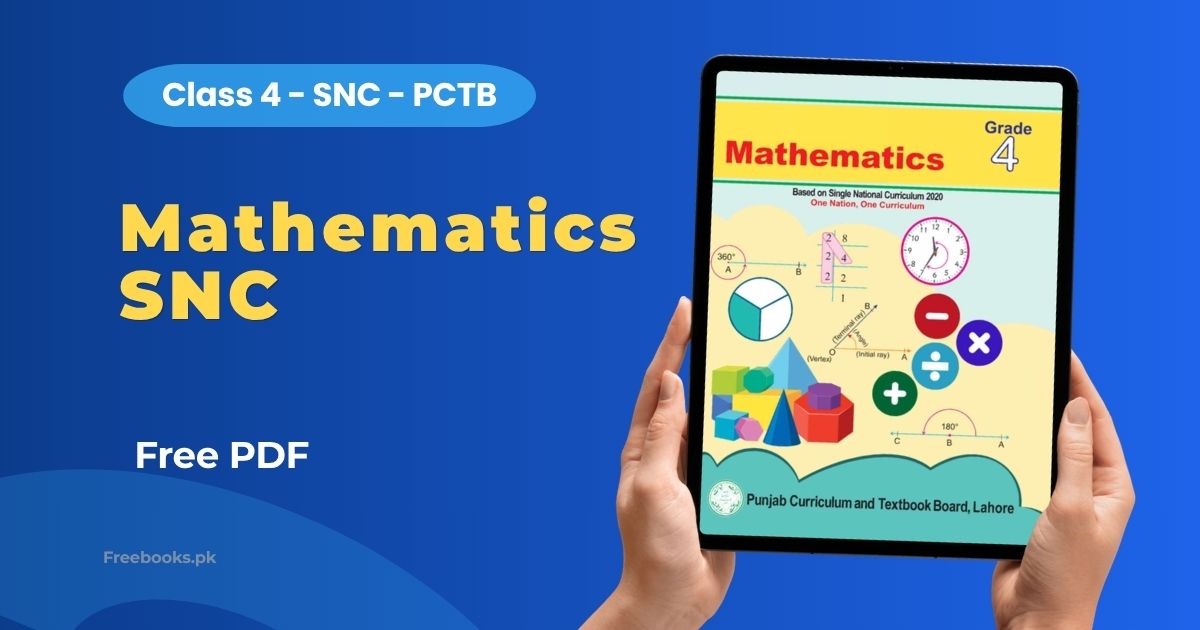
Mathematics for Class 4 is part of the official Punjab Curriculum and Textbook Board (PCTB) syllabus, based on the Single National Curriculum (SNC) 2020. This page covers all 7 units of the book, from whole numbers and fractions to geometry, measurements, and data handling.
For Class 4 students, this book builds the number sense and problem-solving skills needed for higher classes. Each unit here has a short summary and important questions with answers, so revision before class tests is quicker and more focused.
Book Overview
| Class | 4 |
| Subject | Mathematics |
| Board | Punjab Curriculum and Textbook Board (PCTB) |
| Curriculum | Single National Curriculum (SNC) 2020 |
| Total Units | 7 |
| Total Pages | 186 |
| Format | PDF (Free Download) |
Chapter List
Unit 1: Whole Numbers, Addition, Subtraction, Multiplication, Division and Patterns
This large unit teaches students to read, write, and compare whole numbers up to one hundred thousand using place value charts and expanded form, along with ordering numbers in ascending and descending order. It covers addition and subtraction of numbers up to 5 digits, multiplication of numbers up to 5 digits by numbers up to 3 digits, and division of numbers up to 4 digits by numbers up to 2 digits, all through real-life word problems. The unit ends with number patterns, teaching students to find the rule of an increasing or decreasing sequence and complete it.
Important Questions:
- What is the place value of ‘6’ in 69,273? Answer: 6 is at the ten thousands place, so its place value is 60,000.
- What is the smallest 6-digit whole number? Answer: 100,000, formed by adding 1 to the greatest 5-digit number, 99,999.
- How do you divide a 4-digit number by a 2-digit number? Answer: Divide the highest place value digits step by step, subtracting and bringing down the next digit until the remainder is found.
- What is the rule of the pattern 3, 5, 7, 9, 11? Answer: Each term increases by 2, so it is an addition pattern.
Unit 2: Factors and Multiples
This unit teaches the divisibility rules for 2, 3, 5, and 10, and how to use them to check numbers up to 5 digits. It explains prime and composite numbers, how to find factors of numbers up to 50 and the first ten multiples of a 1-digit number, and how to break a number down into its prime factors. Students also learn to find the common prime factors and common multiples of two or more 2-digit numbers.
Important Questions:
- What is the divisibility rule for 3? Answer: If the sum of all the digits of a number is divisible by 3, the number itself is divisible by 3.
- What is a prime number? Answer: A number greater than 1 that has exactly two factors, 1 and itself.
- Find the prime factorization of 30. Answer: 2 x 3 x 5.
- Find the first common multiple of 6 and 8. Answer: 24.
Unit 3: Fractions
This unit covers like and unlike fractions, comparing unlike fractions by converting them to equivalent fractions, and simplifying fractions to their lowest form. It explains unit, proper, and improper fractions and mixed numbers, along with converting between improper fractions and mixed numbers and arranging fractions in ascending or descending order. Students also practice adding and subtracting like fractions, and multiplying and dividing fractions and mixed numbers by whole numbers and by other fractions.
Important Questions:
- What are like fractions? Answer: Fractions that have the same denominator.
- How do you write a fraction in its lowest form? Answer: Divide the numerator and denominator by their common factor.
- Convert 7/3 into a mixed number. Answer: 2 and 1/3.
- Multiply 5/6 by 90. Answer: 75.
Unit 4: Decimals
This unit introduces decimals as another way of writing fractions with denominators of 10, 100, or 1000, covering place value up to three decimal places and conversion between fractions and decimals. It teaches addition, subtraction, multiplication, and division of decimals, including multiplying by 10, 100, and 1000, and solving real-life problems with money, distance, and quantities. The unit closes with estimation, rounding whole numbers to the nearest 10, 100, or 1000, and rounding decimals to the nearest whole number.
Important Questions:
- How do you write 3/10 as a decimal? Answer: 0.3, read as “zero point three.”
- What is 1.75 in expanded form? Answer: 1 + 7/10 + 5/100, or 1 + 0.7 + 0.05.
- How do you multiply a decimal by 100? Answer: Move the decimal point two places to the right.
- Round off 2.45 to the nearest whole number. Answer: 2, since the digit after the decimal point is less than 5.
Unit 5: Measurements (Length, Mass, Capacity and Time)
This unit teaches standard metric units for length, mass, and capacity, and how to convert larger units into smaller ones, such as kilometres into metres, kilograms into grams, and litres into millilitres, along with adding and subtracting these measures. It also covers reading time on analog and digital clocks in both 12-hour and 24-hour formats, converting hours into minutes and seconds, and converting years into months, months into days, and weeks into days, plus adding and subtracting time.
Important Questions:
- How many metres are there in 27 km? Answer: 27,000 metres.
- What is the mass of 1.5 kg in grams? Answer: 1,500 grams.
- How do you convert 8 hours into minutes? Answer: Multiply the hours by 60, giving 480 minutes.
- How many days are there in 6 weeks? Answer: 42 days.
Unit 6: Geometry
This unit covers parallel and non-parallel lines, how angles are formed where two lines intersect, and how to measure and construct angles using a protractor. It explains acute, right, and obtuse angles, the parts of a circle (radius, diameter, and circumference), and how to find the perimeter and area of 2-D figures on a square grid. The unit also introduces lines of symmetry and compares 3-D shapes like cubes, cuboids, spheres, cylinders, cones, and pyramids by their vertices, edges, and surfaces.
Important Questions:
- What is a right angle? Answer: An angle that measures exactly 90 degrees.
- What is the diameter of a circle? Answer: A line segment that joins two points on a circle and passes through its centre; it is twice the radius.
- How do you find the perimeter of a rectangle on a square grid? Answer: Add the lengths of all four sides.
- How many vertices, edges, and surfaces does a cube have? Answer: 8 vertices, 12 edges, and 6 surfaces.
Unit 7: Data Handling
This unit teaches students to read and interpret data from horizontal and vertical bar graphs, line graphs, and pie charts. It explains how to find maximum and minimum values, compare quantities, and calculate totals and differences from real-life data such as blood groups, temperatures, and daily sales. Students also learn to express parts of a pie chart as a fraction of the whole.
Important Questions:
- What does a bar graph’s scale tell you? Answer: How many units each small square on the graph represents.
- What kind of data does a line graph usually represent? Answer: Data that changes over time, shown by joining points on the graph.
- What is another name for a pie chart? Answer: A circle graph.
- If 400 out of 1250 people chose graphic designing, what fraction is that? Answer: 400/1250, which simplifies to 8/25.
Download Mathematics Class 4 PDF
Click the button below to download the Mathematics Class 4 PDF for free:
Who Should Read This
This book is meant for Class 4 students studying Mathematics under the Punjab Curriculum and Textbook Board’s SNC syllabus. It also builds the number sense and problem-solving base useful for entry test Mathematics sections in later years.
Applicable Boards
This book is published by the Punjab Curriculum and Textbook Board (PCTB) and is the primary Mathematics textbook for Class 4 in Punjab. Since it follows the Single National Curriculum (SNC), students in other provinces and boards using the same SNC syllabus can also refer to this book for their Class 4 Mathematics topics.
FAQs
Is this book for Class 4 students?
Yes, this is the official Mathematics textbook for Class 4 under the Punjab Curriculum and Textbook Board’s Single National Curriculum (SNC).
Can other board students use this book?
Yes. Since this book follows the SNC syllabus used across Pakistan, students from other boards following the same curriculum can also use it for Class 4 Mathematics.
Is this the latest edition?
Yes, this is the current SNC 2020 edition used in Punjab schools.
Does it include exercises and important questions?
Yes, each unit has multiple exercises and a review exercise. This page also lists important questions with short answers for quick revision.
How many units are in this book?
The book has 7 units, covering whole numbers, factors and multiples, fractions, decimals, measurements and time, geometry, and data handling.
Is the PDF free to download?
Yes, the PDF on this page is completely free to download.
Related Books
- English Class 4 SNC PDF Download – Punjab Board (PCTB)
- Urdu Class 4 SNC PDF Download – Punjab Board (PCTB)
- Mathematics Class 5 SNC PDF Download – Punjab Board (PCTB)
- General Science Class 5 SNC PDF Download
Related Books
© Copyright Policy
Freebooks.pk is an educational resource for students in Pakistan. Textbooks and other books belong to their respective boards, authors and publishers, and all rights remain with them. If you are the copyright holder of any material on this page and want it changed or removed, please contact us or file a request under our DMCA policy. We review every request and remove reported content promptly.