
A fraction is simply the quotient of two algebraic expressions, and when both the numerator and denominator are polynomials, the result is called a rational fraction. This short but important unit teaches the reverse of a familiar skill: instead of combining several simple fractions into one complicated fraction (as done when adding fractions with different denominators), partial fractions breaks a single complicated rational fraction back down into a sum of simpler ones — a technique used constantly in calculus (integration), engineering (control systems), and higher algebra.
The unit first distinguishes proper fractions (numerator's degree less than denominator's) from improper fractions (numerator's degree greater than or equal to denominator's), showing that every improper fraction can be reduced by division to a polynomial plus a proper fraction. It then develops four separate rules for resolving a proper fraction into partial fractions, one for each type of factor that can appear in the denominator: non-repeated linear factors, repeated linear factors, non-repeated (irreducible) quadratic factors, and repeated quadratic factors.
Learning Objectives
- Define a fraction, a rational fraction, a proper fraction, and an improper fraction
- Convert an improper fraction into a polynomial plus a proper fraction using long division
- Resolve a fraction into partial fractions when the denominator has non-repeated linear factors
- Resolve a fraction into partial fractions when the denominator has repeated linear factors
- Resolve a fraction into partial fractions when the denominator has non-repeated irreducible quadratic factors
- Resolve a fraction into partial fractions when the denominator has repeated irreducible quadratic factors
Key Concepts
4.1 Fractions: Rational, Proper, and Improper
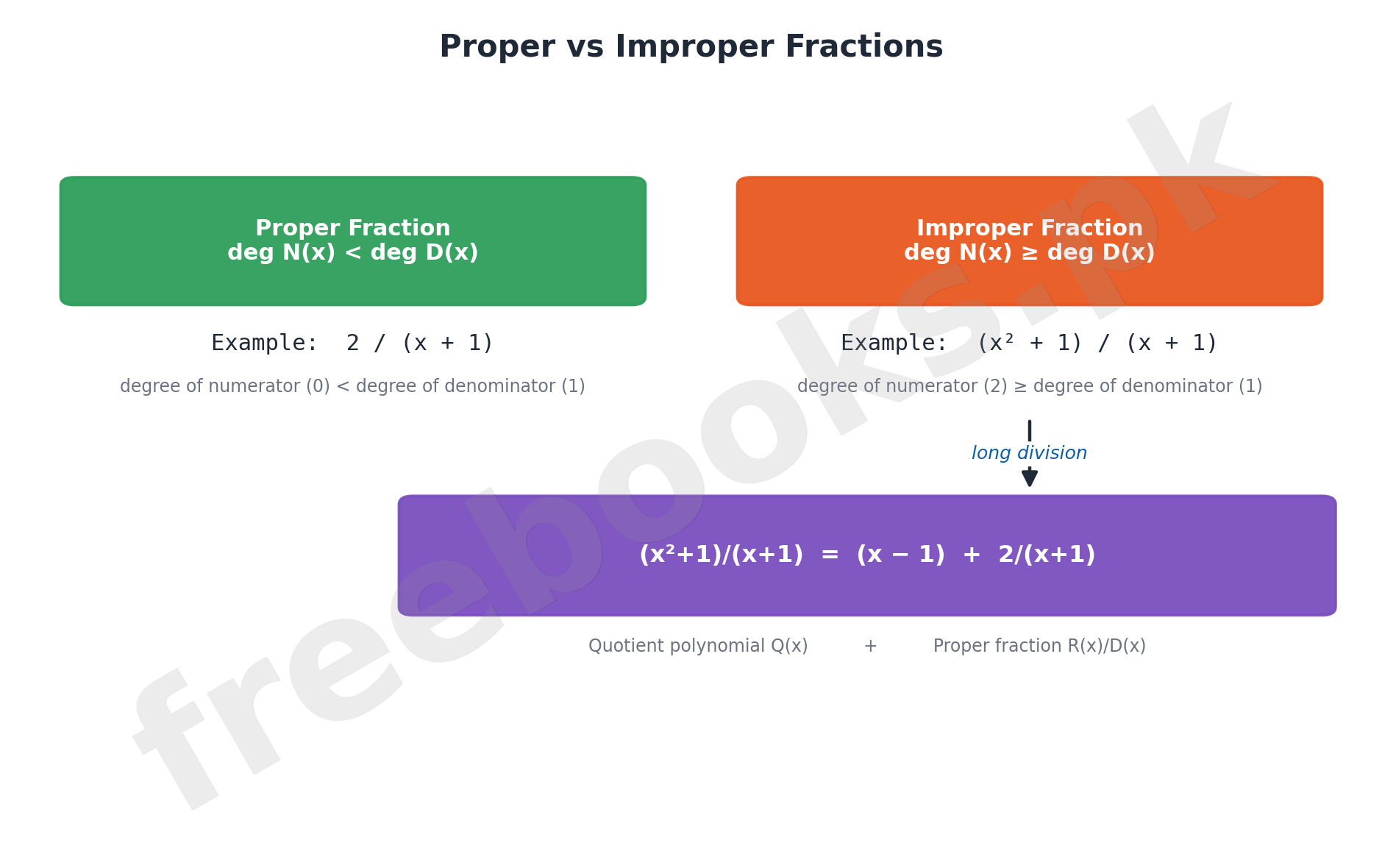
The quotient of two algebraic expressions is a fraction, written with the dividend above a bar and the divisor below it — undefined wherever the divisor equals zero. When both the numerator N(x) and denominator D(x) are polynomials with real coefficients (and D(x) is not zero), the expression N(x)/D(x) is called a rational fraction, e.g. (x^2+3)/((x+1)^2(x+2)). A rational fraction is called proper if the degree of N(x) is LESS than the degree of D(x) (e.g. 2/(x+1)), and improper if the degree of N(x) is GREATER THAN OR EQUAL TO the degree of D(x) (e.g. 5x/(x+2)).
Every improper fraction can be reduced, by ordinary polynomial long division, to the sum of a quotient polynomial Q(x) and a proper fraction R(x)/D(x), where R(x) is the remainder and has a lower degree than D(x): N(x)/D(x) = Q(x) + R(x)/D(x). For example, dividing x^2+1 by x+1 gives quotient x-1 and remainder 2, so (x^2+1)/(x+1) = (x-1) + 2/(x+1). This step must always be done FIRST if a given fraction is improper — partial fraction resolution itself only ever applies to a proper fraction.
4.2 Non-Repeated Linear Factors (Rule I)
If the denominator D(x) factors into distinct (non-repeated) linear factors, (a1x+b1)(a2x+b2)…(anx+bn), then the proper fraction N(x)/D(x) can be written as a sum of simple fractions, one per linear factor: A1/(a1x+b1) + A2/(a2x+b2) + … + An/(anx+bn), where each Ai is a constant to be found. To find the constants, multiply both sides by the full denominator D(x) to clear all fractions, producing a polynomial identity that holds for every value of x.
The fastest way to find each constant is the 'zero method': substitute the value of x that makes ONE particular linear factor zero (e.g. x=4 for the factor x-4) into the cleared identity — every term containing a different factor vanishes, leaving an equation with only that factor's constant, which can be solved immediately. Repeating this for each factor's root finds every constant one at a time, without ever needing to solve a system of equations.
4.3 Repeated Linear Factors (Rule II)
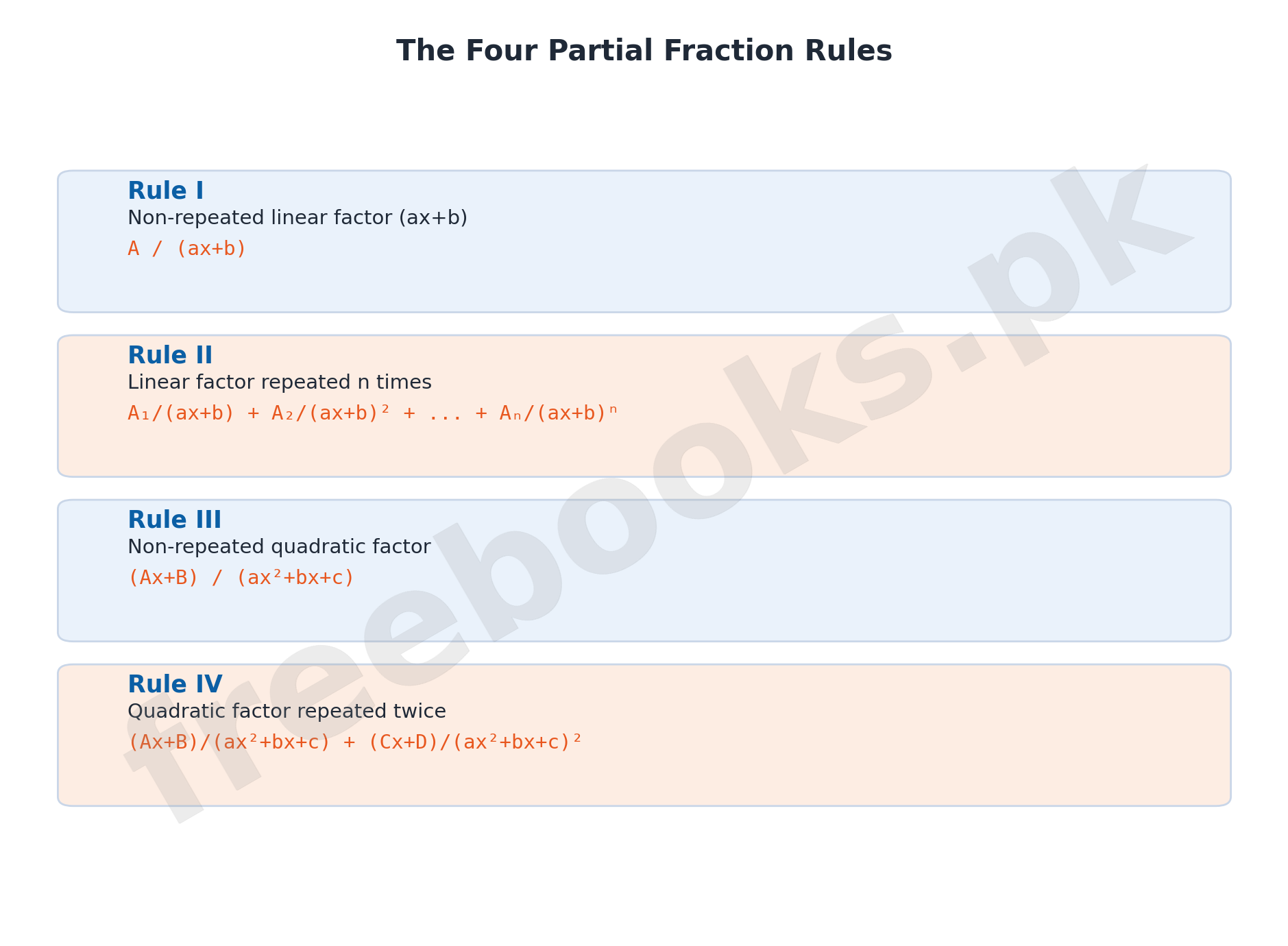
If a linear factor (ax+b) occurs n times in the denominator (n is at least 2), it contributes NOT ONE but n separate partial fractions, with increasing powers of (ax+b) in each denominator: A1/(ax+b) + A2/(ax+b)^2 + … + An/(ax+b)^n, where A1 through An are constants to be found. This reflects the fact that a repeated root needs more 'degrees of freedom' in the partial fraction decomposition than a single occurrence would.
After multiplying through by the full denominator to clear fractions, the zero method still finds the constant attached to the HIGHEST power directly (substituting the repeated factor's root eliminates every other term). The remaining constants (for the lower powers of that same factor, and for any other distinct factors) are then found either by substituting other convenient values of x or by comparing coefficients of matching powers of x on both sides of the identity.
4.4 Non-Repeated Quadratic Factors (Rule III)
If an irreducible quadratic factor (ax^2+bx+c) — one that cannot be factored further into real linear factors — occurs ONCE in the denominator, its partial fraction takes the form (Ax+B)/(ax^2+bx+c), with a LINEAR expression (not just a constant) in the numerator, since a quadratic denominator generally needs two independent constants (A and B) to match.
The solving procedure again starts by clearing all fractions through multiplication by the full denominator. Since a quadratic factor has no real root to substitute directly (the zero method doesn't fully apply to it), any real roots from OTHER linear factors present are substituted first to find their constants quickly, and the remaining unknowns (A and B for the quadratic term) are found by comparing coefficients of matching powers of x (e.g. x^2, x^1, x^0) on both sides of the cleared identity.
4.5 Repeated Quadratic Factors (Rule IV)
If an irreducible quadratic factor (ax^2+bx+c) occurs TWICE in the denominator, it contributes two partial fractions with increasing powers of the quadratic in the denominator, each with a linear numerator: (Ax+B)/(ax^2+bx+c) + (Cx+D)/(ax^2+bx+c)^2, where A, B, C, D are four constants to be found — combining the 'repeated factor needs more terms' idea from Rule II with the 'quadratic factor needs a linear numerator' idea from Rule III.
As with the other rules, the general method is: clear all fractions by multiplying through by the full denominator, substitute any real roots available from other linear factors to find their constants immediately, then compare coefficients of matching powers of x for the remaining unknowns. This four-rule system (combining repeated/non-repeated with linear/quadratic) covers every possible type of denominator factorization that can appear in this course.
Important Definitions
What is a rational fraction?
An expression N(x)/D(x) where N(x) and D(x) are polynomials with real coefficients and D(x) is not zero.
What is a proper fraction?
A rational fraction N(x)/D(x) where the degree of N(x) is less than the degree of D(x).
What is an improper fraction?
A rational fraction N(x)/D(x) where the degree of N(x) is greater than or equal to the degree of D(x).
How is an improper fraction converted to a proper fraction?
By polynomial long division: N(x)/D(x) = Q(x) + R(x)/D(x), where Q(x) is the quotient and R(x)/D(x) is a proper fraction (R(x) has lower degree than D(x)).
What partial fraction form corresponds to a non-repeated linear factor (ax+b)?
A single term A/(ax+b), where A is a constant to be found.
What partial fraction form corresponds to a linear factor (ax+b) repeated n times?
n separate terms: A1/(ax+b) + A2/(ax+b)^2 + … + An/(ax+b)^n.
What partial fraction form corresponds to a non-repeated irreducible quadratic factor?
(Ax+B)/(ax^2+bx+c), with a linear expression Ax+B in the numerator.
What partial fraction form corresponds to an irreducible quadratic factor repeated twice?
(Ax+B)/(ax^2+bx+c) + (Cx+D)/(ax^2+bx+c)^2.
What is the 'zero method' for finding partial fraction constants?
Substituting the value of x that makes one particular linear factor zero, which eliminates every other term and isolates that factor's constant directly.
What is an identity in the context of partial fractions?
An equation that holds true for every value of the variable, such as the cleared equation obtained after multiplying both sides of a partial fraction decomposition by the full denominator.
Key Facts and Relations
| Topic | Key Fact / Relation |
|---|---|
| Proper fraction condition | degree N(x) < degree D(x) |
| Improper fraction condition | degree N(x) >= degree D(x) |
| Improper-to-proper reduction | N(x)/D(x) = Q(x) + R(x)/D(x) |
| Rule I (non-repeated linear) | A/(ax+b) |
| Rule II (linear repeated n times) | A1/(ax+b) + A2/(ax+b)^2 + … + An/(ax+b)^n |
| Rule III (non-repeated quadratic) | (Ax+B)/(ax^2+bx+c) |
| Rule IV (quadratic repeated twice) | (Ax+B)/(ax^2+bx+c) + (Cx+D)/(ax^2+bx+c)^2 |
| General method step 1 | Ensure N(x) has lower degree than D(x) (divide first if not) |
| General method step 2 | Multiply both sides by the full denominator (L.C.M.) to clear fractions |
| General method step 3 | Use the zero method and/or compare coefficients of matching powers of x |
Diagrams
Proper vs Improper Fractions: A comparison diagram showing a proper fraction (numerator degree lower) alongside an improper fraction being reduced by long division into a quotient polynomial plus a proper fraction remainder
The Four Partial Fraction Rules: A summary chart listing the four denominator factor types (non-repeated linear, repeated linear, non-repeated quadratic, repeated quadratic) alongside the partial fraction form each rule produces
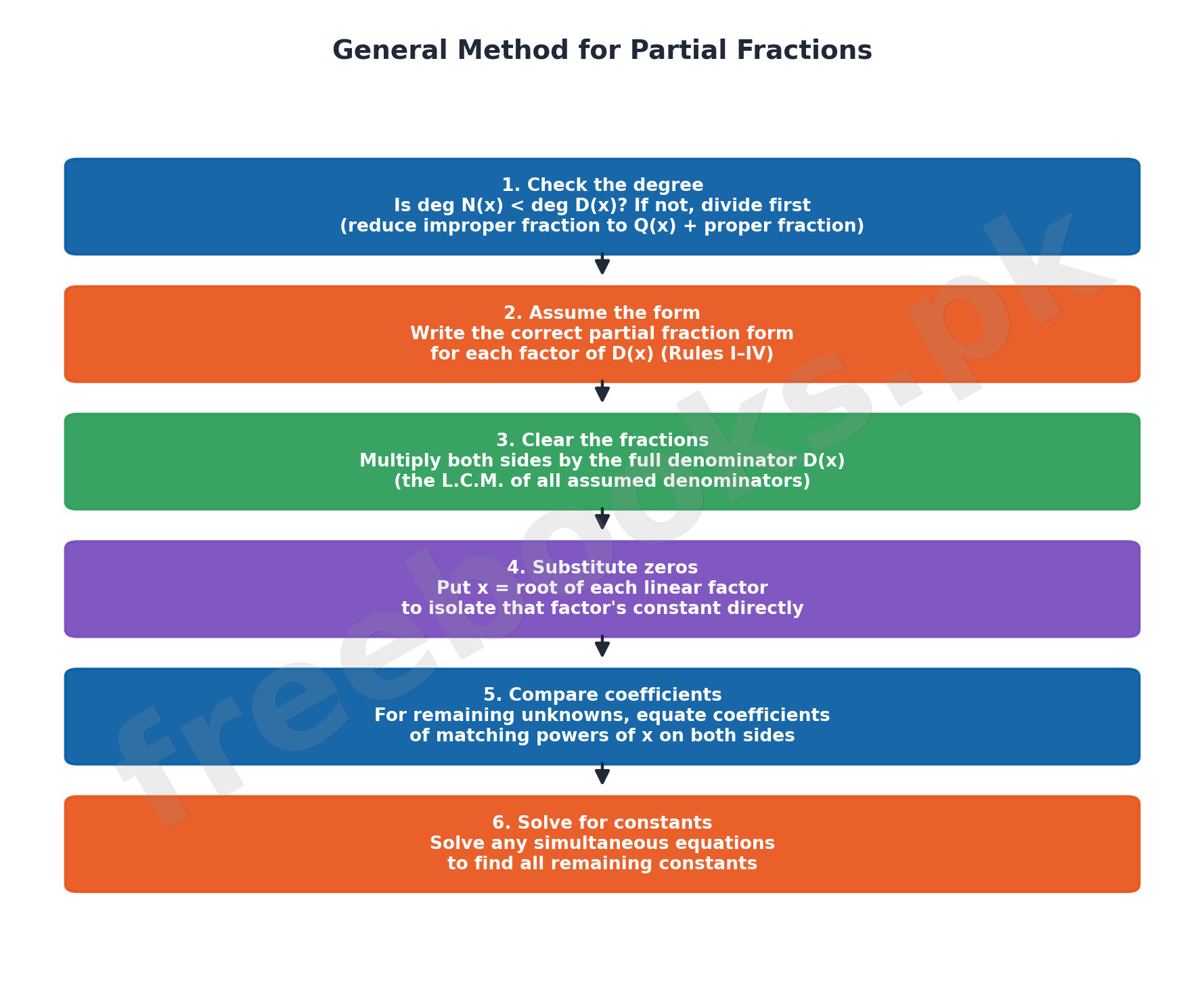
General Method Flow: A flow diagram showing the step-by-step general method for resolving any rational fraction into partial fractions: check degree, multiply by L.C.M., substitute zeros, compare coefficients, solve for constants
Short Questions & Answers
Define a proper fraction.
A rational fraction N(x)/D(x) where the degree of N(x) is less than the degree of D(x).
Define an improper fraction.
A rational fraction N(x)/D(x) where the degree of N(x) is greater than or equal to the degree of D(x).
What form does the partial fraction take for a non-repeated linear factor (ax+b)?
A/(ax+b), where A is a constant to be determined.
What form does the partial fraction take for a non-repeated irreducible quadratic factor?
(Ax+B)/(ax^2+bx+c), with a linear numerator Ax+B.
How many partial fraction terms does a linear factor repeated 3 times produce?
Three terms: A1/(ax+b) + A2/(ax+b)^2 + A3/(ax+b)^3.
What is the first step if the given fraction is improper?
Reduce it by long division into a quotient polynomial plus a proper fraction before applying any partial fraction rule.
Long Questions & Answers
Explain proper and improper fractions, and describe the general method used to resolve any rational fraction into partial fractions.
What is a rational fraction, and how is it classified as proper or improper?
A rational fraction is N(x)/D(x), where N(x) and D(x) are polynomials with real coefficients and D(x) is not zero. It is proper if the degree of N(x) is less than the degree of D(x) (e.g. 2/(x+1)), and improper if the degree of N(x) is greater than or equal to the degree of D(x) (e.g. 5x/(x+2)).
How is an improper fraction converted into a proper fraction?
By polynomial long division: dividing N(x) by D(x) gives a quotient polynomial Q(x) and a remainder R(x) of lower degree than D(x), so N(x)/D(x) = Q(x) + R(x)/D(x). For example, (x^2+1)/(x+1) = (x-1) + 2/(x+1), where x-1 is the quotient and 2/(x+1) is the resulting proper fraction.
What is the first step of the general method for resolving a fraction into partial fractions?
Confirm the fraction is proper (numerator's degree lower than the denominator's); if it is improper, divide first and only apply partial fractions to the resulting proper remainder fraction.
What are the middle steps of the general method?
Assume the correct partial fraction form based on the denominator's factors (linear/quadratic, repeated/non-repeated), then multiply both sides by the full denominator (the L.C.M. of all the assumed denominators) to clear every fraction, producing a polynomial identity true for all values of x.
How are the unknown constants finally found?
By substituting values of x that make individual linear factors zero (the 'zero method', which isolates one constant at a time), and/or by comparing the coefficients of matching powers of x on both sides of the cleared identity — solving the resulting simultaneous equations for any constants not found directly by substitution.
State the four rules for resolving a fraction into partial fractions based on the type of factor in the denominator, with the partial fraction form each rule produces.
What is Rule I, for non-repeated linear factors?
If (ax+b) occurs once as a factor of D(x), it contributes a single partial fraction A/(ax+b), where A is a constant found (most easily) using the zero method: substituting the value of x that makes ax+b zero.
What is Rule II, for repeated linear factors?
If (ax+b) occurs n times as a factor of D(x) (n at least 2), it contributes n separate partial fractions with increasing powers in the denominator: A1/(ax+b) + A2/(ax+b)^2 + … + An/(ax+b)^n, reflecting the extra degrees of freedom a repeated root requires.
What is Rule III, for non-repeated irreducible quadratic factors?
If an irreducible quadratic (ax^2+bx+c) occurs once in D(x), it contributes a single partial fraction (Ax+B)/(ax^2+bx+c), with a LINEAR numerator (two constants A, B) since a quadratic denominator cannot be matched by a single constant alone.
What is Rule IV, for repeated irreducible quadratic factors?
If an irreducible quadratic occurs twice in D(x), it contributes two partial fractions, each with a linear numerator: (Ax+B)/(ax^2+bx+c) + (Cx+D)/(ax^2+bx+c)^2 — combining the repeated-factor idea from Rule II with the linear-numerator idea from Rule III.
How are these four rules combined for a denominator with mixed factor types?
Each distinct factor of the denominator is handled by whichever rule matches its type (linear or quadratic, repeated or not), and the full partial fraction decomposition is simply the SUM of the term(s) each individual factor contributes — the unknown constants across all terms are then found together by clearing fractions and comparing coefficients or substituting convenient values of x.
Multiple Choice Questions (MCQs)
A rational fraction N(x)/D(x) is called proper if: (A) degree N(x) > degree D(x) (B) degree N(x) < degree D(x) (C) degree N(x) = degree D(x) (D) D(x) = 0
Correct answer: (B) degree N(x) < degree D(x). A proper fraction has the numerator's degree strictly less than the denominator's degree.
An improper fraction can always be reduced by division to: (A) Two proper fractions (B) A polynomial plus a proper fraction (C) A single constant (D) Another improper fraction
Correct answer: (B) A polynomial plus a proper fraction. Long division of N(x) by D(x) gives a quotient polynomial Q(x) and a proper remainder fraction R(x)/D(x).
For a non-repeated linear factor (ax+b) in the denominator, the partial fraction form is: (A) A/(ax+b)^2 (B) (Ax+B)/(ax+b) (C) A/(ax+b) (D) A/(ax+b)^n
Correct answer: (C) A/(ax+b). Rule I assigns a single constant-over-linear-factor term, A/(ax+b), to each non-repeated linear factor.
If a linear factor (ax+b) occurs 3 times in the denominator, how many partial fraction terms does it produce? (A) 1 (B) 2 (C) 3 (D) 4
Correct answer: (C) 3. Rule II produces n separate terms (with increasing powers of the factor) for a factor repeated n times, so 3 terms for n=3.
For a non-repeated irreducible quadratic factor, the partial fraction numerator is: (A) A constant only (B) A linear expression Ax+B (C) A quadratic expression (D) Zero
Correct answer: (B) A linear expression Ax+B. Rule III requires a linear numerator (Ax+B) since a quadratic denominator generally needs two constants to be matched.
The 'zero method' for finding partial fraction constants works by: (A) Setting all constants to zero (B) Substituting a value of x that makes one linear factor zero (C) Multiplying by zero (D) Ignoring the denominator
Correct answer: (B) Substituting a value of x that makes one linear factor zero. Substituting the root of one linear factor makes every other term in the cleared identity vanish, isolating that factor's constant.
Before applying partial fraction rules, an improper fraction must first be: (A) Multiplied by its denominator (B) Reduced to a polynomial plus a proper fraction via division (C) Squared (D) Left unchanged
Correct answer: (B) Reduced to a polynomial plus a proper fraction via division. Partial fraction decomposition only applies directly to proper fractions, so an improper fraction must be divided down first.
For a quadratic factor repeated twice, the partial fraction form is: (A) (Ax+B)/(ax^2+bx+c) only (B) A/(ax^2+bx+c)^2 only (C) (Ax+B)/(ax^2+bx+c) + (Cx+D)/(ax^2+bx+c)^2 (D) A + B + C + D
Correct answer: (C) (Ax+B)/(ax^2+bx+c) + (Cx+D)/(ax^2+bx+c)^2. Rule IV combines the repeated-factor and linear-numerator ideas, giving two linear-over-quadratic terms with increasing powers.
To clear all fractions when finding partial fraction constants, both sides of the equation are multiplied by: (A) The numerator N(x) (B) The full denominator D(x) (C) A single constant (D) Nothing needs to be multiplied
Correct answer: (B) The full denominator D(x). Multiplying through by the full denominator D(x) clears every fraction, producing a polynomial identity true for all x.
An identity in algebra is an equation that: (A) Holds for only one value of x (B) Holds for all values of the variable (C) Has no solution (D) Is always false
Correct answer: (B) Holds for all values of the variable. An identity is satisfied by every value of the variable involved, unlike a conditional equation with specific solutions.
Quick Revision Summary
- Rational fraction N(x)/D(x): proper if deg N < deg D, improper if deg N >= deg D
- Improper fraction: N(x)/D(x) = Q(x) + R(x)/D(x) via long division
- Rule I (non-repeated linear factor ax+b): A/(ax+b)
- Rule II (linear factor repeated n times): A1/(ax+b) + A2/(ax+b)^2 + … + An/(ax+b)^n
- Rule III (non-repeated quadratic factor): (Ax+B)/(ax^2+bx+c)
- Rule IV (quadratic factor repeated twice): (Ax+B)/(ax^2+bx+c) + (Cx+D)/(ax^2+bx+c)^2
- Zero method: substitute the root of one linear factor to isolate its constant directly
- For quadratic/unfound constants: compare coefficients of matching powers of x
- Always clear fractions first by multiplying both sides by the full denominator
- An identity holds for every value of x, not just specific solutions
Exam Tips
- Always check whether the fraction is proper or improper FIRST — partial fraction rules only apply to a proper fraction
- Use the zero method wherever a real linear factor exists — it's faster than comparing coefficients
- For quadratic factors with no real root, fall back to comparing coefficients of matching powers of x
- Write out the assumed partial fraction form completely before multiplying through — this avoids missing a term
- Double-check your final answer by adding the partial fractions back together and confirming you get the original fraction
- For repeated factors, remember EVERY power up to n needs its own term — a common mistake is only writing the highest power