Building on Unit 1's solution methods, this unit studies quadratic equations more theoretically: it introduces the discriminant, which reveals the nature of a quadratic equation's roots WITHOUT actually solving the equation, and the cube roots of unity, a special set of three numbers (1, omega, omega-squared) with elegant algebraic properties used throughout higher algebra.
The unit then develops the deep relationship between a quadratic equation's roots and its coefficients — allowing the sum and product of roots (and many other symmetric combinations of them) to be found without solving the equation at all — and uses this relationship in reverse to construct new quadratic equations, including ones whose roots are transformations of another equation's roots. It closes with synthetic division (a fast method for dividing polynomials by linear factors, useful for solving cubic and quartic equations when some roots are already known), simultaneous equations in two variables, and real-life word problems that translate into quadratic equations.
Learning Objectives
- Define the discriminant (b^2 – 4ac) of a quadratic expression and find it for a given equation
- Use the discriminant to determine the nature of the roots of a quadratic equation without solving it
- Find the cube roots of unity and recognize the complex roots as omega and omega-squared
- Prove and apply the key properties of the cube roots of unity
- Find the sum and product of the roots of a quadratic equation from its coefficients, without solving it
- Find unknown values in a quadratic equation given a condition on the nature or relation of its roots
- Evaluate symmetric functions of the roots of a quadratic equation in terms of its coefficients
- Form a quadratic equation from given roots, including roots that are transformations of another equation's roots
- Use synthetic division to divide polynomials, evaluate unknowns, and solve cubic/quartic equations
- Solve a system of two equations in two variables, and apply quadratic equations to real-life word problems
Key Concepts
2.1 Discriminant and Nature of Roots
The two roots of ax^2 + bx + c = 0 (a not equal to 0) are (-b + sqrt(b^2-4ac))/2a and (-b – sqrt(b^2-4ac))/2a. The nature of these roots depends entirely on the value of the expression b^2 – 4ac, called the discriminant of the quadratic equation. To find it, simply identify a, b, c and substitute into b^2 – 4ac — for example, for 2x^2 – 7x + 1 = 0, Disc. = (-7)^2 – 4(2)(1) = 49 – 8 = 41.
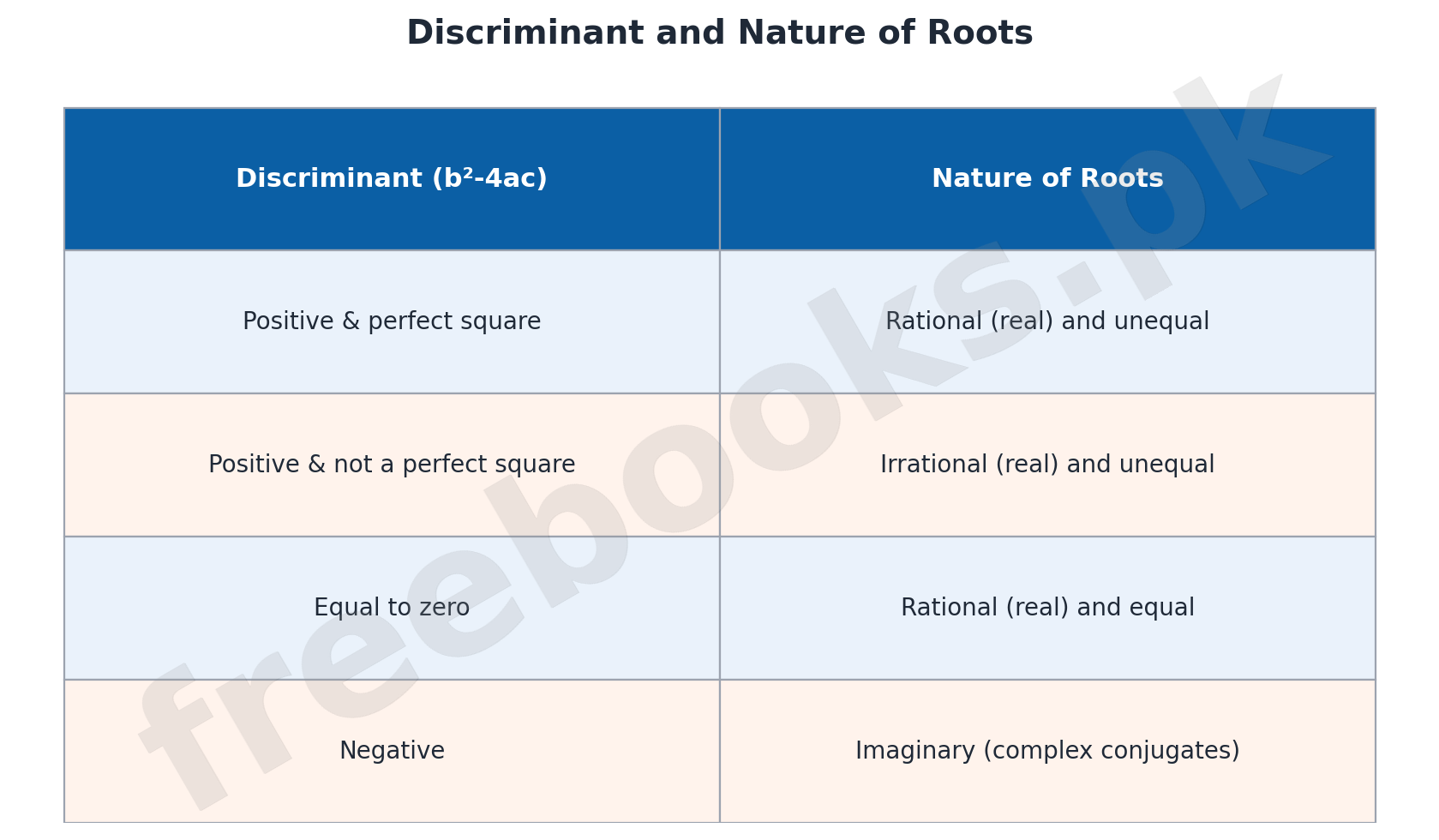
When a, b, c are rational numbers, the discriminant classifies the roots into four cases: if b^2-4ac > 0 and is a perfect square, the roots are rational (real) and unequal; if b^2-4ac > 0 but not a perfect square, the roots are irrational (real) and unequal; if b^2-4ac = 0, the roots are rational (real) and equal; if b^2-4ac < 0, the roots are imaginary (complex conjugates). This lets a problem determine the nature of an equation's roots by a single calculation, without applying the quadratic formula in full.
2.2 Cube Roots of Unity
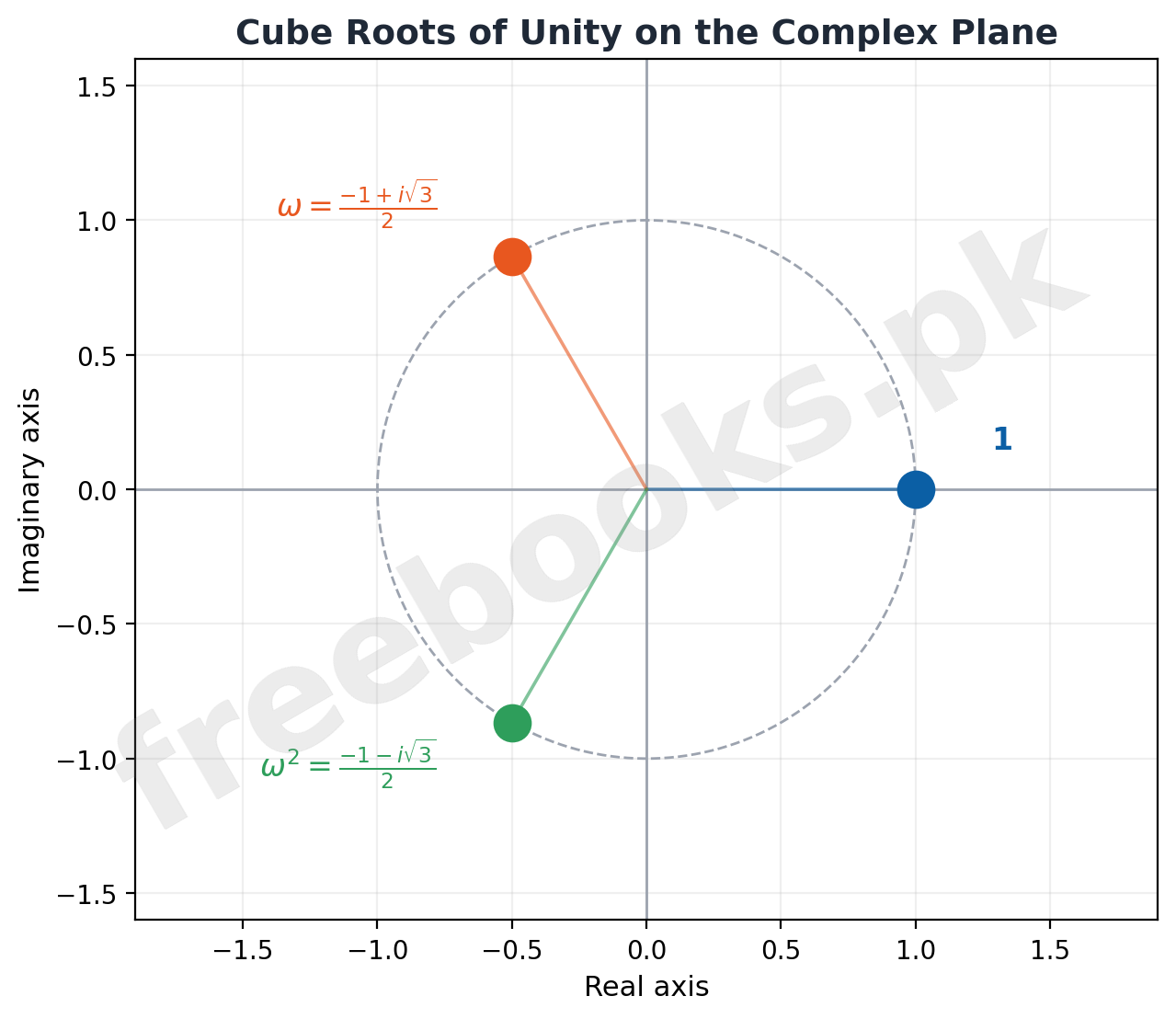
The cube roots of unity are the three solutions of x^3 = 1, found by writing x^3 – 1 = 0 and factoring using a^3-b^3 = (a-b)(a^2+ab+b^2): (x-1)(x^2+x+1) = 0. Solving gives x = 1, or x = (-1 +/- i*sqrt(3))/2 using the quadratic formula on x^2+x+1=0. So the three cube roots of unity are 1, (-1+i*sqrt3)/2, and (-1-i*sqrt3)/2. If either complex root is called omega, the other is omega-squared.
Four key properties (all provable directly from the values above) make omega extremely useful in algebra: each complex cube root is the square of the other; the product of all three cube roots is 1, i.e. omega^3 = 1; each complex cube root is the reciprocal of the other, since omega * omega^2 = 1; and the sum of all three cube roots is zero, i.e. 1 + omega + omega^2 = 0 — which gives the useful deductions omega + omega^2 = -1, 1+omega = -omega^2, and 1+omega^2 = -omega. Because omega^3 = 1, any higher power of omega can be reduced by dividing the exponent by 3 and keeping only the remainder, e.g. omega^7 = (omega^3)^2 * omega = omega.
2.3 Roots and Coefficients of a Quadratic Equation
For ax^2+bx+c=0 with roots alpha and beta, adding the two root expressions from the quadratic formula gives alpha+beta = -b/a, and multiplying them (using difference of squares) gives alpha*beta = c/a. Writing S for the sum and P for the product: S = -b/a = -(coefficient of x)/(coefficient of x^2), and P = c/a = (constant term)/(coefficient of x^2). This means the sum and product of the roots can be read directly off the coefficients, without solving the equation at all — e.g. for 3x^2-5x+7=0, S = -(-5)/3 = 5/3 and P = 7/3.
This relationship is used in reverse to find unknown constants in an equation given a condition connecting its roots — common conditions include: the sum of roots equals a multiple of the product; the sum of the squares of the roots equals a given number (using alpha^2+beta^2 = (alpha+beta)^2 – 2*alpha*beta); the roots differ by a given amount; the roots satisfy a linear relation such as 2*alpha+5*beta=7; or both the sum and product equal the same given number lambda. In every case, express S and P in terms of the unknown constant using the -b/a, c/a formulas, then use the given condition to form and solve an equation for that constant.
2.4 Symmetric Functions of the Roots
A symmetric function of alpha and beta is an expression whose value is unchanged when alpha and beta are swapped — for example alpha^2+beta^2, since beta^2+alpha^2 gives the same value. Because S = alpha+beta and P = alpha*beta are themselves symmetric functions, EVERY symmetric function of the roots can be rewritten purely in terms of S and P (hence purely in terms of the coefficients a, b, c), without ever finding alpha and beta individually.
Common identities used for this rewriting: alpha^2+beta^2 = (alpha+beta)^2 – 2*alpha*beta = S^2-2P; alpha^2*beta+alpha*beta^2 = alpha*beta(alpha+beta) = PS; 1/alpha + 1/beta = (alpha+beta)/(alpha*beta) = S/P. For example, if alpha, beta are the roots of 2x^2+3x+4=0, then S=-3/2 and P=2, so alpha^2+beta^2 = (-3/2)^2 – 2(2) = 9/4-4 = -7/4.
2.5 Forming a Quadratic Equation from Its Roots
If alpha and beta are the required roots, then x=alpha and x=beta, so (x-alpha)(x-beta)=0, which expands to x^2 – (alpha+beta)x + alpha*beta = 0, or simply x^2 – Sx + P = 0. This single formula lets any quadratic equation be reconstructed once its sum and product of roots are known — e.g. roots 3 and 4 give S=7, P=12, so the equation is x^2-7x+12=0.
The same formula solves the harder problem of forming an equation whose roots are some TRANSFORMATION of another equation's roots (e.g. 2*alpha+1 and 2*beta+1, or alpha^2 and beta^2, or 1/alpha and 1/beta) — first find the original equation's S and P from its coefficients, then compute the NEW sum and product using the transformation, and finally substitute the new S and P into x^2-Sx+P=0.
2.6 Synthetic Division
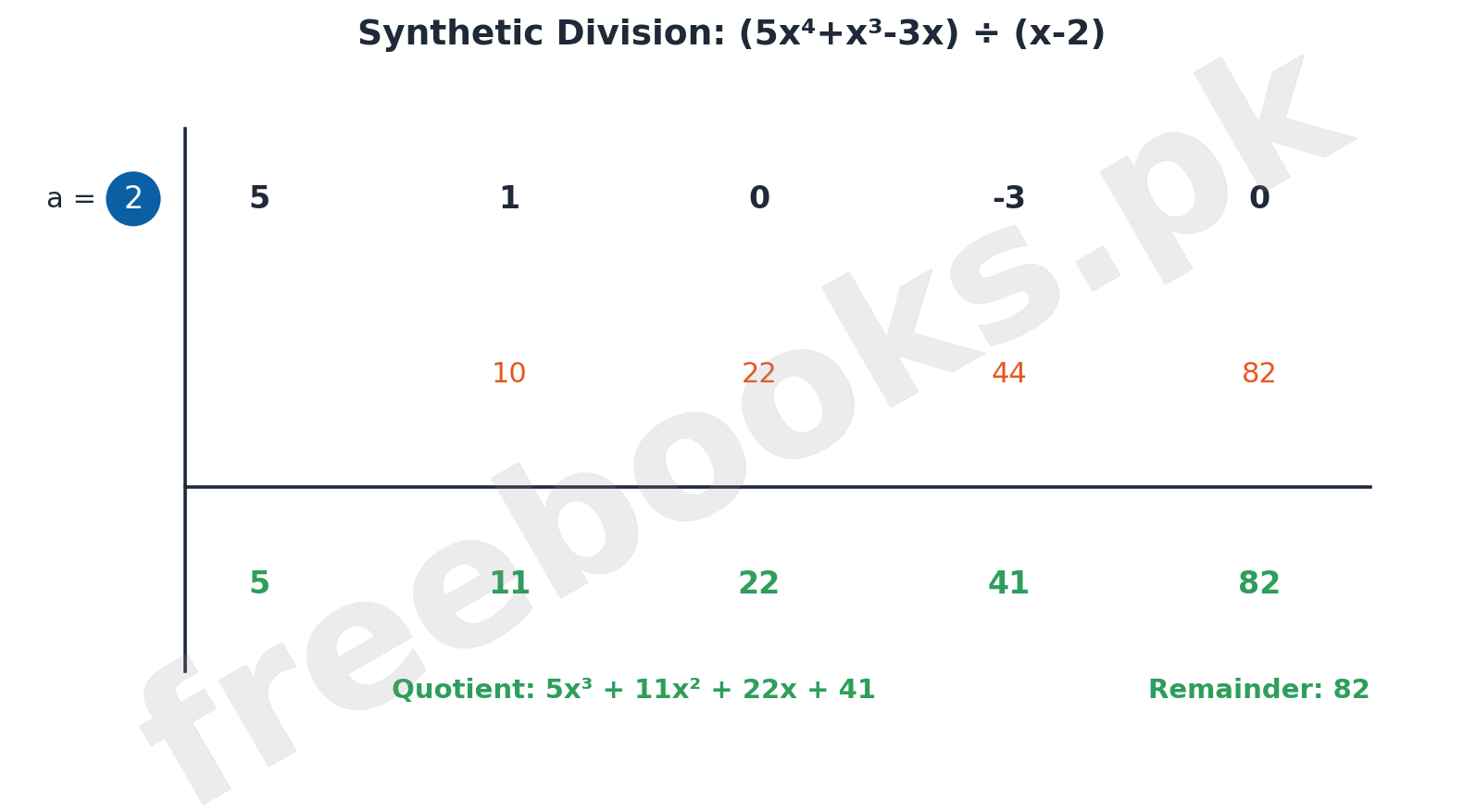
Synthetic division is a fast shortcut for dividing a polynomial P(x) by a linear divisor x-a: write the polynomial's coefficients in a row (using 0 for any missing power of x), place a on the left, bring down the first coefficient, then repeatedly multiply the most recent result by a and add it to the next coefficient. The final row gives the coefficients of the quotient (one degree lower than the dividend) and the last entry is the remainder.
Synthetic division has five main uses: finding the quotient and remainder of a polynomial division directly; finding unknown constants when a zero of the polynomial is given (the remainder must be 0); finding unknowns when specific linear factors are given (each factor's root gives remainder 0, producing simultaneous equations); solving a cubic equation when one root is already known (dividing it out leaves a quadratic 'depressed equation' solvable by the usual methods); and solving a quartic (biquadratic) equation when two of its real roots are known (dividing out both roots in succession leaves a quadratic).
2.7 Simultaneous Equations and Word Problems
A system of simultaneous equations is a set of equations sharing a common solution; the solution set consists of every ordered pair (x,y) satisfying all the equations at once. When ONE equation is linear and the other quadratic, solve the linear equation for y in terms of x, substitute into the quadratic equation to get a new quadratic in x alone, solve it, then find the matching y-values. When BOTH equations are quadratic, a common strategy is to eliminate one squared term by suitable multiplication and subtraction (similar to elimination for linear systems), which often produces a factorable relation between x and y that can be substituted back into either original equation.
Many real-life problems — involving consecutive numbers, rectangle dimensions, or coordinates of a point — translate directly into a quadratic equation (or a system of two equations) once the unknown quantities are represented by variables and the given conditions are written as equations. The roots of the resulting equation(s) then answer the original question, though a root must sometimes be rejected if it doesn't make physical sense (e.g. a negative length).
Important Definitions
What is the discriminant of a quadratic equation?
The expression b^2 – 4ac for the equation ax^2+bx+c=0, whose sign and whether it is a perfect square determine the nature of the roots.
What are the cube roots of unity?
The three solutions of x^3 = 1, namely 1, omega = (-1+i*sqrt3)/2, and omega^2 = (-1-i*sqrt3)/2.
What is omega (ω) in the context of cube roots of unity?
One of the two complex cube roots of unity; the other complex root is then omega-squared, and together with 1 they are the three cube roots of unity.
What is a symmetric function of the roots of an equation?
An expression involving the roots alpha and beta whose value stays the same when alpha and beta are interchanged, e.g. alpha^2+beta^2 or alpha*beta.
What is synthetic division?
A shortcut method for dividing a polynomial by a linear divisor x-a, using only the polynomial's coefficients, that gives the quotient's coefficients and the remainder directly.
What is a depressed equation?
The lower-degree equation left over after synthetic division removes one known root from a cubic or quartic equation, which can then be solved by standard methods.
What is a system of simultaneous equations?
A set of equations that share a common solution set, consisting of every ordered pair (or set of values) that satisfies all the equations at once.
If S is the sum and P is the product of the roots of ax^2+bx+c=0, what are S and P in terms of a, b, c?
S = -b/a and P = c/a.
What formula reconstructs a quadratic equation from its sum S and product P of roots?
x^2 – Sx + P = 0.
What is the formula a^3 – b^3 used to derive the cube roots of unity?
a^3 – b^3 = (a-b)(a^2+ab+b^2), applied to x^3-1=0 as (x-1)(x^2+x+1)=0.
Key Facts and Relations
| Topic | Key Fact / Relation |
|---|---|
| Discriminant | Disc. = b^2 – 4ac |
| Roots rational & unequal | b^2-4ac > 0 and a perfect square |
| Roots irrational & unequal | b^2-4ac > 0 and not a perfect square |
| Roots rational & equal | b^2-4ac = 0 |
| Roots imaginary (complex conjugates) | b^2-4ac < 0 |
| Cube roots of unity | 1, (-1+i√3)/2 = ω, (-1-i√3)/2 = ω² |
| Key omega identities | 1+ω+ω²=0, ω³=1, ω·ω²=1 |
| Sum of roots | S = α+β = -b/a |
| Product of roots | P = αβ = c/a |
| Equation from S and P | x² – Sx + P = 0 |
| Common symmetric identity | α²+β² = (α+β)² – 2αβ = S²-2P |
| Synthetic division | Divide P(x) by (x-a): bring down leading coefficient, repeatedly ×a and add |
Diagrams
Discriminant and Nature of Roots: A summary chart showing the four cases of the discriminant b^2-4ac (positive perfect square, positive non-perfect-square, zero, negative) alongside the corresponding nature of the roots in each case
Cube Roots of Unity on the Complex Plane: An Argand diagram (complex plane) showing the three cube roots of unity — 1, omega, and omega-squared — as three points equally spaced (120 degrees apart) on the unit circle
Synthetic Division Layout: A worked diagram showing the synthetic division grid for dividing 5x^4+x^3-3x by x-2, illustrating the bring-down, multiply, and add steps that produce the quotient's coefficients and the remainder
Short Questions & Answers
Write the formula for the discriminant of ax^2+bx+c=0.
Discriminant = b^2 – 4ac.
If the discriminant of a quadratic equation is zero, what is the nature of its roots?
The roots are rational (real) and equal.
Name the three cube roots of unity.
1, (-1+i√3)/2 (=ω), and (-1-i√3)/2 (=ω²).
State the value of 1 + ω + ω².
0 (the sum of all three cube roots of unity is zero).
Write S and P in terms of a, b, c for ax^2+bx+c=0.
S (sum of roots) = -b/a, and P (product of roots) = c/a.
What formula is used to form a quadratic equation from its sum and product of roots?
x² – Sx + P = 0.
Long Questions & Answers
Explain how the discriminant of a quadratic equation determines the nature of its roots, and describe the cube roots of unity together with their key properties.
What is the discriminant, and how is it calculated?
For ax^2+bx+c=0 (a not equal to 0), the discriminant is the expression b^2-4ac. It is calculated by identifying a, b, c from the equation's standard form and substituting them in — e.g. for 2x^2-7x+1=0, Disc. = (-7)^2-4(2)(1) = 49-8 = 41.
How does the discriminant reveal the nature of the roots without solving the equation?
For rational a, b, c: if the discriminant is positive and a perfect square, the roots are rational (real) and unequal; if positive but not a perfect square, the roots are irrational (real) and unequal; if the discriminant is exactly zero, the roots are rational (real) and equal; and if the discriminant is negative, the roots are imaginary (complex conjugates).
How are the cube roots of unity derived?
Setting x^3=1 gives x^3-1=0, which factors (using a^3-b^3=(a-b)(a^2+ab+b^2)) as (x-1)(x^2+x+1)=0. Solving x-1=0 gives x=1; solving x^2+x+1=0 by the quadratic formula gives x=(-1±i√3)/2. So the three cube roots of unity are 1, (-1+i√3)/2, and (-1-i√3)/2; naming one complex root omega makes the other omega-squared.
What are the key properties of the cube roots of unity?
Each complex cube root is the square of the other; their product is 1 (so omega^3=1); each complex cube root is the reciprocal of the other (omega·omega^2=1); and their sum is zero (1+omega+omega^2=0), giving the useful deductions omega+omega^2=-1, 1+omega=-omega^2, and 1+omega^2=-omega.
How are higher powers of omega simplified?
Since omega^3=1, any power of omega can be reduced by dividing its exponent by 3 and keeping only the remainder as the effective power — e.g. omega^7 = (omega^3)^2·omega = (1)^2·omega = omega, and omega^{63} = (omega^3)^{21} = 1.
Explain the relationship between the roots and coefficients of a quadratic equation, and describe how this relationship is used to form new quadratic equations and solve polynomial equations by synthetic division.
What is the relationship between a quadratic equation's roots and its coefficients?
For ax^2+bx+c=0 with roots alpha and beta, the sum of the roots S = alpha+beta = -b/a, and the product of the roots P = alpha·beta = c/a. This means S and P can be read directly from the coefficients without ever solving the equation.
How are unknown constants found when a condition on the roots is given?
Express S and P in terms of the unknown constant using S=-b/a and P=c/a, then substitute into the given condition (e.g. sum equals a multiple of the product, or the roots differ by a given amount) to form and solve an equation for that constant.
How is a new quadratic equation formed from a known sum and product of roots?
Using the formula x^2 – Sx + P = 0, where S and P are the sum and product of the desired roots — e.g. roots 3 and 4 give S=7, P=12, so the equation is x^2-7x+12=0. For roots that are a transformation of another equation's roots (like 2alpha+1, 2beta+1), first find the original S and P, then compute the transformed sum and product before substituting.
What is synthetic division, and what does its result represent?
A shortcut method for dividing a polynomial P(x) by a linear divisor x-a, using only its coefficients: bring down the leading coefficient, then repeatedly multiply the latest result by a and add it to the next coefficient. The final numbers give the quotient's coefficients (one degree lower than the dividend), and the very last entry is the remainder.
How is synthetic division used to solve a cubic or quartic equation when some roots are known?
Each known root is divided out in turn using synthetic division (its remainder should be zero, confirming it is genuinely a root), which reduces the equation's degree by one each time. Once enough roots have been divided out, the remaining 'depressed equation' is a quadratic, solvable by factorization or the quadratic formula to find the rest of the roots.
Multiple Choice Questions (MCQs)
The discriminant of ax^2+bx+c=0 is: (A) b^2+4ac (B) b^2-4ac (C) 4ac-b^2 (D) b-4ac
Correct answer: (B) b^2-4ac. The discriminant is defined as b^2-4ac for the standard quadratic equation ax^2+bx+c=0.
If the discriminant of a quadratic equation is negative, its roots are: (A) Rational and equal (B) Irrational and unequal (C) Imaginary (complex conjugates) (D) Rational and unequal
Correct answer: (C) Imaginary (complex conjugates). A negative discriminant means the square root involves a negative number, giving imaginary (complex conjugate) roots.
The three cube roots of unity are the solutions of: (A) x^2 = 1 (B) x^3 = 1 (C) x^3 = -1 (D) x^2 = -1
Correct answer: (B) x^3 = 1. The cube roots of unity are, by definition, the three solutions of x^3 = 1.
If omega is a complex cube root of unity, then 1 + omega + omega^2 equals: (A) 1 (B) -1 (C) 0 (D) 3
Correct answer: (C) 0. The sum of all three cube roots of unity (1, omega, omega-squared) is always zero.
For ax^2+bx+c=0 with roots alpha, beta, the product alpha·beta equals: (A) -b/a (B) b/a (C) c/a (D) -c/a
Correct answer: (C) c/a. The product of the roots of a quadratic equation equals c/a (constant term over coefficient of x^2).
The quadratic equation with sum of roots S and product of roots P is: (A) x^2+Sx+P=0 (B) x^2-Sx+P=0 (C) x^2-Sx-P=0 (D) x^2+Sx-P=0
Correct answer: (B) x^2-Sx+P=0. A quadratic equation can be reconstructed from its roots' sum and product using x^2 – Sx + P = 0.
alpha^2 + beta^2 can be rewritten in terms of S=alpha+beta and P=alpha·beta as: (A) S^2 + 2P (B) S^2 – 2P (C) S^2 – P (D) 2S – P
Correct answer: (B) S^2 – 2P. Since (alpha+beta)^2 = alpha^2+2*alpha*beta+beta^2, rearranging gives alpha^2+beta^2 = (alpha+beta)^2 – 2*alpha*beta = S^2-2P.
In synthetic division of P(x) by (x-a), the last number obtained represents the: (A) Quotient (B) Leading coefficient (C) Remainder (D) Value of a
Correct answer: (C) Remainder. The last entry in a synthetic division row is always the remainder of the division.
A depressed equation is obtained after synthetic division by: (A) Adding a known root back (B) Dividing out one known root of a cubic/quartic equation (C) Multiplying two equations (D) Taking the discriminant
Correct answer: (B) Dividing out one known root of a cubic/quartic equation. Dividing out a known root via synthetic division reduces a cubic or quartic equation's degree, leaving a lower-degree 'depressed equation'.
In a system where one equation is linear and the other quadratic, the standard solving strategy is: (A) Add the two equations directly (B) Solve the linear equation for one variable and substitute into the quadratic (C) Take the discriminant of both (D) Graph only
Correct answer: (B) Solve the linear equation for one variable and substitute into the quadratic. The linear equation is solved for one variable in terms of the other, then substituted into the quadratic equation to get a solvable equation in one variable.
Quick Revision Summary
- Discriminant = b^2 – 4ac; its sign and perfect-square status determine the nature of the roots
- b^2-4ac>0 & perfect square: rational, unequal | not perfect square: irrational, unequal
- b^2-4ac=0: rational, equal | b^2-4ac<0: imaginary (complex conjugates)
- Cube roots of unity: 1, ω=(-1+i√3)/2, ω²=(-1-i√3)/2, from x³-1=0
- Key omega facts: 1+ω+ω²=0, ω³=1, ω·ω²=1, each root is the square of the other
- Sum of roots S=-b/a, Product of roots P=c/a — no need to solve the equation
- New equation from roots: x² – Sx + P = 0
- Symmetric functions (α²+β², 1/α+1/β, etc.) can always be rewritten using S and P
- Synthetic division: divide a polynomial by (x-a) using only coefficients; last number = remainder
- A known root removed via synthetic division leaves a lower-degree depressed equation
- Simultaneous equations: substitute the linear equation into the quadratic one, or eliminate a squared term
Exam Tips
- Compute the discriminant first before attempting to factor — it tells you in advance whether factorization will even work nicely
- Memorize the four discriminant cases exactly; exam questions often ask to state the nature of roots WITHOUT solving
- For omega problems, always try to reduce using ω³=1 and 1+ω+ω²=0 before expanding anything directly
- When forming an equation from transformed roots, compute the original S and P first, then transform them — don't try to find alpha and beta explicitly
- In synthetic division, always include a 0 placeholder for any missing power of x in the dividend
- For real-life word problems, always check whether a negative or non-physical root should be rejected before giving the final answer