This chapter covers the Applications and Uses of Computer from the 1st Year (ICS Part-I) Computer Science syllabus of the Punjab Curriculum and Textbook Board (PTB/PCTB). It describes how computers are used in business, e-commerce, industry, CAD/CAM, simulation, medicine, airlines, education and the home, and how they simplify our work. These notes are prepared by freebooks.pk.
Computers are now used in almost every field of life. This chapter surveys the many areas where computers help people work faster, more accurately and more cheaply.
Learning Objectives
- Describe the use of computers in business and e-commerce.
- Explain the use of computers in industry, CAD and CAM.
- Describe simulation and its uses.
- Explain the use of computers in medicine, airlines and education.
- Describe the use of computers in the home.
- Explain how computers simplify our work practices.
Key Concepts
Computers in Business
Businesses use computers for many tasks that were once done by hand: keeping accounts and payroll, storing records of customers and stock in databases, preparing invoices and reports, and communicating by e-mail. Computers make these tasks faster and more accurate, reduce paperwork and allow large amounts of information to be searched and updated easily, which helps a business run efficiently and make better decisions.
E-commerce
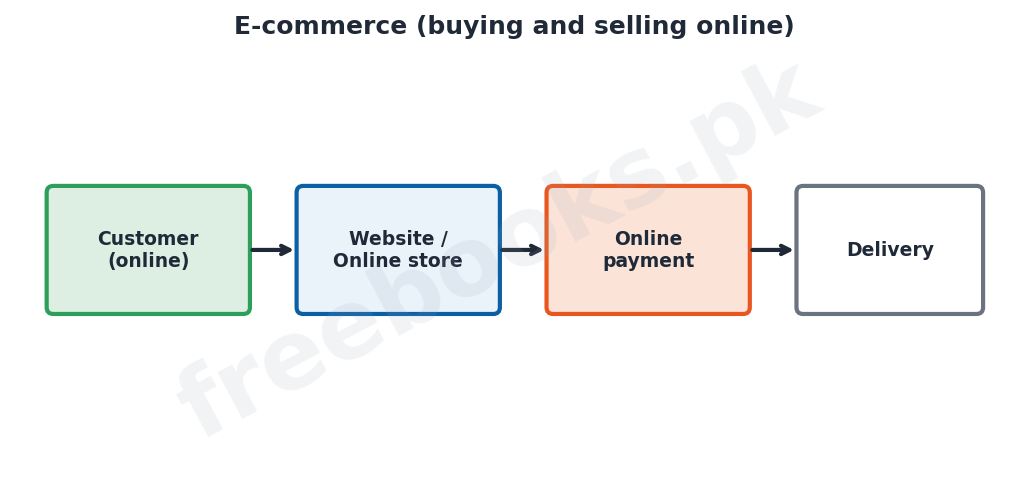
E-commerce (electronic commerce) means buying and selling goods and services over the Internet. Customers can visit an online store, choose products, place orders and pay electronically without leaving home, and the goods are then delivered to them. E-commerce lets businesses reach customers all over the world, stay open 24 hours a day and reduce the cost of running physical shops, while giving customers convenience and a wide choice.
Industry, CAD and CAM
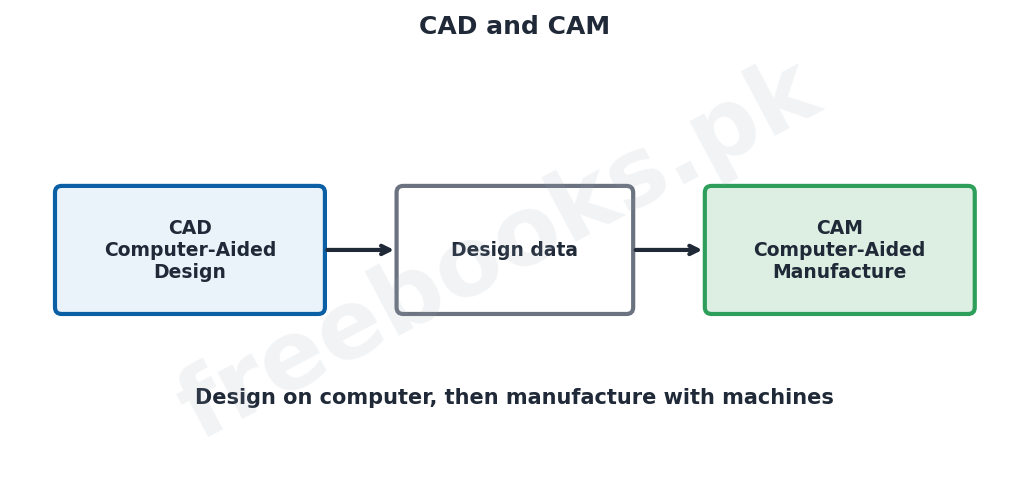
In industry, computers control machines and whole production lines, monitor quality and manage stock. Two important applications are CAD and CAM. Computer-aided design (CAD) uses the computer to design and draw products such as cars, buildings and machine parts accurately on screen before they are made. Computer-aided manufacture (CAM) uses computers to control the machines that actually produce the goods. Together, CAD/CAM allows products to be designed and made quickly, accurately and at lower cost.
Simulation
Simulation is the use of a computer to imitate a real situation or system so that it can be studied safely and cheaply. For example, pilots learn to fly on flight simulators, scientists model the weather, and engineers test designs before building them. Simulation lets people experiment with dangerous, expensive or impossible situations without any real risk, and it is widely used in training, research and design.
Computers in Medicine
In medicine, computers are used to keep patients’ records, to run diagnostic machines such as CT and MRI scanners that produce detailed images of the body, to monitor patients in intensive care, and to control equipment during operations. Computers help doctors diagnose diseases more accurately, store and share medical information quickly, and carry out research into new treatments.
Airline and Reservation Systems
Airlines and railways use computer reservation systems to manage the booking of seats. These systems keep an up-to-date record of every flight and every seat, so that travel agents anywhere can check availability and book tickets instantly without double-booking. Computers also control air-traffic, plan routes and schedules, and handle billing, making travel safer and more efficient.
Computers in Education
In education, computers are used for computer-aided learning, in which students learn through interactive lessons, tutorials and educational software at their own pace. They are also used for research on the Internet, for preparing assignments and presentations, for online (distance) learning and examinations, and for keeping student records. Computers make learning more interesting and give access to a vast amount of information.
Computers in the Home and Simplifying Work
At home, computers are used for entertainment (games, music and films), communication (e-mail and social media), online shopping and banking, and for study and work. Household appliances such as washing machines and microwave ovens also contain small computers. In general, computers simplify our work practices by doing repetitive jobs quickly and accurately, storing and finding information easily, working without tiring, and letting people communicate and share work over networks.
Important Definitions
E-commerce
Buying and selling of goods and services over the Internet.
CAD
Computer-aided design; designing products on a computer.
CAM
Computer-aided manufacture; controlling machines that make products.
Simulation
Using a computer to imitate a real situation for study or training.
Reservation system
A computer system for booking seats or tickets.
Computer-aided learning
Learning through interactive computer software.
Payroll
A computerised record used to calculate employees’ pay.
Database
An organised collection of related data stored on a computer.
Key Facts & Rules
| Item | Detail |
|---|---|
| Business | Accounts, payroll, records, invoices, e-mail |
| E-commerce | Online buying and selling |
| CAD | Design products on computer |
| CAM | Control manufacturing machines |
| Simulation | Imitate real systems safely (e.g. flight simulator) |
| Medicine | Records, scanners (CT/MRI), monitoring |
| Education | Computer-aided learning, research, online exams |
Diagrams & Illustrations
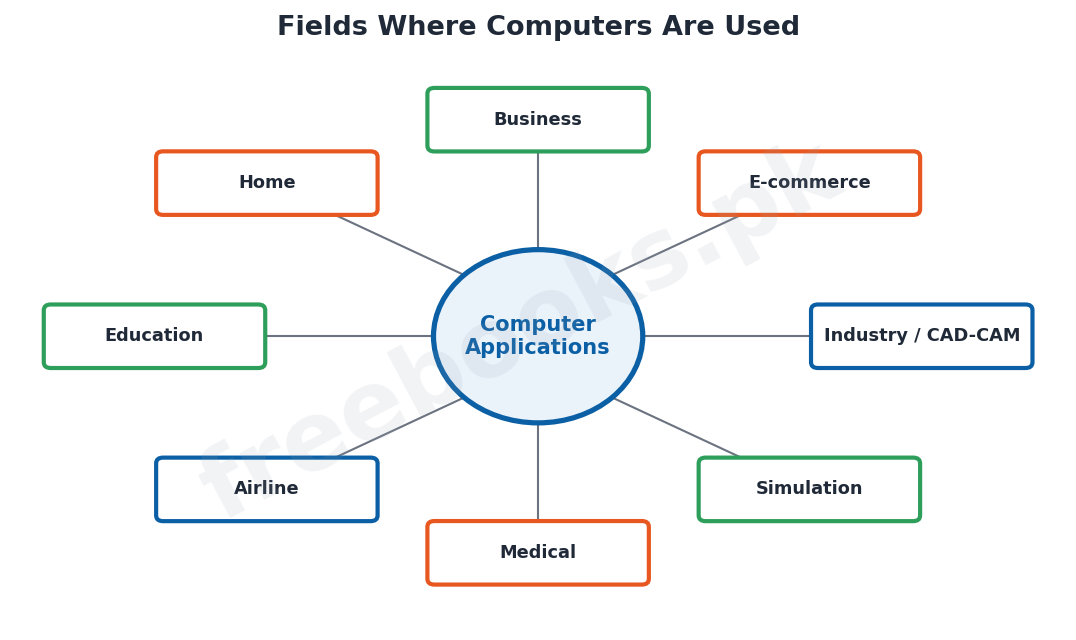
Fields where computers are used: a central hub of computer applications surrounded by the main fields: business, e-commerce, industry/CAD-CAM, simulation, medical, airline, education and home.
CAD and CAM: computer-aided design (CAD) producing design data that is passed to computer-aided manufacture (CAM) to make the product.
E-commerce: the steps of e-commerce: a customer visits an online store, places an order, pays online and the goods are delivered.
Solved Examples & Practice
Choose the application
Designing a car body on screen before it is built uses CAD; controlling the robots that assemble it uses CAM.
Identify the use
A pilot practising landings on the ground without a real plane is using a flight simulator (simulation).
E-commerce example
Ordering a book from an online store and paying by card is an example of e-commerce.
Medicine example
An MRI scanner that produces detailed images of the body is a computer application in medicine.
Short Questions & Answers
What is e-commerce?
The buying and selling of goods and services over the Internet.
Differentiate CAD and CAM.
CAD uses the computer to design products, while CAM uses the computer to control the machines that manufacture them.
What is simulation? Give an example.
Using a computer to imitate a real situation for safe study or training, for example a flight simulator.
Give two uses of computers in medicine.
Keeping patients’ records and running diagnostic scanners such as CT and MRI machines.
What is a reservation system?
A computer system used to book seats or tickets, for example for airlines, keeping an up-to-date record to avoid double-booking.
Give two uses of computers in education.
Computer-aided learning through interactive software and research on the Internet (also online exams and record keeping).
Long Questions & Answers
Q1: Explain the use of computers in business and e-commerce.
Computers have become essential tools in business because they handle large amounts of information quickly, accurately and cheaply. In everyday business operations, computers are used to keep the accounts and prepare the payroll that calculates each employee’s pay; to store records of customers, suppliers and stock in databases that can be searched and updated in seconds; to produce invoices, receipts, letters and reports; and to communicate with customers and other offices by e-mail. Because the computer does routine calculations and record-keeping automatically, it reduces paperwork and human error, saves time and staff costs, and gives managers accurate, up-to-date information on which to base decisions. A more recent and rapidly growing business use of computers is e-commerce, which means carrying out trade, that is, buying and selling goods and services, over the Internet. In e-commerce a business sets up an online store or website where customers, wherever they are in the world, can browse the products, place their orders and pay electronically by card or online banking, after which the goods are delivered to them. E-commerce benefits the business by allowing it to reach a huge, worldwide market, to remain open twenty-four hours a day, and to save the cost of renting and running physical shops; it benefits customers by giving them convenience, a wide choice and the ability to compare prices easily. Well-known examples include online shopping sites, online banking and online booking services.
Q2: Describe the use of computers in industry, including CAD and CAM, and in simulation.
Industry makes very heavy use of computers to design products, to control manufacturing and to improve quality and efficiency. In modern factories, computers control individual machines and entire production lines, monitor the quality of the goods being made, and keep track of raw materials and finished stock. Two especially important industrial applications are CAD and CAM. Computer-aided design (CAD) is the use of the computer to design and draw products, such as cars, aircraft, buildings and machine parts, accurately on the screen; the designer can create, change and test the design before anything is actually built, which saves both time and materials. Computer-aided manufacture (CAM) is the use of computers to control the machines and robots that actually produce the goods according to the design. When CAD and CAM are used together, a product can be designed on the computer and the design fed directly to the machines that make it, so that goods are produced quickly, accurately and at lower cost, with fewer errors. Closely related is the use of computers for simulation, in which the computer is used to imitate a real system or situation so that it can be studied without the cost or danger of the real thing. For example, trainee pilots learn to fly using flight simulators that behave like a real aircraft, engineers test the strength of a bridge or a car by simulating it before building it, and scientists model the weather or the spread of disease. Simulation allows people to experiment safely with situations that would otherwise be too dangerous, too expensive or impossible to try in reality, which is why it is widely used in training, research and design.
Q3: Describe the use of computers in medicine, airlines, education and the home.
Computers now play an important part in many areas of daily life. In medicine, they are used to keep detailed records of patients, to operate diagnostic machines such as CT and MRI scanners that produce clear images of the inside of the body, to monitor the condition of seriously ill patients continuously in intensive care, and to help control equipment during operations; in this way computers help doctors to diagnose illnesses more accurately, to store and share medical information instantly and to carry out medical research. In the airline and railway industries, computers run reservation systems that keep an up-to-date record of every flight or train and every seat, so that a travel agent anywhere can check availability and book a ticket at once without the risk of two people being given the same seat; computers also assist in controlling air traffic and in planning routes and schedules, making travel safer and more efficient. In education, computers are used for computer-aided learning, in which students study interactive lessons and tutorials at their own pace, for research using the Internet, for preparing assignments and presentations, for distance learning and online examinations, and for keeping student and examination records, all of which make learning more interesting and give access to a vast store of knowledge. In the home, computers and computer-controlled devices are used for entertainment such as games, music and films, for communication through e-mail and social media, for online shopping and banking, and for study and work; even ordinary household appliances such as washing machines and microwave ovens contain small computers. Taken together, these applications show how computers simplify our work and daily lives by doing repetitive tasks quickly and accurately, storing and finding information easily, and connecting people through networks.
MCQs with Answers
Buying and selling over the Internet is called: (a) e-mail (b) e-commerce (c) e-book (d) e-learning
Correct Answer: (b) e-commerce.
Designing a product on a computer is: (a) CAM (b) CAD (c) CPU (d) CAI
Correct Answer: (b) CAD.
Controlling machines that make a product is: (a) CAD (b) CAM (c) CD (d) CAL
Correct Answer: (b) CAM.
A flight simulator is an example of: (a) e-commerce (b) simulation (c) payroll (d) a database
Correct Answer: (b) simulation.
CT and MRI scanners are computer uses in: (a) education (b) medicine (c) banking (d) industry
Correct Answer: (b) medicine.
A system to book airline seats is a: (a) payroll (b) reservation system (c) simulator (d) spreadsheet
Correct Answer: (b) reservation system.
Learning through interactive software is: (a) CAD (b) CAM (c) computer-aided learning (d) e-commerce
Correct Answer: (c) computer-aided learning.
Keeping employees’ pay records is called: (a) payroll (b) payload (c) payment (d) packet
Correct Answer: (a) payroll.
An organised collection of data on a computer is a: (a) network (b) database (c) protocol (d) modem
Correct Answer: (b) database.
Household appliances like washing machines may contain a: (a) printer (b) small computer (c) modem (d) scanner
Correct Answer: (b) small computer.
Quick Revision Summary
- Business: accounts, payroll, records, invoices, e-mail.
- E-commerce: online buying and selling; worldwide, 24/7, lower cost.
- Industry: CAD (design) + CAM (manufacture); simulation imitates real systems safely.
- Medicine: records, CT/MRI scanners, patient monitoring.
- Airline/education: reservation systems; computer-aided learning, online exams.
- Home: entertainment, communication, shopping; computers simplify repetitive work. Notes by freebooks.pk.
Exam Tips
- Clearly separate CAD (design) from CAM (manufacture).
- Define e-commerce and give an example.
- Explain simulation with the flight-simulator example.
- List two uses each for medicine, education and business.
- Mention reservation systems for airlines.
- Summarise how computers simplify work (speed, accuracy, storage, networking).