This chapter covers Data Communications from the 1st Year (ICS Part-I) Computer Science syllabus of the Punjab Curriculum and Textbook Board (PTB/PCTB). It explains the components of a data communication system, signals, modes and types of data transmission, bandwidth, communication media and the modem. These notes are prepared by freebooks.pk.
Data communication is the transfer of data from one device to another through some transmission medium. It is the foundation of every network, and this chapter explains how data actually travels between computers.
Learning Objectives
- List the components of a data communication system.
- Distinguish analog and digital signals.
- Describe the modes of data communication.
- Distinguish serial and parallel transmission.
- Define bandwidth and describe the communication media.
- Explain the purpose of a modem.
Key Concepts
Components of Data Communication
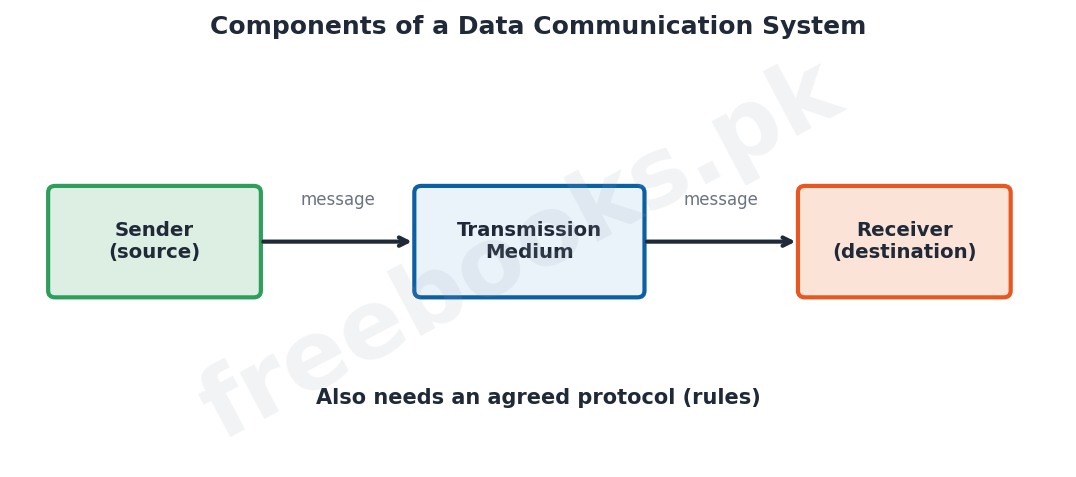
A data communication system has five basic components. The sender (source) is the device that sends the data; the receiver (destination) is the device that receives it; the message is the information (data) being communicated; the transmission medium is the physical path (cable or wireless) along which the message travels; and the protocol is the set of agreed rules that both devices follow so that communication is successful. All five must be present for data to be exchanged correctly.
Signals: Analog and Digital
Data is carried by signals. An analog signal varies smoothly and continuously, like the human voice or a sine wave, taking any value within a range. A digital signal has only a few discrete levels, usually two, representing the 0s and 1s used by computers. Computers work with digital signals, but some transmission media (such as ordinary telephone lines) were designed for analog signals, which is why conversion is sometimes needed.
Data Representation and Encoding
Inside a computer, data such as letters, digits and symbols is represented using binary codes. A common coding scheme is ASCII (American Standard Code for Information Interchange), in which each character is given a unique 7- or 8-bit binary code. Encoding is the process of converting data into a particular pattern of signals suitable for transmission, and decoding is converting it back at the receiver.
Modes of Data Communication
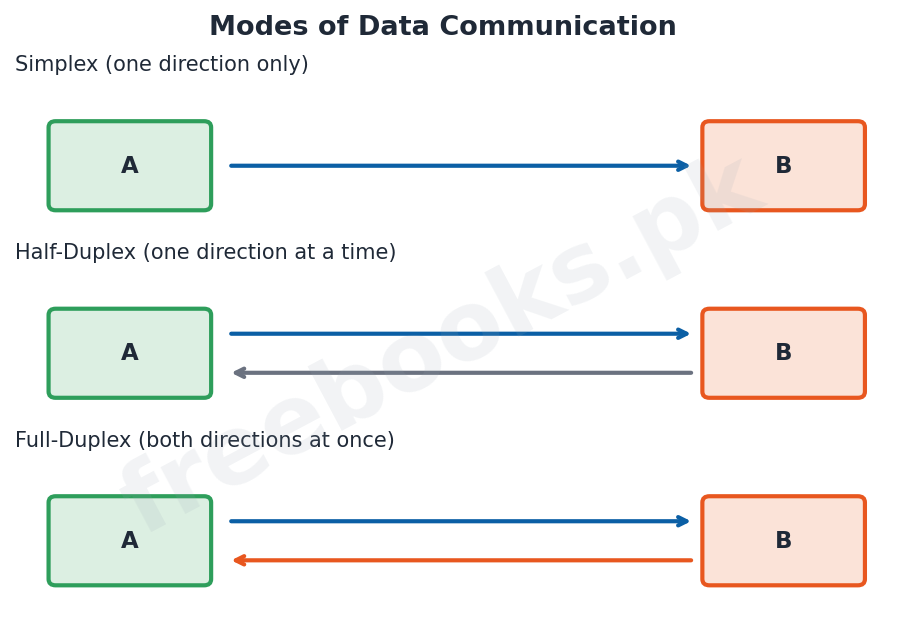
The direction in which data can flow between two devices gives three modes. In simplex mode data flows in one direction only (for example from a keyboard to the computer). In half-duplex mode data can flow in both directions but only one direction at a time (like a walkie-talkie). In full-duplex mode data can flow in both directions at the same time (like a telephone call). Full-duplex allows the fastest two-way communication.
Types of Data Transmission
Data can be transmitted in two ways according to how the bits are sent. In serial transmission the bits of a byte are sent one after another over a single wire, which is cheaper and used over long distances. In parallel transmission several bits are sent at the same time over several wires, which is faster but used only over short distances (such as inside the computer). Transmission may also be asynchronous (one character at a time with start and stop bits) or synchronous (a steady stream of characters kept in step by a clock).
Bandwidth and Communication Media
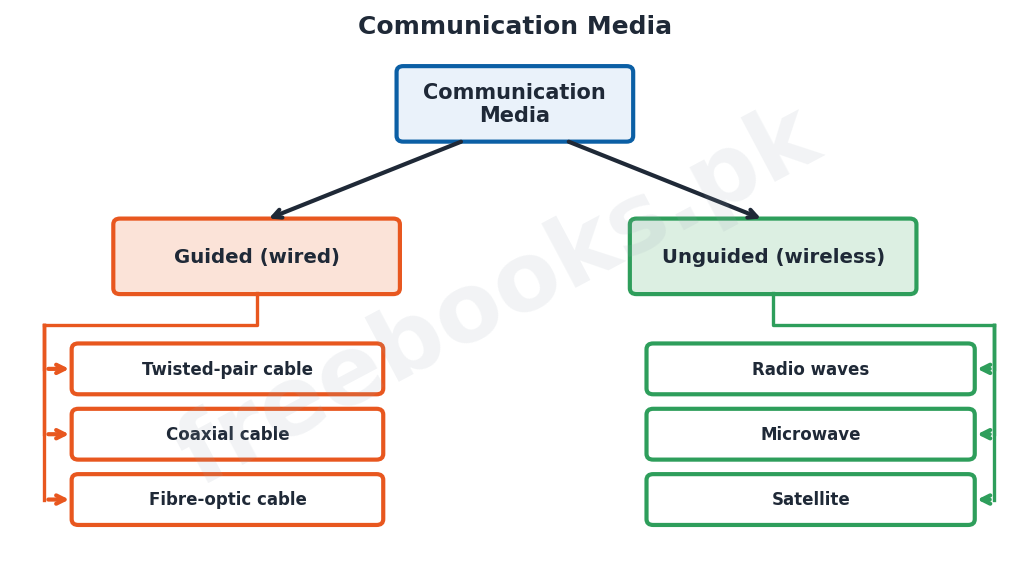
Bandwidth is the amount of data that a communication channel can carry in a given time, usually measured in bits per second (bps); a higher bandwidth means faster data transfer. The transmission media are of two kinds. Guided (wired) media carry the signal along a physical cable and include twisted-pair cable, coaxial cable and fibre-optic cable (the fastest, using light). Unguided (wireless) media carry the signal through the air and include radio waves, microwaves and satellite communication.
The Modem
A modem (from modulator-demodulator) is a device that lets a computer send and receive data over analog lines such as telephone lines. At the sending end it modulates, converting the computer’s digital signals into analog signals that the line can carry; at the receiving end another modem demodulates, converting the analog signals back into digital form for the receiving computer. Modems may be internal (fitted inside the computer) or external (a separate box).
Important Definitions
Data communication
The transfer of data between devices through a transmission medium.
Protocol
The set of rules that governs a data communication.
Analog signal
A continuously varying signal that can take any value in a range.
Digital signal
A signal with discrete levels representing 0s and 1s.
Simplex
Data flows in one direction only.
Full-duplex
Data flows in both directions at the same time.
Bandwidth
The data-carrying capacity of a channel, in bits per second.
Modem
A device that converts digital to analog and back for transmission.
Key Facts & Rules
| Item | Detail |
|---|---|
| Components | Sender, Receiver, Message, Medium, Protocol |
| Simplex | One direction only |
| Half-duplex | Both directions, one at a time |
| Full-duplex | Both directions at once |
| Serial | Bits one after another (long distance) |
| Parallel | Several bits together (short distance) |
| Bandwidth unit | bits per second (bps) |
Diagrams & Illustrations
Data communication system: a data communication system with a sender, transmission medium and receiver, exchanging a message under an agreed protocol.
Modes of communication: the simplex, half-duplex and full-duplex modes showing the direction(s) in which data can flow between two devices.
Communication media: communication media split into guided (twisted-pair, coaxial, fibre-optic) and unguided (radio, microwave, satellite).
Solved Examples & Practice
Identify the mode
A television broadcast sends data in one direction only, so it uses simplex mode; a telephone call is full-duplex.
Serial vs parallel
Sending data across a city over one line is serial; sending 8 bits at once between the CPU and memory inside a computer is parallel.
Bandwidth
If a channel carries 2000 bits every second, its bandwidth is 2000 bps (2 kbps).
Why a modem
A home computer connecting through a telephone line needs a modem to convert its digital signals to analog and back.
Short Questions & Answers
List the components of a data communication system.
Sender, receiver, message, transmission medium and protocol.
Differentiate analog and digital signals.
An analog signal varies continuously and can take any value; a digital signal has only discrete levels representing 0s and 1s.
What is simplex mode?
A mode in which data can flow in one direction only, for example from a keyboard to the computer.
Differentiate serial and parallel transmission.
In serial transmission bits are sent one after another over one wire; in parallel transmission several bits are sent together over several wires.
Define bandwidth.
The amount of data a channel can carry per second, measured in bits per second (bps).
What is the function of a modem?
It converts digital signals to analog for transmission (modulation) and analog back to digital at the receiver (demodulation).
Long Questions & Answers
Q1: Describe the components of a data communication system and the modes of communication.
Data communication is the exchange of data between two devices through some transmission medium, and for it to work a data communication system must have five basic components. The sender, or source, is the device that generates and sends the data, such as a computer. The receiver, or destination, is the device that receives the data. The message is the actual information being sent, which may be text, numbers, pictures or sound. The transmission medium is the physical path along which the message travels from sender to receiver, and it may be a wire such as a cable or a wireless link through the air. The protocol is the set of agreed rules that both the sender and the receiver follow so that the data is understood correctly; without a common protocol, two devices could not communicate even if they were connected. The direction in which data flows between the two devices defines the mode of communication, of which there are three. In simplex mode data can travel in one direction only, as from a keyboard to a computer or from a computer to a monitor. In half-duplex mode data can travel in both directions but only one direction at a time, as with a walkie-talkie where one person speaks while the other listens. In full-duplex mode data can travel in both directions simultaneously, as in a telephone conversation where both people can speak at once; full-duplex therefore allows the fastest and most natural two-way communication.
Q2: Explain the communication media used in data communication.
The transmission medium is the physical channel that carries data from the sender to the receiver, and the media used are of two broad kinds: guided (wired) media and unguided (wireless) media. Guided media carry the signal along a solid physical path. Twisted-pair cable consists of pairs of insulated copper wires twisted together to reduce interference; it is cheap and is widely used in telephone lines and small networks, but it carries data more slowly and over shorter distances. Coaxial cable has a central copper conductor surrounded by insulation and a metal shield; it can carry more data over longer distances than twisted pair and was long used for cable television and networks. Fibre-optic cable carries data as pulses of light through very thin strands of glass; it offers extremely high bandwidth, is very fast, is immune to electrical interference and can carry signals over great distances, which is why it is now used for the backbone of large networks and the Internet. Unguided media carry the signal through the air without any cable. Radio waves are used for short- and medium-range wireless communication such as Wi-Fi and mobile phones. Microwaves travel in straight lines between towers or dishes and are used for long-distance links. Satellite communication uses satellites in orbit to relay signals over very long distances and to remote areas that cables cannot easily reach. The choice of medium depends on the required speed (bandwidth), distance, cost and whether mobility is needed.
Q3: Explain the purpose and working of a modem and the meaning of bandwidth.
Computers work with digital signals, which consist of discrete 0s and 1s, but many of the lines that were originally available for long-distance communication, such as ordinary telephone lines, were designed to carry analog signals that vary continuously. A modem, whose name comes from the words modulator and demodulator, is the device that bridges this gap and allows a computer to communicate over such analog lines. When data is sent, the modem at the sending end performs modulation, converting the digital signals produced by the computer into analog signals that the telephone line can carry. When the signal reaches the other end, the modem there performs demodulation, converting the analog signals back into the digital form that the receiving computer can understand. Because a modem is needed at each end, both computers in such a link must have one; modems may be internal, fitted on a card inside the computer, or external, housed in a separate box connected to the computer. Closely related to communication is the idea of bandwidth, which is the capacity of a communication channel, that is, the maximum amount of data it can carry in a given time. Bandwidth is measured in bits per second (bps), and larger units such as kilobits per second (kbps) and megabits per second (Mbps) are used for faster channels. A channel with a higher bandwidth can transfer more data in the same time, so it gives faster communication; this is why fibre-optic links, with their very high bandwidth, are preferred for carrying large amounts of data quickly.
MCQs with Answers
How many basic components has a data communication system? (a) three (b) four (c) five (d) six
Correct Answer: (c) five.
A continuously varying signal is: (a) digital (b) analog (c) binary (d) serial
Correct Answer: (b) analog.
Computers work with ___ signals: (a) analog (b) digital (c) radio (d) light
Correct Answer: (b) digital.
A walkie-talkie uses which mode? (a) simplex (b) half-duplex (c) full-duplex (d) serial
Correct Answer: (b) half-duplex.
A telephone call is an example of: (a) simplex (b) half-duplex (c) full-duplex (d) parallel
Correct Answer: (c) full-duplex.
Sending bits one after another over one wire is: (a) parallel (b) serial (c) simplex (d) duplex
Correct Answer: (b) serial transmission.
Bandwidth is measured in: (a) bytes (b) bits per second (c) hertz only (d) metres
Correct Answer: (b) bits per second.
Which medium uses light to carry data? (a) twisted pair (b) coaxial (c) fibre-optic (d) radio
Correct Answer: (c) fibre-optic cable.
Radio, microwave and satellite are ___ media: (a) guided (b) unguided (c) wired (d) serial
Correct Answer: (b) unguided.
A modem converts digital to ___ and back: (a) binary (b) analog (c) serial (d) light
Correct Answer: (b) analog.
Quick Revision Summary
- Components: sender, receiver, message, medium, protocol.
- Signals: analog (continuous) vs digital (0s and 1s); ASCII codes characters.
- Modes: simplex (one way), half-duplex (one at a time), full-duplex (both at once).
- Transmission: serial (one wire, long distance) vs parallel (many wires, short distance).
- Bandwidth = capacity in bps; media = guided (twisted/coaxial/fibre) + unguided (radio/microwave/satellite).
- Modem = modulator/demodulator; digital to analog for telephone lines. Notes by freebooks.pk.
Exam Tips
- Memorise the five components of a communication system.
- Give a real example for each mode (simplex/half/full-duplex).
- Compare serial and parallel transmission clearly.
- Define bandwidth and its unit (bps).
- Classify media into guided and unguided with examples.
- Explain modulation and demodulation for the modem.