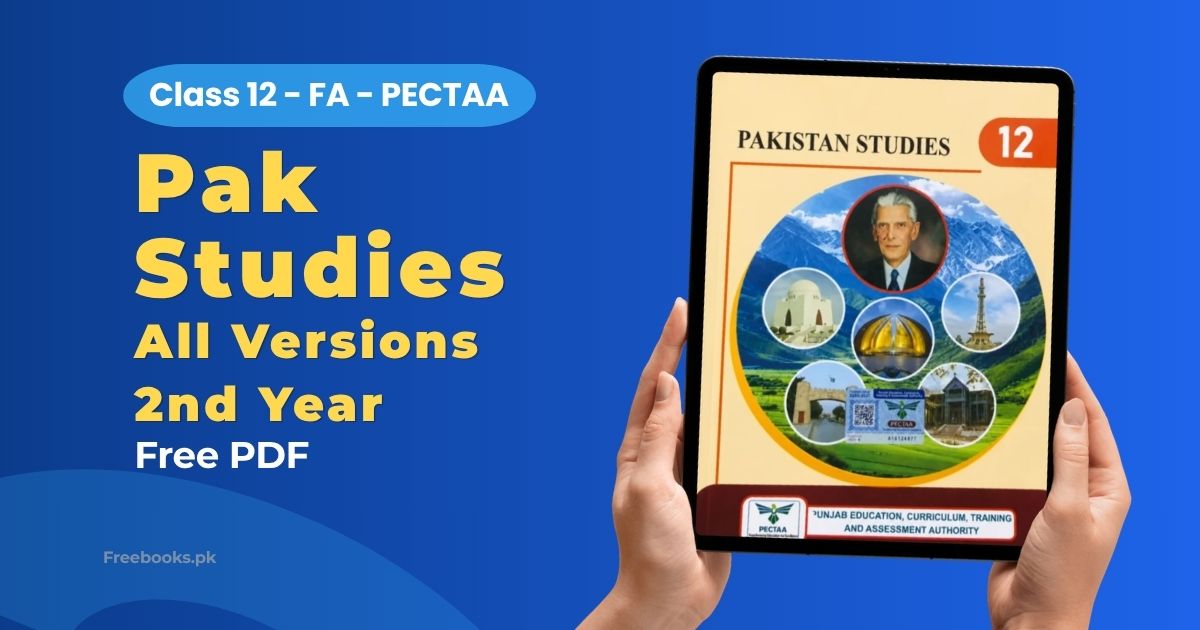
Pakistan Studies Class 12 is a compulsory subject for 2nd Year students across Punjab Board. This page now covers both the new PECTAA edition, based on the Updated National Curriculum of Pakistan 2023, and the earlier PCTB editions (2026 Experimental, 2020, and 2014) for students still following the older syllabus.
For FA, FSc, ICS, and ICOM students preparing for annual board exams, this book builds a strong foundation in Pakistan’s ideology, constitutional history, administrative system, foreign relations, education and sports, and economic resources. Chapter summaries and important questions below follow the actual content of the PECTAA edition so you can revise with confidence.
Book Overview
| Class | 12 (2nd Year) |
| Subject | Pakistan Studies |
| Category | FA, FSc, ICS, ICOM |
| Board | PECTAA (Punjab Education, Curriculum, Training and Assessment Authority) |
| Curriculum | Updated National Curriculum of Pakistan 2023 |
| Total Chapters | 6 |
| Format |
Chapter List
1. Islam and Pakistan (اسلام اور پاکستان)
This chapter explains Islam as the ideological foundation of Pakistan, covering the meaning of ideology and its roots in the Quran and Sunnah. Students study the Two-Nation Theory, the basic principles of Islam such as sovereignty of Allah, justice, equality, brotherhood, and tolerance, and the definition and duties of an Islamic welfare state modeled on the State of Madina. It also covers how Quaid-e-Azam, Allama Iqbal, and the Objectives Resolution shaped Pakistan as an Islamic state, plus Islam’s approach to modernism and religious tolerance.
Important Questions:
• What is the Two-Nation Theory? It holds that Hindus and Muslims are two separate nations, differing in religion, culture, and way of life, unable to live together as one nation.
• What did Allama Iqbal say in his 1930 Allahabad Address? He called for the Muslims of north-western India to form a separate, consolidated Muslim state.
• What did the Objectives Resolution establish about sovereignty? That sovereignty over the universe belongs to Allah alone, and government exercises it only as a sacred trust through elected representatives.
• What is meant by fair distribution of wealth in an Islamic welfare state? Wealth must not stay concentrated among a few; it should circulate so all members of society benefit and poverty is reduced.
2. Constitutional and Political Development in Pakistan (پاکستان میں آئینی اور سیاسی ترقی)
This chapter traces Pakistan’s constitutional and political journey from independence to the present, covering the framing and repeal of the 1962 Constitution, the reasons and impact of the separation of East Pakistan, and the tenures of major leaders including Zulfiqar Ali Bhutto, Zia-ul-Haq, Benazir Bhutto, Nawaz Sharif, and Pervez Musharraf. It also explains how democracy has functioned in Pakistan, the challenges it has faced, and the role of institutions like the Council of Islamic Ideology in constitutional development.
Important Questions:
• What is meant by the sovereignty of Allah in this context? It means ultimate authority over the universe belongs to Allah, and human rulers only exercise power within the limits He has set.
• Why was the 1962 Constitution repealed? Growing political unrest and demands for parliamentary democracy led to its repeal and the imposition of martial law under Yahya Khan in 1969.
• What are the functions of the Council of Islamic Ideology? It advises the government and legislature on whether laws conform to Islamic principles and recommends bringing existing laws in line with the Quran and Sunnah.
• When was the Universal Declaration of Human Rights adopted? It was adopted by the United Nations General Assembly on 10 December 1948.
3. Constitutional and Administrative System (آئینی اور انتظامی نظام)
This chapter explains how Pakistan is governed at the federal, provincial, and local levels under the 1973 Constitution. It covers the roles of the President and Prime Minister at the centre, the Chief Minister and provincial cabinet, and the civil service hierarchy from Chief Secretary down to Section Officer. Students also study the judiciary’s role in providing justice, interpreting the Constitution, giving advisory opinions, and exercising judicial review, along with how duties are divided between the federation and the provinces.
Important Questions:
• How is the Gilgit-Baltistan Council formed? It is headed by the Prime Minister of Pakistan and includes the Chief Minister and Governor of Gilgit-Baltistan along with nominated and elected members.
• Name two duties of a provincial government. Maintaining law and order within the province, and implementing provincial legislation and development schemes.
• What role does judicial review play under the 1973 Constitution? It allows courts to examine whether laws and government actions comply with the Constitution and strike down those that don’t.
• What is the role of the Chief Secretary in a province? The Chief Secretary heads the provincial civil administration and coordinates between departments and the provincial government.
4. Pakistan and International Affairs (پاکستان اور بین الاقوامی امور)
This chapter looks at Pakistan’s foreign policy and its guiding principles, along with its relations with major powers and regions: the United States, United Kingdom, China, the Central Asian states, the Organization of Islamic Cooperation, Turkiye, Middle Eastern countries, and Russia. It highlights cooperation projects like the China-Pakistan Economic Corridor (CPEC) and explains the role of international organizations such as the IMF and the European Union in Pakistan’s economic and diplomatic relationships.
Important Questions:
• What is the China-Pakistan Economic Corridor (CPEC)? A major infrastructure and economic cooperation project linking Gwadar Port to China through roads, railways, and energy projects to boost trade and regional connectivity.
• What was the purpose of creating the IMF? To promote international monetary cooperation and exchange rate stability, and to provide financial assistance to countries facing balance-of-payment problems.
• How would you define foreign policy? It is the set of strategies and principles a country uses to guide its relations and dealings with other states and international organizations.
• Name the Muslim states of Central Asia covered in this chapter. Kazakhstan, Uzbekistan, Turkmenistan, Kyrgyzstan, and Tajikistan.
5. Education, Sports and Tourism in Pakistan (پاکستان میں تعلیم، کھیل اور سیاحت)
This chapter examines Pakistan’s education system, from early childhood and primary education to technical streams like agriculture, business, IT, and teacher training, along with madrassa and distance education and the challenges the sector faces. It then turns to sports, covering their social and physical benefits and Pakistan’s standing in international sports, before connecting education and sport to the country’s tourism potential and human development.
Important Questions:
• What is the difference between professional and general education? Professional education trains students for a specific career or skill, like medicine or engineering, while general education builds broad knowledge across subjects.
• What is meant by IT education? It means teaching students about computer systems, software, and digital tools used to process, store, and communicate information.
• Give a brief introduction to the distance education system in Pakistan. It lets students study through print, broadcast, or online material without attending regular classes, making education accessible to those who cannot join a traditional campus.
• What are the mental benefits of sports? Sports reduce stress, build confidence, sharpen decision-making, and improve focus and discipline.
6. Pakistan’s Resources and Economic Development (پاکستان کے وسائل اور معاشی ترقی)
This chapter surveys Pakistan’s mineral resources, including coal, rock salt, natural gas, mineral oil, chromite, and copper, along with the challenges facing the mining industry. It then covers energy resources, dividing them into non-renewable sources like thermal and atomic power and renewable sources like hydroelectric and solar power, and connects these resources to labour force trends and overall economic development, including industry, trade, and employment.
Important Questions:
• What is meant by renewable resources of energy? Energy sources that naturally replenish, such as hydroelectric, solar, and wind power, which don’t get used up.
• Why is international trade important for a country like Pakistan? It lets Pakistan earn foreign exchange, access goods and technology it cannot produce locally, and connect its economy to global markets.
• What is meant by Special Economic Zones? Designated areas with special tax and regulatory incentives, set up to attract investment and boost industrial and export activity.
• How would you define unemployment? A situation where people who are able and willing to work cannot find suitable jobs.
Download Pakistan Studies Class 12 PDF
Four editions are available below. The PECTAA edition (2026-27) is the newest, based on the current National Curriculum 2023 — click your preferred edition to download the PDF for free.
PECTAA Edition (2026-27) — Latest, National Curriculum 2023
2026 PCTB Edition (Experimental)
2020 Edition
2014 Edition
Who Should Read This Book
This book is for all Class 12 (2nd Year) students studying Pakistan Studies as a compulsory subject under FA, FSc, ICS, ICOM, and D.Com programs at colleges affiliated with Punjab Board — whether your college has already switched to the PECTAA National Curriculum 2023 or is still following the older PCTB syllabus. It is equally useful for students preparing for annual board exams, entry tests, and CSS/PMS exams where Pakistan Studies is a key subject.
Applicable Boards
The PECTAA edition follows the Updated National Curriculum of Pakistan 2023 as adopted across Punjab colleges, while the older editions follow the PCTB syllabus. Both are used across all Punjab boards including Lahore Board, Faisalabad Board, Multan Board, Gujranwala Board, Rawalpindi Board, Bahawalpur Board, Sahiwal Board, Sargodha Board, and DG Khan Board.
FAQs
Is this Pakistan Studies book for FA, FSc, ICS, and ICOM students?
Yes, Pakistan Studies is a compulsory subject for all Class 12 (2nd Year) programs including FA, FSc, ICS, ICOM, and D.Com under Punjab Board. Both the PECTAA and PCTB editions cover the complete syllabus for these programs.
Which edition should I download?
The PECTAA edition (2026-27) is the newest and follows the National Curriculum 2023 — download this if your college has switched to it. The 2026 PCTB, 2020, and 2014 editions are for students still following the older syllabus. Check with your college to confirm which edition you need.
How many chapters are in the PECTAA edition of Pakistan Studies Class 12?
The PECTAA edition has 6 chapters: Islam and Pakistan, Constitutional and Political Development, Constitutional and Administrative System, Pakistan and International Affairs, Education, Sports and Tourism in Pakistan, and Pakistan’s Resources and Economic Development.
What’s different about the PECTAA edition compared to the older PCTB editions?
The PECTAA edition follows the Updated National Curriculum of Pakistan 2023 and reorganizes some topics — for example, it covers Pakistan’s international affairs and economic resources as dedicated chapters instead of the older ‘Human Rights’ chapter. The core themes of ideology, constitution, and governance remain similar.
Which Punjab boards can use this book?
Students from all Punjab boards — including Lahore, Faisalabad, Multan, Gujranwala, Rawalpindi, Bahawalpur, Sahiwal, Sargodha, and DG Khan — studying Pakistan Studies in Class 12 can use this book for exam preparation.
Related Books
• Urdu 2nd Year FA Book
• Akhlaqiat 2nd Year FA Book
• Mutalla Pakistan 2nd Year FA Book
• Civics 2nd Year FA Book
• Economics 2nd Year FA Book
• Health and Physical Education 2nd Year FA Book
Study Resources for Pakistan Studies 2nd Year
Free exam-preparation resources for Pakistan Studies 2nd Year from the Freebooks.pk Editorial Team — chapter-wise notes (definitions, short & long questions and MCQs), the latest paper pairing scheme. Study online or download.