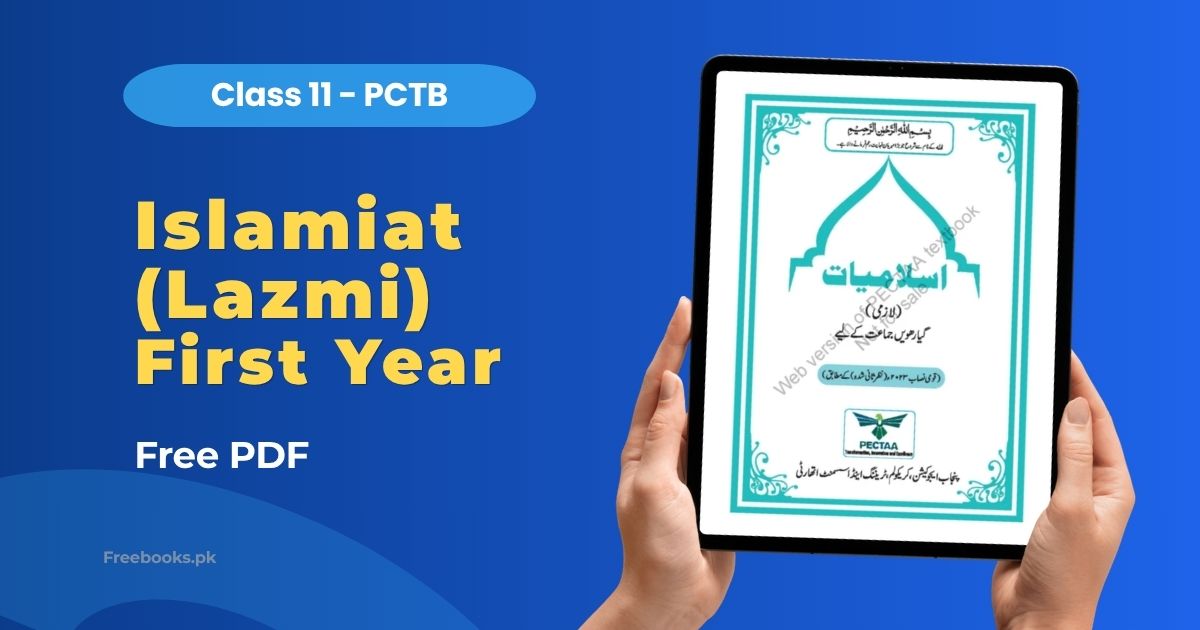
Islamiat Lazmi (Compulsory Islamiyat) for Class 11 (First Year) is published by the Punjab Education, Curriculum, Training and Assessment Authority (PECTAA). The latest edition follows the Updated/Revised National Curriculum of Pakistan 2023. This book is a compulsory subject for all FA and FSC students in Punjab Board colleges and covers Quran, Hadith, Islamic beliefs, worship, Seerat, ethics, and contemporary Islamic teachings.
For FA Part 1 students, Islamiat Lazmi is an important subject in both board exams and everyday understanding of Islamic principles. The book is structured into seven chapters covering a wide range of topics from Quranic sciences to the role of Islam in modern society. The PDF makes revision easy before board exams and helps students understand key Islamic concepts clearly.
Book Overview
| Class | 11 (FA Part 1 / First Year) |
| Subject | Islamiat Lazmi (Compulsory Islamiyat) |
| Category | FA |
| Board | Punjab Board (PECTAA, Lahore) |
| Medium | Urdu |
| Curriculum | NCP 2023 (Updated/Revised) |
| Total Chapters | 7 |
| Total Pages | 140 |
| Format |
Chapter List
Chapter 1 – Quran Majeed (Uloom-ul-Quran and Uloom-ul-Hadith) (قرآن مجید و حدیثِ نبوی)
This chapter introduces Uloom-ul-Quran and Uloom-ul-Hadith, the foundational Islamic sciences students must know for Islamiat Lazmi. It explains the Quran’s defining features, Alamgeeriyat (universality for all mankind), Kamaliyat (completeness of guidance), Jami’iyat (comprehensiveness covering beliefs, worship, ethics, and law), and Abadiyat (eternal applicability), along with its blessed names, the distinction between Makki and Madani Surahs, and Ayat-e-Ahkam (legal verses). It then defines Hadith as the Prophet’s sayings, actions, approvals, and attributes, traces the three historical periods of Hadith compilation, and introduces the Sihah Sittah and Usul-e-Arba’a hadith collections, essential for exam preparation.
Important Questions:
- What is meant by “Alamgeeriyat” (universality) of the Holy Quran? It means the Quran’s message is addressed to the whole of humanity, unlike earlier revealed books which were sent for a specific nation, region, or race.
- According to the chapter, what is Hadith? Hadith refers to the saying (Qaul), action (Fe’l), tacit approval (Taqreer), or physical/moral attribute (Sifat) of Prophet Muhammad (peace be upon him).
- Name any two of the six authentic hadith collections known as “Sihah Sittah,” along with their compilers. Sahih Bukhari, compiled by Muhammad bin Ismail al-Bukhari, and Sahih Muslim, compiled by Muslim bin Hajjaj al-Qushayri, are two of the Sihah Sittah; the set also includes Jami Tirmidhi, Sunan Abu Dawood, Sunan an-Nasa’i, and Sunan Ibn Majah.
- What is meant by “Ayat-e-Ahkam” in the Quran? Ayat-e-Ahkam are the verses of the Quran that state the injunctions and laws of Islamic Shariah, covering worship, transactions, ethics, economics, social matters, and penal laws, and jurists use them as the basis of Islamic law.
Chapter 2 – Imanyaat wa Ibaadaat (Beliefs and Worship) (ایمانیات و عبادات)
This chapter explains the core Islamic beliefs (Imaniyat) and acts of worship (Ibadaat) forming a Muslim’s faith. It covers Tauheed, Allah’s oneness in Zaat, Sifaat, Ruboobiyat, Uluhiyat, and worship, and its opposite, Shirk; Risalat, revelation (Wahi), and Prophet Muhammad’s (PBUH) unique features including Khatm-e-Nubuwwat; belief in angels (Malaika) and their duties; belief in the revealed scriptures (Tauraat, Zaboor, Injeel, Quran); belief in the Hereafter (Akhirat), Qiyamah, Mizan, Pul-Sirat, Shafa’at; and the pillars of worship, Salah, Zakat, Saum, and Hajj/Qurbani, with their conditions and wisdom, all essential exam topics.
Important Questions:
- Write the meaning and concept of Tauheed. Tauheed means believing that Allah alone is one and unique in His Being (Zaat), attributes (Sifaat), lordship (Ruboobiyat), divinity (Uluhiyat), and worship, with absolutely no partner in any of these.
- What is meant by the belief in Khatm-e-Nubuwwat (Finality of Prophethood)? It means the chain of prophethood that began with Prophet Adam (AS) ended with Prophet Muhammad (PBUH), the last prophet, after whom no prophet will come, affirmed in Surah Al-Ahzab (33:40) and in the hadith “I am the last of the prophets; there is no prophet after me” (Sahih Bukhari: 3535).
- What is meant by belief in angels (Iman bil-Malaika)? It is the belief that angels are a creation of Allah made from light who never disobey Him and always carry out whatever He commands, such as recording human deeds, delivering revelation, and protecting believers.
- State the philosophy (falsafa) of Qurbani (animal sacrifice). The philosophy of Qurbani is that, in seeking Allah’s nearness on the days of Eid-ul-Adha, a Muslim sacrifices a specified animal following the Sunnah of Prophet Ibrahim (AS), pledging readiness to sacrifice even one’s own life in Allah’s way if required.
Chapter 3 – Seerat-e-Tayyaba (Importance of the Prophet’s Life) (سیرتِ طیبہ کی اہمیت)
This chapter, Seerat-e-Tayyaba, examines four dimensions of the Prophet Muhammad’s blessed life as the perfect exemplar (uswa-e-hasana): head of family, head of state, military commander, and economic teacher. Students learn how he treated wives, children, and elders with justice and affection; founded the State of Madinah through Mawakhat-e-Madinah and Mesaq-e-Madinah (the Pact of Madinah); led about 28 battles while preferring peace, consultation (shura), and humane rules of war; and taught lawful earning through trade, agriculture, and craftsmanship while condemning hoarding of wealth and riba (interest). These themes are frequently tested in exams.
Important Questions:
- In light of a saying of the Prophet, write two etiquettes of eating. Say Bismillah before eating and eat with the right hand from what is directly in front of you, as the Prophet advised his stepson Umar bin Abi Salama (RA).
- During the Prophet’s era, how much salary did state employees receive from the Bait-ul-Mal (public treasury)? They were paid only enough to meet their basic needs, not more, since the Prophet taught that holding office is a responsibility rather than a privilege.
- In light of the Prophet’s example as a military leader, what is the purpose of jihad fi sabilillah? Its purpose is i’la-e-kalimatillah, raising the word of Allah, not acquiring territory, wealth, or captives; the chapter distinguishes this from terrorism, which targets people out of personal gain or fear-mongering.
- Explain how concentration of wealth (irtikaz-e-daulat) causes corruption in the economic system. It occurs when wealth is accumulated in a few hands and its benefits fail to reach the rest of society; the Quran (Surah At-Tawbah 9:34) warns of a painful punishment for those who hoard gold and silver without spending it in Allah’s way.
Chapter 4 – Akhlaq wa Aadaab (Ethics and Conduct) (اخلاق و آداب)
Chapter 4, Akhlaq-o-Adaab, covers Islamic social ethics in three parts: collective well-wishing (ijtimai khairkhwahi) and respect for humanity (ehtiram-e-insaniyat), grounded in Quranic verses, the Prophet’s Farewell Sermon, and examples from Abu Bakr, Umar, Hasan and Husain (RA); avoidance of moral vices, prejudice (ta’assub), self-conceit (khud-pasandi), foul speech (fahash-goi), intoxicant use, and bribery/corruption (rishwat-sitani wa bad-unwani); and etiquette of social relations covering family, neighbors, non-Muslims, and modern social media conduct. Students should know these key terms, their Quranic/Hadith basis, and their social benefits, all commonly tested in exams.
Important Questions:
- According to a Hadith cited in the chapter, religion (Deen) is described as the name of what? Deen is described as “naseehah,” meaning sincere well-wishing (khairkhwahi), as stated in the Hadith from Sahih Muslim.
- Explain the meaning of Ehtiram-e-Insaniyat (respect for humanity) as given in the chapter. It means honoring and respecting all human beings simply because they are human, since Allah has granted dignity to the children of Adam, and treating everyone well is part of this respect.
- What does the chapter say the Quran states about people who love to be praised for self-conceit (khud-pasandi)? The Quran condemns those who love to be praised for deeds they did not actually do, warning that such people should not think they will escape punishment.
- What does the chapter identify as the basic unit of society? The family (khandan) is identified as the basic unit of society, with family and neighborly ties described as the foundation of strong social relations.
Chapter 5 – Husn-e-Muamlaat wa Muasharat (Social Relations) (حسنِ معاملات و معاشرت)
This chapter, Husn-e-Muamlaat wa Muasharat (Good Social Conduct and Dealings), covers Huqooq-ul-Ibaad (rights of others), teaching that Allah may forgive lapses in Huqooq Allah (prayer, fasting, zakat, hajj) but not Huqooq-ul-Ibaad unless the wronged person forgives. It details rights of teachers, support staff, spouses, children, and widows. It explains Islamic inheritance (wirasat) rules, the concept of wasiyat (will, limited to one-third of estate), and marriage and divorce teachings: nikah as a social contract, mahr (dower), prohibited relations (haram nikah), khula, talaq types (raji, bain, mughallazah), and iddat periods. These are key testable terms and concepts for exams.
Important Questions:
- According to Hadith, what words were on the Prophet Muhammad’s tongue at the time of his passing? To be mindful of prayer and to fear Allah regarding one’s subordinates/dependents (as narrated in Sunan Abi Dawood: 4889).
- What is a widow’s (bewah’s) iddat period if she is not pregnant? Four months and ten days; if she is pregnant, her iddat lasts until the delivery of the child.
- What is the maximum portion of a person’s estate that can be allocated through a wasiyat (will)? A wasiyat cannot exceed one-third of the deceased’s property, and it cannot be made in favor of legal heirs (warathaa).
- What is the difference between talaq raji and talaq bain? In talaq raji, reconciliation (rujoo) is possible during the iddat period, while in talaq bain the nikah is dissolved and a fresh nikah (tajdeed-e-nikah) is required to reconcile.
Chapter 6 – Taareekh ke Aaine Mein Islam (Islam Through History) (ہدایت کے سرچشمے اور مشاہیرِ اسلام)
Chapter 6 examines three sources of guidance in Islam: Khilafat-e-Rashida, the Ahl-e-Bait, and Sufi saints. It covers the roughly thirty-year rule of the four Rightly Guided Caliphs, Abu Bakr, Umar, Uthman, and Ali (RA), highlighting public welfare, trustworthiness (amanat), justice, jihad, kind treatment of non-Muslims, and self-accountability (ihtisab). It then traces the twelve Ahl-e-Bait imams, from Ali (RA) to Imam Muhammad Mahdi, detailing their piety and scholarship. Finally, it profiles two Sufi saints, Pir Syed Mehr Ali Shah of Golra and Mian Sher Muhammad Sharaqpuri, emphasizing tasawwuf, tazkiya-e-nafs, adherence to Sunnah, and defense of Khatm-e-Nubuwwat.
Important Questions:
- What does the word “Khilafat” literally mean, and what is a caliph’s basic responsibility in Islam? Khilafat literally means “successorship,” and a khalifa is a successor or deputy. In Islam, the caliph’s basic responsibility is “Iqamat-e-Deen” (establishing the religion), upholding the pillars of Islam, jihad, ensuring justice, education, and building a welfare state.
- Before whose court did Hazrat Umar Farooq (RA) appear as a litigant, and what did the incident show? He appeared before the court of Hazrat Zaid bin Thabit (RA), the qazi of Madinah; when the qazi rose in respect, Umar (RA) objected, calling it the first injustice in that case, showing that even the caliph was equal before the law.
- What is the name of the book of prayers attributed to Imam Zain-ul-Abideen (RA)? It is known as “Sahifa Sajjadiya.”
- Where was Pir Syed Mehr Ali Shah (RA) born, and which book did he write in defense of the belief in Khatm-e-Nubuwwat (finality of Prophethood)? He was born in Golra, near Islamabad, in 1859; he wrote “Saif-e-Chishtiyan” to defend the belief of Khatm-e-Nubuwwat.
Chapter 7 – Islami Talimaat aur Asr-e-Hazir (Islamic Teachings in the Modern Age) (اسلامی تعلیمات اور عصرِ حاضر کے تقاضے)
This chapter explains how Islamic teachings meet the needs of the modern age through three sub-topics: adherence to law (qanun ki pasdari), signs of establishing the Islamic system, and Islamophobia. It presents rule of law as the guarantor of social peace and justice, citing Quran 4:59 on obeying Allah, the Prophet, and those in authority, plus examples of Abu Bakr and Umar (RA) submitting themselves to accountability. It highlights planning, self-reliance (khud inhesari), and beneficial knowledge (ilm-e-nafi) through Yusuf (AS), Ghazwa-e-Khandaq, and scientists like Khwarizmi. It also defines Islamophobia and explains Pakistan’s Paigham-e-Pakistan initiative and youth responsibilities.
Important Questions:
- What does “adherence to the law” (qanun ki pasdari) mean, and why does it matter for a society? It means following a society’s code of life and conduct in every aspect of life; the chapter states that a society’s welfare and prosperity depend on how sound its laws are and how strictly its people follow them, bringing peace, justice, and protection of rights.
- According to the hadith cited in the chapter, what did the Prophet say caused the destruction of Bani Isra’il? He said they were destroyed because they let the powerful/elite go free of punishment while punishing the weak, showing unequal application of the law (Sunan an-Nasa’i: 4901).
- What is meant by “khud inhesari” (self-reliance) as discussed in the chapter? It means a person should work hard and strive through his own effort rather than depending on others, supported by the Quranic verses that man gets nothing but what he strives for (Surah an-Najm: 39) and that Allah does not change a people’s condition until they change it themselves (Surah ar-Ra’d: 11).
- What is Islamophobia, and what initiative did Pakistan take against it? Islamophobia is an irrational, exaggerated fear and prejudice toward Islam and Muslims, rooted in hostility and negative feelings about Muslim culture and beliefs; Pakistan launched “Paigham-e-Pakistan” (2018) with a unified fatwa clarifying jihad and condemning terrorism, and in 2024 got the UN General Assembly to pass a resolution against hatred toward Muslims, building on the UN’s International Day to Combat Islamophobia (March 15), declared after the 2019 Christchurch mosque attacks.
Download Islamiat Lazmi 1st Year Book PDF
Two editions are available below. Click the button for the edition you need — each opens in a new tab and is ready to read or save on any device.
Latest Edition (NCP 2023 — PECTAA)
⬇ Download PDF (Latest)2020 Edition
⬇ Download PDF (2020)Who Should Read This
This book is for FA Part 1 (First Year) students in Punjab Board colleges where Islamiat Lazmi is a compulsory subject. FSC students also study the same Islamiat Lazmi book. It is useful for any student who wants to strengthen their understanding of Islamic beliefs, ethics, Seerah, and contemporary Islamic issues.
Applicable Boards
This textbook is published by PECTAA and is used in Punjab Board colleges. Students from the Federal Board (FBISE) and AJK Board can also use it for reference, as the Islamiat Lazmi syllabus is largely the same across boards. The subject content also aligns well with other provincial board syllabi.
FAQs
Is this Islamiat Lazmi book for FA Part 1 Punjab Board?
Yes. This is the compulsory Islamiat (Lazmi) textbook for FA and FSC Part 1 (First Year) students in Punjab Board colleges, published by PECTAA.
Is the same book used for FSC students?
Yes. Islamiat Lazmi is a compulsory subject for both FA and FSC students. Both use the same textbook.
How many chapters are in Islamiat Lazmi Class 11?
There are 7 chapters covering Quran and Hadith sciences, Islamic beliefs and worship, Seerah, ethics, social relations, Islamic history, and contemporary Islamic teachings.
What is the difference between the 2020 and latest editions?
The latest edition follows the Updated/Revised NCP 2023 curriculum approved by PECTAA. The 2020 edition follows the earlier curriculum. Students should download the edition matching their college syllabus.
Can Federal Board students use this book?
Yes. The Islamiat Lazmi syllabus is very similar for Punjab and Federal boards. Federal Board students can use this book for additional reference and revision.
Is the PDF free to download?
Yes. Both editions of the Islamiat Lazmi 1st Year book PDF are completely free to download and read on any device.
Does this book cover the Rightly Guided Caliphs and Sufi saints?
Yes. Chapter 6 covers the Khilafat-e-Rashida (the four Rightly Guided Caliphs), the twelve Ahl-e-Bait imams, and notable Sufi saints such as Pir Syed Mehr Ali Shah and Mian Sher Muhammad Sharaqpuri.
Related Books
- English 1st Year FA Book
- English Grammar & Composition 1st Year FA Book
- Urdu 1st Year FA Book
- Akhlaqiat 1st Year FA Book
- Civics 1st Year FA Book
- Farsi 1st Year FA Book
Study Resources for Islamiat 1st Year
Free exam-preparation resources for Islamiat 1st Year from the Freebooks.pk Editorial Team — the latest paper pairing scheme. Study online or download.