
Mensuration is the measurement of lengths, areas and volumes. Unit 10 starts with Pythagoras theorem for right-angled triangles, then moves to the parts of a circle, the length of an arc and the area of a sector.
The second half deals with solid shapes: the surface area and volume of a pyramid, sphere, hemisphere and cone, and of composite solids made by joining these shapes. Unless told otherwise, these notes take π = 22/7.
Learning Objectives
- State Pythagoras theorem and use it to find a missing side of a right-angled triangle.
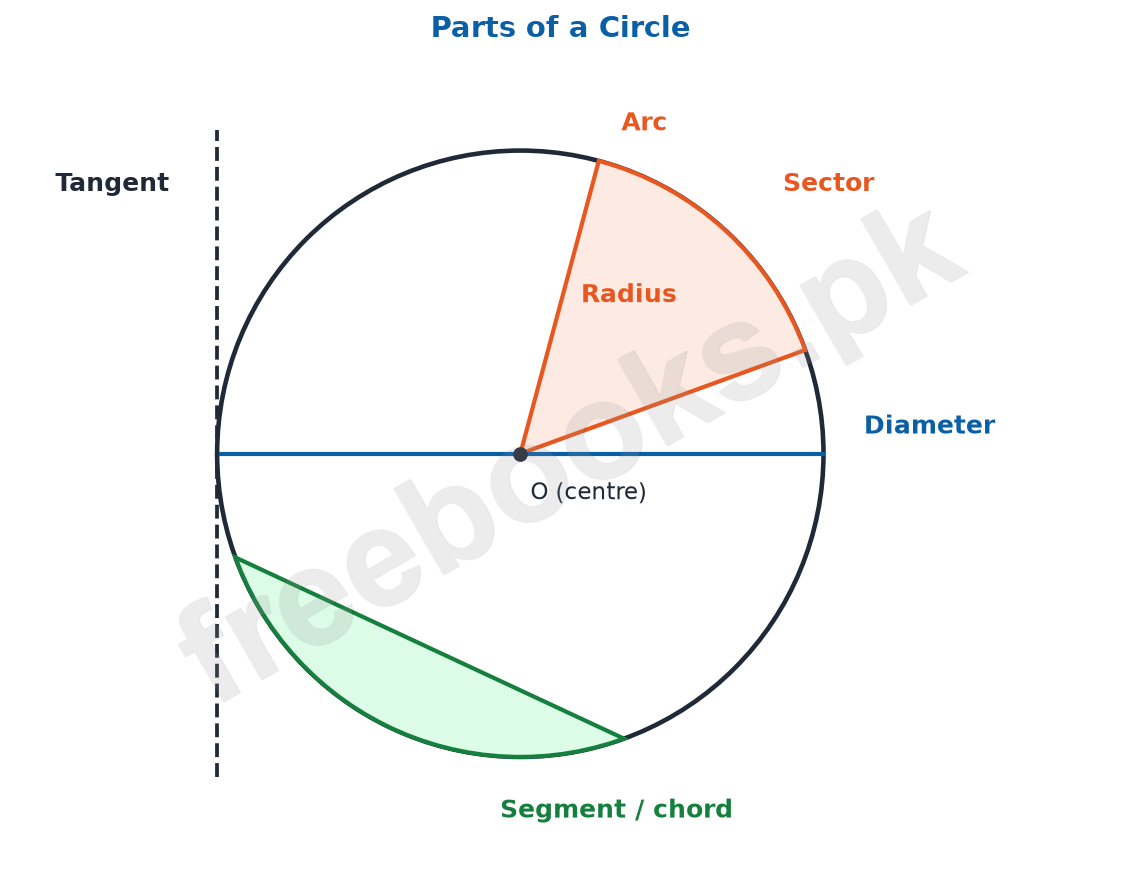
- Identify the parts of a circle: radius, diameter, chord, arc, sector, segment and tangent.
- Calculate the length of an arc and the area of a sector.
- Find the surface area and volume of a pyramid.
- Find the surface area and volume of a sphere, hemisphere and cone.
- Solve problems on composite solids.
Key Concepts
10.1 Pythagoras Theorem
In a right-angled triangle, the square of the hypotenuse equals the sum of the squares of the other two sides: c² = a² + b², where c is the side opposite the right angle.
Example: legs 6 cm and 8 cm give c = √(36 + 64) = √100 = 10 cm. To find a leg, subtract: a = √(c² − b²).
Sets of whole numbers that satisfy the theorem are called Pythagorean triples: (3, 4, 5), (5, 12, 13), (8, 15, 17). The converse is also true: if c² = a² + b², the triangle is right-angled.
10.2 Circle, Arc and Sector
Radius: centre to the circle. Diameter: a chord through the centre (d = 2r). Chord: a segment joining two points on the circle. Arc: a part of the circumference. Sector: the region between two radii and an arc. Segment: the region between a chord and an arc. Tangent: a line touching the circle at one point.
Circumference = 2πr and area = πr².
For a central angle x°: arc length L = (x/360) × 2πr and sector area A = (x/360) × πr². For r = 7 cm and x = 90°: L = ¼ × 44 = 11 cm and A = ¼ × 154 = 38.5 cm².
10.3 Pyramid
A pyramid has a polygon base and triangular faces meeting at a point called the apex. The height h is the perpendicular from the apex to the base; the slant height l is the height of a triangular face.
Surface area = base area + area of all triangular faces, each face = ½ × base edge × slant height. Volume = ⅓ × base area × h.
Example: square base 12 cm, height 8 cm. Slant height l = √(8² + 6²) = 10 cm. Faces = 4 × ½ × 12 × 10 = 240 cm²; total surface = 240 + 144 = 384 cm². Volume = ⅓ × 144 × 8 = 384 cm³.
10.4 Sphere and Hemisphere
Sphere: surface area = 4πr²; volume = (4/3)πr³. For r = 7 cm: surface = 616 cm² and volume ≈ 1437.33 cm³.
A hemisphere is half a sphere. Curved surface = 2πr²; total surface (with the flat circle) = 3πr²; volume = (2/3)πr³. For r = 7 cm: curved 308 cm², total 462 cm², volume ≈ 718.67 cm³.
10.5 Cone
A cone has a circular base and an apex. Radius r, height h and slant height l are related by l² = r² + h².
Curved surface = πrl; total surface = πr(r + l); volume = ⅓πr²h.
Example: r = 7 cm, h = 24 cm, so l = 25 cm. Curved surface = 22/7 × 7 × 25 = 550 cm²; total = 22/7 × 7 × 32 = 704 cm²; volume = ⅓ × 22/7 × 49 × 24 = 1232 cm³.
10.6 Composite Solids
A composite solid is made by joining simple solids. Add the volumes of the parts. For surface area, add only the outside surfaces and leave out joined faces.
Example: a cone of radius 7 cm and height 6 cm on a hemisphere of radius 7 cm. Volume = 308 + 718.67 ≈ 1026.67 cm³.
Important Definitions
Hypotenuse
The longest side of a right-angled triangle, opposite the right angle.
Pythagorean triple
Three whole numbers a, b, c with a² + b² = c².
Chord
A line segment joining two points on a circle.
Arc
A part of the circumference of a circle.
Sector
The region bounded by two radii and an arc.
Segment
The region bounded by a chord and an arc.
Tangent
A line that touches a circle at exactly one point.
Apex
The top point of a pyramid or cone.
Slant height
The distance from the apex down the slanting surface to the base edge.
Hemisphere
Half of a sphere cut through its centre.
Composite solid
A solid made by combining two or more simple solids.
Key Facts at a Glance
| Quantity | Formula |
|---|---|
| Pythagoras | c² = a² + b² |
| Arc length | (x/360) × 2πr |
| Sector area | (x/360) × πr² |
| Pyramid surface area | Base + Σ ½ × edge × slant height |
| Pyramid volume | ⅓ × base area × h |
| Sphere surface area | 4πr² |
| Sphere volume | (4/3)πr³ |
| Hemisphere total surface | 3πr² |
| Hemisphere volume | (2/3)πr³ |
| Cone slant height | l² = r² + h² |
| Cone surfaces | Curved πrl; total πr(r + l) |
| Cone volume | ⅓πr²h |
Diagrams
Pythagoras theorem: A right-angled triangle with squares on each side showing c² = a² + b².

Parts of a circle: A circle labelled with radius, diameter, chord, arc, sector, segment and tangent.
Solids and formulas: A pyramid, sphere, hemisphere and cone with their surface area and volume formulas.

Short Questions and Answers
State Pythagoras theorem.
In a right-angled triangle, hypotenuse² = sum of squares of the other two sides.
Find the hypotenuse if the legs are 5 cm and 12 cm.
√169 = 13 cm.
A ladder 17 m long reaches 15 m up a wall. How far is its foot from the wall?
√(289 − 225) = 8 m.
Are 7, 24, 25 the sides of a right triangle?
Yes: 49 + 576 = 625.
What is the difference between a chord and a diameter?
A diameter is a chord that passes through the centre.
Find the arc length for r = 14 cm, x = 45°.
⅛ × 2 × 22/7 × 14 = 11 cm.
Find the sector area for r = 14 cm, x = 60°.
⅙ × 22/7 × 196 ≈ 102.67 cm².
Find the volume of a pyramid with base area 50 cm² and height 9 cm.
⅓ × 50 × 9 = 150 cm³.
Find the slant height of a square pyramid of base 10 cm and height 12 cm.
√(144 + 25) = 13 cm.
Find the surface area of a sphere of radius 14 cm.
4 × 22/7 × 196 = 2464 cm².
Find the volume of a sphere of radius 3 cm (π = 3.14).
4/3 × 3.14 × 27 = 113.04 cm³.
Find the total surface of a hemisphere of radius 14 cm.
3 × 22/7 × 196 = 1848 cm².
Find the slant height of a cone with r = 6 cm, h = 8 cm.
10 cm.
Find the curved surface of a cone with r = 7 cm, l = 10 cm.
22/7 × 7 × 10 = 220 cm².
Find the volume of a cone with r = 3 cm, h = 7 cm.
⅓ × 22/7 × 9 × 7 = 66 cm³.
Long Questions and Answers
State and apply Pythagoras theorem.
State the theorem.
In a right-angled triangle, c² = a² + b², where c is the hypotenuse.
Find the missing leg if c = 26 cm and a = 10 cm.
b = √(676 − 100) = √576 = 24 cm.
Find the diagonal of a rectangle 9 cm by 12 cm.
√(81 + 144) = √225 = 15 cm.
What is the converse?
If the square of one side equals the sum of the squares of the other two, the triangle is right-angled.
Explain arc length and sector area.
What fraction of the circle is a sector?
x/360 of the whole circle, where x is the central angle.
Write the formulas.
L = (x/360) × 2πr and A = (x/360) × πr².
Find L and A for r = 21 cm, x = 120°.
L = ⅓ × 132 = 44 cm; A = ⅓ × 1386 = 462 cm².
Find the perimeter of that sector.
44 + 21 + 21 = 86 cm.
Find the surface area and volume of a pyramid.
Describe a square pyramid.
A square base with four triangular faces meeting at the apex.
Base 16 cm, height 6 cm: find the slant height.
√(6² + 8²) = 10 cm.
Find its total surface area.
Faces 4 × ½ × 16 × 10 = 320 cm²; base 256 cm²; total 576 cm².
Find its volume.
⅓ × 256 × 6 = 512 cm³.
Explain the sphere and the hemisphere.
Formulas for a sphere
Surface area 4πr² and volume (4/3)πr³.
Formulas for a hemisphere
Curved 2πr², total 3πr², volume (2/3)πr³.
A ball has radius 21 cm. Find its surface area.
4 × 22/7 × 441 = 5544 cm².
Find the volume of a hemispherical bowl of radius 21 cm.
2/3 × 22/7 × 9261 = 19404 cm³.
Find the surface area and volume of a cone.
How are r, h and l related?
l² = r² + h², by Pythagoras theorem.
For r = 5 cm and h = 12 cm, find l.
l = 13 cm.
Find its curved and total surface (π = 3.14).
Curved 3.14 × 5 × 13 = 204.1 cm²; total 3.14 × 5 × 18 = 282.6 cm².
Find its volume.
⅓ × 3.14 × 25 × 12 = 314 cm³.
Solve a problem on a composite solid.
Describe the solid.
A toy is a cone of radius 7 cm and height 24 cm standing on a hemisphere of the same radius.
Volume of the cone
⅓ × 22/7 × 49 × 24 = 1232 cm³.
Volume of the hemisphere
2/3 × 22/7 × 343 ≈ 718.67 cm³.
Total volume and outer surface
Volume ≈ 1950.67 cm³; surface = cone curved 550 + hemisphere curved 308 = 858 cm².
Multiple Choice Questions (MCQs)
In a right triangle, the longest side is the: (A) Base (B) Perpendicular (C) Hypotenuse (D) Median
Correct answer: (C) Hypotenuse. Opposite the right angle.
Legs 9 and 12 give hypotenuse: (A) 13 (B) 15 (C) 21 (D) 17
Correct answer: (B) 15. √225.
Which is a Pythagorean triple? (A) (2, 3, 4) (B) (4, 5, 6) (C) (8, 15, 17) (D) (6, 7, 8)
Correct answer: (C) (8, 15, 17). 64 + 225 = 289.
A chord through the centre is a: (A) Radius (B) Diameter (C) Tangent (D) Arc
Correct answer: (B) Diameter. Longest chord.
Region between two radii and an arc: (A) Segment (B) Sector (C) Chord (D) Tangent
Correct answer: (B) Sector. Sector.
Arc length formula is: (A) (x/360)πr² (B) (x/360)2πr (C) 2πr² (D) πr/x
Correct answer: (B) (x/360)2πr. Fraction of circumference.
Volume of a pyramid: (A) Base × h (B) ½ × base × h (C) ⅓ × base × h (D) ¼ × base × h
Correct answer: (C) ⅓ × base × h. One third.
Surface area of a sphere: (A) 2πr² (B) 3πr² (C) 4πr² (D) πr²
Correct answer: (C) 4πr². 4πr².
Volume of a sphere: (A) (4/3)πr³ (B) (2/3)πr³ (C) ⅓πr³ (D) 4πr³
Correct answer: (A) (4/3)πr³. (4/3)πr³.
Total surface of a hemisphere: (A) 2πr² (B) 3πr² (C) 4πr² (D) πr²
Correct answer: (B) 3πr². 2πr² + πr².
Curved surface of a cone: (A) πrh (B) πrl (C) 2πrl (D) πr²
Correct answer: (B) πrl. πrl.
Volume of a cone: (A) πr²h (B) ⅓πr²h (C) ½πr²h (D) (4/3)πr²h
Correct answer: (B) ⅓πr²h. One third of cylinder.
Cone with r = 3, h = 4 has slant height: (A) 5 (B) 7 (C) 6 (D) 12
Correct answer: (A) 5. √25.
Sector area for x = 180° is: (A) πr² (B) ½πr² (C) ¼πr² (D) 2πr²
Correct answer: (B) ½πr². Half the circle.
A line touching a circle at one point is a: (A) Chord (B) Secant (C) Tangent (D) Radius
Correct answer: (C) Tangent. Tangent.
Quick Revision Summary
- c² = a² + b²; triples (3,4,5), (5,12,13), (8,15,17).
- Arc L = (x/360)2πr; sector A = (x/360)πr².
- Pyramid: SA = base + triangular faces; V = ⅓ × base × h; slant from Pythagoras.
- Sphere 4πr², (4/3)πr³; hemisphere 2πr² / 3πr², (2/3)πr³.
- Cone l² = r² + h²; curved πrl; total πr(r + l); V = ⅓πr²h.
- Composite: add volumes; count only outer surfaces.
Exam Tips
- Draw and label a sketch before using any formula.
- Check whether the question uses π = 22/7 or 3.14.
- Use the slant height for surface area and the vertical height for volume.
- Write units: cm for length, cm² for area, cm³ for volume.
- Choose r as a multiple of 7 when estimating with 22/7 to keep working simple.