Chapter 5 explains how the body’s parts work together and respond to changes around and inside it. Two systems do this job: the nervous system, which sends fast electrical messages along neurons, and the endocrine system, which sends slower chemical messages (hormones) through the blood.
These notes cover the five parts of a coordinated action, the structure and types of neurons, synapses and neurotransmitters, the central and peripheral nervous systems, the parts of the brain and spinal cord, somatic and autonomic systems, the reflex arc, and the major endocrine glands and their hormones, including diabetes and blood glucose testing.
Learning Objectives
- State the five components of a coordinated action with examples.
- Describe the structure of a neuron and name the three types of neurons.
- Explain how a nerve impulse crosses a synapse.
- Describe the parts of the CNS and PNS and their functions.
- Explain the reflex arc using the example of touching a hot object.
- Name the major endocrine glands, their hormones and their functions.
Key Concepts
Coordinated Action
Coordination means the working together of different body parts in response to stimuli. A coordinated action has five components: stimulus, receptor, coordinator, effector and response.
A stimulus is any change inside or outside the body that can produce a response, such as light, sound, heat, touch or infection. Receptors (such as the eyes, ears or skin) detect stimuli. Coordinators (the brain and spinal cord in nervous coordination, endocrine glands in chemical coordination) process the information. Effectors (muscles and glands) carry out the response, for example pulling the hand away from a flame.
5.1 Neurons
Neurons (nerve cells) carry messages as nerve impulses: waves of electrochemical change travelling along the neuron’s membrane.
A neuron has a cell body containing the nucleus; short branched dendrites that carry impulses towards the cell body; and a long axon that carries impulses away from it to other neurons, muscles or glands.
Supporting cells called neuroglia help neurons. Schwann cells wrap many axons in a fatty myelin sheath, which has gaps called nodes of Ranvier. Impulses jump from node to node, so myelinated axons conduct much faster than non-myelinated ones. In the CNS, myelinated axons form white matter; cell bodies, dendrites and non-myelinated axons form grey matter.
Sensory neurons carry impulses from receptors to the CNS; inter-neurons, inside the brain and spinal cord, pass impulses from sensory to motor neurons; motor neurons carry impulses from the CNS to effectors. Groups of cell bodies outside the CNS are called ganglia.
5.1 Synapse, Neurotransmitters and Nerves
A synapse is a tiny gap between two neurons or between a neuron and an effector cell. The impulse cannot jump this gap. When it reaches the axon ending, chemicals called neurotransmitters are released; they cross the gap and bind to the next cell, starting a new impulse there. Examples are acetylcholine, dopamine and serotonin.
A nerve is a bundle of axons wrapped in connective tissue. Sensory nerves contain only sensory axons, motor nerves only motor axons, and mixed nerves contain both.
5.2 Central Nervous System: the Brain
The CNS is the brain and spinal cord. The brain lies inside the cranium, covered by three membranes called meninges. Its cavities (ventricles) and the central canal of the spinal cord contain cerebrospinal fluid (CSF).
Forebrain: the cerebrum is the largest part, divided into right and left hemispheres; each hemisphere controls the opposite side of the body. Its folded outer cortex is grey matter, with white matter beneath. Each hemisphere has four lobes: frontal (thinking, judgement, speech, movement), parietal (touch and language), temporal (hearing, memory, learning, feelings) and occipital (vision). The thalamus relays sensory information to the cerebrum and is involved in pain and consciousness. The almond-sized hypothalamus regulates body temperature, hunger, thirst, sleep and emotions and controls the pituitary gland.
Midbrain: links the forebrain and hindbrain, relays information between them, helps adjust movements, and is involved in alertness, sleep and wakefulness.
Hindbrain: the medulla oblongata controls heartbeat, breathing and blood pressure and reflexes such as coughing, sneezing and vomiting; the cerebellum, the second largest part, coordinates balance and muscle movement; the pons connects the spinal cord, cerebellum and cerebrum and helps regulate sleep. The medulla, pons and midbrain together form the brain stem.
5.2 Spinal Cord and PNS
The spinal cord runs from the brain down the back inside the vertebral column, covered by meninges. Its outer part is white matter and its central butterfly-shaped part is grey matter around the central canal. It carries impulses between the brain and body and is the coordinating centre for simple reflexes.
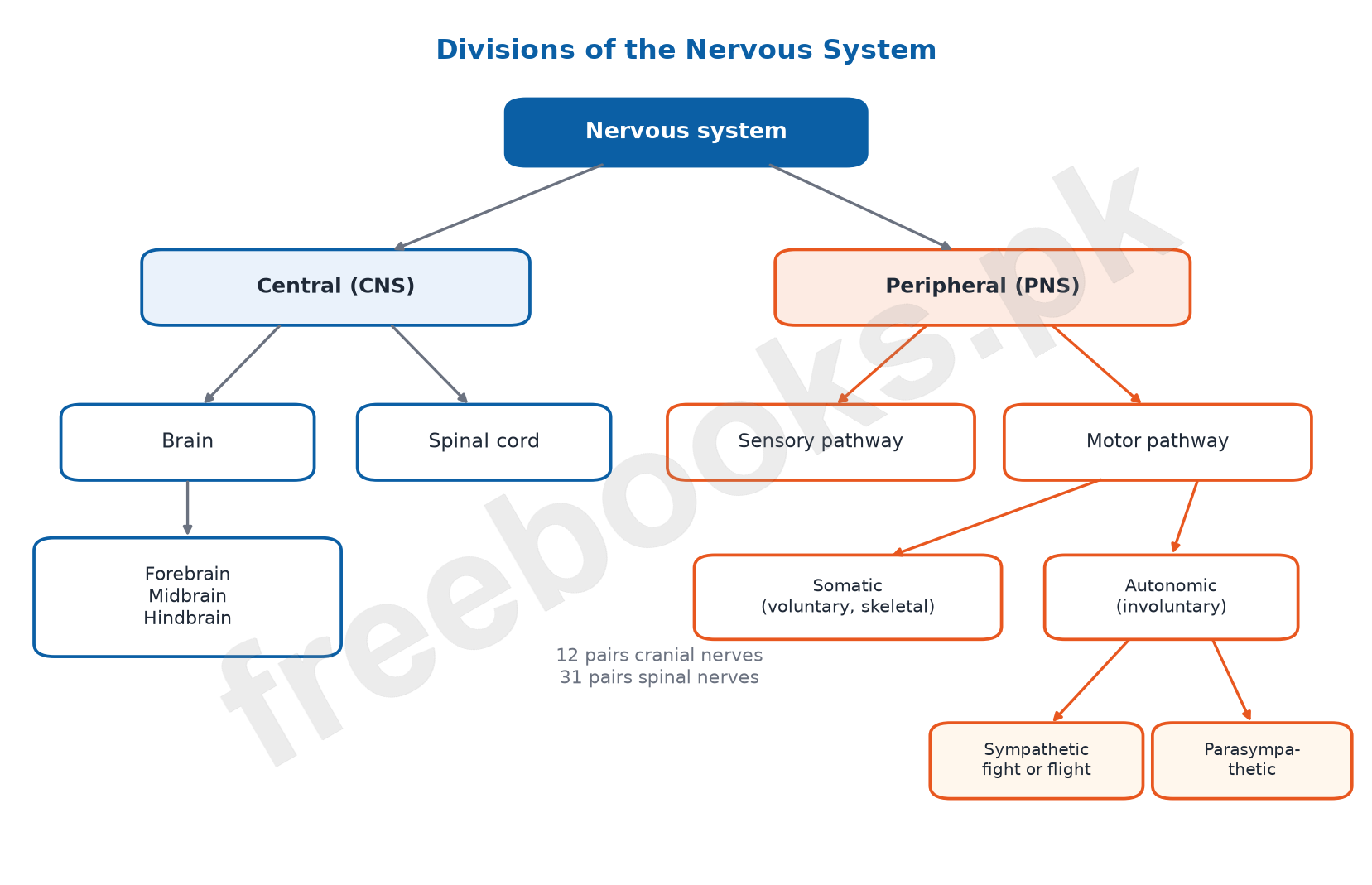
The PNS consists of nerves and ganglia: 12 pairs of cranial nerves (sensory, motor or mixed) and 31 pairs of spinal nerves (all mixed). Each spinal nerve has a dorsal root carrying sensory axons, with a ganglion of cell bodies, and a ventral root carrying motor axons.
The somatic nervous system controls voluntary actions of skeletal muscles. The autonomic nervous system controls cardiac muscle, smooth muscle and glands without conscious control. Its sympathetic division prepares the body for emergencies (‘fight or flight’: pupils widen, heart and breathing speed up, digestion slows); its parasympathetic division restores calm (‘rest and digest’: pupils narrow, digestion resumes, heart rate returns to normal).
5.2 Reflex Action
A reflex action is a rapid, automatic, involuntary response to a stimulus. The pathway of neurons used in a reflex is a reflex arc. Voluntary actions, in contrast, are controlled consciously by the cerebrum.
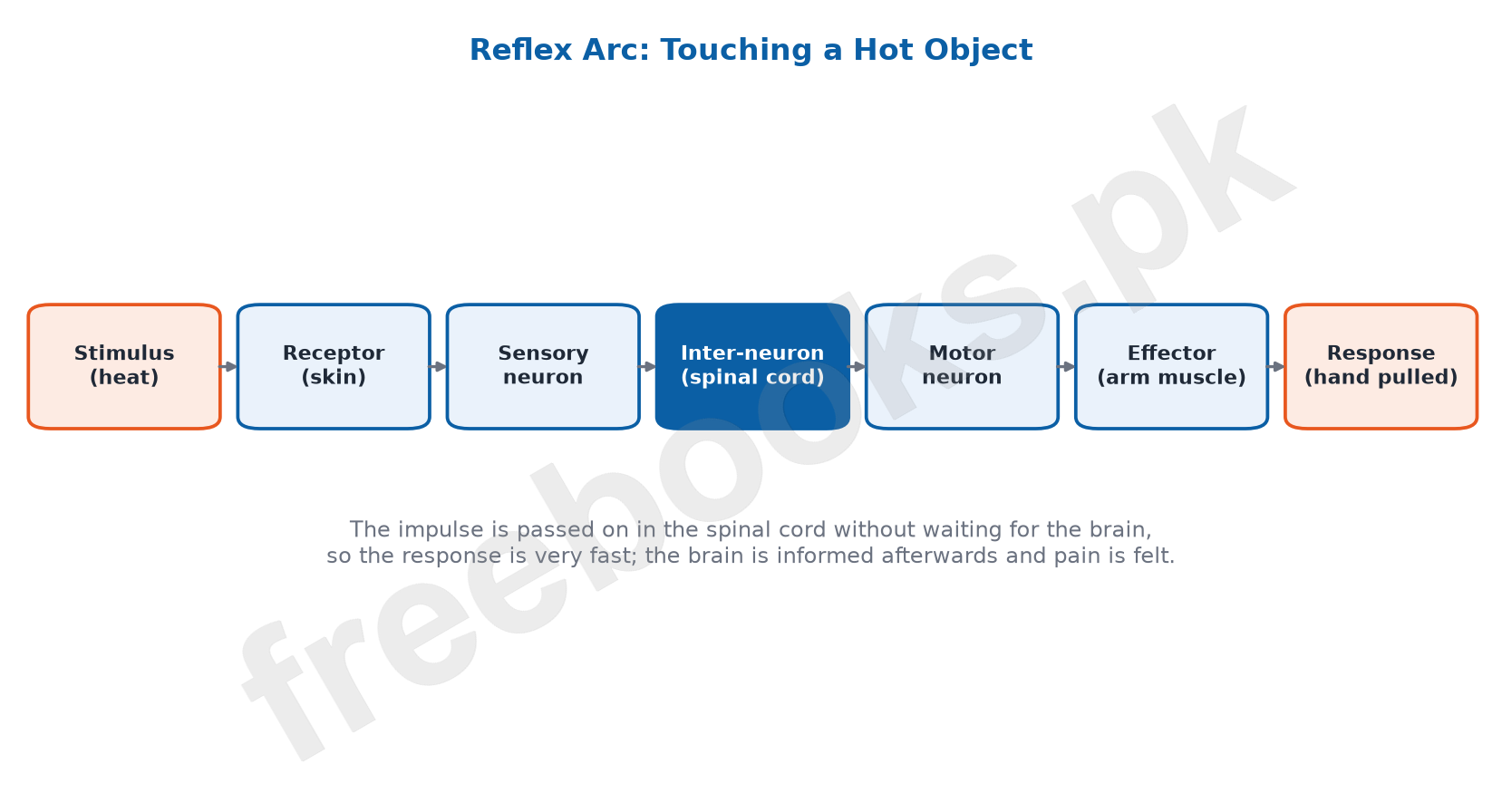
Example, touching a hot object: heat receptors in the skin are stimulated → a sensory neuron carries the impulse to the spinal cord → an inter-neuron passes it to a motor neuron → the motor neuron carries it to the arm muscles (effector) → the muscles contract and the hand is pulled away. The brain is informed afterwards, which is why pain is felt slightly later.
5.3 Endocrine System
The endocrine system is made of ductless glands that release hormones directly into the blood. Hormones are chemical messengers that regulate growth, metabolism, reproduction, blood glucose and other functions.
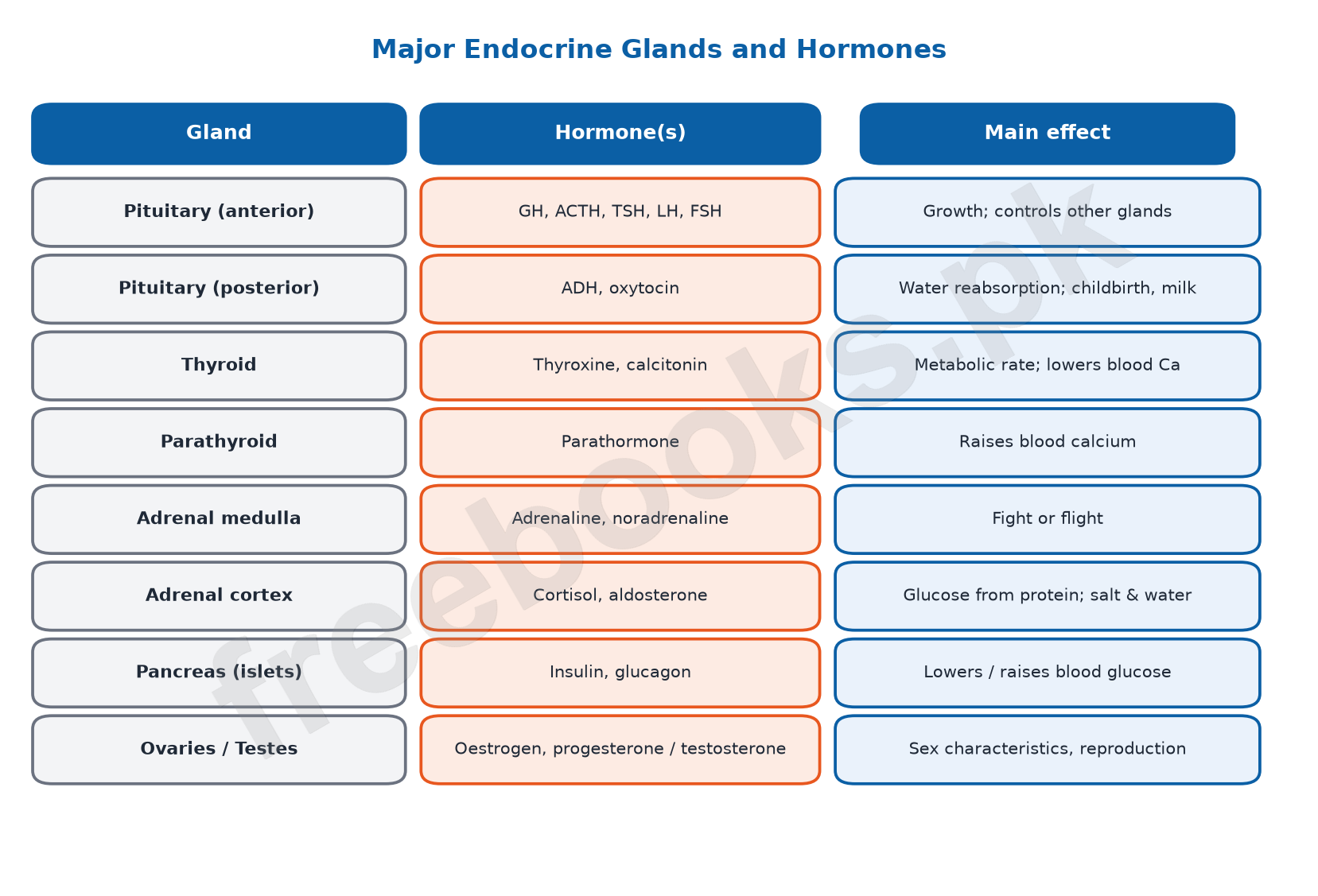
Pituitary gland (hangs from the hypothalamus): its anterior lobe makes growth hormone (too much in childhood causes gigantism, too little causes dwarfism), ACTH (stimulates the adrenal cortex), TSH (stimulates the thyroid), LH and FSH (control the ovaries and testes). Its posterior lobe stores two hypothalamus hormones: ADH (vasopressin), which increases water reabsorption in the kidneys, and oxytocin, which causes uterine contractions in childbirth and milk flow.
Thyroid gland (in the neck below the larynx): thyroxine raises the rate of metabolism and heat production; too little causes lethargy, weight gain and low body temperature, too much causes weight loss and a fast heart rate. Iodine is needed to make thyroxine; lack of it enlarges the gland (goitre), now uncommon in Pakistan because of iodised salt. Calcitonin lowers blood calcium by moving calcium into bone. The four parathyroid glands make parathormone, which raises blood calcium by moving calcium out of bone; too little causes tetany (muscle spasms).
Adrenal glands (above the kidneys): the medulla secretes adrenaline and noradrenaline for the fight-or-flight response (faster heart, higher blood pressure and glucose, wider airways and pupils). The cortex secretes cortisol (makes glucose from proteins) and aldosterone (makes the kidneys keep salt and water).
Pancreas: besides digestive enzymes, its islets of Langerhans secrete insulin, which lowers blood glucose by making cells take it up and store it, and glucagon, which raises blood glucose by making the liver release glucose. Gonads: ovaries secrete oestrogen and progesterone (female characteristics and the reproductive cycle); testes secrete androgens such as testosterone (male characteristics).
Diabetes Mellitus
In diabetes mellitus the cells cannot take in enough glucose, so blood glucose stays high. In type 1 diabetes the pancreas makes too little insulin and daily insulin injections are needed. In type 2 diabetes insulin is made but cells do not respond well; it is managed with diet, exercise and medicines.
Extra glucose in the filtrate reduces water reabsorption, so the patient passes large amounts of urine, becomes thirsty and dehydrated, and may lose weight and feel tired; long-term high glucose can damage the kidneys.
A blood glucose test diagnoses diabetes. After an 8–10 hour fast, 70–99 mg/100 mL is normal, 100–125 is pre-diabetes and 126 or more is diabetes. Two hours after a 75 g glucose drink, below 140 is normal, 140 to just under 200 is pre-diabetes and 200 or more is diabetes.
Important Definitions
Coordination
Working together of body parts in response to stimuli.
Stimulus
Any change in the environment that can produce a response.
Receptor
A cell, tissue or organ that detects a stimulus.
Effector
A muscle or gland that carries out a response.
Nerve impulse
A wave of electrochemical change travelling along a neuron.
Dendrite
A short branch carrying impulses towards the cell body.
Axon
A long fibre carrying impulses away from the cell body.
Myelin sheath
A fatty insulating covering around many axons.
Nodes of Ranvier
Gaps in the myelin sheath where impulses jump.
Synapse
The junction between two neurons or a neuron and an effector.
Neurotransmitter
A chemical that carries a signal across a synapse.
Ganglion
A group of nerve cell bodies outside the CNS.
Meninges
Three protective membranes around the brain and spinal cord.
Cerebrospinal fluid
Fluid in the brain ventricles and spinal canal.
Brain stem
Midbrain, pons and medulla oblongata together.
Reflex action
A rapid automatic response to a stimulus.
Reflex arc
The pathway of neurons used in a reflex action.
Hormone
A chemical messenger secreted into the blood by an endocrine gland.
Endocrine gland
A ductless gland that secretes hormones into the blood.
Goitre
Enlargement of the thyroid gland, often due to lack of iodine.
Diabetes mellitus
A disorder in which blood glucose stays too high.
Key Facts at a Glance
| Item | Fact |
|---|---|
| Pairs of cranial nerves | 12 |
| Pairs of spinal nerves | 31 (all mixed) |
| Largest part of brain | Cerebrum |
| Balance and muscle coordination | Cerebellum |
| Heartbeat and breathing centre | Medulla oblongata |
| Controls pituitary; body temperature | Hypothalamus |
| Fight or flight | Sympathetic system + adrenaline |
| Hormone lowering blood glucose | Insulin |
| Hormone raising blood calcium | Parathormone |
| Hormone for water reabsorption | ADH (vasopressin) |
| Iodine needed for | Thyroxine |
| Fasting glucose for diabetes | 126 mg/100 mL or more |
Diagrams
Reflex arc: A flow diagram of the reflex arc when a hand touches a hot object.
Divisions of the nervous system: A tree chart showing the CNS and PNS and their subdivisions.
Major endocrine glands: A chart of the main endocrine glands with their key hormones and effects.
Short Questions and Answers
List the five components of a coordinated action.
Stimulus, receptor, coordinator, effector and response.
Distinguish between dendrites and axon.
Dendrites are short branches carrying impulses towards the cell body; the axon is a long fibre carrying impulses away from it.
How does the myelin sheath speed up a nerve impulse?
It insulates the axon so the impulse jumps from one node of Ranvier to the next instead of travelling along every part.
Why are neurotransmitters needed?
An impulse cannot jump the synaptic gap; neurotransmitters carry the signal across it to the next cell.
Name the three types of neurons by function.
Sensory neurons, inter-neurons and motor neurons.
Distinguish white matter and grey matter.
White matter is made of myelinated axons; grey matter contains cell bodies, dendrites and non-myelinated axons.
What protects the brain?
The bony cranium, the three meninges and the cushioning cerebrospinal fluid.
Why does damage to the left side of the cerebrum affect the right side of the body?
Each cerebral hemisphere receives information from and controls the opposite side of the body.
What would happen if the cerebellum were injured?
Balance and smooth coordination of muscle movements would be lost, so walking would be unsteady.
Why are all spinal nerves called mixed nerves?
Each contains sensory axons in its dorsal root and motor axons in its ventral root.
Give two effects of the sympathetic nervous system.
It speeds up the heartbeat and widens the pupils (also increases breathing and slows digestion).
Why are endocrine glands called ductless glands?
They release hormones directly into the blood rather than through ducts.
Why has goitre become rare in Pakistan?
Iodine is now added to common table salt, so the thyroid can make enough thyroxine.
How do calcitonin and parathormone work against each other?
Calcitonin lowers blood calcium by moving it into bone; parathormone raises it by releasing calcium from bone.
Distinguish type 1 and type 2 diabetes.
In type 1 the pancreas makes too little insulin; in type 2 insulin is present but the cells do not respond to it properly.
Long Questions and Answers
Describe the structure of a neuron and how impulses cross a synapse.
What are the parts of a neuron?
A cell body with the nucleus, branched dendrites bringing impulses in, and a long axon carrying impulses out.
What is the role of the myelin sheath?
Made by Schwann cells, it insulates the axon; impulses jump between nodes of Ranvier, increasing speed.
What is a synapse?
A tiny gap between a neuron and the next neuron or effector cell.
How does the impulse cross it?
The axon ending releases neurotransmitters such as acetylcholine, which cross the gap and start an impulse in the next cell.
Describe the main parts of the human brain.
What does the cerebrum do?
It is the largest part, with two hemispheres and four lobes controlling thinking, speech, movement, touch, hearing, memory and vision.
What are the roles of the thalamus and hypothalamus?
The thalamus relays sensory information; the hypothalamus controls temperature, hunger, thirst, sleep, emotions and the pituitary.
What does the midbrain do?
It connects the forebrain and hindbrain and helps with movement adjustments, alertness and sleep.
What are the parts of the hindbrain?
The medulla (heartbeat, breathing, coughing), the cerebellum (balance and coordination) and the pons (connections and sleep).
Describe the peripheral nervous system.
What does the PNS consist of?
12 pairs of cranial nerves and 31 pairs of spinal nerves with their ganglia.
What is the somatic nervous system?
Motor neurons to skeletal muscles controlling voluntary actions.
What is the autonomic nervous system?
Motor neurons to cardiac and smooth muscle and glands, working without conscious control.
Compare sympathetic and parasympathetic systems.
Sympathetic prepares for ‘fight or flight’ (faster heart, wider pupils, slower digestion); parasympathetic restores ‘rest and digest’.
Explain a reflex action with the help of a reflex arc.
What is a reflex action?
A quick, involuntary, automatic response to a stimulus.
What is the first step when you touch a hot pan?
Heat receptors in the skin detect the stimulus and a sensory neuron carries the impulse to the spinal cord.
What happens in the spinal cord?
An inter-neuron passes the impulse directly to a motor neuron without waiting for the brain.
How is the response produced?
The motor neuron carries the impulse to arm muscles, which contract and pull the hand away.
Describe the hormones of the pituitary gland.
Where is the pituitary gland?
At the base of the brain, attached to the hypothalamus by a stalk.
What does growth hormone do?
Stimulates growth of bones and muscles; excess causes gigantism and deficiency causes dwarfism.
Which other anterior lobe hormones are there?
ACTH (adrenal cortex), TSH (thyroid), and LH and FSH (ovaries and testes).
What are the posterior lobe hormones?
ADH increases water reabsorption in the kidneys; oxytocin causes uterine contractions and milk flow.
Describe the thyroid, adrenal glands and pancreas as endocrine glands.
What does the thyroid secrete?
Thyroxine, which raises metabolism (needs iodine), and calcitonin, which lowers blood calcium.
What does the adrenal medulla secrete?
Adrenaline and noradrenaline for the fight-or-flight response.
What does the adrenal cortex secrete?
Cortisol (glucose from proteins) and aldosterone (salt and water retention).
What do the islets of Langerhans secrete?
Insulin lowers blood glucose and glucagon raises it; failure of insulin action causes diabetes.
Multiple Choice Questions (MCQs)
Muscles and glands in nervous coordination act as: (A) Receptors (B) Coordinators (C) Effectors (D) Stimuli
Correct answer: (C) Effectors. They carry out responses.
Impulses are carried towards the cell body by: (A) Axons (B) Dendrites (C) Myelin (D) Synapses
Correct answer: (B) Dendrites. Dendrites.
The myelin sheath is produced by: (A) Neurons (B) Schwann cells (C) Red blood cells (D) Ganglia
Correct answer: (B) Schwann cells. Schwann cells.
Neurons that connect sensory and motor neurons are: (A) Inter-neurons (B) Effectors (C) Receptors (D) Ganglia
Correct answer: (A) Inter-neurons. Inter-neurons in the CNS.
An example of a neurotransmitter is: (A) Insulin (B) Acetylcholine (C) Thyroxine (D) Haemoglobin
Correct answer: (B) Acetylcholine. Acetylcholine.
Balance is controlled by the: (A) Cerebrum (B) Cerebellum (C) Thalamus (D) Pons
Correct answer: (B) Cerebellum. Cerebellum.
Breathing and heartbeat are controlled by the: (A) Medulla oblongata (B) Occipital lobe (C) Thalamus (D) Cerebellum
Correct answer: (A) Medulla oblongata. Medulla.
The lobe of the cerebrum concerned with vision is the: (A) Frontal (B) Parietal (C) Temporal (D) Occipital
Correct answer: (D) Occipital. Occipital.
Number of pairs of spinal nerves in humans: (A) 12 (B) 21 (C) 31 (D) 43
Correct answer: (C) 31. 31 pairs.
The ‘rest and digest’ response is due to the: (A) Sympathetic system (B) Parasympathetic system (C) Somatic system (D) Cerebrum
Correct answer: (B) Parasympathetic system. Parasympathetic.
In a reflex arc the impulse goes from the sensory neuron to the: (A) Effector (B) Inter-neuron (C) Receptor (D) Brain only
Correct answer: (B) Inter-neuron. Then to the motor neuron.
Gigantism results from excess of: (A) Thyroxine (B) Growth hormone (C) Insulin (D) ADH
Correct answer: (B) Growth hormone. Growth hormone.
The hormone that helps the kidneys reabsorb water is: (A) Oxytocin (B) ADH (C) Glucagon (D) Calcitonin
Correct answer: (B) ADH. ADH (vasopressin).
Goitre is caused mainly by lack of: (A) Iron (B) Iodine (C) Calcium (D) Vitamin C
Correct answer: (B) Iodine. Iodine.
The hormone that raises blood glucose is: (A) Insulin (B) Glucagon (C) Calcitonin (D) Oxytocin
Correct answer: (B) Glucagon. Glucagon.
Quick Revision Summary
- Coordinated action: stimulus → receptor → coordinator → effector → response.
- Neuron: cell body, dendrites (in), axon (out); myelin + nodes of Ranvier speed impulses.
- Synapse: neurotransmitters (acetylcholine, dopamine, serotonin) carry signals across.
- Neurons: sensory → inter → motor. Nerves: sensory, motor, mixed.
- Brain: forebrain (cerebrum, thalamus, hypothalamus), midbrain, hindbrain (medulla, cerebellum, pons).
- PNS: 12 pairs cranial + 31 pairs spinal nerves; somatic vs autonomic (sympathetic / parasympathetic).
- Reflex arc: receptor → sensory neuron → inter-neuron (spinal cord) → motor neuron → effector.
- Glands: pituitary (GH, ACTH, TSH, LH, FSH; ADH, oxytocin), thyroid (thyroxine, calcitonin), parathyroid (parathormone), adrenal (adrenaline; cortisol, aldosterone), pancreas (insulin, glucagon), gonads.
Exam Tips
- Draw and label a motor neuron and a reflex arc; both are frequent diagram questions.
- Make a table of brain parts and their functions for quick revision.
- Learn each endocrine gland with its hormone and one effect; the book’s gland table is ideal for MCQs.
- Know the pairs of opposites: sympathetic vs parasympathetic, insulin vs glucagon, calcitonin vs parathormone.
- Remember the diabetes test cut-offs: fasting 126 and two-hour 200 mg/100 mL.
Note on Facts
The textbook says the brain is not involved in reflex actions. This is true of spinal reflexes such as pulling the hand from a flame, but many reflexes (blinking, coughing, sneezing, the pupil reflex) pass through the brain stem; they are still involuntary because the cerebrum does not decide them.
The textbook’s glucose table gives ‘over 200’ as diabetes for the two-hour test. The WHO cut-off is 200 mg/100 mL or more, so a reading of exactly 200 also counts as diabetes.
The textbook says oestrogen and progesterone cause the release of the egg. The release of the egg (ovulation) is triggered mainly by a surge of LH from the pituitary, as the same chapter says; oestrogen helps bring on that surge, and progesterone prepares the uterus.