Chapter 4 explains how the body removes nitrogenous wastes, extra water and extra salts from the blood. The urinary system, made of the kidneys, ureters, urinary bladder and urethra, filters the blood, forms urine and keeps the water and salt content of body fluids steady.
These notes cover the position and structure of the kidney, the parts of a nephron, the three steps of urine formation (pressure filtration, reabsorption and tubular secretion), the kidney’s role in osmoregulation, and two important disorders, kidney stones and kidney failure, with their treatments including lithotripsy, dialysis and kidney transplantation.
Learning Objectives
- Name the organs of the urinary system and state their roles.
- Describe the external and internal structure of the kidney.
- Describe the parts of a nephron and the role of each part.
- Explain pressure filtration, reabsorption and tubular secretion.
- Explain how the kidneys carry out osmoregulation.
- Describe the causes, symptoms and treatment of kidney stones and kidney failure.
Key Concepts
4.1 The Urinary System
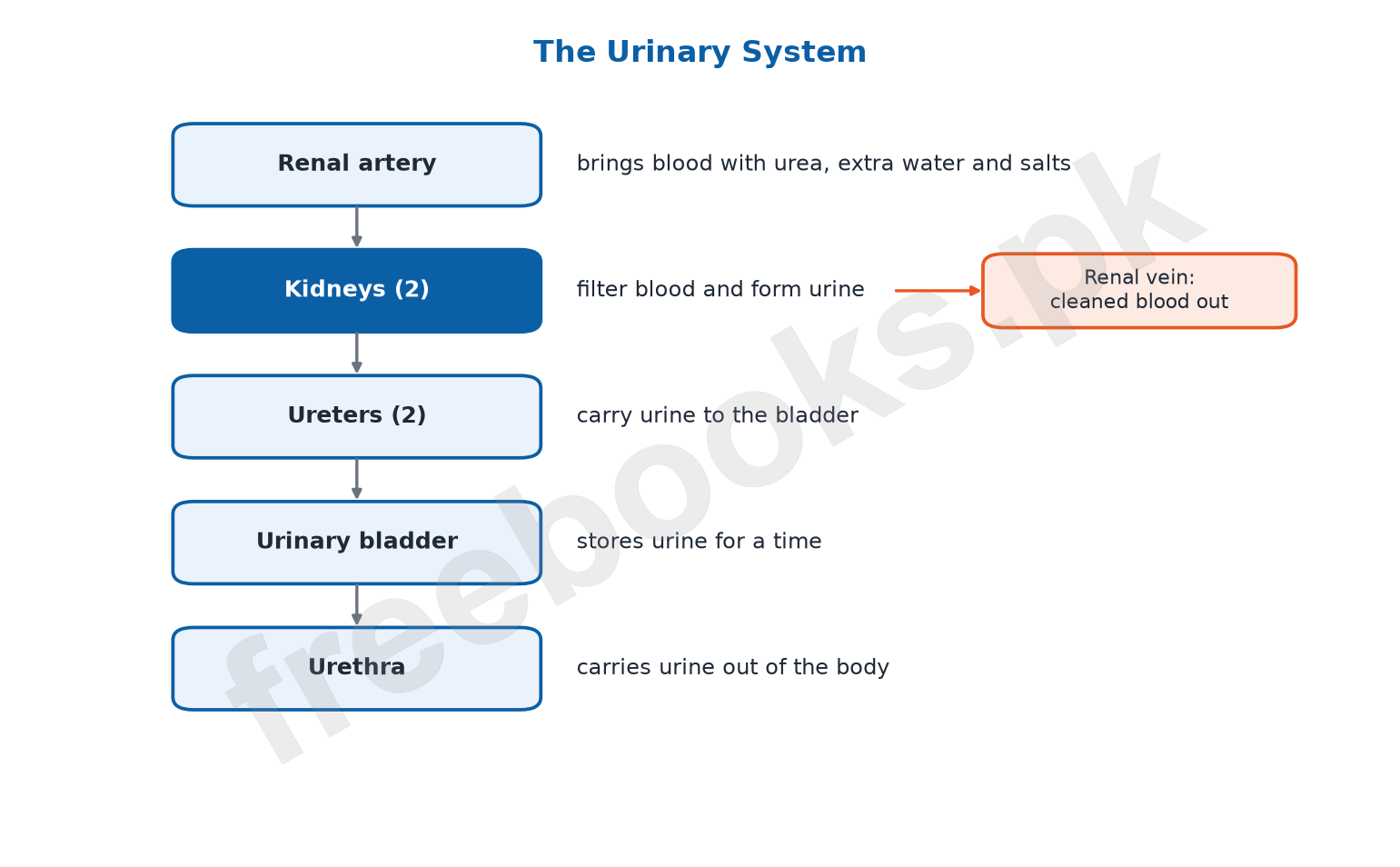
The urinary (excretory) system has a pair of kidneys, a pair of ureters, a urinary bladder and a urethra. The kidneys filter blood and make urine; each ureter carries urine from a kidney to the bladder; the bladder stores urine for a time; and the urethra carries urine out of the body.
The kidneys are bean-shaped, dark red organs in the abdomen below the diaphragm, one on each side of the vertebral column, with the concave side facing the backbone. The left kidney sits slightly higher than the right. Each is roughly 10 cm long, 5 cm wide and 4 cm thick. Renal arteries bring blood containing wastes such as urea; renal veins carry the cleaned blood away.
4.1 Structure of the Kidney
Externally, each kidney is wrapped in a tough renal capsule. The hilus is a notch on the concave side where the renal artery enters and the renal vein and ureter leave.
Internally, a section shows an outer renal cortex and an inner renal medulla. The medulla contains cone-shaped renal pyramids whose broad bases face the cortex and whose tips point into a funnel-shaped cavity, the renal pelvis, which continues as the ureter.
4.1 The Nephron
The nephron is the structural and functional unit of the kidney; each kidney has more than a million nephrons. A nephron has two parts: the renal corpuscle and the renal tubule.
The renal corpuscle consists of the glomerulus, a knot of blood capillaries, and the Bowman’s capsule, a cup-shaped structure that surrounds it.
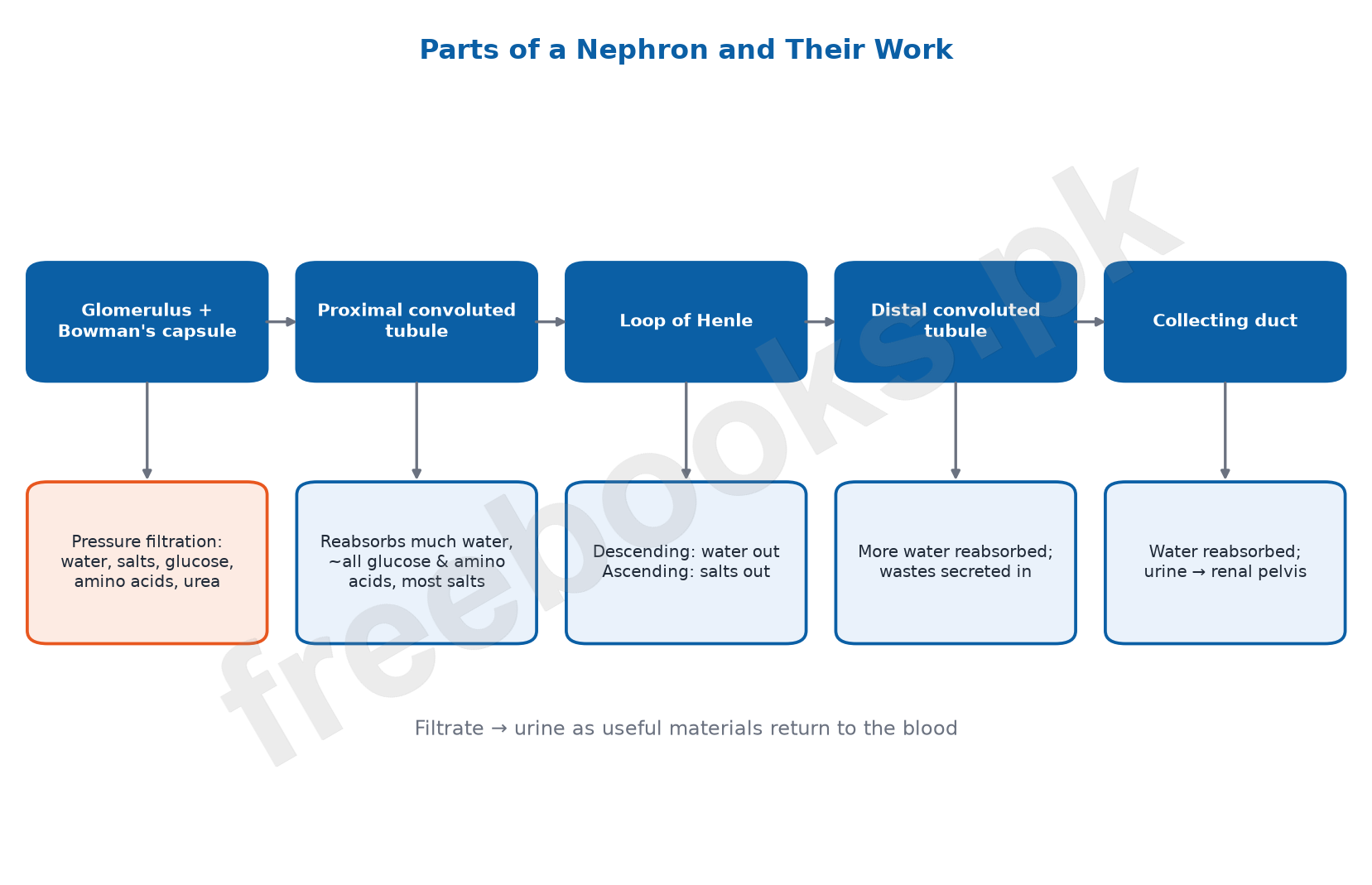
The renal tubule leads from the Bowman’s capsule and has three parts: the coiled proximal convoluted tubule, the U-shaped loop of Henle, and the coiled distal convoluted tubule. The distal tubules of many nephrons drain into one collecting duct, and collecting ducts open into the renal pelvis.
4.2 Formation of Urine
Pressure filtration: the renal artery branches into arterioles that form the glomerulus. Blood pressure in the glomerulus is high, so water and small molecules such as salts, glucose, amino acids and urea are forced into the Bowman’s capsule. Blood cells and large proteins stay in the blood. The fluid collected is the glomerular filtrate, about one-fifth of the plasma entering the glomerulus.
Reabsorption: as the filtrate flows along the tubule, useful substances return to the capillaries around it. In the proximal convoluted tubule a large amount of water, nearly all glucose and amino acids, and most salts are reabsorbed. Some water leaves the descending limb of the loop of Henle and many salts leave the ascending limb. More water is reabsorbed from the distal tubule and collecting duct.
Tubular secretion: some wastes still in the blood are actively transported from the capillaries into the tubule. The fluid that remains is urine, which passes through the collecting ducts to the renal pelvis, down the ureters to the bladder, and out through the urethra.
4.2 Osmoregulation
Osmoregulation is keeping the water and solute content of the body at the right level. The kidneys are the main organs of osmoregulation; by controlling the solutes in blood they also control those in other body fluids.
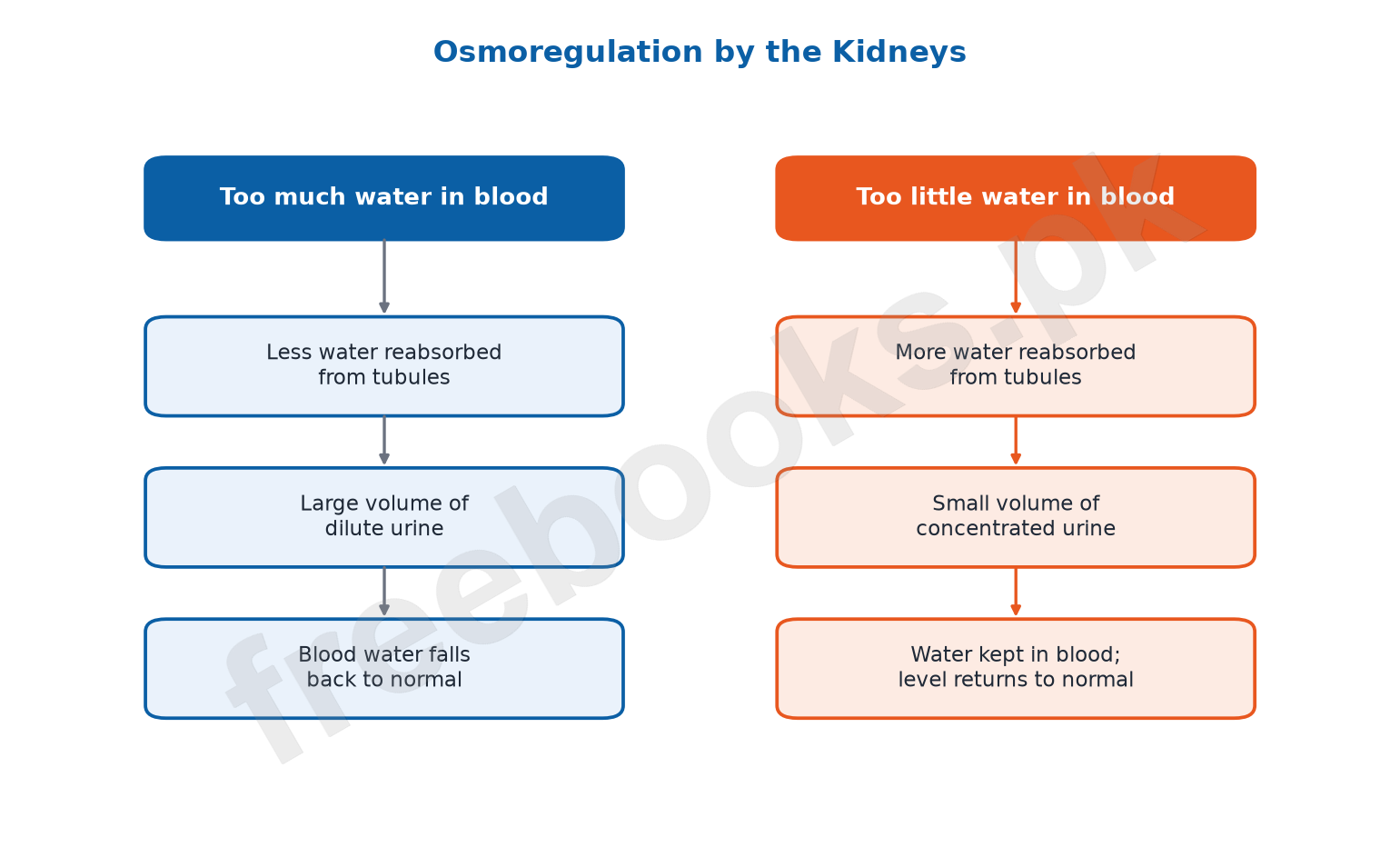
When the body has too much water, less water is reabsorbed from the tubules and a large volume of dilute urine is produced. When the body is short of water, more water is reabsorbed from the tubules and collecting ducts, so a small volume of concentrated urine is produced and water is kept in the blood.
4.3 Kidney Stones
Kidney stones are hard crystalline deposits formed when minerals and salts from the filtrate, such as calcium oxalate, calcium or ammonium phosphate and uric acid, collect in the kidney. Some move into the ureter or bladder and can get stuck.
Symptoms: severe pain in the side or lower abdomen, burning when passing urine, frequent urination, foul-smelling urine, blood or pus in urine, nausea and vomiting. Causes include drinking too little water, a diet very high in oxalate or certain salts, excess vitamin C or D supplements, high uric acid in blood, urinary infections and alcohol.
Treatment: small stones may pass out if the patient drinks plenty of water. In lithotripsy, shock waves aimed at the kidney from outside the body break stones into small pieces that pass out in urine. Large stones may need surgery.
4.3 Kidney Failure and Its Treatment
Kidney (renal) failure is when one or both kidneys can no longer remove wastes from the blood properly. Wastes and fluid build up, causing swelling of the legs, feet and face, weight loss and sometimes blood in urine. Causes include long-term diabetes and high blood pressure, severe dehydration, serious kidney infections, overuse of painkillers such as NSAIDs, large kidney stones, injury, and heart or liver failure.
Haemodialysis: the patient’s blood is pumped through a dialyser containing thin tubes surrounded by dialysis fluid; wastes and extra water diffuse out of the blood into the fluid and the cleaned blood is returned to the body.
Peritoneal dialysis: dialysis fluid is put into the peritoneal cavity of the abdomen; wastes pass from blood vessels in the peritoneal membrane into the fluid, which is drained out after some time.
Kidney transplantation: a healthy kidney from a living or deceased donor, matched to the patient’s immune system, is placed in the patient’s body (usually leaving the damaged kidneys in place). A well-matched kidney can work for many years. In Punjab, organ transplants are regulated by the Punjab Human Organ Transplant Authority.
Important Definitions
Excretion
Removal of metabolic wastes such as urea from the body.
Ureter
The tube that carries urine from a kidney to the urinary bladder.
Urethra
The tube that carries urine from the bladder to the outside.
Hilus
The notch on the concave side of the kidney where vessels and ureter enter or leave.
Renal cortex
The outer region of the kidney.
Renal medulla
The inner region of the kidney containing the renal pyramids.
Renal pelvis
The funnel-shaped cavity of the kidney leading to the ureter.
Nephron
The functional unit of the kidney.
Glomerulus
A network of capillaries inside the Bowman’s capsule.
Bowman’s capsule
The cup-shaped start of the nephron that receives the filtrate.
Loop of Henle
The U-shaped middle part of the renal tubule.
Collecting duct
The duct receiving urine from many nephrons.
Glomerular filtrate
The fluid filtered from the glomerulus into the Bowman’s capsule.
Pressure filtration
Forcing of small molecules out of the glomerulus by high blood pressure.
Reabsorption
Return of useful substances from the tubule into the blood.
Tubular secretion
Active transfer of wastes from blood into the renal tubule.
Osmoregulation
Control of the water and solute content of the body.
Lithotripsy
Breaking kidney stones with shock waves from outside the body.
Dialysis
Artificial removal of wastes from blood using dialysis fluid.
Key Facts at a Glance
| Item | Value / fact |
|---|---|
| Size of a kidney | About 10 cm × 5 cm × 4 cm |
| Higher kidney | Left kidney |
| Nephrons per kidney | More than one million |
| Parts of renal corpuscle | Glomerulus + Bowman’s capsule |
| Parts of renal tubule | PCT, loop of Henle, DCT |
| Glomerular filtrate | About 20% of plasma entering glomerulus |
| Glucose reabsorbed in | Proximal convoluted tubule (nearly 100%) |
| Salts reabsorbed mainly in loop’s | Ascending limb |
| Tubular secretion | Active transport |
| Excess water in body | Large volume of dilute urine |
| Water shortage | Small volume of concentrated urine |
| Two types of dialysis | Haemodialysis and peritoneal dialysis |
Diagrams
The urinary system: A flow chart of the organs of the urinary system and the path of urine.
Parts of a nephron: A simplified flow diagram of a nephron and what happens in each part.
Osmoregulation by the kidneys: A comparison of how the kidneys respond to too much and too little water in the body.
Short Questions and Answers
Name the organs of the urinary system.
Two kidneys, two ureters, one urinary bladder and one urethra.
What is the hilus of the kidney?
A depression on the concave side where the renal artery enters and the renal vein and ureter leave.
Distinguish between renal cortex and renal medulla.
The cortex is the outer region; the medulla is the inner region containing cone-shaped renal pyramids.
What are the two parts of a renal corpuscle?
The glomerulus (capillary network) and the Bowman’s capsule surrounding it.
Why is blood pressure high in the glomerulus?
Blood comes directly from the renal artery through arterioles, and this high pressure drives filtration.
Why are proteins and blood cells normally absent from urine?
They are too large to be filtered out of the glomerulus into the Bowman’s capsule.
Why is glucose not found in the urine of a healthy person?
Almost all glucose in the filtrate is reabsorbed into the blood in the proximal convoluted tubule.
What happens in the loop of Henle?
Some water is reabsorbed from its descending limb and many salts from its ascending limb.
How is tubular secretion different from filtration?
Filtration is passive and driven by pressure; secretion actively moves extra wastes from blood into the tubule.
Why is urine pale and plentiful after drinking a lot of water?
With excess water, less water is reabsorbed from the tubules, so a large amount of dilute urine is produced.
Why is urine dark and small in volume on a hot day?
Water lost in sweat makes the kidneys reabsorb more water, so the urine becomes concentrated.
Give two ways to reduce the risk of kidney stones.
Drink plenty of water and avoid excess vitamin C and D supplements and very high-oxalate diets.
What is lithotripsy?
A non-surgical method in which shock waves break kidney stones into small pieces that pass out with urine.
Give two causes of kidney failure.
Long-term diabetes and high blood pressure (also infections, NSAID overuse, large stones).
Distinguish between haemodialysis and peritoneal dialysis.
Haemodialysis cleans blood in an outside machine; peritoneal dialysis uses fluid in the abdominal cavity and the peritoneal membrane as the filter.
Long Questions and Answers
Describe the structure of the human kidney.
Where are the kidneys located?
In the abdomen below the diaphragm on either side of the backbone, the left one slightly higher.
Describe the external structure.
Bean-shaped, about 10 × 5 × 4 cm, covered by a renal capsule, with a hilus on the concave side for vessels and ureter.
Describe the internal structure.
An outer cortex and an inner medulla with renal pyramids pointing into the renal pelvis.
How does urine leave the kidney?
From the collecting ducts into the renal pelvis and then into the ureter.
Describe the structure of a nephron.
What is a nephron?
The functional unit of the kidney; each kidney has over a million.
Describe the renal corpuscle.
The glomerulus, a knot of capillaries, enclosed by the cup-shaped Bowman’s capsule.
Describe the renal tubule.
Proximal convoluted tubule, U-shaped loop of Henle and distal convoluted tubule.
Where does the tubule drain?
Distal tubules of many nephrons open into a collecting duct, which opens into the renal pelvis.
Explain the formation of urine.
What is pressure filtration?
High pressure in the glomerulus forces water, salts, glucose, amino acids and urea into the Bowman’s capsule as glomerular filtrate.
What is reabsorbed in the proximal tubule?
Much water, almost all glucose and amino acids, and most salts.
What is reabsorbed later in the tubule?
Water from the descending limb, salts from the ascending limb of the loop of Henle, and more water from the DCT and collecting duct.
What is tubular secretion?
Active transport of remaining wastes from capillaries into the tubule; the final fluid is urine.
Explain the role of the kidneys in osmoregulation.
What is osmoregulation?
Keeping the water and solute concentration of body fluids at the correct level.
What happens when there is excess water?
Less water is reabsorbed from the tubules, producing plenty of dilute urine.
What happens when water is short?
More water is reabsorbed from the tubules and collecting ducts, producing a little concentrated urine.
Why is this important?
It keeps the concentration of blood and tissue fluid steady so cells neither swell nor shrink.
Describe kidney stones and their treatment.
What are kidney stones?
Hard crystals of calcium oxalate, phosphates or uric acid formed in the kidney.
What are their symptoms?
Severe pain in the side or lower abdomen, burning and frequent urination, blood or pus in urine, nausea.
What causes them?
Low water intake, diets high in oxalate or salts, excess vitamin C or D supplements, high uric acid, infections and alcohol.
How are they treated?
Small stones pass with plenty of water; lithotripsy breaks larger ones; very large stones need surgery.
Describe kidney failure and its treatments.
What is kidney failure and its symptoms?
Kidneys cannot remove wastes properly; wastes and fluid build up, with swelling of face, legs and feet.
What are its causes?
Diabetes, high blood pressure, dehydration, infections, NSAID overuse, large stones, injury, heart or liver failure.
How does dialysis help?
Haemodialysis or peritoneal dialysis removes wastes and extra water from the blood artificially.
What is kidney transplantation?
Placing a matched healthy kidney from a living or deceased donor into the patient.
Multiple Choice Questions (MCQs)
Urine is carried from the kidney to the bladder by the: (A) Urethra (B) Ureter (C) Renal vein (D) Collecting duct
Correct answer: (B) Ureter. Ureter.
The functional unit of the kidney is the: (A) Neuron (B) Nephron (C) Alveolus (D) Glomerulus
Correct answer: (B) Nephron. Nephron.
The renal artery enters the kidney at the: (A) Cortex (B) Pelvis (C) Hilus (D) Pyramid
Correct answer: (C) Hilus. Hilus.
Renal pyramids are found in the: (A) Cortex (B) Medulla (C) Ureter (D) Bladder
Correct answer: (B) Medulla. Medulla.
The cup-shaped part of the nephron is the: (A) Glomerulus (B) Loop of Henle (C) Bowman’s capsule (D) Collecting duct
Correct answer: (C) Bowman’s capsule. Bowman’s capsule.
Filtration in the glomerulus is driven by: (A) Active transport (B) High blood pressure (C) Osmosis only (D) Hormones only
Correct answer: (B) High blood pressure. Pressure filtration.
Which is normally NOT filtered into the Bowman’s capsule? (A) Glucose (B) Urea (C) Plasma proteins (D) Salts
Correct answer: (C) Plasma proteins. Proteins are too large.
Nearly all glucose is reabsorbed in the: (A) Proximal convoluted tubule (B) Loop of Henle (C) Collecting duct (D) Ureter
Correct answer: (A) Proximal convoluted tubule. PCT.
Moving extra wastes from blood into the tubule is: (A) Filtration (B) Reabsorption (C) Tubular secretion (D) Egestion
Correct answer: (C) Tubular secretion. Tubular secretion.
Glomerular filtrate is about what fraction of plasma entering the glomerulus? (A) 5% (B) 20% (C) 50% (D) 100%
Correct answer: (B) 20%. About one-fifth.
When the body is short of water, the kidneys produce: (A) Dilute urine (B) Concentrated urine (C) No urine (D) Urine with glucose
Correct answer: (B) Concentrated urine. More water is reabsorbed.
A common mineral in kidney stones is: (A) Sodium chloride (B) Calcium oxalate (C) Glucose (D) Iron oxide
Correct answer: (B) Calcium oxalate. Calcium oxalate.
Breaking kidney stones with shock waves is called: (A) Dialysis (B) Lithotripsy (C) Transplant (D) Angioplasty
Correct answer: (B) Lithotripsy. Lithotripsy.
In peritoneal dialysis the filter is the: (A) Glomerulus (B) Peritoneal membrane (C) Dialyser tube (D) Bladder wall
Correct answer: (B) Peritoneal membrane. Peritoneal membrane.
A long-term cause of kidney failure is: (A) Common cold (B) Diabetes (C) Constipation (D) Asthma
Correct answer: (B) Diabetes. Diabetes and hypertension.
Quick Revision Summary
- Urinary system: 2 kidneys → 2 ureters → bladder → urethra.
- Kidney: bean-shaped, ~10 × 5 × 4 cm, left higher; renal capsule, hilus; cortex, medulla (pyramids), pelvis.
- Nephron (>1 million per kidney): glomerulus + Bowman’s capsule; PCT → loop of Henle → DCT → collecting duct.
- Urine formation: pressure filtration → reabsorption → tubular secretion.
- PCT: water, ~all glucose and amino acids, most salts reabsorbed; loop: water (descending), salts (ascending).
- Osmoregulation: excess water → dilute urine; water shortage → concentrated urine.
- Kidney stones: water, lithotripsy, surgery. Kidney failure: haemodialysis, peritoneal dialysis, transplant.
Exam Tips
- Learn the three steps of urine formation in order and the part of the nephron where each happens.
- Draw a labelled nephron and a section of the kidney; both are common diagram questions.
- In osmoregulation answers, always state the amount of reabsorption and the type of urine produced.
- Compare haemodialysis and peritoneal dialysis in a table.
- For disorders, write symptoms, causes and treatment separately.
Note on Facts
The textbook says more water is filtered into the Bowman’s capsule when there is excess water in the blood. The main control is actually in reabsorption: a hormone (ADH) adjusts how much water the distal tubule and collecting duct take back, so filtration stays fairly steady.
The textbook lists green vegetables, fats and dairy products as causes of kidney stones. Normal amounts of these foods are healthy; doctors usually advise avoiding very high-oxalate foods and drinking enough water rather than cutting out dairy, since dietary calcium can actually reduce oxalate stones.