Chapter 2 explains how the human body takes in oxygen and gets rid of carbon dioxide. Cells release energy from glucose by cellular respiration, which needs a steady supply of oxygen and produces carbon dioxide. Breathing moves air in and out of the lungs, and gaseous exchange in the alveoli moves oxygen into the blood and carbon dioxide out of it.
These notes cover the parts of the air passageway, the structure of the lungs and alveoli, blood flow around the alveoli, the mechanism of inhalation and exhalation, the control of breathing rate, the difference between inhaled and exhaled air, five respiratory disorders (bronchitis, emphysema, pneumonia, asthma and lung cancer) and the harmful effects of smoking and vaping.
Learning Objectives
- Distinguish between breathing, gaseous exchange and cellular respiration.
- Describe the parts of the air passageway and the role of each.
- Describe the structure of the lungs and how alveoli are suited to gas exchange.
- Explain inhalation and exhalation in terms of the ribs, intercostal muscles and diaphragm.
- Compare the composition of inhaled and exhaled air.
- Describe the causes, symptoms and treatment of common respiratory disorders and the effects of smoking.
Key Concepts
Breathing, Gaseous Exchange and Respiration
Cellular respiration is a chemical process inside cells in which glucose is oxidised to release energy; in aerobic respiration oxygen is used and carbon dioxide and water are produced.
Gaseous exchange is the diffusion of oxygen from the air in the lungs into the blood and of carbon dioxide from the blood into that air.
Breathing is the physical (mechanical) process of moving air into and out of the lungs. Breathing makes gaseous exchange possible, and gaseous exchange supplies the oxygen needed for respiration.
2.1 The Air Passageway
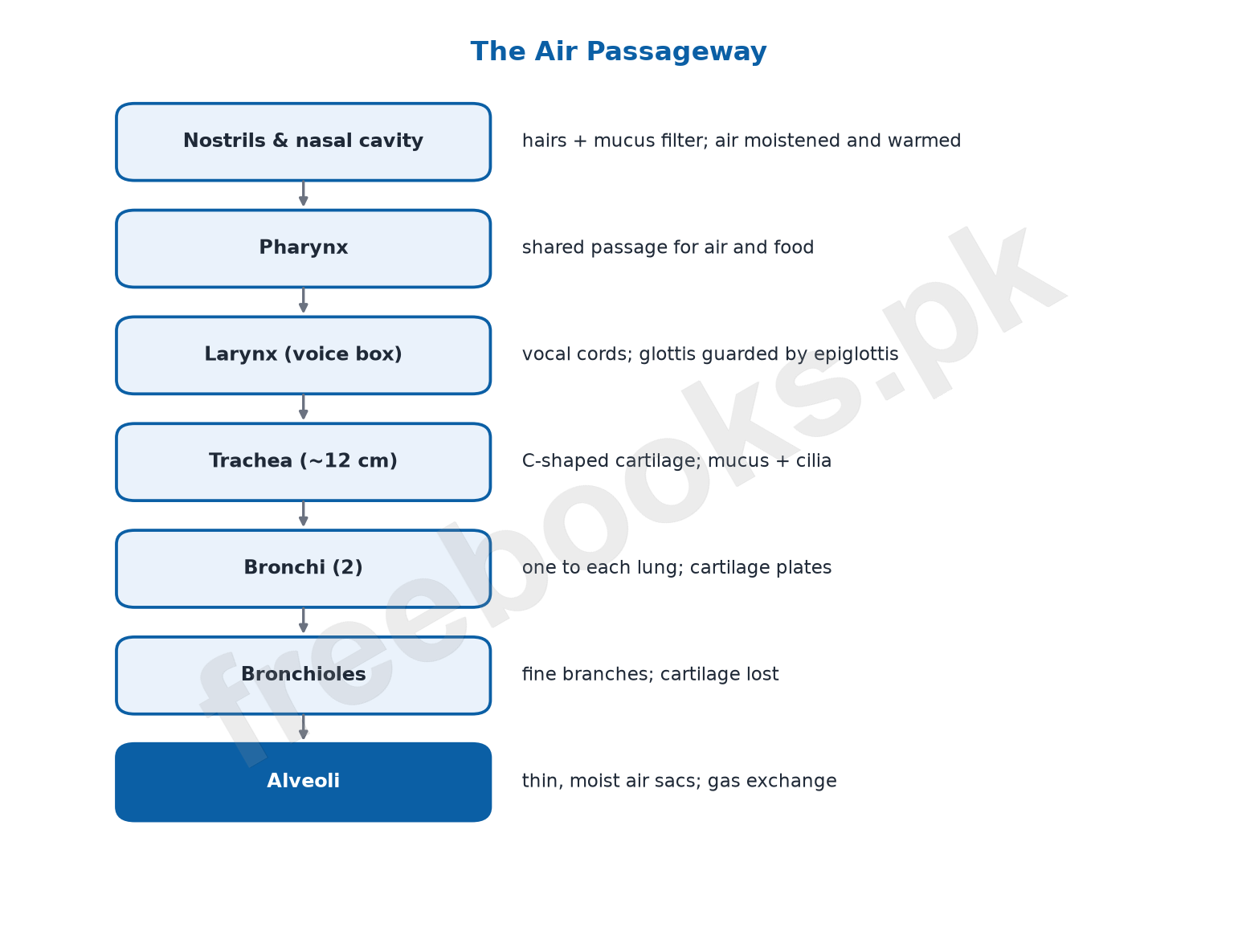
Nostrils and nasal cavity: air enters through the nostrils into two narrow nasal cavities. Hairs filter out larger dust particles, sticky mucus traps finer particles and moistens the air, and the air is warmed close to body temperature before it reaches the lungs.
Pharynx: the nasal cavity opens into the pharynx, a passage shared by food and air. In its floor is the glottis, the opening of the larynx, guarded by the epiglottis so that food and drink do not enter the windpipe.
Larynx: the voice box between the pharynx and trachea. It contains two vocal cords; air passing over them makes them vibrate and produce sound, which the lips, tongue, cheeks and jaws shape into speech.
Trachea and bronchi: the trachea (windpipe), about 12 cm long, divides into two bronchi, one entering each lung. Their lining has mucus that traps dust and bacteria and cilia that sweep this mucus up towards the pharynx. C-shaped cartilage rings in the trachea and cartilage plates in the bronchi keep these tubes open.
Bronchioles and alveoli: inside the lungs each bronchus branches again and again into fine bronchioles, whose cartilage decreases and finally disappears. Each smallest bronchiole ends in an alveolar duct leading to a cluster of tiny thin-walled air sacs, the alveoli, each surrounded by blood capillaries.
2.1 The Lungs
The two lungs lie in the thoracic cavity, enclosed by the chest wall (12 pairs of ribs with intercostal muscles) and resting on the dome-shaped muscular diaphragm below. They are spongy and elastic. The right lung has three lobes; the left lung is slightly smaller and has two lobes, leaving room for the heart.
Each lung is covered by a double membrane, the pleura. The inner layer sticks to the lung and the outer layer lines the chest wall and diaphragm; pleural fluid between them reduces friction during breathing.
Blood supply: the pulmonary artery brings deoxygenated blood from the heart. It branches into arterioles and then capillaries around the alveoli, where oxygen enters and carbon dioxide leaves the blood. The capillaries join into venules and then the pulmonary vein, which returns oxygenated blood to the heart.
Alveoli suit gas exchange because there are millions of them giving a huge surface area, their walls are one cell thick, their surface is moist so gases dissolve, and they are covered with a dense network of capillaries.
2.2 Mechanism of Breathing
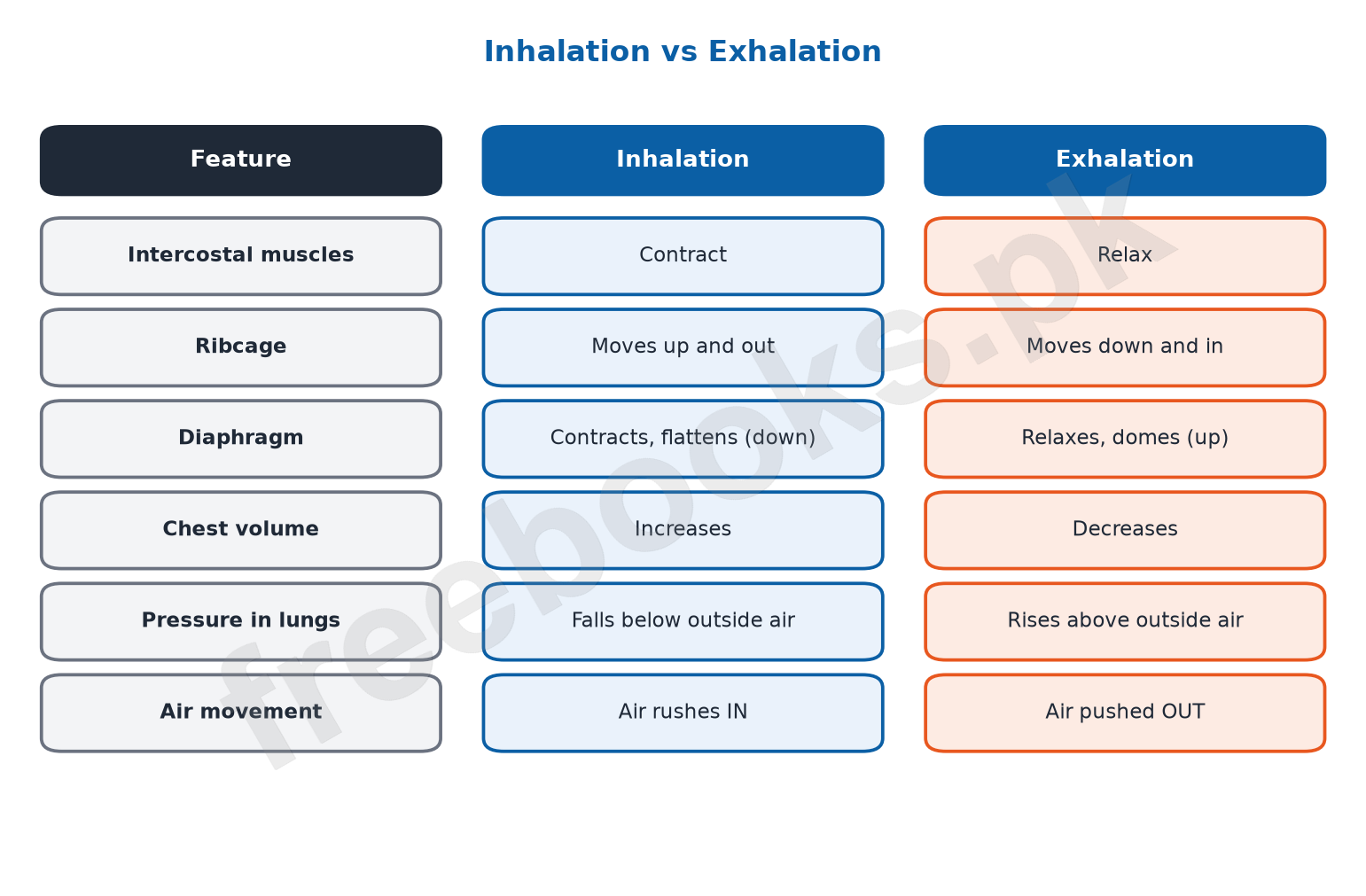
Inhalation (inspiration): the external intercostal muscles contract and pull the ribcage upward and outward; at the same time the diaphragm contracts and flattens (moves down). The volume of the chest increases, the pressure inside the lungs falls below atmospheric pressure, and air rushes in.
Exhalation (expiration): the intercostal muscles relax and the ribcage moves down and in; the diaphragm relaxes and domes upward. The volume of the chest decreases, the pressure inside the lungs rises above atmospheric pressure, and air is pushed out. Quiet exhalation is mostly passive, helped by the elastic recoil of the lungs.
Breathing rate: at rest an adult breathes about 16 to 20 times per minute. During exercise, muscles respire faster and make more carbon dioxide; the respiratory centre in the brain detects the rise in blood CO2 and sends faster nerve impulses to the rib muscles and diaphragm, so the rate can rise to about 30 to 40 breaths per minute.
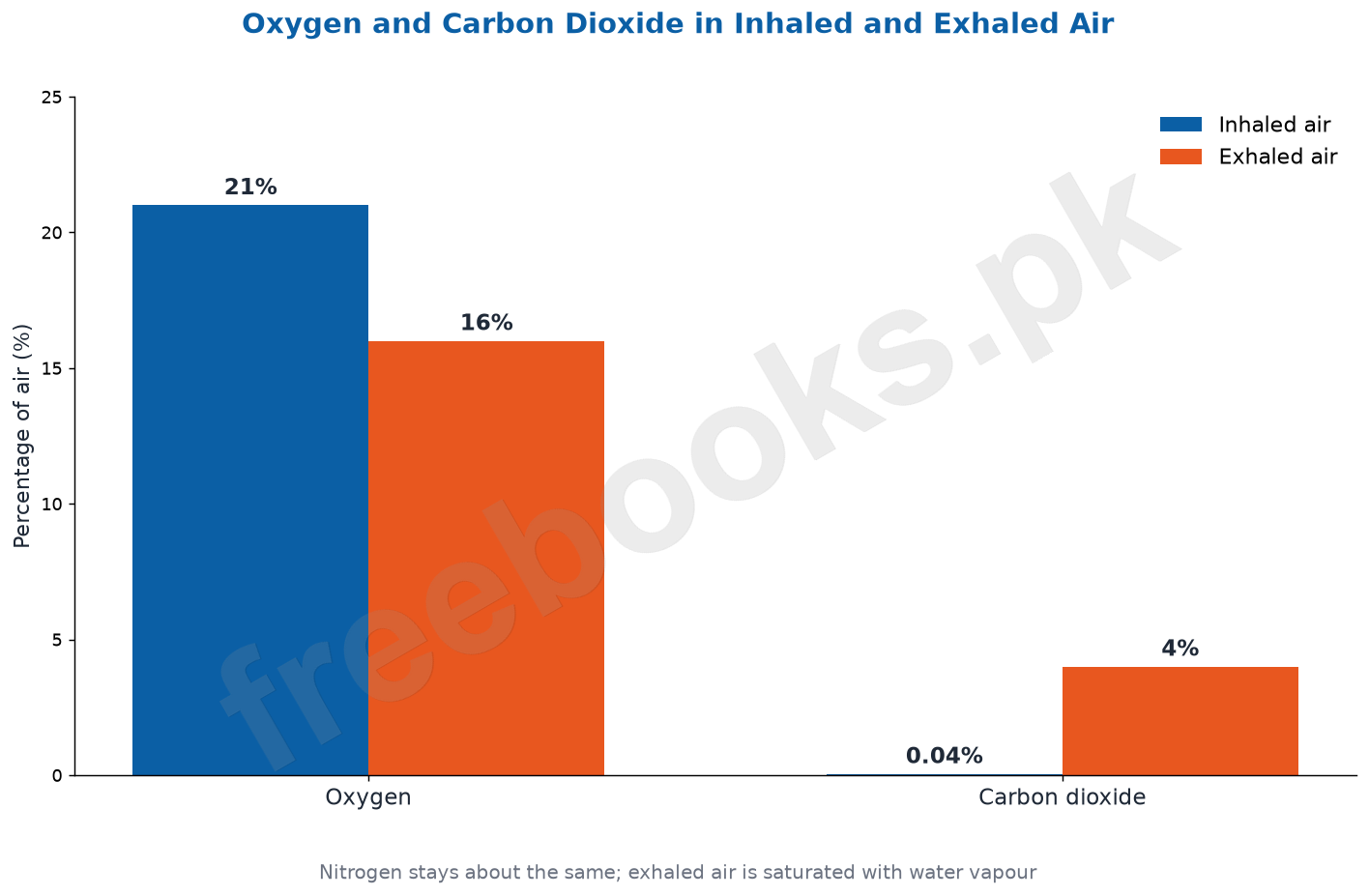
Exhaled air contains less oxygen (about 16%) and much more carbon dioxide (about 4%) than inhaled air (about 21% oxygen and 0.04% carbon dioxide). Nitrogen stays the same. Exhaled air is saturated with water vapour, is near body temperature and is almost free of dust. We lose roughly half a litre of water a day in exhaled air.
2.3 Respiratory Disorders
Bronchitis: inflammation of the bronchi or bronchioles that narrows the airways. It may be acute (lasting one to two weeks) or chronic; in chronic bronchitis mucus-secreting cells multiply and thick mucus blocks the airways. Causes: viral or bacterial infection and irritants such as tobacco smoke. Symptoms: cough, wheezing, fever, chills and shortness of breath. Treatment: medicines to ease coughing and breathing, antibiotics or antivirals as needed, and avoiding smoke and pollution.
Emphysema: the walls between alveoli weaken and break, so many small alveoli merge into fewer large spaces. The surface area for gas exchange falls and the patient becomes breathless. It is caused by long-term exposure to tobacco smoke, chemical fumes and polluted air. Symptoms are shortness of breath, chronic cough, wheezing and chest tightness. It cannot be fully cured; medicines only relieve symptoms.
Pneumonia: infection and inflammation of the lungs in which alveoli fill with fluid and pus. It is caused by bacteria, viruses or fungi. Symptoms: high fever, chills, breathlessness and a cough with sputum. Treatment depends on the cause: antibiotics, antivirals or antifungals. Vaccines can prevent some forms of bacterial pneumonia.
Asthma: an inflammatory condition in which the bronchi and bronchioles swell and narrow. Attacks bring shortness of breath, wheezing, coughing and chest tightness. Triggers include allergens (dust mites, pollen, mould, pet dander), smoke and fumes, strong scents and cold air; it often runs in families. Bronchodilator inhalers widen the airways during an attack.
Lung cancer: uncontrolled division of cells in the lungs forming masses of non-functional cells. It is the most commonly diagnosed cancer worldwide. Causes include carcinogens in tobacco smoke, passive smoking, ionising radiation and some viral infections. Symptoms: breathlessness, persistent cough (sometimes with blood) and weight loss. Treatment may involve surgery, chemotherapy and radiotherapy.
Effects of Smoking and Vaping
Tobacco smoke contains thousands of chemicals, dozens of which are carcinogens (cancer-causing). Nicotine is addictive, raises heart rate and blood pressure and damages blood vessels. Carbon monoxide binds to haemoglobin in red blood cells and reduces the oxygen the blood can carry. Tar settles in the lungs and reduces the surface for gas exchange. Benzene and formaldehyde are carcinogens; ammonia and other irritants damage the airways.
Smokers also face higher risks of heart disease, cancers of many organs, tuberculosis and pneumonia, as well as stained teeth, bad breath and tooth loss. Passive smokers breathing others’ smoke also face greater risk of heart disease and lung cancer.
Vaping (using e-cigarettes) heats a liquid that may contain nicotine and other chemicals. It is not a safe alternative: it can inflame and injure the lungs and raise heart rate and blood pressure. World No Tobacco Day is observed on 31 May.
Important Definitions
Cellular respiration
Oxidation of food such as glucose inside cells to release energy.
Gaseous exchange
Diffusion of oxygen into the blood and carbon dioxide out of it in the lungs.
Breathing
The physical movement of air into and out of the lungs.
Glottis
The opening in the floor of the pharynx leading into the larynx.
Epiglottis
A flap that covers the glottis during swallowing.
Larynx
The voice box, containing the vocal cords.
Trachea
The windpipe, about 12 cm long, supported by C-shaped cartilage rings.
Bronchioles
Fine branches of the bronchi inside the lungs.
Alveoli
Tiny thin-walled air sacs where gas exchange takes place.
Pleura
The double membrane surrounding each lung.
Diaphragm
The dome-shaped sheet of muscle below the lungs.
Intercostal muscles
Muscles between the ribs that move the ribcage.
Inhalation
Taking air into the lungs (inspiration).
Exhalation
Moving air out of the lungs (expiration).
Bronchitis
Inflammation of the bronchi or bronchioles.
Emphysema
Breakdown of alveolar walls reducing the surface for gas exchange.
Pneumonia
Infection of the lungs in which alveoli fill with fluid and pus.
Asthma
Swelling and narrowing of the airways causing attacks of breathlessness.
Carcinogen
A substance that can cause cancer.
Vaping
Inhaling vapour produced by an e-cigarette.
Key Facts at a Glance
| Feature | Value / fact |
|---|---|
| Length of trachea | About 12 cm |
| Cartilage in trachea / bronchi | C-shaped rings / plates |
| Lobes of lungs | Right lung 3, left lung 2 |
| Chest wall | 12 pairs of ribs + intercostal muscles |
| Breathing rate at rest | 16–20 per minute |
| Breathing rate in exercise | Up to 30–40 per minute |
| Oxygen: inhaled / exhaled air | About 21% / 16% |
| Carbon dioxide: inhaled / exhaled air | About 0.04% / 4% |
| Water lost by breathing | About half a litre a day |
| Alveolar walls broken | Emphysema |
| Alveoli filled with pus | Pneumonia |
| World No Tobacco Day | 31 May |
Diagrams
The air passageway: A flow chart of the route taken by air from the nostrils to the alveoli, with the role of each part.
Inhalation and exhalation: A comparison of rib, intercostal muscle, diaphragm, volume and pressure changes during inhalation and exhalation.
Inhaled and exhaled air: A bar chart comparing the percentages of oxygen and carbon dioxide in inhaled and exhaled air.
Short Questions and Answers
Why is breathing called a physical process and respiration a chemical process?
Breathing only moves air in and out by muscle action; respiration breaks chemical bonds in glucose inside cells to release energy.
How does the nasal cavity clean the air we breathe?
Hairs filter out larger dust particles and mucus on the walls traps finer particles and germs.
Why is breathing through the nose better than through the mouth?
Air passing through the nose is filtered, moistened and warmed before it reaches the delicate lungs.
What is the role of cilia in the trachea?
They beat and sweep mucus containing trapped dust and bacteria upward to the pharynx, away from the lungs.
Why does the trachea not collapse when we breathe in?
C-shaped rings of cartilage in its wall hold it open even when the pressure inside falls.
Why is the left lung smaller than the right lung?
Space is needed on the left side of the chest for the heart.
What is the function of pleural fluid?
It reduces friction between the lungs and the chest wall as the lungs expand and shrink.
Give three features of alveoli that speed up gas exchange.
A very large total surface area, walls only one cell thick, and a moist surface surrounded by many capillaries.
What happens to the diaphragm during inhalation?
It contracts and flattens, moving downward and increasing the volume of the chest.
Why does air move into the lungs when the chest expands?
The larger volume lowers the pressure inside the lungs below atmospheric pressure, so air flows in.
Why does breathing rate rise during exercise?
Muscles produce more CO2; the respiratory centre in the brain detects this and speeds up the breathing muscles.
Why does exhaled air contain more water vapour?
Air picks up moisture from the moist lining of the airways and alveoli and leaves saturated.
How does emphysema make a person breathless?
Broken alveolar walls reduce the surface area for gas exchange, so less oxygen enters the blood.
How does carbon monoxide from smoking harm the body?
It binds to haemoglobin more strongly than oxygen, so the blood carries less oxygen.
Why is vaping not a safe alternative to smoking?
Vapes can contain nicotine and other chemicals that inflame and injure the lungs and raise heart rate and blood pressure.
Long Questions and Answers
Describe the parts of the human air passageway.
What happens in the nostrils and nasal cavity?
Air is filtered by hairs and mucus, moistened and warmed to near body temperature.
What are the roles of the pharynx and larynx?
The pharynx is a shared passage for air and food; the larynx (voice box) contains vocal cords that vibrate to make sound, and its opening is guarded by the epiglottis.
Describe the trachea and bronchi.
The 12 cm trachea, held open by C-shaped cartilage, divides into two bronchi with cartilage plates; mucus and cilia in their lining trap and remove dust and germs.
Where do bronchioles lead?
They branch repeatedly, losing cartilage, and end in alveolar ducts that open into clusters of alveoli surrounded by capillaries.
Describe the structure of the lungs and their blood supply.
Where are the lungs and what protects them?
In the thoracic cavity, enclosed by the ribs and intercostal muscles, with the diaphragm below.
How do the two lungs differ?
The right lung has three lobes; the left lung is smaller with two lobes to leave room for the heart.
What is the pleura?
A double membrane around each lung; the fluid between its layers reduces friction.
How does blood flow through the lungs?
The pulmonary artery brings deoxygenated blood, which flows through capillaries around the alveoli and returns oxygenated to the heart in the pulmonary vein.
Explain the mechanism of breathing.
What happens to the ribs during inhalation?
The intercostal muscles contract and lift the ribcage upward and outward.
What happens to the diaphragm during inhalation?
It contracts and flattens, moving down; together these raise chest volume, lower lung pressure, and air flows in.
What happens during exhalation?
The intercostal muscles and diaphragm relax; the ribcage falls, the diaphragm domes up, chest volume falls, pressure rises and air flows out.
How is the rate of breathing controlled?
The respiratory centre in the brain responds to the level of CO2 in the blood, increasing the rate from 16–20 to about 30–40 per minute in exercise.
Compare inhaled and exhaled air and explain the differences.
How does oxygen content change?
It falls from about 21% to about 16% because oxygen diffuses into the blood in the alveoli.
How does carbon dioxide content change?
It rises from about 0.04% to about 4% because CO2 diffuses out of the blood into the alveoli.
What happens to nitrogen?
It stays about the same because the body does not use nitrogen gas.
How do water vapour, temperature and dust differ?
Exhaled air is saturated with water vapour, close to body temperature and nearly dust-free.
Describe bronchitis, emphysema and pneumonia.
What is bronchitis and what causes it?
Inflammation and narrowing of the bronchi or bronchioles, caused by infections and irritants such as smoke; chronic cases produce thick mucus.
What happens in emphysema?
Alveolar walls break and merge into large spaces, reducing the area for gas exchange; it is linked to long-term smoke and fume exposure and cannot be fully cured.
What is pneumonia?
An infection of the lungs by bacteria, viruses or fungi in which alveoli fill with fluid and pus, causing fever and a productive cough.
How is pneumonia treated and prevented?
With antibiotics, antivirals or antifungals according to the cause; vaccines prevent some bacterial forms.
Explain the harmful effects of smoking.
How does nicotine affect the body?
It is addictive, raises heart rate and blood pressure, and damages blood vessels.
How do carbon monoxide and tar harm the lungs and blood?
Carbon monoxide reduces the oxygen-carrying capacity of haemoglobin; tar deposits in the lungs and reduces the surface for gas exchange.
Which smoke chemicals cause cancer?
Carcinogens such as benzene, formaldehyde and substances in tar; they can cause cancers of the lungs and many other organs.
What are other effects of smoking?
Higher risk of heart disease, TB and pneumonia; stained teeth, bad breath and tooth loss; harm to passive smokers.
Multiple Choice Questions (MCQs)
The physical movement of air into and out of the lungs is called: (A) Respiration (B) Breathing (C) Gaseous exchange (D) Diffusion
Correct answer: (B) Breathing. Breathing is the mechanical process.
Large dust particles in the nose are trapped mainly by: (A) Cilia (B) Hairs (C) Alveoli (D) Vocal cords
Correct answer: (B) Hairs. Nasal hairs filter large particles.
The vocal cords are found in the: (A) Pharynx (B) Trachea (C) Larynx (D) Bronchi
Correct answer: (C) Larynx. The larynx is the voice box.
The trachea is kept open by: (A) Bone (B) C-shaped cartilage rings (C) Muscle only (D) Pleura
Correct answer: (B) C-shaped cartilage rings. Cartilage rings prevent collapse.
Gas exchange takes place in the: (A) Bronchi (B) Trachea (C) Alveoli (D) Larynx
Correct answer: (C) Alveoli. Alveoli are surrounded by capillaries.
The number of lobes in the right lung is: (A) One (B) Two (C) Three (D) Four
Correct answer: (C) Three. Right lung has three lobes.
During inhalation the diaphragm: (A) Relaxes and moves up (B) Contracts and moves down (C) Does not move (D) Contracts and moves up
Correct answer: (B) Contracts and moves down. It flattens downward.
During exhalation the pressure inside the lungs: (A) Falls (B) Rises (C) Stays the same (D) Becomes zero
Correct answer: (B) Rises. Lower volume raises pressure.
The normal breathing rate of an adult at rest is about: (A) 5–8 per minute (B) 16–20 per minute (C) 30–40 per minute (D) 70 per minute
Correct answer: (B) 16–20 per minute. 16–20 breaths per minute.
Exhaled air contains about this much carbon dioxide: (A) 0.04% (B) 1% (C) 4% (D) 16%
Correct answer: (C) 4%. About 4%.
The gas whose percentage hardly changes in exhaled air is: (A) Oxygen (B) Carbon dioxide (C) Nitrogen (D) Water vapour
Correct answer: (C) Nitrogen. Nitrogen is not used.
A bronchodilator is used to treat: (A) Pneumonia (B) Asthma (C) Lung cancer (D) Emphysema only
Correct answer: (B) Asthma. It widens the airways.
Alveoli filled with pus are a sign of: (A) Bronchitis (B) Pneumonia (C) Asthma (D) Emphysema
Correct answer: (B) Pneumonia. Pneumonia.
The chemical in tobacco smoke that reduces oxygen carried by blood is: (A) Tar (B) Nicotine (C) Carbon monoxide (D) Ammonia
Correct answer: (C) Carbon monoxide. CO binds haemoglobin.
World No Tobacco Day is observed on: (A) 29 September (B) 31 May (C) 7 April (D) 1 December
Correct answer: (B) 31 May. 31 May each year.
Quick Revision Summary
- Breathing (physical) → gaseous exchange (diffusion in alveoli) → cellular respiration (chemical, in cells).
- Air route: nostrils → nasal cavity → pharynx → larynx → trachea → bronchi → bronchioles → alveolar ducts → alveoli.
- Nose filters, moistens, warms air; cilia + mucus clean trachea and bronchi; cartilage keeps them open.
- Lungs: right 3 lobes, left 2; pleura with pleural fluid; pulmonary artery in, pulmonary vein out.
- Inhalation: intercostals contract, ribs up/out, diaphragm contracts/down → volume up, pressure down, air in. Exhalation is the reverse.
- Rate: 16–20/min at rest, 30–40/min in exercise; controlled by brain sensing CO2.
- Inhaled vs exhaled: O2 21% → 16%; CO2 0.04% → 4%; N2 same; exhaled air saturated, warm, dust-free.
- Disorders: bronchitis, emphysema, pneumonia, asthma, lung cancer. Smoking: nicotine, CO, tar, carcinogens.
Exam Tips
- Write the air route in the correct order; examiners often ask what comes after the larynx or before the alveoli.
- For the breathing mechanism, always link muscle action → volume change → pressure change → air movement.
- Learn the inhaled vs exhaled air table exactly; it is a common fill-in question.
- Do not confuse emphysema (broken alveoli) with pneumonia (alveoli filled with pus).
- For diseases, write symptoms, causes and treatment under separate headings.
Note on Facts
The textbook says mucus in the nasal cavity warms the incoming air. The warming is mainly done by the rich blood supply in the lining of the nasal cavity; mucus mainly traps particles and moistens the air.
The textbook gives nitrogen as 79% of inhaled air. Pure nitrogen is about 78%; the remaining 1% is mostly argon and other gases, which are often counted together with nitrogen in this table.
The textbook says carbon monoxide combines with RBCs. More exactly, it binds to the haemoglobin inside red blood cells, as the book itself explains in Chapter 3.