
Unit 8 builds the main tools of algebra. It begins with open and closed sentences and polynomials, then shows how to add, subtract, multiply and divide polynomials. Algebraic identities such as (a + b)² = a² + 2ab + b² make expansion quick, and factorization reverses expansion by writing an expression as a product.
The unit also covers exponents (powers), the laws of exponents including zero, negative and fractional indices, and standard form / scientific notation for writing very large and very small numbers.
Learning Objectives
- Distinguish open and closed sentences and identify polynomials, their degree and type.
- Add, subtract, multiply and divide polynomials.
- Use algebraic identities to expand expressions and to calculate values like 103² and 101 × 99.
- Factorize expressions by common factors, grouping, identities and splitting the middle term.
- Apply the laws of exponents, including zero, negative and fractional indices.
- Write numbers in standard form and scientific notation.
Key Concepts
8.1 Sentences and Polynomials
A closed sentence is a statement that is clearly true or false, e.g., 5 + 3 = 8. An open sentence contains a variable and its truth depends on the value, e.g., x + 3 = 7.
A polynomial is an algebraic expression whose terms have variables with whole-number exponents only (0, 1, 2, …), e.g., 3x² − 5x + 2. Expressions such as 1/x + 2 or √x + 1 are not polynomials.
In 7x², 7 is the coefficient and x is the variable; a term without a variable is the constant term. A polynomial may have one variable (x² + 1), two variables (x²y + xy) or more.
The degree is the highest exponent (or highest sum of exponents in a term). Degree 1: linear; 2: quadratic; 3: cubic; 4: biquadratic. Example: x²y + xy has degree 3.
8.2 Operations on Polynomials
Add or subtract by combining like terms: (3x² + 2x − 1) + (x² − 5x + 4) = 4x² − 3x + 3. When subtracting, change the sign of every term of the second polynomial.
Multiply each term of one polynomial by each term of the other: (x + 2)(x + 3) = x² + 5x + 6. The degree of the product is the sum of the degrees.
Divide by long division, as with numbers: (x² + 5x + 6) ÷ (x + 2) = x + 3 with remainder 0, so x + 2 is a factor. If the remainder is 0, the division is exact.
8.3 Algebraic Identities
(a + b)² = a² + 2ab + b²; (a − b)² = a² − 2ab + b²; (a + b)(a − b) = a² − b².
(a + b)³ = a³ + 3ab(a + b) + b³; (a − b)³ = a³ − 3ab(a − b) − b³.
Using identities for quick calculation: 103² = (100 + 3)² = 10000 + 600 + 9 = 10609; 99² = (100 − 1)² = 9801; 101 × 99 = 100² − 1² = 9999.
8.4 Factorization
Factorization writes an expression as a product of its factors; it is the reverse of expansion.
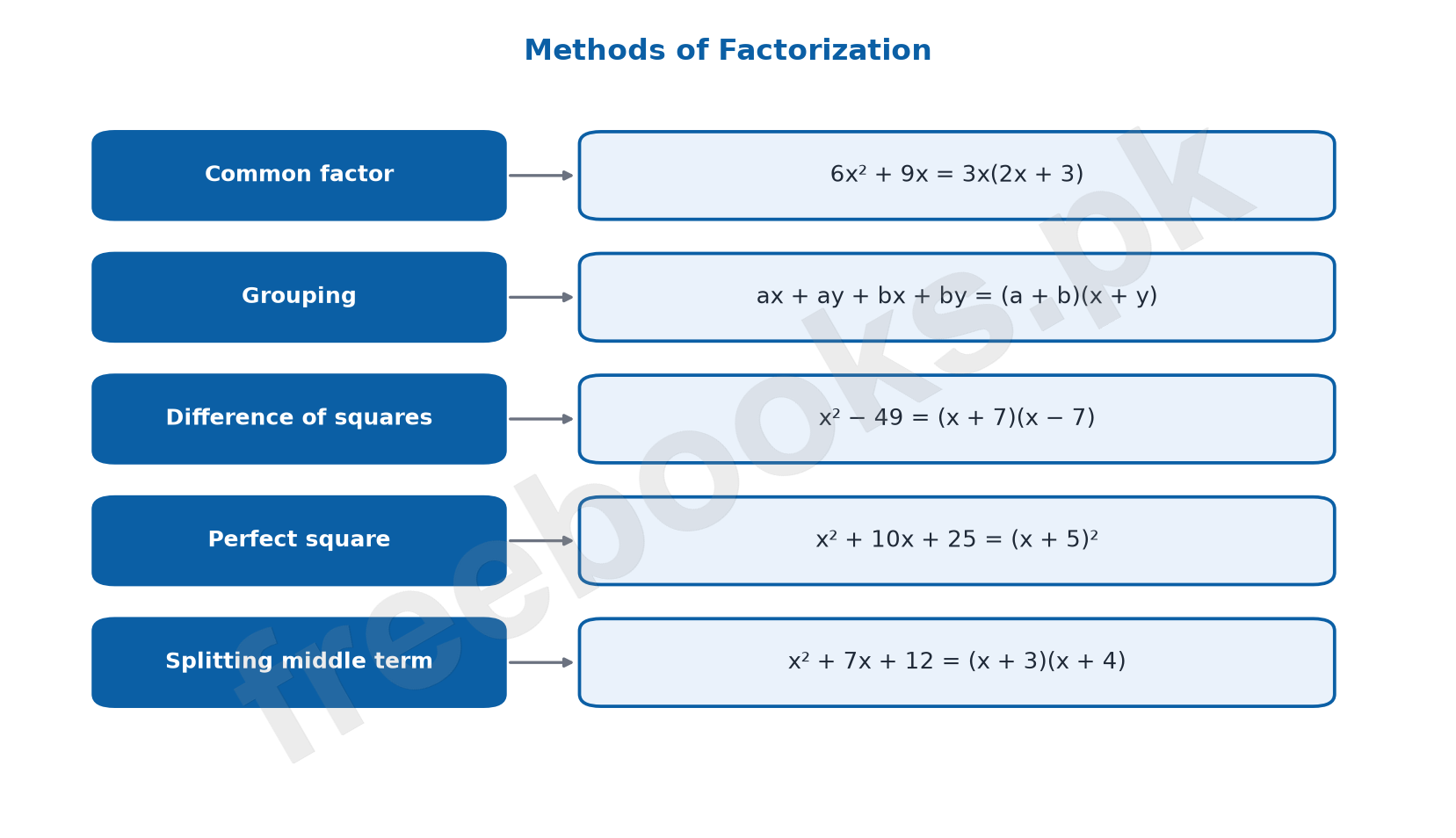
Common factor: 6x² + 9x = 3x(2x + 3). Grouping: ax + ay + bx + by = a(x + y) + b(x + y) = (a + b)(x + y).
Using identities: x² − 49 = (x + 7)(x − 7); x² + 10x + 25 = (x + 5)²; a² + 2ab + b² − c² = (a + b)² − c² = (a + b + c)(a + b − c).
Splitting the middle term: for x² + 7x + 12 find two numbers with product 12 and sum 7 (3 and 4), so x² + 7x + 12 = (x + 3)(x + 4). For 3x² + 7xy + 2y², split 7xy as 6xy + xy: (3x + y)(x + 2y).
8.5 Exponents and Their Laws
In aⁿ, a is the base and n is the exponent (index): 2⁵ = 32. 10⁵ is read ’10 raised to the power 5′.
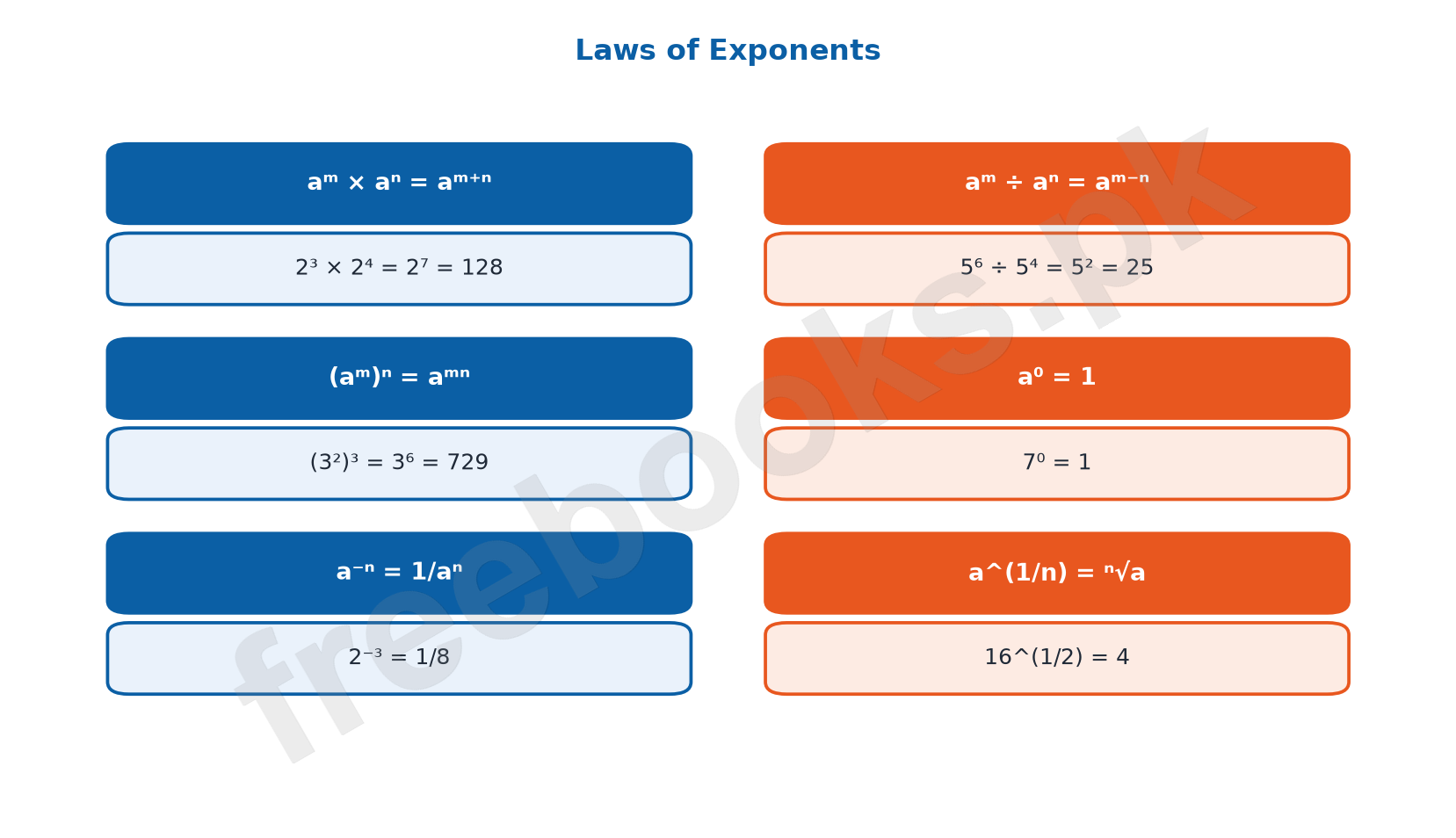
Laws: aᵐ × aⁿ = aᵐ⁺ⁿ; aᵐ ÷ aⁿ = aᵐ⁻ⁿ; (aᵐ)ⁿ = aᵐⁿ; (ab)ⁿ = aⁿbⁿ; (a/b)ⁿ = aⁿ/bⁿ.
Special indices: a⁰ = 1 (a ≠ 0); a⁻ⁿ = 1/aⁿ; a^(1/n) is the nth root of a, so 16^(1/2) = 4 and 27^(2/3) = (∛27)² = 9.
8.6 Standard Form and Scientific Notation
Scientific notation writes a number as a × 10ⁿ where 1 ≤ a < 10 and n is an integer: 4,500,000 = 4.5 × 10⁶ and 0.00072 = 7.2 × 10⁻⁴.
Large numbers have a positive power of 10; small numbers (less than 1) have a negative power. The speed of light, about 300,000,000 m/s, is 3 × 10⁸ m/s.
Important Definitions
Closed sentence
A statement that is definitely true or false.
Open sentence
A sentence with a variable whose truth depends on its value.
Polynomial
An expression whose variables have only whole-number exponents.
Coefficient
The number multiplying a variable in a term.
Degree of a polynomial
The highest exponent (or sum of exponents) of any term.
Quadratic polynomial
A polynomial of degree 2.
Cubic polynomial
A polynomial of degree 3.
Biquadratic polynomial
A polynomial of degree 4.
Identity
An equation true for all values of its variables.
Factorization
Writing an expression as a product of factors.
Base and exponent
In aⁿ, a is the base and n is the exponent.
Scientific notation
Writing a number as a × 10ⁿ with 1 ≤ a < 10.
Key Facts at a Glance
| Identity / law | Form |
|---|---|
| (a + b)² | a² + 2ab + b² |
| (a − b)² | a² − 2ab + b² |
| a² − b² | (a + b)(a − b) |
| (a + b)³ | a³ + 3ab(a + b) + b³ |
| (a − b)³ | a³ − 3ab(a − b) − b³ |
| aᵐ × aⁿ | aᵐ⁺ⁿ |
| aᵐ ÷ aⁿ | aᵐ⁻ⁿ |
| (aᵐ)ⁿ | aᵐⁿ |
| a⁰ | 1 (a ≠ 0) |
| a⁻ⁿ | 1/aⁿ |
| 103² | 10609 |
| 0.00072 | 7.2 × 10⁻⁴ |
Diagrams
Area model of (a + b)²: A square of side a + b divided into a², two ab rectangles and b².

Methods of factorization: A chart of the main factorization methods with an example of each.
Laws of exponents: A chart of the laws of exponents with numerical examples.
Short Questions and Answers
Is x + 5 = 9 an open or closed sentence?
Open, because its truth depends on x.
Is 2x² − 3/x a polynomial? Why?
No; 3/x = 3x⁻¹ has a negative exponent.
Find the degree of 4x³y + 2xy − 7.
4 (3 + 1 in the first term).
Subtract (2a² − a + 3) from (5a² + 4a − 1).
3a² + 5a − 4.
Multiply (2x − 1)(x + 4).
2x² + 7x − 4.
Divide x² + 8x + 15 by x + 3.
x + 5, remainder 0.
Expand (2x + 3)².
4x² + 12x + 9.
Find 98² using an identity.
(100 − 2)² = 10000 − 400 + 4 = 9604.
Find 105 × 95 using an identity.
100² − 5² = 9975.
Expand (x + 2)³.
x³ + 6x² + 12x + 8.
Factorize 9a² − 16b².
(3a + 4b)(3a − 4b).
Factorize x² − 5x + 6.
(x − 2)(x − 3).
Simplify 2³ × 2⁴ ÷ 2⁵.
2² = 4.
Evaluate 5⁰ + 2⁻² + 8^(1/3).
1 + 1/4 + 2 = 3.25.
Write 0.0000056 in scientific notation.
5.6 × 10⁻⁶.
Long Questions and Answers
Explain polynomials and their types.
What is a polynomial?
An algebraic expression in which every variable has a whole-number exponent, such as 2x³ − x + 4.
How are polynomials named by variables?
In one variable (x² + 1), two variables (x²y − y) or more (xyz + 2).
How are they named by degree?
Linear (1), quadratic (2), cubic (3) and biquadratic (4).
Classify 5x⁴ − x² + 1 and 3x − 2.
The first is biquadratic (degree 4); the second is linear.
Explain the operations on polynomials.
Add (4x² − 3x + 2) and (x² + 5x − 7).
5x² + 2x − 5.
Multiply (x + 3)(x² − 2x + 1).
x³ + x² − 5x + 3.
Divide x³ − 1 by x − 1.
x² + x + 1 with remainder 0.
What is the degree of a product?
The sum of the degrees of the factors: degree 1 × degree 2 gives degree 3.
State and apply the algebraic identities.
Write the square identities.
(a ± b)² = a² ± 2ab + b² and (a + b)(a − b) = a² − b².
Write the cube identities.
(a + b)³ = a³ + 3ab(a + b) + b³ and (a − b)³ = a³ − 3ab(a − b) − b³.
Expand (a − 1)³.
a³ − 3a(a − 1) − 1 = a³ − 3a² + 3a − 1.
If a + b = 7 and ab = 10, find a² + b².
(a + b)² − 2ab = 49 − 20 = 29.
Explain the methods of factorization with examples.
Taking a common factor
12x²y − 18xy² = 6xy(2x − 3y).
Grouping
px − py + qx − qy = p(x − y) + q(x − y) = (p + q)(x − y).
Using identities
4x² + 12x + 9 = (2x + 3)²; x² − 2xy + y² − z² = (x − y + z)(x − y − z).
Splitting the middle term
2x² + 7x + 3: product 6, sum 7 → 6 and 1: 2x² + 6x + x + 3 = (2x + 1)(x + 3).
Explain the laws of exponents.
Product and quotient laws
aᵐ × aⁿ = aᵐ⁺ⁿ and aᵐ ÷ aⁿ = aᵐ⁻ⁿ; e.g., 3⁴ × 3² = 3⁶ and 7⁵ ÷ 7³ = 49.
Power laws
(aᵐ)ⁿ = aᵐⁿ, (ab)ⁿ = aⁿbⁿ, (a/b)ⁿ = aⁿ/bⁿ; e.g., (3²)³ = 729.
Zero and negative indices
a⁰ = 1 and a⁻ⁿ = 1/aⁿ; e.g., (2/3)⁻² = 9/4.
Fractional indices
a^(m/n) = (ⁿ√a)ᵐ; e.g., 27^(2/3) = 9 and 32^(1/5) = 2.
Explain scientific notation with examples.
What is scientific notation?
Writing a number as a × 10ⁿ with 1 ≤ a < 10 and n an integer.
Write 72,000,000 in scientific notation.
7.2 × 10⁷.
Write 0.000304 in scientific notation.
3.04 × 10⁻⁴.
Write 6.1 × 10⁵ in ordinary form.
610,000.
Multiple Choice Questions (MCQs)
Which is a polynomial? (A) x + 1/x (B) √x + 2 (C) 3x² − x + 5 (D) 2/x²
Correct answer: (C) 3x² − x + 5. Whole-number exponents.
Degree of 3x²y³ − xy is: (A) 2 (B) 3 (C) 5 (D) 6
Correct answer: (C) 5. 2 + 3.
A polynomial of degree 3 is: (A) Linear (B) Quadratic (C) Cubic (D) Biquadratic
Correct answer: (C) Cubic. Cubic.
(x + 4)(x − 4) = (A) x² − 16 (B) x² + 16 (C) x² − 8x + 16 (D) x² − 8
Correct answer: (A) x² − 16. Difference of squares.
(a − b)² = (A) a² − b² (B) a² − 2ab + b² (C) a² + 2ab + b² (D) a² + b²
Correct answer: (B) a² − 2ab + b². Identity.
101 × 99 = (A) 9999 (B) 10001 (C) 9899 (D) 10099
Correct answer: (A) 9999. 100² − 1.
x² + 6x + 9 = (A) (x + 3)² (B) (x − 3)² (C) (x + 9)(x + 1) (D) (x + 6)(x + 3)
Correct answer: (A) (x + 3)². Perfect square.
Factors of x² + 7x + 10 are: (A) (x + 2)(x + 5) (B) (x + 1)(x + 10) (C) (x − 2)(x − 5) (D) (x + 3)(x + 4)
Correct answer: (A) (x + 2)(x + 5). 2 × 5 = 10, 2 + 5 = 7.
a⁰ = (A) 0 (B) 1 (C) a (D) Undefined for a ≠ 0
Correct answer: (B) 1. Zero index.
2⁻³ = (A) −8 (B) −6 (C) 1/8 (D) 8
Correct answer: (C) 1/8. 1/2³.
(x³)⁴ = (A) x⁷ (B) x¹² (C) x⁸¹ (D) x
Correct answer: (B) x¹². 3 × 4.
81^(1/2) = (A) 9 (B) 40.5 (C) 3 (D) 27
Correct answer: (A) 9. √81.
4,200 in scientific notation is: (A) 42 × 10² (B) 4.2 × 10³ (C) 0.42 × 10⁴ (D) 4.2 × 10²
Correct answer: (B) 4.2 × 10³. 1 ≤ a < 10.
0.0035 = (A) 3.5 × 10⁻³ (B) 3.5 × 10³ (C) 35 × 10⁻⁴ (D) 3.5 × 10⁻²
Correct answer: (A) 3.5 × 10⁻³. Move point 3 places.
x + 3 = 7 is a(n): (A) Closed sentence (B) Open sentence (C) Identity (D) Polynomial
Correct answer: (B) Open sentence. Has a variable.
Quick Revision Summary
- Closed sentence: true/false; open sentence: contains a variable.
- Polynomial: whole-number exponents; degree → linear, quadratic, cubic, biquadratic.
- Product degree = sum of degrees; exact division leaves remainder 0.
- (a ± b)² = a² ± 2ab + b²; a² − b² = (a + b)(a − b); (a ± b)³ = a³ ± 3ab(a ± b) ± b³.
- Factorize: common factor, grouping, identities, splitting the middle term.
- Exponent laws; a⁰ = 1; a⁻ⁿ = 1/aⁿ; a^(1/n) = ⁿ√a.
- Scientific notation: a × 10ⁿ, 1 ≤ a < 10.
Exam Tips
- Always look for a common factor first before trying other methods.
- Check a factorization by multiplying the factors back.
- Write identities at the top of your answer before using them.
- For negative indices, flip the base: (a/b)⁻ⁿ = (b/a)ⁿ.
- In scientific notation count how many places the decimal point moves.