Chapter 10 explains evolution: the change in the inherited traits of a population over many generations. Small changes that help organisms survive in their environment build up over time and can lead to new species. Charles Darwin explained how this happens through natural selection.
These notes cover Darwin’s voyage on HMS Beagle and his observations, the theory of evolution by natural selection with the beetle, giraffe and peppered moth examples, the definition of species, allopatric and sympatric speciation, the sources of variation, and the evidence for evolution from fossils, comparative anatomy and selective breeding.
Learning Objectives
- Describe Darwin’s main observations on the voyage of HMS Beagle.
- Explain the theory of evolution by natural selection with examples.
- Define species and explain allopatric and sympatric speciation.
- Describe mutation, recombination, gene flow and random fertilisation as sources of variation.
- Describe fossil evidence, homologous and vestigial structures as evidence of evolution.
- Explain how selective breeding supports the idea of evolution.
Key Concepts
10.1 Darwin’s Observations
Charles Darwin (1809–1882), an English naturalist, travelled around the world for five years on HMS Beagle and collected many observations.
Unique species: different regions and islands had their own distinct plants and animals. Variation within species: members of the same species living in different places differed in ways that suited their environments (adaptations).
Finches: on the Galápagos Islands, finches on different islands had beaks of different size and shape, each suited to the food available there, such as seeds, cactus or insects. Fossils: fossils of extinct animals resembled living species, suggesting species change over time.
After years of further study, Darwin published ‘On the Origin of Species’ in 1859, setting out the theory of evolution by natural selection.
10.2 Evolution by Natural Selection
The theory states that living things change over time: individuals with helpful variations survive and reproduce more, passing these variations to their young, so over many generations the helpful traits become common and new species can arise.
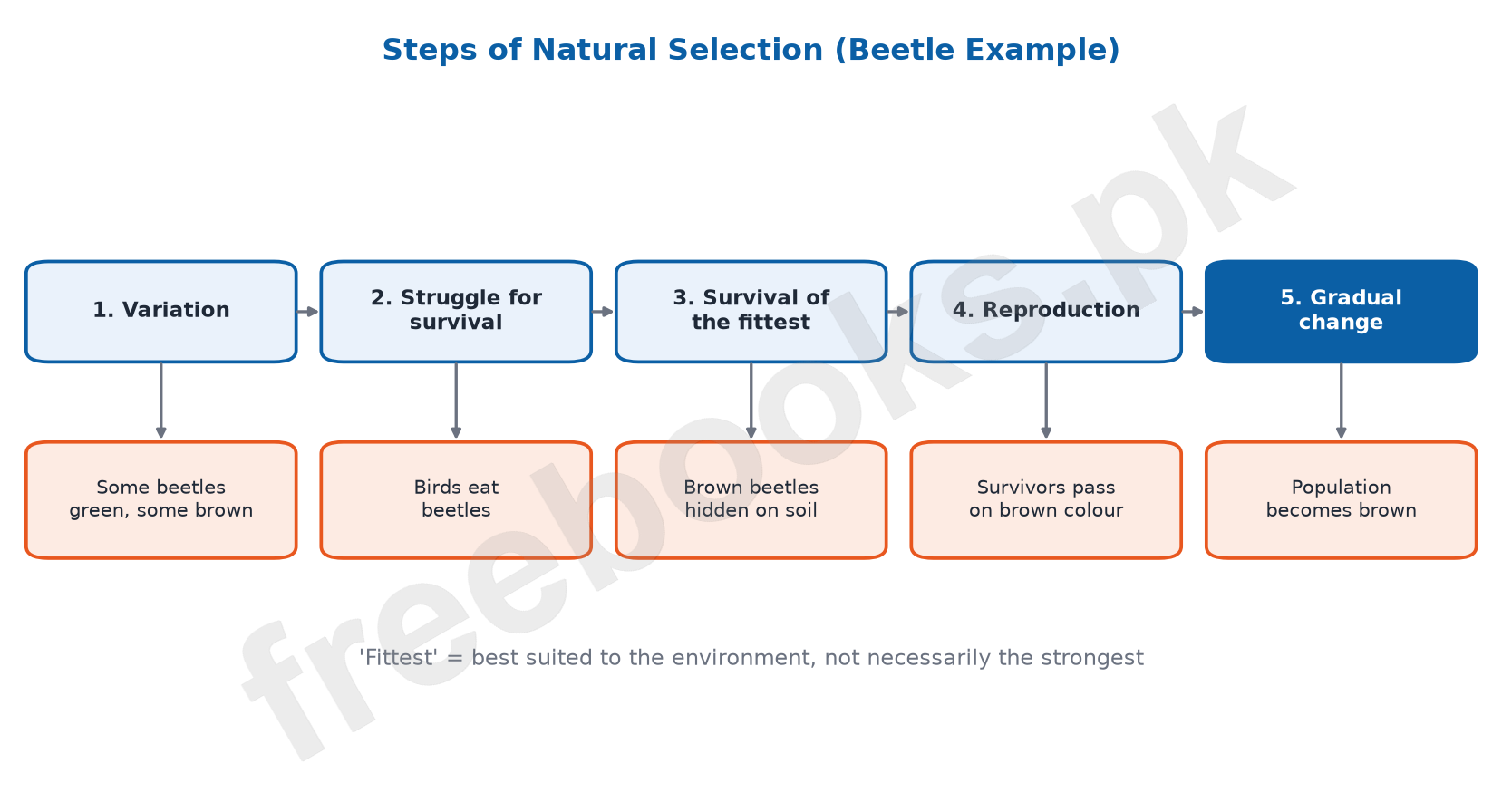
Steps: (1) Variation: individuals of a species differ, for example some beetles are green and some brown. (2) Struggle for survival: resources are limited and there are predators and diseases; birds eat beetles. (3) Survival of the fittest: those best suited survive; brown beetles blend with soil and are eaten less. ‘Fittest’ means best suited, not strongest. (4) Reproduction: survivors pass on their useful traits, so more brown beetles are born. (5) Gradual change: over many generations the whole population may become brown.
Giraffe example: giraffes with slightly longer necks reached leaves on tall trees in dry seasons, survived and reproduced more, so long necks became common. Peppered moth example: in industrial England, soot darkened tree bark; dark moths were better hidden from birds than light moths, so the dark form became more common.
10.3 Species and Speciation
A species is a group of organisms that can interbreed under natural conditions and produce fertile offspring, and is reproductively isolated from other groups. Lions (Panthera leo) and tigers (Panthera tigris) are separate species because they do not interbreed in nature.
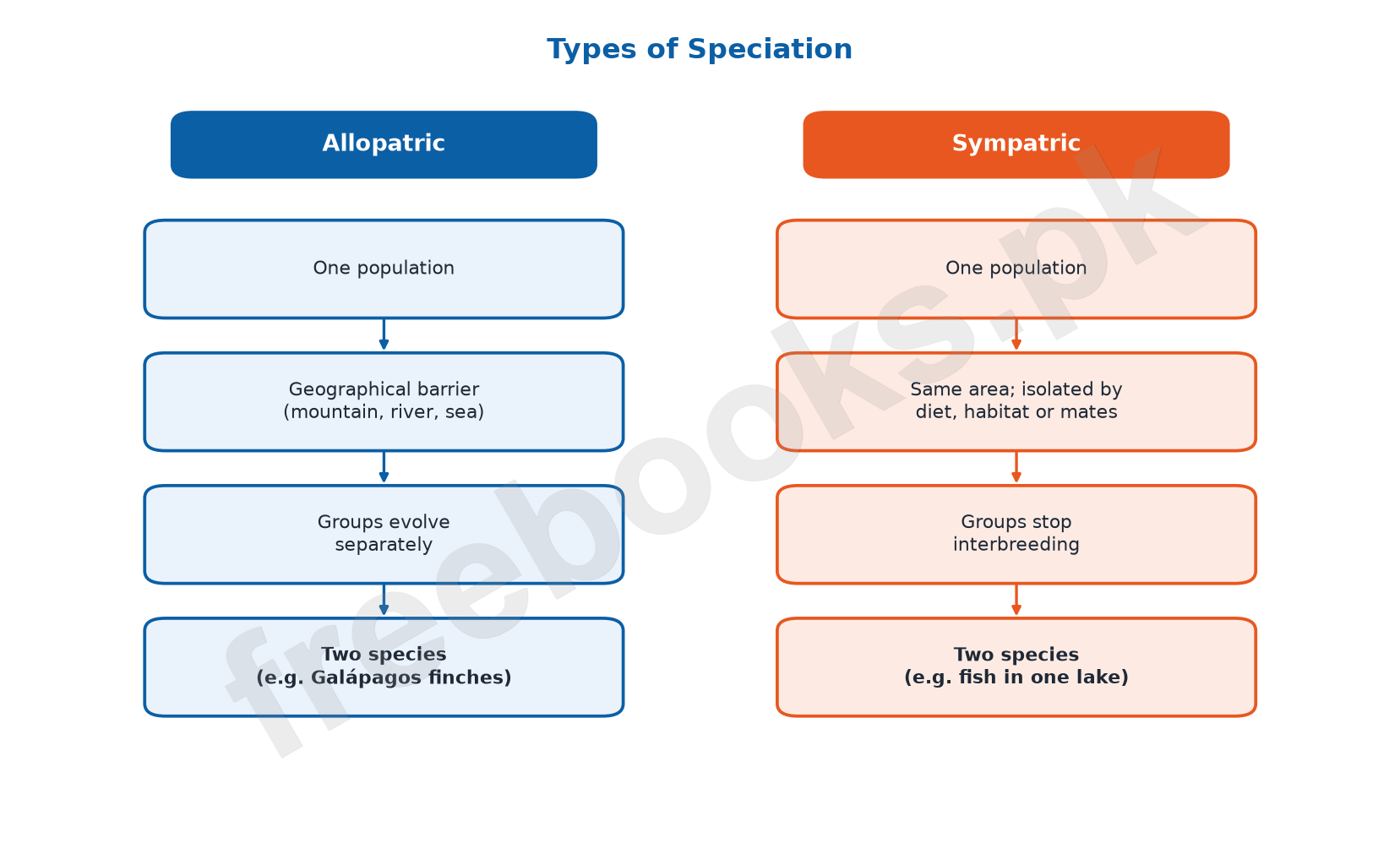
Speciation is the formation of new species. In allopatric speciation, a population is split by a geographical barrier such as a mountain range, river or sea; the separated groups evolve differently and become distinct species, as with the Galápagos finches. In sympatric speciation, groups in the same area become reproductively isolated because of differences in habitat, diet or mate choice, for example fish groups in one lake that stop interbreeding.
10.4 Sources of Variation
Mutation: a permanent change in DNA, arising spontaneously or due to radiation or chemicals, that can be inherited. Most mutations are neutral or harmful but some are useful; for example a mutation giving antibiotic resistance helps bacteria survive when antibiotics are used.
Genetic recombination: during meiosis, genes are shuffled into new combinations in gametes, so offspring of sexually reproducing parents get new mixtures of traits; this is why siblings differ.
Gene flow (migration): individuals or pollen moving from one population to another bring in new alleles, such as drought-resistance genes. Random fertilisation: any sperm can fuse with any egg, so each child of the same parents gets a unique combination of genes.
10.5 Evidence of Evolution
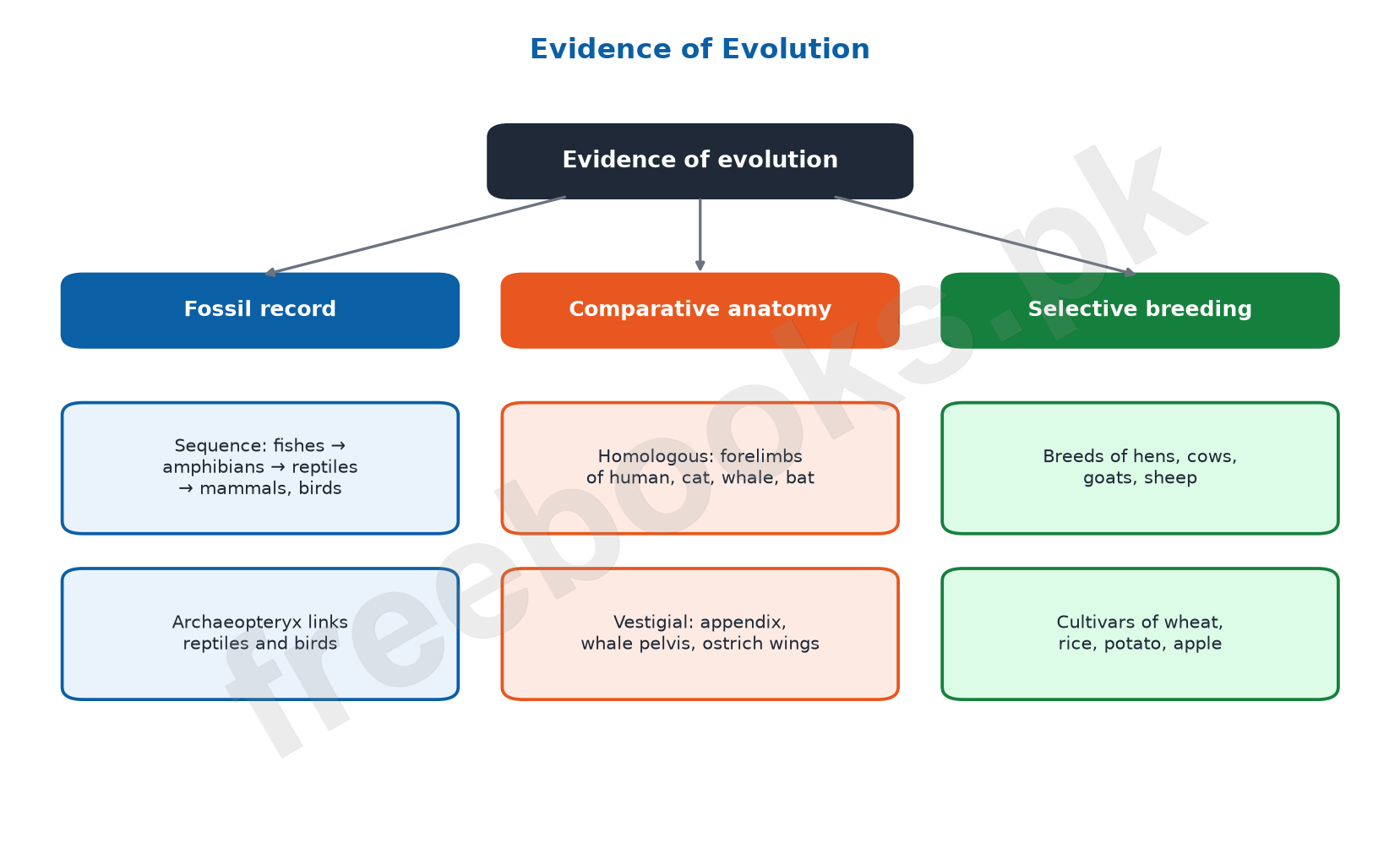
Palaeontology (fossil record): fossils are remains, impressions or traces of past organisms, mostly in sedimentary rocks. They show a sequence of change; the earliest vertebrate fossils are fishes, followed by amphibians and reptiles, then mammals and birds. Archaeopteryx, with both reptile and bird features, links birds to reptile (dinosaur) ancestors.
Comparative anatomy: homologous structures have the same basic structure but different functions, such as the forelimbs of humans, cats, whales and bats, pointing to a common ancestor. Analogous structures have the same function but different structure, such as wings of insects and birds. Vestigial structures have little or no use now but were functional in ancestors: the human appendix, human ear muscles, pelvic bones in whales and wings of flightless birds such as ostriches.
Selective breeding: humans choose plants or animals with desired traits and breed them, producing breeds of animals (hens, cows, goats, sheep) and varieties or cultivars of plants (wheat, rice, potato, apple). It shows how much natural variation exists and how selection can change a population over generations, just as natural selection does.
Important Definitions
Evolution
Change in the inherited traits of a population over successive generations.
Adaptation
A feature of body or behaviour that helps an organism survive in its environment.
Natural selection
Process by which better-suited individuals survive and reproduce more.
Survival of the fittest
Survival of individuals best suited to their environment.
Species
Organisms that interbreed naturally to produce fertile offspring.
Speciation
Formation of new species by evolution.
Allopatric speciation
Speciation after populations are separated by a geographical barrier.
Sympatric speciation
Speciation within the same area due to reproductive isolation.
Variation
Inheritable differences among individuals of a population.
Mutation
A permanent, heritable change in DNA.
Genetic recombination
New combinations of genes formed during meiosis.
Gene flow
Movement of genes between populations by migration.
Fossil
Remains, impression or trace of an organism from the past.
Homologous structures
Similar structures with different functions, from a common ancestor.
Analogous structures
Structures with similar function but different structure.
Vestigial structures
Reduced parts with little or no function now.
Selective breeding
Breeding chosen organisms to obtain desired traits.
Cultivar
A plant variety produced by selective breeding.
Key Facts at a Glance
| Item | Fact |
|---|---|
| Charles Darwin | 1809–1882, English naturalist |
| Darwin’s ship | HMS Beagle; five-year voyage |
| ‘On the Origin of Species’ | Published 1859 |
| Finches studied on | Galápagos Islands |
| Industrial example | Peppered moth |
| Lion and tiger | Panthera leo and Panthera tigris |
| Speciation by barrier | Allopatric |
| Speciation in same area | Sympatric |
| Earliest vertebrate fossils | Fishes |
| Bird–reptile link fossil | Archaeopteryx |
| Example of homologous organs | Forelimbs of human, cat, whale, bat |
| Vestigial in humans | Appendix, ear muscles |
Diagrams
Steps of natural selection: A flow chart of the five steps of natural selection using the beetle example.
Types of speciation: A comparison of allopatric and sympatric speciation.
Evidence of evolution: A chart of the main evidence of evolution with examples.
Short Questions and Answers
What is evolution?
A change in the inherited characteristics of a population over many generations.
What did the Galápagos finches show Darwin?
Their beaks differed in shape and size to suit the food on each island, showing adaptation.
How did fossils influence Darwin?
Fossils of extinct animals resembled living ones, suggesting species change over time.
What does ‘fittest’ mean in natural selection?
Best suited to the environment, not necessarily the strongest.
Why must there be variation for natural selection to act?
Selection can only favour some individuals over others if they differ in inherited traits.
Explain the peppered moth example in one or two lines.
Soot darkened tree bark; dark moths were hidden from birds and survived more, so they became common.
Define species.
A group of organisms that interbreed in nature and produce fertile offspring.
Why are lions and tigers separate species?
They do not interbreed under natural conditions; they are reproductively isolated.
Distinguish allopatric and sympatric speciation.
Allopatric happens after a geographical barrier separates populations; sympatric happens within the same area through reproductive isolation.
How can mutation be useful? Give an example.
A mutation may give a survival advantage, such as antibiotic resistance in bacteria.
Why are siblings different from one another?
Genetic recombination during meiosis and random fertilisation give each child a unique gene combination.
What is gene flow?
Movement of genes into a population when individuals or pollen migrate from another population.
Why is Archaeopteryx important?
It has features of both reptiles and birds, supporting the evolution of birds from reptile ancestors.
Distinguish homologous and analogous organs.
Homologous organs share structure but differ in function; analogous organs share function but differ in structure.
Give two vestigial structures.
The human appendix and pelvic bones in whales (also human ear muscles, ostrich wings).
Long Questions and Answers
Describe Darwin’s observations during the voyage of HMS Beagle.
What was the voyage?
A five-year journey around the world on HMS Beagle by the naturalist Charles Darwin.
What did he notice about species and variation?
Different regions had unique species, and members of a species varied in ways suited to their environment.
What did the finches show?
Beak size and shape on each Galápagos island matched the available food.
What did fossils suggest?
Extinct animals resembled living ones, suggesting gradual change; he published ‘On the Origin of Species’ in 1859.
Explain the theory of evolution by natural selection.
What is variation?
Individuals of a species differ in colour, size, speed and other traits.
What is the struggle for survival?
Limited food and space, predators and diseases mean not all individuals survive.
What is survival of the fittest?
Individuals best suited to the environment survive and reproduce more.
How does this lead to evolution?
Useful traits are inherited and become common over many generations, which may produce new species.
Explain natural selection using the giraffe and peppered moth.
How did long necks become common in giraffes?
Longer-necked giraffes reached high leaves in dry seasons, survived and passed on long necks.
What happened to peppered moths?
Pollution darkened tree bark, so dark moths were camouflaged and survived better than light ones.
What was the result?
The population came to have more of the favoured form over generations.
What do both examples show?
The environment selects the variation that improves survival, changing the population.
Describe species and speciation.
What is a species?
Organisms that interbreed naturally and produce fertile offspring, isolated from other groups.
What is speciation?
The formation of new species by evolution.
Describe allopatric speciation.
A barrier like a mountain or sea separates populations, which evolve differently, as in Galápagos finches.
Describe sympatric speciation.
Groups in the same area stop interbreeding due to diet, habitat or mate choice, e.g., fish in a lake.
Describe the sources of variation.
What is mutation?
A permanent change in DNA that may produce new traits, e.g., antibiotic resistance.
What is genetic recombination?
Shuffling of genes during meiosis giving new combinations in gametes.
What is gene flow?
Migration of individuals or pollen bringing new alleles into a population.
What is random fertilisation?
Any sperm can fuse with any egg, giving unique combinations in each offspring.
Describe the evidence of evolution.
How does the fossil record support evolution?
Fossils show a sequence of change through time, and Archaeopteryx links reptiles and birds.
What are homologous structures?
Forelimbs of human, cat, whale and bat share structure but differ in function, indicating common ancestry.
What are vestigial structures?
Reduced organs like the human appendix and whale pelvic bones that were functional in ancestors.
How does selective breeding support evolution?
It shows natural variation exists and that selection over generations changes a population.
Multiple Choice Questions (MCQs)
Darwin travelled around the world on: (A) HMS Victory (B) HMS Beagle (C) Titanic (D) Endeavour
Correct answer: (B) HMS Beagle. HMS Beagle.
‘On the Origin of Species’ was published in: (A) 1809 (B) 1859 (C) 1882 (D) 1900
Correct answer: (B) 1859. 1859.
Darwin studied finches on the: (A) Canary Islands (B) Galápagos Islands (C) Maldives (D) Hawaii
Correct answer: (B) Galápagos Islands. Galápagos.
In natural selection, ‘fittest’ means: (A) Strongest (B) Largest (C) Best suited (D) Fastest
Correct answer: (C) Best suited. Best suited.
Dark peppered moths increased because they were: (A) Stronger (B) Better camouflaged (C) Larger (D) Faster
Correct answer: (B) Better camouflaged. Hidden on dark bark.
Organisms that interbreed naturally and give fertile offspring form a: (A) Genus (B) Species (C) Population only (D) Family
Correct answer: (B) Species. Species.
Speciation caused by a mountain range separating populations is: (A) Sympatric (B) Allopatric (C) Artificial (D) Random
Correct answer: (B) Allopatric. Allopatric.
A permanent change in DNA is a: (A) Fossil (B) Mutation (C) Breed (D) Cultivar
Correct answer: (B) Mutation. Mutation.
New gene combinations formed during meiosis are due to: (A) Gene flow (B) Recombination (C) Mutation only (D) Selection
Correct answer: (B) Recombination. Recombination.
Migration of pollen bringing new genes is: (A) Gene flow (B) Speciation (C) Mutation (D) Analogy
Correct answer: (A) Gene flow. Gene flow.
The earliest vertebrates in the fossil record are: (A) Reptiles (B) Fishes (C) Birds (D) Mammals
Correct answer: (B) Fishes. Fishes.
Archaeopteryx links birds with: (A) Fishes (B) Reptiles (C) Mammals (D) Amphibians
Correct answer: (B) Reptiles. Reptile (dinosaur) ancestors.
Forelimbs of human and bat are: (A) Analogous (B) Homologous (C) Vestigial (D) Unrelated
Correct answer: (B) Homologous. Same structure, different function.
Wings of an insect and a bird are: (A) Homologous (B) Analogous (C) Vestigial (D) Fossils
Correct answer: (B) Analogous. Same function, different structure.
Plant varieties produced by selective breeding are called: (A) Breeds (B) Cultivars (C) Mutants (D) Fossils
Correct answer: (B) Cultivars. Cultivars.
Quick Revision Summary
- Evolution: change in heritable traits of a population over generations.
- Darwin (1809–1882), HMS Beagle; unique species, variation, Galápagos finches, fossils; ‘On the Origin of Species’ (1859).
- Natural selection: variation → struggle for survival → survival of the fittest → reproduction → gradual change.
- Examples: beetles, giraffe neck, peppered moth.
- Species: interbreed, fertile offspring. Speciation: allopatric (barrier) vs sympatric (same area).
- Variation: mutation, recombination, gene flow, random fertilisation.
- Evidence: fossils (Archaeopteryx), homologous vs analogous, vestigial (appendix, whale pelvis), selective breeding.
Exam Tips
- Learn the five steps of natural selection and practise applying them to any example.
- Do not confuse homologous (same structure) with analogous (same function).
- Remember allopatric = ‘other place’ (barrier) and sympatric = ‘same place’.
- Give one example for each source of variation and each type of evidence.
- Learn key dates: Darwin 1809–1882, Origin of Species 1859.
Note on Facts
The textbook lists the order of vertebrate fossils as fishes, amphibians, reptiles, then birds and mammals. Early mammals actually appear in the fossil record before the first birds (about 200 million years ago versus about 150 million years ago); both came after reptiles.
The textbook describes the human appendix as vestigial. It is reduced compared with the large caecum of plant-eating mammals, but scientists now know it contains lymphoid tissue and may help the immune system and gut bacteria, so it is not entirely without function.
The textbook says natural selection works in three steps but then describes five. The five-step description (variation, struggle, survival of the fittest, reproduction, gradual change) is the complete one to learn.