Chapter 9 looks at what makes us ill and how the body protects itself. The WHO defines health as complete physical, mental and social well-being, not just the absence of disease. Diseases may be caused by pathogens (infectious) or by genes, lifestyle, environment or ageing (non-infectious).
These notes cover infectious and non-infectious diseases, zoonotic and vector-borne diseases with examples, allergies and their types, the main kinds of pathogens and how they spread, the three lines of defence of the immune system (innate and acquired immunity), and the steps of blood clotting.
Learning Objectives
- Distinguish infectious and non-infectious diseases with examples.
- Define zoonotic and vector-borne diseases and give examples.
- Describe allergies and their main types.
- Name the types of pathogens, with examples and modes of transmission.
- Describe the first, second and third lines of defence.
- Describe the steps of blood clotting.
Key Concepts
9.1 Disease and Its Basic Types
A disease is a condition that disturbs the normal working of the body or mind, such as an infection, a metabolic disorder or a genetic disorder. Illness is a person’s own experience of feeling unwell.
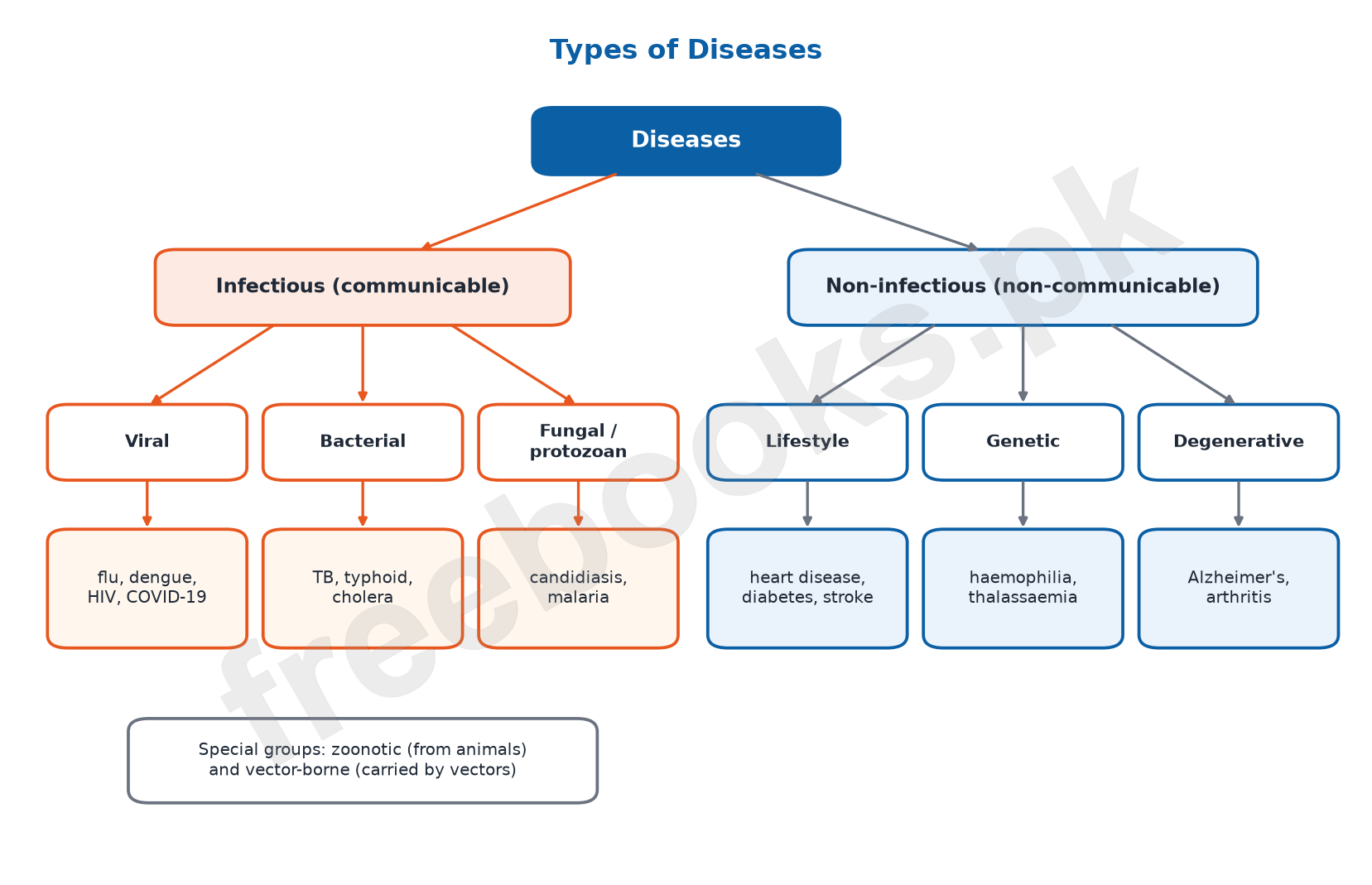
Infectious (communicable) diseases are caused by pathogens and can spread from person to person or from the environment, through contaminated food or water or insect bites. Examples: viral (hepatitis, flu, dengue, measles, HIV, COVID-19); bacterial (typhoid, cholera, tuberculosis, strep throat); fungal (candidiasis); protozoan (malaria, amoebiasis); worms (roundworm, tapeworm). Infections may be localised (one area) or systemic (many organs). Overuse of antibiotics has made many bacteria resistant, a serious health risk.
Non-infectious (non-communicable) diseases do not spread between people. They result from lifestyle (heart disease, hypertension, diabetes, some cancers, stroke), mental health conditions (depression), genetic abnormalities (haemophilia, thalassaemia, muscular dystrophy) or decline of organs with age (Alzheimer’s, Parkinson’s, arthritis). Diabetes and cancers also have a genetic basis; a healthy lifestyle can delay them.
9.1 Zoonotic and Vector-Borne Diseases
A zoonotic disease is an infection naturally passed from animals to humans, through direct contact, food, water or the environment. Anthrax is caused by the bacterium Bacillus anthracis and spreads from contaminated hides, wool or meat, entering through wounds, food or inhaled spores. Bird flu (avian influenza) is caused by influenza A virus and spreads by close contact with infected birds. Ebola, caused by the Ebola virus, spreads through blood and body fluids of infected people or animals and contaminated objects. Some diseases such as AIDS began as zoonoses and later spread only among humans.
Vector-borne diseases are spread by vectors, living organisms that carry pathogens from one host to another. Malaria (protozoan Plasmodium) is spread by the female Anopheles mosquito and affects the liver and red blood cells. Dengue fever (dengue virus) is spread by the Aedes mosquito. Lyme disease (bacterium Borrelia burgdorferi) is spread by ticks and affects skin, joints and nerves. Yellow fever (yellow fever virus) is spread by Aedes or Haemagogus mosquitoes and attacks the liver and then other organs.
9.1 Allergies
An allergy is an abnormal immune response to a substance that is normally harmless, called an allergen (pollen, dust mites, some foods, insect stings, some medicines). The body releases chemicals such as histamine, causing symptoms in the skin, airways, gut or circulation.
Types: respiratory allergies (allergic rhinitis or hay fever with sneezing and runny nose; asthma with narrowed airways); skin allergies (eczema with itchy inflamed patches; contact dermatitis from nickel, latex or plants); food allergies (peanuts, nuts, shellfish, milk, eggs, wheat); insect sting allergies (bee, wasp, ant venom); drug allergies (some antibiotics, aspirin, NSAIDs).
Anaphylaxis (anaphylactic shock) is a severe, sudden, life-threatening allergic reaction with difficulty breathing and a sharp fall in blood pressure; it needs emergency treatment.
9.2 Pathogens
A pathogen is a microorganism or agent that causes disease in its host: viruses, bacteria, fungi, protists and parasitic worms. Pathogens spread mainly through air, food, water, person-to-person contact and animal bites.
Examples: influenza virus (flu, airborne droplets), HIV (AIDS, sexual contact, blood, needles), SARS-CoV-2 (COVID-19, droplets and surfaces); Streptococcus pyogenes (strep throat), Mycobacterium tuberculosis (TB, airborne droplets), Escherichia coli (food poisoning, contaminated food or water); Candida albicans (candidiasis), athlete’s foot fungi (contaminated surfaces), Aspergillus (aspergillosis, inhaled spores); Plasmodium falciparum (malaria, mosquito), Giardia (giardiasis) and Entamoeba histolytica (amoebiasis) from contaminated food or water. Tapeworms and roundworms live in the intestine as parasites.
9.3 Immunity: First and Second Lines of Defence
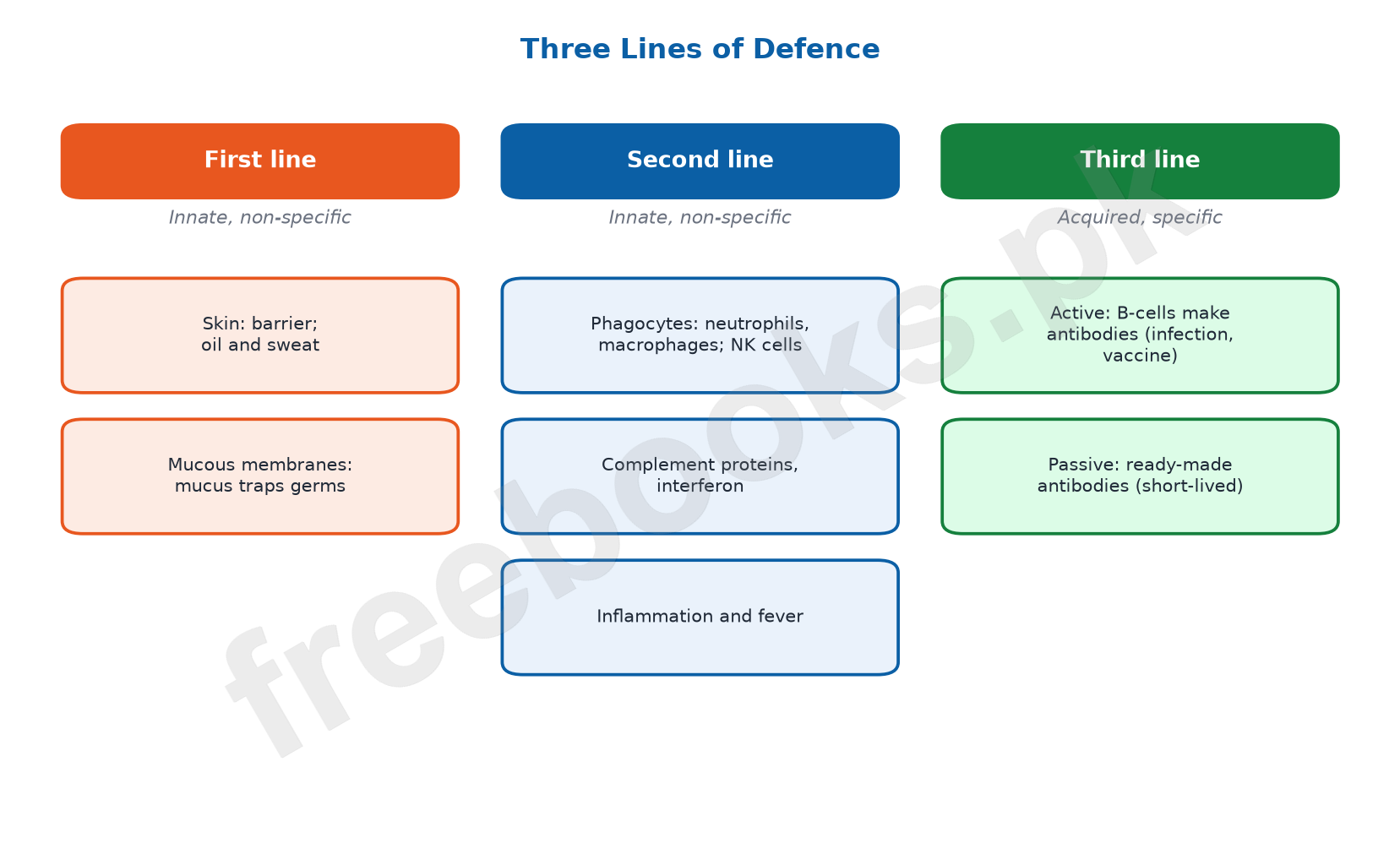
Immunity is the body’s ability to defend itself against pathogens. Innate immunity is present from birth and includes the first and second lines of defence; acquired immunity develops during life and forms the third line.
First line (non-specific barriers): the skin is a physical barrier and its oil and sweat secretions slow microbial growth; mucous membranes lining the airways, gut and urethra secrete mucus that traps pathogens.
Second line (non-specific internal defences): phagocytes such as neutrophils and macrophages (from monocytes) engulf and destroy microbes, and neutrophils also release killing chemicals and fibre nets; natural killer cells destroy virus-infected cells and cancer cells. Protective proteins include complement proteins that punch holes in the membranes of target cells and interferon, released by virus-infected cells, which helps neighbouring cells resist the virus.
Inflammation: damaged cells release histamine, which widens local blood vessels, causing heat, redness and swelling and bringing more defence cells. Fever: macrophages release pyrogens that act on the brain’s temperature centre, raising body temperature above 37 °C; this boosts phagocytes and slows microbial growth.
9.3 Third Line of Defence and Blood Clotting
The third line is acquired, specific immunity. In active immunity, B-lymphocytes make antibodies against a particular pathogen; it may be natural (after infection) or artificial (after vaccination) and is long-lasting. In passive immunity, ready-made antibodies are given to a person (or pass from mother to baby); it acts at once but is short-lived.
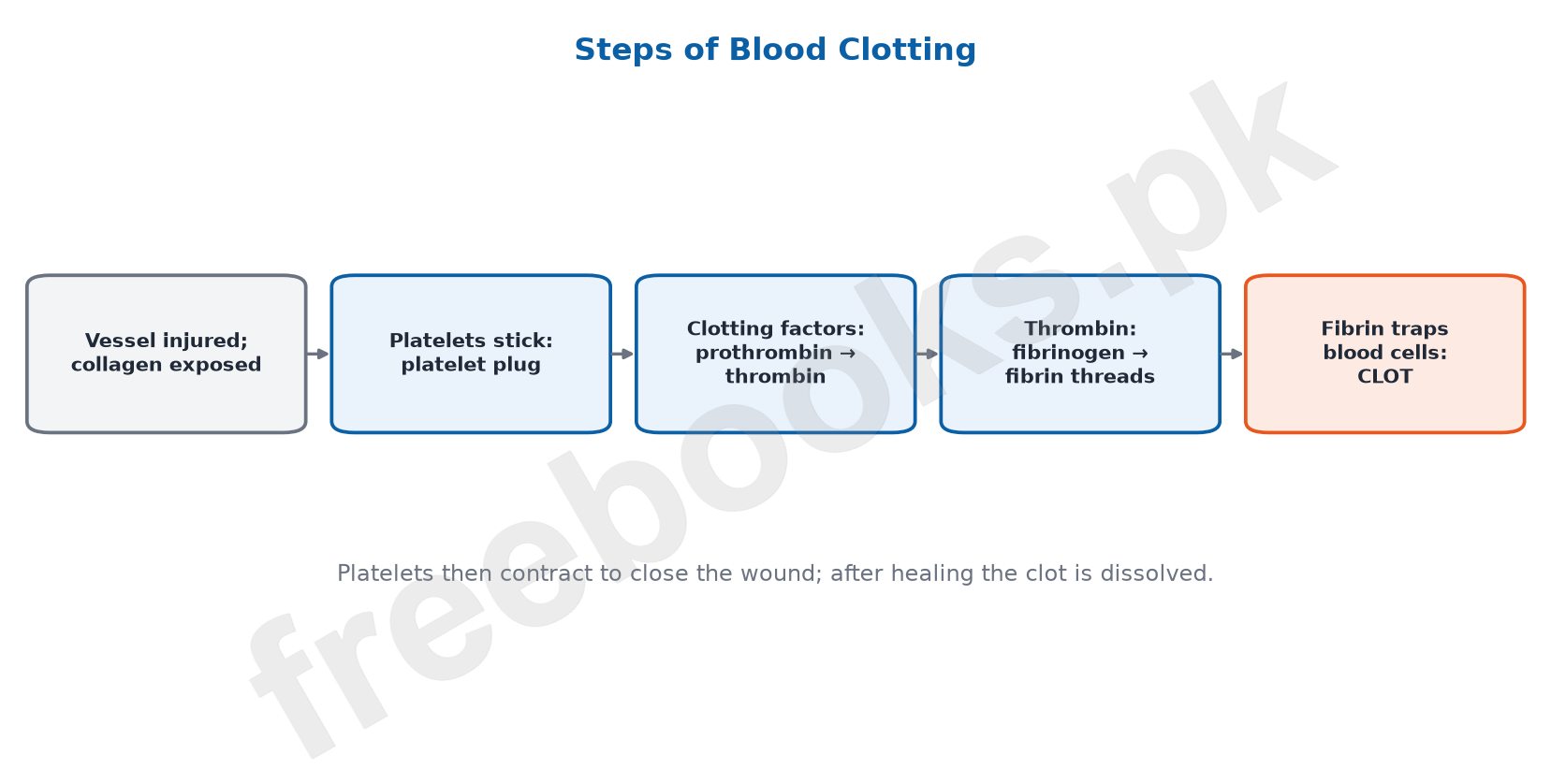
Blood clotting (coagulation) stops bleeding: (1) exposed collagen in an injured vessel activates platelets, which stick to it and form a temporary platelet plug; (2) clotting factors released by platelets convert the plasma protein prothrombin into thrombin; (3) thrombin converts soluble fibrinogen into insoluble fibrin threads, which weave through the plug and trap blood cells to form a clot; (4) platelets in the clot contract, pulling the wound edges together. After healing, the clot is dissolved by a plasma protein and normal flow returns.
Important Definitions
Health
A state of complete physical, mental and social well-being, not merely absence of disease.
Disease
A condition that disturbs normal functioning of the body or mind.
Pathogen
A microorganism or agent that causes disease.
Infectious disease
A disease caused by a pathogen that can spread.
Non-infectious disease
A disease that does not spread from person to person.
Zoonotic disease
An infection naturally transmitted from animals to humans.
Vector
A living organism that carries a pathogen from one host to another.
Allergy
An abnormal immune response to a normally harmless substance.
Allergen
A substance that triggers an allergy.
Histamine
A chemical released in allergy and inflammation that widens blood vessels.
Anaphylaxis
A severe, life-threatening allergic reaction.
Immunity
The body’s ability to resist disease-causing organisms.
Phagocytosis
Engulfing and digesting of microbes by cells such as neutrophils.
Interferon
A protein released by virus-infected cells that protects nearby cells.
Inflammation
Local heat, redness and swelling caused by histamine after injury or infection.
Pyrogens
Chemicals from macrophages that cause fever.
Active immunity
Immunity in which the body makes its own antibodies.
Passive immunity
Short-lived immunity from antibodies received ready-made.
Thrombin
An enzyme that converts fibrinogen into fibrin.
Key Facts at a Glance
| Disease / item | Cause / fact |
|---|---|
| Malaria | Plasmodium; Anopheles mosquito |
| Dengue fever | Dengue virus; Aedes mosquito |
| Lyme disease | Borrelia burgdorferi; ticks |
| Yellow fever | Virus; Aedes / Haemagogus mosquitoes |
| Anthrax | Bacillus anthracis; animal products |
| Bird flu | Influenza A virus; infected birds |
| Tuberculosis | Mycobacterium tuberculosis; airborne |
| Candidiasis | Candida albicans (fungus) |
| First line of defence | Skin and mucous membranes |
| Normal body temperature | 37 °C (98.6 °F) |
| Antibodies made by | B-lymphocytes |
| Fibrinogen converted to fibrin by | Thrombin |
Diagrams
Types of diseases: A tree chart of infectious and non-infectious diseases and their sub-types with examples.
Three lines of defence: A chart of the first, second and third lines of defence with their components.
Steps of blood clotting: A flow chart of the steps from vessel injury to clot formation.
Short Questions and Answers
Distinguish disease and illness.
A disease is a condition disturbing body function; illness is the person’s own experience of feeling unwell.
Distinguish infectious and non-infectious diseases.
Infectious diseases are caused by pathogens and can spread; non-infectious ones arise from genes, lifestyle, environment or ageing and do not spread.
Why is overuse of antibiotics dangerous?
It allows resistant bacteria to survive and multiply, so antibiotics stop working.
What is a zoonotic disease? Give two examples.
An infection passed from animals to humans, e.g., anthrax and bird flu.
What is a vector? Name the vectors of malaria and dengue.
An organism carrying a pathogen between hosts; Anopheles mosquito (malaria) and Aedes mosquito (dengue).
Why is removing standing water important in preventing dengue?
Aedes mosquitoes breed in standing water, so removing it reduces the vector population.
What is an allergen? Give three examples.
A normally harmless substance that triggers allergy, e.g., pollen, dust mites and peanuts.
What is anaphylaxis?
A severe sudden allergic reaction with breathing difficulty and a drop in blood pressure that needs emergency treatment.
How does the skin protect against pathogens?
It is a physical barrier and its oil and sweat secretions inhibit microbial growth.
How do neutrophils and macrophages defend the body?
They engulf and destroy microbes by phagocytosis.
What is the role of interferon?
Released by virus-infected cells, it makes nearby cells produce proteins that resist the virus.
Why is inflammation useful?
Widened blood vessels bring more blood and defence cells to the site, helping stop the spread of microbes.
How does fever help fight infection?
Higher temperature increases phagocyte activity and slows the growth of bacteria and viruses.
Distinguish active and passive immunity.
In active immunity the body makes its own antibodies (long-lasting); in passive immunity antibodies are given ready-made (short-lived).
What is the role of thrombin in clotting?
It converts soluble fibrinogen into insoluble fibrin threads that form the clot.
Long Questions and Answers
Describe infectious and non-infectious diseases.
What are infectious diseases?
Communicable diseases caused by pathogens that spread by contact, food, water or bites.
Give examples of infectious diseases by pathogen.
Viral (flu, dengue, HIV), bacterial (TB, typhoid, cholera), fungal (candidiasis), protozoan (malaria), worms (tapeworm).
What are non-infectious diseases?
Non-communicable diseases due to lifestyle, genes, environment or ageing.
Give examples of non-infectious diseases.
Heart disease, diabetes, cancer (lifestyle/genetic); haemophilia, thalassaemia (genetic); Alzheimer’s, arthritis (degenerative).
Describe zoonotic and vector-borne diseases.
What are zoonotic diseases?
Infections naturally passed from animals to humans through contact, food, water or the environment.
Describe anthrax, bird flu and Ebola.
Anthrax (Bacillus anthracis, from hides, wool, meat); bird flu (influenza A, from birds); Ebola (virus, from body fluids).
What are vector-borne diseases?
Infections carried from host to host by vectors such as mosquitoes and ticks.
Give examples.
Malaria (Anopheles), dengue and yellow fever (Aedes), Lyme disease (ticks).
Describe allergies and their types.
What is an allergy?
An abnormal immune reaction to a harmless allergen, releasing histamine.
What are respiratory and skin allergies?
Hay fever and asthma; eczema and contact dermatitis.
What are food, sting and drug allergies?
Reactions to foods like peanuts and eggs, to bee or wasp venom, and to some antibiotics, aspirin or NSAIDs.
What is anaphylaxis?
A severe, life-threatening reaction with breathing difficulty and low blood pressure needing urgent treatment.
Describe the first and second lines of defence.
What is the first line?
Skin and mucous membranes that physically block and trap pathogens.
Which cells act in the second line?
Neutrophils and macrophages (phagocytosis) and natural killer cells (destroy infected and cancer cells).
Which proteins help?
Complement proteins that puncture target cells and interferon that protects neighbouring cells against viruses.
How do inflammation and fever help?
Histamine widens vessels to bring defence cells; pyrogens raise temperature to boost phagocytes and slow microbes.
Describe the third line of defence.
Why is it called acquired immunity?
It develops during life after exposure to a pathogen or vaccine.
What is active immunity?
B-lymphocytes produce antibodies against a specific pathogen; long-lasting.
How can active immunity be natural or artificial?
Natural after recovering from infection; artificial after vaccination.
What is passive immunity?
Ready-made antibodies are received, giving immediate but short-lived protection.
Describe the process of blood clotting.
How is the platelet plug formed?
Exposed collagen activates platelets, which stick to the injured wall.
How is thrombin formed?
Clotting factors from platelets convert prothrombin into thrombin.
How is the clot formed?
Thrombin converts fibrinogen into fibrin threads that trap blood cells.
What happens afterwards?
Platelets contract to close the wound; after repair the clot is dissolved.
Multiple Choice Questions (MCQs)
A disease that spreads from person to person is: (A) Diabetes (B) Tuberculosis (C) Haemophilia (D) Arthritis
Correct answer: (B) Tuberculosis. TB is infectious.
Thalassaemia is an example of a: (A) Viral disease (B) Genetic disease (C) Zoonotic disease (D) Vector-borne disease
Correct answer: (B) Genetic disease. Genetic disorder.
A disease naturally passed from animals to humans is: (A) Allergic (B) Zoonotic (C) Degenerative (D) Genetic
Correct answer: (B) Zoonotic. Zoonotic.
Anthrax is caused by a: (A) Virus (B) Bacterium (C) Protozoan (D) Fungus
Correct answer: (B) Bacterium. Bacillus anthracis.
The vector of malaria is the: (A) Aedes mosquito (B) Anopheles mosquito (C) Tick (D) Housefly
Correct answer: (B) Anopheles mosquito. Anopheles.
Lyme disease is spread by: (A) Mosquitoes (B) Ticks (C) Water (D) Air
Correct answer: (B) Ticks. Ticks.
The chemical released in allergic reactions is: (A) Insulin (B) Histamine (C) Thrombin (D) Interferon
Correct answer: (B) Histamine. Histamine.
Candidiasis is caused by a: (A) Fungus (B) Bacterium (C) Virus (D) Worm
Correct answer: (A) Fungus. Candida albicans.
Tuberculosis is mainly transmitted by: (A) Mosquito bite (B) Airborne droplets (C) Contaminated water (D) Ticks
Correct answer: (B) Airborne droplets. Airborne droplets.
The first line of defence includes: (A) Antibodies (B) Skin and mucous membranes (C) Macrophages (D) Fever
Correct answer: (B) Skin and mucous membranes. Physical barriers.
Macrophages develop from: (A) Lymphocytes (B) Monocytes (C) Platelets (D) RBCs
Correct answer: (B) Monocytes. Monocytes.
Interferon is released by cells infected with: (A) Bacteria (B) Viruses (C) Fungi (D) Worms
Correct answer: (B) Viruses. Viruses.
Fever is triggered by chemicals called: (A) Histamines (B) Pyrogens (C) Antibodies (D) Allergens
Correct answer: (B) Pyrogens. Pyrogens.
Immunity after vaccination is: (A) Natural passive (B) Artificial active (C) Innate (D) Artificial passive
Correct answer: (B) Artificial active. Body makes its own antibodies.
Fibrinogen is converted into fibrin by: (A) Prothrombin (B) Thrombin (C) Collagen (D) Histamine
Correct answer: (B) Thrombin. Thrombin.
Quick Revision Summary
- Health (WHO): physical, mental and social well-being.
- Infectious: viruses, bacteria, fungi, protozoa, worms. Non-infectious: lifestyle, genetic, degenerative.
- Zoonotic: anthrax, bird flu, Ebola. Vector-borne: malaria (Anopheles), dengue (Aedes), Lyme (ticks), yellow fever.
- Allergy: allergen → histamine; respiratory, skin, food, sting, drug; anaphylaxis is an emergency.
- Pathogens spread by air, food, water, contact, bites.
- Innate: 1st line (skin, mucus), 2nd line (phagocytes, NK cells, complement, interferon, inflammation, fever).
- Acquired (3rd line): active (B-cells make antibodies; natural or vaccine) vs passive (given antibodies, short-lived).
- Clotting: platelet plug → prothrombin → thrombin → fibrinogen → fibrin → clot.
Exam Tips
- Make a table of disease, pathogen, type and vector; it covers many MCQs.
- Learn the three lines of defence with one or two examples each.
- Remember: vaccines give active artificial immunity; ready-made antibodies give passive immunity.
- Learn the clotting sequence prothrombin → thrombin, fibrinogen → fibrin in order.
- Do not confuse vector-borne (carried by an organism) with zoonotic (from animals).
Note on Facts
The textbook calls natural killer cells a type of T-lymphocyte. Natural killer cells are lymphocytes, but they are a separate group from T-cells and belong to innate (non-specific) immunity, as the chapter itself places them in the second line of defence.
The textbook’s pathogen table lists ‘Tinea pedis’ as the fungus that causes athlete’s foot. Tinea pedis is the medical name of the disease itself; it is caused by fungi such as Trichophyton.