Chapter 7 explains how characteristics pass from parents to offspring. This passing of traits is called inheritance or heredity. The instructions for every trait are stored in DNA inside chromosomes; a cell reads a gene to make a protein, and proteins decide the cell’s and the organism’s characteristics.
These notes cover the structure of a chromosome, the structure of DNA and RNA, how a gene is used to make a protein (transcription and translation), the terms gene, allele, genotype, phenotype, homozygous, heterozygous, dominant and recessive, and Mendel’s experiments on pea plants with the law of segregation and the law of independent assortment.
Learning Objectives
- Describe the structure and chemical make-up of a chromosome.
- Compare the structure of DNA and RNA.
- Explain how information in DNA is turned into a protein through mRNA.
- Define gene, allele, genotype, phenotype, homozygous, heterozygous, dominant and recessive.
- Explain Mendel’s monohybrid and dihybrid crosses with ratios.
- State the law of segregation and the law of independent assortment.
Key Concepts
7.1 Structure of a Chromosome
Chromosomes are made of chromatin. In eukaryotes chromatin consists of DNA and proteins called histones; the long DNA molecule is wound around bundles of histones. In a non-dividing cell chromatin is spread through the nucleus as fine threads; before division it coils tightly into compact chromosomes.
A chromosome seen during cell division is rod-shaped and made of two identical sister chromatids joined at a point called the centromere. The centromere holds the chromatids together until they separate during division, so that each daughter cell gets one copy.
Body cells are diploid (2n): their chromosomes are in homologous pairs, and every cell of a species has the same chromosome number. Prokaryotes have a single circular DNA molecule lying in the cytoplasm, not enclosed in a nucleus.
7.2 DNA and RNA
DNA (deoxyribonucleic acid) is a double-stranded helix made of nucleotides. Each nucleotide has deoxyribose sugar, a phosphate group and one of four bases: adenine (A), thymine (T), cytosine (C) or guanine (G). The two strands are held together by base pairing: A with T and C with G.
RNA (ribonucleic acid) is usually a single strand of nucleotides. Its sugar is ribose and its bases are adenine, uracil (U), cytosine and guanine; uracil replaces thymine.
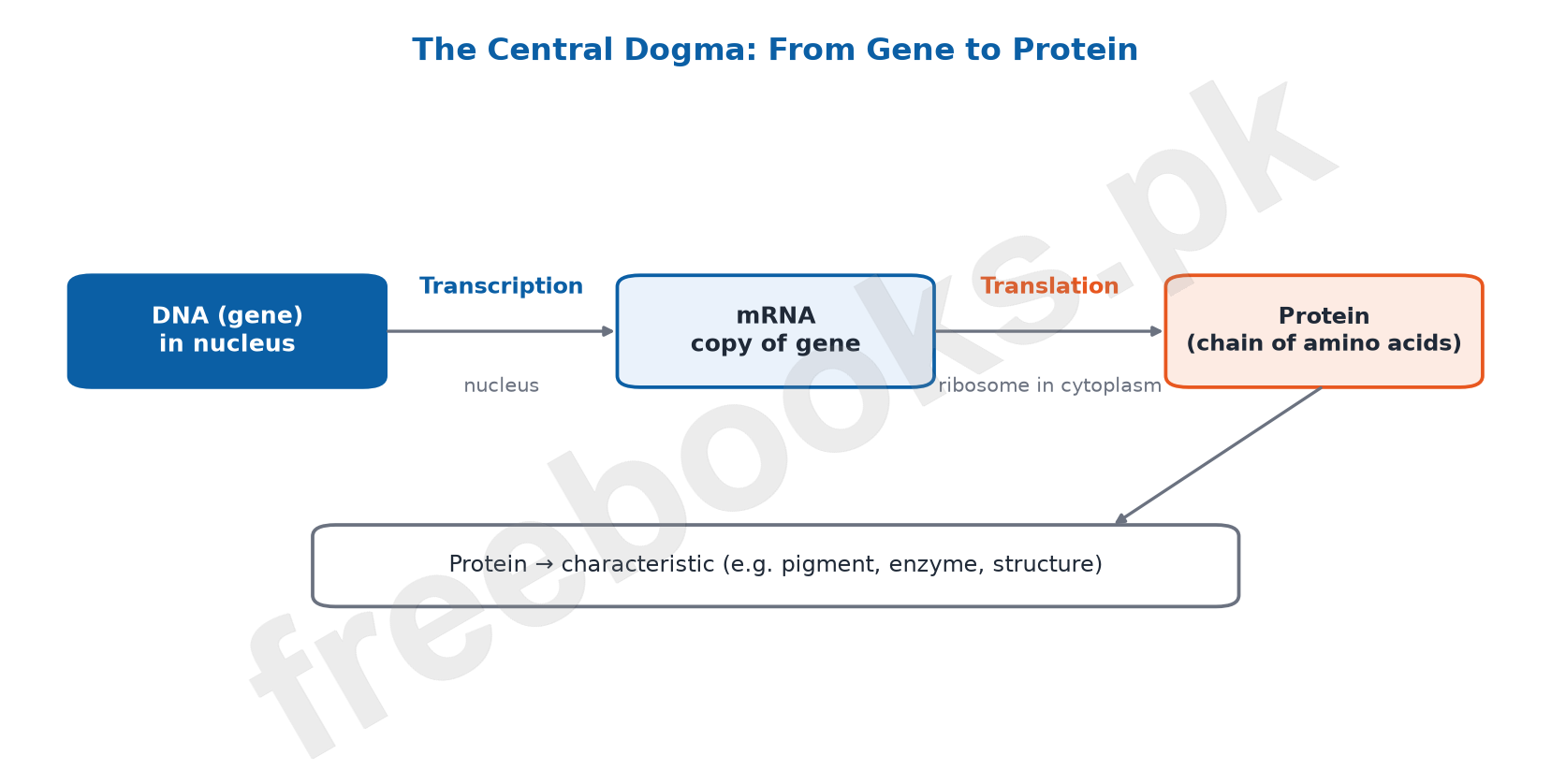
A gene is a segment of DNA with the information to make a particular protein. Transcription: the gene acts as a template and a messenger RNA (mRNA) copy is made in the nucleus. Translation: the mRNA moves to the cytoplasm, ribosomes attach to it and join amino acids in the order it specifies, producing a protein. This flow, DNA → mRNA → protein, is called the central dogma.
7.2 Genes, Alleles and Genotype
Genes for traits such as eye colour or earlobe shape sit at fixed positions (loci) on chromosomes. Because chromosomes come in homologous pairs, genes also come in pairs.
Alleles are different forms of the same gene, for example one allele for free earlobes and another for attached earlobes. The pair of alleles an organism carries is its genotype. If both alleles are the same (TT or tt) the genotype is homozygous; if they differ (Tt) it is heterozygous.
In a heterozygote, the allele whose effect shows is dominant (written with a capital letter) and the allele that is hidden is recessive (small letter). The visible trait produced by the genotype is the phenotype. In peas, T (tall) is dominant over t (dwarf), so TT and Tt plants are both tall and only tt plants are dwarf.
7.3 Mendel and the Garden Pea
Gregor Mendel, a monk, carried out experiments on garden peas from 1856 to 1863. Peas were a good choice because they grow quickly, show seven clearly contrasting traits (such as tall/dwarf, round/wrinkled seeds, yellow/green seeds and purple/white flowers), and normally self-pollinate, while cross-pollination can be done by hand by removing the stamens of one flower and dusting it with pollen from another.
Mendel began with true-breeding plants, which always produce offspring like themselves when self-pollinated. At that time many people believed in blending inheritance, expecting a tall × dwarf cross to give medium plants; Mendel’s results disproved this.
7.3 Monohybrid Cross and Law of Segregation
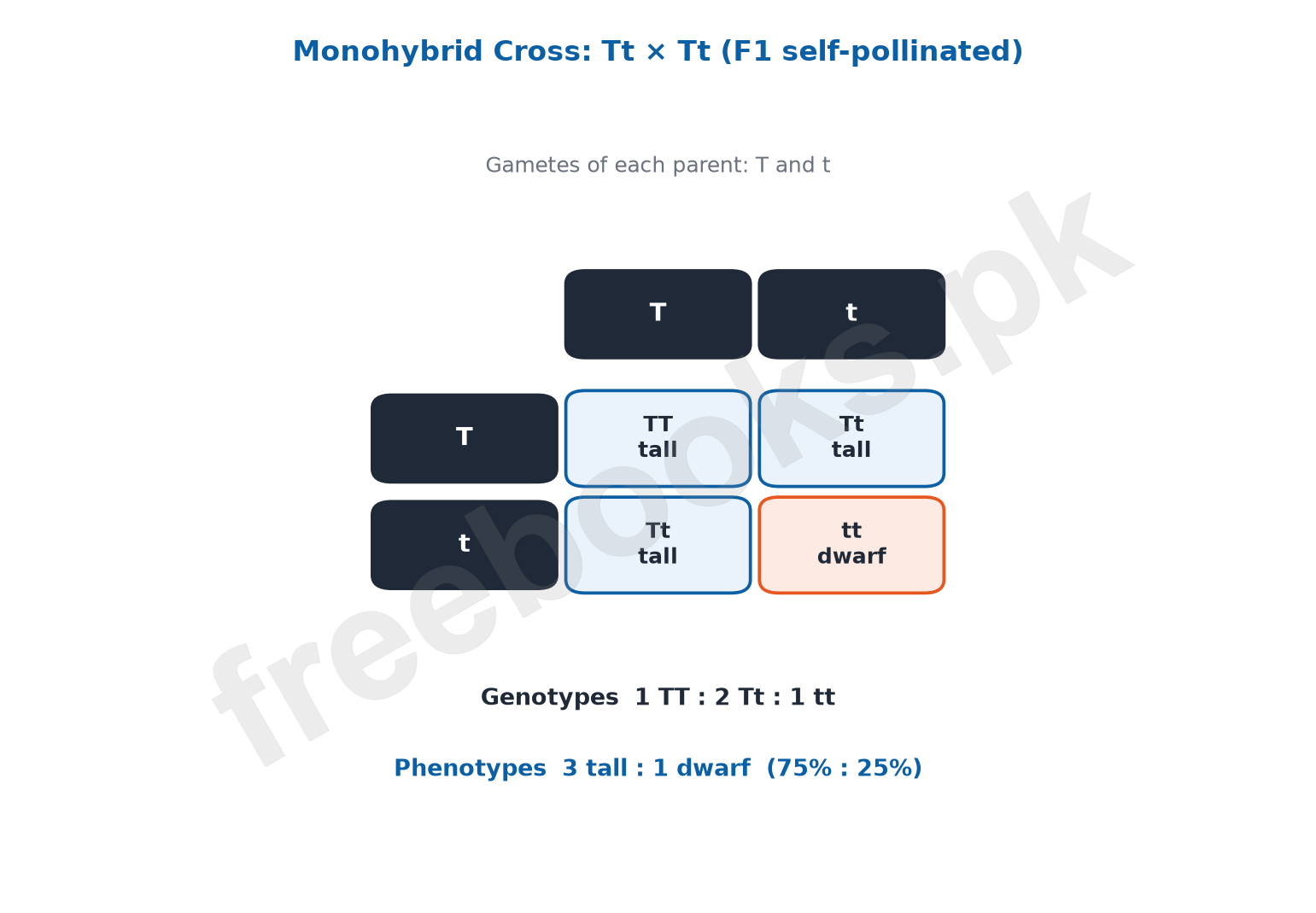
A monohybrid cross studies one trait. Mendel crossed true-breeding tall (TT) with true-breeding dwarf (tt) plants (P generation). All F1 plants were tall (Tt). When F1 plants self-pollinated, the F2 generation was about 3 tall : 1 dwarf (75% : 25%).
Genotypes in F2: 1 TT : 2 Tt : 1 tt (25% : 50% : 25%). TT and Tt are tall; tt is dwarf. The dwarf trait reappeared in F2 because the recessive allele had been present but hidden in F1.
Concept of dominance: when two different alleles are together, one may mask the other. Law of segregation: the two alleles of a gene separate during gamete formation, so each gamete receives only one of them; the pair is restored at fertilization.
7.3 Dihybrid Cross and Law of Independent Assortment
A dihybrid cross studies two traits at once. Mendel crossed true-breeding round yellow (RRYY) with wrinkled green (rryy) plants. All F1 were round yellow (RrYy), showing that round (R) is dominant over wrinkled (r) and yellow (Y) over green (y).
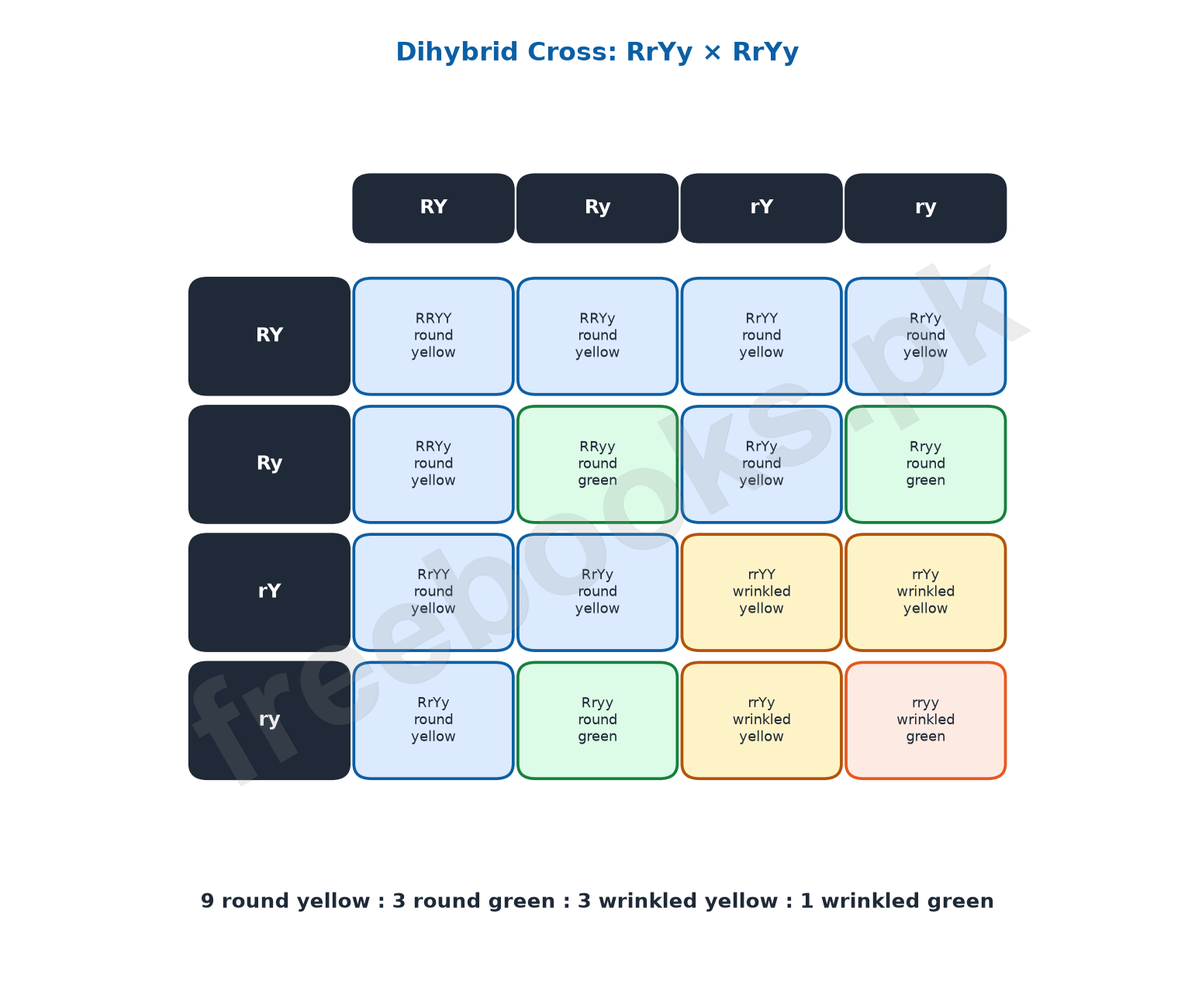
Each F1 plant formed four kinds of gametes in equal numbers: RY, Ry, rY and ry. Self-pollination gave 16 combinations in F2, with phenotypes in the ratio 9 round yellow : 3 round green : 3 wrinkled yellow : 1 wrinkled green.
Law of independent assortment: alleles of different genes separate independently of one another during gamete formation, so the inheritance of seed shape does not affect the inheritance of seed colour.
Important Definitions
Inheritance
Passing of characteristics from parents to offspring.
Chromatin
The DNA–histone material of which chromosomes are made.
Histones
Proteins around which DNA is wound.
Chromatid
One of the two identical halves of a replicated chromosome.
Centromere
The point where two sister chromatids are joined.
Gene
A segment of DNA carrying information for a protein or trait.
Locus
The position of a gene on a chromosome.
Allele
An alternative form of a gene.
Genotype
The pair of alleles an organism has for a trait.
Phenotype
The observable trait produced by a genotype.
Homozygous
Having two identical alleles of a gene.
Heterozygous
Having two different alleles of a gene.
Dominant allele
An allele that shows its effect in a heterozygote.
Recessive allele
An allele hidden in a heterozygote.
True-breeding
Always producing offspring with the same trait on self-pollination.
Monohybrid cross
A cross studying one trait.
Dihybrid cross
A cross studying two traits at the same time.
Transcription
Making mRNA from a DNA template.
Translation
Making a protein from the information in mRNA at ribosomes.
Central dogma
The flow of genetic information DNA → RNA → protein.
Key Facts at a Glance
| Item | Fact |
|---|---|
| Chromatin consists of | DNA + histone proteins |
| DNA bases | A, T, C, G (A–T, C–G) |
| RNA bases | A, U, C, G |
| Sugar in DNA / RNA | Deoxyribose / ribose |
| Strands in DNA / RNA | Two (double helix) / one |
| Site of transcription / translation | Nucleus / ribosomes in cytoplasm |
| Years of Mendel’s experiments | 1856–1863 |
| Contrasting traits studied in pea | Seven |
| Monohybrid F2 phenotype ratio | 3 : 1 |
| Monohybrid F2 genotype ratio | 1 TT : 2 Tt : 1 tt |
| Dihybrid F2 phenotype ratio | 9 : 3 : 3 : 1 |
| Gametes from RrYy | RY, Ry, rY, ry |
Diagrams
The central dogma: A flow diagram showing how a gene is transcribed into mRNA and translated into a protein.
Monohybrid cross: A Punnett square of Tt × Tt showing the 1 : 2 : 1 genotype and 3 : 1 phenotype ratios.
Dihybrid cross: A 4 × 4 Punnett square of RrYy × RrYy showing the 9 : 3 : 3 : 1 ratio.
Short Questions and Answers
What is chromatin made of?
DNA wound around bundles of histone proteins.
What is the role of the centromere?
It holds the two sister chromatids together until they separate during cell division.
Give two differences between DNA and RNA.
DNA is double-stranded with deoxyribose and thymine; RNA is single-stranded with ribose and uracil.
If one DNA strand reads ATGC, what is the matching strand?
TACG, because A pairs with T and C pairs with G.
Distinguish transcription and translation.
Transcription copies a gene into mRNA in the nucleus; translation uses mRNA at ribosomes to join amino acids into a protein.
How do proteins decide our characteristics?
Proteins such as enzymes and structural proteins control cell activities and build structures, producing traits like pigment colour.
Distinguish gene and allele.
A gene is the DNA segment for a trait; alleles are different forms of that gene.
Distinguish genotype and phenotype.
Genotype is the allele pair (e.g., Tt); phenotype is the visible trait (e.g., tall).
Why are TT and Tt plants both tall?
T is dominant, so one T allele is enough to produce tallness.
Why did Mendel use true-breeding plants?
So that he knew the parents’ alleles were identical and results could be traced clearly.
Why was the garden pea a good choice?
Short generation time, seven clear contrasting traits, and easy control of self- and cross-pollination.
How did Mendel’s results reject blending inheritance?
F1 plants were all tall, not medium, and dwarf plants reappeared unchanged in F2.
State the law of segregation.
The two alleles of a gene separate during gamete formation, so each gamete gets only one.
What gametes are formed by a plant of genotype RrYy?
Four kinds in equal numbers: RY, Ry, rY and ry.
State the law of independent assortment.
Alleles of different genes separate independently of one another during gamete formation.
Long Questions and Answers
Describe the structure of a chromosome.
What is a chromosome made of?
Chromatin, which is DNA wrapped around histone proteins.
How does chromatin change in cell division?
Fine threads in a resting nucleus coil up into short, thick chromosomes before division.
What are chromatids and centromere?
A replicated chromosome has two identical sister chromatids joined at the centromere.
How do prokaryotic chromosomes differ?
Prokaryotes have one circular DNA molecule in the cytoplasm without a nuclear envelope.
Compare DNA and RNA and explain how a protein is made from a gene.
Describe DNA.
A double helix of nucleotides with deoxyribose, phosphate and bases A, T, C, G paired A–T and C–G.
Describe RNA.
A single strand of nucleotides with ribose, phosphate and bases A, U, C, G.
What is transcription?
A gene acts as a template to make a complementary mRNA in the nucleus.
What is translation?
Ribosomes read the mRNA in the cytoplasm and join amino acids in the right order to form a protein.
Explain the terms used in genetics with examples.
What are gene and alleles?
A gene is a DNA segment for a trait; alleles are its alternative forms, e.g., free and attached earlobe alleles.
What are homozygous and heterozygous?
Homozygous has identical alleles (TT, tt); heterozygous has different alleles (Tt).
What are dominant and recessive?
In Tt, T shows its effect (dominant) and t is hidden (recessive).
What are genotype and phenotype?
Genotype is the allele combination; phenotype is the observable trait it produces.
Describe Mendel’s monohybrid cross.
What was the parent cross?
True-breeding tall (TT) × true-breeding dwarf (tt).
What was the F1 result?
All plants tall with genotype Tt.
What was the F2 result?
3 tall : 1 dwarf phenotypes; genotypes 1 TT : 2 Tt : 1 tt.
What conclusions did Mendel draw?
Dominance, and the law of segregation: alleles separate into different gametes.
Describe Mendel’s dihybrid cross.
What was the parent cross?
True-breeding round yellow (RRYY) × wrinkled green (rryy).
What was the F1 result?
All round yellow (RrYy), showing R and Y are dominant.
What gametes did F1 make?
RY, Ry, rY and ry in equal proportions, giving 16 combinations in F2.
What was the F2 ratio and conclusion?
9 round yellow : 3 round green : 3 wrinkled yellow : 1 wrinkled green; alleles assort independently.
State and explain Mendel’s laws of inheritance.
What is the concept of dominance?
In a heterozygote one allele masks the other’s effect.
What is the law of segregation?
Each gamete receives only one allele of each gene because the pair separates during gamete formation.
What is the law of independent assortment?
Alleles of different genes are distributed to gametes independently of one another.
Which crosses demonstrate each law?
Segregation by the monohybrid 3 : 1 ratio; independent assortment by the dihybrid 9 : 3 : 3 : 1 ratio.
Multiple Choice Questions (MCQs)
Chromatin is made of DNA and: (A) Lipids (B) Histones (C) Starch (D) Ribose
Correct answer: (B) Histones. Histone proteins.
Two sister chromatids are joined at the: (A) Gene (B) Centromere (C) Locus (D) Ribosome
Correct answer: (B) Centromere. Centromere.
In DNA, adenine pairs with: (A) Cytosine (B) Guanine (C) Thymine (D) Uracil
Correct answer: (C) Thymine. A–T.
The base found in RNA but not DNA is: (A) Adenine (B) Thymine (C) Uracil (D) Guanine
Correct answer: (C) Uracil. Uracil.
Making mRNA from DNA is called: (A) Translation (B) Transcription (C) Replication (D) Segregation
Correct answer: (B) Transcription. Transcription.
Proteins are assembled on: (A) Ribosomes (B) Centromeres (C) Histones (D) Nucleolus only
Correct answer: (A) Ribosomes. Ribosomes.
Alternative forms of a gene are called: (A) Loci (B) Alleles (C) Chromatids (D) Histones
Correct answer: (B) Alleles. Alleles.
A genotype with two identical alleles is: (A) Heterozygous (B) Homozygous (C) Recessive (D) Hybrid
Correct answer: (B) Homozygous. Homozygous.
The visible trait of an organism is its: (A) Genotype (B) Phenotype (C) Allele (D) Locus
Correct answer: (B) Phenotype. Phenotype.
A plant with genotype tt will be: (A) Tall (B) Dwarf (C) Medium (D) Half tall
Correct answer: (B) Dwarf. Both recessive alleles.
F1 of TT × tt are: (A) All dwarf (B) All tall (C) Half tall (D) 3 tall : 1 dwarf
Correct answer: (B) All tall. All Tt, tall.
The F2 phenotype ratio in a monohybrid cross is: (A) 1 : 1 (B) 1 : 2 : 1 (C) 3 : 1 (D) 9 : 3 : 3 : 1
Correct answer: (C) 3 : 1. 3 : 1.
Percentage of Tt plants in F2 of Tt × Tt: (A) 25% (B) 50% (C) 75% (D) 100%
Correct answer: (B) 50%. 2 of 4.
In F2 of a dihybrid cross, wrinkled green seeds form: (A) 9/16 (B) 3/16 (C) 1/16 (D) 4/16
Correct answer: (C) 1/16. rryy is 1/16.
The law of independent assortment comes from the: (A) Monohybrid cross (B) Dihybrid cross (C) Test of blending (D) Self-pollination only
Correct answer: (B) Dihybrid cross. Dihybrid cross.
Quick Revision Summary
- Chromosome = chromatin (DNA + histones); two sister chromatids joined at centromere.
- DNA: double helix, deoxyribose, A–T, C–G. RNA: single strand, ribose, uracil instead of thymine.
- Central dogma: DNA → (transcription, nucleus) → mRNA → (translation, ribosome) → protein.
- Gene, locus, allele; genotype (TT, Tt, tt), phenotype; homozygous vs heterozygous; dominant (capital) vs recessive (small).
- Mendel (1856–1863), garden pea: short life cycle, seven traits, controlled pollination.
- Monohybrid: TT × tt → F1 Tt (all tall) → F2 3 tall : 1 dwarf; 1 TT : 2 Tt : 1 tt. Law of segregation.
- Dihybrid: RRYY × rryy → F1 RrYy → F2 9 : 3 : 3 : 1. Law of independent assortment.
Exam Tips
- Always show gametes and a Punnett square when solving a cross; examiners give marks for each step.
- Learn the ratios 3 : 1, 1 : 2 : 1 and 9 : 3 : 3 : 1 and which cross gives each.
- Use capital letters for dominant and small letters of the same letter for recessive alleles.
- Practise defining the genetics terms in one line each; they are frequent short questions.
- Compare DNA and RNA in a table: strands, sugar, bases.
Note on Facts
The textbook describes every chromosome as having two identical chromatids. This is true only after the DNA has copied itself before cell division; before replication each chromosome is a single DNA molecule (one chromatid).