Chapter 6 explains sexual reproduction in humans. Gametes (sperms and eggs) are formed in the gonads by meiosis, so they carry half the normal number of chromosomes. When a sperm and an egg fuse at fertilization, a diploid zygote is formed that can develop into a new individual.
These notes cover spermatogenesis and oogenesis, the steps of fertilization, the hormones that control male and female sexual development, the parts of the male and female reproductive systems with their functions, and sexually transmitted diseases with AIDS as the main example.
Learning Objectives
- Describe gametogenesis: spermatogenesis and oogenesis.
- Describe the steps of fertilization.
- State the roles of GnRH, FSH, LH, testosterone, oestrogen and progesterone.
- Identify the parts of the male reproductive system and their functions.
- Identify the parts of the female reproductive system and their functions.
- Describe AIDS: its cause, spread, symptoms and treatment.
Key Concepts
6.1 Gametogenesis
Gonads are the organs that make gametes: testes in males make sperms, and ovaries in females make eggs (ova). Gametogenesis, the formation of gametes, involves meiosis, which halves the chromosome number from diploid (2n) in body cells to haploid (n) in gametes.
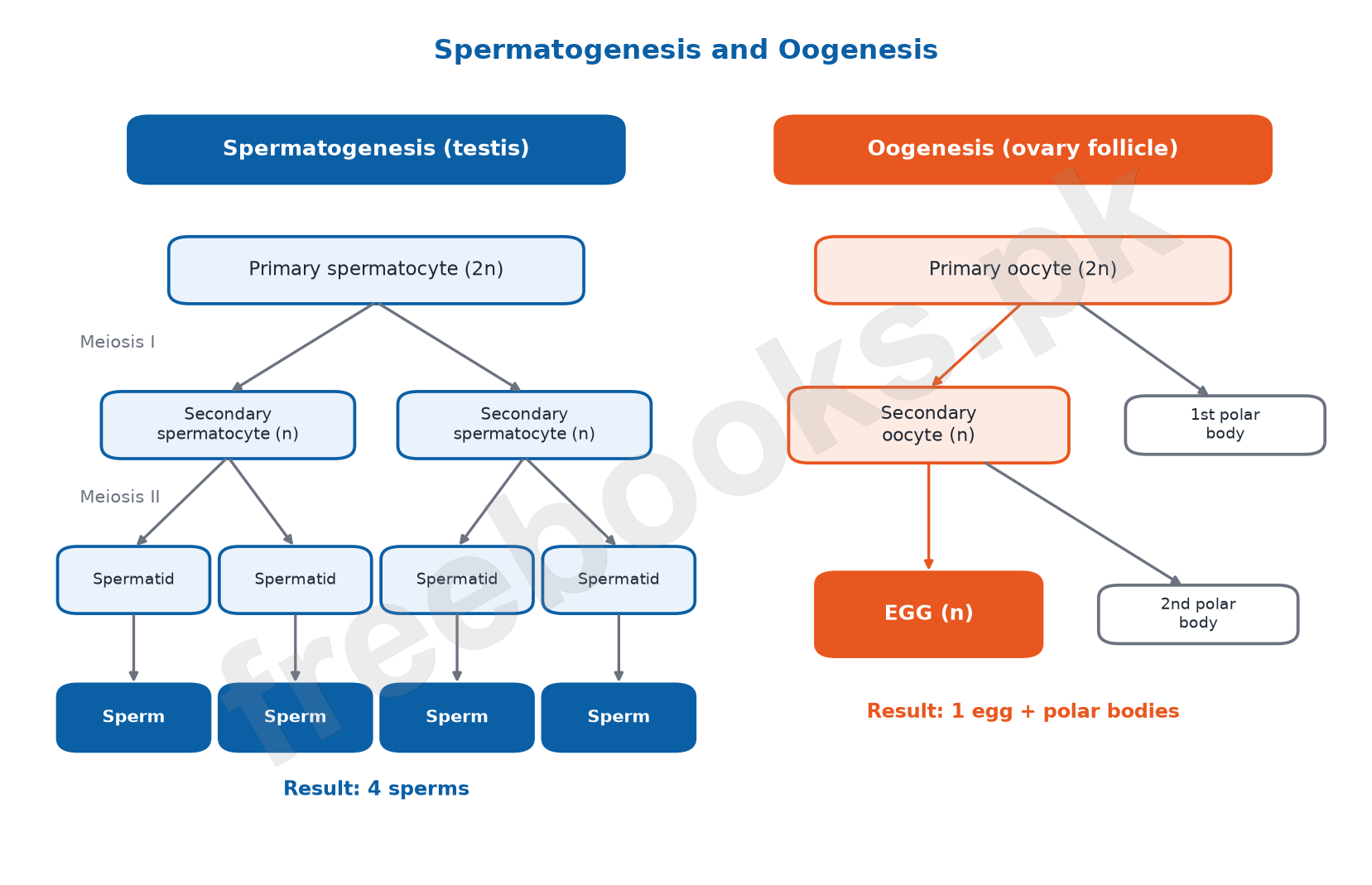
Spermatogenesis takes place in the seminiferous tubules of the testes, stimulated by FSH from the anterior pituitary and testosterone from the testes. A diploid primary spermatocyte undergoes meiosis I to form two haploid secondary spermatocytes; each undergoes meiosis II, giving four haploid spermatids in total. The spermatids then mature into motile sperms.
Oogenesis takes place inside a fluid-filled follicle in the ovary, stimulated by FSH. A diploid primary oocyte undergoes meiosis I, dividing unequally into a large secondary oocyte and a small first polar body. In meiosis II the secondary oocyte divides unequally again into a large egg and a small second polar body. So one primary oocyte gives one functional egg, while one primary spermatocyte gives four sperms.
6.1 Fertilization
Fertilization is the fusion of a male and a female gamete to form a zygote. In humans it takes place inside the female body, in the fallopian tube, after ovulation (release of the egg from the ovary).
Steps: (1) sperms swim towards the egg, guided by chemical signals; (2) the acrosome, a cap on the sperm head, releases enzymes that digest the egg’s outer layers; (3) the membranes of the sperm and egg fuse, and the egg’s outer layers change so that no more sperms can enter; (4) the sperm nucleus enters the egg; (5) the two haploid nuclei fuse to form a diploid zygote.
6.2 Hormones in Sexual Development
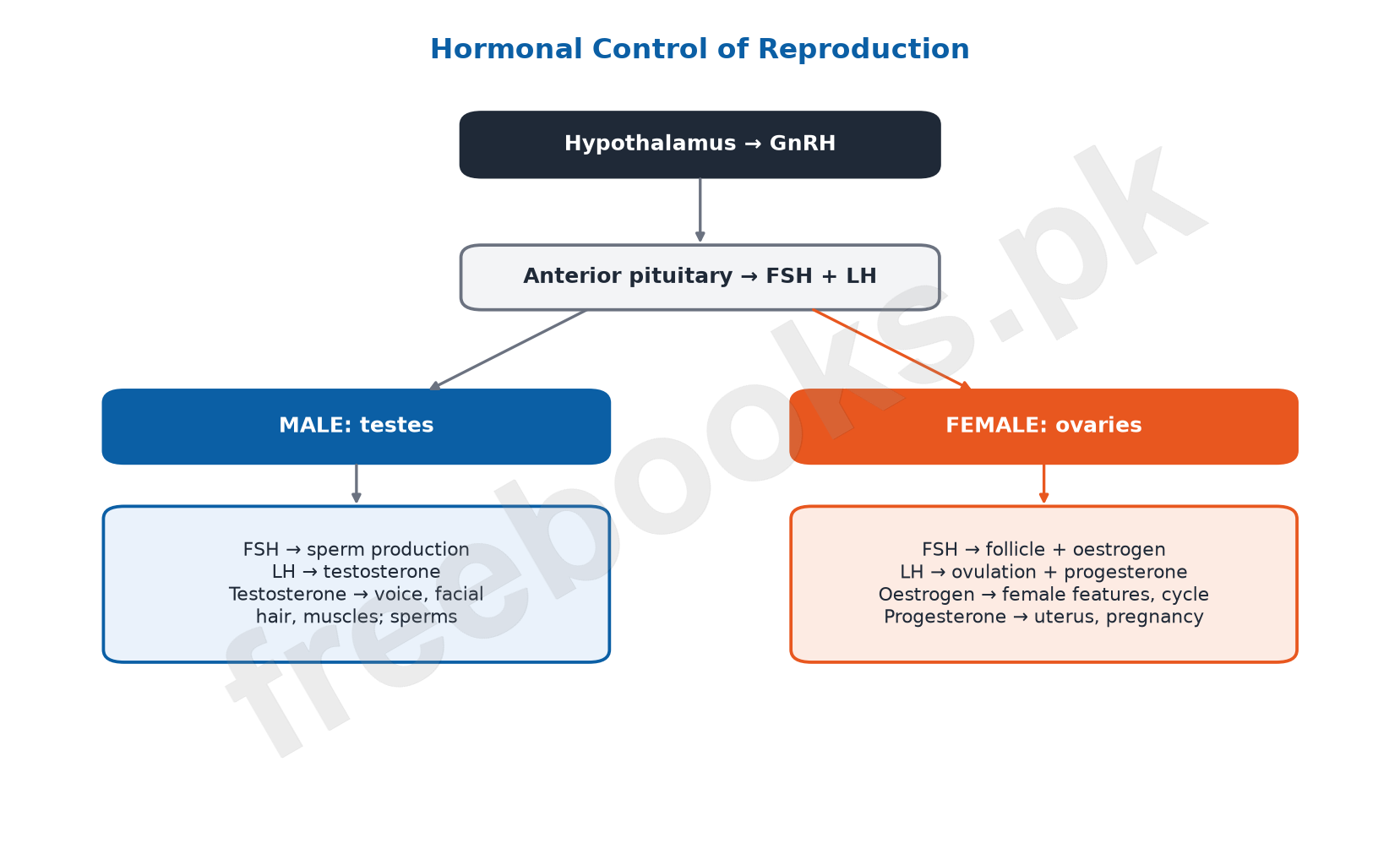
GnRH from the hypothalamus stimulates the anterior pituitary to release FSH and LH in both sexes.
In males: FSH stimulates the testes to produce sperms; LH stimulates the testes to make testosterone; testosterone is needed for sperm production and brings about male secondary sexual characteristics at puberty, such as a deeper voice, facial and body hair and greater muscle mass.
In females: FSH stimulates the growth of follicles and the production of oestrogen; LH triggers ovulation and the production of progesterone. Oestrogen brings about female secondary sexual characteristics at puberty and regulates the reproductive cycle. Progesterone, made after ovulation, prepares the lining of the uterus for implantation and maintains pregnancy by preventing uterine contractions.
6.3 Male Reproductive System
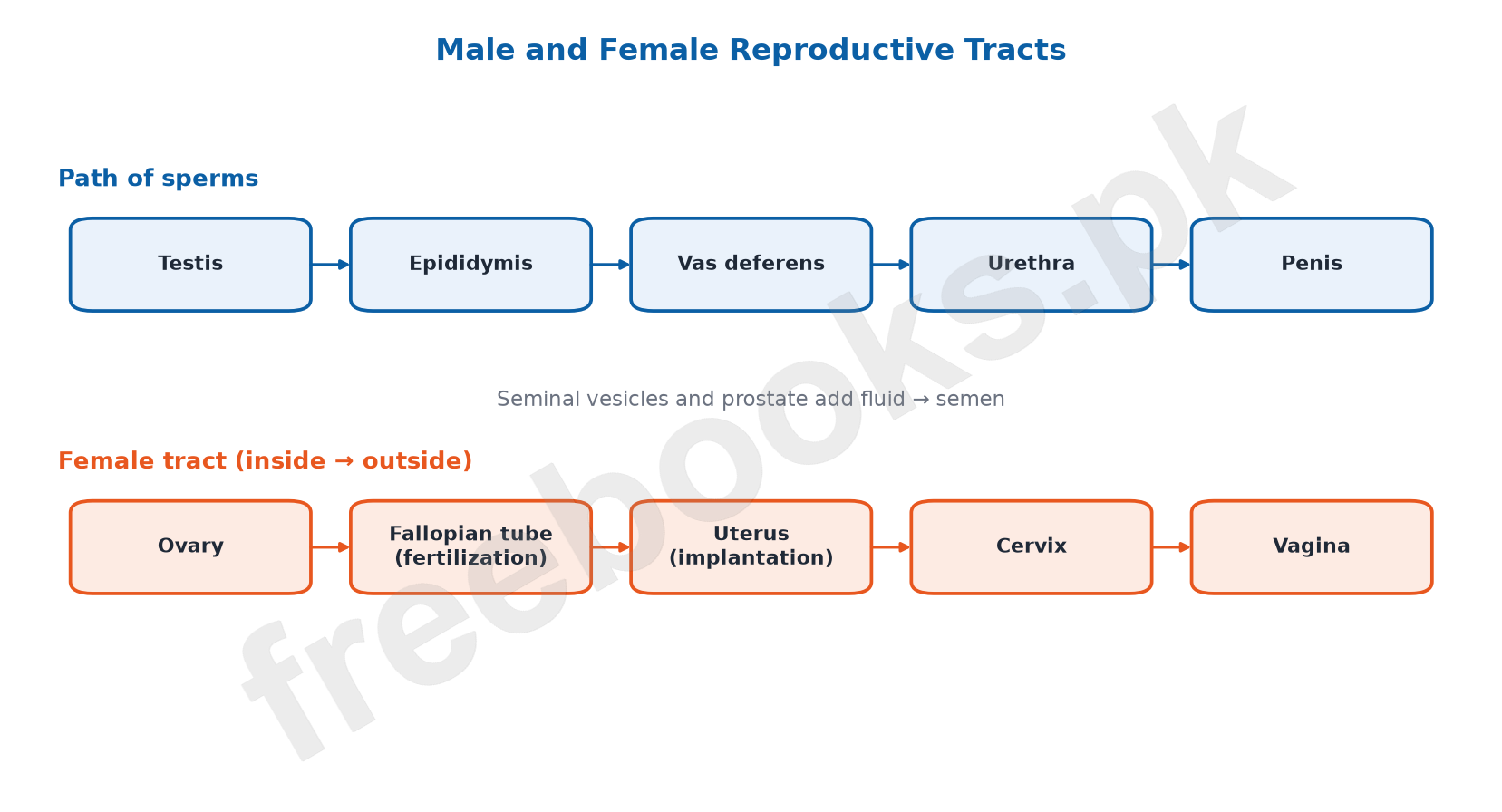
Testes: a pair of oval glands producing sperms and testosterone. Epididymis: a long coiled tube on each testis where sperms are stored and mature. Vas deferens: a muscular tube carrying sperms from the epididymis to the urethra.
Accessory glands add fluid to form semen: the seminal vesicles (behind the bladder) produce a sugary fluid that nourishes sperms, and the walnut-sized prostate gland (below the bladder) adds a protective fluid. The urethra carries semen (and, at other times, urine) through the penis to the outside, and the penis transfers sperms into the female reproductive tract.
6.3 Female Reproductive System
Ovaries: a pair of almond-shaped glands producing eggs and the hormones oestrogen and progesterone. Fallopian tubes (oviducts): carry the egg from the ovary towards the uterus; fertilization takes place here.
Uterus: a hollow muscular organ where the fertilized egg implants and develops into a foetus. Cervix: the narrow lower part of the uterus. Vagina: a muscular canal connecting the cervix to the outside.
6.4 Sexually Transmitted Diseases and AIDS
Sexually transmitted diseases (STDs) are infections passed mainly through sexual contact, caused by bacteria, viruses or parasites; examples are HIV/AIDS, syphilis and herpes. Many show no symptoms at first, so people can spread them unknowingly. Untreated, they may cause infertility and damage to organs. Low awareness, particularly in rural areas, delays treatment.
AIDS (Acquired Immunodeficiency Syndrome) is caused by HIV (Human Immunodeficiency Virus), which attacks the immune system so the body can no longer fight infections and some cancers.
HIV spreads through sexual contact, sharing contaminated needles or syringes, transfusion of infected blood, and from an infected mother to her baby during birth or breastfeeding. In Pakistan, unsafe injections and unscreened blood transfusions are important causes of rising cases. It does not spread by shaking hands, sharing food or ordinary social contact.
Early symptoms include fever, tiredness, swollen lymph nodes and rashes; later, severe infections such as pneumonia, chronic diarrhoea, weight loss and certain cancers appear. There is no cure, but antiretroviral therapy (ART) controls the virus and lets patients live longer, healthier lives. Prevention: use only new or sterilised syringes, screened blood, safe practices and awareness.
Important Definitions
Gonads
Organs that produce gametes: testes and ovaries.
Gametogenesis
Formation of gametes by meiosis.
Spermatogenesis
Formation of sperms in the seminiferous tubules of the testes.
Oogenesis
Formation of eggs inside follicles of the ovary.
Haploid
Having one set of chromosomes (n).
Diploid
Having two sets of chromosomes (2n).
Spermatid
An immature haploid cell that develops into a sperm.
Follicle
A small fluid-filled sac in the ovary in which an egg develops.
Polar body
A small cell formed during oogenesis that usually degenerates.
Ovulation
Release of an egg from the ovary.
Fertilization
Fusion of male and female gametes to form a zygote.
Acrosome
A cap on the sperm head containing enzymes to penetrate the egg.
Zygote
The diploid cell formed by fertilization.
Epididymis
A coiled tube on the testis where sperms mature and are stored.
Vas deferens
The tube carrying sperms from the epididymis to the urethra.
Fallopian tube
The tube carrying the egg from ovary to uterus; site of fertilization.
Uterus
The muscular organ in which the foetus develops.
STD
An infection spread mainly through sexual contact.
AIDS
A disease caused by HIV that destroys the immune system.
ART
Antiretroviral therapy used to control HIV.
Key Facts at a Glance
| Item | Fact |
|---|---|
| Site of spermatogenesis | Seminiferous tubules of testes |
| Site of oogenesis | Follicle in the ovary |
| Products of one primary spermatocyte | 4 sperms |
| Products of one primary oocyte | 1 egg + polar bodies |
| Site of fertilization | Fallopian tube |
| Hormone triggering ovulation | LH |
| Hormone stimulating testosterone production | LH |
| Hormone releasing FSH and LH | GnRH (hypothalamus) |
| Hormone maintaining pregnancy | Progesterone |
| Sugary fluid for sperms | Seminal vesicles |
| Cause of AIDS | HIV (a virus) |
| Treatment of HIV | Antiretroviral therapy (no cure) |
Diagrams
Spermatogenesis and oogenesis: A comparison of the meiotic divisions in spermatogenesis and oogenesis and their products.
Hormonal control of reproduction: A flow chart from GnRH to FSH and LH and their effects in males and females.
Male and female reproductive tracts: Flow charts of the path of sperms in the male system and the order of organs in the female system.
Short Questions and Answers
Why must gametes be haploid?
So that when two gametes fuse, the zygote gets the normal diploid number of chromosomes.
Where does spermatogenesis take place and which hormones control it?
In the seminiferous tubules of the testes, under the control of FSH and testosterone.
How many sperms are formed from one primary spermatocyte?
Four haploid sperms, after meiosis I and meiosis II.
Why does oogenesis produce only one egg from a primary oocyte?
The divisions are unequal; most cytoplasm goes to one cell, the egg, while the small polar bodies degenerate.
What is the role of the acrosome?
It releases enzymes that digest the egg’s outer layers so the sperm can reach the egg membrane.
How is entry of more than one sperm prevented?
After one sperm’s membrane fuses with the egg, the egg’s outer layers change and become impermeable to other sperms.
Where does fertilization take place in humans?
In the fallopian tube, after ovulation.
What is the role of GnRH?
It stimulates the anterior pituitary to release FSH and LH.
Give two functions of LH.
In females it triggers ovulation and progesterone production; in males it stimulates testosterone production.
Give two male secondary sexual characteristics.
Deepening of the voice and growth of facial hair (also increased muscle mass).
What is the role of progesterone?
It prepares the uterine lining for implantation and maintains pregnancy.
What is the function of the epididymis?
Sperms are stored there and complete their maturation.
Name the accessory glands of the male system.
Seminal vesicles and prostate gland.
How does HIV cause AIDS?
It attacks and weakens the immune system so the body cannot fight infections and some cancers.
Give three ways HIV spreads.
Sexual contact, sharing contaminated needles, and transfusion of infected blood (also mother to baby).
Long Questions and Answers
Describe spermatogenesis.
Where and under which hormones does it occur?
In the seminiferous tubules of the testes, stimulated by FSH and testosterone.
What happens in meiosis I?
A diploid primary spermatocyte divides into two haploid secondary spermatocytes.
What happens in meiosis II?
Each secondary spermatocyte divides, giving four haploid spermatids in all.
How are sperms formed?
The spermatids change shape and mature into motile sperms.
Describe oogenesis and compare it with spermatogenesis.
Where does oogenesis occur?
In a follicle in the ovary, stimulated by FSH.
What happens in meiosis I?
The primary oocyte divides unequally into a large secondary oocyte and a small first polar body.
What happens in meiosis II?
The secondary oocyte divides into an egg and a second polar body.
How does it differ from spermatogenesis?
It produces one egg per primary oocyte with unequal divisions, while spermatogenesis produces four equal sperms.
Describe the process of fertilization.
How do sperms reach the egg?
They swim towards it, guided by chemical signals.
How does the sperm penetrate the egg layers?
Enzymes from the acrosome digest the egg’s outer layers.
What happens after membrane fusion?
The egg’s outer layers become impermeable to other sperms and the sperm nucleus enters.
How is the zygote formed?
The haploid sperm and egg nuclei fuse to form a diploid zygote.
Explain the role of hormones in male and female sexual development.
Which hormones start the process in both sexes?
GnRH from the hypothalamus causes the pituitary to release FSH and LH.
What do FSH and LH do in males?
FSH stimulates sperm production; LH stimulates testosterone production.
What do FSH and LH do in females?
FSH stimulates follicle growth and oestrogen; LH triggers ovulation and progesterone.
What do the sex hormones do?
Testosterone and oestrogen produce secondary sexual characteristics; progesterone prepares the uterus and maintains pregnancy.
Describe the male and female reproductive systems.
What are the main male organs?
Testes, epididymis, vas deferens, urethra and penis.
What are the male accessory glands?
Seminal vesicles (sugary fluid) and prostate gland (protective fluid), forming semen.
What are the main female organs?
Ovaries, fallopian tubes, uterus, cervix and vagina.
What are their roles?
Ovaries make eggs and hormones; fertilization is in the fallopian tube; the foetus develops in the uterus.
Describe AIDS.
What causes AIDS?
The Human Immunodeficiency Virus (HIV), which damages the immune system.
How is HIV transmitted?
Through sexual contact, contaminated needles, infected blood and from mother to baby.
What are its symptoms?
Early fever, tiredness, swollen lymph nodes and rash; later severe infections, weight loss, diarrhoea and some cancers.
How is it treated and prevented?
No cure; ART controls the virus. Prevention: sterile syringes, screened blood, safe behaviour and awareness.
Multiple Choice Questions (MCQs)
Gametes are formed by: (A) Mitosis (B) Meiosis (C) Budding (D) Binary fission
Correct answer: (B) Meiosis. Meiosis halves chromosome number.
Sperms are produced in the: (A) Epididymis (B) Seminiferous tubules (C) Prostate (D) Vas deferens
Correct answer: (B) Seminiferous tubules. Seminiferous tubules.
One primary spermatocyte forms: (A) One sperm (B) Two sperms (C) Four sperms (D) Eight sperms
Correct answer: (C) Four sperms. Four sperms.
The small cells formed in oogenesis are: (A) Spermatids (B) Polar bodies (C) Follicles (D) Zygotes
Correct answer: (B) Polar bodies. Polar bodies.
The egg develops inside a: (A) Follicle (B) Seminiferous tubule (C) Uterus (D) Cervix
Correct answer: (A) Follicle. Follicle.
Enzymes that digest the egg’s layers come from the: (A) Sperm tail (B) Acrosome (C) Polar body (D) Follicle
Correct answer: (B) Acrosome. Acrosome.
In humans fertilization occurs in the: (A) Ovary (B) Uterus (C) Fallopian tube (D) Vagina
Correct answer: (C) Fallopian tube. Fallopian tube.
GnRH is released by the: (A) Ovary (B) Testis (C) Hypothalamus (D) Thyroid
Correct answer: (C) Hypothalamus. Hypothalamus.
Ovulation is triggered by: (A) FSH (B) LH (C) Testosterone (D) Insulin
Correct answer: (B) LH. LH surge.
The hormone that maintains pregnancy is: (A) Oestrogen (B) Progesterone (C) Testosterone (D) GnRH
Correct answer: (B) Progesterone. Progesterone.
Sperms mature and are stored in the: (A) Epididymis (B) Urethra (C) Prostate (D) Seminal vesicle
Correct answer: (A) Epididymis. Epididymis.
The sugary fluid nourishing sperms comes from the: (A) Prostate (B) Seminal vesicles (C) Testes (D) Bladder
Correct answer: (B) Seminal vesicles. Seminal vesicles.
The narrow lower part of the uterus is the: (A) Vagina (B) Cervix (C) Oviduct (D) Ovary
Correct answer: (B) Cervix. Cervix.
AIDS is caused by a: (A) Bacterium (B) Virus (C) Fungus (D) Worm
Correct answer: (B) Virus. HIV is a virus.
HIV infection is controlled by: (A) Antibiotics (B) Antiretroviral therapy (C) Vaccination (D) Insulin
Correct answer: (B) Antiretroviral therapy. ART; there is no cure.
Quick Revision Summary
- Gonads: testes (sperms), ovaries (eggs). Meiosis: 2n → n.
- Spermatogenesis: primary spermatocyte → 2 secondary spermatocytes → 4 spermatids → 4 sperms (FSH + testosterone).
- Oogenesis: primary oocyte → secondary oocyte + 1st polar body → egg + 2nd polar body (FSH).
- Fertilization (fallopian tube): chemical attraction → acrosome enzymes → membrane fusion (block to other sperms) → nucleus enters → zygote (2n).
- GnRH → FSH + LH. Male: FSH (sperms), LH (testosterone). Female: FSH (follicle, oestrogen), LH (ovulation, progesterone).
- Male: testes → epididymis → vas deferens → urethra → penis; seminal vesicles + prostate add fluid.
- Female: ovaries → fallopian tubes → uterus → cervix → vagina.
- AIDS: HIV; spread by sex, needles, blood, mother to child; no cure; ART.
Exam Tips
- Compare spermatogenesis and oogenesis in a table (site, divisions, products, hormones).
- Learn the five steps of fertilization in order.
- Match each hormone with its source and effect; GnRH, FSH and LH are common MCQs.
- Practise labelling diagrams of both reproductive systems.
- For AIDS, write cause, spread, symptoms, treatment and prevention as headings.
Note on Facts
The textbook shows meiosis II of the secondary oocyte as if it happens before fertilization. In humans the secondary oocyte is released at ovulation and completes meiosis II only after a sperm enters it; the first polar body may also divide.