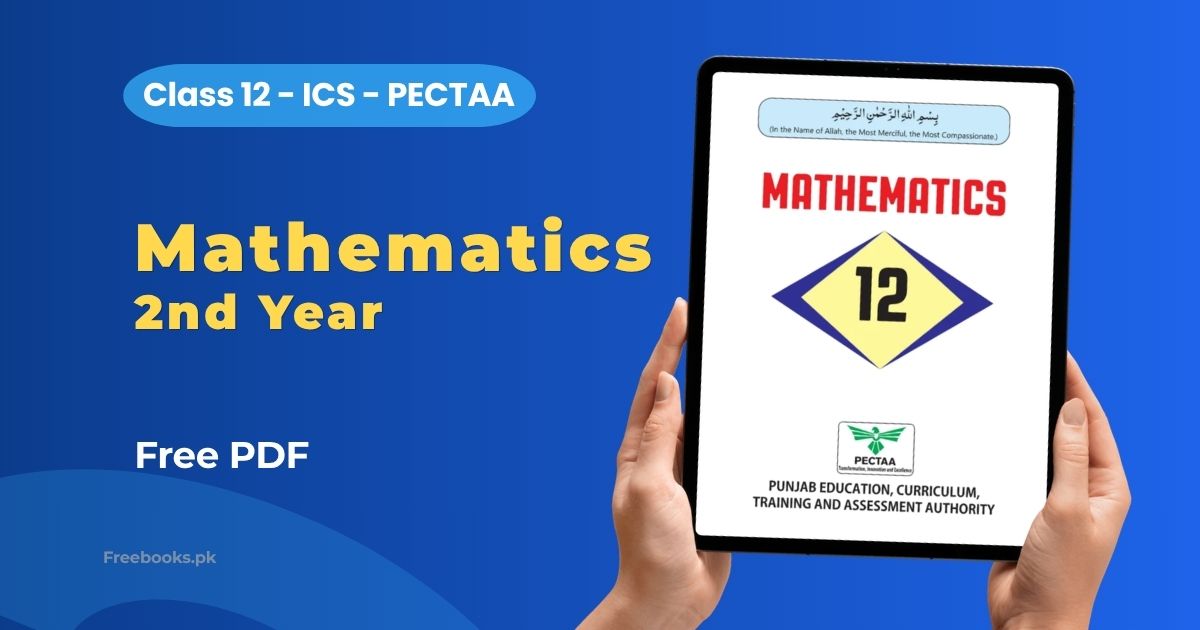
Mathematics 2nd Year ICS book for Part 2 (Class 12) is published by the Punjab Education, Curriculum, Training and Assessment Authority (PECTAA). The latest 2026–27 edition is based on the Updated/Revised National Curriculum of Pakistan 2023. It covers eleven units from Graphical Representation of Functions to Vector Valued Functions and Their Differentiations.
For ICS Part 2 students, Mathematics is the most important subject in the programme. Each unit builds on earlier calculus concepts with clear theory, worked examples, and graded exercises. The PDF lets students revise formulas, practice numerical problems, and go over difficult topics at any time before the final board exam.
Book Overview
| Class | 12 (ICS Part 2 / Second Year) |
| Subject | Mathematics |
| Category | ICS |
| Board | Punjab Board (PECTAA, Lahore) |
| Curriculum | NCP 2023 (Updated/Revised) |
| Total Chapters | 11 units + Answers key |
| Total Pages | 309 |
| Format |
Chapter List
Unit 1 – Graphical Representation of Functions
This unit teaches students to sketch quadratic graphs from factorized form y = a(x-h)(x-k), locating x-intercepts, the vertex, and y-intercept, and to reverse the process by predicting a quadratic equation from a given graph. It then classifies functions as algebraic or transcendental, studying exponential, logarithmic, hyperbolic, and inverse hyperbolic functions with their domains, ranges, and asymptotes. Students construct inverse-function graphs by reflecting about y = x, apply shifts and scaling to transform graphs, and solve exponential and logarithmic equations and inequalities, applying them to growth and decay, sound intensity in decibels, and compound interest. Since exponential-logarithmic equations, transformations, and real-life applications recur almost every year in board papers, this unit is essential exam preparation.
Important Questions:
- Find an equation of the graph whose x-intercepts are x = -1 and x = -2 and which passes through the point (-3, 2). y = x² + 3x + 2
- Solve the equation: 3^(x+1) – 2·9^x + 9 = 0. x = 1
- A sound has intensity I = 10⁻⁶ W/m² and reference intensity I₀ = 10⁻¹² W/m². Find the sound level. 60 dB
- A sum of Rs. 4000 is invested at 6% per annum, compounded annually for 3 years. Find the final amount. ≈ Rs. 4764.06
Unit 2 – Further Differentiation
Building on first-principles differentiation and the sum, difference, product, and quotient rules from the previous class, this unit develops derivatives of trigonometric, inverse trigonometric, exponential, and logarithmic functions, then introduces the Chain Rule for composite, parametric, and implicit functions. It covers finding equations of tangent and normal lines to curves, higher-order derivatives of algebraic, implicit, parametric, and transcendental functions, and identifying increasing/decreasing behavior through stationary and critical points. Students also learn the Second Derivative Test to classify local extrema and the closed-interval method for global maxima/minima, followed by linearization and differentials used to estimate function values and compute relative/percentage errors, such as in cube volumes and circle measurements. These differentiation and error-estimation techniques underpin nearly every calculus numerical and application question on the board exam.
Important Questions:
- Differentiate y = x²cos x with respect to x. 2x cos x − x² sin x
- Differentiate y = sec x + 4√x − 10 with respect to x. sec x tan x + 2/√x
- Using the Second Derivative Test, find the local extreme value of f(x) = 8 − 2x². Relative maximum value 8 at x = 0
- Find y₂ (the second derivative) if y = x⁴ − 3x² + 4x − 5. 12x² − 6
Unit 3 – Integration
Integration begins with antiderivatives and the indefinite integral, building basic rules like the power rule and sum-difference rule, plus a formulae table linking trigonometric, exponential, logarithmic, and inverse trigonometric derivatives to their integrals. Students then master substitution, trigonometric substitution, integration by parts, and partial fractions for rational functions. The unit develops the definite integral via the Fundamental Theorems of Calculus and its properties, applying these tools to area under and between curves, volumes of solids of revolution, consumer and producer surplus, moment of inertia, distance-velocity-acceleration problems, average value of a function, and drug-dosage concentration curves. These techniques matter for board exams since substitution, by-parts, and definite integral questions appear in nearly every ICS/FSc paper.
Important Questions:
- Find all the antiderivatives for dy/dx = 100x⁴. 20x⁵ + c
- Evaluate ∫ ln x dx using integration by parts. x ln x − x + c
- Evaluate the definite integral ∫₁² (x² + x) dx. 23/6
- Evaluate ∫ x(7x² + 8)⁹ dx using substitution. (7x² + 8)¹⁰/140 + c
Unit 4 – Differential Equations
This unit introduces differential equations, defining order and degree and classifying ordinary equations built from practical scenarios like population growth, Newton’s law of cooling, RC/RL circuits, and inflation or deflation. Students learn two core techniques for first-order, first-degree equations: separable variables, where terms are separated and integrated, and homogeneous equations, solved via the substitution y = vx to reduce them to separable form. Initial value problems then apply these methods to real situations such as bacterial growth, radioactive decay and half-life, Newton’s cooling law, compound interest, and current in RL/RC circuits. Since board exams regularly test constructing and solving separable or homogeneous equations plus growth-decay word problems, mastering these techniques is essential for scoring well.
Important Questions:
- Find the order and degree of the differential equation (d²y/dx²)³ + dy/dx = 1. order 2, degree 3
- Find the order and degree of the differential equation dy/dx + eʸ sin x = 0. order 1, degree 1
- Find the general solution of the differential equation y dx + x dy = 0. xy = c
- A particle moves in a straight line with acceleration a = 2t − 7. Find velocity v in terms of t if v = 10 m/sec when t = 0. v = t² − 7t + 10
Unit 5 – Analytical Geometry
Analytical Geometry studies straight lines and triangles using coordinates and algebra. Students learn six equivalent forms of a line’s equation (general, slope-intercept, point-slope, two-point, intercept, normal), then find equations of a triangle’s medians, altitudes, and right bisectors, proving each set concurrent using determinants. Further topics include the determinant condition for three concurrent lines, families of lines through an intersection point, the tangent formula for the angle between two lines, the determinant formula for triangular area and its collinearity test, and homogeneous second-degree equations representing pairs of lines through the origin, with conditions for real, coincident, or perpendicular pairs. These determinant-based techniques for concurrency, angles, and area appear frequently in board exam questions on triangles.
Important Questions:
- Find equation of the altitude of triangle XYZ from vertex X(1, 3), where Y(5, 7) and Z(-3, 9). 4x – y – 1 = 0
- Find the value of k if the lines x + y – 4 = 0, 2x – y + 1 = 0 and kx + 2y – 10 = 0 are concurrent. k = 4
- By computing the area of triangle ABC check whether the points are collinear, where A(0, 4), B(3, 2) and C(6, 0). Area = 0, so the points are collinear
- Find the equations of lines represented by 5x² + 6xy + y² = 0 and the measure of the angle between them. x + y = 0 and 5x + y = 0, θ ≈ 33.69°
Unit 6 – Conic Section
Conic Section builds analytic geometry around curves formed by slicing a cone, deriving standard and general equations of the circle, parabola, ellipse, and hyperbola from distance-based definitions. Students find a circle’s centre and radius from three given points or tangency conditions, and write tangent, normal, and chord-of-contact equations using parametric forms like x = r cos(theta), y = r sin(theta). For the parabola, ellipse, and hyperbola, the unit develops foci, directrices, eccentricity, and latus rectum, then applies tangent conditions like y = mx + a/m. Real applications include suspension-bridge cables modelled as parabolas. Since these locus and tangent problems appear as compulsory long questions every year, mastering the standard forms is essential for board exams.
Important Questions:
- Find the equation of a circle which passes through the origin and cuts off intercepts 2 and 3 on the x-axis and y-axis respectively. x² + y² − 2x − 3y = 0
- Find the equation of the tangent to the parabola y² = 12x which is parallel to the line 3x − y + 4 = 0. Also find the point of tangency. y = 3x + 1, point of tangency (1/3, 2)
- Find the equation of the ellipse as the locus of points P(x, y) such that the sum of the distances from P to the points (−3, 0) and (3, 0) is 10. x²/25 + y²/16 = 1
- A hyperbola has its centre at the origin, transverse axis of length 14 along the y-axis, and conjugate axis of length 10 along the x-axis. Find the equation of the hyperbola. y²/49 − x²/25 = 1
Unit 7 – Kinematics of Motion in a Straight Line
Unit 7 covers kinematics of motion along a straight line, distinguishing scalar quantities like distance and speed from vector quantities like displacement, velocity, and acceleration. Students learn average versus instantaneous velocity, express velocity and acceleration as derivatives (v = dx/dt, a = dv/dt = d²x/dt², a = v·dv/dx), and interpret displacement-time and velocity-time graphs, using slope for velocity/acceleration and area under a v-t graph (via integration) for displacement. The unit derives and applies the three equations of motion for constant acceleration — v = u + at, x = ut + ½at², 2ax = v² − u² — including free fall and vertical projectile problems using g = 9.8 m/s². These formulas and graph-based techniques appear repeatedly in board exam numericals on braking distance, projectile motion, and calculus-based velocity/acceleration problems.
Important Questions:
- A vehicle moving with a speed of 36 km/h is stopped by applying brakes and comes to rest in 10 seconds. Find the retardation and distance covered during this time. retardation = 1 m/s², distance = 50 m
- A train moving at 54 km/h is accelerated uniformly to 90 km/h in 20 s. Find the acceleration and the distance covered in this time. a = 0.5 m/s², distance = 400 m
- A particle moving in a straight line starts from rest and is accelerated uniformly to attain a velocity of 30 km/h in 5 seconds. Find the distance travelled by the particle in the last three seconds. 17.5 m
- A particle is projected vertically upwards with a velocity 100 m/s, and another is let fall from a height of 200 m at the same time. Find the height of the point where they meet each other. 180.4 m (after 2 s)
Unit 8 – Numerical Solutions of Nonlinear Equations
Unit 8 covers numerical solutions of nonlinear equations that cannot be solved exactly by algebra. It begins with the Location of Root Theorem, using a sign change of a continuous function to guarantee a root, then the Graphical Method for a rough first estimate. Students master three iterative techniques for refining that estimate to a required decimal accuracy: the Bisection Method (interval halving), the Regula-Falsi Method (secant lines), and the Newton-Raphson Method (tangents and derivatives). The unit also covers the Trapezium Rule for approximating definite integrals, with real-life applications in chemistry, cardiology, electronics, and cryptography. Since these iteration-table problems are standard long questions in board exams, mastering the stepwise procedure is essential for scoring well.
Important Questions:
- Find the real root of f(x) = x³ − x − 1 correct to two decimal places, given that [1, 2] is an interval of sign change. 1.32
- Use the Trapezoidal Rule to approximate the definite integral ∫₀² x³ dx, taking n = 8. 4.0625
- Use the Newton–Raphson method to find the real root of x³ + 2x − 5 = 0, correct to four decimal places. 1.3283
- In a chemical reaction, the equilibrium concentration x (in moles per liter) satisfies x² + 0.2x − 0.04 = 0. Use the bisection method to find the positive equilibrium concentration correct to two decimal places. 0.12
Unit 9 – Inverse Trigonometric Functions and Their Graphs
Unit 9 introduces inverse trigonometric functions by restricting the domains of sine, cosine, tangent, cosecant, secant and cotangent to intervals where each becomes one-to-one, then defining sin⁻¹x, cos⁻¹x, tan⁻¹x, csc⁻¹x, sec⁻¹x and cot⁻¹x along with their exact domains, ranges and graphs obtained by reflecting the principal functions about the line y = x. Students learn to evaluate principal values of standard inputs, determine domains of composite inverse expressions, and prove reciprocal and complementary identities such as sin⁻¹x + cos⁻¹x = π/2. The unit then derives sum and difference formulas for sin⁻¹, cos⁻¹ and tan⁻¹, including double-angle versions, applying them to prove identities and solve equations for unknowns. Mastery of principal values and these addition formulas matters for board exams, where proving and simplifying inverse trigonometric identities is a recurring question type.
Important Questions:
- Find the principal value of sin⁻¹(√3/2). π/3
- Find the principal value of cos⁻¹(-√2/2). 3π/4
- Find the principal value of tan⁻¹(-√3). -π/3
- Find the principal value of sec⁻¹(2/√3). π/6
Unit 10 – Solution of Trigonometric Equations
Unit 10 covers solving trigonometric equations like sin θ = k, cos θ = k, and tan θ = k, using quadrant and periodic properties to find principal solutions in [0, 2π] and general solutions of the form θ + 2nπ, n ∈ Z. Students simplify equations with identities, factor trigonometric quadratics, and verify solutions to eliminate extraneous roots introduced by squaring both sides. The unit also introduces graphical solutions for equations such as sin x = x/2 that resist algebraic methods, and applies inverse trigonometric functions to real-life problems like finding tower heights, angles of elevation, and projectile range. Since general-solution and extraneous-root problems appear regularly in board exams, this unit builds exam skills.
Important Questions:
- Solve the trigonometric equation sin x = 1/√2 for x ∈ [0, 2π]. x = π/4, 3π/4
- Solve the trigonometric equation 2cos x = -1 for x ∈ [0, 2π]. x = 2π/3, 4π/3
- Solve the trigonometric equation 3tan²x = 1 for x ∈ [0, 2π]. x = π/6, 5π/6, 7π/6, 11π/6
- Solve the trigonometric equation 9 – 3csc²x = 5 for x ∈ [0, 2π]. x = π/3, 2π/3, 4π/3, 5π/3
Unit 11 – Vector Valued Functions and Their Differentiations
Unit 11 introduces vector-valued functions, mapping a scalar variable t (usually time) to a vector r(t) = f(t)i + g(t)j + h(t)k, contrasting them with scalar functions that output a single number. Students learn to identify scalar versus vector functions, find domains and ranges by intersecting component domains, and differentiate vector functions component-wise using the limit definition. These derivatives are then applied to motion: velocity as r'(t), acceleration as r”(t), speed as the magnitude of velocity, and direction via the unit tangent vector, illustrated through projectile motion, drones, satellites, and circular paths. This matters for board exams since velocity-acceleration numerical problems on vector functions appear regularly in the Calculus paper.
Important Questions:
- Find the derivative of r(t) = (t² + 1)î + (t³ + t² + 3t)ĵ with respect to t. r'(t) = 2tî + (3t² + 2t + 3)ĵ
- Find the velocity vector of r(t) = 2sin t î + 3t ĵ at t = π/2. v(π/2) = 3ĵ
- Find the velocity vector of r(t) = cos t î + sin t ĵ + 2t k̂ at t = π. v(π) = -ĵ + 2k̂
- Find the velocity vector of r(t) = t² î + t ĵ + t³ k̂ at t = 2. v(2) = 4î + ĵ + 12k̂
Download Mathematics Class 12 ICS Book PDF
Click the button below to download the free PDF of Mathematics Class 12 ICS (2026–27 PECTAA edition) — it opens in a new tab and is ready to read or save on any device.
⬇ Download PDF (2026–27 Edition)Who Should Read This
This book is for ICS Part 2 (Second Year) students preparing for the Punjab Board annual Mathematics exam under the PECTAA NCP 2023 curriculum. Since Mathematics is the defining subject of ICS, thorough preparation from this book is essential. It is also useful for students planning for ECAT and CS-related entry tests, as calculus, numerical methods, and vector functions are tested in those exams.
Applicable Boards
This textbook is published by PECTAA for Punjab Board colleges under the Updated/Revised National Curriculum of Pakistan 2023. Students from the Federal Board (FBISE) and AJK Board can also use it for reference, as the ICS Part 2 Mathematics syllabus is largely similar across these boards. Students from Sindh and KPK boards will find most chapters relevant as well.
FAQs
Is this the latest Mathematics book for ICS Part 2 Punjab Board?
Yes. The 2026–27 edition is the latest, published by PECTAA and based on the Updated/Revised National Curriculum of Pakistan 2023.
How many chapters are in Mathematics Class 12 ICS?
There are 11 units, from Graphical Representation of Functions to Vector Valued Functions and Their Differentiations, plus an answers key.
Is this book the same as the FSC Part 2 Mathematics book?
Yes. ICS and FSC students study the same Mathematics book under the new PECTAA curriculum. The content, chapters, and exercises are identical.
Is this book useful for ECAT preparation?
Yes. Topics like differentiation, integration, numerical methods, and vector functions from this book are directly tested in ECAT.
What is new in the 2026-27 PECTAA edition compared to the older Calculus and Analytic Geometry book?
The new edition follows the Updated/Revised National Curriculum of Pakistan 2023 and adds units like Differential Equations, Kinematics, Numerical Solutions of Nonlinear Equations, and Vector Valued Functions that were not part of the earlier PCTB book.
Is the PDF free to download?
Yes. The Mathematics Class 12 ICS book PDF is completely free to download and read on any device.
How many pages does the Mathematics Class 12 ICS book have?
The 2026–27 PECTAA edition runs to 309 pages, covering 11 units and an answers section at the end.
Related Books
- Mathematics 1st Year ICS Book
- Mathematics 1st Year FSC Book
- Mathematics 2nd Year FSC Book
- Mathematics 1st Year ICOM Book
- Statistics 2nd Year ICS Book
- Computer Science 2nd Year ICS Book
Related Books
- Mathematics 1st Year ICS Book
- Mathematics 2nd Year FSC Book
- Mathematics 1st Year FSC Book
- Mathematics 1st Year ICOM Book
- Statistics 2nd Year ICS Book
- Computer Science 2nd Year ICS Book
Study Resources for Mathematics 2nd Year
Free exam-preparation resources for Mathematics 2nd Year from the Freebooks.pk Editorial Team — the free PDF textbook, chapter-wise notes (definitions, short & long questions and MCQs), the latest paper pairing scheme. Study online or download.
© Copyright Policy
Freebooks.pk is an educational resource for students in Pakistan. Textbooks and other books belong to their respective boards, authors and publishers, and all rights remain with them. If you are the copyright holder of any material on this page and want it changed or removed, please contact us or file a request under our DMCA policy. We review every request and remove reported content promptly.