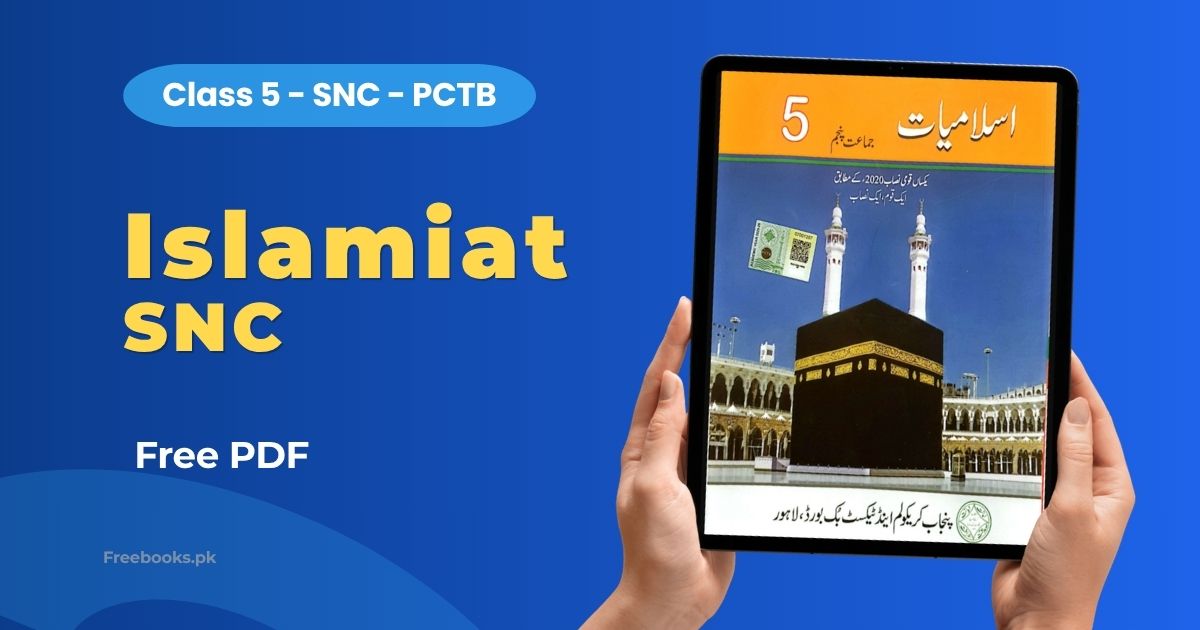
Class 5 Islamiat is part of the Punjab Textbook Board syllabus under the Single National Curriculum (SNC) 2020. This subject introduces students to Hifz and translation of short Surahs and duas, Hadith of the Prophet (PBUH), core Islamic beliefs and worship, Seerat-e-Tayyiba, morals and manners, and lives of prophets and notable Muslim figures.
Class 5 students preparing for their annual exams can use this book to revise Quranic verses, Ahadith and Islamic history with ease. Each Baab explains its topics in simple Urdu with practical examples from daily life. The old PCTB edition is also available below for students still studying from the earlier textbook.
| Class | 5 |
| Subject | Islamiat (Compulsory) |
| Curriculum | SNC 2020 (Single National Curriculum) |
| Board | Punjab Textbook Board (PCTB) |
| Language | Urdu |
| Editions Available | SNC Edition, PCTB Old Edition |
| Total Chapters | 7 (29 lessons) |
| Total Pages | 96 |
| Format |
Chapter List
Baab 1: Quran Majeed wa Hadith-e-Nabvi (قرآن مجید و حدیثِ نبوی)
This chapter helps students memorize Surah Al-Fil, Surah Quraish and Ayat-ul-Kursi, along with the translation of Surah Al-Fatiha, Tashahhud, Durood Ibrahimi and Dua-e-Qunoot. It also includes six short Ahadith on good character and duas for travelling and entering or leaving home, meant to be recited daily.
Important Questions:
- What is the virtue of reciting Ayat-ul-Kursi? It brings the protection of Allah and keeps Shaitan away.
- What are the other names of Surah Al-Fatiha? Umm-ul-Kitab, Umm-ul-Quran, Surah Al-Hamd and Sab’a Mathani.
- What is meant by a Muttafiq Alaih Hadith? A Hadith found in both Sahih Bukhari and Sahih Muslim.
- Which dua should be recited when leaving home? Bismillahi tawakkaltu ala Allah, la hawla wala quwwata illa billah.
Baab 2: Imaniyat wa Ibadaat (ایمانیات و عبادات)
This chapter covers belief in the Hereafter (Aakhirat) and accountability for one’s deeds, and the finality of Prophethood along with obedience to the Prophet (PBUH) and the importance of Sunnah. It also explains Zakat and its Nisab, the virtue of Friday prayer, and the significance and etiquettes of Eid-ul-Fitr and Eid-ul-Adha.
Important Questions:
- What is meant by belief in Aakhirat? Believing that worldly life is temporary and everyone will be resurrected to answer for their deeds.
- What does the belief in Khatm-e-Nabuwat mean? Prophet Muhammad (PBUH) is the last and final Prophet, and no prophet will come after him.
- What is the Nisab of Zakat? About 7.5 tola gold or 52.5 tola silver, or their equivalent cash value.
- Why is Eid-ul-Adha celebrated? To commemorate Hazrat Ibrahim (AS)’s willingness to sacrifice his son Hazrat Ismail (AS) for Allah’s command.
Baab 3: Seerat-e-Tayyiba (سیرتِ طیّبہ)
This chapter narrates the night journey of Isra and Meraj, the two pledges of Aqaba, the migration (Hijrat) to Madina, and Muakhat-e-Madina, the bond of brotherhood between the Muhajireen and the Ansar. It also covers the building of Masjid-e-Nabvi, the Misaq-e-Madina agreement, and the battles of Badr, Uhud and Khandaq.
Important Questions:
- What are the two parts of the journey of Meraj called? Isra, from Masjid-e-Haram to Masjid-e-Aqsa, and Meraj, from Masjid-e-Aqsa to the heavens.
- What is Muakhat-e-Madina? The bond of brotherhood the Prophet (PBUH) established between the Muhajireen and the Ansar.
- What is Misaq-e-Madina considered in history? The world’s first written constitution, an agreement between the Muslims and Jews of Madina.
- When and where was the Battle of Badr fought? On 17 Ramadan, 2 AH, at Badr, the first major battle between the Muslims and the Makkan disbelievers.
Baab 4: Akhlaq wa Aadaab (اخلاق و آداب)
This chapter teaches Rawadari (tolerance) towards people of other faiths, following the example of the Prophet (PBUH). It also covers Afw-o-Darguzar aur Rehmdili, forgiveness and compassion shown even towards enemies, and Kifayat Shiari, spending according to one’s needs while avoiding both extravagance and miserliness.
Important Questions:
- What does Rawadari mean? Tolerance and respect for the beliefs and customs of others.
- What did the Prophet (PBUH) do at the conquest of Makkah? He announced a general pardon for the people of Makkah.
- What is Kifayat Shiari? Spending according to one’s needs while avoiding wastefulness and extravagance.
- What does the Quran say about extravagant spenders? It calls them the brothers of Shaitan.
Baab 5: Husn-e-Muamalaat wa Muasharat (حسنِ معاملات و معاشرت)
This chapter explains Eefa-e-Ahd, fulfilling one’s promises, using the example of the Treaty of Hudaybiyyah. It also covers Islami Ukhuwwat, the bond of brotherhood among all Muslims regardless of race or language, and Chughal Khori, the serious sin of tale-bearing that spreads hatred and conflict in society.
Important Questions:
- What does Eefa-e-Ahd mean? Fulfilling one’s promise or commitment.
- What are the three signs of a hypocrite mentioned in Hadith? Lying when speaking, breaking promises, and betraying trust.
- What does Islamic brotherhood (Ukhuwwat) mean? All Muslims, regardless of race, colour or language, are brothers to one another.
- Why is Chughli (tale-bearing) considered a major sin? It spreads hatred between people, and Hadith states a tale-bearer will not enter Paradise.
Baab 6: Hidayat ke Sarchashme aur Mashaheer-e-Islam (ہدایت کے سرچشمے اور مشاہیرِ اسلام)
This chapter covers the life and miracles of Prophet Dawood (AS), who received the Zabur, and Prophet Isa Ibn Maryam (AS), who was raised to the heavens by Allah. It also introduces Hazrat Ali Al-Murtaza (RA), the fourth caliph known for his bravery and knowledge, and Sufi saints such as Sheikh Abdul Qadir Jilani and Data Ganj Bakhsh Hajveri who spread Islam through their teachings.
Important Questions:
- Which holy book was revealed to Hazrat Dawood (AS)? The Zabur.
- What miracles could Hazrat Isa (AS) perform by Allah’s permission? He could heal the blind and lepers, and bring the dead back to life.
- What was Hazrat Ali (RA)’s relation to the Prophet (PBUH)? He was the Prophet’s cousin and son-in-law, married to Hazrat Fatima (RA).
- Where is the shrine of Data Ganj Bakhsh Hajveri located? In Lahore.
Baab 7: Islami Ta’leemat aur Asr-e-Hazir ke Taqaze (اسلامی تعلیمات اور عصرِ حاضر کے تقاضے)
This chapter covers Islamic teachings on protecting human life by following traffic rules and taking precautions during accidents and natural disasters. It also explains the importance of planting trees, which the Prophet (PBUH) called an ongoing charity, along with a short glossary of key Islamic terms used throughout the book.
Important Questions:
- What does Islam say about saving a human life? Saving one life is equal to saving all of humanity.
- What precaution did the Prophet (PBUH) advise during an outbreak of plague? Neither enter nor leave an area affected by the epidemic.
- Why did the Prophet (PBUH) call planting trees a sadaqa (charity)? Because any bird, human or animal that eats from a planted tree counts as charity for the planter.
- What did the Prophet (PBUH) advise about unused land? A person should cultivate it themselves or let a fellow Muslim use it for cultivation.
Click the buttons below to download the Islamiat Class 5 PDF book for the edition you need.
⬇ Download PDF (SNC Edition) ⬇ Download PDF (PCTB Old Edition)
Who Should Read This
This book is meant for Class 5 students studying under the Punjab Textbook Board. It suits students following the SNC 2020 curriculum as well as those still using the older PCTB edition. It is also useful for teachers and parents helping children learn and revise Islamic studies at home.
Applicable Boards
This book is published by the Punjab Textbook Board (PCTB) and is used in schools across Punjab. Students from other boards following the SNC 2020 curriculum for Class 5 Islamiat can also use this book, since the topics and syllabus are similar.
FAQs
Is this book for Class 5 Islamiat students?
Yes, this book is designed for Class 5 students studying Islamiat under the Punjab Textbook Board.
Can students from other boards use this book?
Yes, students following the SNC 2020 curriculum on other boards can also use this book since the topics are similar.
Is this the latest edition?
Yes, the SNC edition is the latest 2020 curriculum book. The older PCTB edition is also provided for reference.
Does the book include solved exercises?
The book includes exercises and questions from each Baab, but solved answers are not provided in the original PDF.
How many chapters are in this book?
The book has 7 chapters (Baabs) made up of 29 short lessons, covering Quran and Hadith, beliefs and worship, Seerat, morals, social conduct, notable Islamic figures, and Islamic teachings for present times.
Is the PDF free to download?
Yes, the PDF is free to download from the links provided on this page.
Related Books
- English Class 5 SNC PDF Download
- Mathematics Class 5 SNC PDF Download
- Urdu Class 5 SNC PDF Download
- General Science Class 5 SNC PDF Download
- Social Studies Class 5 SNC PDF Download
Related Books
© Copyright Policy
Freebooks.pk is an educational resource for students in Pakistan. Textbooks and other books belong to their respective boards, authors and publishers, and all rights remain with them. If you are the copyright holder of any material on this page and want it changed or removed, please contact us or file a request under our DMCA policy. We review every request and remove reported content promptly.