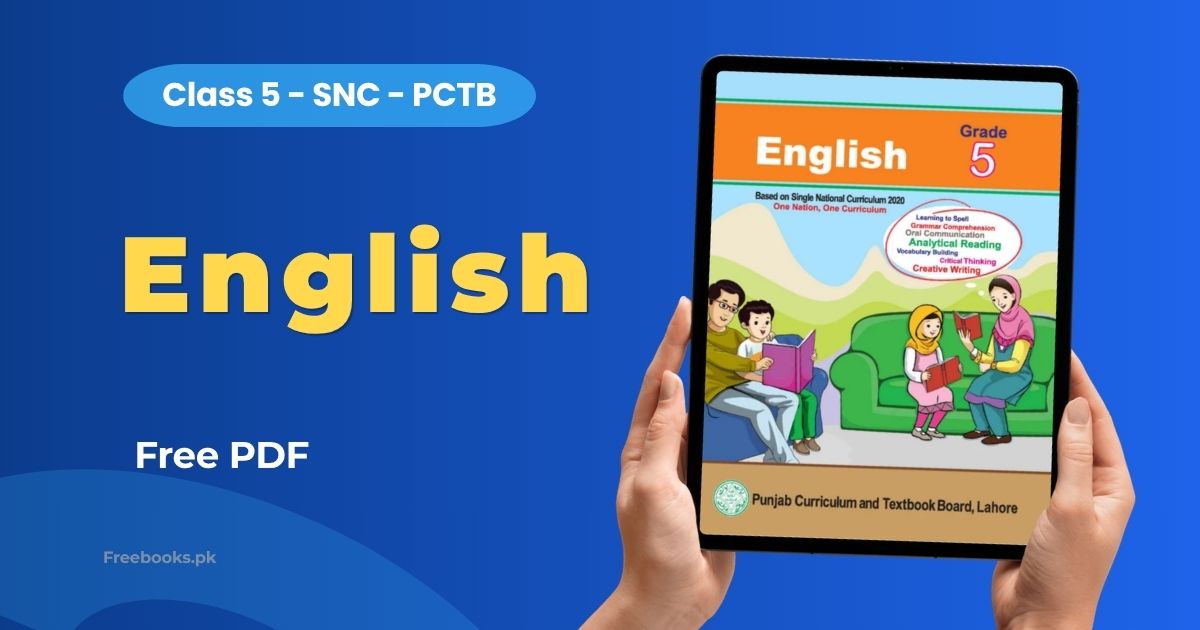
English for Class 5 is part of the official Punjab Curriculum and Textbook Board (PCTB) syllabus. It is part of the official Class 5 syllabus and is available in two editions on this page, the current Single National Curriculum (SNC) 2020 book and the older PCTB edition. The SNC book has 14 units plus 4 review units, covering themes like patience, gratitude, patriotism, and healthy living alongside oral communication, reading, grammar, and writing skills.
For Class 5 students, this book builds core English skills, reading comprehension, vocabulary, grammar, and writing, through short stories, poems, and dialogues drawn from everyday and moral topics. The chapter summaries and important questions on this page make revision quicker, in either the SNC or the older PCTB edition.
Book Overview
| Class | 5 |
| Subject | English |
| Board | Punjab Curriculum and Textbook Board (PCTB) |
| Editions Available | SNC 2020 (current) and PCTB old edition |
| Total Units | 14 (plus 4 Review units) |
| Total Pages | 154 (SNC edition) |
| Format | PDF (Free Download) |
Chapter List
Unit 1: Patience
This unit centers on a story about the patience of the Holy Prophet Muhammad (PBUH), called Al-Saadiq and Al-Amin for his honesty, and his patient response to the hostile people of Taif who rejected his message and pelted him with stones. It teaches silent letters, digraphs, trigraphs, routine greetings and social courtesies, topic sentences and supporting details, common and proper nouns, countable, uncountable and collective nouns, the articles a and an, and adjectives of quality, size, shape, colour, origin and quantity.
Important Questions:
- Why was the Holy Prophet (PBUH) called Al-Saadiq and Al-Amin? Because he always spoke the truth and was completely honest, so people trusted him and called him the truthful and the trustworthy.
- How did the people of Taif treat the Holy Prophet (PBUH)? They rejected his message, mocked him, and a mob pelted him with stones, injuring him.
- What is a topic sentence? The sentence that carries the main idea of a paragraph, with other sentences supporting it.
- When do we use an instead of a? Before a noun that starts with a vowel sound, such as an apple or an umbrella.
Unit 2: Be Grateful
This unit opens with the poem Allah Loves Me, expressing gratitude for blessings and Allah presence in daily life, followed by the fable of the lion and the mouse showing how kindness is repaid. It covers vowel sounds, expressing and responding to opinions, offering and accepting apologies, regular and irregular nouns, the definite article the, a and an with mute consonants, degrees of regular adjectives, conjunctions, transitional words, and sequence markers.
Important Questions:
- What lesson does the fable of the lion and the mouse teach? That kindness is often repaid, since the small mouse was able to save the lion life after the lion had earlier spared him.
- How do we use the article the? For something already mentioned, something unique, before superlatives, and with rivers, mountain ranges, and famous buildings.
- What is the difference between regular and irregular nouns? Regular nouns form plurals by adding s or es, while irregular nouns change form differently, like man to men or tooth to teeth.
- Give an example of offering and accepting an apology. I am so sorry is used to offer an apology, and That is okay or No problem is used to accept one.
Unit 3: Women as Role Models
This unit profiles four Pakistani women, Fatima Jinnah, honoured as Maadar-e-Millat for her role in the Pakistan Movement, Dr. Ruth Pfau, who fought leprosy across Pakistan, Arfa Karim, the youngest Microsoft Certified Professional in the world, and Samina Baig, the first Pakistani woman to climb Mount Everest. It covers long and short vowel sounds, transitional devices, position and direction words, nouns with no change in plural, and action words in the past tense.
Important Questions:
- Why is Fatima Jinnah known as Maadar-e-Millat? Because of her untiring efforts for the Pakistan Movement and support for Muslim women, earning her the title Mother of the Nation.
- What did Dr. Ruth Pfau devote her life to? Fighting leprosy in Pakistan, setting up 150 leprosy clinics across the country.
- What achievement made Arfa Karim famous at age nine? She became the youngest Microsoft Certified Professional in the world.
- Who was the first Pakistani woman to climb Mount Everest? Samina Khayal Baig, who is also the first Muslim woman to climb all Seven Summits.
Unit 4: Unforgettable Moments of My Life
This unit follows a narrator restoring their grandparents neglected farmhouse in Swat after the gardener death, working with siblings to replant and water the garden before an exciting zip-line ride in Swat Valley. It covers diphthongs, position and preposition words, vocabulary and anagrams, gender nouns, sentence structures with direct and indirect objects, and capitalisation of book and story titles.
Important Questions:
- Why was the writer shocked on reaching the farmhouse? Because the gardener who used to care for it had passed away, leaving the trees wilted and the grass burnt.
- How did the family restore the farmhouse? The brothers brought fertiliser and planted new plants, the sister watered them, and the narrator cared for the birds nests.
- What is the difference between masculine, feminine, and neuter nouns? Masculine nouns refer to males, feminine nouns refer to females, and neuter nouns refer to neither, like objects or places.
- What does a sentence with an indirect object look like? Subject plus verb plus indirect object plus direct object, such as My father gave me an old watch.
Unit 5: Amazing Planet
This unit features the poem I am the Earth, voicing the planet plea against pollution and waste, encouraging students to care for the environment. It covers three-consonant clusters, punctuation in reading aloud, prefixes and suffixes, synonyms and antonyms, common and proper nouns for places like mountains and rivers, common gender nouns, and punctuation rules.
Important Questions:
- What is the main message of the poem I am the Earth? That the Earth is being harmed by pollution and waste, and it needs love and care from people.
- What is an affix? Something added to a base word to change its meaning, either a prefix at the start or a suffix at the end.
- What are synonyms and antonyms? Synonyms are words with similar meanings, and antonyms are words with opposite meanings.
- What is a common gender noun? A noun that can refer to either a male or a female, such as teacher, worker, or cousin.
Unit 6: A Fit and Healthy Life
This unit presents Dr. Haroon visiting a school to talk about personal hygiene and preventing the spread of COVID-19, covering handwashing, wearing masks, and avoiding junk food. It teaches consonant clusters, inflectional endings, compound words, homophones, subjective, objective and possessive pronouns, and subject-verb agreement.
Important Questions:
- Why did the school invite Dr. Haroon? To talk to students about personal hygiene and raise awareness about preventing the spread of COVID-19.
- How long should hands be washed with soap? For at least twenty seconds, especially before eating and after using the toilet.
- What is a compound word? A word formed by combining two or more words to create a new meaning, like toothbrush or playground.
- What is subject-verb agreement? The rule that a singular subject takes a singular verb and a plural subject takes a plural verb.
Unit 7: What Goes Around, Comes Around
This unit tells the fable of a frog who tricks a mouse into the water, leading to both being caught and eaten by a hawk, teaching the moral as you sow, so shall you reap. It covers vowel and consonant sounds, elements of a fable such as character, setting, plot, conflict and resolution, compound words, homonyms, personal pronouns ending in self or selves, and interrogative sentences with be and do.
Important Questions:
- What is the moral of the fable of the frog and the mouse? As you sow, so shall you reap, meaning selfish or unkind actions eventually bring consequences back to the person who caused them.
- What are the five elements of a fable? Character, setting, plot, conflict, and resolution.
- What is a homonym? A word that sounds the same and is spelled the same as another word but has a different meaning, like bank for a riverbank or a place to keep money.
- How do you form a question using do? By putting do, does, or did at the beginning of the sentence, such as Did they learn a lesson.
Unit 8: Do What is Right
This unit follows Ali, who finds his classmate Mohsin dropped wallet with money inside, is tempted to keep it, but ultimately returns it after remembering his teacher lessons about honesty. It covers long and short vowel sounds, alphabetical order in dictionaries, paired adjectives, personal and possessive pronouns, prepositions of position and time, adverbs of manner, and writing short invitations.
Important Questions:
- What did Ali find on his way home? A wallet dropped by his classmate Mohsin, containing three thousand rupees.
- What made Ali decide to return the wallet? Remembering his teacher advice never to lie and to return anything found unattended to its owner.
- How do we arrange words in alphabetical order in a dictionary? By the first letter, and if that is the same, by the second or third letter.
- What are paired adjectives? Two adjectives used together to describe a noun, such as bright and shiny.
Unit 9: Patriotism
This unit presents the poem A Nation Strength, explaining that brave, honest people, not gold, make a nation great, alongside a classroom discussion about Pakistan Day and the Lahore Resolution of 1940. It covers the ed sound endings, table of contents and glossary use, map legends and cardinal directions, pronoun-antecedent agreement, negative forms of be, do, and have, modal verbs can and may, and adverbs of time and place.
Important Questions:
- What does the poem A Nation Strength say makes a nation great? Brave, honest, hardworking men and women, not gold or wealth.
- Why do we celebrate Pakistan Day on March 23rd? To remember the Lahore Resolution of 1940, which proposed the idea of an independent state for Muslims.
- What are cardinal directions? The four main points of a compass, North, South, East, and West.
- What is the difference between can and may? Can is used to show ability or informally ask permission, while may is used to show possibility or more formally ask permission.
Unit 10: Eid-ul-Azha
This unit tells the story of Suleman and his family preparing for Eid-ul-Azha, buying a goat, and learning about Hazrat Ibrahim (AS) and Hazrat Ismail (AS) behind the tradition of sacrifice. It covers syllables, charts on keeping the environment safe and clean, synonyms, antonyms, homonyms, homophones, compound words, demonstrative pronouns, the use of should and should not, apostrophes with contractions, and adverbs of frequency.
Important Questions:
- Why do Muslims sacrifice animals on Eid-ul-Azha? To remember Hazrat Ibrahim (AS) willingness to sacrifice his son Hazrat Ismail (AS) on Allah command, after which Allah sent an animal in his son place.
- On which date is Eid-ul-Azha celebrated? On the 10th of Zhul-Hijjah every year.
- What is the difference between should and should not? Should expresses an obligation or good advice, while should not advises against doing something wrong.
- How is an apostrophe used in contractions? It marks the letters left out when two words are combined, such as didnt for did not.
Unit 11: Let us Be Helpful
This unit follows Abdullah and his friends saving their pocket money for a month to buy their friend Sara a new dress after her father lost his job, showing the value of sharing and kindness. It covers using a dictionary to divide words into syllables, note-taking as a study skill, question words like why and how often, prepositions of movement and direction, the simple present tense, and hyphens with numbers and fractions.
Important Questions:
- Why was Sara feeling sad? Because her father had lost his job and could not afford to buy her a new dress.
- What did Abdullah and his friends do to help Sara? They saved their pocket money for a month and bought her a new dress as a gift.
- What is note-taking used for? To highlight important information, summarise a text, and review it later.
- When do we use a hyphen? To join two or more words together, usually with numbers and fractions, like forty-five or one-fourth.
Unit 12: Our National Animal
This unit describes the markhor, Pakistan national animal, a wild goat known for its long curly horns, strong climbing ability, and status as an endangered species threatened by hunting. It covers weak forms of will not and shall not, reading calendars and pie charts, joining words, statements versus questions, wh-question words, and the present continuous tense.
Important Questions:
- Why is the markhor considered a symbol of bravery? Because it can jump down from mountain peaks with ease and can even kill snakes.
- Why is the markhor an endangered species? Because it is hunted for its meat and horns, which are used for traditional medicines and trophies.
- What are the weak forms of will not and shall not? Won’t and shan’t.
- What is a wh-question word? A word like what, where, who, or which, used to ask for specific information.
Unit 13: When Something Went Wrong
This unit follows Hafsa, who receives the wrong parcel of books instead of the storybooks she ordered, and her mother writing a formal complaint letter to the book company. It covers rising and falling intonation, regular and irregular plural nouns, regular and irregular verb forms, the simple past and past continuous tense, transitional devices, types of sentences such as command, instructional and exclamatory, and the format of formal and informal letters.
Important Questions:
- What problem did Hafsa face with her parcel? The book company sent the wrong books instead of the storybooks she had ordered.
- What did Hafsa mother do about the wrong parcel? She wrote a formal complaint letter to the book company requesting the correct parcel.
- What are the parts of a formal letter? The writer address, receiver address, date, subject, salutation, body, and signature.
- What is the difference between the simple past and past continuous tense? The simple past describes a completed action, while the past continuous describes an action that was ongoing at a specific past time.
Unit 14: Together We Live
This unit presents the poem Two Little Kittens, about two kittens who quarrel over a mouse on a stormy night and are swept outside, learning that fighting brings only cold and discomfort. It covers rhythm, stress and intonation, non-verbal cues and tone, similes and analogies, the simple future tense, and questions using be, do, and have.
Important Questions:
- What lesson do the two kittens learn in the poem? That quarrelling and fighting is worse than getting along, since they end up cold and wet outside instead of warm by the fire.
- What is a simile? A comparison between two different things using like or as, such as as brave as a lion.
- What are non-verbal cues? Facial expressions and body gestures used to communicate without words.
- How is the simple future tense formed? Subject plus will or shall plus the base form of the verb, such as I shall go to the park.
Download English Class 5 PDF
Click the button below to download the English Class 5 PDF for free. Both the current SNC edition and the older PCTB edition are available:
⬇ Download PDF (PCTB Old Edition)
Who Should Read This
This book is meant for Class 5 students studying English under the Punjab Curriculum and Textbook Board, whether following the current SNC syllabus or the older PCTB edition. It also builds a foundation in reading, grammar, and writing useful for entry test English sections in later years.
Applicable Boards
This book is published by the Punjab Curriculum and Textbook Board (PCTB) and is the primary English textbook for Class 5 in Punjab. Since the current edition follows the Single National Curriculum (SNC), students in other provinces and boards using the same SNC syllabus can also refer to this book for their Class 5 English topics.
FAQs
Is this book for SNC or PCTB students?
Both editions are available on this page. Download the SNC 2020 edition if you follow the new curriculum, or the older PCTB edition if that is what your school uses.
Can other board students use this book?
Yes. Since the SNC edition is used across Pakistan, students from other boards following the Single National Curriculum can also use this book for Class 5 English.
Is this the latest edition?
The SNC 2020 book is the current edition used in Punjab schools. The PCTB edition is provided as an older alternative for schools still using it.
Does this book include exercises and questions?
Yes, each unit has reading, grammar, vocabulary, and writing exercises. This page also lists important questions with short answers for quick revision.
How many units are in this book?
The SNC edition has 14 units plus 4 review units, covering stories, poems, and skill-building activities.
Is the PDF free to download?
Yes, both editions on this page are completely free to download in PDF format.
Related Books
- Mathematics Class 5 SNC PDF Download – Punjab Board (PCTB)
- Urdu Class 5 SNC PDF Download – Punjab Board (PCTB)
- General Science Class 5 SNC PDF Download
- Islamiat Class 5 SNC PDF Download
- Social Studies Class 5 SNC PDF Download
Related Books
© Copyright Policy
Freebooks.pk is an educational resource for students in Pakistan. Textbooks and other books belong to their respective boards, authors and publishers, and all rights remain with them. If you are the copyright holder of any material on this page and want it changed or removed, please contact us or file a request under our DMCA policy. We review every request and remove reported content promptly.