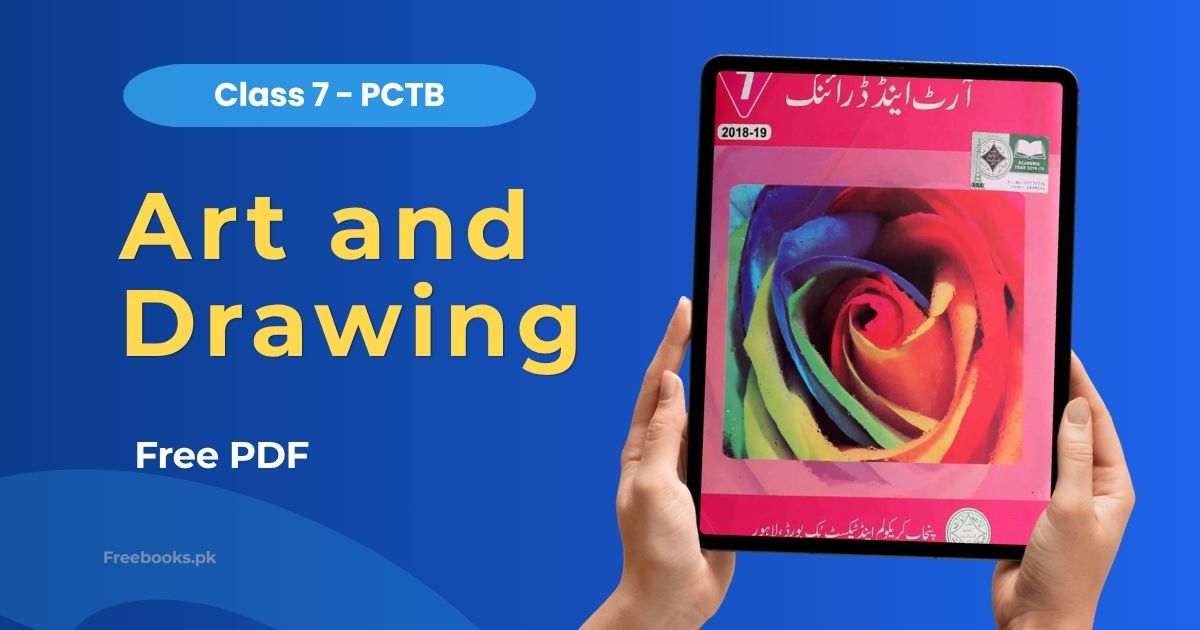
Art and Drawing for Class 7 is the official textbook published by the Punjab Curriculum and Textbook Board (PCTB), Lahore, in Urdu medium. It is part of the official syllabus for Class 7 students and covers seven chapters on model drawing, painting, geometry, design, handicraft, and a glossary of art terms.
For Class 7 students, this book builds a step-by-step foundation in drawing and painting before moving into geometric design and hands-on craft projects. This page breaks down every chapter with a clear summary and its important questions, useful for revision alongside the practical work.
Book Overview
| Class | 7 |
| Subject | Art and Drawing |
| Board | Punjab Board (PCTB, Lahore) |
| Year | 2018 |
| Total Chapters | 7 |
| Total Pages | 84 |
| Medium | Urdu |
| Format | PDF (Free Download) |
Chapter List
Chapter 1: Model Drawing (ماڈل ڈرائنگ)
This chapter teaches beginners to sketch simple household objects by direct observation, without color. The model is placed at or below eye level, about two metres from the student, who first studies its overall shape and proportions before choosing landscape or portrait paper to match. Using light pencil outlines and minimal erasing, students practice drawing everyday items in pairs, a glass, bucket, flower pot, jar, book, box, brick and tin canister.
Important Questions:
- At what height and distance should a model be placed for model drawing? At or below the student’s eye level, about two metres away; if seated at a desk, the model should be raised about 45 cm from the ground.
- How should paper orientation be chosen? If the model is wider than tall, hold the paper horizontally (landscape); if taller than wide, hold it vertically (portrait).
- Which objects are practiced in this chapter’s exercises? Glass, bucket, flower pot, jar, book, box, brick and tin canister, drawn in pairs viewed from below eye level.
- What should be minimized while sketching, and why? Use of the eraser should be kept to a minimum, with light delicate lines, so the paper does not get spoiled.
Chapter 2: Representational Painting (حقیقی مصوری)
This chapter defines representational painting as depicting a natural object with color so the result closely resembles the real thing. Students first sketch a light pencil outline from direct observation, then complete it with watercolor or colored pencils, filling color evenly. Beginners start with simple leaves, twigs, flowers, fruits and vegetables, with worked exercises including an orange, a guava, a brinjal, a turnip with green chilies, and bananas with oranges.
Important Questions:
- What is representational painting? Depicting a natural object using color so that the finished picture resembles the real object.
- What is the recommended process for making a representational painting? First sketch the object lightly while observing it directly, then complete it with watercolor or colored pencils, filling color evenly.
- What kinds of objects should beginners start with? Simple leaves, twigs, flowers, fruits and vegetables, arranged in groups of two or three.
- Give examples of objects covered in this chapter’s exercises. Orange, guava, brinjal, tomato, turnip with chilies, turnip with peas, carrot with leaves, and bananas with oranges.
Chapter 3: Expressional Painting (تخیلی مصوری)
This chapter defines expressional painting as painting in which students express, in their own personal style, everyday experiences and observations from memory rather than copying an object placed in front of them. It stresses collaborative practice and neatness, with exercises applying color to remembered scenes: a jug and glass, a sailing boat, a duck in water, a mosque, a school, and a village.
Important Questions:
- What is expressional painting? Painting in which a student expresses, in their own style, everyday experiences and observations rather than copying a real object directly.
- What does expressional painting rely on? Past experiences and observations, students build knowledge by looking at various things and forming their shapes from memory.
- What should be kept in mind during group practice? Students should work together with classmates to benefit from each other’s experience, and keep their work neat.
- Name some scenes drawn in this chapter’s exercises. Jug and glass, sailing boat, tree behind a hut, duck in water, mosque, school, television and village.
Chapter 4: Plane Geometry (پلین جیومیٹری)
Building on Class 6 geometry, this chapter teaches division of lines and angles and construction of plane shapes with compass, ruler and set-square. Students learn to bisect a line and angle, identify a triangle’s parts, and classify triangles by sides and angles, then construct equilateral, isosceles and right-angled triangles and their inscribed/circumscribed circles. It closes with orthographic projection, drawing an object’s front, side and top views.
Important Questions:
- What is plane geometry? The knowledge of drawing and measuring the shapes of flat surfaces and their parts in terms of length and width.
- What are the five parts of a triangle described in the chapter? Base, vertex, perpendicular, altitude and vertical angle.
- How are triangles classified by sides and by angles? By sides: equilateral, isosceles and scalene; by angles: right-angled, acute-angled and obtuse-angled.
- What is orthographic projection? The representation of an object’s front view, side view and top view obtained by viewing the object at eye level.
Chapter 5: Design (ڈیزائن)
This chapter covers Design, an arrangement of lines and shapes that forms a pleasing pattern. Geometrical designs are built with compass and ruler from lines, arcs, circles, triangles, squares and hexagons, colored using the primary colors, and form the basis for decorating floors, ceilings, window grilles, carpets and religious buildings. Exercises cover grid-based motifs, bordered patterns, and hexagon and semicircle patterns, plus freehand calligraphy exercises.
Important Questions:
- What is a geometrical design and what tools are used to make it? A pattern made using a compass and ruler from shapes like lines, arcs, circles, triangles, squares and hexagons.
- What are the three primary colors mentioned in the chapter? Blue, yellow and red; other colors are obtained by mixing them together.
- Where are geometrical designs commonly used? To decorate floors, ceilings, window grilles (jaalis) and carpets, and especially mosques, tombs and religious buildings.
- What calligraphy exercises are included in this chapter? Freehand writing of ‘Allah,’ ‘Muhammad (PBUH),’ and the names of the four Khulafa inside a semicircle.
Chapter 6: Handicraft (فن عملی)
This chapter defines handicraft as making useful items by hand with simple tools, using cheap materials like paper, cardboard, cloth and wool. It gives step-by-step instructions for nine projects, paper-and-wire flowers, a cardboard fairy with wings, wheat-straw models, a folded paper basket, a dough-and-cardboard rabbit, a wire-armature papier-mache fish, a dough chick on an eggshell, and two abri (marbling) techniques for printing patterns.
Important Questions:
- What is handicraft, and what materials does the chapter encourage using? Making useful things by hand or with simple tools; the chapter encourages cheap, easily available materials like waste paper, cardboard, cloth and wool.
- How is the fish project made in this chapter? A wire armature is bent into a fish shape, stuffed with dough, covered with small pasted pieces of paper, and finished with paper fins and colored eyes.
- What are the two abri (marbling) methods described? One floats oil colors on water and lifts the pattern onto paper; the other sprays diluted color through a wire mesh with a toothbrush over leaf cutouts to leave a stencil pattern.
- How is the wheat-straw model made? Softened, dampened wheat straws are cut and pasted in sequence onto a traced outline, such as a mosque, using glue, then dried and trimmed.
Chapter 7: Glossary (فرہنگ)
The final chapter is a glossary of Urdu-English art and geometry terms used throughout the book, such as Compass, Eye Level, Horizontal, Arc, Painting, Powder Colour, and Rectangle, helping students connect the technical English vocabulary of art and drawing with its Urdu equivalents.
Download Art and Drawing Class 7 PDF
Your free PDF is ready. Click the button below to download the complete Art and Drawing Class 7 textbook.
⬇ Download PDFWho Should Read This
This book is for Class 7 students following the Punjab Board (PCTB) syllabus who take Art and Drawing. It is especially useful for building a foundation before moving into Art and Model Drawing in later classes.
Applicable Boards
This book is published mainly for Punjab Board (PCTB) Class 7 students. Students from other boards offering a similar art and drawing elective can also use it as a reference.
FAQs
Is this Art and Drawing book for Class 7?
Yes, this is the official Class 7 Art and Drawing textbook published by the Punjab Curriculum and Textbook Board (PCTB), Lahore.
Can students from other boards use it?
Yes, students from other boards following a similar art and drawing elective can use it as a reference, though it is designed for PCTB Class 7 students.
Is this the latest edition?
This PDF follows the official 2018 PCTB Art and Drawing Class 7 curriculum and chapter structure.
Does it include solved exercises?
Yes, this page covers every chapter with its content explained and the important questions asked at the end of each chapter, alongside the book’s practical drawing and craft exercises.
What does this book cover?
It covers seven chapters on model drawing, representational and expressional painting, plane geometry, design, handicraft, and a glossary of art terms.
Is the PDF free to download?
Yes, the Art and Drawing Class 7 PDF is completely free to download and read on any device.