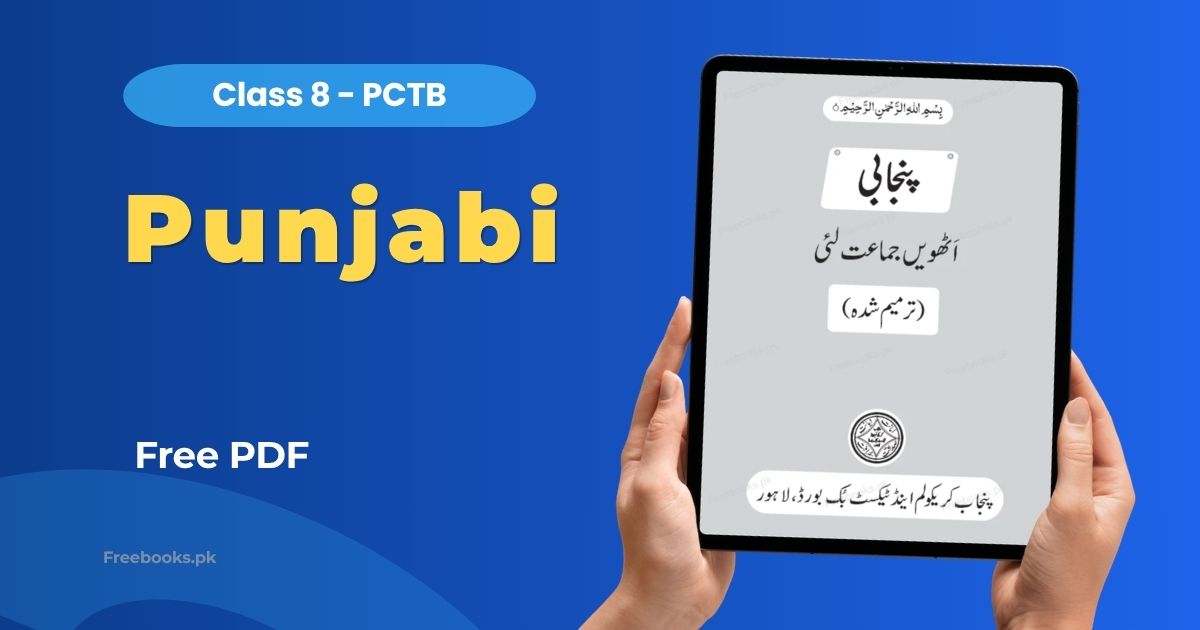
Punjabi for Class 8 is the official textbook published by the Punjab Curriculum and Textbook Board (PCTB), Lahore, for students who study Punjabi in Shahmukhi script. It follows the official Punjab Board syllabus and gathers 36 short lessons of prose and poetry, from naats and hamds to patriotic poems, folk stories and essays.
For Class 8 students, each lesson pairs a short reading with its own comprehension questions, so this page walks through every lesson with a plain-English summary of what it is actually about, along with its real exercise questions. It is a useful way to revise the book’s poems and prose pieces before the board exam.
Book Overview
| Class | 8 |
| Subject | Punjabi |
| Board | Punjab Board (PCTB, Lahore) |
| Edition | 2018 (Revised) |
| Total Lessons | 36 |
| Total Pages | 92 |
| Medium | Punjabi (Shahmukhi script) |
| Format | PDF (Free Download) |
Chapter List
1 – Sach Zaat Rabb Di (سچ ذات ربّ دی), by Hakeem Abdul Lateef Aarif
A hamd (poem in praise of Allah) addressing God directly as “Maula,” reflecting on His absolute power, mercy and providence over creation. The poet asks for rain and a blooming earth, describes God as Qahhar, Razzaq, Raheem and Kareem, and prays for guidance onto the path that pleases Him.
Important Questions:
- Describe in prose the praise of God given in this poem. The poem praises God as the sole, all-powerful sustainer and provider of the universe, merciful and forgiving, who guides His servants to the right path.
2 – Hazrat Muhammad (S.A.W.) (حضرت محمد صلی الله علیه وآله وسلم)
This prose piece describes the Prophet’s mission to transform a corrupt, ignorance-ridden Arabia into a just and compassionate society, achieved through love rather than the sword. It recounts the Quraysh offering him wealth and leadership to stop preaching, his refusal, the persecution he endured without ever cursing his tormentors, and his simple personal life despite ruling over both spiritual and worldly domains.
Important Questions:
- Shed light on the virtues of the Holy Prophet (PBUH). The text highlights his justice, mercy, truthfulness, humility, generosity, and his equal, kind treatment of everyone regardless of status or religion.
- What is described as the single greatest and truest task in the world? Turning sinners into good people — reforming human character so people live together in peace.
- What did the disbelievers of Makkah offer the Prophet to make him stop preaching, and how did he respond? They offered him wealth, chieftainship, and a prestigious marriage; he replied he wanted none of these, only to fulfil the mission Allah had entrusted to him.
3 – Naat Shareef (نعت شریف), by Hafeez Sabit
A short naat describing the Prophet as leader of both worlds and beloved of his Creator, whose guidance brings spring-like blessing and whose mercy shelters humanity. It praises his exalted, sweet character, that no falsehood ever touched his tongue, and that he is the helper of the weak and helpless.
Important Questions:
- What does ‘naat’ mean? A naat is a poem composed in praise of the Holy Prophet Muhammad (PBUH).
- What qualities of the Prophet are described in this naat? Leader of both worlds, beloved of God, a source of guidance and mercy, of exalted and sweet character, always truthful, and a helper of the weak.
4 – Hazrat Umar Farooq (RA) (حضرت عمر فاروق رضی الله تعالی عنه), by Amin Khayal
A biographical piece on Hazrat Umar (RA) — his birth into Banu Adi, his conversion to Islam at 27, his migration to Medina, his role in early battles, and his accession as the second Caliph. It details his austere lifestyle as ruler, including personally carrying food at night to a hungry widow’s family, and closes with his ten-year caliphate’s territorial expansion and his martyrdom.
Important Questions:
- What kind of life did Hazrat Umar (RA) lead? An extremely simple, austere life despite being ruler of a vast empire — patched clothes, plain bread, sleeping on bare ground, and personally serving the needy.
- What services did he render to Islam? As the second Caliph, over ten years he greatly expanded the Islamic state into Egypt, Syria, Persia and Roman lands, establishing justice-based governance.
5 – Aise Di Barkat (ایکے دی برکت), by Aashiq Raheel
An essay on “ekaa” (unity), arguing it turns even the hardest tasks easy and brings blessing to a household. It illustrates this with the parable of a farmer’s four feuding sons who could not break a bundle of sticks tied together, yet broke each one easily once separated, and closes by holding up Pakistan’s creation as the greatest example of unity.
Important Questions:
- What is meant by ‘ekaa’ (unity)? Setting aside disputes to live together in harmony, brotherhood, and mutual love.
- What are the benefits of unity? Unity makes even the hardest tasks easy and brings blessing and prosperity to a household.
- How did the father teach his sons the lesson of unity? He gave them a tied bundle of sticks, which none could break; once untied, each stick broke easily one by one, showing they were only strong when united.
- Can a single bee build a honeycomb alone? No, a honeycomb can only be built through the combined effort of many bees.
6 – Mehmaan Dari (مہمان داری), by Nadir Jajvi
A narrative poem about a poor Arab host whose guest arrives with almost nothing to feed him. Filled with the spirit of selflessness (ایثار), his wife extinguishes the lamp on a pretext so the guest cannot see the emptiness of his own plate, while the host fakes eating in the dark, letting the guest eat freely without ever realizing his hosts went hungry to feed him.
Important Questions:
- What sentiment is described in this poem? The spirit of selflessness — a poor host prioritizing his guest’s comfort and dignity over his own hunger.
- Narrate in your own words the story told in this poem. A poor host has his wife put out the lamp so the guest can’t see the emptiness of his plate, then fakes eating by making chewing sounds, so the guest eats freely, never realizing his hosts went hungry.
7 – Achha Shehri (اچھا شہری), by Ghulam Mustafa Pansli
A civics essay defining a citizen as someone belonging to a country under its laws, regardless of religion or location. It lists a citizen’s key rights (religious freedom, lawful livelihood, protection of life and property, equality before law, education) and duties (respecting the law, paying dues, using wealth lawfully for the benefit of both oneself and others).
Important Questions:
- What is meant by ‘citizen’? Anyone who belongs to a country under its laws, whether they live in a city or village, regardless of religion.
- What are the duties of a good citizen? Respecting the law, paying dues/taxes, and using earnings in lawful, beneficial ways for oneself and others.
- Name some of a citizen’s rights. Freedom of religion, moral rights, lawful livelihood, protection of life and property, equality before the law, and education.
8 – Villan No Vilaal De Raah (ولاں نوں ولال دے راہ), by Zaheer Niaz Baig
A folk narrative in the Sandal Bar area: an elderly woman gets off a train alone and must walk to a deserted village with Eid gifts for her daughter. A horseman rudely refuses to carry her bundle, then returns intending to rob her; sensing danger, she cleverly claims other travelers are approaching, and he flees. The story closes on the proverb that whoever God protects, no one can harm.
Important Questions:
- What difficulty faced the woman who had set out? She had gotten off the train alone and had to walk to a deserted village with no companion or help.
- What was she carrying, and for whom? A bundle of Eid gifts that she was taking to her daughter.
- Why did the horseman come back, and what did she tell him? He returned intending to rob her since no one else was around; she cleverly told him other men approaching were coming to help her.
- How does the saying ‘whom God protects, none can harm’ fit this story? She escaped being robbed through a chain of coincidences, which reads as divine protection of the innocent.
9 – Ghazal (غزل), by Peer Fazal Gujrati
A classical Punjabi ghazal built on the repeated refrain “sada na” (never forever), meditating on the impermanence of worldly things — forests don’t stay green forever, brides don’t stay new forever, fortune doesn’t ride on forever. The closing verse names the poet (“Fazal”) and likens his own lament to a nightingale’s song.
Important Questions:
- Explain in prose the central idea of the ghazal. Nothing in the world is permanent — youth, beauty, wealth, and good fortune all fade with time, so one should not become attached to them.
10 – Jannat Di Khaatun (جنت دی خاتون)
A biographical essay about Hazrat Fatima (RA), youngest daughter of the Prophet, covering her mother’s early death, her simplicity even as a child, her modest wedding to Hazrat Ali (RA), her patient endurance of hard labor over asking for a servant, and the Prophet’s deep affection for her. It presents her life as a model for Muslim women.
Important Questions:
- Narrate an incident showing Hazrat Fatima’s simple life. When her hands blistered from grinding grain, Hazrat Ali urged her to ask the Prophet for a servant; on hearing the poor Companions of Suffah needed help more, she quietly returned home without asking.
- What items did she receive as dowry at her wedding? A simple set of household items: a bed, sheets, a leather pillow, a cot, silver bracelets, a prayer mat, clay jars, a cup, a waterskin, and a hand mill.
- What lesson do we learn from her life? Patience, simplicity, contentment, and self-sacrifice.
11 – Qadir Yaar (قادریار), by Muhammad Athar Tahir
A biographical-literary essay about Qadir Yaar, one of the foremost classical Punjabi poets, born around 1802 near Eminabad. Of his books, five survive: Miraj Nama, Har Singh Nalwa Di Var, Roznama, Sohni Mahiwal, and Puran Bhagat — the last, a folk qissa in the Si-harfi verse form, brought him the most fame.
Important Questions:
- What was Qadir Yaar’s ancestral profession? Farming — he belonged to the Jat Sindhu clan.
- Write about Qadir Yaar’s books. Five of his books survive: Miraj Nama, Har Singh Nalwa Di Var, Roznama, Sohni Mahiwal, and Puran Bhagat.
- Which book brought him the most fame? His qissa “Puran Bhagat,” written in the Si-harfi verse form.
12 – Qaid-e-Azam Zindabad (قائد اعظم زندہ باد), by Ashraf Pal
A short patriotic poem praising Muhammad Ali Jinnah as the gardener of a fragrant garden and father of the nation, who freed a captive people and brought them prosperity. It calls him a guide and teacher, and closes paraphrasing his own words that sincere hard work never leads one astray.
Important Questions:
- Why is Quaid-e-Azam called a guide and teacher in this poem? Because he showed the nation the right path, freed it from bondage, and led it toward independence.
- Explain the meaning of the poem’s third stanza. That if work is done sincerely and well, the path will never go wrong, and without hard work, no reward is ever earned.
13 – Insaan Di Kahani (انسان دی کہانی)
This prose piece traces the religious account of human origins from Hazrat Adam (AS), through the development of speech, family and tribal bonds, early survival and tool-making, and surveys ancient civilizations (Egypt, Mesopotamia, the Aryan invasion of India), ending with the coming of Prophet Muhammad (PBUH) as the final messenger.
Important Questions:
- How did man learn to speak? Speech developed gradually, from cries and calls to distinct words that grew into full language.
- All humans come from one lineage, so why are their languages different? As groups scattered and lived apart for long periods, their speech patterns diverged into separate languages.
14 – Nashay Toon Bachao (نشے توں بچاؤ), by Professor Sajjad Haider Pervez
A warning essay about drug addiction, citing a WHO review of Multan’s mental-health data against other countries to show alarming rises in illness caused by drug abuse. It explains addiction’s roots in unmet desires, describes heroin’s false relief followed by collapse, and stresses that teachers and parents must proactively warn young people about drugs’ dangers.
Important Questions:
- How many countries’ data did the World Health Organization review? Five — America, Britain, West Germany, Russia, and Japan.
- Into how many groups are drug users and non-users divided? Three groups — those completely free of drugs, those who reject them, and an indifferent group.
- What is needed to save the youth from drug addiction? Teachers and institutions need to clearly and repeatedly warn students about drugs’ harmful effects.
15 – Quaid-e-Azam Muhammad Ali Jinnah (RA) (قائد اعظم محمد علی جناح رحمة الله علیه), by Dr. Syed Akhtar Jafri
A biographical sketch of Muhammad Ali Jinnah, covering his birth in Karachi in 1876, his schooling and departure for England where he qualified as a barrister, his return, his shift from Congress to the Muslim League, his leadership of the Pakistan Movement, his role as first Governor-General, and his death in 1948.
Important Questions:
- When and where was Quaid-e-Azam born? On 25 December 1876 in Karachi.
- Which school in Bombay did he first enroll in? An English-medium primary school (Gokal Das Tej school), after earlier schooling in Karachi.
- When and where was the Pakistan Resolution passed? On 23 March 1940 at Iqbal Park (Minto Park), Lahore.
- What advice did Quaid-e-Azam give to students? To serve with courage and endurance, work hard, keep good character, and never fear death.
16 – Mela Shalamar (میلا شالامار), by Feroze Sain
A nazam celebrating the seasonal fair at Lahore’s Shalamar Gardens, its fountains, terraces and riot of color from blooming flowers. It moves from joyful description of the garden’s beauty and youthful festivity into a reflective closing note that this beauty, like the fair itself, is fleeting.
Important Questions:
- In which season does the Shalamar fair take place, and why? In spring, when the gardens burst into full bloom, drawing crowds to enjoy the seasonal beauty.
- Explain the meaning of the fourth and fifth stanzas. The fourth paints the garden’s mixture of colors blooming everywhere; the fifth describes fresh blossoms and fragrance spreading from every branch.
17 – Dera Babe Raath Da (ڈیرہ بابے راٹھ دا), by Shareef Sabir
A dialogue-drama set at a village elder’s dera, where old-fashioned Baba Raath ranks castes above occupational trades. A newly arrived schoolteacher argues all humans are equal before God, and Baba Raath’s nephew cites his engineer friend, son of a blacksmith, as proof that a person’s worth comes from character and effort, not inherited caste.
18 – Chithi (چٹھی), by Dr. Shahbaz Malik
A personal letter from a young man to his friend describing his happy homecoming to his ancestral village, home-cooked food, and village life shared with his uncles who jointly farm the family land. It describes traditional Persian-wheel irrigation, the one well-off family’s electricity and tractor, and the sugarcane harvest season.
Important Questions:
- What work do Allah Rakha’s uncles do? They are farmers who jointly cultivate the family’s ancestral land.
- Describe the picture of village life in the letter. A simple, contented rural life — fresh home-cooked food, traditional irrigation, and the sugarcane harvest season when gur and shakar are made.
19 – Shuhada No Salam (شہیداں ٹوں سلام)
A prose piece on national defense arguing that every citizen has a role in keeping the nation ready. It recounts the 1965 Pakistan-India war on the Chawinda/Sialkot front, where Pakistani forces repelled a major Indian armored assault and shot down 17 aircraft, closing with tribute to the martyrs and ghazis of that battle.
Important Questions:
- What is the role of the nation during wartime? Every citizen contributes according to their role — farmers grow food, students study and prepare, workers keep factories running.
- What losses did the enemy suffer on the Chawinda front? Heavy tank losses, 17 aircraft shot down, and several tanks captured intact.
20 – Mehnat Di Wadeiani (محنت دی وڈیائی), by Tanveer Bukhari
A poem (geet) celebrating labor as the foundation of dignity and a meaningful life, repeating the refrain that hard work is life itself and a source of pride, arguing that honest effort earns respect and fills both home and homeland with prosperity.
Important Questions:
- What is the meaning of the line ‘without hard work, no one becomes a Quaid-e-Azam’? Greatness is earned, not given — even a towering leader achieved his stature through relentless hard work.
21 – Bheenan De Ver (بھیناں دے ویر) — folk song
A collection of short Punjabi folk verses (boliyan) traditionally sung by sisters in praise of their brothers, describing the brother’s handsome looks and fine clothes, and the sister’s fierce, protective affection.
22 – Kujh Atomi Tawanai Baare (About Atomic Energy), by Syed Muhammad Zaki Rizvi
An informational piece explaining atomic structure and nuclear fission, then describing the 1945 US atomic bombings of Hiroshima and Nagasaki. It pivots to peaceful uses of atomic energy — nuclear power plants in Karachi and Chashma, and radioisotopes used in medicine, agriculture and industry.
Important Questions:
- In World War II, which country used the atomic bomb? The United States.
- Which country’s cities were destroyed by the atomic bomb? Japan’s cities Hiroshima and Nagasaki.
- What benefits is atomic energy providing to humankind? Electricity through nuclear power plants and radioisotopes used in medical, agricultural, and industrial research.
- List the benefits of atomic energy in medicine, industry, and agriculture. Radioisotopes like Iodine-131 treat thyroid disease, tracers detect pipeline leaks and engine wear, and isotopes help study fertilizer uptake and pest control.
23 – Des Pyara Geet (دیس پیارا گیت), by Muhammad Hanif Hanafi
A patriotic poem declaring devotion to Pakistan, describing its four provinces as united brothers, thanking Allah for its natural blessings, and calling on citizens to stay united against enemies and embrace education for the nation’s future.
Important Questions:
- Explain the verses about the homeland being paradise-like, with rivers and colorful cities. They praise Pakistan’s natural beauty and prosperity, its rivers, and its many vibrant cities.
- What does the poet mean by ‘move forward with the times’? The poet urges youth to keep pace with the modern era through good education and progress.
24 – Faza Di Safai (فضا دی صفائی)
An expository essay on environmental pollution — environmental, soil, water, air, radiation and noise pollution — explaining causes like deforestation and factory smoke, and recommending government regulation, tree planting, proper drainage, and masks in polluted air.
Important Questions:
- What is meant by ‘air cleanliness’? Keeping the surrounding environment free of pollutants so the air remains pure and healthy.
- What causes pollution? Deforestation, factory and vehicle smoke, untreated sewage, pesticide overuse, and noise.
- How can air pollution be reduced? Keeping factories out of residential areas, fitting smoke filters, planting trees, and using masks in polluted air.
25 – Jehad (جہاد)
An essay explaining the Islamic concept of jihad and distinguishing it from ordinary warfare — Muslims are peace-loving and honor treaties, but jihad becomes obligatory when Muslims are unjustly attacked. It recounts the Battle of Badr and the Battle of Uhud, including young boys desperate to be allowed into battle.
Important Questions:
- What is the difference between a ghazwa and an ordinary war? A ghazwa is fought under the Prophet’s leadership for Allah’s cause according to Islamic principles; an ordinary war is fought for worldly gain.
- What is the difference between jihad and ordinary worship? Worship is a personal act of devotion; jihad is a collective struggle requiring sacrifice of life and wealth for the community’s defence.
26 – Ghani Saeen (غنی سائیں), by Akbar Lahori
A character sketch of the author’s boyhood friend Ghani, a factory worker who became a self-sufficient ascetic, owning almost nothing and freely giving away simple herbal remedies. When the author tries to give him money for a fare, Ghani firmly refuses, explaining that true wealth is needing nothing from anyone.
Important Questions:
- Which of Ghani Saeen’s qualities do you like? His self-sufficiency and his generosity in freely giving away medicines without asking anything in return.
- Which of his qualities might one dislike? His extreme austerity — refusing even small, well-meant help — could be seen as excessive.
27 – Jeeve Sada Pakistan (جیوے ساڈا پاکستان), by Dr. Rasheed Anwar
A patriotic anthem-style poem celebrating Pakistan’s flag, its place among Islamic nations, and the unity of Sindhis, Punjabis, Baloch and Pathans standing together like brothers. It calls on citizens to guard the country’s borders, honor its martyrs, and uphold hard work and honor as the nation’s true wealth.
28 – Pehiye Ton Gaddi Tori (پہیے توں گڈی توڑی), by Mumtaz Bukhari
An essay tracing the history of the wheel — from carrying loads by hand to pack animals, rolling logs, and the wheeled cart. It covers ancient chariots, the invention of the bicycle in France, and the development of the motor car and the railway engine.
Important Questions:
- What are the various uses of the wheel? It reduces the effort of carrying loads and underlies transportation from carts and chariots to bicycles, cars, and trains.
- What other things is the wheel combined with? Animal power in carts, pedals in bicycles, engines in cars, and rail tracks in trains.
29 – Patay Da Mehram — Harappa (پتے دا محرم — ہڑپہ), by Dr. Saif-ur-Rehman Dar
An archaeological essay about the excavation and significance of Harappa, one of the great cities of the ancient Indus Valley civilization near Sahiwal. It describes the excavation history, a local legend about the city’s last king, and findings like wide streets, drainage systems and public baths, noting the undeciphered Harappan script is believed by many to be an early ancestor of Punjabi.
Important Questions:
- What connection does the Harappan civilization have with Punjab? Harappa is located in Punjab, and the script on its seals is widely believed to be an early form of the Punjabi language.
30 – Qudrat Rabb Di (قدرت ربّ دی), by Mian Muhammad Bakhsh
A narrative poem about a hunter aiming his trained hawk at a small bird, when a venomous snake bites and kills the hunter, while the bird escapes unharmed. The poem’s moral, delivered in its final line, is that fate belongs entirely to God’s power.
Important Questions:
- Narrate the event of this poem in your own words. A hunter aims his hawk at a bird in a tree; as he draws his bow, a snake bites and kills him instead, and the bird survives unharmed.
31 – Latife (لطیفے), by Syed Muhammad Hussain Taqvi Mashhadi
A collection of five short humorous anecdotes built around foolishness and misunderstanding — a wealthy man scolding his driver over dust, a farmer’s son neglecting the harvest for a fair, a boy’s lie about a film getting exposed, a naive man confused about what stops a bus, and a mix-up between a reflection and a real cat.
Important Questions:
- Explain what makes each of the jokes funny. The humour comes from someone’s foolishness or misunderstanding in each situation.
32 – Dohray (دوہڑے), by Dr. Faqir Muhammad Faqir
A set of short didactic couplets contrasting worldly wealth with knowledge — wealth withers like thorns while the garden of knowledge stays forever in bloom. Further couplets warn against laziness, state that good deeds bring good outcomes, and praise selfless giving, comparing a generous person to a lamp that lights the way for everyone.
Important Questions:
- Explain the meaning of these couplets. True and lasting worth lies in knowledge and virtue rather than material wealth, and one’s actions determine one’s fate.
- What is said in the fifth couplet? Good and bad actions lead to good and bad conditions in life.
33 – Insaan Te Qudrat (انسان تے قدرت), by Sharif Sabir
An expository essay explaining that Allah has given human beings remarkable abilities, yet nature also holds forces that can destroy man instantly. It surveys the importance to human life of air, sunlight, water, plants, the moon and stars, and mountains, arguing that scientific discovery is gradually uncovering these God-given natural laws.
Important Questions:
- How is human power controlling the phenomena of nature? Through scientific knowledge, man has learned to harness forces such as water for electricity and metals for tools.
- How is science helping in recognizing Allah? As science uncovers the fixed laws behind natural phenomena, it reveals the order and design of creation.
34 – Ghazal (غزل), by Saleem Kashar
A five-couplet ghazal of social and moral reflection, opening by saying the chains of self-interest have made people forget the light of truth. It contrasts worldly chaos with the quiet light knowledge brings, criticizes fame from outward show, and closes with the poet’s estrangement from truth upon hearing the cries of the poor.
Important Questions:
- Explain the meaning of the first and fifth couplets. The first says self-interest and greed make people slaves of worldly schemes; the fifth describes the poet’s own estrangement from truth on hearing the cries of the poor.
35 – Zubaida Naami Bachi (زبیدہ نامی بچی), by Parveen Malik
A real-life-style story about Zubaida, whose poor father died in a construction accident, leaving her mother to raise the children alone. Despite hardship, Zubaida was educated to eighth grade, married young, then later returned to studying at night, eventually passing matric and becoming a college lecturer, urging that anyone facing hardship can build their own life through courage and determination.
36 – Sohneya Saaeen (سوہنیا سائیاں)
A devotional Punjabi hymn (munajat) addressed to God as “Saaeen” (Lord). Each stanza is a prayer: for true love and freedom from hatred, for guidance onto the right path, for courage to build one’s own life, and closing with the message that life’s purpose is not just eating and drinking but living for truth.
Important Questions:
- Explain the meaning of the poem’s final stanza. Life’s purpose is not simply eating and drinking; the poet prays that God grant true meaning and greatness to one’s life.
Download Punjabi Class 8 PDF
Your free PDF is ready. Click the button below to download the complete Punjabi Class 8 textbook.
⬇ Download PDFWho Should Read This
This book is for Class 8 students following the Punjab Board (PCTB) syllabus who study Punjabi. It is especially useful for revising each lesson’s theme and the important questions asked at the end of it before the board exam.
Applicable Boards
This book is published mainly for Punjab Board (PCTB) Class 8 students. Students from other boards offering Punjabi as a subject can also use it as a reference.
FAQs
Is this Punjabi book for Class 8?
Yes, this is the official Class 8 Punjabi textbook (2018 edition) published by the Punjab Curriculum and Textbook Board (PCTB), Lahore.
Can students from other boards use it?
Yes, students from other boards who study Punjabi can use it as a reference, though it is designed for PCTB Class 8 students.
Is this the latest edition?
This PDF follows the 2018 revised PCTB Punjabi Class 8 curriculum and lesson structure.
Does it include the exercise questions from each lesson?
Yes, this page covers each lesson with its theme explained and the important comprehension questions asked at the end of it.
What does this book cover?
It covers 36 lessons of Punjabi prose and poetry, including naats, patriotic poems, folk stories, ghazals, and essays on topics like citizenship, unity, and pollution.
Is the PDF free to download?
Yes, the Punjabi Class 8 PDF is completely free to download and read on any device.
Related Books
- Punjabi Class 7
- Mathematics Class 8 (English Medium)
- Mathematics Class 8 (Urdu Medium)
- Mathematics Class 8
- Computer Science Class 8
- History Class 8
© Copyright Policy
Freebooks.pk is an educational resource for students in Pakistan. Textbooks and other books belong to their respective boards, authors and publishers, and all rights remain with them. If you are the copyright holder of any material on this page and want it changed or removed, please contact us or file a request under our DMCA policy. We review every request and remove reported content promptly.